Your ShelfYour Projects

Signs of the Times, Vol. 30, No. 28.

THE PURPOSE OF HIS WORKS

Signs of the Times

Jul 13, 1904

Pacific Press Publishing Company · Oakland, California · Jul 13, 1904

THE PURPOSE OF HIS WORKS.
BECAUSE of sin we are continually compelled to look upon the hideous where we might be viewing the glorious perfection of God’s beauteous handiwork. From time to time we catch faint glimpses of what we might see but for the fog-mantle of sin that now hangs heavy over the world.
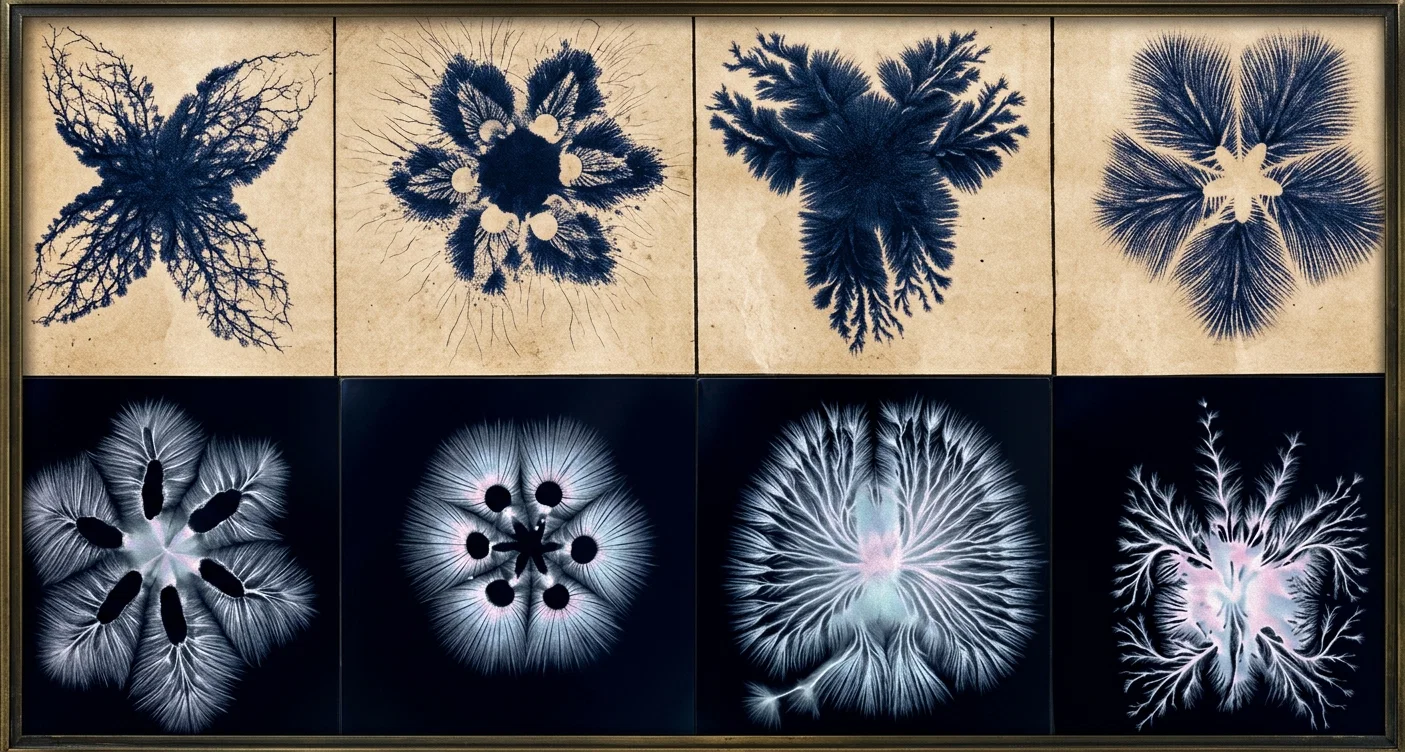
Courtesy of "Scientific American." Photographs of Electrical Discharges on Sensitized Plates.
THERE is one wonderful manifestation of God’s power to beautify, that even sin has not been able to purloin from the world, and that is the “covenant of promise” in the clouds. What marvelous display of color symphony, the whole gamut of color is thrown upon the sky-screen; but there is no discord of color, shade, or blending, no spot where the most critical or irreverent can find a flaw. Satan is not permitted to touch that covenant of the Creator, and so its beauty still stands unmarred. While still holding before us God’s promise to the race, that bow of promise also speaks to us of the loveliness, the perfection of beauty, which might be seen throughout the world if the race had never submitted to the contaminating touch of sin. What beauties in flower and field and forest, in mountain and hill and valley, in lake and rill and river, before the curse of sin fell to blight and mangle and destroy.
STILL, we are not wholly reft of beauty. We would see more than we do even now if our very eyes had not been pilfered of their visual power, and our senses dulled by the demoralizing and devitalizing influences of evil that have been working in us since the days of Adam. We recognize that we can not better, or even reproduce, the delicate beauty of tint in the commonest flowers. We see something of the perfection in them even with our sin-debilitated sight. The glories of the heavens are dimmed by the dust of our deserts and the fine ashes of our belching volcanoes; and yet there is enough left to us still to show us something of the marvelous handiwork of our Creator. Yet it is not in these great luminaries alone that we recognize the workings of the Omnipotent One. We see it also in the marvelous perfection of detail in the tiniest thing that flies or creeps, as well as in the mammoth and the man. Take down your microscope (which but for sin we would not need to use) and examine the minute winged mote that settles on your hand, as small as a speck of dust. Notice the beautiful coloring of those little fragile wings. Notice, too, what you can not see, that those wings must be operated by a perfectly-working set of muscles, which, in turn, are directed by a perfectly-working set of nerves under the control of a brain center; that those nerves and muscles and wings perform their work, if anything, more wonderfully, than do those of the great eagle; for quicker than the winking of an eye he is gone. In the works of man the minute is always lacking in detail. In the works of God what appears to us the most fragile, insignificant, evanescent, and transitory, has received the same attention to perfection as has that which looks to us mighty, permanent, and important.
NOTICE the wonderful designs in the picture printed on this page. Examine the delicate tracery of the lines and then the beauty of the completed piece. Each one of these designs was made in, perhaps, the thousandth part of a second by a discharge of electricity upon a sensitized plate. The result was, in a measure, controlled, or directed, by pieces of metal set in various symmetrical positions on the plate, which was sprinkled with metallic dust; but it was the pen of electricity that made a thing of beauty out of the crude design of the human brain and hand. The tracery of the delicate filigree of the electric discharge no human eye or microscope can follow to its termination. But this is only one of the tireless agencies of God working His perfect will. Is it any wonder, then, that the redeemed hosts, viewing the works of God with eyes loosed from the bonds of sin, shout in mighty chorus: “Great and marvelous are Thy works, Lord God Almighty; just and true are Thy ways, Thou King of saints.” The psalmist declares: “Neither are there any works like unto Thy works.”
THE Lord has a purpose in bringing His wonderful works to our attention. It is that we may not forget Him; and that, seeing Himand remembering Him, we may be drawn to Him to love Him for what He is and for what He has done for us. He would teach us by the power manifested in His greater works that He is able to perform every promise made to man; and by the perfection of His most delicate and minute works that He is ever mindful of the needs and interests of every member of the human race. It is difficult for some to believe that the Creator of the heavens and the earth can stoop to the detail of recognizing the faith and hope, and caring for the needs of “such unworthy creatures as we are.” He is teaching us by these very works that He can and does. “Even the very hairs of your head are all numbered.” The God who has made us cares for and loves us; is pleased when we come to Him in faith to seek strength and grace and courage and blessing; pleased when we lay our troubles all bare before Him. Then, too, one of His most wonderful works was the plan and the gift for our salvation. “He hath made His wonderful works to be remembered.” Let us remember them, learn to think of Him when we remember them, and thus become more and more like Him from day to day.

SECOND KINGS.

BY F. D. STARR.
THREE and one-third centuries are covered by the interesting history of this book, from B.C. 896 to B.C. 562, or 334 years. We can better comprehend the length of the time by comparing it with the same period preceding our own time. If we go back three centuries it takes us to a time just preceding the translation of the Bible, by which, under King James, the Authorized Version was produced. It seems a good while to look back to the time of the landing of the Pilgrim fathers on Plymouth Rock in 1620, but the entire history of the colonies of the Revolutionary War and of the United States, with all the contemporary history of Europe and the rest of the world, lacks one-half a century of being as long as the period covered by the book of 2 Kings.
The book begins with the closing events of the life of Elijah, the prophet, and closes with the account of the captivity of the Jews.
The first chapter contains the account of the calling of fire from heaven to devour the impious men who dared to disrespectfully commandthe man of God to obey the behest of the king. This incident is referred to by the disciples, as recorded in Luke 9:51–56, with the inquiry as to whether they should imitate the conduct of the prophet. Without criticizing the action of Elijah the Lord plainly instructs the disciples that it is not the deeds of retribution performed by the prophet, but deeds of mercy that we are to copy. Circumstances of which we are not competent judges, made the summary sentence of destruction by fire proper in the days of Elijah, but improper in the time of the disciples. But the awful fire that shall devour the adversaries will again be visited upon the Lord’s enemies. See 2 Thess. 1:7–10; 2:8. We may be thankful that we now have the ministration of the Spirit that gives life instead of the letter that killeth. Judgments of this kind are mostly reserved for the future. But the sentence, though long delayed, will be no less certain. Eccl. 8:11. The second chapter of 2 Kings contains the supremely interesting account of the translation to heaven of the man of like passions with ourselves. This case, like that of Enoch, has special significance for us, who are living in the time when the remnant church are preparing for a like experience. “We shall not all sleep,” says Paul. There will be scores of thousands of saints living on the earth when the Lord comes, and these will be taken to heaven without seeing death. Glorious theme! Never to taste of death!
But as it was then, so it is now: the ungodly mocked at the sublime and solemn theme. We read that more than twoscore children (boys the French Version says) scoffed at the companion of Elijah, who was left behind, saying, “Go up thou bald head,” or, as the German Version gives it, “Bald head, come up hither.” The exceeding irreverence of this conduct is seen in considering these words. The call, “Come up hither,” would of course be supposed to come from above. So it seems that these rude boys thought to amuse themselves by seeing how confused the prophet would be upon hearing a call from above for him to ascend like his famous teacher, without his being given the power to do so. It is probable that these lads got their irreverent ideas from their parents at home, at least in part, and this would indicate a sad condition in family religion.
From 2 Peter 3:3, 4 we learn that in the last days there are to be people who will scoff at these same solemn themes, and the sport that is sometimes made of those who have been looking for the Lord to come and expecting translation, shows the existence of this very class of ungodly people. But the Lord will come, and the living righteous will be taken to the celestial regions without seeing death, and that coming will not be long delayed.
One of the most lucid cases of simple childlike faith is recorded in 2 Kings 5. The little captive maid was confident that the prophet Elisha could heal Naaman of his leprosy. But how did she know that the prophet could heal this deadly disease? The reply comes that she had, no doubt, seen him heal lepers when she was in her native land, or at least that she had heard of his healing these poor unfortunate objects. But how many lepers had she known of his healing? Have we any means of knowing? We have. Our Lord tells us in Luke 4:27, “And many lepers were in Israel in the time of Eliseus the prophet; and none of them was cleansed, saving Naaman the Syrian.” So it seems that Elisha (Eliseus) never healed one case of leprosy before meeting the Syrian general. Then the little maiden had never heard of the prophet healing a case of leprosy. She simply acted by faith, and faith is based, not on what we have seen and heard simply, but on the word and power of God, and the little girl knew that God could heal the leprosy just as well as if she had seen him heal a hundred cases.
In chapter six we have the account of a son of one of the prophets losing an ax in the water, and the miracle by which it was recovered. Our version conveys the idea that the prophet threw a stick into the place where the ax fell. Another version indicates that the prophet cut a pole and thrust one end of it into the water, evidently in the act of trying to stick the pole through the eye of an ax, and thus pull the ax out of the water. The miracle is just as great in either case, but the latter would indicate that the prophet was making an effort to recover the tool when the miracle occurred. God does not despise our feeble efforts, but works with them as shown by the multiplying of the widow’s oil, and many other miracles.
The sickness and miraculous recovery of Hezekiah, as recorded in chapter twenty, are of intense interest. It would seem that the lengthening of the king’s life was not used altogether as it should have been, for his son, Manasseh, who was born three years after the recovery, became one of the most wicked kings the nation ever had. Numerous are the lessons to be learned from this inspired, historical book.

THE INFIDEL’S WAGER.

A young man named Thorpe, who afterwards became an effective minister of that Gospel which he at first ridiculed, was one of Mr. Whitefield’s most insulting opposers; and, possessing an unusual talent for mimicry, he not only interrupted his sermons in public, but ridiculed them in private in convivial theatrical circles.
On one occasion, at such a gathering for revelry and wit, he and three of his companions laid a wager for the most effective imitation and ridicule of Whitefield’s preaching. Each was to open the Bible at random, and deliver an extempore harangue from the first verse that presented itself, and the audience, after the profane exhibition, were to adjudge the prize.
Thorpe’s three competitors each went through the game with impious buffoonery and then it came to his turn. They had a table for their rostrum; and as he was about to step upon it, confident of his superior ability, Thorpe exclaimed, “I shall beat you all.” They handed him the Bible, and when he opened it the invisible providence of God directed his eye at the first glance to the third verse in the thirteenth of Luke’s Gospel, “Except ye repent, ye shall all likewise perish.”
He read the words, but the moment he had uttered them he began to see and to feel their full import. The sword of the Spirit in that passage went through his soul as a flash of lightning. An instantaneous conviction of his own guilt as a sinner before God seized hold upon him, and his conscience was fearfully aroused. The retribution in that passage he felt was for himself, its terrors glared upon him; and out of that rapid and overwhelming conviction he preached. His fervor and fire increased as he went on, the sympathetic gloom of his audience deepened the convictions in his own soul, and the sentences fell from his lips with such intense and burning imagery, and with such point and power of language, that, as he afterwards stated, it seemed to him as if his own hair would stand erect with terror at their awfulness. Yet no man interrupted him, for all felt and saw, from the solemnity of his manner, what an overwhelming impression there was upon him; and, tho their astonishment gradually deepened into anger, yet they sat spell-bound, listening and gazing at him. And when he had finished a profound silence reigned in the whole circle, and not one word concerning the wager was uttered.
Thorpe instantly withdrew from the company, without speaking a word, and never returned to that society; but, after a season of the deepest distress and conflict, passed into the full light of the Gospel, and at length became a most successful preacher of its grace.—G. B. Cheever.

THE LOVE OF GOD.

BY MRS. E. G. WHITE.
THE love of God is a golden chain, binding finite human beings to Himself. This love passes our knowledge. Human science can not explain it. Human wisdom can not fathom it. Parents love their children, but the love of God is larger, broader, deeper, than human love can possibly be. All the paternal love that has come down from generation to generation, through the channel of human hearts, all the springs of tenderness that have opened in the sons of men, are but as a tiny rill to the boundless ocean, when compared with the infinite, exhaustless love of God. Tongue can not utter it; pen can not portray it. You may meditate upon it every day of your life; you may search the Scriptures diligently in an effort to understand it; you may summon every power and capability that God has given you; and yet there is an infinity beyond. You may study that love for ages, and yet you can never fully comprehend the length and breadth and depth and height, of the love of God.
To God, the dearest object on earth is His church. “The Lord’s portion is His people; Jacob is the lot of His inheritance. He found him in a desert land, and in the waste howling wilderness; He led him about, He instructed him, He kept him as the apple of His eye.” “For thus saith the Lord of hosts: After the glory hath he sent me unto the nations which spoiled you; for he that toucheth you toucheth the apple of His eye.”
Disappointment will come to us; tribulation we may expect; but we are to commit everything, great and small, to God. He does not become perplexed by the multiplicity of our grievances, nor overpowered by the weight of our burdens. His watch-care extends to every household, and encircles every individual. He marks every tear. He is touched with the feeling of our infirmities. The trials and afflictions that befall us here below are permitted to work out His purposes of love toward us, “that we might be partakers of His holiness,” and thus become participants in that fulness of joy which is found in His presence.
The Lord’s children are never absent from His mind. He knows the house in which they live. He has at times given directions to His servants to go to a certain street in a certain city, to such a house, to find one of His children.
Only as we contemplate the great plan of redemption can we have a just appreciation of the character of God. The work of creation was a manifestation of His love; but the gift of God to save a guilty and ruined race alone reveals the infinite depths of divine tenderness and compassion. “God so loved the world, that He gave His only-begotten Son, that whosoever believeth in Him should not perish, but have everlasting life.” While the law of God is upheld, and its justice vindicated, the sinner can be pardoned. The dearest gift that Heaven itself had to bestow has been poured out, that God “might be just, and the justifier of him which believeth in Jesus.”
“Behold, what manner of love the Father hath bestowed upon us, that we should be called the sons of God.” What love, what matchless love, that, sinners and aliens that we are, we may be brought back to God, and adopted into His family! We may address Him by the endearing name, “Our Father,” which is a sign of our affection for Him, and a pledge of His tender regard for us. And the Son of God, beholding the heirs of grace, is not ashamed to call them brethren. They have even a more sacred relationship to God than have the angels who have never fallen.
Human love may change, but God’s love knows no change. “The mountains shall depart, and the hills be removed; but My kindness shall not depart from thee, neither shall the covenant of My peace be removed, saith the Lord that hath mercy on thee.” Circumstances may separate friends; the broad waters of the ocean may roll between them; but no circumstance, no distance, can separate us from the love of God. “I am persuaded,” Paul declares, “that neither death, nor life, nor angels, nor principalities, nor powers, nor things present, nor things to come, nor height, nor depth, nor any other creature, shall be able to separate us from the love of God, which is in Christ Jesus our Lord.”

A PRAYER.

To THINE eternal arms, O God, Take us, Thine erring children, in; From dangerous paths too boldly trod, From wandering thoughts and dreams of sin.
Those arms were ’round our childish ways, A guard through helpless years to be; O, leave not our maturer days, We still are helpless without Thee.
We trusted hope and pride and strength— Our strength proved false, our pride was vain, Our dreams have faded all at length— We come to Thee, O Lord, again!
A guide to trembling steps yet be! Give us of Thine eternal powers! So shall our paths all lead to Thee, And life smile on, like childhood’s hours.
—Thomas Wentworth Higginson.

DID THE WOMAN OF ENDOR RAISE SAMUEL?

BY L. D. SANTEE.
WITH the Bible understanding of the condition of Samuel at that time, the answer is easy. Eccl. 9:5, 6: “For the living know that they shall die; but the dead know not anything. . . . Also their love, and their hatred, and their envy, is now perished; neither have they any more a portion forever in anything that is done under the sun.” But, as Paul says (1 Cor. 8:7), “Howbeit there is not in every man that knowledge,” therefore, an examination of the question seems justifiable.
Samuel enjoyed a long life, spent from his infancy in the service of God. As soon as he was weaned, his mother took him to the temple, and God soon commenced to give warnings and instructions through the child. He was the prophet of Israel, and multitudes sought the mind of the Lord through him. God is pleased when they come to inquire of His prophets. “Believe in the Lord your God, so shall ye be established; believe His prophets, so shall ye prosper.” 2 Chron. 20:20. Multitudes sought through them the divine guidance.
Saul, when walking in the council of God, asked of the prophet often, and through him received the command of God to smite Amelek. The fifteenth chapter of First Samuel contains the command and also a record of Saul’s disobedience. He was cursed with that curse so common to kings, self-exaltation. Of Satan it is said, “Thine heart was lifted up because of thy beauty.” Eze. 28:17. Saul also had lost his humility; and in his arrogance heard the command, and marched against the nation that heaven had doomed to annihilation. What wonder that he disobeyed? When did pride ever yield obedience? Nebuchadnezzar had his reason taken away, because he ignored high Heaven.
The punishment of Saul was different. Samuel said to him sorrowfully, “Thou hast rejected the word of the Lord, and the Lord hath rejected thee from being king over Israel.” 1 Sam. 15:26. In this connection, too, the prophet voiced that grand principle that exists for all time, and expresses the mind of God in His dealings with men. “And Samuel said, Hath the Lord as great delight in burnt offerings and sacrifices, as in obeying the voice of the Lord? Behold, to obey is better than sacrifice, and to hearken than the fat of rams.” Verse 22.
Saul repented, but it was too late; his downfall dated from his disobedience. He had been tested and failed, “weighed in the balance, and found wanting.” Like Esau, he had no space for repentance. His descent was rapid. Watching with jealous eye for his successor, he finally singled out David, and trying to compass his death, was in heart a murderer. He had also imbibed the ideas of the heathen in regard to the nether world. God, in the Law of Moses, recognized those that seek to familiar spirits, as being equally guilty with the murderer, and affixes the death-penalty. Ex. 22:18. Saul, in his administration, had executed this law, but now, forsaken of God, and desperate, he says to this guilty woman, “Bring me up Samuel.” And now comes the question at the beginning of this article, Did she do it? We remember the words of scripture in Eccl. 9:5, and we say at once, All her claims depend on that scripture statement being a falsehood. Again, God is pleased when inquiry is made of the prophets. “Believe His prophets, so shall ye prosper.” But of the apostate king, the record is, “So Saul died for his transgression which he committed against the Lord, even against the word of the Lord, which he kept not, and also for asking counsel of one that had a familiar spirit, to enquire of it.”
Again we ask, Was it Samuel? Had he so changed, that what was once commendable, was now a terrible sin? Away with such foolishness; the spirit was a “familiar” spirit, and Samuel never was “familiar” with a class that was at enmity with God.
Samuel, in his grave at Ramah (1 Sam. 25:1) “knew not anything.” He was “sleeping in Jesus,” while the evil spirit personating Samuel, was simply one of the “spirits of devils” (Rev. 16:14), and was in the service of him who was a liar and a murderer from the beginning.
It might be asked, if it was not Samuel, how could it tell so correctly the next day’s events? It is easy to answer when we know the power of familiar spirits. There is in the eye a “picture screen,” and through it, external objects are brought to our knowledge. Pictures are also thrown upon the screen internally. Our imagination throws a picture on this wonderful screen, and this picture can be seen by the spirits. Beyond that they can not read. Of the thoughts in the mind that are abstract, or that make no picture, they have no knowledge. Here, too, you have all the secret of mind-reading. Now, in the case of Saul, the frightened king had in his mind the death of himself and sons, and the defeat of Israel, and the spirit mercilessly read the “picture screen” and the woman prophesied to him the fears that filled his mind, the horrors of his imagination. The probabilities were so strong, that Saul expected the answer to be what it was, before he visited the woman.
Isaiah says of this sin that, in part, caused the death of Saul, “And when they shall say unto you, Seek unto them that have familiar spirits, . . . should not a people seek unto their God?”

Trials and Temptations

TRIALS and temptations are the furnaces of life in which the character must be tried before it will become the pure, refined gold, free from the dross of this world.
Continue reading: The Industrial Conflict in the Light of Revelation