THE eyes of the whole world are turned toward this delightful Dutch capital, for here are convened the much-talked-of Peace Congress, and the Zionist leaders; yet we believe that all heaven is interested in the doings of that small company met here to lay more effectual plans for the spread of the glad tidings of the great Prince of Peace, who is gathering out the true children of Abraham to inherit that everlasting kingdom of David. How precious to us the promise: “Fear not, little flock; for it is your Father’s good pleasure to give you the kingdom.” In view of our insignificance, even in the midst of this small nation of the Netherlanders, we are compelled to say: “Not by might, nor by power, but by my Spirit, saith the Lord of hosts.”
Preceding the conference proper, which was held August 15-18, there was a ten days’ canvassers’ convention, attended by the eighteen colporteurs in the field. Theoretical and practical instruction necessary to success in the distribution of our publications was given. There has been an encouraging growth in this department of the cause: the sales for 1905 were $794; 1906, $2,012; and for the twelve months ending July 1, 1907, $3,200. We believe the future will see still better progress.
About one hundred of our people were in attendance at the mission conference. On Sabbath forty or more came forward for prayer, and ten have been baptized to-day. Brother J. Wintzen was ordained to the ministry.
We are pleased to see so many strangers attending the public lectures. However, there is strong prejudice against our work, and in places there has been bitter persecution. Nevertheless, during the year, sixty-four were received into membership by baptism and by vote, bringing our present enrolment up to one hundred and seventy-five, scattered among thirteen churches and companies, all of which had representatives at the conference. Cause for special joy is to be found in the newly organized company in Brussels—the second we now have in Flemish Belgium (the first being organized in Antwerp). We also have believers in Amsterdam, The Hague, Groningen, Helder, Haarlem, Hilversum, Rotterdam, Utrecht, Winschoten, Wagen-Zwolle, and Zutphen. The tithe last year was $1,050.49, or $335.95 more than for 1905.
Elder R. G. Klingbeil was again chosen unanimously as mission superintendent. In all the business doings, there was present a spirit of candor and co-operation. The brethren felt very thankful to God for his blessings in the past; they were grateful to the American brethren for the tent that had been so recently given them, and to the German brethren for the assistance the German Union has rendered, and for the presence and help of Brethren Conradi and Pieper.
We bespeak for our Dutch work and for the circulation of our Holland paper and literature, the interest of our friends in all parts of the world. Wherever our readers know of Dutch-speaking neighbors and acquaintances, let them be diligent in placing the truth before this nationality, for “this gospel of the kingdom shall be preached in all the world for a witness unto all nations; and then shall the end come.”
The Hague.
China
By John J. Westrup
JOHN J. WESTRUP
We can not afford to be without the Review, the messenger of inspiration and courage, in this wilderness of heathenism. It comes to us every week as a loving letter from home, continually reminding us of the great and blessed hope we have in Jesus—the day when we shall see our dear Saviour face to face, and meet and embrace all the dear brethren in the Lord. We nearly always read Sister White’s article first, because it is especially Spirit-filled and inspiring.
We have just finished reading “Christ Our Saviour” through the second time for little Joseph. While he has been blessed, my wife and I have been doubly blessed in reading it. This book and the “Desire of Ages” help one to realize the love of Jesus better than any other books I ever read. All who really want to come up on higher ground, who hunger and thirst for the righteousness of Jesus, and long for the day when they can measure their lives by the life of Christ, will thank God every day for the blessed books and Testimonies that he in his love has given to this people.
O, how we long for the day when we shall be able to give this grand truth in its completeness and depth to this people! The first year and a half is very trying in China, as one’s very breast seems to be continually aching with a longing desire to give this blessed gospel story to these people. But we thank God that now we can begin to see the fruit of eighteen months’ hard study. Mrs. Westrup has been preaching to the women and children at ten o’clock in the morning, and teaching them the Sabbath-school lessons at three in the afternoon, for some time. I have conducted the meetings for the men, and taught them the Sabbath-school lessons. Yesterday (Sabbath) was a very blessed day for me. It reminded me of olden times as I,13during the Sabbath-school, was standing before about thirty persons, preaching, teaching, and asking questions. And I was glad to see in their beaming faces that they understood the truth presented, and the love of Jesus.
Let this be an encouragement to the many brethren and sisters who, we expect, will come to the Lord’s help in China this fall. While it is difficult in the beginning, let us remember that God lives, and that he is able and willing to help us over all obstacles—only let us have faith in God.
A week ago last Sabbath, a woman possessed with the devil came to the Sabbath-school. As my wife was telling the women and children about the love of Jesus, the devil began to torment the woman. My wife prayed, and the very name of Jesus made the enemy powerless. When thus brought face to face, so to speak, with the devil, how very thankful we are that we have Jesus, mighty to save. The enemy is exceedingly angry, and he is using even those who profess Christ to persecute those who wish to keep the same Sabbath that Jesus kept, who believe that Christ will create a new heaven and a new earth, wherein dwelleth only righteousness, when sin and sinners and the author of sin shall have been destroyed, and come to naught. But thus it has always been, is, and will be to the end. Those who love the truth are regarded as peculiar and bigoted, and are held in contempt.
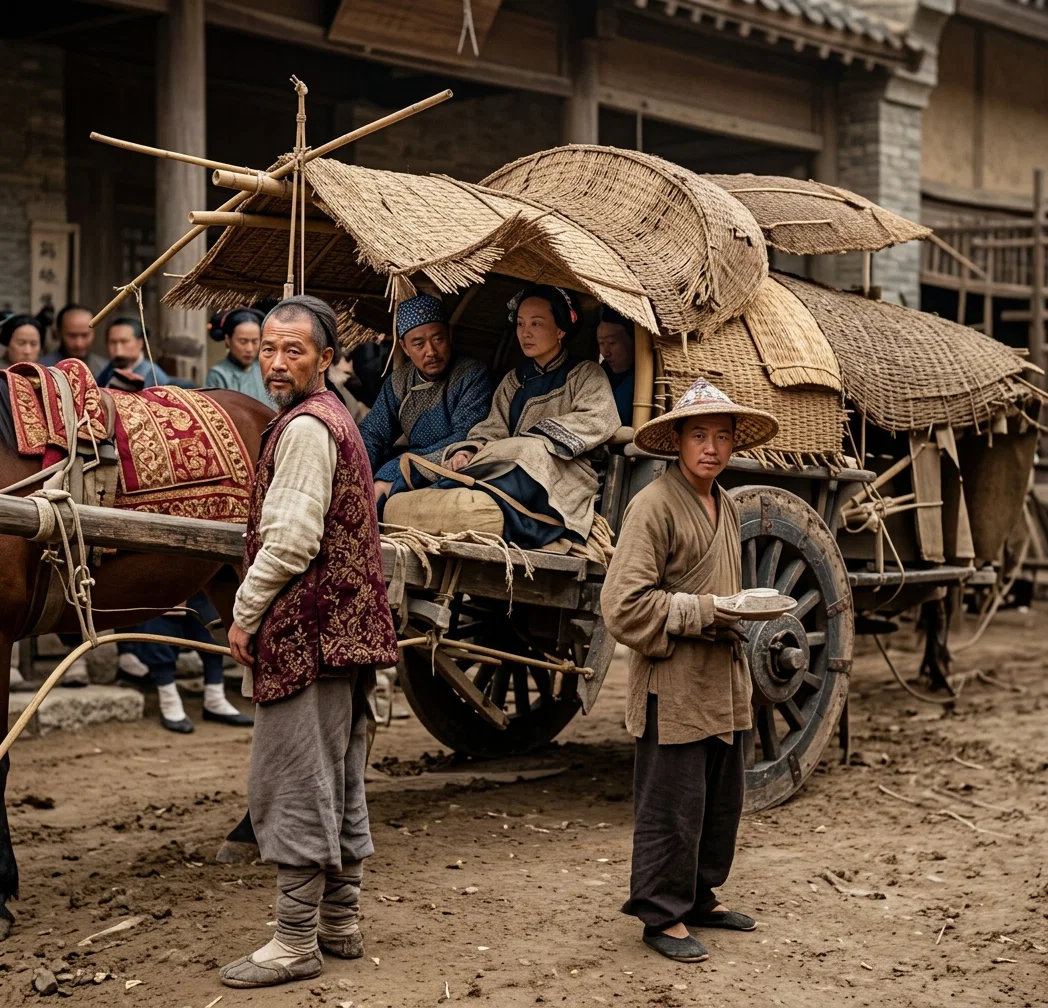
ONE MODE OF TRAVEL IN HONAN
Now we read about the great centenary missionary convention, held in Shanghai. The Chinese Recorder states that about fifteen hundred people were present, representing eighty-three different societies or agencies working in more than five hundred cities throughout the empire of China. In the great Martyrs’ Memorial Hall is this embroidered motto:
“1807 LAUS DEO 1907
UNUM IN CHRISTO”
The uppermost thought in the conference is union—union at any cost. The plan is to form a Chinese church, “and leave confessional questions to the judgment of the Chinese church for future consideration.” Dr. Gibson reminded the conference of the old story of the man who went out early in the morning and thought he saw a tiger through the mist. Coming nearer, he saw it was a man; and when nearer still, found it was his own brother. Unity is a thing to be prayed for; but it must be unity in Christ. And Christ is the truth; hence it must be unity in the truth, and not to persecute those who hold the truth precious. This great union will not include Seventh-day Adventists in China; one may be sure of that. But God lives, and Christ is with us even to the end of the world.
It is a great encouragement to read about the great movement among the Hwa Miao tribe in the southwest of China. Hundreds walked six and eight days in order to get within the sound of the blessed gospel, and then stayed and studied the gospel until two o’clock in the morning. As a result, fifty immoral club-houses were destroyed, and hundreds of drunkards became total abstainers, and have remained so for over two years. In three years’ time thousands have diligently sought and found Christ, and with childlike faith, they are living up to the light they have, and are waiting for more. This gives us a little glimpse of what God will do when he wakes up the sincere and honest ones, and cuts his work short in righteousness. These great unions will bring persecution, and persecution will bring out the sincere ones. Hence we rejoice to see them affected; for thus the last part of Revelation 13 will soon be fulfilled, and this will hasten the consummation of all things.
In the face of these sign-fulfilling events, what shall we do? Let us lay aside all self, get out of Babylon and into Christ, and thus be ready for the great finishing work that God shall accomplish through his people. Let us, by the grace of God, prefer one another in love. Let love be without dissimulation, and let us pray earnestly for one another. Christ has told us to watch and be ready; “for in such an hour as ye think not the Son of man cometh.”
In the dark hours before us let us constantly have our eyes directed toward heaven, and the approaching advent of our Lord, with all its attending events, and we shall never lose courage, but be faithful to the end, and receive the crown of life.
We are all well, and the truth was never more precious to us than it is now. What we all need is more earnestness in prayer in the name of Jesus. Prayer brings all the grace and power of heaven at our disposal.
Shang-tsai, Honan.
Baby’s Comfort
Do not forget that the cool mornings and evenings are felt by the baby. The floor is the coldest place in the house, and the crawling or toddling baby should be protected from the sudden changes. Put on the light flannels, the long sleeves, and the high-neck dresses, the little stockings and shoes, even though you must remove part or all at midday. Do not let the little one crawl about on the bare floor with wet clothing, or with blue, mottled flesh. Much of a baby’s sickness is clearly traceable to thoughtless neglect during the changeable weather of the late summer and early autumn. It will not always do to “harden” the baby by letting it get through the variable temperatures as best it can. Young things must be kept warm, whether human or animal, and a healthy baby is never a cold, rough-skinned one. Whatever is neglected, don’t let it be the baby, whose “only language is a cry,” or something told only in signs of discomfort, anxiety, and fretfulness, because it has not yet learned how intelligibly to tell you of its troubles. Take good care of the baby.
Don’t forget the extra quilt or comfort laid beside the children’s bed, or your own, these cool nights, and do not close the windows and doors too soon. See that there is fresh air, though there must be additional covering at hand for any change.
Don’t send the little ones out to school without making some provision to meet the rapid lowering of temperature which sometimes, at this season, converts the warm, sunny morning into the cold, windy, or wet afternoon. It is better to put on an additional outside wrap for a month or more yet, than to put on the thick woolen underwear which, though at the time comfortable, may be a source of great discomfort if the weather should become suddenly warm. Colds, coughs, catarrhs, and a tendency to rheumatic and other ailments, are surely “in the air,” these deceptive autumn days.— Selected.
Short Cords of Wood
SOME white men might study ethics under an old Indian on the Kakima Reservation. He is a Christian. A lady had bought several cords of wood of him. When the wood was measured, he found that it lacked just a few pieces of full measure. The lady said, “O, that is all right!” A few days afterward, however, he came with enough wood to fully make it up. The lady said, “Why, I told you that was all right.” But the Indian replied, “Me want no short cords of wood to meet me in heaven.”—Selected.
St. Vincent, West Indies
By J. Gershom Dasent
J. GERSHOM DASENT
ST. VINCENT, one of the Lesser Antilles, and the smallest in the range of volcanic islands, was discovered by Christopher Columbus, Jan. 22, 1498. This day is known in the Spanish calendar as Saint Vincent’s day; hence, the origin of the island’s name.
At the time of its discovery, it was inhabited by a tribe of wild Indians, known as the Caribs, a fierce and desperate people by nature. With the entrance of civilization, adventurous colonists were introduced, who settled in the most fertile portions of the country, and eventually owned the land, and became rich. The Caribs, however, maintained their hold until 1796, when their subjugation was accomplished by Great Britain, after a bloody struggle. In 1763 St. Vincent was declared a British possession, and from that time to now it has endeavored to keep to the front, and hold its own among the islands of the Caribbean.
The island is traversed lengthwise by a range of volcanic hills, intersected by the Morne Carow, which rises about fifty-two hundred feet above the level of the sea. “From its dark top, upon which clouds almost constantly hang, the rich lava soil slopes to the sea, spreading into great plantations and verdant groves and gardens toward the coast.” The great Morne Soufrière, the scene of the terrible eruption of 1812, and the more terrible one of 1902, is about four thousand feet in altitude, in the northwest, flanking the main peaks at some distance.
As in other parts of the world, the inhabitants of St. Vincent have had warnings from God in dreadful visitations. Twice have they been panic-stricken by terrible eruptions of the volcano La Soufrière, and thrice by devastating hurricanes; and by these two destroying elements—fire and wind—the colony has been greatly reduced. St. Vincent is now poor, and her resources are quite limited. Agriculture is the general pursuit. Formerly sugar and arrowroot were the chief exports, but recently the cotton trade was introduced, and is taking the place of that of sugar. The plantations are worked by water-mills, the water coming from ravines, in which the island abounds.
At the meeting of the West Indian Union Conference, held in Jamaica last January, I was asked to make the island of St. Vincent my future field of labor; so on the twelfth of March I sailed from Barbados, where I had been laboring for14two and a half years, and landed at Kingstown, the chief town, on the morning of the thirteenth. I met a small church of about twenty members, who extended to me a cordial welcome. We very soon found plenty to do. We have no meeting-house in the town, and it is now about four years since aggressive work of any sort has been carried on here.
There is a population of about forty thousand, and four thousand of these are in the town. The Church of England and the Wesleyan Methodists are well represented. Besides these, there are the Church of Rome, Presbyterian, and a few Antinomians. St. Vincent is ripe for the message that is to make ready a people for the second coming of the Lord. Selfishness, with its destructive train, abounds on every hand. Suddenly are men and women called from time into eternity, without a hope to cheer the tomb. The time has come for another special effort to be made in behalf of our people here. The members of our tract society have divided themselves into bands, and are doing successful work with our tracts and leaflets, and we hope soon to begin preaching services in the town. Remember us in your prayers, that we may find grace in the sight of the people, and gain souls for the kingdom of Christ.
Kingstown.
The Message in the Land of Livingstone
By JOEL C. ROGERS
JOEL C. ROGERS
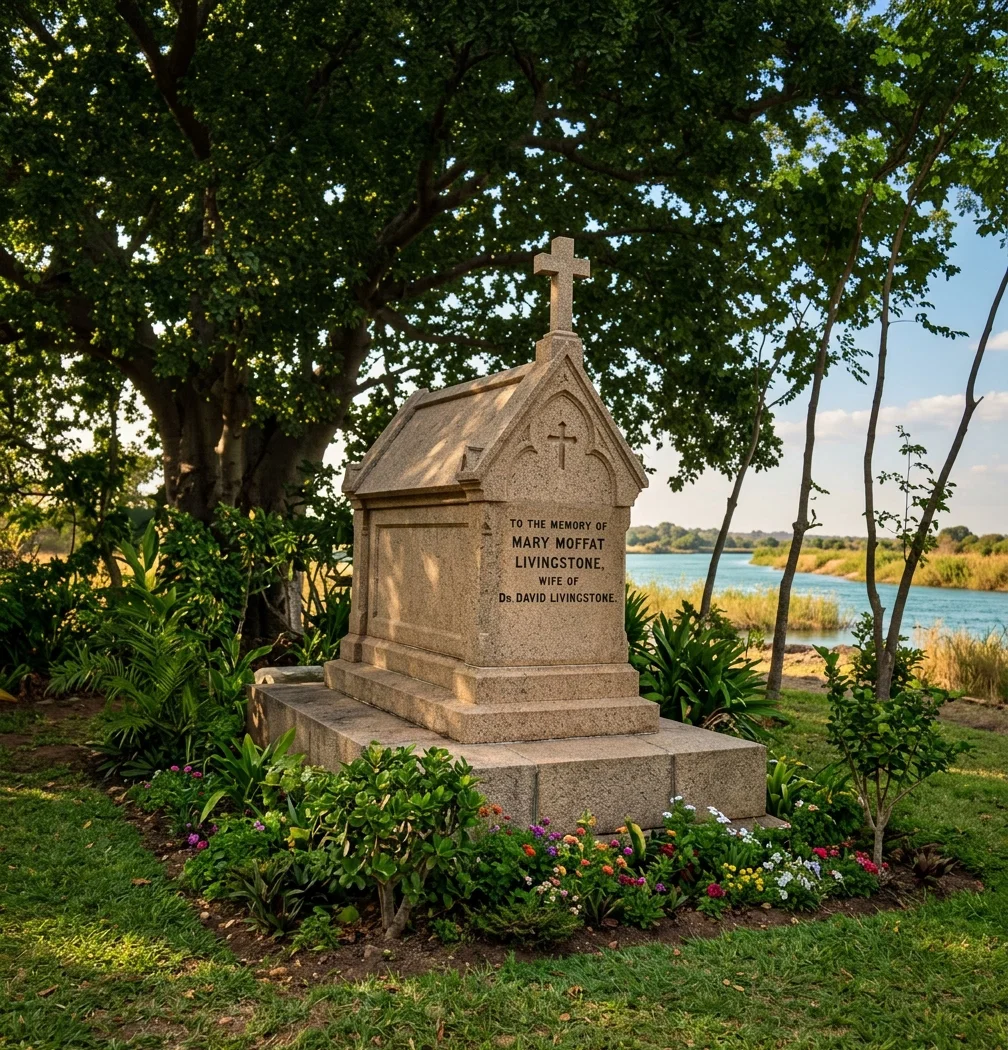
The path of the white man in Africa may be traced by graves. At Shupanga, on the left bank of the Zambesi River, and some two hundred miles from its mouth, Mary Moffat Livingstone is buried. The accompanying photograph, which I took last May, shows her resting-place. Her tomb is under a baobab-tree, near the Roman Catholic mission. The little steamer ascending the river usually stops for passengers to see this historic tomb. The mission was an asylum to Dr. Livingstone and his wife—as it has been to others—when she descended the river, stricken with Africa's plague—malaria. I was thankful to be in good health during the journey up this deadly river, and also thankful that God has sent faithful missionaries before us, to prepare his way.
This East Central Africa may well be called the land of Livingstone. He traversed it many times, and began the suppression of the slave-trade, thus giving the native peace and prosperity, and preparing him for the gospel. He lived a long time in the land, established missions, and died here.
The message now has a foothold in this land. A Brother James came here in 1895, I believe, and scattered the seeds of truth. His fever-stricken remains also lie buried on the Zambesi banks. But the seed took root, and though the plant is still small, it is growing.
On May 23 my wife and I reached our mission at Cholo. We found Brother Branch and family carrying on the work left in their hands by the death of Elder J. H. Watson. On the hillside, a few yards from the mission house where I am writing, is Brother Watson's grave. Brother and Sister Branch have done the general work of the mission, while Miss Mabel has taught the school, assisted by her brother Paul and some native teachers. The attendance is from fifty to sixty-five. The yearly vacation began May 28, and the family, except Brother Branch, went to Cape Town for a rest. They have been here almost five years, and have worked faithfully.
According to instructions from the South African Union Conference Board, I set out, soon after arriving, to find a new station farther in the interior. The old station, called Plainfield Mission by its former owners, the Seventh-day Baptists, is not centrally located. It has comparatively few natives near it, and these are of an inferior tribe. We should have our main station farther north, within reach of the two leading tribes of British Central Africa. In a later article I hope to write more fully of these tribes.
On my first trip over the country, I visited Blantyre. This town is about forty miles northeast of Plainfield, and is the business center, as well as the mission center, of British Central Africa. A railway will soon connect Blantyre with the Zambesi River. The track is now laid within twenty miles of the town. Probably Blantyre will always be the base of supplies for the whole country. Here there is but one way in and the same way out of the country; quite different from American cities, where railways radiate as wheel spokes. I believe our main station for training native teachers should be within reasonable distance of such a center as Blantyre. Small stations where well-trained natives can teach the truth to their own people, must be planted in all parts of the land.
With Brother Branch, I first visited a place called Shiloh, which we found to be entirely unsuitable for our work.
We next visited a place which we found well suited to our needs, and it is offered at a price far below its real value. We have recommended the purchase of this place. If the Board decides to buy it, I shall describe it later. Our training-school for teachers could be started at once on this place.
The three leading tribes of Nyassaland are distributed in the form of a triangle, the center of which is the new station which we hope to secure. Zomba, the seat of government, is forty miles north of Blantyre, and thirty miles from the place just mentioned.
While we must forego many conveniences and comforts of the home land, we are favored with good garden ground; vegetables grow well, and can be had fresh almost the year round. Since coming I have planted sweet corn, beets, potatoes, lettuce, radishes, etc.; we are now eating radishes planted three weeks ago.
Both my wife and myself have had good health in all our travel, and since coming here. We know many who are praying for us, and we are thankful for God's answers. We are studying the language, and while it is not difficult, yet we desire divine help to learn it quickly. Remember us in this, and also pray that we may have wisdom to reach the people quickly with the message.
Cholo, Nyassaland, B. C. A.
Tomb of Mary Moffat Livingstone, wife of David Livingstone, on the bank of the Zambesi River, at Shupanga.
Angola
By L. Brooking
L. BROOKING
ANGOLA, or Portuguese West Africa, having a population estimated at from five to nineteen millions, is a country of which Portugal has had control for four centuries, and is one of the darkest portions of the Dark Continent. The first Protestant missionary to that country was Matthew Stober, who left England and landed in Loanda, the capital, in 1899. As he walked about the town, and saw the slave sheds where the slaves were stored previous to shipment, and heard the flogging of them, he did not fully sleep much that first night. He wrote about the horrors of that traffic, making an effort to get the Portuguese government to put a stop to it, also endeavoring to arouse public opinion in Great Britain and other European countries to ask that it be stopped. He described how the slaves (called contracted laborers) live only a short time—the women two years, and the men five at most—on the islands of Santo Thome and Principe, under appalling drudgery on the cocoa plantations, and the terrible climatic and other conditions which make the islands a death-trap. Seven thousand slaves were taken over annually from the mainland, to fill up the gaps caused by death—and this goes on at present.
His first hymn translated into the native language was, “Wombaka Kwa Yesu,” and this is the name by which he is known; “Steal away to Jesus.” He has seen how the Spirit of God has gone before him among the heathen, especially so on one occasion, when, on reaching a district to which he had been told by the Portuguese it was death to go, he found an old chieftain who listened15attentively, and who had the peculiar name “Petto Dingalala Kwa Nzambi,” which means “Peter Waiting for God.” On asking him how he got such a name, the old chief replied: “My name was not always so, but years ago I had a dream, in which I was told that I was no more to be called by my usual name, but ‘Peter Waiting for God.’” The missionary inquired among the old people privately if they remembered any such change, and they said, Yes; that years ago, one morning the chief had come very excitedly to them, telling them of the dream and the instruction.
The old chief asked him to stay with him. But Mr. Stober told him that he must go farther on and tell the gospel to others also. So he went on, finding many times a hostile reception at first; but when he left, he would often be accompanied by hundreds of the natives, listening as he went. He never has had an opportunity to go over the same ground again. There are other missionaries of his and other societies now; but they are few, in the midst of such darkness.
Mr. Stober told me that if the natives could be said to keep any day at all, it is the seventh, as on that day, he has noticed, they generally refrain from cultivating the crops, which work is done mostly by the women. So amid darkest Africa the remembrance of God’s true Sabbath is recognized to some extent, through all the ages of the darkest heathenism.
This gentleman gladly took some of our doctrinal tracts to study, and three copies of our Portuguese paper.
*Caterham Sanitarium, England.**
South America
By J. W. Westphal
J. W. WESTPHAL
TAKING the steamer “Mapocho” at Guayaquil, Ecuador, Friday, June 28, on the return trip to Argentina, I was agreeably surprised to meet a brother, Frank E. Hinkley, of Boston. He was on his way to Arequipa, Peru, to connect with the Harvard University observatory at that place, as photographer, under a five-years’ contract. We are glad thus unexpectedly to have a representative located at this important place. Brother Hinkley loves the message, and it is his purpose to witness for the truth in that needy land. During our two-weeks’ trip together we had good visits, and I was pleased to learn thus directly in regard to the work in the Eastern States, and of Elder H. F. Ketring, who had labored in our field, and whom Brother Hinkley had seen very recently. There have been several surprises in my trip on the west coast. In Ecuador I met a young man from my home in Wisconsin.
Our steamer stopped at Callao four days, including Sabbath, July 6, and this time I spent with the brethren at Callao and Lima. On Sunday I was privileged to baptize two sisters, very earnest souls, who united with the Lima church. During my trip to Ecuador, meetings had been begun in a rented room in Callao; and, although the door had to be screened, and invitations to public meetings could not be given, there was a fair attendance and interest. “One man had begun to keep the Sabbath, and his wife was expecting to begin the next Sabbath. We hope for more fruit from this effort. Three meetings for the public are being held weekly in both Lima and Callao now. This keeps Brother Perry and his associates quite busy. There is also some interest in Lima, but a better place is really needed for the meetings. The brethren are of good courage. They desire the prayers of our people.
Leaving Lima July 8, our vessel reached Valparaiso the twenty-second. I had made every reasonable effort to get to this place to take the steamer for Montevideo, due to leave the twenty-third, but its departure was postponed first to the twenty-seventh, then to August 3, and finally to the sixth, just a fortnight after the schedule time. I met my brother and several members of the conference committee in counsel at Valparaiso, which had been arranged for in view of my coming. They have important questions to decide in their new but growing work. They have a good press, and other things necessary to fit up a small printing plant, purchased at a very low price, and are already doing effective work. They are printing eight thousand copies of their paper monthly, and many tracts and leaflets. Lately agents for our periodicals seem to be springing up spontaneously, and the future prospects for our literature work are good in Chile. But they own no place on which to locate their plant. The place they now occupy will have to be vacated in a few months, and it is certainly expensive to move frequently. They desire to get a location in some smaller town, within easy reach of Valparaiso. But there is no means with which to purchase, and since the earthquake rents are very high.
Sickness had come to hinder the work. Elder E. Balada was called home from the north, on account of the serious illness of his wife. Sister Steele was ill; Brother Julian Torreblanca, a member of the conference committee, who had recently been engaged in canvassing work, had been dangerously ill. But at the time of my departure both were recovering. Notwithstanding the difficulties, the work is moving forward. Elder Balada reports having baptized eight in the north of Chile during his three-months’ stay there. On the Sabbath before I left Valparaiso, Brother Steele, the elder of the church, administered the rite to three.
At Quillota, a city of over ten thousand inhabitants, less than two hours by train from Valparaiso, seven have recently begun to observe the Sabbath. One of these is now busily engaged in selling our literature. The selling of the Señales de los Tiempos on the streets was the beginning of this work. Elder Damaso Soto has followed it up. Others are interested. The writer had one meeting with them. Evidently a baptismal service will be held there erelong.
At Santiago, where I preached twice, there is a growing interest. In the four months since the conference, a large number of new faces had made their appearance, and some had already taken their stand for the truth. Some of the brethren are moving to new fields. This, we trust, will serve to open up new territory. The work is great, and the laborers are few.
It was my purpose to stop off at Punta Arenas, to visit our brethren there. But as I had already been gone so long from Argentina, and the situation urgently demanded my speedy return; and as our boat did not stop long enough for us to land and return, I was under the necessity of foregoing this. There is at least one, and I think there are more, in this southernmost city of the world, keeping the Sabbath. It is evidently a place where further work should be done to plant more firmly the truth.
As I write this, August 16, our steamship “Orita,” the largest to the west coast, is nearing the harbor of Montevideo. Except for the cold, the voyage has been an exceptionally pleasant one. In another week I expect to reach home, after an absence of five months. Pray for the work in South America.
Buenos Ayres, Argentina.
Mission Notes
A LETTER from Cape Town, South Africa, brings an appeal for help from Brother D. C. Theunissen. He says: “We have quite a nice, large company at Salt River, two or three miles from Cape Town. Sabbath after Sabbath we are crowded into a room not very large, for which we pay thirty shillings a month. We can not afford to hire a larger place. What we need is a suitable building, large enough to accommodate a good-sized congregation, that the cause of God might be established here among the colored people. We need about four hundred pounds—from one hundred to one hundred and fifty for the lot, and the remainder for the building. I appeal to you to help us in our extreme need. I have prayed earnestly about this matter. I trust God will help.”
MISS ANNA T. JEANES, a Quakeress of large means, has given one million dollars, the income of which is to assist in establishing and maintaining rural schools for the colored people all through the South. Booker T. Washington is one of the trustees in charge of these funds, and colored people and white people will be represented on the governing board, the power of naming being lodged with the three trustees. Mission schools will be supported as far as such schools can be started. This is not to be understood as providing for all that needs to be done in this direction; for the report closes by saying: “Notwithstanding such gifts as this of Miss Jeanes, and of Mr. Rockefeller to the General Educational Board; notwithstanding the increased prosperity of the South as a section; notwithstanding the16new disposition of the Southern political leaders to champion generous appropriations for the education of the negro, his former and long-tried friends in the North still have their duty and generosity to perform.”
THE power of real self-sacrifice, and the true courage born of it, are beautifully illustrated by an incident in the life of Robert Moffat, who was surrounded one day by a South African chief and twelve followers with poised spears, ready to kill the noble missionary on the spot. At the time, Moffat was engaged in repairing a wagon; and his wife, with babe in arms, was watching every movement of their foes. She heard her heroic husband, in a singular tone of voice, defy them to do their worst, as he bared his breast, after dropping his tools, calmly saying: “Your threats are vain. We have come to bless you, and here we stay. If you are bound to be rid of us, do what you will. But our hearts are with you, and we shall stay with you till we are killed. Now spear me, if you will, and when you have slain me, others like me will come to take up the work.” Down went their spears, and the chief turned to his comrades, saying: “These missionaries are so fearless of death, they must have ten lives: there must be another life beyond!” From that time, instead of opposition, Moffat had the co-operation of the natives.
Central America
By E. L. Cardey
LA CEIBA, SPANISH HONDURAS.—The Lord has been merciful to us all this summer, although the fever has attacked most of our workers and their families. However, all are well again, so far as I know. It went through my family, and left my wife in a bad condition. As a consequence, I have had to send her to the States for treatment.
The enemy has been working very hard in this field this summer; but this is evidence that the Lord is working, also. The prospect for our work never looked brighter than it does now. Our laborers are all of the best of courage, and are ready to move as good soldiers. In the past three months I have baptized thirty-four souls. Just to-day I administered the rite to two here in La Ceiba.
Our finances are in good condition. At the end of the year we shall be able to return to the union conference all that the Mission Board has sent to us this year, and even more. Our tithe will, without doubt, almost double that of last year.
In a few days I go from here to Bonacca, to hold a few weeks’ meeting. A good interest has been awakened on the north side of the island, where, with a little more labor, we believe a church can be organized. Brother Smalley is doing a good work on the island of Ruatan. He reports two new Sabbath-keepers in a place where he has been holding meetings.
As soon as I finish this trip through the island, I shall try again to go into Guatemala. Perhaps things will have quieted down there by that time. September 29 and 30 our workers will meet together in French Harbor, Ruatan, and talk over matters, and lay plans for the winter, also for the general meeting which we hope to have next spring.
It encourages my soul to see the truth advancing in all parts of the globe; and it inspires me to work harder to push out into the unentered fields in our own territory. We have a large field in this mission, and it means something to grapple with the conditions as we find them in these countries. Darkness surely covers this people. E. L. CARDEY.