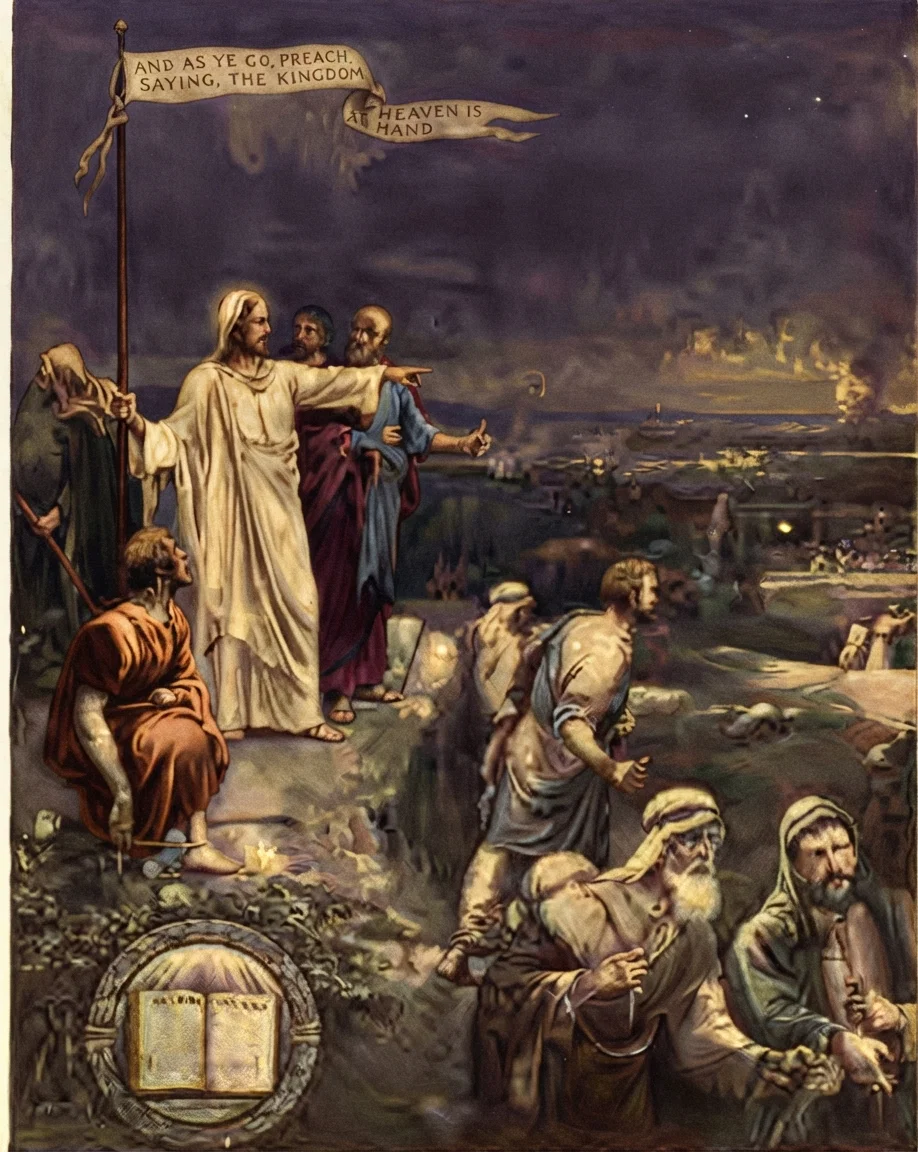
Signs of the Times, Vol. 41, No. 21.

THE CHURCH TRIUMPHANT

Signs of the Times

Jun 2, 1914

Pacific Press Publishing Association · Mountain View, California · Jun 2, 1914

THE CHURCH TRIUMPHANT

Courageous Work of the Early Heroes of Faith—The Marvelous Spiritual Temple in Process of Building
By MRS. E. G. WHITE
MORE than eighteen centuries have passed since the apostles rested from their labors; but the history of their toils and sacrifices for Christ's sake is still among the most precious treasures of the church. This history, written under the direction of the Holy Spirit, was recorded in order that by it the followers of Christ in every age might be impelled to greater zeal and earnestness in the cause of the Saviour.
The commission that Christ gave to the disciples, they fulfilled. As these messengers of the cross went forth to proclaim the gospel, there was such a revelation of the glory of God as had never before been witnessed by mortal man. By the cooperation of the divine Spirit, the apostles did a work that shook the world. To every nation was the gospel carried in a single generation.
Upon the foundation that Christ Himself had laid, the apostles built the church of God. In the Scriptures the figure of the erection of a temple is frequently used to illustrate the building of the church. Zechariah refers to Christ as the Branch that should build the temple of the Lord. He speaks of the Gentiles as helping in the work: "They that are far off shall come and build in the temple of the Lord;" and Isaiah declares, "The sons of strangers shall build up thy walls."

ERECTING THE SPIRITUAL TEMPLE

Writing of the building of this temple, Peter says, "To whom coming, as unto a living stone, disallowed indeed of men, but chosen of God, and precious, ye also, as lively stones, are built up a spiritual house, an holy priesthood, to offer up spiritual sacrifices, acceptable to God by Jesus Christ."
THE GREAT COMMISSION THE FOUNDATION OF THE CHURCH'S TRIUMPH
In the quarry of the Jewish and the Gentile world the apostles labored, bringing out stones to lay upon the foundation. In his letter to the believers at Ephesus, Paul said: "Now therefore ye are no more strangers and foreigners, but fellow citizens with the saints, and of the household of God; and are built upon the foundation of the apostles and prophets, Jesus Christ Himself being the chief corner-stone; in whom all the building fitly framed together groweth unto an holy temple in the Lord: in whom ye also are builded together for an habitation of God through the Spirit."

THE SURE FOUNDATION

And to the Corinthians he wrote: "According to the grace of God which is given unto me, as a wise master builder, I have laid the foundation, and another buildeth thereon. But let every man take heed how he buildeth thereupon. For other foundation can no man lay than that is laid, which is Jesus Christ. Now if any man build upon this foundation gold, silver, precious stones, wood, hay, stubble; every man's work shall be made manifest: for the day shall declare it, because it shall be revealed by fire; and the fire shall try every man's work of what sort it is."
The apostles built upon a sure foundation, even the Rock of Ages. To this foundation they brought the stones that they quarried from the world. Not without hindrance did the builders labor. Their work was made exceedingly difficult by the opposition of the enemies of Christ. They had to contend against the bigotry, prejudice, and hatred of those who were building upon a false foundation. Many who wrought as builders of the church could be likened to the builders of the wall in Nehemiah's day, of whom it is written: "They which builded on the wall, and they that bare burdens, with those that laded, every one with one of his hands wrought in the work, and with the other hand held a weapon."

PROGRESSING DESPITE DANGER AND DEATH

Kings and governors, priests and rulers, sought to destroy the temple of God. But in the face of imprisonment, torture, and death, faithful men carried the work forward; and the structure grew, beautiful and symmetrical. At times the workmen were almost blinded by the mists of superstition that settled around them. At times they were almost overpowered by the violence of their opponents. But with unfaltering faith and unfailing courage they pressed on with the work.
One after another the foremost of the builders fell by the hand of the enemy. Stephen was stoned; James was slain by the sword; Paul was beheaded; Peter was crucified; John was exiled. Yet the church grew. New workers took the place of those who fell, and stone after stone was added to the building. Thus slowly ascended the temple of the church of God.
Centuries of fierce persecution followed the establishment of the Christian church, but there were never wanting men who counted the work of building God's temple dearer than life itself. Of such it is written: "Others had trial of cruel mockings and scourgings, yea, moreover of bonds and imprisonment: they were stoned, they were sawn asunder, were tempted, were slain with the sword: they wandered about in sheepskins and goatskins; being destitute, afflicted, tormented; (of whom the world was not worthy:) they wandered in deserts, and in mountains, and in dens and caves of the earth."

PERSECUTIONS COULD NOT STOP IT

The enemy of righteousness left nothing undone in his effort to stop the work committed to the Lord's builders. But God "left not Himself without witnesses." Workers were raised up whoably defended the faith once delivered to the saints. History bears record to the fortitude and heroism of these men. Like the apostles, many of them fell at their post, but the building of the temple went steadily forward.
The workmen were slain, but the work advanced. The Waldenses, John Wyclif, Huss and Jerome, Martin Luther and Zwingle, Cranmer, Latimer, and Knox, the Huguenots, John and Charles Wesley, and a host of others brought to the foundation material that will endure throughout eternity. And in later years those who have so nobly endeavored to promote the circulation of God's word, and those who by their service in heathen lands have prepared the way for the proclamation of the last great message,—these also have helped to rear the structure.

GLEAMING LIKE JETS OF LIGHT

Through the ages that have passed since the days of the apostles, the building of God's temple has never ceased. We may look back through the centuries, and see the living stones of which it is composed gleaming like jets of light through the darkness of error and superstition. Throughout eternity these precious jewels will shine with increasing luster, testifying to the power of the truth of God. The flashing light of these polished stones reveals the strong contrast between light and darkness, between the gold of truth and the dross of error.
Paul and the other apostles, and all the righteous who have lived since them, have acted their part in the building of the temple. But the structure is not yet complete. We who are living in this age have a work to do, a part to act. We are to bring to the foundation material that will stand the test of fire,—gold, silver, and precious stones, "polished after the similitude of a palace." To those who thus build for God, Paul speaks words of encouragement and warning: "If any man's work abide which he hath built thereupon, he shall receive a reward. If any man's work shall be burned, he shall suffer loss: but he himself shall be saved; yet so as by fire." The Christian who faithfully presents the word of life, leading men and women into the way of holiness and peace, is bringing to the foundation material that will endure, and in the kingdom of God he will be honored as a wise builder.

A GLORIOUS DAY AHEAD

If the church will put on the robe of Christ's righteousness, withdrawing from all allegiance with the world, there is before her the dawn of a bright and glorious day. God's promise to her will stand fast forever. He will make her an eternal excellency, a joy of many generations.
We may have a vision of the future, the blessedness of heaven. In the Bible are revealed visions of future glory, scenes pictured by the hand of God, and these are dear to His church. By faith we may stand on the threshold of the eternal city, and hear the gracious welcome given to those who in this life cooperate with Christ, regarding it as an honor to suffer for His sake. As the words are spoken, "Come, ye blessed of My Father," they cast their crowns at the feet of the Redeemer, exclaiming: "Worthy is the Lamb that was slain to receive power, and riches, and wisdom, and strength, and honor, and glory, and blessing. . . . Honor, and glory, and power, be unto Him that sitteth upon the throne, and unto the Lamb forever and ever."

THE SONGS OF VICTORY AND JOY

There the redeemed greet those who led them to the Saviour, and all unite in praising Him who died that human beings might have the life that measures with the life of God. The conflict is over. Tribulation and strife are at an end. Songs of victory fill all heaven as the ransomed ones take up the joyful strain, Worthy, worthy is the Lamb that was slain, and lives again; a triumphant conqueror.
"I beheld, and, lo, a great multitude, which no man could number, of all nations, and kindreds, and people, and tongues, stood before the throne, and before the Lamb, clothed with white robes, and palms in their hands; and cried with a loud voice, saying, Salvation to our God which sitteth upon the throne, and unto the Lamb."

NO MORE DEATH NOR SORROW

"These are they which came out of great tribulation, and have washed their robes, and made them white in the blood of the Lamb. Therefore are they before the throne of God, and serve Him day and night in His temple: and He that sitteth on the throne shall dwell among them. They shall hunger no more, neither thirst any more; neither shall the sun light on them, nor any heat. For the Lamb which is in the midst of the throne shall feed them, and shall lead them unto living fountains of waters: and God shall wipe away all tears from their eyes." "And there shall be no more death, neither sorrow, nor crying, neither shall there be any more pain: for the former things are passed away."

ESTIMATING VALUES

APPARENTLY, one of the most difficult things of life is to put the proper estimate on reputed values. Some persons strain every nerve to acquire fortunes. Others burn midnight oil to gain social standing or political honor. The fact that every vital energy is bent in the direction of securing some one of these worldly attainments, reveals the relative estimate placed on things which, when secured, are but temporary possessions at best.
There is, however, one acquisition, the value of which can never, in this world, be fully estimated, and that is the "riches of God's grace." Such a consideration may be declared not practicable, as it does not come within the purview of ordinary mortals.
Certainly there are untold numbers who have not entered upon the possession of this rich endowment; yet when considering the wealth of earthly millions from which they are nearly as far removed, they do not seem to be deterred from reaching after that. Indeed, its value seems to be quickly comprehended; and yet it can not begin to compare with the heavenly riches, either in present worth or in the continuance of its benefits.
But when the eyes of one's understanding have been sufficiently anointed with the divine unction, he will then be able, with the appreciative apostle, to reckon that the things of this world are not worthy to be compared with the riches of God's grace, which is able to develop its glory in the soul of human happiness. J. O. C.

The Pentecostal Power

By ELIZA H. MORTON
From Olivet to proud Jerusalem Christ's chosen ones returned at His command— His parting words were ringing in their ears— To wait the Father's promise there, to wait The Spirit's power. They met and sought the Lord, And praying, felt they had an Advocate Above. In solemn awe they bowed the knee, And claimed they should receive as they should ask In Jesus' name. His pure and holy life Came to their minds. They longed to live again Those years with Him, to show Him how they loved His words. They sorrowed o'er their sins, and wept As low they bowed in earnestness and prayed, Not for themselves alone, but for the souls In all the world. They claimed the promised power, With words of penitence and songs of praise, And lo, the Spirit came in fulness sweet, Baptizing every one with power to serve! They cried, "Herein is love, redeeming love," And tongues of fire appeared upon their heads, A symbol of the gift they had received. The Scriptures shone with luster new and clear, And all were of one heart and mind and soul, Becoming more and more like Jesus day by day, As forth they went to speak the truth with words That burned into the hearts and souls of men, And thousands were converted in a day.
And near the close of earth's great harvest-time, The days of Pentecost will come again In fulness greater than before, that souls May know the truth,—the present truth, that tests The hearts of men as it is shed abroad, And lightens earth from sea to sea. Full soon The timid will be strong, the stammering tongue Be loosed, the lips be touched with coals of fire. The early and the latter rain combined Will come from clouds made bright with showers of rain. Supplies of grace for daily needs prepare The soul for added grace, and only those Who work and pray, with lamps all trimmed, will know The sanctifying, living faith that grasps The throne, and makes us laborers with God, While temporal things before that glory fade. Baptize us, Lord, to work for souls. Amen.

Building the Wall of Apostasy

Thought to Stand above Moses — Men Claiming to Reverse the Teaching of God and Christ — The Untempered Mortar — Fate of the Arrogant Builders
By T. E. BOWEN
NEARLY every prophet whose writings compose the Old Testament Scriptures, gives evidence that there were portrayed before him, in holy vision, scenes down here at the "time of the end." All speak of the great and terrible day of the Lord. Nahum describes the flaming chariots raging through the land, in the day of His "preparation," coursing with lightning speed and "flaming torches," their winding path of iron over rivers, through mountains, jostling and raging in the streets. He saw our ponderous trains, but scarcely knew how to describe them.

APOSTASY UNDER SYMBOL OF A WALL

Ezekiel describes an apostasy developing, down at the end, with such wide-spread proportions that he gives quite a little space to it in his scroll. He uses the simile of a wall — a very fit illustration when we come to see that the prophet is describing a movement involving the law of God. God's law is to His obedient people like a great protecting wall about a city — very common in Ezekiel's time. He saw a great company of shepherds down at the end. He speaks of these hired ministers under the term "prophets," as they are supposed to be speaking to the people for God. This is his message to them:

THE LORD HAD NOT SPOKEN

"Thus saith the Lord God; Wo unto the foolish prophets, that follow their own spirit, and have seen nothing! O Israel, thy prophets are like the foxes in the deserts. Ye have not gone up into the gaps, neither made up the hedge for the house of Israel to stand in the battle in the day of the Lord [plainly referring to the time of the end, just before the coming of Christ]. They have seen vanity and lying divination, saying, The Lord saith: and the Lord hath not sent them: and they have made others to hope that they would confirm the word. Have ye not seen a vain vision, and have ye not spoken a lying divination, whereas ye say, The Lord saith it; albeit I have not spoken? Therefore thus saith the Lord God; Because ye have spoken vanity, and seen lies, therefore, behold, I am against you, saith the Lord God. And Mine hand shall be upon the prophets [false shepherds] that see vanity, and that divine lies; they shall not be in the assembly of My people, neither shall they be written in the writing of the house of Israel, neither shall they enter into the land of Israel; and ye shall know that I am the Lord God." Eze. 13: 3-9.

NOT PREPARED FOR THE BATTLE

This scripture depicts an apostasy from God. By false teaching, people are not prepared to "stand in the battle in the day of the Lord." But the real cause of this falsity follows:
"One built up a wall, and, lo, others daubed it with untempered mortar: say unto them which daub it with untempered mortar, that it shall fall: there shall be an overflowing shower; and ye, O great hailstones, shall fall; and a stormy wind shall rend it." Verses 10, 11.
This is an important scripture. It reveals that which we see before our very eyes today, a condition world-wide in its extent. "One built up a wall." The papacy replaced, in the great wall of God's law, the fourth commandment, which enjoins the keeping of the seventh day, with a false patch of a wall enforcing the first-day sabbath rest. Without one word of authority, the Roman Catholic Church instituted this false sabbath. She claims it as the mark of her authority for changing other precepts of Christ.

BY PAPAL AUTHORITY

Here is one statement of theirs making this plain:
"By the authority of the [Roman] Catholic Church, the weekly day of rest from servile work was transferred from Saturday to the first day of the week precisely to commemorate the resurrection. Moses instituted the Sabbath; the higher authority of the Catholic Church instituted the 'Lord's day.' Or we may put it this way: God gave through Moses on Mount Sinai the command for the weekly observance of the Sabbath, or seventh day, to commemorate the divine cessation of the work of creation; while the same divine Legislator gave through His church, rock-founded on the Mount Calvary, the command for the weekly observance in future of the Sunday or first day in commemoration not alone of the first day of creation, but of the 'day of days' — Easter day. This important change in the literal observance of one of the commandments in the Decalogue is not recorded in the Holy Scripture. 'The Bible alone' theory of Protestantism apart from the living authority of the [Roman] Catholic Church, is quite incapable of justifying the universal Christian observance of Sunday." — (Roman) Catholic Record, a paper published in Canada.

WORKERS WITH UNTEMPERED MORTAR

While "one" built up the false wall, "lo, others daubed it with untempered mortar." "Others" implies more than one. Notice Ezekiel's surprise. "Lo" is an expression of surprise and wonder. "Why should they do it?" no doubt he thought. Nearly every Protestant denomination in the world is engaged in daubing with untempered mortar this Roman Catholic, man-made wall.
What better illustration could the prophet have used than "untempered mortar" — stuff that will not hold together? One uses one argument, another another, to bolster up this unscriptural device of the Sunday-sabbath by which Christ and His Father are robbed every week of the glory and honor and praise due the Creator. Not one word of authority from God in His holy word can be found for this transfer of days, as the Roman Catholic Church freely boasts.
You have no greater authority for Sunday sacredness than for the claim that no marriage is legal unless performed by a Roman Catholic priest, or for infant sprinkling, or the observance of the mass. All stand on the one and selfsame foundation — the man-made authority of the papal church.

WHAT BECOMES OF THE APOSTASY

But this wall — what becomes of it? Here is what God has predicted concerning it: "Therefore thus saith the Lord God; I will even rend it with a stormy wind in My fury; and there shall be an overflowing shower in Mine anger, and great hailstones in My fury to consume it. So will I break down the wall that ye have daubed with untempered mortar, and bring it down to the ground, so that the foundation thereof shall be discovered, and it shall fall, and ye shall be consumed in the midst thereof: and ye shall know that I am the Lord." "Lo, when the wall is fallen, shall it not be said unto you, Where is the daubing wherewith ye have daubed it?"
Christ's indignation against this skilfully planned system of iniquity, by Satan himself working through an apostate church, will come in the seven last plagues, just prior to Christ's second appearing in power and great glory, attended by all the holy angels. It is at that time that great hailstones, and a horrible tempest, are to come upon the inhabitants of earth who have defied God by disregarding His law. It is the wrath of the Lamb. That terrible storm no mind can fully comprehend, no pen picture. Only those who are covered by the Almighty shall abide through it. The scenes of this day of the Lord are described by the prophet John, in Revelation 16, not in symbols or figurative language, but in literal expressions, easy to understand. Reader, turn to that chapter, and picture as you can what it will mean to you to escape these awful plagues.

JUDGMENTS THAT BREAK FORTH

A glimpse of God's judgments is given us in these words: "And there was a great earthquake, such as was not since men were upon the earth, so mighty an earthquake, and so great. . . . And great Babylon [the builder of this wall Ezekiel is talking about] came in remembrance before God, to give unto her the cup of the wine of the fierceness of His wrath. And every island fled away, and the mountains were not found. And there fell upon men a great hail out of heaven, every stone about the weight of a talent: and men blasphemed God because of the plague of the hail; for the plague thereof was exceeding great." Rev. 16: 18-21.
Viewing this same visitation from God, another prophet wrote: "Howl ye; for the day of the Lord is at hand; it shall come as a destruction from the Almighty." "Enter into the rock, and hide thee in the dust, for fear of the Lord, and for the glory of His majesty. The lofty looks of man shall be humbled, and the haughtiness of men shall be bowed down, and the Lord alone shall be exalted in that day." Isa. 13: 6; 2: 10, 11.

CONDEMNED BY DESPISED LAW

It is impossible to describe the horror and despair of those who have trampled upon God's holy requirements. The Lord gave them His law; they might have compared their characters with it, and learned their defects while there was yet opportunity for repentance and reform; but in order to secure the favor of the world, they set aside its precepts and taught others to transgress. They have endeavored to compel God's people to profane His Sabbath. Now they are condemned by that law which they have despised. With awful distinctness they see that they are without excuse. They chose whom they would serve and worship. 'Then shall ye return, and discern between the righteous and the wicked, between him that serveth God and him that serveth Him not.'

THEY SEE IT TOO LATE

"The enemies of God's law, from the ministers down to the least among them, have a new conception of truth and duty. Too latethey see that the Sabbath of the fourth commandment is the seal of the living God. Too late they see the true nature of their spurious sabbath, and the sandy foundation upon which they have been building. They find that they have been fighting against God. Religious teachers have led souls to perdition while professing to guide them to the gates of Paradise. Not until the day of final accounts will it be known how great is the responsibility of men in holy office, and how terrible are the results of their unfaithfulness. Only in eternity can we rightly estimate the loss of a single soul. Fearful will be the doom of him to whom God shall say, 'Depart, thou wicked servant.'"

THE OPPORTUNITY NOW

There is opportunity now, reader, to take your stand with God, and come out from all this apostasy. Get away from this unholy wall. It will soon fall, and great will be the fall of it. While hoary with age, that does not make the Sunday sabbath holy. Christ Jesus created the world, and gave to men the Sabbath. The Son of God spoke it from Sinai, kept it Himself while with us, and died on Calvary to rock-found the whole law of God, including the seventh-day Sabbath. Not one jot or tittle of that law did He change. And as it stood when He died, so must it remain to all generations. "Think not that I came to destroy the law or the prophets: I came not to destroy, but to fulfil. For verily I say unto you, Till heaven and earth pass away, one jot or one tittle shall in no wise pass away from the law, till all things be accomplished." Matt. 5: 17, 18.
Reader, which will you believe and obey, Christ Jesus, or the "one" who built the wall?

A Sunday Law for Portland, Oregon

A CRIMINAL IF HE SELLS BREAD—A LAW-ABIDING CITIZEN IF HE SELLS TOBACCO

By W. F. Martin
Just now, the Northwest seems to be the center of attack for those who are seeking to secure religious legislation. Only recently, the city council at Wenatchee, Washington, passed a Sunday-closing ordinance, at the request of the church people. A strong effort was made to secure a similar measure in Walla Walla.
For some time, a Sunday-closing ordinance has been pending before the commission of Portland. At its last meeting, that body passed the measure, and it is now a law.

BREAD AND TOBACCO

In common with all such measures, this Sunday law is inconsistent. It does not close the stores; and while prohibiting the sale of bread and other such articles, it allows the sale of tobacco. Thus a merchant may sell tobacco and be within the pale of the law, whereas if he should sell a loaf of bread he would be a criminal. It is said that the law was passed at the instigation of the leading grocers, and yet it met with more or less opposition. There is now some talk that the opponents of the measure will fight the law in the courts.
Following is the text of the measure:
"Section 1. It shall be unlawful to keep open any shop, store, or grocery for the purpose of labor or traffic on the first day of the week, commonly called 'Sunday,' or the 'Lord's day,' except for works of necessity or charity; provided, that the above provision shall not apply to theaters or places of amusement, drug stores, undertaking establishments, shoe-shining stands, livery-stables, garages, butcher shops, bakery and delicatessen shops; and provided further, that meals may be served on the premises or elsewhere by caterers, and tobacco, milk, fruit, confectionery, soft drinks and ice-cream, newspapers and periodicals, and medical and surgical appliances and supplies may be sold in a quiet and orderly manner."
"Section 2. In works of necessity or charity shall be included whatever is needful for the good order or health of a community, and acts for the preservation of life and property, but nothing in this ordinance shall be construed to permit the sale of groceries, clothing, sporting-goods, boots or shoes, haberdashery, hardware, or dry-goods."
"Section 3. Any person, firm, or corporation violating any provisions of this ordinance shall, upon conviction thereof in the municipal court, be punished by a fine not to exceed fifty (50) dollars, or by imprisonment in the city jail not to exceed sixty (60) days, or by both such fine and imprisonment."

"Signs in the Sun"

Words That Have Been Most Literally Fulfilled—The Cause for the Great Dark Day Unknown

By J. M. COLE
IMMEDIATELY after the tribulation of those days shall the sun be darkened." Matt. 24:29. "IN those days, AFTER that tribulation, the sun shall be darkened." Mark 13:24.

A MOST UNACCOUNTABLE DARKENING

Concerning the wonderful dark day, Mr. R. M. Devens, a member of the Historical Society of Pennsylvania, says in his book "Our First Century," published at Springfield, Massachusetts, in 1876: "Almost if not altogether alone, as the most mysterious and as yet unexplained phenomenon of its kind in nature's diversified range of events during the last century, stands the dark day of May 19, 1780,—a most unaccountable darkening of the whole visible heavens and atmosphere in New England,—which brought intense alarm and distress to multitudes of minds, as well as dismay to the brute creation, the fowls fleeing bewildered to their roosts, and the birds to their nests, and the cattle returning to their stalls."
The seer of Patmos tells us that the sun would become as "black as sackcloth of hair."

ALIKE INVISIBLE

Dr. Samuel Tenny, in 1785, as quoted in Gage's "History of Rowley, Massachusetts," in describing the intensity of the darkness, said it "was probably as gross as has ever been observed since the Almighty fiat gave birth to light. It wanted only palpability to render it as extraordinary as that which overspread the land of Egypt in the days of Moses. . . . I could not help conceiving, at the time, that if every luminous body in the universe had been shrouded in impenetrable shades, or struck out of existence, the darkness could not have been more complete. A sheet of white paper held within a few inches of the eyes, was equally invisible with the blackest velvet."

WENT DOWN AT NOON

"And it shall come to pass in that day, saith the Lord God, that I will cause the sun to go down at noon, and I will darken the earth in the CLEAR day." Amos 8:9.
Milo Bostwick, writing from Camden, New Jersey, March 3, 1848, says: "The 19th of May, in the year 1780, I well remember. I was then in my sixteenth year. The morning was clear and pleasant, but somewhere about eight o'clock my father came into the house and said there was an uncommon appearance in the sun. There were not any clouds, but the air was thick, having a smoky appearance, and the sun shone with a pale and yellowish hue, but kept growing darker and darker, until it was hid from sight."

TO BE IN THE MORNING

The prophet Isaiah, speaking of the darkening of the sun, says, "The sun shall be darkened in his going forth." Isa. 13:10. The historian records the fact.
Josiah Litch, in his "Prophetic Expositor," says: "I refer to the dark day of A. D. 1780, May 19. That was a day of supernatural darkness. It was not an eclipse of the sun, for the moon was nearly at the full. It was not owing to a thickness of the atmosphere, for the stars were seen. The darkness began about 9 A. M. and continued through the day. Such was the darkness that work was suspended in the field and shop, beasts and fowls retired to their rest, and the houses were illuminated at dinner time. . . . The sun was supernaturally darkened."
Noah Webster, in the New Haven Daily Herald, says, "No satisfactory cause has yet been assigned." Also in his dictionary, edition of 1869, we find the following: "The dark day, May 19, 1780, so called on account of a remarkable darkness on that day, extending over all New England. In some places, persons could not see to read common print in the open air for several hours together. . . . The true cause of this remarkable phenomenon is not known."

UNSOLVED MYSTERY

Sir William Herschel, England's royal astronomer, private astronomer to George III, said, "That phenomenon of the dark day, May 19, 1780, has baffled all astronomical solution, and must remain an unsolved mystery to the end of time."
After making a careful study of the event, he gave his understanding of it in the following language: "The dark day in North America was one of those strange phenomena that will always be read with interest, but which philosophy is at a loss toexplain. We have had dark days when there were eclipses, but here there was nothing of the kind. It was dark at noonday without intervention of a heavenly body; and after the lapse of more than a hundred years, it stands unexplained by the great scientists that have studied the perplexing problem."
Continue reading: The Liquor Traffic and Personal Liberty