Your ShelfYour Projects

Review and Herald, Vol. 82, No. 35.

DAMASCUS

Review and Herald

Aug 31, 1905

Review and Herald Publishing Association · Washington, D. C. · Aug 31, 1905
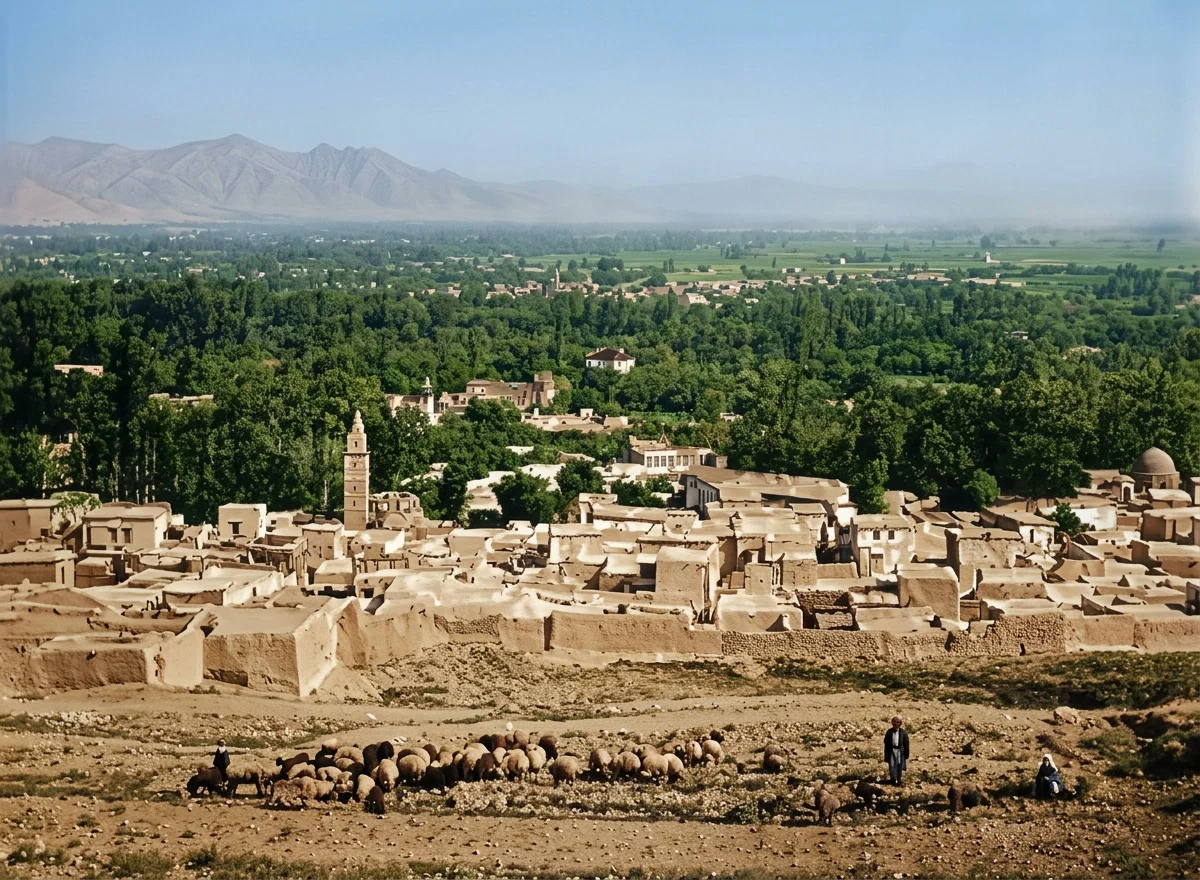
DAMASCUS

This celebrated city of Syria is one of the most ancient cities in the world, having been in existence as early as the time of Abraham. It is situated in the midst of a very fertile plain, at the foot of Mt. Libanus, about fifty miles from the sea, and is nearly surrounded by hills. The city and suburbs are well watered by fountains and streams, and the natural beauty of the place was such that in ancient times it was considered one of the four paradises of the East.
Damascus occupies a prominent place in sacred history. The city was taken by King David, but was lost to the dominion of Israel near the close of Solomon's reign. Rezin and Benhadad were two of its kings who are mentioned in the Scriptures. The city was many times besieged, and often changed masters as a result of the fortunes of war, yet it never permanently suffered from these vicissitudes. Since the time of the Crusades it has remained under the Ottoman dominion.
Damascus was the center of important events in the days of the apostles. It was close to Damascus that Saul, “breathing out threatenings and slaughter” against the Christians in the city, was converted by the sudden vision that fell upon him, and became Paul the apostle. The street called Straight, to which Ananias was directed in his vision, is still a principal street of the city, extending east and west across the city and suburbs to a length of about a league in a direct line. The traveler is shown the places where, according to tradition, Paul lodged in the city, and where he received his sight; also the place which tradition marks as that where Paul was let down from the wall in a basket to escape from the Jews.
The present population of Damascus is between one hundred thousand and one hundred and fifty thousand. The Greek Church has the strongest following in the place outside of Mohammedanism. The houses are mostly of poor appearance externally, but are said to have quite magnificent interiors. About three miles from the city is the celebrated “plain of roses,” a large tract devoted to the careful culture of rose trees, from which place comes the “attar of rose” perfume.

With the Publications and the Workers

“The Lord gave the word: great was the company of those that published it.”
“SENT broadcast over the country,” is what a Catholic priest said of the little tract “Appeal to Clergy.” Nearly half a million copies of this leaflet have been circulated, but there are other places where it should be sown “broadcast” even as the “leaves of autumn.” It can be secured at the low rate of 40 cents a hundred, $3.75 a thousand.
It will be an encouragement to workers with our publications to read in the report of the Manitoba camp-meeting that “two churches were admitted to the conference, one of eighteen members being largely the result of two books sold by one of our faithful canvassers.” Not every worker will see such early and definite results from his work, but every one who faithfully sows the seed has the assurance from the Master that “my word shall not return unto me void.”
“It is not opportunity, but time that I lack,” said one young person not long ago, in speaking of missionary work. How true this is! The avenues for reaching the people are innumerable, and our time so limited that at best we can do but little. How much time can you spend in giving the world the saving truth?
“DANIEL IN CAPTIVITY (Temperance Lesson),” is the title of the Sunday-school lesson for September 17. The “Story of Daniel the Prophet” with its complete references, furnishes the best help that can be had on this topic, and also fully portrays the results of a life that is really temperate. Are there not some Sunday-school workers near you who would be glad of the opportunity to purchase this invaluable help? This may be your opportunity to reach them. Try it.
“I wish to express the most unqualified appreciation of the ‘Publishers’ Forum,’” says one of our best known book men. “I am delighted with the idea, and hope it will be followed every week. I think it would add greatly to the page if occasional paragraphs were dropped in indicating the success of agents, churches, and home workers in selling literature.” We agree with the brother, and request him and all others who have interesting items for this page to send them in.
“THE FATHER’S presence encircled Christ, and nothing befell him but that which Infinite Love permitted for the blessing of the world. Here was his source of comfort, and it is for us. He who is imbued with the Spirit of Christ abides in Christ. The blow that is aimed at him falls upon the Saviour, who surrounds him with his presence. Whatever comes to him, comes from Christ. He has no need to resist evil; for Christ is his defense. Nothing can touch him except by our Lord’s permission; and ‘all things’ that are permitted, ‘work together for good to them that love God, to them who are the called according to his purpose.’”—Thoughts from the Mount of Blessing, page 110. A wonderful book full of messages of hope and comfort. Mark some of these passages and loan your copy to some discouraged brother, sister, or neighbor.
THE secretary of the Manitoba Tract Society recently sent in a batch of subscriptions for the Sabbath School Worker, which contained orders for 53 copies for one year. These 53 copies go to 35 different addresses, so it would appear that one or more persons in a large number of the Sabbath-schools of the Manitoba Conference have the benefit of the monthly visits of this valuable journal. Do the officers and teachers in your school take the Worker?
“MY GARDEN NEIGHBORS,” by Dr. L. A. Reed, is an excellent book for the home and the church-school. Church-school teachers will find it of especial value either as a book for supplementary reading, as a guide to nature study work (several chapters being devoted to this), or as a book from which to read to the pupils. The last chapter gives minute instruction in bird study, and the whole book will throw a light upon nature that is bound to make the work of the teacher more effective than ever.
“THERE is no branch of legitimate business for which the Bible does not afford an essential preparation. Its principles of diligence, honesty, thrift, temperance, and purity are the secret of true success. . . . The accounts of every business, the details of every transaction, pass the scrutiny of unseen auditors, agents of Him who never compromises with injustice, never overlooks evil, never palliates wrong.”—Education, pages 135, 144. Another most helpful book which the world needs. Our “home workers” ought to circulate it by the thousand.
IN several conferences during the campaign in behalf of the circulation of the REVIEW last fall, a “Roll of Honor” was started, and in it was enrolled the name of every church in which the REVIEW was taken in every family of Sabbath-keepers. We would be pleased to start a Roll of Honor in this column which shall contain the name of every conference in which every Seventh-day Adventist family takes the REVIEW. Is this too much to expect? Do you not think that the members of such a conference would be in touch with the development of the work in all its phases, and imbued with missionary zeal?
A book of special interest to our young people is “My Garden Neighbors,” now in press. It is difficult to know just what literature to put into the hands of our young people. This book contains stories which give us an insight into nature, and make us acquainted with some of her creatures, leaving us to pick up some very useful lessons as we read. The stories are exceedingly interesting, some of them being almost tragic, and all of them true to the facts. It is a safe book to put into the hands of anybody, old or young. It is well illustrated, a number of the pictures being in the natural colors.
The last pages of the book show how to tell one bird from another, and introduce us to nearly one hundred of the most common ones in America.
The price is one dollar. Advance orders may be sent to your tract society, or to the Review and Herald Publishing Association, Washington, D. C.

Editorial

Our Great Deliverer

It needs no argument to convince us that we need help. We have all had the experience of struggling “against the principalities, against the powers, against the world-rulers of this darkness, against the spiritual hosts of wickedness in the heavenly places,” and of finding ourselves utterly unable to cope with these opposing powers. Then we have appreciated more than ever the provision which has been made in our behalf, and have been devoutly thankful for the assurance, “I have laid help upon one that is mighty.” How helpless we are when we are left without special help! How weak and fruitless are our best endeavors to overcome the tempter! How soon we should sink in despair if we did not remember the encouraging exhortation, “Call upon me in the day of trouble: I will deliver thee.” When we consider these things, we are stirred more deeply than ever over the work of those whose whole effort seems to be directed toward discrediting Christianity and undermining confidence in a personal God and a divine Saviour. What do these men propose to give us in the place of the God of the Bible and the Saviour of sinners? At best it is only an “Infinite Force,” or a “Personal Power,” working under established laws and regardless of the special needs of any individual. This leaves no place for prayer, and no comfort for the one who prays. This leaves us with “no hope and without God in the world.” This leaves us to be the sport of temptation, and to be taken captive by the enemy at his will. Those who are thus induced to discard pilot and chart will be “driven by the wind and tossed,” and will finally make shipwreck of their faith and be eternally lost. We know something of the insidious working of these doubters and skeptics. With beautiful sentiments and fair speeches they plant the seeds of distrust, which take root all too quickly. With plausible arguments and assurances which are flattering to the natural heart they undermine the foundation of our confidence in the work of Christ for us, and while promising us liberty, they leave us in the bondage of sin. Be not deceived by these apostles of a new religion. Our only hope is to cling to the old faith, and to hang our helpless souls on our great Deliverer.

A Testing Truth

FROM the rise of the third angel's message until the present time the light upon the Sabbath question has been a testing truth, and it will be so until the work is finished, and the people of God are gathered home. It is interesting to note how the call to Sabbath reform and the observance of the seventh day of the week was kept before the people in the publications issued at the very beginning of this advent movement. In the first numbers of The Present Truth, published in the summer of 1849, there were articles in every issue bearing upon the Sabbath truth. The consideration of this question was continued in nearly every one of the eleven numbers which were issued under this name.
In November, 1850, was begun the publication of the Second Advent Review and Sabbath Herald, which, with a slight change in the name, has been issued regularly until the present time. The first article in the first number is on the Sabbath truth, and the larger portion of it was reprinted in the REVIEW of August 17.
In the second number we find an article by J. N. Andrews, affectionately remembered by many believers of the present day for his life of self-sacrifice in behalf of this message, in which he presents some “Thoughts on the Sabbath.” More than half a century has passed since these “thoughts” were put into print, but no one has been able to break the force of the simple truths of the scriptures so plainly stated, and many thousands have been led to Sabbath observance by these very considerations.
We believe that our readers will be profited by perusing this article by Brother Andrews, and we therefore reprint it without any change or abridgment:—
Those who observe the Sabbath of the Bible may plead, as their foundation, a divine institution. “God blessed the seventh day, and sanctified it.” In this consists the Sabbatic institution itself. As God has never taken this blessing from the seventh day, the original institution still exists. As God has never sanctified another day of the week, much less enjoined another day as a weekly Sabbath, it is the only Sabbath institution.
Jehovah was the first who rested on the seventh day. His example was followed by the Son of God, and by the church universal, so far as the record of inspiration extends. How absurd to believe that the great Creator observed a “carnal ordinance”!
As the seventh day was here sanctified by God, its observance is henceforth a moral duty. But like the other precepts of the decalogue, it was not at first expressly enjoined in the written word.
When God enjoined the Sabbath on Israel (Exodus 16), he pointed out the true seventh day, by a threefold weekly miracle, which continued for the space of forty years. Thenceforward the history of the Sabbath is given in the records of inspiration, so that a knowledge of the true seventh day has been preserved to the church.
When the law was given by the voice of the Almighty, we find the observance of the Sabbath enforced by the fourth commandment. The reason for its observance, as well as the date of its sanctification, is also clearly given.
The Lord made heaven and earth in six days and rested the seventh, “wherefore the Lord blessed the Sabbath day, and hallowed it.” The Sabbath, then, is a standing memorial of God's act of creation. By its observance men would have kept in memory the knowledge of the true God.
We have now considered three important points in the history of the Sabbath: first, its institution (Genesis 2); second, the fact that the true seventh day was pointed out to Israel (Exodus 16; Nehemiah 9); and, third, the grand law of the Sabbath. Exodus 20.
As we proceed in this examination, we notice three different sabbaths: first, the Sabbath of the Lord, the seventh day (see Exodus 20); second, the sabbaths of the Jews, the first and eighth day of their feasts, etc. (Leviticus 23); and, third, the sabbath of the land, the seventh year. Leviticus 25.
As the Sabbath of the Lord had a real existence before “the law of commandments contained in ordinances” was appended, therefore, when that law wasnailed to the cross, the Sabbath remained in full force. Not so with the sabbaths of the Jews and the sabbath of the land. That law gave them their only force; and when that ceased, they were abolished.
The most precious blessings are promised to those who keep God's Sabbath. See Isaiah 56 and 58. And it is worthy of note that this prophecy pertains to a period when God's salvation is near to be revealed. The blessing is promised to “the son of the stranger” (the Gentile) as well as to Israel.
Mark the distinction between God's Sabbath and those of the Jews, as presented in the prophets. Of the perpetuity of the first, let us judge after reading Isaiah 66, where we are informed of its existence in the new earth. But God assures us by the prophet that the latter shall “cease.” See Hosea 2:11. The fulfilment of this prophecy may be read in Colossians 2. Please compare Isa. 56:4; Ex. 20:10, with Hosea 2 and Leviticus 23, and note the language, “my sabbaths” and “her sabbaths.”
Though the Scriptures nowhere teach or authorize a change of the Sabbath, yet they contain an accurate prophecy of the power that should do this thing. Let the reader compare Daniel 7 with the history of the papal church, and note its acts of changing “times and laws.”
We have seen the grand law of the Sabbath embodied in the decalogue. We come now to the New Testament. That our Lord did not destroy that law, or lessen our obligation to obey it, he clearly teaches in Matt. 5:17-19. And we may with the utmost safety affirm “that the apostles did not disturb what their Lord left untouched.” See Rom 3:31; James 2. We say, therefore, that the New Testament teaches the perpetuity of God's law, and for that reason does not re-enact it. Brevity forbids a more lengthy notice of this important point.
Our Lord came to “magnify the law, and make it honorable.” He kept his Father's commandments; but he brushed aside the traditions of men by which they were made void. “The Sabbath,” says he, “was made for man, and not man for the Sabbath;” by which he rebuked the pharisaic observance of the Sabbath on the one hand, and the views of those on the other who teach that the Lord's Sabbath is one of the things against us which were taken out of the way at Christ's death. Colossians 2.
The fact that those who had been with Jesus during his ministry “rested the Sabbath day according to the commandment,” after his crucifixion, and resumed labor on the first day of the week, shows clearly that they knew nothing of its change from the seventh to the first day.
The fact that God has never sanctified the first day of the week, shows plainly that it is not sacred time—is not a divinely instituted Sabbath.
The fact that he has never required us to rest on that day shows that its observance in the place of the Sabbath, is a clear instance of making void the commandments of God to keep the traditions of men.
That sanctified time exists in the gospel dispensation, or in other words, that there is a day which belongs to God, is clear from Rev. 1:10. That “the Lord's day” is the Sabbath day, is plain from Isa. 58:13.
As the Sabbath was made for man, we find it under all dispensations, and in every part of the Bible. Those, therefore, who profane the Sabbath, sin against God and wound their own souls.

The Harvest Home

DON’T think that our missionaries in the far-away fields are homesick for native land. They are facing homeward the other way. They are homesick for the heavenly home that lies beyond the harvest of the whitening fields.
Old memories and associations are with them still. None of the dear hearts and ties of home are forgotten. But wherever their feet press, they are in the world that God loves. And their fields, with all the burdens and cares and privations, have grown into the heart and life until the hardest thought of all is that of separation from the beloved work.
I believe Elder Anderson will pardon a quotation from a personal paragraph in his last letter, sent off from the boat at Vancouver:—
I am glad to be off again for China. My visit to the States has been pleasant, and I think profitable, but it will be a glad day when I get back to my work. I feel much encouraged by the many assurances of deep interest and sympathy on the part of our people in the home land. I am sure China will neither be forgotten nor neglected.
Depend upon it, brethren and sisters who pray for missions, the hearts of our missionaries are true to their fields. They have set their faces like a flint to press the line of advance to the finish. Until the Lord comes, that place is home which most needs the service the worker can render.
I venture to say that the most homesick hearts are some who on account of health or exigencies of the work are held back from needy fields whose cry they ever hear. Here is a little poem voicing this longing for the frontier field of service, which some “on furlough” will most appreciate:—
“Let me go back! I am homesick For the land of my love and toil, Though I thrill at sight of my native hills, The touch of my native soil. Thank God for the dear home country, Unconquered and free and grand! But the far-off shores of the East, for me, Are the shores of the promised land.
“My brain is dazed and wearied With the New World’s stress and strife, With the race for money and place and power, And the whirl of the nation’s life. Let me go back! Such pleasures And pains are not for me; But O! for a share in the harvest home Of the fields beyond the sea!
“For there are my chosen people, And that is my place to fill, To spend the last of my life and strength In doing my Master’s will. Let me go back! ’Tis nothing To suffer and do and dare; For the Lord has faithfully kept his word, He is ‘with me alway’ there!”
O, ’tis a grand thing to work for God in such a needy world as this, and at such a time as this, when the harvest home is so soon to be sung.
W. A. S.

Will Protestants Indorse It?

THE Northwestern Christian Advocate (Methodist) quotes with approval these words from Bishop Ludden (Catholic), of Syracuse, N. Y., on the subject of Sunday observance:—
Many who call themselves Christians, and some who call themselves Catholics, start out on Saturday nights and Sunday mornings to spend the Sunday at some pleasure resort, places of very questionable amusement, such as dancing, midway[s], and drinking places. All these forget the observance of the third commandment, “Keep holy the Sabbath day.” While the Sabbath is made for man, man is made for God. Hence the first duty on the Sabbath is to give glory to God according to prescribed forms of divine service, then sanctified rest and innocent recreation.
“To the sentiments of Bishop Ludden,” adds the Advocate, “every Protestant Christian should respond ‘Amen.’”
Should they? Are American Protestants ready to indorse this position? “The observance of the third commandment, ‘Keep holy the Sabbath day,’”—are Protestants ready to indorse this statement?
Are Protestants ready to indorse Rome’s remodeling of the decalogue, which leaves out the second commandment (and divides the tenth), so that the fourth commandment becomes the third in number? Rome claims that she has the right to make this change in the decalogue. Are Protestants ready to indorse this claim?
Are Protestants ready to indorse Rome’s wording of the Sabbath commandment,—“Keep holy the Sabbath day”? The Sabbath commandment as given from Sinai tells which day is the Sabbath, and why the Sabbath was instituted. Rome’s sabbath commandment omits this, because Rome specifies a different day to be observed than the one enjoined at Sinai, and puts forward her own authority as the basis of the sabbath institution, in the place of the reason assigned for the sanctification of the seventh day. Are Protestants ready to indorse this position of Rome?
There is no reason why, if Protestants are ready to indorse Rome’s position in the matter of Sabbath observance, they should not also indorse it in every other matter, and become identified with Romealtogether. If Rome’s authority is a good foundation for one part of a system of belief and practise, it is good for all parts.
The more Protestants cling to Sunday in the face of the light that is now shining from the Scriptures regarding true Sabbath observance, and the more they turn to the state to supply the power and authority lacking in the Scriptures for the support of Sunday observance, the more will they be led to indorse the sentiments of Rome, and be drawn, in spite of themselves, onto papal ground.
L. A. S.

Tithing Among the Methodists

We have received from an esteemed fellow worker in the field a copy of the Pacific Christian Advocate (Methodist) of recent date in which is printed a well-written article in favor of the practise of tithing as the proper method for the support of the gospel.
An editorial in the same issue calls attention to the article, and says:—
Who has any better plans for securing the necessary funds for the work of the church than the old Mosaic tithing system? Let him who has bring it forward, let us hear what it is; but until such a system is produced, our people should give careful attention to the time-honored law which has worked so successfully among the Jews and so well among the Mormons, and is the secret of the growing influence and efficiency of the Seventh-day Adventists. We invite special and favorable attention to the article in this issue by Mr. G. L. Cleaver, who is a banker in La Grande [Ore.], and who wrote the paper, not from the standpoint of the minister, but from that of a business man.
We quote the following paragraphs from the article:—
Most Christians dismiss the subject of tithing with the impression that it was a Mosaic law, and therefore abolished by Christ, but this is not strictly true, for Abraham paid tithes hundreds of years before Moses was born, so did Jacob, and it is fair to suppose from this that all the patriarchs of sacred history did likewise.
The first mention of the tithe in the Mosaic law was the simple statement that “the tithe is the Lord’s,” as if there was no question about it, and no need for explanation.
I have been studying this question for several years, and I am satisfied that it is at least God’s plan, if not his law. Ancient history tells us that the Arabians in Asia, the Britons, Romans, and Grecians in Europe, and the Carthagonians in Africa practised tithing, some of them thousands of years before Christ’s advent, and I can not understand why this reasonable financial principle does not apply as well to our lives to-day, and I am glad that so many Christians are coming to believe that the revival of tithing in our churches in these later days would mean unprecedented advancement of Christ’s kingdom. I believe that one tenth of my income is the Lord’s, not shall be, but is; and I give it gladly (if you can call it giving) for Christian and benevolent objects. . . .
We are not asked to turn back half that the Lord gives us, however; but I believe that we are expected, and that it is our duty, to put at least one tenth back into God’s work of making the world better. Christ said to the Pharisees, who boasted of their careful tithing, “These things ought ye to have done,” thus commending that part of their service. We believe that it is right and proper for us to pray God’s blessing on our temporal affairs, and for wisdom to guide us in all our duties.
We can not keep our labor, business, or profession separate from our religion, and as for me, I feel more like praying for these blessings when the responsibility of how much of my prosperity shall go back to the Giver of all good things, is settled.
He says, ONE TENTH.
As you have heard it so often said, we are but his stewards after all. Everything is his, and we are accountable to him for the use of what he gives us, or in other words, gives us the power to earn. Giving a tenth is simply a practical recognition of his ownership. A seventh of our time and a tenth of our income belong to God in a special sense, and no Christian can afford not to study these things. Here are some of the things the Bible says about it:—
Prov. 3:9: “Honor the Lord with thy substance, and with the first-fruits of all thine increase: so shall thy barns be filled with plenty, and thy presses shall burst out with new wine.”
Luke 6:38: “Give, and it shall be given unto you: . . . for with the same measure that ye mete withal it shall be measured to you again.”
2 Cor. 9:7, 8: “Every man according as he purposeth in his heart, so let him give; not grudgingly, or of necessity: for God loveth a cheerful giver. And God is able to make all grace [I think the word grace here refers to temporal blessings] abound toward you; that ye, always having all sufficiency in all things, may abound to every good work.”
Mal. 3:10, 11: “Bring ye all the tithes into the storehouse, that there may be meat in mine house, and prove me now herewith, saith the Lord of hosts, if I will not open you the windows of heaven, and pour you out a blessing, that there shall not be room enough to receive it. And I will rebuke the devourer for your sakes, and he shall not destroy the fruits of your ground; neither shall your vine cast her fruit before the time in the field, saith the Lord of hosts.”
It is not hard to convince Christian men that tithing is upheld by the Scriptures, and that it is a laudable practise; but it is difficult to get them to go farther and prayerfully study this great subject, of such vital importance to the church of Jesus Christ.
All sorts of excuses are presented by good people for not tithing, but after they are all summed up, you will find them weak indeed, and all finally end in the admission that it is too much trouble to keep such an account.
One man says, “Well, I don’t keep exact count of it, but I expect that I give more than a tenth, when you come to figure in all the good causes that I help support.” You will be surprised how much you fall short of what you could give keeping a careful account.
Another man says, “I am a merchant, and never know how much I have made until the end of the year, and then, more than likely, my profits are all tied up in new goods.” This is very true, and I will admit that in some lines of business it is more difficult to tithe your increase; but I insist that where there is a great desire to please God and serve him, there is always a way to find the tenth. . . .
It can be made comparatively easy in any business if you try. For men and women working for a given wage it is simple bookkeeping, therefore they can not make the same excuse the merchant does, and I know you will feel repaid many times for the little trouble, if you try. Don’t begin to deduct your personal or family expenses before you tithe, neither your debts, or you will make a miserable failure of it. Go on the principle that one tenth is not yours, and take that out of your salary or wages first. “Seek ye first the kingdom of God.” Pay first what you owe to God, and he will surely help you pay the rest.

Supplying a Great Need

ABOUT forty years ago, by a proclamation of the President of the United States of America nearly four millions of slaves were made freemen of this country. Hitherto this people had been in a servile condition, and were held by their owners as chattels or other personal property.
As shocking as it may seem to the rising generation, these men and women and children were at the mercy of their owners, and had no rights in law, nor redress in courts of equity, but their conditions were subject to the goodness or the caprice of their respective masters.
Those who were so fortunate as to have gentle, considerate owners were far more fortunate than those whose owners were tyrants and cruel at heart. At best, it is a sad picture to think of all that these poor unfortunate souls were compelled to undergo while in a state of slavery and bondage.
When these four millions of souls were declared freemen, a great civil war was raging between the North and the South. The nation was in the very throes of strife and carnage, and the North and the South were in a death grip for the mastery.
The world looked on aghast, and believed the days of an “elective government” were at an end, and that our nation must crumble into fragments. Great debts were accumulating. The homes of the South were being desolated, their fortunes ruined, and everywhere was war, and loss, and ruin.
It was in the very midst of this greatest struggle in our national life that these four millions of colored men, women, and children were declared free, and placed where they must providethemselves a home and supply their own necessities.
They and their fathers had ever been bondsmen. They owned no property, they had no shelter for their heads, they owned no land on which to plant their feet, they had no earth in which to bury their dead.
Where should they go? What should they do? They had no money with which to travel, they had but little knowledge to guide them, and they were without business training. Poor, unfortunate people! They were still on the old plantations, where they had toiled for many a year; but he who had been their master was at the battle’s front, or was lying with fellow comrades on some lost, but hard-fought battle-field.
Only forty short years ago and this four millions of human beings were without education, or schools, or land, or shelter. Improvident by nature, and made more so by their environment, the bravest heart almost staggers at the hopelessness of their future.
But they are buoyed by a cheerfulness native to their race; and all their lives long having endured privations, this people set forth under the banner of “freemen” to solve their future.
It has been a struggle, but we believe it has been an upward struggle, and an upward growth, and that the Lord God of hosts has led them all the way.
Ten millions of this people to-day live within the borders of our country, and constitute about one eighth of our nation’s population. There has been crime and sin among them, but is there less among the white people? Has the African alone been the transgressor? We deprecate the savage lust and depravity of the black man, but why not also cry out against the white man’s sin in leading astray the innocent women and daughters of these people?
The black man shows a great aptitude for learning, and often proves himself an overmatch to his fellow white student. In music, in oratory, and in language they progress rapidly, and with only forty years of liberty we believe they have made rapid strides of upward progress.
They are a religious people, devoutly religious. Whatever is descriptive or touching or comical finds a response in their hearts; and while their services are not always in the same cold formalism of their white brethren, are they less acceptable to him who is our Judge?
The great mass of this people live south of the Mason and Dixon line. Upon our Southern brethren, therefore, rests the direct burden of setting before this people the third angel’s message. But our Southern brethren are poor. Their conferences are feeble, and their membership is limited. The field is wholly unable to carry on the work for such a constituency. Nor is it because the South is selfish, and the people penurious, that these conditions exist. It is doubtful if a warmer-hearted, more generous, responsive people can be found in all the world than this Southern people. But they have not yet recovered fully from the loss and waste of the Civil War.
But few of those who have accepted the truth have means. The colored people have comparatively little. Our brethren in the South who are directing our work are constantly crippled for lack of funds. They need money for school buildings, for little chapels, to help pay local teachers, and to set native workers preaching the gospel. More must be done for our colored brethren than heretofore.
The General Conference at its late session voted that the first Sabbath in October should be the day when we would request all our people to make an offering for the colored work. Last year the offering brought in several thousand dollars. It was a great blessing to our colored people, and has helped to keep several workers in the field. This year we hope for a liberal donation; for the needs are greater than we can think.
There is no greater need in this country to-day than that of the colored race. Their need should appeal to all our hearts, and may God help us to contribute liberally to supply this need.
I. H. EVANS.

Note and Comment

In a press telegram of recent date, is given the following testimony concerning the nature and working of Christian Science, by one who has renounced connection with that church, Dr. C. G. Pease, of New York City:—
Dr. Charles G. Pease has resigned as a member of the First Church of Christ, Scientist, and also from the mother church in Boston. He renounces the belief as “a fabric of deceit, falsehood, and dishonesty,” and as a “grave danger to the community.” In a book of one hundred and thirty pages he descants upon abuses he alleges exist in the practise of so-called healing, and brings up battery after battery against the ramparts of the system established by Mrs. Mary Baker G. Eddy.
“Christian Science is nothing more nor less than self-hypnotism,” says Dr. Pease in his book. “Its whole secret lies in the repetition of certain formulae until the subject has brought himself into a state in which he can be affected by other minds. “In Christian Science there is just enough Scriptural truth to float the deceptive, hypocritical, hypnotic, human philosophy of teaching which is a poisonous narcotic to the spiritual perceptive power of the mind. Self-complacency and self-love pass for Christianity; and dishonesty, falsehood, deception, trespass, and oppression in the individual pass as virtue.”
Dr. Pease declares that by Christian Science the conscience is blunted, and that he has reason to believe that with this new thought leavening the world, there is more perjury in the courts than ever before. He says he does not believe that Mrs. Eddy had a full realization of her dangerous teaching, yet that she must have had some idea when she introduced in her book a chapter on hypnotism to nullify the baneful influence of her methods.

The Whisky Moloch’s Human Tribute

The annual report of the Interstate Commerce Commission, just published, shows for 1904 a casualty list on American railways of 10,046 persons killed and 84,155 injured. These figures are exciting much press comment, accompanied by demands for remedial legislation; yet this sacrifice to carelessness and greed, appalling though it is, is but a fraction of the annual tribute of life and suffering paid in this country to the whisky Moloch, which, unlike the railways, serves no useful purpose whatever, but is an infliction as unnecessary as it is evil. Yet no great stir is made over the prospective continuation of this sacrifice.
Continue reading: L. A. S