Your ShelfYour Projects

Signs of the Times, Vol. 22, No. 42.

THE HOPE OF THE POOR

Signs of the Times

Oct 22, 1896

Pacific Press Publishing Company · Oakland, California · Oct 22, 1896

THE HOPE OF THE POOR.
In the beginning, when the earth came from the hand of its Creator, it was pronounced "good." Its laws were all beneficent, working for the good and happiness of every creature in sea, earth, and air. From earth's fertile bosom came all that man needed; all his wants were supplied. It was all made for him; it was all good.
Man himself was made upright, a righteous governor over sinless territory. As the laws of nature were perfect and beneficent in all their operations, the laws of morality implanted in man's being, the things which God required of him, were "holy and just and good." "God made man upright," says the preacher. God looked upon all that he had made and pronounced it "very good." He crowned that work for man's benefit by making the Sabbath day, the sign of his own power, a spiritual boon and blessing to man forevermore; for "the Sabbath was made for man."
The One Precious Object above all others on that fair, sinless earth was man; and we here use the term "man" in its generic sense, including male and female. He was God's crowning creative work, the one being for whose benefit all else was made, superior to all else, all else subordinate to his rule, his good, and his happiness. While God created all things, including man, for his own glory, yet God's glory is ever man's highest good. Had this continued as ordained of God, man and the earth would have existed forever, in a holy, blessed state, knowing no sin, no woe, no want, no starving multitudes, no dying millions, no tyranny, no oppression, no slavery, no death.
But Man Sinned.—He yielded to him who exalted self instead of God (see Isa. 14:12-14), whose ambition it was to serve self, at the expense, if necessary, of the very universe itself. He would build his throne on the ruins of wrecked hopes and outraged love.
He would pervert, and he did pervert, every law of God wherever there was submission to him. Man, the prince of the earth, yielded; and in yielding, he yielded the earth and all under him. The earth, as well as man, came under the curse. Thorns took the place of fruits; thistles, of grains; weeds, of flowers. All nature in earth was perverted; "for the creation was subjected to vanity [corruption, decay, death], not of its own will, but by reason of him [sinful man] who subjected it." (Rom. 8:20.)
Notwithstanding all this curse, God's merciful goodness still provides for man, in order to bring him to repentance. Well may the psalmist say: "Thou makest the outgoings of the morning and evening to rejoice. Thou visitest the earth, and waterest it; thou greatly enrichest it with the river of God, which is full of water; thou preparest them corn, when thou hast so provided for it. Thou waterest the ridges thereof abundantly; thou settlest the furrows thereof; thou makest it soft with showers; thou blessest the springing thereof. Thou crownest the year with thy goodness; and thy paths drop fatness. They drop upon the pastures of the wilderness; and the little hills rejoice on every side. The pastures are clothed with flocks; the valleys also are covered over with corn." (Ps. 65:8-13.) God thus bestows his bounties in spite of sin, that man may learn the same lessons of generosity and benevolence toward his fellows; that freely as he has received, so freely may he give to the poor and the needy on every side.
But selfish man regards not God or his gifts. There is plenty in the world to-day for all its needs—plenty of land upon which to live and to furnish food for earth's teeming millions, plenty of food to feed her hungry children, plenty of wool and cotton and linen to clothe them, plenty of all things, so that men may eat and drink, and praise God for his bounties. Barns and granaries and storehouses are bursting with grain, and fruit crops are abundant.
And yet there is poverty, dire poverty. Worthy men who long for labor tramp our streets without finding it. At home the wife and mother grows pale and haggard, the faces of the children pinched and wan. Good food is plenty; he can not obtain it. Clothing is loading the shelves of furnishing and dry-goods stores, made cheap oftentimes by a system that wrings the very life-blood from the toiler, but he can not buy it. His rich neighbor, his equal playmate when a boy, revels now in luxury a few blocks away in a brownstone mansion, while he starves in a hut. This and much more is not a fancy picture; it is "repeated o'er and o'er" in every large city of our land, in greater number still among the crowded masses of the Old World. As the result of it, Socialism, Nihilism, and Anarchy flourish, and rulers tremble on their thrones.
An incident of a few years ago is vividly recalled—the year 1885 in beautiful England, rich with memories and incidents of all the opposites of life. The writer was walking in one of its fine, smooth country roads in one of the best agricultural shires of the island. He had as his companion a gentleman of culture, of largeness of heart, of breadth of mind, of noble instincts, of strong faith in God, of liberty-loving principles, of pity for the poor and the oppressed, of keen observation, and one who had had, even for a public man, more than ordinary opportunities for observation among the common people of two continents. How sweet was the balmy air on that early summer day, redolent with the perfume of the fragrant hawthorn! How inviting looked the fields and groves of "Merrie England"! And yet at the entrance to every forest and grove and field, with their cooling shade and soft green carpet, was the legend-warning to poachers or trespassers to beware. The whole of the surrounding country so far as could be seen belonged to the Earl of —. The income of one large farm of the estate went to feed the earl's kennel of dogs, much better kept than many of his tenants. Right there were the extremes of luxurious wealth and dire poverty, so manifest in England then and since.
We talked of the wretched inequality existing; of how good tradesmen and artificers were then walking the streets of the great cities aweary and despairing, seeking rest in labor to earn even a mere pittance, their wives and children hungry and starving, crowded into rooms and wretched tenements unworthy the name house, not to say home. We talked of the wealth squandered in races, in sport, in gambling, in drunkenness; of the fertile land given up to a few hares to minister to the pleasure of a few "titled" men; of the poor who were dying of want under the shadow of the mansions of those who were rolling in wealth, oftentimes wrung from the underfed muscles and nerves of the poor; of classes of workmen represented by the match-box makers of Europe, who work for so small a pittance, and in such a condition of perennial starvation that their employers could not furnish them the wretched paste lest the hungry steal it for his needs. Of the tyranny and sordidness and heartlessness, of the love of money we talked, till the righteous indignation of our friend could no longer be suppressed, and burst forth: "I tell you,"
"M—, if I were not a Christian, I would be a nihilist."
And thousands of others who know somewhat of justice, but who have no hope in Eternal Justice, think the same way without the "if." It is the Spirit of God, the fear of God, that restrains men from what must eventually come upon all the world,—a repetition in different forms of the revolution in France, unless there is a change in systems of government and finance. We do not ask nor wish for such a state. We plead against it; but its coming is predicted by the "more sure word of prophecy."
That to which we point the reader is the Gospel of Christ and his coming eternal reign. Amid all the strife of war and bloodshed, amid all the injustice of trade and commerce and law, amid all the persecution and misery and death, will be heard by him who listens, the fourfold voice from the living throne of God to the oppressed of earth, "Come." Jesus says, "Come unto me, all ye that labor and are heavy laden, and I will give you rest." "And the Spirit and the bride say, Come, . . . and whosoever will, let him come, and take of the water of life freely." At the best, reader, this life, this world of sin, is disappointing. It is but the fitting-up place for the one eternal world to come. It is open to all who will come by Christ. No warning to poachers will meet the weary-footed traveler who comes in the name of King Jesus. No gate is barred to the poor of earth. The exceeding riches of God's grace and glory are free, free to all who will come to him and submit to his eternally beneficent and joyous rule. O poor of earth, why lose this world and the better one to come? Why not make the Lord your God by yielding to him now, and placing your cause in his hands? We know that one will sneer, and another laugh, but those that put their trust in God "shall not be ashamed nor confounded world without end." (Isa. 45:17; 50:7.)

War in Heaven

THE CONTROVERSY OF THE AGES. NO. 3.

War in Heaven.

THE sixth verse of Revelation 12 follows logically, altho not closely chronologically, after verse 5. It is a prophetic statement of the great tribulation of the church and the preserving power of God. It will be considered more fully when we reach verse 14, where the same thought is repeated in other words. In this paper we will consider verses 7-9, which carry us back to a period preceding verse 5. Verses 7-9 read as follows:—
"And there was war in heaven; Michael and his angels going forth to war with the dragon; and the dragon warred and his angels; and they prevailed not, neither was their place found any more in heaven. And the great dragon was cast down, the old serpent, he that is called the Devil and Satan, the deceiver of the whole world; he was cast down to the earth, and his angels were cast down with him." R. V.
Michael means "who is like God." He is elsewhere called the Archangel, who has power over death (Jude 9; 1 Thess. 4:16), "the great Prince which standeth for the children of thy people" (Dan. 12:1). These facts, together with the meaning of the name
Michael, would clearly indicate that Michael is the Son of God, the Chief over all the angels, the Lord of hosts, or armies, the Angel, or Messenger, of whom Jehovah said, "My name is in him." (Ex. 23:21.)
The war in heaven, then, must be a war which existed between the Son of God and the good angels and Satan and the angels who fell with him, from the time he sinned, culminating in his defeat and overthrow, an overthrow so marked, so clearly manifesting the weakness and wickedness of sin as compared with the inherent strength and vitality of love, as to forever set at rest among the principalities and powers in heavenly places the ultimate and all-comprehending authority of the God of love.

Satan Triumphant over Man.

When Lucifer fell he was not immediately cast down to hell [tartarus (2 Peter 2:4), the regions encompassing and including this sin-cursed earth], but he was allowed a freedom in the universe of God not now known. This is evident from glimpses which the word of God gives of his history and work. Adam was given dominion of this earth, subject to the throne of heaven. Over every other inhabited world God also had his sons to whom dominion was given. These, as well-regulated government and the highest enlightenment, unity, efficiency and good of God's creatures demanded, met from time to time before the Lord and gave report of their respective domains. This earth was not represented by its rightful prince—Man—to whom it had been given. Man had yielded himself a slave, and yielding himself, he yielded his kingdom to Satan. So "when the sons of God came to present themselves before the Lord," "Satan came also among them." When asked from whence he came, he replied: "From going to and fro in the earth, and from walking up and down in it." (See Job 1:6, 7).
While cast out from the immediate presence of God, he yet came among the other angels. He was there as a usurper, to justify which he became an accuser. He asserted that his way was right, his Maker's wrong. Having in his very purpose the elements of corruption and death, he promised and yet promises liberty to his dupes. He claimed the earth as his by the power of might. "From going to and fro in the earth, and from walking up and down in it" showed that Satan felt that in the earth he was king—he did as he liked. By the same power of fraud and force he was determined to conquer the universe, and exalt his throne "above the stars of God." (Isa. 14:13.) Michael met him on the eternal principle of love—righteousness. With Satan, "might is right," "the end justifies the means," were molding principles; with the Son of God, right is might, the righteous means will be justified by the eternal end, were the principles on which his warfare was conducted. Satan "can not brook delay," but Michael and all the good "can well afford to wait." Yea, tho longing for the universal reign of righteousness, the principle of righteousness may not be departed from in obtaining it.
All must wait God's time for the vindication of right.
We have two examples of evil undeveloped, and the course of the Son of God in meeting that evil, knowing it to be evil. First, when he came down with his shining hosts to raise Moses from the dead, (see Jude 9), Satan was there to oppose him. The devil claimed Moses as his lawful captive in his own prison-house, the grave. He contended that Jesus had no right there, that the earth was his own by conquest, and that every sinner, and all who died, were his lawful slaves and captives. Jesus does not argue the question. He could not stoop to this. He did not present his own claims or position as a reason why the doors of the grave should unlock and release the servant of God. He simply said to him who in all his temptations and badgerings and satanic devices of forty years could get but one failure from the "man of God," "The Lord rebuke thee," leaving to the eternal future his right to "release the prisoners."
Again, in the record of Zech. 3:1-5, we have a similar instance. The Angel of the Lord, Michael, and Joshua the high priest, representing Israel, clothed in filthy garments, symbols of their sins, and Satan, the adversary, at Joshua's right hand to resist him, are the actors in this drama of the ages, a typical scene of which is opened before us. Joshua pleads with God before the Angel for acceptance and relief. Satan is there to accuse, and to declare that forgiveness of such vile sins can not be granted. He declares that Jehovah punished him for sins less vile—for Joshua and Jerusalem there is no hope. Again are heard the words: "The Lord rebuke thee, O Satan; even the Lord that hath chosen Jerusalem rebuke thee; is not this a brand plucked from the burning?" And so the conflict went on for the ages, Satan tempting to sin, accusing the sinner, and yet claiming his course to be justified by God's arbitrary dealings with man, while Christ, and good angels waited till such time as the final battle should be fought and the eternal principles of God's character vindicated.

Stooping to Conquer.

This came when the man child was brought forth by the waiting church. Satan won the kingdom from Adam by becoming incarnate. Michael—"who is like God"—must win it back by becoming incarnate. When man yielded his heart to Satan, sin became incarnate, dominant over the flesh. When the Son of God, who, tho in God's form, did not affect to be like God, humbled himself to save man (Phil. 2:5-7, R. V.), he took the body of a flesh of sin, prepared for him of God (Heb. 10:5), that he might be both a brother and Saviour to man. And in this
body of flesh, such as all men bear, righteousness became incarnated by Jesus Christ. Still is he Michael to all the angelic host, but how changed—a man, poor, weak from fasting, a seeming failure in all but character, in himself helpless.
Thus he was when met by Satan during, and especially at the close, of the forty days' fast. Eve was led by Satan to doubt God. "Hath God said, Ye shall not eat of every tree of the garden?" asked Satan with a sneer, in order to induce doubt. "If thou be the Son of God" he suggests to the Seed of the woman. From outward appearance, how suggestive the "if." But the voluntarily weak Michael is strong in God's word and in the principle of right. "It is written" is his ever ready and all-potent weapon. Twice he replies as tho Satan was what he claimed to be, an angel of light; but when the adversary demanded worship which belonged to God, he is answered in words which show to him that his true character is revealed: "Get thee hence, Satan; for it is written."
THE MANIFESTATION OF GOD'S LOVE.
Michael had conquered by the King's weapons, and had withstood every assault by the armor of righteousness. Every power and device of the prince of darkness and evil had been used against Incarnate Righteousness, every assault had been completely met by the Prince of life and righteousness. It was the battle in the conflict of the ages between good and evil, and all the heavenly host witnessed the duel with interest that mortal never knew. It was eternal defeat to Satan, it was eternal victory for Christ and the faithful.

Results of Victory.

The demons acknowledge this defeat, and the disciples rejoice in the results before they understand the struggle which made it possible. Shortly after, Jesus—the Michael of the angelic host—meets a poor sufferer, possessed, or controlled, by demons, angels of the
dragon. They know his power, and cry out: "What have we to do with thee, Jesus, thou Son of God? art thou come hither to torment us before the time?" (Matt. 8:29.) They knew defeat had come; they knew that eventually punishment was certain; and reasoning from their own injustice, they feared it might be visited previous to the time appointed by the Judge. (See also Luke 4:34.) On another occasion, the seventy disciples returned from a mission with joy, and declared, "Lord, even the devils [demons] are subject unto us through thy name." They had never known such things before. Poor lunatics! many were controlled by demons, but man could not before this, to their knowledge, cast them out. Jesus revealed the secret. "I beheld Satan as lightning fall from heaven. Behold, I give unto you power to tread on serpents and scorpions, and over all the power of the enemy." (Luke 10:18, 19.) The battle had been fought, the victory
won. The dragon had fought and his angels, and Michael had fought and his angels, the great spiritual warfare, but Righteousness Incarnate triumphed.
But the dragon did not rest here. In some unguarded moment, doubtless, he reasoned, Jesus might fall even as did Moses. He would follow Jesus still. He would stir up against him a proud, self-righteous, ungrateful people. He would persecute and harass him. He would flatter him by a selfish and unthinking populace which wanted a king. He would get Jesus to take glory to himself; he would discourage him by turning against him his own nation and even his own disciples. But none of these things led to even a compromise of one principle of right. Weakened and distressed humanity could sometimes sigh for deliverance, but above the
sigh rose the prayer of the heart that God's will might be wrought. As he nears the last fearful hour of agony the prayer arises: "Now is my soul troubled; and what shall I say, Father, save me from this hour?" but for this cause came I unto this hour. Father, glorify thy name."
That hour is reached in its fulness in the agony of Gethsemane's Garden. Again we hear the human wail of agony: "Abba, Father, all things are possible unto thee; take away this cup from me." Humanity shrinks from the trying ordeal. But this is not the petition of the heart above all others. Paramount to that agonizing cry is what immediately follows: "Nevertheless, not what I will, but
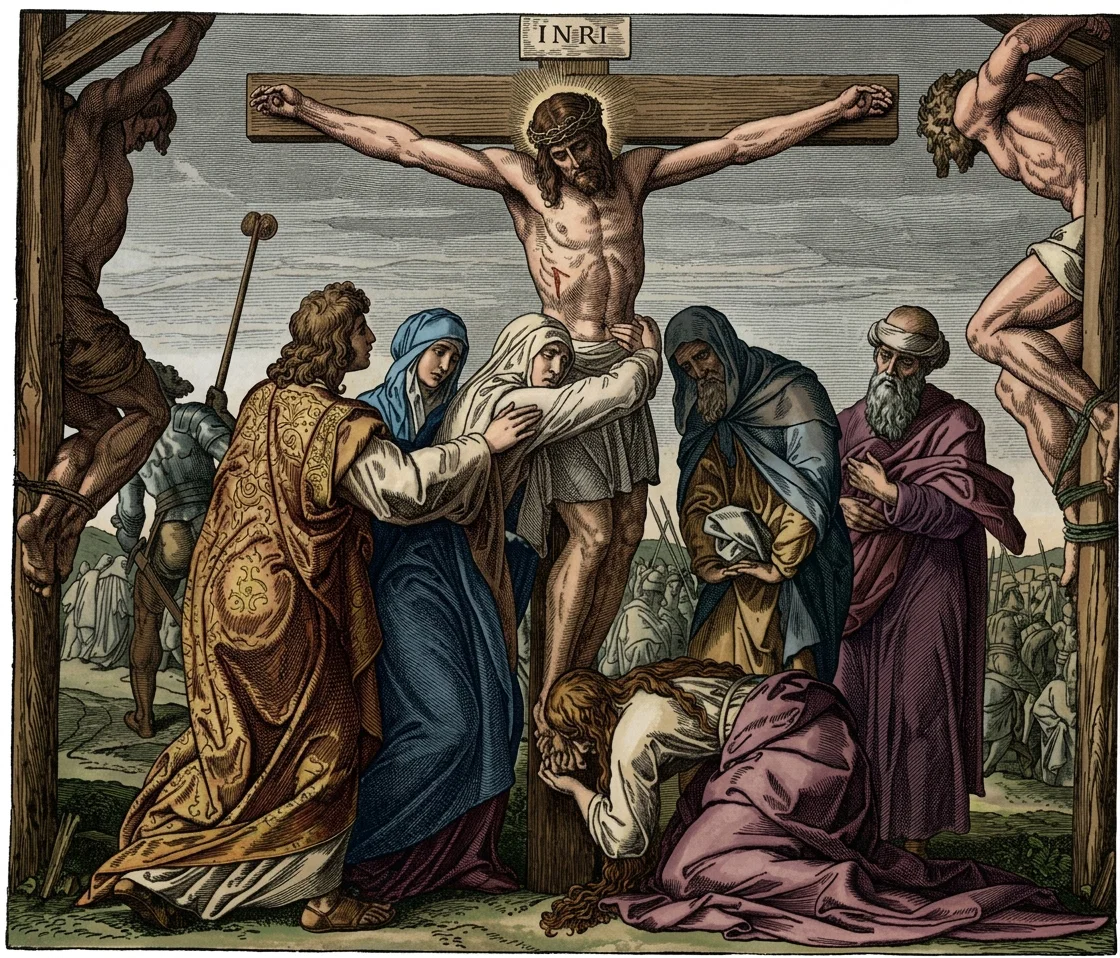
what thou wilt.” (Mark 14:36.) The struggle is over. God’s will,—the cruel scourging, the humiliation, the mock honor, the crown of thorns, the cross of Calvary, the darkness of death, the hiding of the Father’s face, the sins of the world, the climax of the eternal sacrifice with God’s righteous will and a redeemed race, are all preferable to all other glory gotten by a single compromise of right, a single yielding to self.
Jesus Christ died, but for others. He laid down his own life. He was buried. The portals of the grave closed above him. A seal was set to the grave by the authority of one of the dragon heads—Pagan Rome—whose empire then filled the world. A Roman guard and demons of darkness were set to watch the sepulcher. Michael, he who was once like God in heaven, he who had laid aside that glory for man and become Immanuel, was at last locked in the tomb, in the prison-house of Satan. His disciples mourned. Nature grew black at his death. The hosts of God must have well-nigh despaired. But altho under the power of death, “it was not possible that he should be holden of it” (Acts 2:24). Right is Might. Righteousness is life. All the powers of darkness commanding all the powers of earth could not lock the tomb over Eternal Righteousness, incarnate tho it were. In God’s time he would come forth; and God’s time came on the third day. Angels of light shine away the darkness, and Michael, the triumphant and eternal Conqueror, steps forth.
(To be continued.)

THE SABBATH AND THE SUNDAY. NO. 6.

IN our issue of October 8 we had traced the Sunday down to the year 1201. We have found in these historic quotations and citations, both sacred and profane, that it has no Biblical foundation for sacredness, the Bible in that respect, at the most, being entirely silent. Not only is it silent in respect to Sunday sacredness, but it absolutely prohibits the observance of the times of the heathen, among which the Sunday had a prominent place, even as did sun-worship. We have also learned from reliable historians and the "fathers" of the Catholic Church that Sunday was not considered a sacred day or a holy day in the early church. It stood on a par with Thursday, the day of the betrayal, and Friday, of the crucifixion. It is only when apostasy is becoming full-grown that Sunday is considered sacred; but its first law is built upon the "Christian" emperor Constantine and the bishops and councils following.
The Sabbath we have traced from creation to the sixth century. It is confirmed, not only by God's command and word and the example of Christ, but by the efforts of the enemy of righteousness to destroy it, even down to the anathemas of the Council of Laodicea, A.D. 538, upon its faithful observers still left. More than this, we referred to the fact that the day had been kept by the Abyssinian Church to the present. Yet in the Church of Rome, and, later, throughout Christendom, as the apostasy came in, even as of old in Israel, the Sabbath was crushed out.
69. Among the early sects of Christians were the Nazarenes. Of these Morer says that they (Dialogues on the Lord's Day, p. 66) "retained the Sabbath; and tho they pretended to believe as Christians, yet they practiced as Jews," a common charge brought against Sabbath-keeping Christians even in these days. The Nazarenes seem to have been of the early church at Jerusalem, which fled at the command of the Lord (Matt. 24: 15-20) when the city was taken by the Romans. (See Gibbon's Decline and Fall of the Roman Empire, chapter 15.) They appear to have kept the Sabbath down to the fourth century.
70. Morer (Dialogues on the Lord's Day, p. 67) and Bingham (Antiquities of the Christian Church, book 16, chap. 6, sec. 2) give us accounts of another church, the Hypsistarii, who observed the Sabbath, regarded distinction between clean and unclean meats, but rejected circumcision. These by the Catholic Church were adjudged heretics.
In fact, all that we know of the true people of God during the great apostasy must be learned from their enemies, who were interested in blackening their fame in order to justify their persecutions.
71. Dr. Twisse (Morality of the Fourth Commandment, pp. 19, 20) speaks of a class of people in the city of Rome itself who kept the Sabbath, and were condemned by Pope Gregory in strong language. This was about A.D. 600
72. The early Christians of Great Britain, previous to Augustine's visit to that island, in A.D. 596, were better Christians than those of Rome. The leader of these Christians, Columba, was evidently a Sabbath-keeper. He died, according to Dr. Alvan Butler (Lives of Fathers, Martyrs, and Principal Saints, St. Columba), on "Saturday, the ninth of June," 597. That day he said to one of his disciples, Diermit: "This day is called the Sabbath, that is, the day of rest, and such will it truly be to me; for it will put an end to my labors."
73. The Waldenses, whom their enemies admit to be an "ancient" sect, and to "live justly before men," retaining "the utmost show of piety," classing among them the Toulousians and the Albigenses, were, or at least some of them, Sabbath-keepers. Some of them were, doubtless because of this, called the Sabbati, Sabbatati, or Insabbati. (See Benedict's General History of the Baptist Denomination, vol. 2, pp. 413, 414; also Andrews' History of the Sabbath, chap. 21.) The Waldenses existed, as Sabbath-keepers doubtless, to a greater or less extent, from apostolic times nearly to the persecutions of the Dark Ages.
74. The Petrobruysians were of a sect of Christians condemned by Rome for the "heresy" of Sabbath-keeping. Peter de Bruys, one of the prominent leaders, was burned a martyr in 1130
75. Peter Heylyn (Hist. Sabbath, part 2, chap. 5, sec. 1) says that "some did [prohibit working on the seventh day]; who thereupon were censured and condemned by another Gregory, of that name the seventh, as the law informs us. But this was not till 1074." This shows that Sabbatarians were then in existence.
But we have not time or space, nor need we take them, to trace the matter further now. Suffice to say the Sabbath of the Lord had its witnesses, even as did its Lord, all through the Dark Ages. Rome could not wholly extirpate them. In our next we will notice the Sabbath-keepers of England, closing with our own day.

Abstaining from Meats, etc

"Enquire, and make search, and ask diligently."

No. 432. Abstaining from Meats, etc.

PLEASE explain 1 Tim. 4:1-5, especially commanding to abstain from meats and forbidding to marry.
The passage reads as follows: "[1] But the Spirit saith expressly, that in later times some shall fall away from the faith, giving heed to seducing spirits and doctrines of devils, [2] through the hypocrisy of men that speak lies, branded in their own conscience as with a hot iron; [3] forbidding to marry, and commanding to abstain from meats, which God created to be received with thanksgiving by them that believe and know the truth. [4] For every creature of God is good, and nothing is to be rejected, if it be received with thanksgiving; [5] for it is sanctified through the word of God and prayer."
We have quoted from the Revised Version, because it may perhaps make the meaning a little clearer. Note the following:—
1. The prophecy has evident reference to the apostasy, to the falling away, which came on apace in the "later times" after the apostle's death. Compare Acts 20: 29, 30; 2 Thess. 2: 3-7.
2. The falling away is because of giving heed to seducing spirits and doctrines of devils, or, rather, demons, as in the margin. The idolatrous worship of the heathen is demon worship. 1 Cor. 10:20. This worship soon crept into the Christian church and corrupted it, the dead martyrs and "saints" being substituted for dead heroes of the heathen, but all of them demons just the same; "for the dead know not anything." Those who pray to the dead are only honoring the angels of the devil, who come in the guise of the dead. Compare verses 37 and 28 of Psalm 106.
3. These doctrines are brought in, not by overzealous but sincere Christians, who are sometimes called "radical," or "extreme," but by hypocrites, who have hardened their consciences by transgression against God.
4. These leaders forbid to marry or enjoin celibacy. It may be universally forbidden, or only partially. The text does not refer to advice or counsel not to marry, but it is commanding not to marry. It meets a fulfillment in the celibacy of Roman Catholic priests and orders, and the celibacy of certain societies.
5. Forbidding "meats," more properly, "foods," for the original word includes both animal and vegetable foods, even as does the word meats in the older English. We use it commonly for the kernel of the nut, and it is common to hear an English farmer speak of meat for his horses. Commanding to abstain from meats would be to enjoin fasts. This we see in the stated fasts in the apostate church. Christian fasting is voluntary.
6. The meats or foods referred to are those "sanctified," or set apart, "by the word of God and prayer," and to be received with thanksgiving by them that know the truth. The original word for "creature" is defined by Strong to be "an original formation, product, created thing." And all created things set apart by the word of God for the purpose of food are good for food and should be received and partaken of in thanksgiving by all who need and have them.
The application of this prophecy is to whatever class or classes of people that meet its specification, during the "later times," from the apostles' day to this. It will probably be more fully seen in the closing days of time.
Continue reading: THE SOURCE OF STRENGTH