HARK! there comes the sound of crying,
Borne across the western sea;
China's countless millions dying,
Mourn in hopeless agony;
Moan on moan, with few to pity—
So they die eternally!
Lo! the priests are chanting, chanting,
Endless prayers at monotone;
While, the demon spirits haunting,
Hired mourners shriek and moan;
Incense burns while souls are dying,
But these ne'er for sins atone!
See! the shrines are dimly lighted;
Hear the mourners' measured tread;
Past the chant for souls affrighted,
Now the worship for the dead.
Vain is all that man can offer
For the souls for which Christ bled!
So the countless millions passing,
Go beyond this earthly light;
By the countless millions massing,
Wait for judgment's endless night;
So the days go by, and going,
End our time of doing right!
Christ is coming—judgment awful
Waits for souls that die in sin;
Christ is coming—judgment lawful
Must with church of God begin.
Rouse, ye saints! arise deliver;
They will shine who souls shall win!
—Selected.
Child-Wives and Widows
By Mrs. Bessie L. Shaw
By Mrs. Bessie L. Shaw, Wife of the Superintendent of S. D. A. India Missions
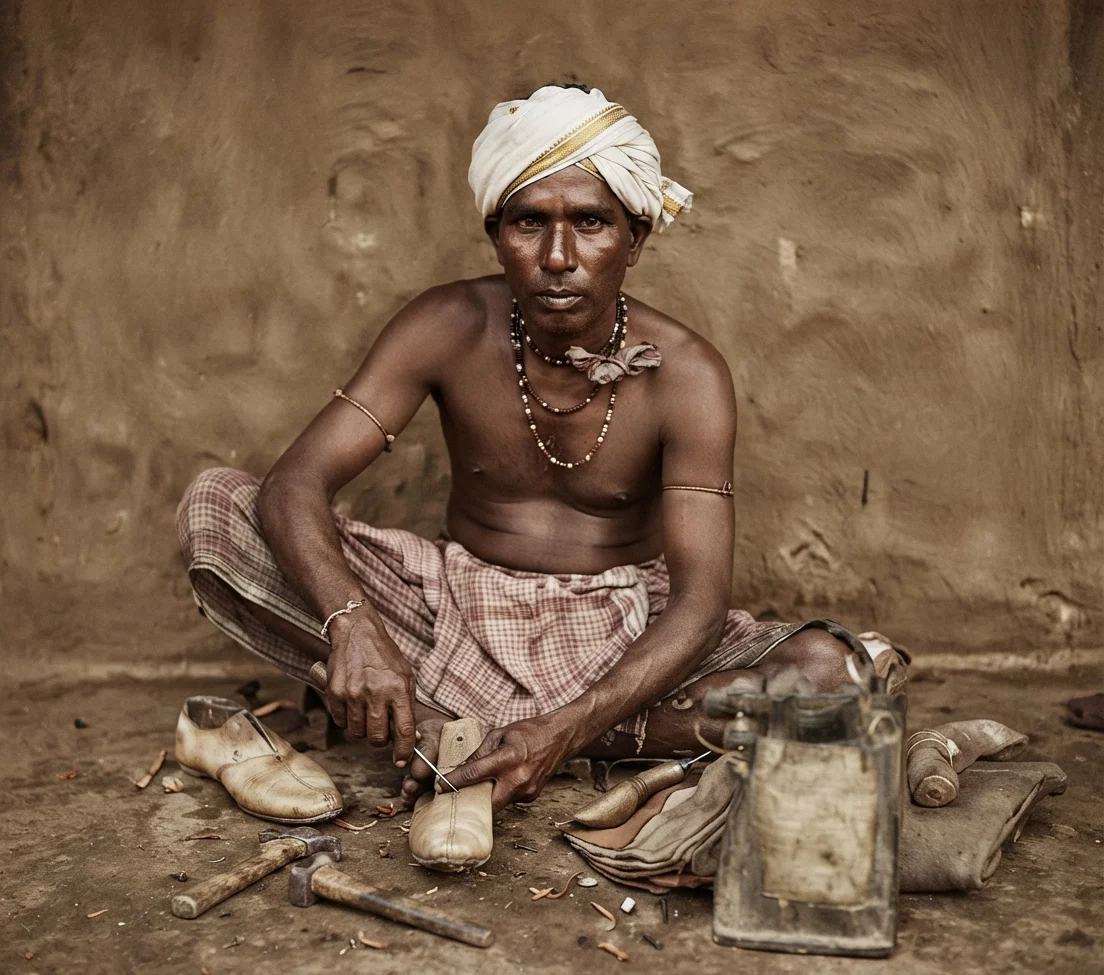
Shoemaker, India.
INDIA has been called a nation of children. Motherhood at the age of ten or twelve is not infrequent. How the thought strikes terror to the mothers in the home land, and their whole soul rebels, and they say, Has not the Indian mother any love for her child to give her in marriage so young? The Indian women have hearts just as loving and just as tender and fond as any mother, yet they are taught this as their religion, and if their daughters are not married at an early age, they will suffer "great pains" in the future state.
So the wee little brides are often sent away from their father's house when they are only ten or twelve. Often they have never seen their husband's face until their wedding-day, when their loving home is exchanged for one of tyranny, ruled by an over-bearing mother-in-law. In some cases the new home becomes nothing more than a prison-house, and the little bride leaves it not until the day of her death. The condition of keeping the women shut in brings about a sad condition for the bright, active little child-brides.
When the Mohammedans went to India, they carried the custom of keeping their women in seclusion, and often they compelled a beautiful Hindu woman to leave her household and join theirs. This greatly enraged the Hindu people, and for protection they adopted the same custom of keeping their women shut in, and it soon became a disgrace to be seen by any man excepting those of their own household. It is estimated that fully one-third of the women of India live this shut-in life.
When we see the misery and suffering that these customs bring, we get a little glimpse of the awfulness of these heathenish practises. No matter how ill Hindu or Mohammedan women may be, their husbands would be everlastingly disgraced if their wives were seen by a gentleman physician. In extreme cases they may take their pulse if the patient is kept screened behind a curtain, but this is the limit of the examination. There is a saying that a Mohammedan man will blush ten times before he allows his wife to put her tongue thru a slit in the curtain to show the physician just how ill she is.
These things seem ridiculous, and yet they are facts that bring misery and suffering to these shut-in women, and all over India one is constantly confronted with heart-rending examples of utter neglect in times of illness when the tenderest care and attention are required, and one of the saddest things is that these poor people follow these customs from a religious sense of duty. The Indian people are a religious people; they are said to "eat religiously and sleep religiously." So they follow these customs carefully, and yet their hearts rebel at some of these things, and when approached about them, they will say, "How can we help it? This is our fate. It was written in our foreheads. Our fathers did thus, and what was good for our fathers is good for us."
We have seen very touching scenes in the parting of parents with their children, and the bitterness of the little bride in being snatched from the loving care of her mother. One dear old man in parting with his daughter was very much overcome, and when we offered sympathy and encouragement, he replied, "How can I help but grieve? She is the child of my youth." He asked us to pray to our God to protect and guard his child.
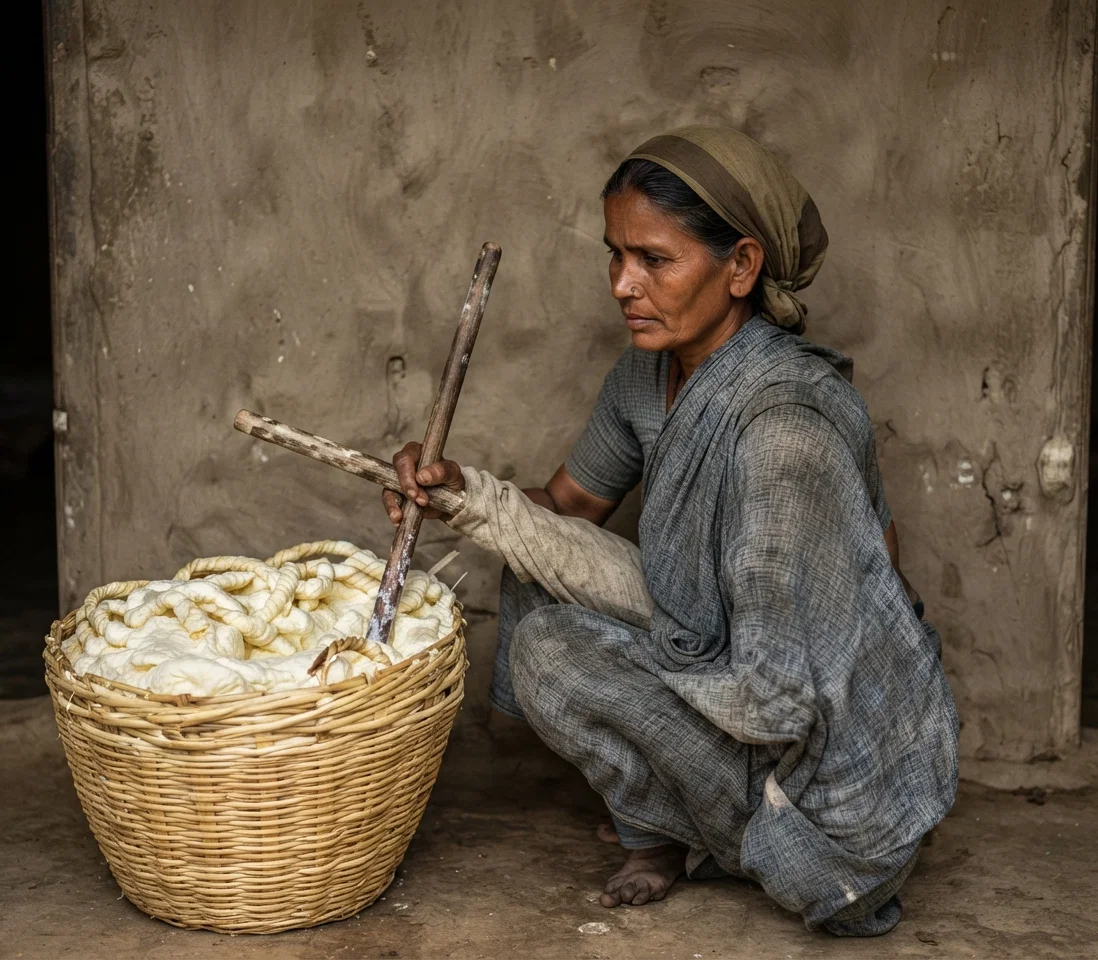
Selling Curds, India
So anxious are the Indian fathers and mothers to marry their children that they will give a little child of ten to an old man of sixty. So the little wee bride is often a widow at ten or twelve. Fourteen thousand children are found to be baby widows under four years of age, and 60,000 are widows between five and nine years of age, and widowhood in India is so different from widowhood in our enlightened land. To a widow in America, our heart goes out in love and tender sympathy for her bereavement, but not so in India. When a wife is left a widow here it is supposed that she is the cause of her husband's death, and that for some sin of hers, he has been taken away. From the day of his death, the wife, no matter how young, is considered an outcast, and her very presence an omen of future ill.
The following is a true picture which we take from a paper:
"The inhumanity with which widows are treated is one of the foulest blots upon the Hindu character. A poor girl is given by her father in marriage. She may never have set her eyes on her husband except on her wedding-day. But if the man who calls her wife dies, she is his widow and a widow for life. She is stripped of her ornaments, her dress is changed, and among some classes her head is shaved, and her rich, black hair is taken from her. Then begins a cry of bitterness and degradation. She is charged with her husband's death. He is taken from her, they say, to punish her sin in her former birth. The younger she is the greater sinner she must have been to be overtaken so soon. Her presence is a curse and a blight to any social festivity. The house is cursed for her sake. No accident or misfortune occurs but that it is her fault. She is the drudge and curse of the family."
We once visited a little Indian queen who was much better favored than the ordinary widow, as her husband's station in life left her a beautiful home, to which she brought her own father and mother. When we visited her one day we remarked on her blessings and how much more favored she was than her Indian sisters in general. Her beautiful countenance saddened, and she replied, "Ah, mem-sahib, the joyful things are all removed from my life." And so it was, tho her husband's home was beautiful, yet she could not get out and enjoy the outside world and its freedom. There was always hung over her the stigma of being a widow and the direct cause of her husband's death.
It is very sad to see that while the men are being educated and are receiving their college degrees, the majority of the women do not know a single letter of their alphabet. On an average not more than three women in a hundred can read and write. A missionary who has worked for years among these shut-ins, vividly pictures their life in the following language:
"It is a common saying among men that the more uneducated the women, the better wives they will make. A Hindu once told me that he could beat his wife and abuse her and she would know no better than to suffer and endure and get a worse beating if she did not do better. A Hindu gentleman of high standing and good education said, 'To give women education is like giving wings to a bird. It always tries to use its wings, and often flies away; so,' he said, 'as we do not want to lose our women, we will clip their wings, or give them none at all!' According to their custom, most of the Hindu women are their husbands' slaves. Think of them having to wait hours sometimes without food because their lord and master has not taken his. In most cases he eats first, and what he condescends to leave is her meal. When he entertains his companions and friends she is generally in the background or closed in a dark room. She must not sit down before him unless with special permission."
These conditions in India have come as the result of heathenism. The beautiful home-life we find in our own land has simply come as the result of following God's word. Our fathers and mothers have been surrounded by Christian influences and the freedom that comes from obedience to God's word. India's hope for its 150,000,000 women comes in accepting the Gospel call. There are many who have found the Sa20viour, and to such homes there have come a new life and a bettering of conditions. There are to-day in India loyal women who have forsaken their idols of wood and stone and in return have given their lives to the bettering of their Indian sisters. The Gospel, like the little grain of mustard seed, has commenced to unfold in the lives of these dear women, and as the result some homes in India are beginning to see the blessedness of the Christ-life and are faithful unto death. One poor woman who had learned to love Jesus died with a Bible under her head. Her priest came and sought to minister heathen services and wished her to take dying powders. These she refused in spite of angry look and word, but till death she was faithful, and to many of these women shut in from the outside world will come the words, 'Well done, thou good and faithful servant.'
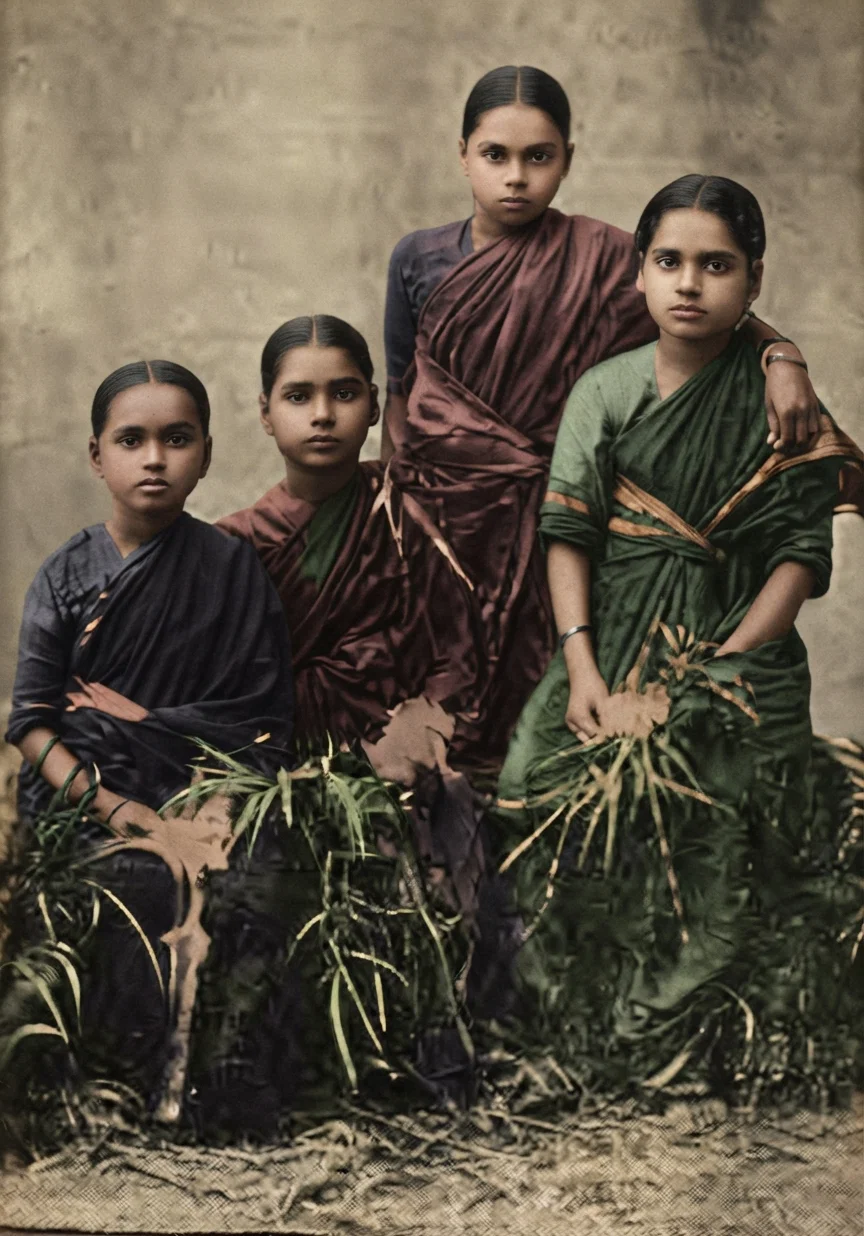
Group of Child-Widows, India.
Messages from the Nations
By Mrs. J. N. Anderson
"What then shall one answer the messengers of the nation? That Jehovah hath founded Zion, and in her shall the afflicted of His people take refuge."
—Isa. 14:32.
Messages from the Nations
Messages from the Nations
Mighty Appeals from China.
A Typical Widow.
IT would seem that any one would have noticed her, there was such a look of distress in the delicate features, as, with the downcast eyes of the modest woman unaccustomed to the street, she came painfully—her feet were very small—making her uncertain way, leaning on the shoulder of a little slave girl for support. She was not old, but the secluded life, with absence of either work or recreation, had left her in young womanhood dependent on the strength of this mere child. The golden hair-ornaments and the earrings of yellow gold and green jade had been exchanged for silver-white articles, and the soft silken garments had been laid aside for the coarse, glazed linen of the bereaved.
Turning into the comparative quiet of a side street, in the shade of a great tree, she pauses to take a look about her, and then, in abject grief, casts herself upon the stone altar at its base. No words are spoken; only the sobs and moans of the widowed woman are heard. The slave lights the incense sticks and places them in receivers before the senseless idol whose stony face seems to grin more hideously in the presence of this hopeless grief. Presently she becomes more calm and rises up. The hands are clasped; the body sways this way and that, or bows before the shrine; the lips move, while spreading circles rise higher from the smoking taper tips.
A pile of clothing is taken from a basket carried by the slave,—beautiful silken stuffs in delicate tints, and in more serviceable shades. One by one the worshiper lifts the garments in sacrifice, prostrates herself before the idol, and lays them on the fire. Piece by piece they are consumed to cinders while the distressed woman continues her supplications. He had been a good husband; she would send this token of her devotion to him in the spirit world, so her deceived heart reasoned in a vain attempt to comfort itself.
Once more the almost girlish figure is prostrated on the stone in a convulsion of grief, and then the two go away as they came, the mourner to spend the night in lonely vigils before the household gods, seeking consolation and peace where they may not be found, knowing not Him who graciously invites, "Come unto Me, all ye that labor and are heavy-laden, and I will give you rest."
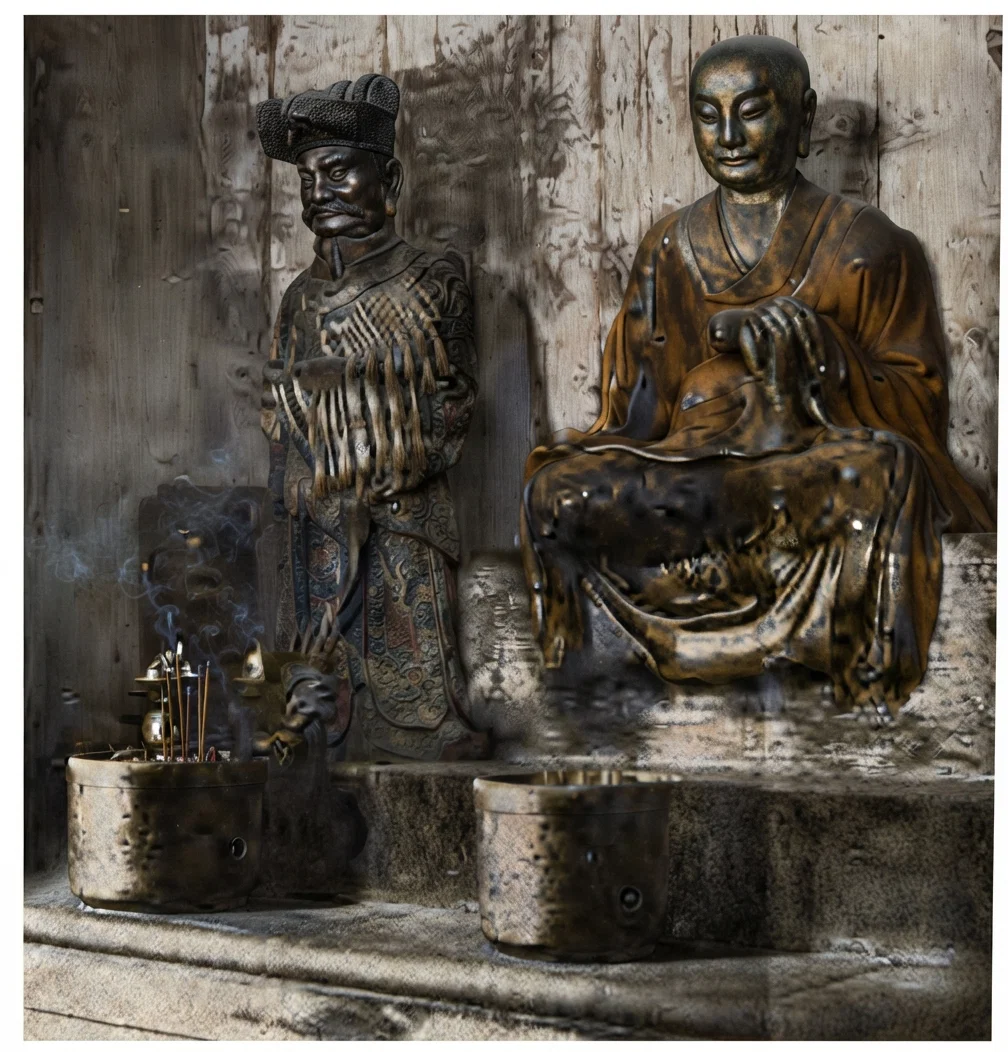
Chinese Idols.
An Abandoned Baby.
WALKING down an unfrequented lane in the suburbs of Canton with a friend one day, we noticed a bundle of old clothes, wrapped in matting, loosely tied about, lying in the grass and weeds at one side of the path. We had passed the spot where it lay, when my companion, stepping short in the conversation, said, "I feel curious as to the contents of that bundle," and walking back to the spot where it lay poked open the end of the parcel with her walking stick. "We are too late," she said, as with pale face she rejoined me on the path.
Fathers and mothers, you in whose homes the little daughter is the joy in your household, can you guess what she saw? I did not ask, for well I knew. This was not the first baby-girl, innocent of even the first breath of life, which, under cover of night, had been cast into that out-of-the-way place.
A Baby for Sale.
"I HAVE had a strange experience to-day," said one of the ladies of our mission, coming from a long tramp in the city.
She had been walking some distance with a native woman in attendance, for the greater part of the way conscious that still another person was taking the same route. No matter what turns were taken, the shadow was still present, till she began to feel uneasy, and she took the opportunity of the next corner to see who it might be following so persistently.
It was only a woman of the working class carrying a baby on her back. Feeling more at ease, the two continued their way, the woman still coming after, till the thought that her pursuer certainly had some object, and, perhaps, a malicious one, so harassed her mind that the lady determined to face the matter. Turning to the woman, she said, "I see you have been following us some distance; have you some business with us?" The woman looked confused. "Tell me what you want, or please do not follow us any farther," she said decisively. "I only want to sell my baby to you," the woman remarked coolly.
Her story, as it came out, is that of many another Chinese woman. The husband's earnings were small, the family large and mostly girls, the wife must do her part to earn a living. That morning a family council decided to reject the responsibility of the tiny newcomer (she ought to have been born a boy), and to the wife had been committed the task of carrying the three-days-old infant to a native orphanage, where she would receive twenty-five cents to pay for the ginger root added to the mother's simple diet for the past few days, and be relieved of any further care of her offspring.
At sight of the foreign woman she remembered having heard that foreign missionaries sometimes received little girls, reared and educated them, and saw them married to steady, sober husbands. Under the impulse of these recollections she had followed the kind and generous-hearted foreigner to offer her the baby for but a slight premium above the customary government price. She was willing to sell it to the missionary for $1.00.
With ready tact the lady set to work to touch the chord of mother-love and save the baby from the orphanage. She was all interest in the tiny mite. How really pretty it was; just see the mass of silky, black hair. How cunning she would be in a little while when this was plaited in glossy braids and tied with pink zephyr wool; such fat little hands; such a fine, strong baby would soon grow up and ere long be able to help in the light work of the house—thus she went on as tho thinking aloud. Why, yes, indeed, who would not be willing to pay one dollar for such a baby!
The mother drew back a little. The baby nestled and opened her mouth. O, see! she is hungry. At my house she would be obliged to drink rice water or tinned cow's milk. (Many Chinese deem cow's milk unfit for food since these are work animals in China.) You have plenty of nourishment for your child that costs you nothing. Would you really sell your dear little one, the babe you yourself have borne, for one dollar?
The appeal went home, and so did the baby, snuggled close to the mother's breast.
Up from the narrow, crowded thoroughfare, where only the strong and sure-footed might safely make their way, and above the noise of barter, carriage, and traffic, rose a woman's wailing cry,—22
Main Building of Sanitarium, Kobe, Japan.
"Have pity! have pity! O, pity a poor, old, blind woman, who has no one to care for her. You who are blessed, you who have money, give an alms to a poor, blind woman. O, you generous lords, and you kind-hearted ladies, give an alms to a poor, blind woman."
There at the side of the street from whence the cry came, was a kneeling figure. Kneeling on the rough stone blocks of the pavement,—kneeling, half crouching, as tho caught in the early rush of the busy market street and afraid to move,—with thin, pale cheeks and sunken lids, drooping over orbless sockets turned to the dawn, which may never more dispel her night, a woman begged for bread. In the lines of her countenance was written the tale of suffering thru which she had passed, uncared for and alone, ere nature relinquished the precious boon of sight. The half-starved infant in her arms tugged at the lymphless breast and cried.
Farther on and on the cry still came, and mingling with the voices of the street, above which rose the one distinct utterance. It seemed swelling into the voice of a great multitude of her hopelessly blind sisters in China, from whom not only the physical light, but the very "Light of Life" has been shut away, many of whom, in the hands of remorseless masters, lead a shameful life for bread, pleading with outstretched hands in touching appeal, "Pity, O pity the blind!" You who have means, you who know comfort and love, you who are kind and tender-hearted, have pity on the poor spiritually blind of China.
Mrs. J. N. ANDERSON.
Canton, China.
Singapore.
By G. F. Jones
TAKE your map and find Singapore, a small island just off the most southern point of Asia, barely separated from the mainland by a narrow strait. A mighty city of commerce is Singapore, the great depot for the thousands of islands between there and Australia. In tonnage, it is the seventh among the great ports of the world, and fast becoming, as did Tyre of old, the "Queen of the Eastern Seas." All nations are represented here, and there seems to be a mutual consent that it is the great center of educational advantage, and the important station for missions that work in the surrounding country. It is therefore an important strategic point for the last great message of preparation in gathering people for their coming Lord.
Many publications have been scattered, many hearts have been reached by the truth, and thruout Singapore and neighboring States souls are stirred to hear more of the message which settles their eternal destiny. A devoted Buddhist came to me the other day and offered to buy the land for us, telling us we could pay him back when we were able, without interest, for the erection of a building where the truth could be preached. We need a training-school for young people where they can be trained, away from the awful corrupting influences of Singapore, and where they may earn their own way thru school. The field is white already unto the harvest, and laborers are few. Even the unapproachable Mohammedan finds something in our message that he needs. One of them offered to give us a few acres of his land in the country for a training-school; but we need more than he can afford to give us. Just recently a young Chinese lady accepted the truth, losing all her worldly property and prospects by so doing. But she said, "I care for nothing but the truth." She is an unselfish and untiring worker.
We need workers in the various tongues of the natives. Sometimes I speak thru two interpreters. A stereopticon would be a splendid idea for conveying the meaning of the prophetic symbols. Each one of us here takes into his home two or three of the young people and clothes and educates them. We have invested our all in the work we are called to do, and we rejoice in it. Now are our opportunities. Among the other needs is that of a sanitarium. Many of the sick could be reached in this way.
"Brothers, hear your brothers calling,
Throw the line this way;
Sisters, see your sisters sinking,
With no arm to save.
Night is swiftly coming,
Behold the setting sun!
Jesus is the life-line;
You may save one."
G. F. JONES.
Labors in Japan.
By H. Kuniya
It is now over eight years since I entered the missionary work in this field. During this time we have often met trials and hindrances in our work, but we trust all in the mighty Hand, and sow the seeds of truth here and there over Japan.
Altho missionaries of different churches have been laboring in Japan for about forty years past, still many souls do not know even the name of Christ. To these people we must first tell about the true God and the Saviour. The minds of many in Japan are filled with Buddhist philosophy, and they like to argue about the doctrines of religion; but such arguments only make it the harder for them to accept the simple truths of the Gospel.
Among Japanese believers in various churches, there is now quite a strong movement in favor of an independent Japanese church, and some of the leaders are strongly opposed to being controlled by foreign missionaries. Some are teaching the Unitarian doctrine that Jesus is not the divine Son of God, and this doctrine is spreading rapidly, like a pestilence. As a result of these conditions, many sincere believers are seeking the true church. For example, in Nagasaki where I am now laboring, a girl who attends our Sabbath-school came to one of our sisters and asked, "Isn't Christ the Son of God? You teach me so; but lately I attended the — church [an evangelical church], and the teacher explained to us that Christ is not the Son of God, but simply a good man."
In the first epistle of John we are warned against false teachers; and now is the time for us to work, and teach only the Bible to these interested ones. But who will do this work? For years I have desired that we might have a devoted lady Bible worker, who could labor from house to house in Japanese families. In my experience, wherever I go women are the first to become interested. But I often find it difficult to present the truth to them, where a lady worker would be free to enter the home and study with them, without going contrary to Japanese custom.
Especially among the higher classes there are many women who are very unhappy in their domestic life. Are there some who have a desire to help these unhappy women? A devoted lady worker could enter homes that would be closed to a man.
The work in this field seems very slow to develop; but we must allow time for the seed sown to bring forth fruit. We praise the Lord and thank Him for His wonderful salvation. He has promised to be with us till the end of the world. This message must be preached to every class of people. The Lord has already opened the way for us to enter the large cities. I have often been perplexed because I could not answer all the calls of those who were interested here and there. The Lord bids us pray for His vineyard, and we are praying; and I rejoice to see His blessing of late.
H. KUNIYA.
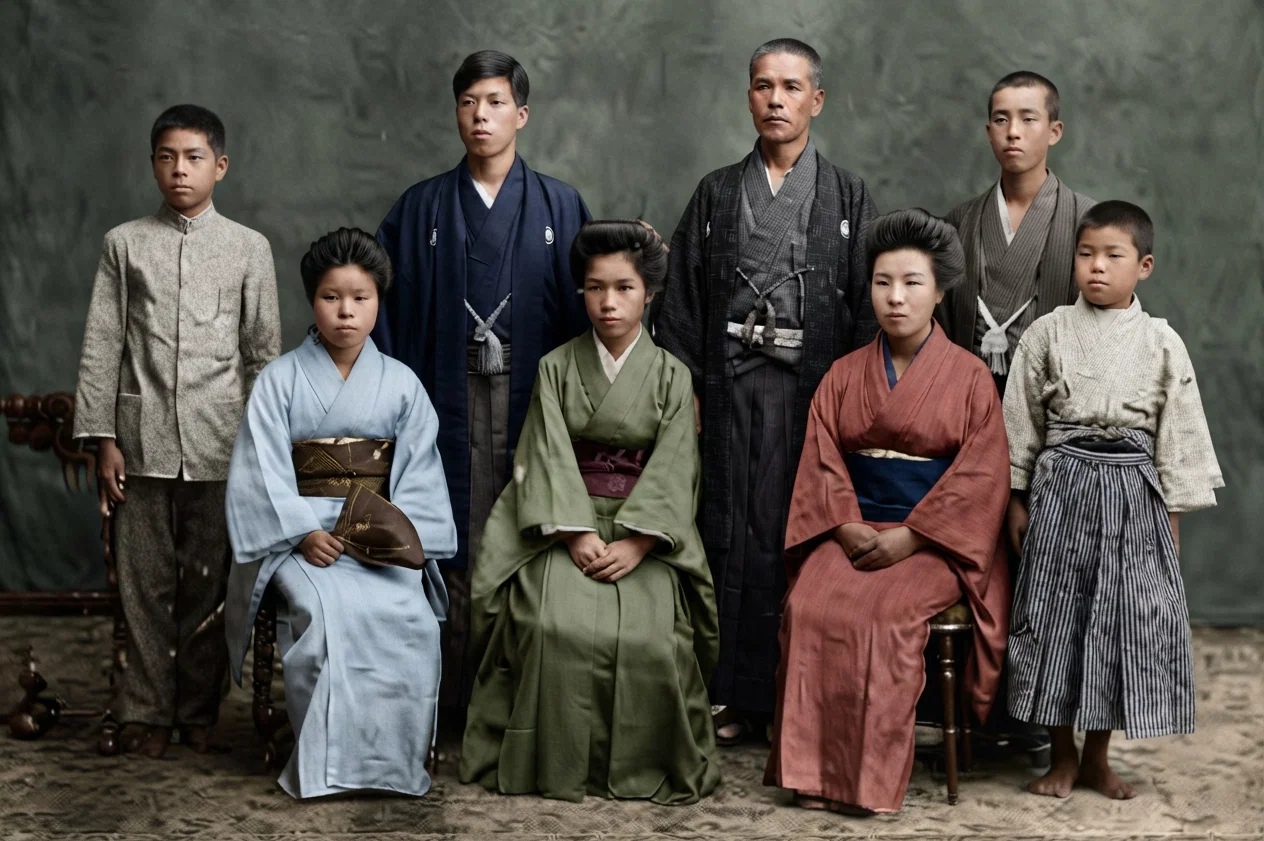
Evangelist Kuniya, and Class of Japanese Students.