Your ShelfYour Projects

Signs of the Times, Vol. 27, No. 44.

GOD THE PRESERVER

Signs of the Times

Oct 30, 1901

Pacific Press Publishing Company · Oakland, California · Oct 30, 1901

GOD THE PRESERVER.

The Mighty Power of Faith.
BABYLON, great Babylon, “the glory of kingdoms, the beauty of the Chaldeans’ pride,” the mighty city that, by her religion and education and influence, had, for fifteen centuries or more, molded the world,—Babylon, that had brought under her wondrous spell civilizations Hamitic and Semitic, friend and foe, conqueror and conquered, had at last fallen. Hamitic civilization put forth mighty endeavor to rule the world, and had failed. The children of Shem followed, and were dominant for many centuries. Now the children of Japheth, in the nations of Media and Persia, are given the throne. Babylon’s mighty walls, supported only by weak, effeminate, luxury-loving men, were insufficient to protect her from the clearer-thinking, hardier, more frugal Medes and Persians.
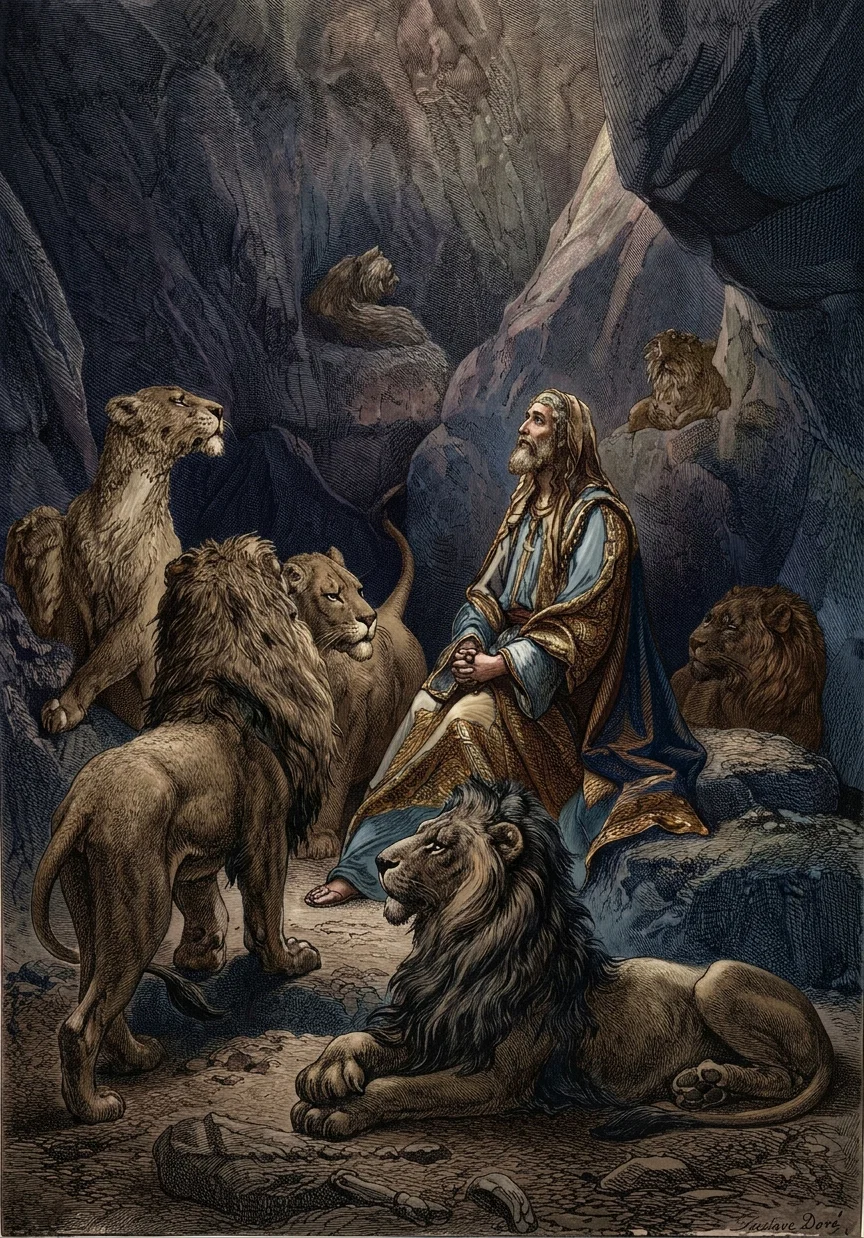
“My God hath sent His angel, and hath shut the lions’ mouths.”
Over the Medo-Persian forces was Cyrus, the virtual monarch of both peoples; but with rare forethought and wise policy he allayed the suspicions of the conquered Medes by placing one of their own nation upon the throne,—the probable son of Astyages, Cyaxares II. He may have been one of the cousins of Cyrus. At any rate he was a Median, and known to the Jews as Darius the Mede, the term Darius meaning “coercer,” “conservator,”—a title rather than name, the same as Pharaoh.
The character of Darius the Mede, as shown in Daniel 6, is, like that of most other men, a blending of weakness and strength. His large division of the responsibility of his empire showed wisdom, and his choice of a prime-minister revealed sagacity. But he was susceptible of one of the greatest temptations a ruler has to meet,—flattery from those seeking favors,—and he yielded to it, to his own discomfiture and disgrace.

Daniel the Faithful.

One character shines out in this chapter above all others,—that of Daniel the captive. He was an old man now. He had kept through all the years his purpose not to be defiled by the corruptions of Babylon, not alone in his eating and drinking, but in all his life.
He had stood as prime-minister under the reign of Nebuchadnezzar, uncontaminated by court life, untouched by bribery. God was with him. To him had the Revealer of Secrets opened the future. His knowledge, drawn from the great Storehouse of God, had been demonstrated to be greater than that of magician or Chaldean. His wisdom, drawn from the great Fountain, exceeded that of all the wise men of the greatest empire of earth, enriched (?) by the traditions of centuries. In the business of the kingdom he was without a rival.
With such a record, knowledge of which must have extended to every kingdom with which Babylon had had to do, it is not wonderful that Darius chose him as one of the three presidents; not the first, as in the common version, but “one” of the three, as in the Revision, Septuagint, and others. The king would not at first thus exalt him; that was to come later, as Daniel’s wisdom and merit were demonstrated in counsel. Thus the record reads: “Then this Daniel was ‘distinguished above the ‘presidents and the ‘satraps, because an excellent spirit was in him; ‘and the king thought ‘to set him over the ‘whole realm.’” The Septuagint declares that this was done, and following verses show this to be the fact. Daniel was made the prime-minister, the chief of the cabinet of three, the representative of the king.

Envy and Its Fruit.

The result of the king’s preference was soon manifest. Never was merit exalted but it aroused envy in the hearts of the selfish; envy that is ever pained at the seemingly equal or greater prosperity of another. Here is the record:—
“Then the presidents and the satraps sought to find occasion against Daniel as touching the kingdom; but they could find none occasion nor fault; forasmuch as he was faithful, neither was there any error or fault found in him. Then said these men, We shall not find any occasion against this Daniel, except we find it against him concerning the law of his God. Then these presidents and satraps assembled together to the king, and said thus unto him: King Darius, live forever. All the presidents of the kingdom, the deputies and the satraps, the counselors and the governors, have consulted together to establish a royal statute, and to make a strong interdict, that whosoever shall ask a petitionof any god or man for thirty days, save of thee, O king, he shall be cast into the den of lions. Now, O king, establish the interdict, and sign the writing, that it be not changed, according to the law of the Medes and Persians, which altereth not. Wherefore King Darius signed the writing and the interdict.”
1. Note the remarkable record of Daniel. Was there ever a politician in America against whom some charge of evil-doing or mistake, wrought sometime in his public career, could not be brought? Sometime he had slipped, committed some sin, made some egregious blunder (worse than sin in a politician’s estimation), and so marred his life. But this was not the case with Daniel. The presidents and satraps, one hundred and twenty-two in number, set themselves to find some occasion against Daniel in his public work. They searched the records of State, looked over Daniel’s books, cross-examined his private secretary—if he had one—interviewed his enemies; but after all the searching and prying, “they could find none occasion nor fault; forasmuch as ‘he was faithful, neither was there any error or fault found in him.’” It was a remarkable record.
2. Then they tried another tack. Our only hope, said they, is to find some occasion “against him concerning the law of his God.” Envy would condemn him for his very virtues.
3. Then the whole number of the presidents and princes came to the king,—“came tumultuously,”—with great enthusiasm telling the king that he was divine, and worthy of worship, and that all his officers had agreed that his worship should be firmly established by royal decree. Thirty days was to be given to this, during which time no one was to ask any petition of any god or man save the king.
4. The king, blinded by the “poisoned flattery,” yielded, and signed the decree. Little did he know what it meant. Hannah More well says:—
“No adulation; ’tis the death of virtue; Who flatters is of all mankind the lowest, Save he who courts the flattery.”
5. Daniel knew what they were about, but it did not change his purpose. Character was more precious in his estimation than wealth and honor and position combined; aye, even than life. Duty must be done. He did not even counsel with his companions. He knew what was right in the premises. He did not appeal to the king to change the law; he knew this would be futile in view of the purpose of those who framed it. They had perverted the God-given authority of the kingdom to destroy him; the faithful servant would leave his case with his beloved Master. To yield to the law meant destruction of character; more than this, it meant dishonor to God, whose representative he was. Better death a thousand times than loss of character or falsity to his trust. The king and all Medo-Persia were but for a time; God and His kingdom were eternal. He would stand for God.
The worth of a purpose is shown, not in sweet sunshine and pleasant paths, surrounded by friends; but it is revealed when the sky is dark, the path rugged and uninviting, beset by temptations and snares, and there is no one to help save God, and He seen only by the eye of faith. Daniel’s purpose was not for a sunshiny day and on easy paths, but for life, in whatever paths it led; and therefore, when he “knew ‘that the writing was signed, he went into his house (now his windows ‘were open in his chamber toward Jerusalem); and he kneeled upon his ‘knees three times a day, and prayed, and gave thanks before his God, ‘as he did aforetime.’”
There was no spirit of braggadocio in Daniel. He did not defy the law. If the law contravened the righteous purpose of his life, his solemn duty to God, that was only incidental; it was not a principle to mold or change his steadfast purpose. He continued to do as he had ever done. Neither did the man of God yield to human fear. He might have argued that discretion was the better part of valor; that it would be more politic to close his windows and pray in secret for the next thirty days. But he did nothing of the kind. His windows were usually open toward his beloved Zion; he would leave them so. He had his regular seasons of devotion, tho doubtless the busiest man in the empire; he would not depart from this duty and privilege. And his enemies knew that he would not. They assembled at the stated time, “and found Daniel making petition and supplication before his ‘God.’” They expected to find him there. He prayed as beforetime, and doubtless for the very men that were plotting his destruction; for did he not serve God? and had not God said, “Seek the peace of the ‘city whither I have caused you to be carried away captives, and pray ‘unto the Lord for it’?” Daniel also gave thanks to God. He knew that his prayer was heard; that it would be all well whatever came.

Report to the King.

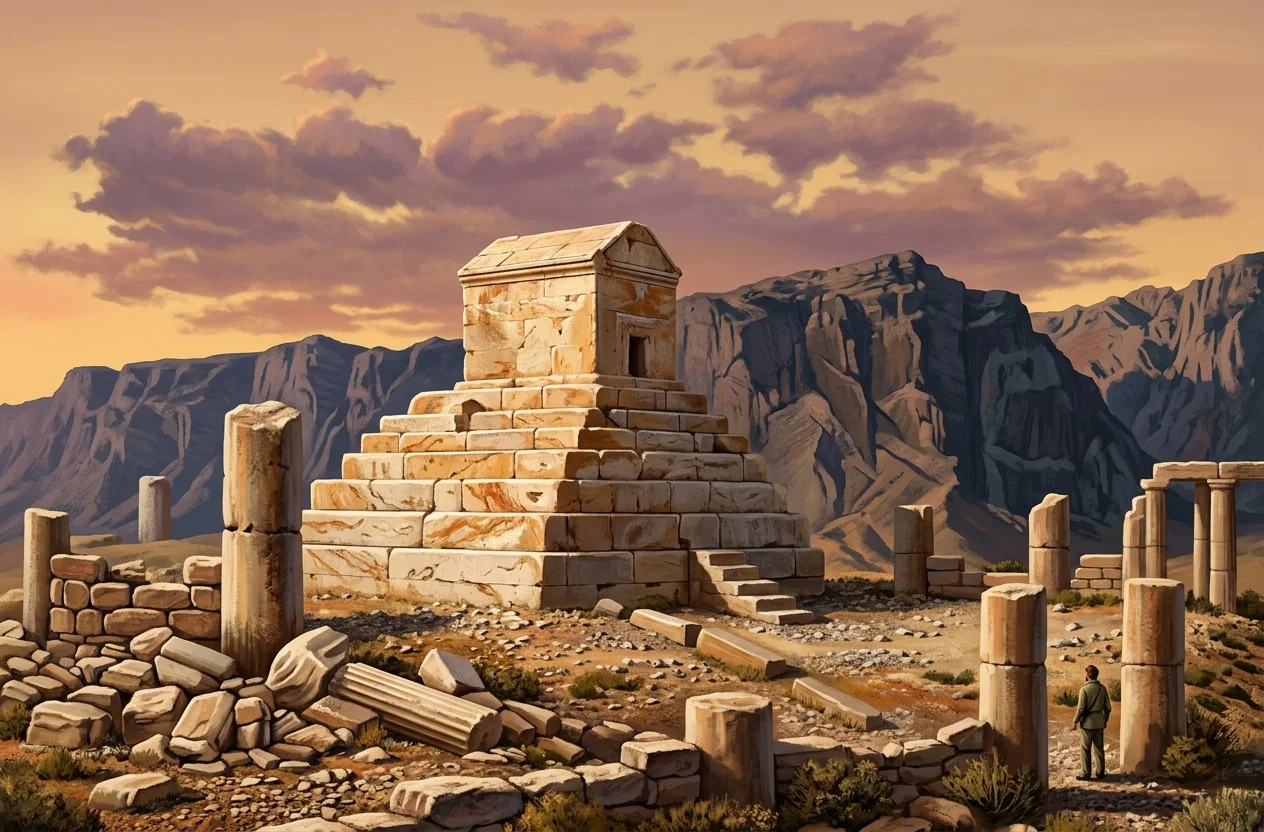
Tomb of Cyrus, Murgab, or Pasagardae, the ancient capital of Persia.
Then the spies report to the king. They approach him by reminding him of the recent law of worship; and the king declared it true and unalterable. Then they present their charge against “that ‘Daniel,’ the Judean captive, even he, O king, ‘regardeth not thee.’”
Too late the king saw his folly, and was “sore displeased with ‘himself, and set his heart on Daniel to deliver him; and he labored ‘till the going down of the sun to deliver him.” He doubtless plead with his officers to change the decree, with Daniel to yield to it, but his efforts were futile. How easy it is for man to bind with chains which he can not sunder! how easy to fetter the soul and body with shackles of sin that no human power can break. O, it is well for a human to be thoughtful. Each present moment is big with eternal possibilities. The king found himself powerless; his own law bound him; he was held through it by the plotters against the good of his realm. “Know, O king, that it is a law of the Medes and Persians, that no ‘interdict nor statute which the king established may be changed.’”
Then at the king’s enforced command, Daniel was cast into the den of the fierce lions, the king expressing his own hungry hope, and endeavoring to cheer Daniel, in the words: “Thy God whom thou ‘servest continually, He will deliver thee.” It expressed the dawning of a faith which we are fain to hope was perfected, and it was a royal certificate of Daniel’s faithfulness.
Then the king closed the den, and sealed the stone, that no mortal interference might occur to deliver the criminal; and then he retired to his palace and spent the night in praying and fasting. In the early morning, after a sleepless night, with mind alternating between hope and fear, he hastes to the den of lions, and cries with a lamentable voice, “O Daniel, servant of the living God, is thy God, whom thou ‘servest continually, able to deliver thee from the lions?” And Daniel is able to reply, prefaced with the courtesy due, “My God hath sent ‘His angel, and hath shut the lions’ mouths, and they have not hurt ‘me; forasmuch as before Him innocency was found in me; and also ‘before thee, O king, have I done no hurt.’”
It was a double lesson to the king. It showed to him, even as God taught it to Babylon, that there was one Ruler who could make of no effect the puny laws of men. It revealed to him that the God who could make and preserve character in the corrupt court of Babylon, could deliver from all physical ills. It bears the same lesson to plotters, politicians, statesmen, rulers, to-day. Jehovah is the living God, and rules above men.

Kept by the Power of Faith.

Daniel was taken from the den of lions, “and no manner of hurt ‘was found upon him, because he had trusted in his God.” He was kept by the power of faith; not that his faith furnished the power. Faith was the arm that reached up and made connection with the throne. It is like the pipe that taps the great fountain. It is like the trolley that reaches up and taps the live wire. The power of God flows forever from the Great Fountain; faith opens heart and life to receive it. It was faith that brought, in the beginning, cleansing and power to Daniel. It was because he believed God that he formed in the beginning his noble purpose. It was faith that kept his character unstained, untarnished, through all the years of his public service. It was faith that led him to devote time to the service and worship and Word of God,—time all gained, because these things made him what he was. And it was wholly because of what faith had done for him morally that God could consistently deliver him physically. What a testimony is here left the young, aspiring men of the world and the church! There is as great need now as of old for Daniels. God is as able to make them. Where are the men who are willing to be what God wants to make them?
The king was convinced, but not then converted. He visited upon those who plotted against Daniel’s life the same doom they planned for the Hebrew. Then he made a decree, commendable enough, indeed, for a heathen coming to the light; but no criterion for any ruler. It had this, however, that was indeed favorable, and thatwas the proclamation of the Gospel, the power of the true God to deliver. Here it is:—
“Then King Darius wrote unto all the peoples, nations, and languages, that dwell in all the earth: Peace be multiplied unto you. I make a decree, that in all the dominion of my kingdom men tremble and fear before the God of Daniel: for He is the living God, and steadfast forever, and His kingdom that which shall not be destroyed, and His dominion shall be even unto the end. He delivereth and rescueth, and He worketh signs and wonders in heaven and in earth, who hath delivered Daniel from the power of the lions.”
The decree is foolish—that men tremble and fear before God. This may be their duty; it is not in man’s power to enforce it. But the reasons why men should fear God are indeed ample. “He is the ‘living God,’ the self-existent One. Note how in this chapter the law of the Medes and Persians which altereth not is set in contrast with the living God,—steadfast forever, and His overruling kingdom enduring to the end. Note how man’s purpose to destroy is set over against God’s power to rescue and deliver. Happy he who can say, This God is our God, even forever and ever.
This chapter closes with: “So this Daniel prospered in the reign ‘of Darius, and in the reign of Cyrus the Persian.” Surely he was the “Grand Old Man” of the kingdom, simply and solely because he was, a few years before, the youth of a steadfast purpose. Steadfast toward God, he found God just what He eternally is,—steadfast in faithfulness and power to him. So will all find God who will trust Him.

RESISTING EVIL.

DO YE think that the Scripture saith in vain, The spirit that ‘dwelleth in us lusteth to envy? But He giveth more grace. ‘Wherefore He saith, God resisteth the proud, but giveth grace ‘unto the humble. Submit yourselves therefore to God. Resist the ‘devil, and he will flee from you. Draw nigh to God, and He will ‘draw nigh to you.”
There are those who when they grieve the Holy Spirit draw away from God because they feel that He is not pleased with their course of action. But how much better and safer it is to draw near to God, that the pure light shining from His Word may heal the wounds that sin has made in the soul. The Lord will draw near to him who confesses to his brethren the wrongs he has done them, and then comes to God in humility and contrition.
The closer we are to God, the safer we are; for Satan hates and fears the presence of God. “Submit yourselves therefore to God. ‘Resist the devil, and he will flee from you.”
“Cleanse your hands, ye sinners; and purify your hearts, ye ‘double minded. Be afflicted, and mourn, and weep; let your laughter ‘be turned to mourning, and your joy to heaviness. Humble your-‘selves in the sight of the Lord, and He shall lift you up.” Precious promise! How good and acceptable it will be to the Lord when His people draw near to Him and humble themselves before Him.
“Speak not evil one of another, brethren.” How much merchandise has been made of a brother’s mistakes and a brother’s sins by those who are far more guilty in the sight of the heavenly Father than the one they condemn. “Doth a fountain send forth at the same place sweet water and bitter?” There is but one answer to this question: No; it is impossible. “Can the fig-tree, my brethren, bear ‘olive berries? either a vine, figs? So can no fountain both yield salt ‘water and fresh.” The sum is proved by one who never makes a mistake. The contradiction between the life and the profession of the Christian who speaks evil of his brethren is self-evident.
“Who is a wise man and endued with knowledge among you? ‘let him show out of a good conversation his works with meekness ‘of wisdom.” How many sins this consistent conduct would prevent! How many souls it would turn from crooked paths into paths of righteousness. By a well-ordered life and godly conversation, God’s people are to demonstrate the power of the great truths God has given them.
“But if ye have bitter envying and strife in your hearts, glory ‘not,”—tho you may suppose that you have gained the mastery in argument,—“and lie not against the truth.” You may be keen in argument, but with a controversial spirit God is not pleased. “This ‘wisdom descendeth not from above, but is earthly, sensual, devilish. ‘For where envying and strife is, there is confusion and every evil work. ‘But the wisdom that is from above is first pure, then peaceable, gentle, ‘and easy to be entreated, full of mercy and good fruits, without partial-‘ity, and without hypocrisy.” “Easy to be entreated.” It would rather suffer wrong than do an injury to God’s heritage.
A contrast is drawn between those who think themselves wise and those whom God has gifted with wisdom. A man may speak fair words, but unless his life reveals good works, his wisdom is worthless. Genuine wisdom is full of gentleness, mercy, and love. The worldly policy which men call wisdom is by God called foolishness. Many in the church have become spiritual bankrupts because they have been satisfied with this wisdom. They have lost the opportunity to obtain knowledge, because they have not realized that the efficiency of Christ is essential to make a successful steward for God, one who will trade wisely on his entrusted goods. They have failed to supply themselves with the heavenly merchandise, and the value of their stock in trade has continually decreased.
It is not enough to have knowledge. We must have the ability to use knowledge aright. God calls upon us to live the life of Christ, a life free from all roughness and vanity. Speak no words of harsh command; for they will gender strife. Speak instead words that will give light and knowledge, words that will restore and build up. A man shows that he has true wisdom by using the talent of speech to produce music in the souls of those who are trying to do their appointed work, and who are in need of encouragement.
“Let him show out of a good conversation his works with meekness of wisdom.” Let every action be such that it will win the divine approval. Into every business transaction bring mercy, justice, and the love of God.
Let sin be called by its right name, and let it be purged from the church by confession, repentance, and reformation, that the members may not present before angels and men a misrepresentation of the truths they profess to believe.
Let the words of the apostle, spoken so clearly and distinctly, and with such tenderness and love, break down every barrier. Let God’s people make earnest, thorough work for repentance. Do not be zealous to humble one another. Humble yourselves. Take hold of your own case, and by humble confession stand clear before God. Confess your faults to one another, that you may be healed. How many there are who are carrying a load of unconfessed wrong-doing. They try to shape matters so that their dignity will not be hurt. To make wrongs right from the very first departure, looks to them like extinguishing themselves. They think that if they did this, their usefulness would be destroyed. If they would cease this reasoning, and place themselves in the hands of God, to let Him work out His will in them, how much safer they would be. Delaying the confession of injustice to others is the most dangerous course that can be followed. Thus a compromise is made with Satanic agencies. The burden of unconfessed sin is the heaviest burden that can be borne. Jesus, the great burden-bearer, asks you to transfer your load to Him. Draw nigh to God, and never again separate from Him. Satan shuns the company of those with whom he was once connected in the heavenly courts.
Be faithful in little things, and you will be faithful in larger trusts. “He that is faithful in that which is least is faithful also in much; and ‘he that is unjust in that which is the least is unjust also in much.” Perform faithfully the preparatory work in the perfection of Christian character, and you will gain a grand, eternal victory. “The work of ‘righteousness shall be peace, and the effect of righteousness quietness ‘and assurance forever.” MRS. E. G. WHITE.

HEART PURITY.

BLESSED are the pure in heart; for they shall see God.” Matt. 5:8. Are you pure in heart? If not, you will never in that condition see God.
If you are pure in heart, your thoughts will be pure; for the heart is the fountain of thought. See Matt. 15:19; James 3:10–18.
If you are pure in heart, your words will be pure; for your words are the vocal expression of your thoughts. If you speak words that you would not under any circumstances utter in the presence of a pure woman or a gentleman, you may know that your heart is not pure.
If your heart is pure, your works will be pure also. In the Bible the hand is used as a symbol of works. The thought is beautifully expressed in these words: “Who shall ascend into the hill of the Lord ‘[Mount Zion in heaven. See Heb. 12:22]’ or who shall stand in ‘His holy place’? He that hath clean hands [works] and a pure ‘heart.’” Ps. 24:3, 4. In Isa. 33:14 the question is asked, “Who ‘among us shall dwell with the devouring fire? Who among us shall ‘dwell with everlasting burnings?’” The answer is given in the next verse, which expresses the outward tokens of a pure heart. Thisscripture will be fulfilled when God shall have rained fire out of heaven to devour the wicked; the people of God, being in the midst of it, will be untouched, as were the three Hebrews in the midst of the fiery furnace. See Rev. 20:7–9; 2 Peter 3:7; Mal. 4:1; Ps. 37:28, 34.
But if your heart is not pure, how may it become so? “Who can ‘say, I have made my heart clean, I am pure from my sin?’” Prov. 20:9. Can you say that?—No. Then seek for it as David did, and let your prayer be like his, “Create in me a clean heart, O God; and ‘renew a right spirit within me.’” Ps. 51:10.
When the loathsome leper heard that Jesus of Nazareth was coming his way, he improved that opportunity of his life to be healed. He made a rush for the Saviour, and cried out, “Lord, if Thou wilt Thou ‘canst make me clean.’” A prayer of only nine words; but they expressed his utmost need. The people fled, and Jesus did what none of them dare do, He touched the loathsome man, and said, “I will; be ‘thou clean.’” Just five words; but O, what a blessing in them. The leper was immediately cleansed.
So likewise Jesus can cleanse the soul leprous with sin. When the heart is cleansed from sin, no duty will longer seem a cross, no service a burden. Then you can say as Jesus said, “I delight to do ‘Thy will, O My God; yea, Thy law is within My heart.’” Ps. 40:8. Then the keeping of the Lord’s Sabbath day will be a delight, not a burden.
Do you desire such a heart? If so, let David’s prayer be yours also. A. SMITH.
Grandville, Mich.

The Scriptures Our Only Safeguard

MODERN SPIRITISM.—No. 9.

The Scriptures Our Only Safeguard.

WHEN Satan, in his final deception, personates Christ, and in kingly appearance and with a glory surrounding him surpassing anything mortal eyes have seen, professes to be Christ come the second time, how may we know that it is Satan and not Christ Himself? This is an interesting and an important question.
One thing is certain, God would never permit such a deception to occur without first giving us both a warning concerning it, and a means of detecting it when it comes; for He has promised not to permit us to be tempted “above that ye are able,” and that with every temptation He would make a “way of escape,” so that we would be able to bear it. 1 Cor. 10:13. No one, therefore, need be deceived.
Eve need not have been deceived by Satan in the beginning. God not only warned Adam and Eve of the wily foe, but He gave them sufficient instruction to shield them from his temptations, and enable them to detect him in whatever form he might appear. He had given them a plain command, an explicit “Thou shalt not,” and had also told them what would be the consequences should they disobey. In other words, He had given them His Word. So long as they held to that, and followed that, they were safe. Nothing could harm them.
So now, God has given us His Word. As a means of detecting all manner of sorceries and false teachings He has said to all the world, “To the law and to the testimony: if they speak not according to this word, it is because there is no light in them.” Isa. 8:19, 20. And in order to prepare the world for the deceptions of the last days, He has caused His Word to be multiplied as never before, so that every soul who desires may have a copy, and know for himself what God has said. Just now, when Satan is to work “with all power and signs and lying wonders,” God is giving the world His Word by the millions of copies, so that whoever is deceived may be without excuse.
It is God’s design that all should study the Bible just as diligently as Christ studied it when He was on earth, and to meet the sophistries and temptations of the devil just as He met them. When Satan, in the form of a kingly and beautiful young person, tempted Christ to fall down and worship him, Christ detected the true character of the one with whom He was conversing, and said, “Get thee hence, Satan; for it is written, Thou shalt worship the Lord thy God, and Him only shalt thou serve.” Matt. 4:8–11.
So when Satan again appears, this time to deceive the whole world, and if possible the very elect, there will be one, and but one, sure and infallible means of detecting him, and that will be the Word of God. But no one will be prepared to meet him with this unless he has familiarized himself with it. No one can say, “It is written,” unless he knows what is written. From this we may see the imperative necessity of studying the Word of God now while we have opportunity; and not only of studying it, but of believing every word we find in it. Adam and Eve were led first to doubt, then to disbelieve, and finally openly to disobey God’s word. Christ, our Example, believed every word of God. He, the author of the Word, had said, “Man doth not live by bread only, but by every word that proceedeth out of the mouth of the Lord doth man live.” Deut. 8:3. He clung to the Word. So also must we.
What, therefore, is there in the Bible that will enable us to detect Satan as Satan when he appears in the assumed character of Christ? Two points especially are worthy of note. When he comes, both the manner of his coming, and what he teaches when he comes, will be out of harmony with the Word of God.
1. When Christ comes, the Bible says He comes “in the clouds of heaven with power and great glory;” with “all the holy angels with Him;” “with a shout, with the voice of the archangel, and with the trump of God;” as visible as the lightning flash spanning the whole heavens; and that “every eye shall see Him.” Matt. 24:30; 25:31; 1 Thess. 4:16; Matt. 24:27; Rev. 1:7. Satan will not come in this way. He will not be permitted to counterfeit the manner of Christ’s second advent, but will appear in different parts of the earth, working miracles, and professing that he is Christ.
2. Christ ever taught in harmony with the Word. He upheld the law of God, and said that whosoever would break one of the least of God’s commandments, and teach men so, would be of least esteem in the reign of heaven. But when Satan, in the assumed character of Christ, appears, he will do this very thing. He will teach that Sunday is the Sabbath; that he, as Christ, has changed the Sabbath to Sunday, and that those who refuse to observe this day are dishonoring him and blaspheming his name. But in all His Word, God has said nothing of the kind. Nowhere has He called Sunday the Sabbath or Lord’s day, or commanded men to observe it in honor of Christ. Nowhere has He pronounced a blessing for keeping it, or threatened a curse for not keeping it. By this also, therefore, may the true character of Satan be detected when he appears. He will teach contrary to the Word. We are to apply the rule to him, the same as to all who are inspired by him: “To the law and to the testimony; if he speaks not according to this Word, it is because there is no light in him.” He who began a warfare against the law and government of God in heaven, will keep it up to the last on earth.
How thankful, therefore, should we be that we have the Bible! We should prize it above rubies. And how carefully, how diligently, and how faithfully should we study it, to know just what God has said! The perils of the last days are upon us; deceptions innumerable surround us; and the “hour of temptation, which shall come upon all the world, to try them that dwell upon the earth” (Rev. 3:10), is near at hand. Who will now prepare himself to pass through all these safely, and to stand before the Son of man when He appears? May God bless every one who has followed us through the studies of this series of articles; and when Christ Himself comes, may we be prepared to look up and say, “Lo, this is our God; we have waited for Him, and He will save us; this is the Lord; we have waited for Him, we will be glad and rejoice in His salvation.” Isa. 25:9.
W. A. COLCORD.

THE EVERLASTING PROMISES OF THE LIVING WORD.

THE wonderful, soul-satisfying Word of God was given to us, not by the will of man, “but holy men of God spake as they were ‘moved by the Holy Ghost.” God inspired these men by the in-breathing of His own Spirit. Hence the Bible is not simply an inspired idea; but God goes by the thought, and inspires the direct word; for He says by the mouth of David, the sweet psalmist of Israel, “The Spirit of the Lord spake by me, and His word was in my tongue.” It was given through the agency of the holy angels, who delight to bring light to this dark world from the courts above, and by gentle, patient ministry, move upon the hearts of men, to bring the lost into a fellowship with Christ which is even closer than they themselves can know.
That the all-wise Father used these agencies to impart to man a knowledge of His will, and of all that concerns his salvation, is shown in the case of Daniel. When he had received a vision of earth’s history to the end of prophetic time, he was troubled, and at a loss to understand the vision; then he heard a voice say, “Gabriel, make this ‘man to understand the vision.” Then, later, as he set his face unto the Lord God by prayer and supplication, with fasting, to seek to understand this vision, while he was yet speaking, Gabriel, whom he had seen in the vision, touched him, saying, “O Daniel, I am now ‘come forth to give thee skill and understanding.” And yet again, “I ‘will show thee that which is noted in the Scripture of truth.”
God designs that we should be perfect, thoroughly furnished unto all good works. He therefore gives to us “exceeding great and precious promises, that by these ye might be partakers of the divine ‘nature, having escaped the corruption that is in the world through ‘lust.” When we receive these great and precious promises by faith, God gives us power to become the sons and daughters of God, and our whole being is brought into conformity with the character of God. Then every dwarfed, withered, and dormant member of the body and faculty of the mind will be vitalized by the Spirit of God; for our connection with God will be established.
What God’s Word can accomplish in the heart receiving it by faith is best shown by some of the inspired examples given us in the Word. See what it did for Moses, the meekest of men, yet the mighty leader of a great people. Until he was twelve years old he was diligently and prayerfully taught by a godly mother in harmony with the instruction given to Israel: “Thou shalt love the Lord thy ‘God with all thine heart, and with all thy soul, and with all thy might. ‘And these words, which I command thee this day, shall be in thine ‘heart; and thou shalt teach them diligently unto thy children, and ‘shalt talk of them when thou sittest in thine house, and when thou ‘walkest by the way, and when thou liest down, and when thou risest ‘up.” Deut. 6:5-7. His whole life was a working out of this instruction.
See the child Samuel, earnestly and prayerfully instructed by his mother, becoming, even at the age of six years, the mouthpiece of God. Daniel, before the captivity separated him from the home of his father and mother, had such training as this, and he became one of the greatest statesmen the world has ever known, and, above all, became greatly beloved in the courts of heaven.
Jesus, our great Example, our Saviour, was taught at His mother’s knee of the things of His Father, both in the written Word, contained in the parchments of the Old Testament, and in the growing word seen in the world of nature, until He was thoroughly fitted to take up the work His Father gave Him to do, and “to finish the work.” “To ‘finish the work!” Wondrous words! All His work rounded out, completed in perfection. No broken threads, no tangled skeins, but perfection! Such may be our work if the living Word animates and infuses every faculty of mind and heart. O, that we would receive it into our hearts, to become flesh in us, that God’s name might be magnified, His thoughts for man made manifest, and the work of righteousness go with power, the world being lighted with the glory of Him who loved us, and gave Himself for us. LILIAN OTIS MCPHERRON.
Continue reading: WORDS