Your ShelfYour Projects

Signs of the Times, Vol. 37, No. 31.

Jesus Our Saviour

Signs of the Times

Aug 9, 1910

Pacific Press Publishing Association · Mountain View, California · Aug 9, 1910

Jesus Our Saviour

“Why art thou cast down, O my soul? and why art thou disquieted within me? hope thou in God: for I shall yet praise Him, who is the health of my countenance, and my God.” Ps. 42:11.
“But whosoever drinketh of the water that I shall give him shall never thirst; but the water that I shall give him shall be in him a well of water springing up into everlasting life.” John 4:14.

Jesus Our Saviour

By Charles Wesley
Thou hidden Source of calm repose, Thou all-sufficient love divine, My help and refuge from my foes, Secure I am if Thou art mine! And, lo! from sin and grief and shame I hide me, Jesus, in Thy name.
Jesus, my all in all Thou art, My rest in toil, my ease in pain, The healing of my broken heart, In strife my peace, in loss my gain, My smile beneath the tyrant's frown, In shame my glory, and my crown,
In want my plentiful supply, In weakness my almighty power, In bonds my perfect liberty, My light in Satan's darkest hour; No trouble can my soul appall: Thou art my life, my heaven, my all.

"IF YE WILL INQUIRE, INQUIRE YE."

This Inquirers' Department is conducted for the purpose of helping those who are studying the Bible. The answers are oftentimes only suggestive. They are never to be considered infallible, only as they agree with the infallible Word. The writer who may answer them does not consider that his opinion is infallible. He will simply give the best that he has, and plead with the inquirer to search the Word. Such questions only will be answered as, to the editors, seem to minister to the good of the readers and to the mission of the paper. We can not answer repeatedly in the same volume questions upon the same scripture. The name and address must accompany question, not for publication, but as an evidence of good faith, and that answer may be made by letter if deemed advisable. No letters are answered which do not contain the name of the writer. It is well always to enclose stamp for reply.

3211.— The Rest That Remains

What rest had Paul reference to when he wrote Heb. 3:18 to Heb. 4:11?
C. J. L.
The rest is the eternal inheritance of God's children of which the Sabbath is a pledge, for God rested from His works from the foundation of the world. That is, He made this earth for the home of man, a home of eternal peace was God's design, and that Sabbath stood as a pledge of God's love and power and fatherhood of all His children; but man sinned and wandered from God and found no rest in his wanderings. Then the Lord proposed to take a nation out from bondage and give them rest, and that is what He declared to Moses and to Joshua that He would do. Moses sinned, consequently He could not lead the children of Israel through to the promised land. Joshua was chosen, and yet because of the sins of the people Joshua did not give them rest, as Heb. 4:8 declares. See the Revised Version. The word "Jesus" in Greek, and "Joshua" in Hebrew, are the same. It does not mean Jesus the Saviour, but Joshua the typical saviour. Joshua did not give them rest, therefore the Lord spoke of another day; but that other day was now. "To-day if ye will hear His voice, harden not your hearts." God will give rest to every soul now and here, whatever our surroundings may be, if we will but accept His promise, and cast off our own works of sin, and let Him invest us with righteousness, His own righteousness. That rest, that spiritual rest, is also a pledge of His eternal rest, and to the soul who thus accepts the Lord Jesus Christ the Sabbath becomes a pledge of the future inheritance. As it is a token of remembrance of God's works (Ex. 20:8-11), so to the soul that finds the Lord Jesus Christ it becomes also a sign of redemption. Ex. 31:17; Eze. 20:12, 20. There is no reference to any other day as the Sabbath save the seventh day.
The eighth verse does not refer to the keeping of a weekly day, but to a time when God would give rest to His children. The seventh day is brought in as a pledge of that eternal rest, and the ninth verse declares, "There remaineth therefore a Sabbath rest for the people of God;" but we may have, as before remarked, that Sabbath rest now by giving up our own way and yielding ourselves to God and keeping His commandments, including the Sabbath precept. God's only Sabbath becomes a pledge to us of His eternal rest in the earth made new. See Isa. 66:22, 23.

3212.— The Two Creations

Will you kindly explain the two creations that are recorded in the first and second chapters of Genesis? In the first chapter it is said God made man in His image, and in the second chapter from the dust of the earth. Why only were there two creatures? E. M.
There are not two creations mentioned in Genesis 1 and 2. It is simply two accounts of one creation. The fact that it is said that man is made in God's image, in the first chapter, is not in any wise contradictory to saying that he was made from the dust of the earth. If the two were put together we would read that he was made from the dust of the earth, in God's image; and the fact that woman was created out of the man would not indicate that she was not included in that creation, because she was of the same substance of man and formed after the fashion of man. In fact the term "man" in Genesis 1 and sometimes elsewhere in the Scripture includes both male and female.
Throughout all the latter Scriptures we find reference to the creation without any question whatever as to any contradiction in the accounts of God as given. Our Lord Himself emphatically endorsed Moses, as you will see by numerous quotations which He made from his writings. Three times over when He met the temptations of the enemy on the mount, as recorded in Matthew 4, He quoted from the writings of Moses to meet them. When the Pharisees came to Jesus in their unbelief, He told them to search the Scriptures, because they testified of Him; and still further, "Think not that I will accuse you to the Father; there is one that accuseth you, even Moses, on whom ye have set your hope. For if ye believed Moses, ye would believe Me; for he wrote of Me. But if ye believe not his writings, how shall ye believe My words?" And the account of creation is admittedly among the writings of Moses. He may have taken the story which had been handed down through generations; he may have had access to writings which other prophets and children of God had written before, like Abraham. This to our mind is immaterial. Moved by the Spirit of God, he has given us these records. There is no contradiction between the records, and the record is affirmed by our Lord.
The first chapter tells of creation in general; the second chapter of the human pair in particular, and the center of their home in which they were placed. God may have had various reasons for starting the various species of creatures from pairs. In the first place He wanted them of special kinds. There was one constant lesson in the law of their procreation and growth, that like produces like. In man we can see additional reasons for this. The whole human family would forever be bound together as one, all descending from the same head, all looking to the first man Adam as the origin of the race. There would be no quarrels over family trees, no feeling of superiority over this race or that race. All these things have been wrought by sin. God designed that His earth family of children should be one. And that will be true when God's plan is finished; for what failed in Adam will not fail in Christ, if all will look to Christ, earth's King, as their Father.

3213.— Death of Christ

Was it necessary that Christ should die on the cross of wood in order to save a lost world? J. W. W.
No, it was not. The Lord had declared, however, that He would die upon a cross—a wonderful prediction in a way, because it was only for a little time that Rome executed her criminals in that way. Jesus came at the very time that that was done, consequently was hung upon a cross. In God's plan it was not necessary that His people should crucify Him. When He died, it was not simply that His own people condemned Him to death and that Rome executed Him, but He gave His own life; consequently we read that "Pilate marveled if He were already dead." Mark 15:44. And yet had he known the Scriptures this would not have been the case, because the prophet had before said, "He poured out His soul unto death." Isa. 53:12. And Jesus Himself declared, "I lay down My life, that I may take it again. No one taketh it away from Me, but I lay it down of Myself. I have power to lay it down, and I have power to take it again. This commandment received I from My Father." John 10:17, 18.
Jesus died upon the cross not because that was the only death that could save, but because that was the way Rome had of executing criminals. The Lord predicted it because He knew that that would be the case, but it is not of the particular manner of the death that He died, but it is the fact that He gave His life for us. In that death to sin for our sins, we find forgiveness. In that life we find righteousness.

3214.— The Millennium

Please explain the one thousand years of Rev. 20:1-3. Does it mean 360 thousand years, or literal years?
The one thousand years of Rev. 20: 1-3 are evidently literal years. The Biblical history of the world gives about six thousand years of man's probationary time upon the earth. It was one of the laws of God inherent in man and in the earth that the Sabbath should be kept. The Sabbath of the earth was every seventh year according to the instructions which He gave to His children in Judea. They failed to keep the Sabbath themselves and the Sabbath of the earth as well. Hence came the seventy years during which time the land of Israel lay largely desolate until the earth should keep its Sabbath. See 2 Chron. 36: 17-21, and Jer. 25: 8-11.
The people of the earth generally have disregarded God and His laws from the very beginning of earth's history. The last thousand years of the reign of sin the earth shall lie desolate even as did Palestine the seventy years. During this thousand years the children of God are in heaven; the wicked are in their graves; Satan and his angels are here upon this desolate earth. The same period of time is mentioned in Isa. 24:22 as "many days," after which the wicked will be visited. This is the second resurrection. Following that comes the second death. All these things are much more fully told in a tract entitled "The Great Day of the Lord," Bible Students' Library, No. 65; price 2 cents.

3215.— Prophetic or Symbolic Time

What is the meaning of the time mentioned in Rev. 12:14, time, times, and half a time, and Dan. 7:25?
The same period of time is mentioned in Rev. 12:6 as a thousand two hundred and threescore days, and in Rev. 13:5 and 11:2 as forty and two months, each of them making twelve hundred and sixty days of prophetic time. They are all used in connection with the symbols of great empires, and in symbolic prophecy a day stands for a year, according to Eze. 4:6. Ezekiel himself became a symbol of Israel, and the time that Ezekiel used became a symbol of the longer period. God uses short-lived animals to represent long-existing kingdoms. It is very proper and befitting that He should use short periods of time to represent long periods. Therefore He has taken, according to His own rule, “a day for a year.” This, however, is not the case in Revelation 20. Revelation 20 is giving us a future history of Satan and his work. All symbols of time and empires are in the past. Everything, in fact, connected with the history of the earth and its great climax would show that the time of Revelation 20 is literal, while the connection and particulars of Revelation 11, 12, 13, and Daniel 7 are symbolic. History has established the year-day period without question.

The Sabbath in Scripture

3216.— Sabbath.— R. W. T.— We have not space in this department to give the various places and times the term "Sabbath" or kindred terms are used. The word occurs something like 171 times in singular and plural. About half of these are in the New Testament in the singular. It would take the greater part of a column of solid references to give the instances where the Sabbath occurs. If our inquirer has not a good concordance, he ought to get one. A good smaller concordance with a good reference Bible will give him nearly every place where the expression occurs.

Paul’s Possible Sanhedrin Membership

3217.— Paul.— L. W. C.— Paul may have been a member of the Jewish Sanhedrin. Some have concluded that he was, from the high trust imposed upon him in the persecution against the Christians and the prominent part he played at that time. There is nothing in the Scriptures, however, which states that to be the case.

Man's Sin and Saviour

V. A Nation of Slaves

"And He said unto Abram, Know of a surety that thy seed shall be a stranger in a land that is not theirs, and shall serve them; and they shall afflict them four hundred years; and also that nation, whom they shall serve, will I judge: and afterward shall they come out with great substance. And thou shalt go to thy fathers in peace; thou shalt be buried in a good old age. But in the fourth generation they shall come hither again: for the iniquity of the Amorites is not yet full." Gen. 15: 13-16.
THUS spake the Lord to the "father of the faithful." These words were spoken, too, on the occasion when, in revealing the unnumbered stars of the firmament, the Giver of the promises had declared, "So shall thy seed be." He who sees the end from the beginning, also foresaw and foretold the sojournings of the descendants of Abraham, and their bondage in Egypt.
But the four hundred years here mentioned were not all spent by the Israelites in Egypt; for we read in Gal. 3: 17, that God's promise and oath to Abraham were four hundred and thirty years before the law was given on Sinai. This being true, it is evident that the four hundred years' sojourn mentioned in Genesis fifteen, includes their pilgrimage from the day Abraham entered Palestine, to the deliverance of His people from Egyptian bondage.
It figures thus: "Abram was seventy and five years old when he departed out of Haran" and came into the land of Canaan (Gen. 12: 4). Twenty-five years later Isaac was born. Gen. 21: 5. Isaac was sixty (Gen. 25: 26) at the birth of Jacob; and Jacob was one hundred thirty when he and his family entered Egypt. Gen. 47: 8, 9. Hence we have the sum of 25 and 60 and 130, or 215 years, as the total time spent by Abraham and his posterity in the land of Canaan before the sojourn in Egypt began. And this subtracted from the 430 years mentioned in the book of Galatians, leaves 215 years as the time spent in Egypt. But this is nothing new, for the marginal dates in all our Bibles sustain the same reckoning.

A Change in Attitude

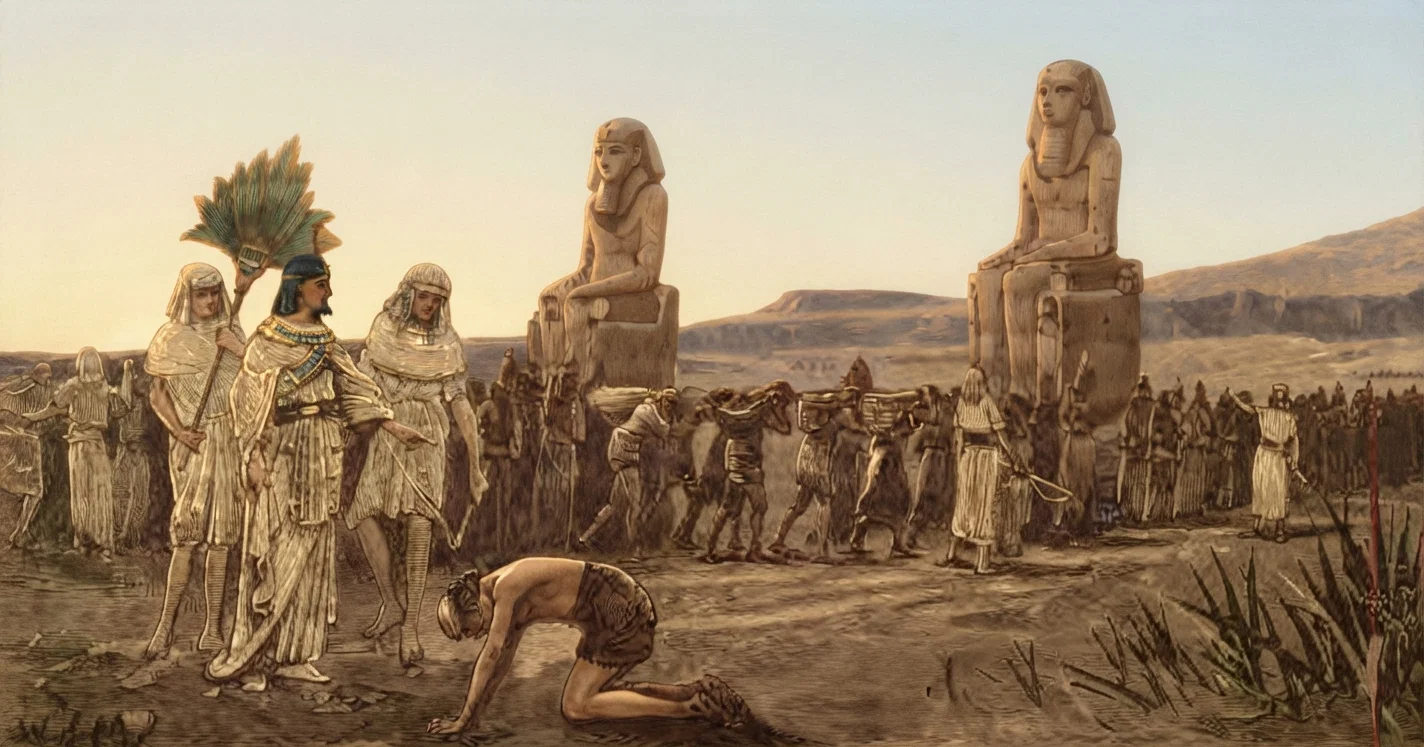
Because of the service rendered by Joseph previous to their entrance, the king of Egypt insisted that to his people be given a home in the best of the land. Here, in the land of Goshen, they fared sumptuously during all the remaining years of Joseph, which were seventy-one in number. But some time afterward (the exact time we do not know), "there arose a new king over Egypt, which knew not Joseph. And he said unto his people, Behold, the people of the children of Israel are more and mightier than we: come on, let us deal wisely with them; lest they multiply, and it come to pass, that, when there falleth out any war, they join also unto our enemies, and fight against us, and so get them up out of the land. Therefore they did set over them taskmasters to afflict them with their burdens. And they built for Pharaoh treasure cities, Pithom and Raamses." Ex. 1: 8-11.
Toiling in Hard Bondage in Egypt. Ex. 1: 11, 13, 14.
In ancient Egypt, as in modern India, the gods were more numerous than the people. "It was easier to find a god than a man." "All Egypt bore the impress of religion. Its writing was full of sacred symbols and of allusions to sacred myths, so that its use beyond the influence of Egyptian religion became, as it were, impossible. Literature and science were but branches of theology. The fine arts were only employed with a view to religion and the glorification of the gods or deified kings. The prescriptions of religion were so multiplied, so constantly repeated, that it was not possible to exercise a profession, to provide for one's subsistence, or satisfy one's commonest wants, without being constantly reminded of the laws laid down by the priests. Each province had its special gods, its peculiar rites, its sacred animals."—Lenormant. In such an environment the people of God must live—did live, for over two centuries.
It was under the reign of Thothmes III, and in the year 1706 B.C., that the children of Israel entered Egypt. This king was a mighty conqueror of nations, and under his reign Egypt attained to the zenith of her power. This king left a list of more than three hundred names of cities, towns, and districts he had conquered. "When his conquests were completed, his dominions embraced Ethiopia, Nubia, Libya, Cyprus, and 'the isles in the midst of the Great Sea,' the 'circuit of the Great [Mediterranean] Sea,' Arabia, Moab, Ammon, Palestine, Phenicia, Asia Minor, the land of the Hittites, Armenia, Mesopotamia, Assyria, Babylonia," and beyond that to the east, even into the land of India. This gives something of an idea of the earthly power of that nation amid whose confines the Israelites lived.
Now Joseph continued to live throughout the reign of this king and three of his successors, to the beginning of the reign of Amenophis IV. So Joseph died at the age of one hundred and ten years, in 1635 B.C.

A Sun-Worshiping Nation

It was this last named king who endeavored to bring his whole realm to the worship of only one god, and that god the sun. To accomplish this, fearful pressure was brought to bear upon all the people of his realm. In such a time, we can easily imagine the attitude of God's faithful children, and the affliction it brought upon them. But this must have been somewhat relieved because of the fact that his whole realm revolted at the thought of giving up the worship of their "gods many" and "lords many." In fact, such revolutions were caused by this attempt to swing all into the worship of the one sun-god, that it led to a change of dynasty; and the one who succeeded in bringing order out of chaos took the throne, and assumed the name of Rameses I.
Between this king and Rameses II there was one king who reigned. But Rameses II it was who built the treasure cities named in Exodus, chapters one and twelve, one of which bore the name of the builder, "Rameses." His reign continued from 1564 to 1497 B.C., a period of sixty-seven years, and to within six years of Israel's exodus from the land of Egypt. It was he who is now known as the Pharaoh of the oppression.
But notwithstanding their hardships and oppressions, the people "multiplied and grew," until at the exodus, instead of the "threescore and fifteen" who entered, there were about three million that departed.

The Meaning of Egypt

The very name of Egypt is a synonym for all that is idolatrous and sinful; for that bondage to the powers of evil from which there is no deliverance for a helpless and enslaved people, except through the power of the Infinite. But that power is ample, and God had given His promise.
"But when the time of the promise drew nigh, which God had sworn to Abraham, the people grew and multiplied in Egypt, . . . in which time Moses was born. . . . And when he was full forty years old, it came into his heart to visit his brethren the children of Israel. . . . For he supposed his brethren would have understood how that God by his hand would deliver them; but they understood not." Acts 7: 17-25.
When Moses was forty years old, the time was nigh, the 400 years mentioned of God, for 390 years had passed. But Moses' attempt at deliverance, at that time, brought only trouble. So he fled to the land of Midian, where he remained forty years longer. This made 430 years in all, and brought the time of their deliverance 30 years later than it might have been, had all understood the "promise," and the power of God.
But tho the people themselves delayed their own deliverance, yet the mercy of God finally accomplished it, without sword or spear, or the din of battle. He took "one nation from the midst of another nation" in the manner concerning which all are familiar, and which need not be repeated here. But the degradation of that vast host, born and reared in the midst of idolatry and slavery, who could fathom? This was the people whom God saw fit, in fulfilment of His promise, to make the light of the world. How could it be accomplished?

The Living Testimony

By Mrs. E. G. White
"Then they that feared the Lord spake often one to another: and the Lord harkened, and heard it, and a book of remembrance was written before Him for them that feared the Lord, and that thought upon His name. And they shall be Mine, saith the Lord of Hosts, in that day when I make up My jewels; and I will spare them, as a man spareth his own son that serveth him."
We are not only to contemplate the glory of Christ, but also to speak of His excellences. Isaiah not only beheld the glory of Christ, but He also spoke of Him. While David mused, the fire burned; then spoke he with his tongue. While he mused upon the wondrous love of God, he could not but speak of that which he saw and felt. Who can by faith behold the wonderful plan of redemption, the glory of the only-begotten Son of God, and not speak of it? Who can contemplate the unfathomable love that was manifest upon the cross of Calvary in the death of Christ, that whosoever believeth in Him should not perish, but have everlasting life, and have no words by which to extol the Saviour's glory? We can not become partakers of His love, and give no expression to our reverence and adoration.
As believers behold Christ, they will be led to assemble together, and to speak one to another words that will express their fervent love. They will say, He is "the chiefest among ten thousand," "Yea, He is altogether lovely." "In His temple doth every one speak of His glory." The sweet singer of Israel praised Him upon the harp, singing: "I will speak of the glorious honor of Thy majesty, and of Thy wondrous works.
And men shall speak of the might of Thy terrible acts; and I will declare Thy greatness. They shall abundantly utter the memory of Thy great goodness, and shall sing of Thy righteousness. . . . They shall speak of the glory of Thy kingdom, and talk of Thy power; to make known to the sons of men His mighty acts, and the glorious majesty of His kingdom." This will be the character of the conversation of those who are described in the Scriptures as those that "feared the Lord, and that thought upon His name." God is represented as listening to their words and writing them in a book.

The Word of Life

John, the beloved disciple, bore a living testimony, saying: "That which was from the beginning, which we have heard, which we have seen with our eyes, which we have looked upon, and our hands have handled, of the Word of life; (for the life was manifested, and we have seen it, and bear witness, and show unto you that eternal life, which was with the Father, and was manifested unto us;) that which we have seen and heard declare we unto you, that ye also may have fellowship with us: and truly our fellowship is with the Father, and with His Son Jesus Christ. And these things write we unto you, that your joy may be full. This then is the message which we have heard of Him, and declare unto you, that God is light, and in Him is no darkness at all."
Surely, those who speak one to another of the goodness of the Lord are highly privileged. Peter exclaims, "Ye are a chosen generation, a royal priesthood, an holy nation, a peculiar people; that ye should show forth the praises of Him who hath called you out of darkness into His marvelous light." We have rich themes for thought and conversation; and if we will dwell upon these themes, our souls will be encouraged and uplifted. Those who are subjects of the grace of God, upon whom the bright beams of the Sun of Righteousness are shining, are to be God's witnesses. Should they hold their peace, the stones would immediately cry out. God will be glorified.

Living Union

If the members of the church are one with Christ, there will be union one with another. The unity of believers will be a living testimony to the world of the power of the Gospel. When there is love one to another, the bright beams of the Sun of Righteousness will be diffused to a world that lies in darkness. Why can we not see from the lessons of Christ, and especially from His prayer for the unity of believers, that Christians must be perfect in unity in order to represent the glory of their Redeemer? If those who believe the truth, would bring the prayer of Christ into their practical life, they would grow up into the full stature of men and women in Christ Jesus. As believers in Christ, we are "built upon the foundation of the apostles and prophets, Jesus Christ Himself being the chief cornerstone; in whom all the building fitly framed together groweth unto an holy temple in the Lord; in whom ye also are builded together for an habitation of God through the Spirit."

Source of Division

The believer in Christ should understand that dissension and division in the church are brought about through the working of the powers of darkness, in order that those who profess to be the children of God may not present the oneness for which Christ prayed. God's people greatly dishonor His name, and misrepresent His truth, when they manifest a lack of love one for another. As love for God grows cold, they lose the childlike simplicity that knits heart to heart in loving tenderness. Hard-heartedness comes in, and there is a drawing away one from another. Many are saying by their actions, "I care not for the prayer of Christ." They feel under no special obligation to love others as Christ has loved them, and Jesus can do little for these souls, for His words and Spirit are not permitted to enter into the heart.
Many are in darkness, and know not the cause; they are not at peace with God; they are not one with Christ nor in unity with the brethren. They seem to think that they are at liberty to act out the natural feelings of the heart. They testify by their words and actions that they do not desire to be in union with those who do not exactly meet their mind, even tho they are believers. All who entertain evil surmisings, and cherish ill feelings to others, need to be converted. They need to learn to live by every wordthat proceedeth out of the mouth of God.
Love for one another is not to be manifested by praise and by flattery of one another, but by true fidelity. The love of Christ will lead us to watch for souls, and if we see one in danger, we will tell him so, plainly and kindly, even at the risk of his displeasure. The religion of Christ is not to be controlled by impulse. We need to pray much and lean wholly upon God. We need to hold the truth with firmness, and in all righteousness and truth; but while we speak the truth with fidelity, we should speak it in love.

What Do Our Great Men Say?

By J. M. Cole

THE opinions of our learned men are often urged as arguments that the first day of the week is the Sabbath, and many cling to the observance of Sunday, "because," say they, "if there is no evidence in the Bible for it, our great men would surely know it." The God who knows the hearts of all men tells us plainly in His Word that "great men are not always wise" (Job 32: 9), "but God hath chosen the foolish things of the world to confound the wise" (1 Cor. 1: 27). Again, it is said to those who have followed the say so of men, "Ye have plowed wickedness, ye have reaped iniquity [sin]; ye have eaten the fruit of lies: because thou didst trust in thy way, in the multitude of thy mighty men." Hosea 10: 13.
Listen to a few of the frank confessions from the lips of those who are themselves Sunday keepers. Dr. William Smith, LL.D., after examining all the texts supposed to have reference to Sunday keeping, says:
"Taken separately, perhaps, or even all together, these passages seem scarcely adequate to prove that the dedication of the first day of the week to the purpose afore mentioned was a matter of apostolic INSTITUTION, or even of apostolic PRACTISE."—"Dictionary of the Bible," article "Lord’s Day."
The "Encyclopædia Britannica," after calling attention to the usual Scriptural arguments, says:
"Still it must be owned that these passages are not sufficient to prove the apostolic institution of the Lord’s day, or even the actual observance of it."—Article "Sabbath."
"Encyclopedia of Religious Knowledge," by B. B. Edwards, article "Sabbath," says:
"There is not on record any divine command issued to the apostles to change the Sabbath from the day on which it was held by the Jews, to the first day of the week."
Rev. Lyman Abbott, in the Christian Union of Jan. 19, 1882, plainly states:
"The current notion that Christ and His apostles authoritatively substituted the first day of the week for the seventh, is absolutely without authority in the New Testament."
Now hear the Rev. Dr. Barnes: "No precept for it [Sunday keeping] is found in the New Testament." Rom. 4: 15.
Buck’s "Theological Dictionary," page 403, after presenting all the first-day arguments, says:
"These arguments, however, are not satisfactory to some; and it must be CONFESSED that there is no law in the New Testament concerning the first day."
The Protestant Episcopal Church, in "Explanation of Its Catechism," says:
"The day is now changed from the seventh to the first day; . . . but as we meet with NO SCRIPTURAL DIRECTION for the change, we may conclude it was done by the authority of the church."
Richard Watson, in his "Theological Dictionary," says:
"Now there is not on record ANY divine command to the apostles to change the Sabbath from the day on which it was held by the Jews to the first day of the week."
Dr. Fallows says:
"The New Testament is silent about a change of days. The apostles doubtless observed the same Sabbath before and after the resurrection of our Lord, as would be very natural."
Binney’s "Theological Compend Improved" (Methodist), designed for Bible classes, theological students, and young preachers, admits that "it is true there is no positive command for infant baptism, . . . nor is there any for keeping holy the first day of the week."—Page 181.
And again, on page 171 of the same work, it reads:
"Jesus, after His resurrection, changed the Sabbath from the seventh day to the first day of the week; when Jesus gave instructions for this change we are not told, but very likely during the time when He spake to His disciples of things pertaining to His kingdom. Acts 1: 3. This is probably one of the many unrecorded things which Jesus did."
Now let another of the D.D.’s hit the mark. Dr. Chas. H. Parkhurst, in the Christian Union of Jan. 24, 1886, says on the "Lord’s day" of Rev. 1: 10:
"The case is a difficult one to state justly. That is one reason that the pulpit has so little to say concerning it, and one reason so much written upon it misses the mark. It is a hard mark to hit. One reason of this is the target is so obscure, and another that so many arrows are flying through the air at all angles that it becomes difficult to gain a clear, sure, and steady aim. It is certainly wise to confess the difficulties. If Christ had Himself made some definite utterance in regard to observing holy time, matters would be simplified. Opportunities occurred frequently when He might have said something very definite, and that was exactly what the people wanted Him to say; but He dealt with the matter only generally. Paul, likewise, handles the question in much the same way. We never hear Paul telling them to observe Sunday, and never discover him sketching any plan for Sunday observance. No one who wants an itemized scheme of Sunday keeping can obtain any such thing either from Paul or the Lord. No one has yet made any careful study of the New Testament if he does not discover clear evidence of intentional indefiniteness."
Alexander Campbell, in a lecture in Bethany College, 1848, quoted in Proclamation and Reformer, Cincinnati, says:
"Was the first day of the week set apart by public authority in the apostolic age? No. By whom was it set apart, and when? By Constantine, who lived about the beginning of the fourth century."
"National Encyclopedia," article "Sabbath," says:
"It has been held by many eminent divines that there is not sufficient evidence in the New Testament for such an institution; that the change of the day from the seventh to the first day of the week is an insuperable difficulty."—article "Sabbath."
E. A. Waffle, M.A., professor of rhetoric and English literature in Lewisburg University, Lewisburg, Pa., in his book called "The Lord’s Day," on page 186 says:
"Up to the time of Christ’s death no change had been made in the day. The authority must be sought in the words or in the example of the inspired apostles."
On the next page (187) he further states:
"So far as the record shows, they [the apostles] did not, however, give any explicit command enjoining the abandonment of the seventh-day Sabbath, and its observance on the first day of the week."
Rev. E. B. Hatch, pastor of the Baptist Church, Salinas, Cal., in the August number, 1892, of Pacific Coast Sabbath Union Monthly, writes:
"The religious observance of the first day of the week is not directly commanded in the New Testament. We frankly concede all the Sabbatarian claims on this point, and the absence of any such command in the New Testament concerning the ‘Lord’s day’ is a stumbling-block to the mere superficial reader."
Rev. John Snyder, in an article in the St. Louis Globe Democrat of April 3, 1887, said:
"Every instructed man knows that there is no New Testament authority for the change of the day of rest from the seventh to the first day of the week."
— ★★ —

The Supreme Gift

MAN has no wings, and yet he can soar above the clouds; he is not swift of foot, and yet he can outspeed the fleetest hound or horse; he has but feeble weapons in his organization, and yet he can slay or master all the great beasts; his eye is not so sharp as that of the eagle or the vulture, and yet he can see into the farthest depths of sidereal space; he has only very feeble occult powers of communication with his fellows, and yet he can talk around the world and send his voice across mountains and deserts; his hands are weak things beside a lion’s paw or an elephant’s trunk, and yet he can move mountains and stay rivers and set bounds to the wildest seas. His dog can out-smell him and out-run him and out-bite him, and yet his dog looks up to him as a god. He has erring reason in place of unerring instinct, and yet he has changed the face of the planet.
Without the specialization of the lower animals—their wonderful adaption to particular ends—their tools, their weapons, their strength, their speed, man yet makes them all his servants. His brain is more than a match for all the special advantages nature has given them. The one gift of reason makes him supreme in the world.—John Burroughs.
Yet with that reason unsubmitted to God, unguided by God, man himself becomes a brute.
Continue reading: XVIII. God's Plan for Jerusalem