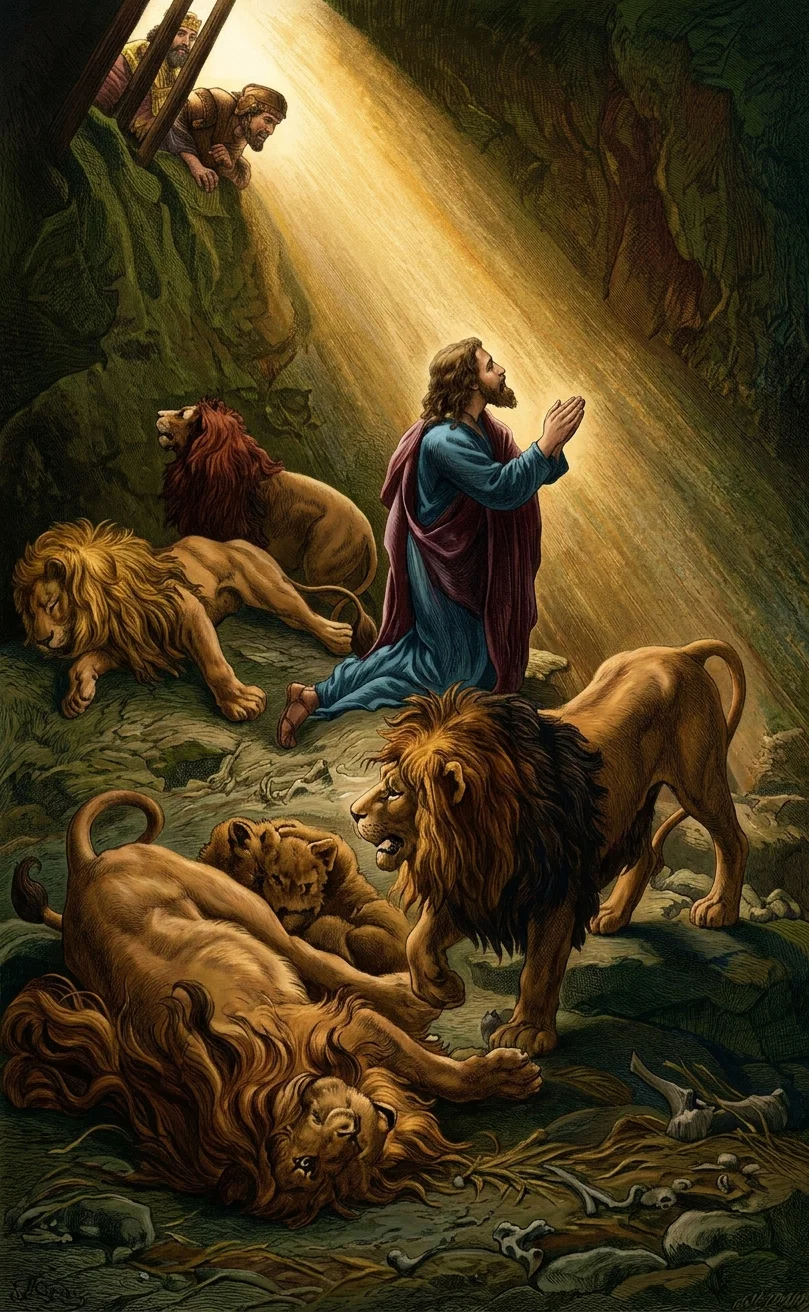
The lives of Daniel and his three companions afford us a useful lesson upon the rights and duties of Christian citizens under civil government.
Carried captives to Babylon in their youth, Daniel, Hananiah, Mishael and Azariah found a test of loyalty to God awaiting them almost from the hour of their entrance into the city.
As recorded in the first chapter of the Book of Daniel, the king commanded to select “certain of the children of Israel, and of the king’s seed, and of the princes; children [youth] in whom there was no blemish, but well-favoured, and skillful in all wisdom, and cunning in knowledge, and understanding science, and such as had ability in them to stand in the king’s palace, and whom they might teach the learning and the tongue of the Chaldeans.”
Among those chosen to be thus educated in “the learning and the tongue of the Chaldeans,” were the four young men already named. “And the king appointed them a daily provision of the king’s meat, and of the wine which he drank.” But Daniel and his three companions had conscientious scruples against partaking of such food; and as the record runs, “Daniel purposed in his heart that he would not defile himself with the portion of the king’s meat, nor with the wine which he drank: therefore he requested of the prince of the eunuchs that he might not defile himself.”
Daniel, the First of the Three Presidents, in the Lions’ Den.
“Be ye Wise as Serpents, and Harmless as Doves.”
The prince of the eunuchs was fearful lest he might endanger his head to the king; but upon further representation by Daniel he consented to try the four young men for ten days. The test was satisfactory and they were not required to eat the objectionable food.
Notice carefully the facts stated. First, Daniel purposed that he would not defile himself. But instead of offensively refusing to partake of food from the king’s table, he put his protest in the form of a request, in behalf not only of himself, but of his fellows. Nor did he in this thing concede the right of the king or of the prince of the eunuchs to control his conscience; he simply combined the wisdom of the serpent with the harmlessness of the dove. Had it been necessary he doubtless would have braved death itself, as he did subsequently, rather than violate his conscience; but craving as a favor that which was his absolute right, he not only retained the sympathy, respect, and confidence of Ashpenes, but obtained his request, not only for himself but for his companions. This is an example of Christian citizenship. Daniel and his companions rendered to Cæsar the things that were Cæsar’s, and to God the things that were God’s. Respect was shown for those in authority, and at the same time conscience was preserved void of offense.
Royal Counselors.
When their education had been completed the king communed with the young men who had been selected for special training for the public service, “and among them all was found none like Daniel, Hananiah, Mishael and Azariah: therefore stood they before the king” as counsellors. “And in all matters of wisdom and understanding, that the king inquired of them, he found them ten times better than all the magicians and astrologers that were in all his realm. And Daniel continued even until the first year of King Cyrus.”
The next account we have of any of the public acts of Daniel we find him among the wise men of the kingdom. He is condemned to die with them because of their inability to interpret the king’s dream, recorded in the second chapter. In this matter also he shows remarkable tact, and after gaining time for prayer he saves not only his own life but the lives of all the wise men of Babylon by making known to the king his dream and the interpretation thereof.
Daniel’s Reward and His Request for His Friends.
For interpreting the dream Daniel was highly honored. The king first commanded that an offering be made to him. But to this the prophet evidently objected, declaring that to God belonged the glory; for “the king answered unto Daniel, and said, Of a truth it is that your God is a God of gods, and Lord of kings, and a revealer of secrets, seeing thou couldst reveal this secret. Then the king made Daniel a great man, and gave him many great gifts, and made him ruler over the whole province of Babylon, and chief of the governors over all the wise men of Babylon.” And so far was Daniel from refusing all part in civil affairs, and from saying that since his citizenship was in heaven he could not participate in the affairs of earthly governments, that he “requested of the king, and he [the king] set Shadrach, Meshach, and Abed-nego [Hananiah, Mishael, and Azariah] over the affairs of the province of Babylon.”
How long Daniel’s three friends retained their positions before their religion brought them into conflict with the king we are not told, but a severe trial was in store for them. As recorded in the third chapter of Daniel, the king made a great image and caused this proclamation to be made: “O people, nations, and languages, that at what time ye hear the sound of the cornet, flute, harp, sackbut, psaltery, dulcimer, and all kinds of music, ye fall down and worship the golden image that Nebuchadnezzar the king hath set up: And whoso falleth not down and worshippeth shall the same hour be cast into the midst of a burning fiery furnace.”
Deliberately Disobeyed a Royal Mandate.
The three Hebrews exalted to high office at the request of Daniel, were present upon this occasion and heard the sound of the music, but remembering the command, “Thou shalt not bow down to them, nor serve them,” they deliberately disobeyed the king’s decree. “Wherefore at that time certain Chaldeans came near and accused the Jews. They spake and said to the king Nebuchadnezzar, O king, live for ever. Thou, O king, hast made a decree, that every man that shall hear the sound of the cornet, flute, harp, sackbut, psaltery, and dulcimer, and all kinds of music, shall fall down and worship the golden image: And whoso falleth not down and worshippeth, that he should be cast into the midst of a burning fiery furnace. There are certain Jews whom thou hast set over the affairs of the province of Babylon, Shadrach, Meshach, and Abed-nego; these men, O king, have not regarded thee: they serve not thy gods, nor worship the golden image which thou hast set up.” The king then summoned the culprits before him and offered them another opportunity to obey him, assuring them that a failure to respect his authority would be swiftly punished by death in the burning fiery furnace. “Shadrach, Meshach, and Abed-nego answered and said to the king, O Nebuchadnezzar, we are not careful to answer thee in this matter. If it be so, our God whom we serve is able to deliver us from the burning fiery furnace, and he will deliver us out of thine hand, O king. But if not, be it known unto thee, O king, that we will not serve thy gods, nor worship the golden image which thou hast set up.”
Their Punishment.
From the king’s standpoint this was a most high-handed and flagrant defiance of his authority, and he attempted to visit it with swift and condign punishment. To suffer such insubordination was in his eyes to forfeit the respect of all his subjects and invite anarchy. The integrity of his throne demanded prompt action. The three men were hastily bound and hurried to the furnace, heated seven times hotter than it was wont to be heated. Into this seething caldron of fire these men, only a short time before occupying some of the highest official positions in the gift of the king, were cast. “And these three men, Shadrach, Meshach, and Abed-nego, fell down bound into the midst of the burning fiery furnace.”
Their Vindication.
But while from the standpoint of the king they merited only death, the God whom they honored and who had clothed them with certain inalienable rights, who himself had ordained civil government, not to rule over the consciences of men but to secure, among others, the very right which was by the king denied these men, made bare his arm for their deliverance. “Then Nebuchadnezzar the king was astonied, and rose up in haste, and spake, and said unto his counsellors, Did not we cast three men bound into the midst of the fire? They answered and said unto the king, True, O king. He answered and said, Lo, I see four men loose, walking in the midst of the fire, and they have no hurt; and the form of the fourth is like the Son of God. Then Nebuchadnezzar came near to the mouth of the burning fiery furnace, and spake, and said, Shadrach, Meshach, and Abed-nego, ye servants of the most high God, come forth, and come hither. Then Shadrach, Meshach, and Abed-nego, came forth of the midst of the fire. And the princes, governors, and captains, and the king’s counselors, being gathered together, saw these men, upon whose bodies the fire had no power, nor was an hair of their head singed, neither were their coats changed, nor the smell of fire had passed on them.”
Daniel’s Trial and Triumph.
Daniel was not involved in this matter, for what reason does not appear. It seems probable, however, that his office of counselor did not require his presence on this occasion, while his three companions being more actively engaged in the affairs of government were doubtless prominent figures in all public functions.
But Daniel’s time of trial was coming. The kingdom had changed rulers, but Daniel was still in public life. He did not find the service of his fellowmen any bar to the service of God. He did not reason that because Babylon was a pagan kingdom he could have nothing to do with it except to live in it, without renouncing his heavenly citizenship. On the contrary he recognized the fact that while rendering to the king and to his fellow-citizens their due he could also render to God that which was due to him. The sequel shows that in Daniel’s mind the limits of civil authority were clearly drawn. With him the right of conscience was dearer than life itself. Neither political patronage nor fear of the royal disfavor could swerve him from the path of duty or lead him to surrender his God-given rights—rights the exercise of which he could not forego without yielding to man that which belonged alone to God.
The sixth chapter of Daniel tells the story of Daniel’s trial and of his triumph. Being of easy access to all we shall not quote it here. Suffice it to say that whereas his three companions had been required to do an act expressly forbidden by the second commandment, Daniel was by a general law binding alike upon all Darius’ subjects, forbidden to ask any petition of any God or man for thirty days save of the king only. Prayer, and especially prayer open to the observation of the public, is not directly required by the law of God. Indeed the Saviour taught that the closet was the proper place for prayer, so that from one standpoint it would appear that Daniel might very properly have ceased to pray, except mentally, for thirty days, and that without any abandonment of principle and without incurring moral guilt.
But viewed from another standpoint, and as we believe the right standpoint, to have complied in any degree with the king’s decree forbidding prayer to God for thirty days, would have been a violation of the first commandment, “Thou shalt have no other gods before me.” To have admitted the right of the king to forbid prayer for thirty days, or for any time whatever, would have been to admit his right to forbid all service to God for all time, and that would have been to put the king in the place of God, and so to violate the first commandment.
Nor are we left in doubt upon this point. Daniel’s miraculous deliverance from the lions is positive evidence that God approved his course, and shows that the Christian citizen, even though he be a public official, can, while rendering to Cæsar the things which are Cæsar’s, render also “to God the things that are God’s.” Christianity does not require, nor even permit men to use force in matters of conscience, neither does legitimate civil authority, the power ordained of God for the preservation of natural rights, warrant any invasion of God’s realm, the sacred precincts of the soul.
THE PRIEST POLITICIAN.
By S.
The term “priest” may seem a strange one to be applied, by any man in his senses, to an official of the government; and such it is. Nevertheless it was thus used in all seriousness in a discourse delivered at the late Christian Endeavor convention in Washington, D. C., by one of the leading speakers at that gathering, “Evangelist” B. Fay Mills.
This discourse was given Sunday, July 12. Mr. Mills read from his Bible the words of Rev. 5:6: “And I beheld, and lo, in the midst of the throne . . . a Lamb, as it had been slain,” and proceeded to apply the text after his own fancy to the affairs of civil government. By the aid of his imagination he drew from it the conclusion that the “slain Lamb”—Christ—should be legally recognized299and his will made supreme in the laws of the nation.
From this he proceeded to show that all our great political and social problems—difficulties which threaten the very existence of the body politic—would be easily solved by means of this union of Christianity with the State. And this, he declared, was the only remedy for them.
This brought him to the climax of his discourse, which he reached in these words: “There is something more sacred than the Church—the fellowship of the nation.” This idea he elaborated by saying that the calling of the “Christian” politician is more sacred than that of the gospel minister, in which connection he referred to President Cleveland as “the priest of the White House,” whose position was the most sacred of all!
Whether these remarks of Mr. Mills fell upon sympathetic ears or not, we are not told, though it would be fair to presume from other circumstances that they did; but certain it is that his views coincide exactly with those of numbers of his fellow-clergymen. It is as though Mr. Mills’ discourse was taken by a large number of the clergy as the key-note of the campaign into which they were just about entering.
The calling of the “Christian” politician more sacred than that of the gospel minister—to their belief in this sentiment their actions have emphatically testified. But, as we view it, they have just as emphatically proclaimed the utter unholiness of that same “calling.” By the “mud-slinging” and recrimination which now characterize the Sunday discourse in so many places, the “Christian” politician of our land is giving us a beautiful(?) illustration of Mr. Mills’ theory in operation. The only things lacking to make its beauty complete are a decision by vote that Christ is the nation’s King, and that President Cleveland is its high “priest”!
S.
PROPOSAL TO TAX CHURCH PROPERTY IN PENNSYLVANIA.
It is reported that a movement is under way in Pennsylvania to repeal the tax exemption upon church property in that State. A press dispatch says:—
A movement is on foot that will create a furore in Pennsylvania. A measure is to be introduced providing for the taxation of church property.
J. Carson Mercer, county commissioner of Allegheny, is having prepared a bill to be introduced at the next session of the legislature providing that hereafter all church property shall be subject to taxation the same as any other property. Commissioner Mercer will also bring the matter before the annual convention of the State, which will be held in Reading probably next month.
Heretofore church property in Pennsylvania has been exempt from taxation for any purpose. The holdings of church property, by all denominations, however, have increased to such enormous proportions, that it is now proposed to tax them. It is contended that the properties of immense values held by rich congregations should be taxed because, otherwise, it is a discrimination against the small property owner, who is a member of the small congregation and has his taxes increased because the more valuable properties are exempted.
The Dunmore (Pa.) Pioneer, in which the above appeared, makes this pertinent comment upon the proposed bill: “This is opposed by some people on the ground that churches are built and maintained by taxpayers, and that it is not fair to tax church-goers twice. The same reason would apply to the members of secret societies who erect buildings, or to anyone else who erects buildings and runs them. That equal and exact justice, which Jefferson contended, for would tax churches the same as any other property. Exempting church property from taxation is only a step toward a union of Church and State, which can never be countenanced in the United States.”
HEAPING CONTEMPT ON A SOLEMN THEME.
By S.
Probably never before since the subject of the end of the world was presented by William Miller and his associates previous to and including the year 1844, has this subject received so much attention from the secular press as during the few days preceding and following Sept. 2, 1896,—the date fixed upon by the leader of a fanatical band in Brooklyn for the dissolution of earthly things. The geographical location of this band unfortunately placed them and their doctrine among the observable features of life in the nation's metropolis, and naturally they were not overlooked by the sensation hunters whose task it is to keep a modern enterprising daily “up with the times.” For several consecutive days the leading secular journals of “Greater New York” published extended accounts setting before their millions of readers the foolish prophecy of these misguided religionists that the world would end on September 2, and the preparations made in view of the expected event, not forgetting the inevitable reference to “ascension robes,” etc.
The absurdity of the prediction put forth to the world in this instance—that on September 2 the sun would reach and melt all the ice at the north pole, causing a deluge which would sweep over the earth, while the little band of “the faithful” would be borne away to paradise—doubtless added to the effect which the setting of a date for the end of the world must have upon the average mind. That this effect is to bring the whole subject of the end of the world and the second advent of Christ into disrepute, as a theme only for religious speculators, visionaries, and fanatics, no one will deny.
The subject of the second advent of Jesus Christ is the most prominent and momentous theme of inspired prophecy. Its importance to every inhabitant of this earth cannot be exaggerated. The day of his appearing is the day of all days. The first inspired prophecy ever uttered by man and recorded for man's instruction was a prophecy of Christ's second coming—“Behold, the Lord cometh, with ten thousands of his saints, to execute judgment upon all, and to convince all that are ungodly among them of all their ungodly deeds,” etc. It was Enoch, the contemporary of Adam, who proclaimed these words, and the last revelation which the Book of God records, is “Surely I come quickly.” The same momentous theme burdens the pages of Holy Writ everywhere throughout both Old Testament and New.
Signs of the end have appeared in the heavens and upon the earth. Sun and moon and stars have given their testimony to the reality of the approaching dissolution. “The sea and the waves roaring,” “earthquakes in divers places,” “distress of nations, with perplexity,” are earthly heralds of the same event. It would require a volume to set forth the prophecies upon the point, with that which has occurred in their fulfillment.
The Saviour, in speaking upon this subject to his disciples, as a caution to all men which he foresaw would be most essential, plainly declared: “But of that day and hour knoweth no man, no, not the angels of heaven, but my Father only.” Matt. 24: 36. This language is unequivocal. It cuts squarely across all setting of time for the end of world. It compels time-setters to stand before the seeker for truth in their true light, as ignorant or dishonest speculators, and not guides to Scriptural truth.
It is characteristic of such persons that they still cling to their folly after the dates which they have published are in the past. So it is, we are told, in the present instance. They are certainly to be pitied. But if the harm done by their unscriptural speculation and vagarizing were confined to themselves, their work would not possess a hundredth part of the baleful significance which it has.
S.
CANADA APPEALS TO ROME.
THE Catholic school controversy in Manitoba has taken a novel and startling turn. Up to this time it has seemed that the advantage in the contest was all on the side of the Protestants. It appears now, however, that Rome purposes to reap a very substantial benefit from the controversy, even nothing less than the exaltation of the Pope to the position of arbiter in the affairs of the Dominion. It is an adverse wind indeed which Jesuitical craft and cunning cannot turn in some way to the benefit of the papal ship of State. The facts of the situation are set out, with appropriate comments, in the Toronto Mail and Empire, of September 10, as follows:—
OTTAWA, Sept. 2.—(Special)—A new and extraordinary development of the Manitoba school controversy is about to take place. The government has purchased from Manitoba, as the price of a portfolio, certain concessions to the Roman Catholics of that province. At to-day's meeting of the Greenway Cabinet the bargain was ratified, and it is expected that Mr. Sifton will enter immediately, by the grace of the electors of Brandon, into the enjoyment of the consideration.
Your correspondent is informed to-night that an embassy of the Laurier Government will leave immediately for Rome to ask from the Pope ratification of the bargain. If acceptable to his holiness, the terms of the agreement will be implemented, but if not, the threat of Mr. Laurier to enforce the constitution in its entirety, will be carried out. The whole question now hinges upon the view of the case which will be taken by Pope Leo XIII.
According to the information that comes to hand to-night, the gentleman who is to undertake the unusual task of consulting his holiness has been chosen, and is known to the informant of your correspondent. This course is taken to meet the views of the Quebec Liberals, who insist that before they take their hands off her throat, Manitoba must satisfy the church. In adopting this policy the government is gaining time, which is important, and it is invoking the aid of the visible head of the Catholic Church, which is more important.
Never before has a Federal administration in Canada taken so remarkable a step. Mr. Mercier made an act of the Quebec legislature dependent upon the approval of the Pope, but though Mr. Laurier had nothing but praise for the sainted count, he never flattered him before to the extent of so close an imitation. It will be an unpleasant piece of news to the Canadian public to know that the latest development of the Liberal policy is that in matters educational there is an appeal from the judgment of the Privy Council of England to the judgment of his holiness of Rome.
The course of the government has all along been directly contrary to its election promises. There was to have been an immediate investigation of the question, but there has been none. Sir Oliver Mowat was to be one of a great tribunal to which the issue would be submitted, but Sir Oliver has done nothing beyond sitting comfortably in the Senate. Mr. Laurier was to bring about harmony with Manitoba by means of his sunny ways, but he has traded a portfolio for a settlement.
Finally, instead of the people's representatives, who were elected to deal with the subject, being permitted to voice the sentiments of their constituents, they are to await the pleasure of the Pope, and follow his directions. It is to be hoped that it is not too late for Mr. Laurier to retrace the unfortunate steps300he has taken and to make an honest effort to carry out his pledges to the people.
During the campaign nothing was said of a reference to Rome. This is therefore an absolutely new departure, so far as the public is aware, from the Liberal policy. The information that it has been decided upon comes from so reliable a source that it is difficult to conceive that it can be at fault, but there is reason to hope that as the matter has leaked out the administration will modify its intentions in this respect.
Will it not be in order next for Rome to spring this arbitration scheme upon the United States? Surely this development of affairs in Canada affords food for serious thought to American citizens.
CHRIST WORSHIP VS. CREED WORSHIP.
By GEO. E. FIFIELD
BY GEO. E. FIFIELD.
The assertion is constantly made by the agnostic that Christianity is opposed to progress; that the progress of the world for many centuries has been in despite of Christianity, rather than by its aid. The names of Bruno and Galileo, and a thousand other heroes, and heroines too, who, by the church, were persecuted for the truth’s sake, are often mentioned in support of these assertions.
It seems to me that this grave accusation against Christianity is seldom fairly answered. It is not enough to point to the fact that Christian lands are the most enlightened. The objector may present what he considers other reasons for this enlightenment. It is not enough for Protestants to assert that it was Roman Catholicism that thus opposed progress. Has not Protestantism too, in Scotland, in England, and in Geneva made its martyrs? Nay, even here, though not yet so allied with the State as to possess full power to persecute, does not the church often look askance with holy horror at the new idea? If Christianity is true, it can and ought to be shown, that it is in harmony with the very innermost principles of progress, and that only a false, a corrupted Christianity could oppose it.
What is Christianity? If I mistake not, it is more than hero worship, however great, however divine that hero may have been. It was Christ’s own assertion, “I am the way, the truth,” and also, “I and my Father are one.” God, as revealed in Jesus Christ, is the infinite All Truth, living and personal, and touched with tender throbbing love. Christianity is the worship of God as thus revealed. Not a God far away in some dim and distant heaven, merely, but a God here and everywhere, in the universe, in touch with a sorrowing and needy humanity.
It was Carlyle, I think, who said, “The universe is the realized thought of God.” Grand old Kepler, gazing into the blue depths until those wondrous laws of planetary motion burst upon his ken, with heart throbbing with emotion, and eyes moist with tears, said, “O God, I think thy thoughts after thee!” Perhaps a greater even than Kepler, many centuries before, said, “O God, how great are thy works, and thy thoughts are very deep.”
All true knowledge is the knowledge of God, for he is the truth. The best that any of us can do, is to think reverently and worshipfully, his thoughts after him. The botanist only traces God’s thought through the vegetable world, and the zoologist traces the same divine thought through the various orders of animal life, the mathematician through the mysterious relations of numbers, carry and the astronomer through the wondrous star-gemmed pathway of the sky. The traveler at Washington, on mounting the dome of the Capitol, discovers that the streets center from all directions at that point. Thus too, in the ancient Roman civilization, it was said that all roads led to Rome. Even so, in the center of his mighty universe, God sits enshrined, and every pathway of knowledge is a magnificent avenue leading to the throne. The agnostic may prefer to walk backward, admiring the pebbles by the way, but the Christian thinker prefers to face about. He admires the pebbles none the less, but rather more, in that he beholds them in the prospective light of greater glories farther on, and sees all the lesser glories centering their tributary rays in him who is the all, and in all—the one who sits enthroned at the end of the road.
God has made the universe thus, that he might lead the devout soul, by every avenue of truth, upward through limitless heights, into the knowledge of himself. This, too, is Christianity, for Christianity is the worship of Christ,—the truth. The worship of gold leads men with intense eagerness, ever to seek for more gold, so the worship of truth lifts man above all sordid, all politic motives, into the earnest pursuit of truth,—truth not as a theory merely, but truth to be acted out lovingly in the life.
All truth is divine, and therefore religious in the highest sense, when we view it as such. Nor can it be said, as it would sometimes seem that the church thinks, that any man, in the past, gave us the all truth. Not even Jesus claims for himself this honor. On the contrary, on the last night he was with his disciples before the crucifixion, he said, “I have yet many things to say unto you, but ye cannot bear them now.” But he added, “I will pray the Father, and he shall give you another Comforter, that he may abide with you forever, even the Spirit of Truth whom the world cannot receive, because it seeth him not, neither knoweth him, . . . and when he the Spirit of Truth is come, he will guide you into all truth.” Splendid promise!
It is ever true that God has many things to say unto us that we yet cannot bear. Christianity is the worship not of our little creed,—not of what we may know, or think we know of the truth; it is the worship of the All Truth beyond our present knowledge. It is the worship of truth, in the Spirit of truth, given to guide us into all truth. Nothing more grandly uplifting than this can be even dreamed of. This is the divine secret of all human progress. Such are the worshipers who have ever stood upon the frontiers of truth, holding high the standard for the tardy millions.
Jesus said, “I am the light of the world.” He also said to his church, “Ye are the light of the world.” His church was to be the organized body of truth worshipers, who should catch the latest ray from the divine All Truth, and reflect it upon the world. It was therefore His design that the church should be the conservator of all true progress.
How then has it come that the church has so often arrayed herself against progress, persecuting the worshipers of truth? It is because there has been so little Christianity, and so much “churchanity,” so little Christ worship, and so much creed worship. I dare say it, the history of Christianity has never been written. The history of the church has been written often enough, and it is too often the history of persecution, of selfishness, of intrigue, and of crime. The history of Christianity never can be written until the last great day shall make manifest the secret of all lives, for it will be the history of those lives which went out in the vanguard of human progress,—went out hated, maligned, persecuted, crucified for the truth, their very memory blackened by the prejudice and bigotry of their time.
Creed worship is very different from Christ worship. When a church writes out its creed, from that moment it ceases to be the light of the world, and becomes an organized institution for resisting the more light which God ever has to give. First, it resists by its social and ecclesiastical power. It looks askance at the progressive man, and next it anathematizes him as a dangerous fellow. Finally, when he will walk in the dawning light, notwithstanding the social damnation and ecclesiastical scorn, the church asks the State for power to enforce its creed and persecute this man. This is the philosophy of all persecution. It is ever the creed that persecutes and crucifies the Christ,—he that is born of the flesh only, that persecutes him that is born of the Spirit,—the Spirit of Truth.
The spirit of Christ is the spirit of humility, of progress, and of hope in the great future. The spirit of the creed, whatever creed it may be, is the spirit of pride, of glorifying the present, and of deifying the past. According to Paul, the first step into idolatry is to change God into the image of a man, that is, to think that God is identical with my conceptions of him; only equal to the measure of my mind. An idol was but a creed in marble, seeking to make permanent the present thought of God. Creed worship is idolatry. It was the custom once to carve the creed—the ideal of God—in marble; it is the custom now to hold it in the heart, or write it in a book. The principle is the same in each case. Now, as then, a splendid edifice, artistic music, and a magnificent ceremonial are too often dedicated to the making permanent the present thought of God,—of the truth,—instead of being dedicated to the splendid work of lifting humanity ever toward the All Truth.
Now as ever, there are many who will guard the creed, and only a few who are willing to be crucified for the truth. There are thousands who will shout for the truth triumphant, but only a few who will follow it to Gethsemane and Calvary. The willingness to do this last, however, is Christianity: and what a mistake to charge up to Christianity that opposition to progress which in every age has been in reality the opposition to Christianity itself.
BOYS' BRIGADES.
In all brotherly freedom, we would call your very serious attention to the organizations known as “Boys' Brigades,” which have been recently introduced in many congregations, and have met with a dangerous popularity. Let us consider whether there are not tendencies and consequences inseparable from them which are inimical to the highest interests of our youth, and the true work of the church.
With the inculcation of prompt obedience to superiors, is there not fostered a love of arbitrary power in the boys who command? Is not an admiration for martial display begotten by the parade and the trappings which are part of the outfit of the brigade? Do301these not minister to the pride and vanity of human nature, which so early assert themselves, and, viewed from the Christian standpoint, need no stimulus? Will not the precision and efficiency with which large numbers move under the control of one or more leading minds, give an undue estimate as to the value or necessity for military service in the administration of civil government? And is not the general tendency of such training as is derived through the Boys' Brigade, to lead away from the gospel view of the church, its rightful service, the nature of that conflict with sin and error to which it is indeed called, and the method by which it is to be carried on, whereof the Apostle Paul declares, “The weapons of our warfare are not carnal, but mighty through God to the pulling down of strongholds, casting down imaginations and every high thing that exalteth itself against the knowledge of God, and bringing into captivity every thought to the obedience of Christ.”
If the system has these tendencies, unfavorable to moral and religious welfare, of how little comparative value are the discipline and physical advantages claimed for it! and how directly does it conflict with the principle involved in the command of our Saviour, “Seek first the kingdom of God and the righteousness thereof.”