CHURCH UNIONISM AND TRADE UNIONISM COMING TOGETHER.
IT has been well known to those conversant with the religious movements in this country that for many years there has been an organization called the National Reform Association, the object of whose existence is the embodiment of “Christian laws, institutions, and usages on an undeniable legal basis in the fundamental law of the land,” or a union of Church and State with all its resultant pains and penalties. One of the chief demands which this association has made has been the enactment of civil laws for enforcement of Sabbath observance.
This association was at first laughed at and ridiculed by the Protestant and secular press, then opposed, then tolerated in its teaching, listened to and accepted, till every denomination of note has committed itself to religious legislation over the Sunday question. Sabbath unions of various sorts have sprung up, federations have been formed with other national organizations and with political parties, and the Sunday-sabbath, wholly a church institution, has been pressed upon the Legislature of every State which did not possess a Sunday law, and upon the national Congress.
One of the principal directors in this work for years is Rev. Wilbur F. Crafts, whose headquarters is at the national Capital, where he is constantly working with and working government officials in the interest of the Church-and-State régime.
While we believe the movement is, in its very fundamentals, evil and only evil, and its results bound to be baneful to both Church and State, we freely concede that the men engaged in it are sincere men, working for what they believe to be the general good. Many of them are tremendously in earnest, and the virus of their teachings has permeated and poisoned our churches, our institutions of learning, and their threats of vote-controlling power has had effect upon our legislators.
The same spirit of combination manifest in the trust and the labor union, to crush out competition and opposition, to freeze out smaller dealers, and set aside the individual, is manifest in the church in the effort to federate on politico-religious questions, not so much as a matter of conviction of truth as of policy.
Latterly the National Reform Association, with all its allied forces, has been pressing upon labor unions and associations the importance of uniting with them, not for a day of rest, but for a religious day. One illustration among many is the following recently uttered by a clergyman in Des Moines, Iowa, on the problem confronting labor, to a large congregation:—
If it [trades unionism] is ever to furnish the panacea for our labor ills, it must broaden and deepen its life-currents on the moral ideas that affect the welfare of the laboring man. It must join the churches everywhere in the protection of Sunday as a day of rest and recreation. It means more to the laboring man to have all unnecessary work done away with on the Lord’s day than to any one else. Here is a place for effectively using the splendid machinery of organized labor.
And labor is awakening to the situation, and has taken action in many cases locally, so far as their own organizations are concerned.
The church, too, is bringing into her policy (it is rarely longer a matter of principle and conviction) the principles of the trust and trades union. Note the following as illustrative of this, taken from a recent news item from Lincoln, Neb.:—
The pastors of the larger Lincoln churches have signed an ironclad agreement intended to drive out the small church, and bring greater revenues to the larger, longer-established house of worship. The agreement is aimed at the exclusion of several projected new parishes.
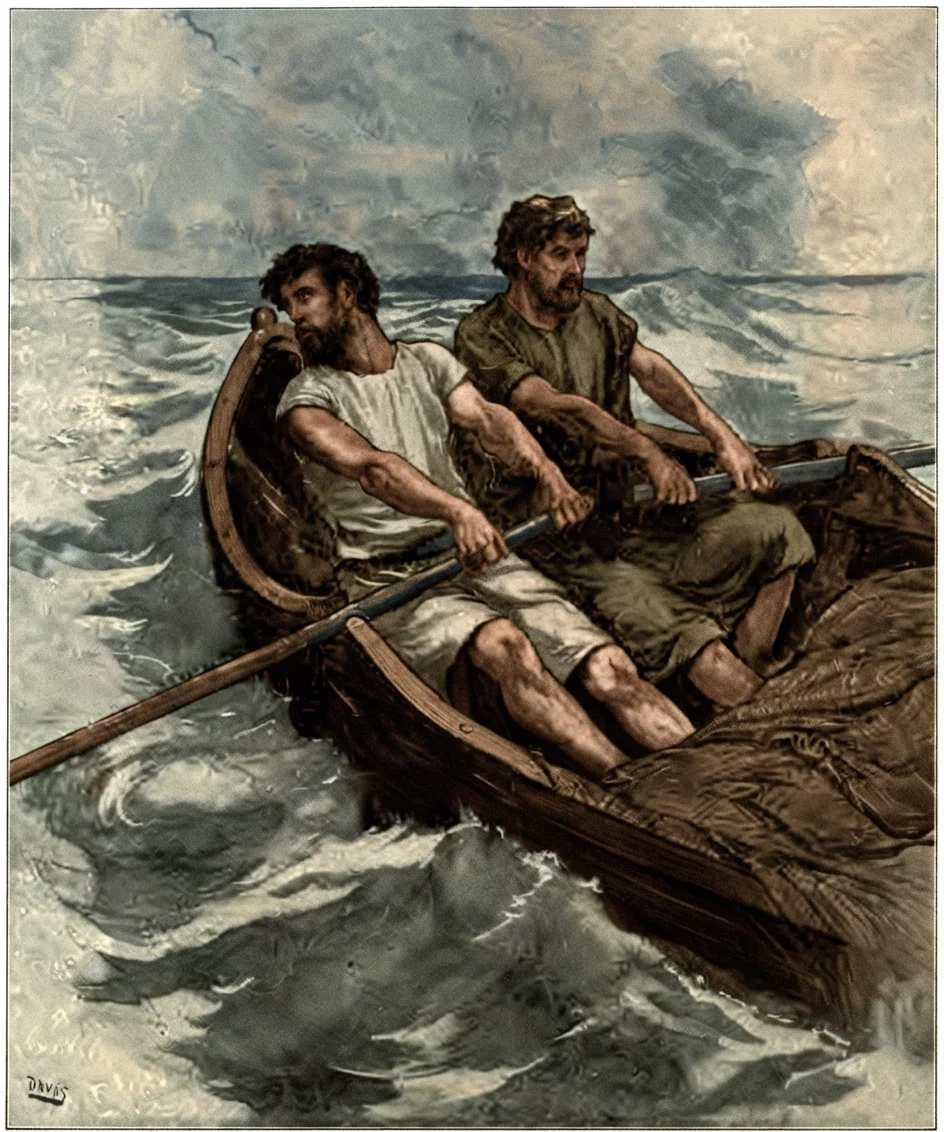
PETER and ANDREW, Fishermen. Matt. 4 : 18.
The Lincoln ministers take the stand that the field is already crowded. One of the ministers admitted frankly that the organization has all the features and aims of the big trusts incorporated under the New Jersey law. “Too many ministers are working for small salaries,” he declared. “Congregations are too small; the salaries of the best ministers are too small. A remedy is the abolition of the small churches and congregations.”
The Monthly People, of New York City, asks if this is a trust or a union, and says:—
All these are thrilling questions. Not the curious, merely, the serious, also, are anxiously looking for an answer.
While the church is pursuing labor-union methods, the unions are imbibing the autocratic, imperialistic spirit of religious bigotry and persecution. The following from the Independent (friendly to labor), of October 1, will illustrate this:—
Human nature is harder to change than social forms are. A born bigot does not become a liberal because he forswears the creed of his fathers, and sets up as an apostle of the latest philosophical quackery. The man or woman who grovels in superstition does not become a fearless rationalist by swapping “isms.” The heresy-hunter does not become less strenuous when he exchanges Presbyterianism or Old-Two-Seed-in-the-Spirit Baptismalism for Trade Unionism.
No one can watch the recent development of trade unionism, with all its unquestioned value and importance, and not be impressed by the rapidity with which it is tending to become a dogmatic religion, surcharged with bigotry, fanaticism, and superstition. The unions have erected Sunday into a sabbath of the faithful. The union itself has become a church, to which on every seventh day the faithful repair. The unbeliever is no longer merely a “scab,” he is a sinner, living under wrath. The individual member who goes out from among the industrially redeemed is a lost being, who can not be permitted to live inconspicuously among his fellows, but must be followed with anathemas, and all the pains and penalties of the excommunicated. The danger to trade unionism from this tendency is serious and deplorable.
To make plainer its allegations the Independent refers to the resolutions passed by the Central Labor Union of the District of Columbia in condemnation of President Roosevelt because of his action relative to the case of W. A. Miller in the book-binding department of the Government Printing Office. Mr. Miller, the union declares, has “violated every moral, and, in two instances, criminal law,” he has been “tried and found guilty of flagrant non-unionism,” and the President, by his action, has committed himself to “the policy of the open [communion] shop.” And his order in reinstating Miller must be considered “unfriendly.”
And all this because Mr. Miller is in favor of the “open shop,” and of so reorganizing the government office as to accomplish much more work for the government at less expense.
Not only this, but the unions arrogate to themselves the authority of sponsors of citizenship. They further say:—
The principle of trade unionism is intended to raise the standard of living among the working classes, to instil into their hearts the blessing of free governments, to educate them so that they might uphold the law and its representatives, to make them good citizens in time of peace and zealous patriots in time of war.
Upon this the Independent remarks:—
If all this is humorous, it is also serious. The trade unions embrace possibly two and a half million members. If they are all to become dogmatic religionists, the days of persecution “for the faith” are not over. It looks as if a great deal of educating and broadening of the human spirit would have yet to be done before all the American people shall be brought to a full realization of what is meant by instilling into the heart a vital sense of the blessings of free government.
In a prophecy of the last days, the central field of which is laid in these United States, we have a certain religious, civil-secular element combining, through vote and influence, to enforce the authority of what the prophecy calls “the image of the beast” under pain of death; and this power, when thus established, prescribes a mark or badge for all within its authority upon the right hand or the forehead, under the severest boycott, even to the prohibition of buying and selling. That this mark is religious in intent and purpose is evident from its being the mark or badge of the system of worship called “the image of the beast,” and that it pertains to commercialism is also evident by its penalty of boycott. See Revelation 13.
It does not need a prophetic gift to clearly see that the attitude of the labor federations and unions confederated with the churches will result in a legal “civil-sabbath” Sunday law enforced upon all, and which must be acknowledged by all, in formal acquiescence at least, as the test of government authority and loyalty on the part of the subject. Failure to do this results in the boycott in which the very necessities of life are denied the transgressor.
The outcome of all combinations to effect religious purposes has always been disastrous to both Church18and State. The union of the religious and the secular to accomplish politically what can not be wrought morally has always embruted the hearts of those who have engaged in such a movement, resulted in the persecution of the truest of men, and the utter ruin of the church and government which permits it. This has been true of the past. The present will prove no exception to the rule.
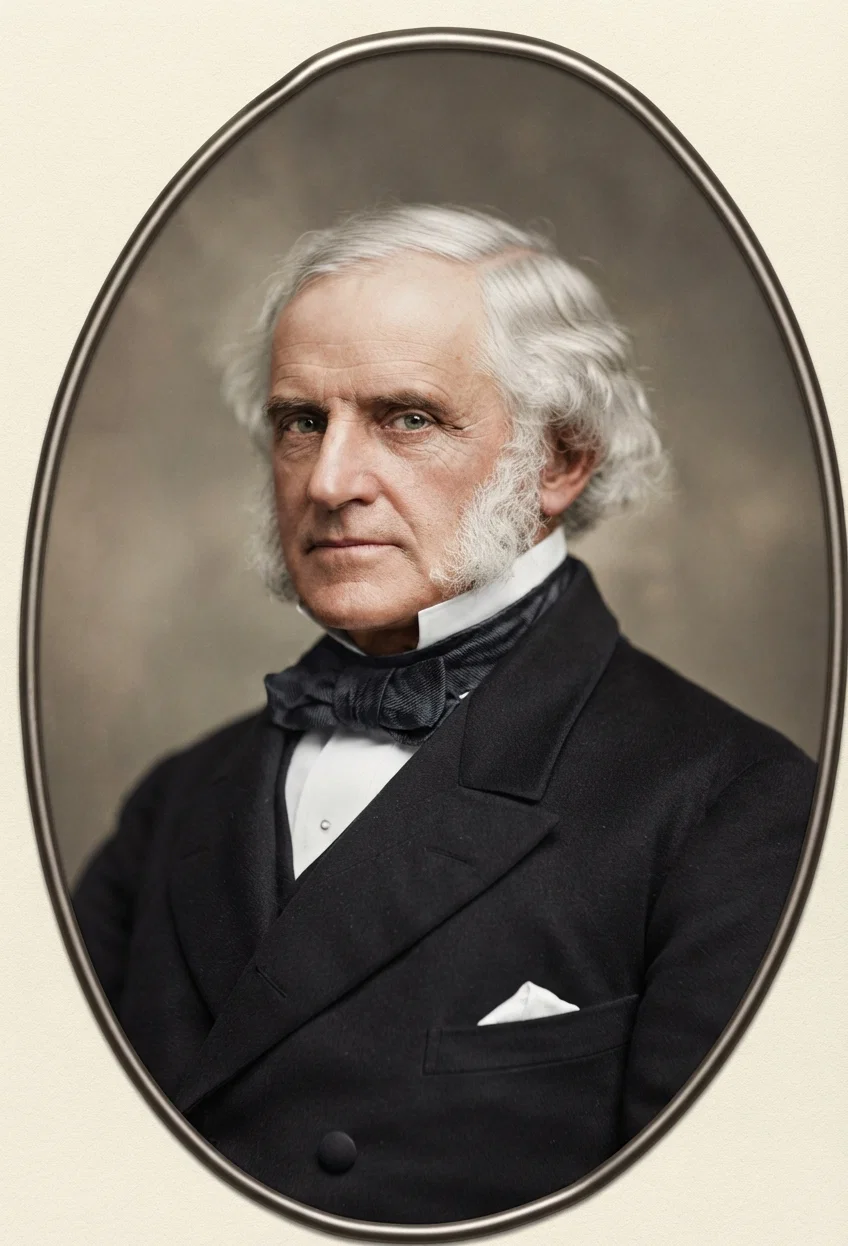
George Peabody.
Upon all the climax of oppression in these last days—whether that oppression come from capital or labor, capital and labor, capital, labor, and religion, or Church and State, in any form—will burst the overwhelming glory of the King of kings and Lord of lords. He comes to relieve the oppressed, to set the captive free, and to begin that reign of righteousness which shall know no tyranny of class, no injustice in rule, no disregard of the poor. Then the “King shall reign in righteousness, and princes shall rule in judgment. And a man [the Man, Christ Jesus] shall be as a hiding-place from the wind, and a covert from the tempest, as streams of water in a dry place, as the shadow of a great rock in a weary land.” All the evils are past, the survival of the fittest is manifest, and forever endures the reign of righteousness over a righteous people.
To that kingdom God in His goodness invites all. To the attainment of the character necessary to obtain that kingdom Christ has pledged His infinite power to every soul who will seek it. He has made that life possible to all; all may possess it in Him and by His own righteous way.
The Union for Which We Plead
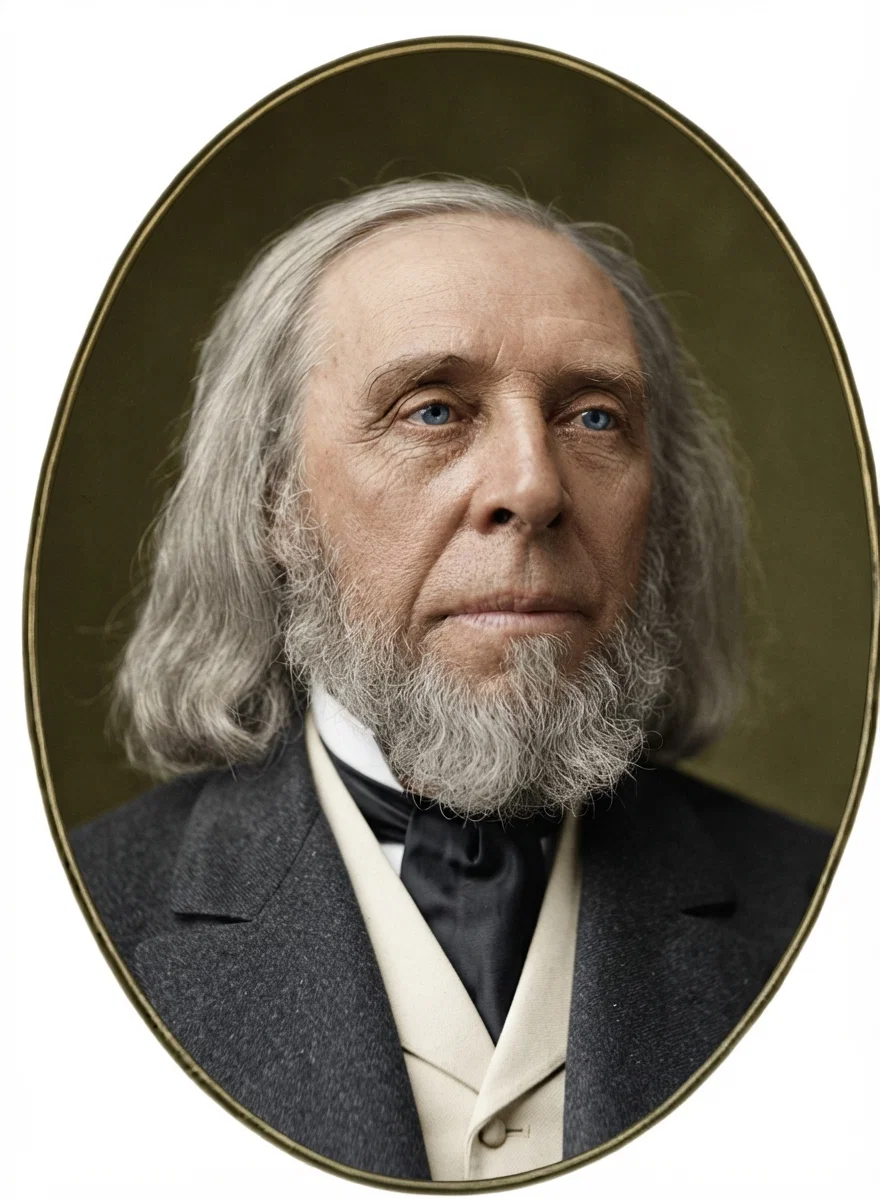
Born in New York City, February 12, 1791; died there, April 4, 1883. Limited education, learned trades of hatter and carriage-making. Business, manufacturing machinery, cabinet ware, glue, and iron industry. Built first locomotive engine constructed in America; largely instrumental in laying the Atlantic cable; very charitable; best known for interest in industrial education; builder of the Cooper Union for the advancement of science and art, 1854. Building and endowment cost $1,000,000.
Peter Cooper.
is arrayed against class, company against company, hatred against avarice, man against man—to force the coffers of other men; and when it is worked out, all that might have been is lost, and the full coffers of eternity are bolted and barred against them. Is it worth it?
How much better, O, how infinitely much better, is that union which Christ is instituting among men! Running all through it are the golden threads of love, and hatred and strife and accusation have no place. Selfishness is sacrificed; but in its place we have all working for the good of each, and the hearts and interests of all twined and intertwined and woven into one harmonious web of love and peace stretching out in undimmed and unending beauty as long as the universe holds and God lives. Works of love and mercy here, and all the riches and blessings of eternal life when Christ shall come. That is the union for which we plead. “Come unto Me, all ye that labor and are heavy laden, and I will give you rest. Take My yoke upon you and learn of Me; for I am meek and lowly in heart; and ye shall find rest unto your souls. For My yoke is easy, and My burden is light.”
THE UNION LABEL.
By Walter Gordon Merritt
(Walter Gordon Merritt.)
The indispensable part of all boycotts is a distinguishing mark. In the case of labor organizations, the efficient weapon is the union label, or, in some cases, the specific trade-mark of the boycotted manufacturer. The former is the preeminently important part of their machine of conspiracy. It is now a well-recognized trade-mark, by which every dealer and walking delegate distinguishes all goods of union manufacture. As soon as this practical method of discrimination was adopted, the establishment of the boycott was assured.
This label does not necessarily represent quality, earning capacity, sanitary conditions, or short hours, but is a club to coerce employers and injure independent workmen, by making possible the boycott. It is so totally void of the usual significance of trade-marks that, in the absence of special statutes, many courts have denied it protection. The threat of being deprived of valuable trade causes the distributor to select union goods with the label, and the general consumer buys what is offered him, regardless of the label.
THE BLESSED HOPE.
("Christian Index," Glasgow.)
Come, King of Glory, come!
Earth's woes thy healing crave;
Its weary, wasted sum
Of hopes but finds a grave
In moaning hollows of distress
Or blank, abysmal nothingness.
O Christ, when shall again
Thy presence Israel bless?
We look for Thee to reign
Thy reign of righteousness;
We hold that promise sacred yet
The angels gave at Olivet.
Did not Thy shining ones
A light of life impart,
Brighter than noonday suns,
To cheer the church's heart?
This Jesus ye have seen ascend,
Again to earth His steps shall bend.
Fulfil, O Christ, fulfil
That hope of advent given!
We hold that promise still
A beam of light from heaven
Thy church to cheer along its way
To sunshine of a perfect day.
When, crowned with sevenfold crown,
And garments dipped in blood,
To smite oppression down
And curb the restless flood
Of human wrong, Thou'lt come again,
The King of kings on earth to reign.
—Organized labor threatens to withdraw $300,000,000 from the banks of the country unless organized employers cease damage suits against labor unions. This, labor predicts, would cause a financial panic.
Knights of Labor and Strikes
—The organization known as the Knights of Labor, which was organized at Reading, Pa., in 1878, now has a membership of 40,000.
—"Public Opinion" declares that the past year has seen more and larger strikes than any previous year in the history of the country.
A New Book
By Editor
OUR PARADISE HOME
Is a new book just from the press. In this volume its author, Pastor S. H. Lane, presents in an interesting and instructive way facts relative to the establishment of the Kingdom of Christ and the restitution of all things.
The book treats of the Permitting of Sin, The Fall of Satan, The Promise of God to Abraham, The Three Heavens, The Three Worlds, The Two Jerusalems, The Two Kingdoms of Grace and Glory, The Transfiguration, The Rest that Remaineth, The Two Resurrections, The Millennium, The Description of the Kingdom of Glory and the New Jerusalem. The work is so interesting and entertaining that when one commences to read he will not want to cease until the book is finished.
The book contains 128 pages. It is nicely illustrated, Bound in board, price 25 cents; in cloth, 50 cents, post-paid. Address
Pacific Press Publishing Company
Oakland, California
Bookkeeping, Shorthand, and Penmanship
Bookkeeping, Shorthand, and Penmanship successfully taught by mail. Students holding responsible positions. Booklet sent on application. Test lesson in shorthand free. Write to-day.
Fireside Accounting Institute, Battle Creek, Mich.
BEAUTIFUL
PHOTOGRAPHS
Of America's Grandest Mountain Scenery.
35c each, one half dozen $2.00
$3.50 per dozen
Photos 5x8, on Mounts 7x11.
Yosemite Valley
BEAUTIFUL PHOTOGRAPHS
Of America's Grandest Mountain Scenery.
35c each, one half dozen $2.00
$3.50 per dozen
Photos 5x8, on Mounts 7x11.
E. J. DRAKE, 830 Isabella St., Oakland, Cal.
"FREEDOM OF LABOR MUST BE UPHELD."
By Goldwin Smith
(Prof. Goldwin Smith, in San Francisco "Examiner" of Dec. 21, 1902.)
The lawfulness of unions and strikes is now admitted on all hands. Capital is spontaneously combined; and, without counter combination, labor would have little chance of justice. On the other hand, the community has its rights. Freedom of labor must be upheld. Every man must be at liberty to take the work which another man declines, that there may be no monopoly of employment. There must be no arbitrary restriction upon the workman's use of his capacities or upon the extent of production. All this is commonplace. At the same time, strikes and lockouts are barbarous and wasteful modes of settling a difference between employer and employed. They not only cause great loss, but poison the heart of industrial society.
THE LABORER.
By William D. Gallaher
(Wm. D. Gallaher.)
Stand up—erect! Thou hast the form
And likeness of thy God—who more?
A soul as dauntless 'mid the storm
Of daily life, a heart as warm
And pure as breast e'er wore.
What then?—Thou art as true a man
As moves the human mass among,
As much a part of the great plan
That with creation's dawn began,
As any of the throng.
Who is thine enemy?—the high
In station, or in wealth the chief?
The great, who coldly pass thee by,
With proud step and averted eye?—
Nay, nurse not such belief.
If true unto thyself thou wast,
What were the proud one's scorn to thee?—
A feather, which thou mightest cast
Aside, as idly as the blast
The light leaf from the tree.
No; uncurbed passions, low desires,
Absence of noble self-respect,
Death, in the breast's consuming fires,
To that high nature which aspires
Forever, till thus checked,—
These are thine enemies—thy worst;
They chain thee to thy lowly lot,
Thy labor and thy life accursed.
O, stand erect! and from them burst!
And longer suffer not!
Thou art thyself thine enemy!
The great!—what better they than thou?
As theirs, is not thy will as free?
Has God with equal favors thee
Neglected to endow?
True, wealth thou hast not—'tis but dust!
Nor place—uncertain as the wind!
But that thou hast, which, with thy crust
And water, may despise the lust
Of both,—a noble mind.
With this, and passions under ban,
True faith, and holy trust in God,
Thou art the peer of any man.
Look up, then, that thy little span
Of life may be well trod.
Lamp Chimney Index
Our “Index” describes all lamps and their proper chimneys. With it you can always order the right size and shape of chimney for any lamp. FREE. Macbeth, Pittsburg, Pa.
ITEMS OF INTEREST.
—In the following-named States, eight hours' work constitutes a day's labor on all public work: Arkansas, California, Colorado, Connecticut, District of Columbia, Idaho, Illinois, Indiana, Kansas, Massachusetts, Minnesota, Missouri, Montana, Nebraska, New Jersey, New Mexico, New York, Ohio, Pennsylvania, Tennessee, Utah, Washington, West Virginia, Wisconsin, and Wyoming. In the following named of these, eight hours constitute a legal day's work for all, unless specified otherwise by contract between employer and employee: California, Connecticut, Illinois, Indiana, Missouri, Nebraska, New York, Pennsylvania, and Wisconsin. These laws do not apply in agricultural work.
—The American Federation of Labor, of which Samuel Gompers, of 423 G Street, N. W., Washington, D. C., is president, and John Mitchell, of Indianapolis, Ind., is second vice-president, is composed of 96 affiliated national unions, 27 State branches, 406 city central unions, and 1,378 local unions. The aggregate membership is 2,000,000. About 235 weekly and monthly papers, devoted to the cause of labor, are issued by these various affiliated unions. About 900 organizers of local unions are working under the direction of the federation.
—The following ten national unions are not affiliated with the American Federation of Labor: The Brotherhoods of Locomotive Firemen, Railroad Trainmen, Railroad Conductors, Locomotive Engineers, and Railroad Switchmen, the Stone Cutters' Association, Bricklayers' and Masons' Union, Brotherhood of Operative Plasterers, National Association of Letter Carriers, and Post-office Clerks' National Union.
—At a conference of the representatives of capital and labor, held in New York, Dec. 17, 1901, under the auspices of the National Civic Federation, a permanent board was appointed to settle differences between employers and the labor unions. This board consisted of thirty-eight persons, fourteen on behalf of the public, twelve on behalf of employers, and twelve on behalf of the labor unions. The Chairman is Senator Marcus A. Hanna.
—From the annual report of the United States Commissioner of Labor we learn that, between the years 1881 and 1900, there were in the United States 22,793 strikes and 1,005 lockouts, involving 127,442 establishments and 6,610,101 men. The average lengths of the lockouts was 97 days, and of the strikes, nearly 24 days. These involved a loss to the laborers of $306,683,223, and to the employers a loss of $142,659,104. Of the strikes, 50.77 per cent succeeded, 13.04 per cent were partially successful, and 36.19 per cent failed. Of the lockouts, 50.79 per cent succeeded, 6.28 per cent succeeded partly, and 42.93 per cent failed.
—During the first nine months of the current year there has been a large falling off in building operations throughout the United States. In eight of the largest cities this decrease has been tabulated, and amounts to $42,250,000. This is an indication of the condition of the country as a whole. The loss to laborers is enormous, and this means a money shrinkage in the communities where these laborers purchase supplies.
—The wealth of the United States in the year 1900 was computed to be $94,300,000,000. The gold in circulation at the present time in the United States amounts to $629,271,532, and the silver, $151,436,658; total of money in circulation (including bank notes) in the United States, $2,246,529,412. The total value of articles manufactured in the United States in the year 1900 was $13,039,279,566. The value of manufactures exported during the year 1902 amounted to $1,381,719,401.
—It is stated that the recent unsuccessful strike of 100,000 textile workers in Philadelphia caused a loss of $12,000,000 to the manufacturers and $8,000,000 to the employees. One result was the introduction of labor-saving machinery which displaced 2,000 men.
—The great anthracite coal strike in the coal regions of Pennsylvania was inaugurated on May 12, 1902, and lasted five months, involving 147,000 men. It was settled by a commission appointed by President Roosevelt, the miners returning to work October 24.
—The meat trusts are paying 25 per cent less for cattle than last year, at the same time raising the cost of meat to the consumer 10 per cent. This makes their business 35 per cent more profitable to them, while both consumer and producer are suffering loss in consequence.
—There are in the United States 15,000 persons possessing fortunes of over $300,000.
Beautiful
I find that PEARLINE is the best soap powder I ever used. I soak my clothes overnight and rub them out next morning with little labor, and my clothes are beautiful and white. Mrs. Rev. J. H. D.
against Drudgery
Delicate
Have used Pearline for eight years. Am never without it. Use it with the most delicate fabrics and with coarse things. Find it satisfactory in all things. Mrs. Rev. G. E. L.
White Clothes
I have used Pearline for the last ten years. Always satisfied with it. It never turns the clothes yellow. Mrs. Rev. R. G. J.
Silverware
I prefer Pearline to other soap powders. I like it for dish-washing better than soap; it keeps the silver bright. Mrs. Rev. H. B. M.
Colored Goods
I prefer PEARLINE to any other powder I have used. I do not think it will injure colored clothes, which is more than I can say for most other washing powders. Mrs. Rev. M. E. M.
Lace Curtains
I have used Pearline today for washing lace curtains and like it very much. Washed easier and cleaner than with any soap used before. I like it very much. Mrs. Rev. J. D. E.
Baby's Things
I prefer Pearline to other soap powders. For cleaning baby bottles, nipples, and silverware it has no equal. I will try it alone for washing. Mrs. Rev. J. F. R.
Infants' Clothes
I have found Pearline a great help in the cleaning of badly soiled infants' clothes, as it does away with all rubbing. Mrs. Rev. J. S.
1. One new yearly subscription and one renewal, or two new yearly subscriptions, sent at one time, $2.50.
2. Two new yearly subscriptions and one renewal, or three new yearly subscriptions, sent at one time, $3.25.
3. Three new yearly subscriptions and one renewal, or four new yearly subscriptions, sent at one time, $4.00.
Sample copies sent on application.
TO OUR PATRONS.
By Editor
Please be careful to write all names of persons and places plainly.
Send money by Post-office Money Order, Express Order, or Bank Draft on New York, Chicago, or San Francisco.
Orders and Drafts should be made payable to the Pacific Press Publishing Co.
Paper money or silver should be sent in a registered letter.
Registered mail is safe. Unregistered mail is at the risk of the sender.
Postage-stamps in five or ten cent denominations will be accepted for small amounts.
The address label on your paper will indicate the time to which your subscription is paid. In case of non-receipt of papers, or any other irregularity, please notify us immediately.
When subscriptions expire, no more papers are sent to the party except by special arrangement.
You are requested to watch the date on your label, and renew early, and save the loss of papers. We can not always furnish missing numbers.
When requesting change of address, be sure to give both old and new addresses.
The Strife and Its Settlement
The Strife and Its Settlement.—It has not been the aim of this paper to present the sensational nor to foment prejudice. We believe there are good men on both sides of the great controversy. We believe that there are many who wish to do just right. But we do not believe that this great strife will ever be settled as long as men's hearts are selfish. We know it will not, all compromises to the contrary. There will be temporary lulls and truces and combinations, but the smoldering fires of selfishness and class hatred will again burst forth in greater malignity. As long as the negative is left out of the Eighth and Tenth Commandments in men's creeds, so long will this strife continue, and every commandment will be broken. So long as the Golden Rule is perverted to mean "Do others or they will do you" the conflict will continue till it is lost in the battle of Armageddon. The only way it can be permanently settled is in each individual soul in Christ Jesus.
Capital and Labor Troubles.—In 1897 T. De Witt Talmage said: "You may pooh, pooh it; you may say, This trouble, like any angry child, will cry itself to sleep; but it will not; . . . it is the mightiest, the darkest, the most terrible threat of the century. All attempts at pacification have been dead failures; the monopoly is more arrogant, the trades union more bitter." What would Mr. Talmage say if he had lived in 1903?
Have Men a Right to Unionize?—They have. Let them form unions so good, on so broad a basis, so truly educational, elevating, and helpful, so free from dictatorship and imperialism, that every true man in the trade will feel it a privilege to belong to it; but let them never seek to coerce him who is outside to join; let them never take from him one right which he has in common with them. His right not to belong is as sacred as their right is to belong. His right to be a solitary or to form a union alone with his employer is as sacred as their right is to combine together. The right not to join a union is as sacred as is the right to join. I may be a dozen, and he may be one. His conscientiousness which prevents him from joining me may seem strange and narrow to me, but I have no right to coerce it. It is as sacred in the sight of God as mine, and it may be altogether true, while mine may be selfish. The same principles apply equally to trusts.
Our Regular Issue
By Editor
For the scope of our regular issue see advertisement on last page of the cover. Our departments were omitted to give more space for this great question.
An Apology for This Issue
By Editor
It is but justice to editors and proof-readers to say that this paper has been gotten out under a pressure of work too great for the human. The finished product falls far below our wishes and expectations. But such as it is, we send it forth. The work has been wrought with a constant prayer for the blessing and guidance of the great Master Workman. May He cover all its human errors, and bless its mighty truth to the saving of souls.
The Labor Question
By Editor
We greatly regret that we could not obtain from representative labor leaders and capitalists articles for this number. We wrote to several on both sides of the question, but obtained no reply from capitalists. Two labor union leaders, Mr. Gompers and Mr. Mitchell, were too busy to furnish the articles. Mr. Gompers suggested the reproduction of an editorial in the American Federationist; we asked him to designate, but received no reply. We, therefore, reproduced another article of his designed to cover, at least the year 1903. The article from Mr. D. M. Parry is from the view-point of the employer; while that of General H. G. Otis is a general view on the principles involved. We hope that all will be read candidly and carefully, and weighed in the balance of Everlasting Right.
OUR NEXT ISSUE.
By Editor
Our original plan in this issue of the SIGNS OF THE TIMES was a 32-page number with cover, but, on the earnest solicitation of our friends, we reduced it to a 20-page issue with cover, which could be sold for five cents, tho worth a dime.
As a consequence of the change of our plan, we have as excellent, as stirring, as comprehensive articles left over as appear in this issue. Following are some of these with additional features:—
1. "THE INDIVIDUAL AND HIS RIGHTS: THE PRESENT TREND AS REGARDS THESE RIGHTS." By the Editor. A discussion of the question from the standpoint of religion, the State, and society.
2. "THE FIRST COMMANDMENT: ITS APPLICATION TO THE LABOR PROBLEM." By Alonzo T. Jones.
3. "AMERICAN CONTEMPT OF LAW," from "McClure's Magazine."
4. "TWO MIGHTY CORRUPTERS OF CHARACTER." Editorial.
5. VALUABLE UTTERANCES FROM EMINENT MEN.
6. A fine FIRST-PAGE DRAWING prepared for this issue.
7. Beautiful ORIGINAL SONG AND MUSIC.
The price of the issue containing the above, dated December 23, will be five cents; in lots of fifty or more, at the rate of 2½ cents each.
THE NEXT SIX MONTHS.
No one issue, or two, could adequately discuss the great questions raised between capital and labor, involving, as they do, the very question of government itself.
During the next six months the SIGNS OF THE TIMES will illumine this subject as it has never been before. Here are three series of articles:—
1. "THE INDUSTRIAL PROBLEM: THE UNSETTLED STRIFE BETWEEN LABOR AND CAPITAL." A discussion of fundamental principles, present conditions, inevitably logical outcome, and the light of prophecy. From ten to twenty articles.
2. "THE HISTORY OF GOVERNMENT." Eleven articles by Alonzo T. Jones, a study of every phase of government and its outcome, from ancient Babylon to the present. A valuable study, having a direct bearing upon present issues.
3. A continuation of the STUDIES ON THE REVELATION.
These things ought to give the SIGNS OF THE TIMES a circulation of 100,000 weekly.
Price one year, $1.50;
Six months, 75 cents;
Three months, 40 cents.
Send in your subscription at once. Address THE SIGNS OF THE TIMES, Oakland, Cal.