Signs of the Times, Vol. 34, No. 31.

Salvation Is of the Lord

Signs of the Times

Jul 29, 1908

Pacific Press Publishing Company · Mountain View, California · Jul 29, 1908

Salvation Is of the Lord
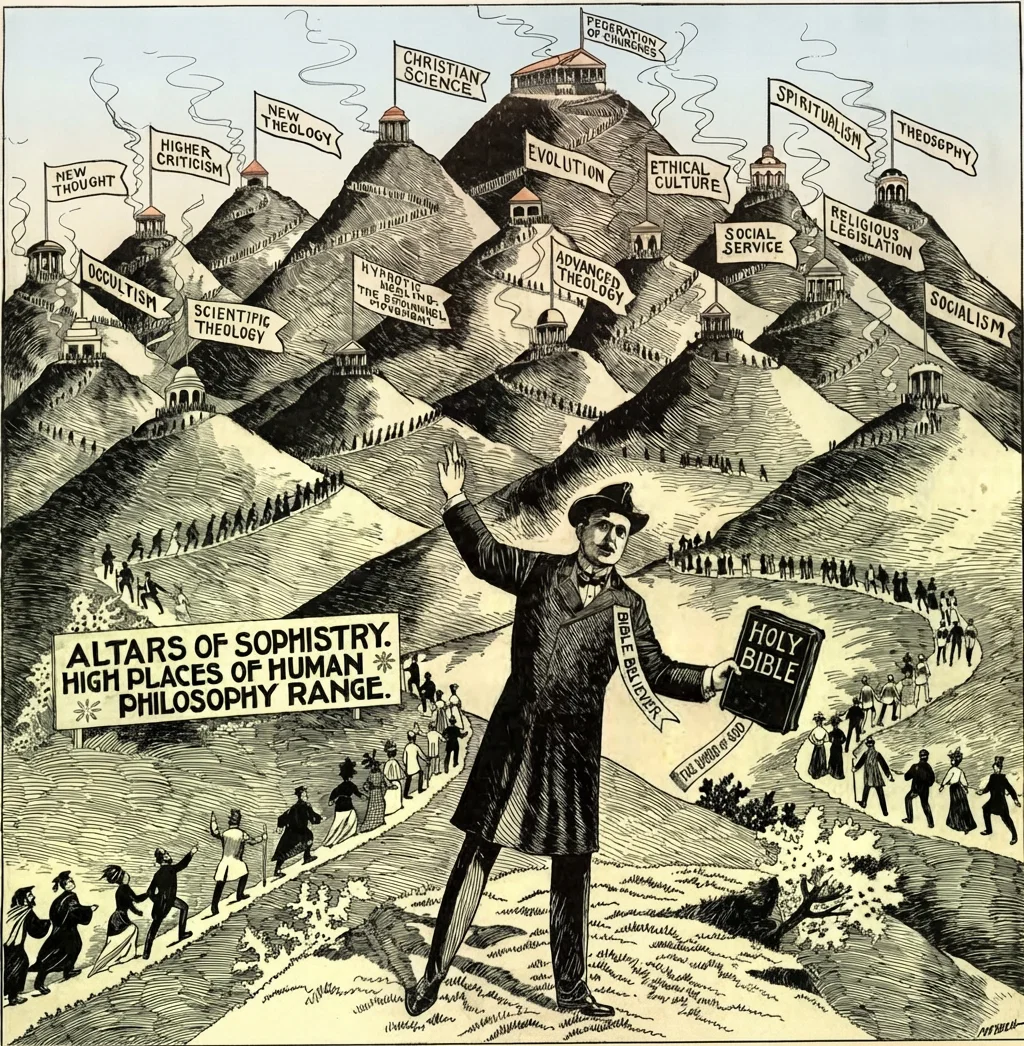
"Truly in vain is salvation hoped for from the hills, and from the multitude of mountains: truly in the Lord our God is the salvation of Israel." Jer. 3:23. See page 8.

With Our Inquirers

"If ye will inquire, inquire ye." This Inquirers' Department is conducted for the purpose of helping those who are studying the Bible. The answers are oftentimes only suggestive. They are never to be considered infallible, only as they agree with the infallible word. The writer who may answer them does not consider that his opinion is infallible. He will simply give the best that he has, and plead with the inquirer to search the word. Such questions only will be answered which, to the editors, seem to minister to the good of the readers and to the mission of the paper. We can not answer repeatedly in the same volume questions upon the same scripture. The name and address must accompany question, not for publication, but as an evidence of good faith, and that answer may be made by letter if deemed advisable. No letters are answered which do not contain the name of the writer. It is well always to enclose stamp for reply.

2568.—The Son of Man.

Why did Christ our Saviour call Himself the Son of Man?
M. M.
Simply and solely because He was the Son of Man. "Forasmuch then as the children are partakers of flesh and blood, He also Himself likewise took part of the same; that thru death He might destroy him that had the power of death, that is, the devil." "Wherefore in all things it behooved Him to be made like unto His brethren." Heb. 2:14, 17. "And the Word was made flesh and dwelt among us." John 1:14. He became our kindred that He might redeem; one with mankind that He might suffer, sympathize with them; truly the Son of God, and truly the Son of Man. Therefore, He reveals Himself to us as the Son of Man that we may know His divine, infinite sympathy with us in all our needs.

2569.—Commanding to Abstain from Meats.

Please explain 1 Tim. 4:1-5.
G. T.
We have probably had not less than a score of inquiries recently regarding this scripture. Because of the many inquiries we present the following extended explanation. We hope that it will suffice for at least a whole year to come. Here is the text quoted from the American Standard Revised Version: 1. "But the Spirit saith expressly, that in later times some shall fall away from the faith, giving heed to seducing spirits and doctrines of demons; (2) thru the hypocrisy of men that speak lies, branded in their own conscience as with a hot iron; (3) forbidding to marry, and commanding to abstain from meats, which God created to be received with thanksgiving by them that believe and know the truth, (4) for every creature of God is good, and nothing is to be rejected, if it be received with thanksgiving; (5) for it is sanctified thru the word of God and prayer." 1. The text has not special reference to the last days. It relates to later times than apostolic, to the great apostasy which had in Paul's day already begun, and would continue. Acts 20:29, 30; 2 Thess. 2:7. 2. It does not necessarily refer to one special class which does all these things, but to "some," among whom all these things should be done. It predicts apostasy in general, with particular characteristics or evidences of its manifestations. 3. All these things herein condemned are primarily the result of departing "from the faith." The only true faith there is, is living, personal faith, that which makes life-connection with God, that which dwelt in our blessed Lord, "the faith of Jesus." "The faith" does not relate to "body of doctrine." That idea is a fruit of the apostasy, a justification of lifeless formality. This faith is not that which is based on the doing of any particular order, or the building up of a self-righteous character by the means of fasts or abstinence from certain kinds of food. The great Gospel truth is that "the kingdom of God is not meat and drink; but righteousness, and peace, and joy, in the Holy Ghost." 4. The doctrines, or teaching, of demons are teachings contrary to the word of God. Primary among these is that old word of the serpent, "Ye shall not surely die; . . . ye shall be as God." Gen. 3:4, 5. Out of that has grown the doctrine of natural inherent immortality, eternal torment, universal salvation, ultra-Calvinism, purgatory, intercession of saints, prayers for the dead, and works of supererogation. The system of human merit has been built up on just such a foundation: that Christ's offering, work, and power are not sufficient, but that these must be supplemented by men. 5. And all these are the fruits of hypocrisy. One of the fearful denunciations which fell again and again from the lips of Him who "knew what was in man" was that of "hypocrites," applied to the Jewish nation. Yet they boasted of their good works, and laid upon others heavy burdens and grievous to be borne, in ceremonial exactions and numerous fastings and ablutions. The same hypocrisy was even more evident in the apostasy. Departing from God's plan and substituting the human, covering inward sins with the cloak of hypocrisy, became ever more manifest as the centuries of apostasy rolled on. Under such influence conscience soon becomes hard and speechless. 6. "Forbidding to marry" would not involve the prohibition of marriage. Neither would it include advice against hasty and unwise marriages. We see the fulfillment of the Spirit's prediction in the enforced celibacy of the priesthood in the Roman Church and in those organizations which, under the pretense of holiness, forbid all marriage of its members as fornication. 7. The word translated "meats" is broma, meaning food of any kind. See John 4:34; Matt. 14:15. In that latter text it is rendered "victuals," its literal meaning. "Commanding to abstain from foods" does not mean instruction or advice as to what foods are good, proper, or injurious. It does not say to abstain from flesh-meats or cereals or fruit; but from food in general. It would not apply to a physician who should forbid grains and enjoin flesh, nor to a vegetarian who should denounce flesh-meats as injurious, and advise with all the ardor of his soul a diet of fruit and grains. The prophecy relates to enjoined and stated fasts as meritorious in themselves, even as the forbidding to marry. These can be seen in plenty in the enjoined fasts in the Roman Church. Fasts are often beneficial if voluntary and reasonable; they are good for the spiritual, mental, and physical man; but they should be voluntary. "If ye died with Christ from the rudiments of the world, why as though living in the world," says Paul to the Christians at Colosse, "do ye subject yourselves to ordinances, Handle not, nor taste, nor touch, . . . after the precepts and doctrines of men? Which things have indeed a show of wisdom in will-worship, and humility, and severity of the body; but are not of any value against the indulgence of the flesh." Col. 2:20-23. Fast if need be, but be sure it is not will-worship, self-righteousness, or from mere commandments of men. 8. God has created all that man needs for food, of every variety. Let the Christian select from that abundance, as he is able, that which will glorify God. 9. "Every creature," meaning a created thing, whether animal, mineral, or vegetable, would in common sense include only the things that God gave for food. Because "every creature" is used, we would not gather that it meant that men were bound to eat everything that God had created. Nothing that God has created for man's good and His glory is to be rejected at the command of men. Let every child of God know the truth of this, and so act with thanksgiving. 10. "Sanctified thru the word of God and prayer" would certainly seem to limit the food to be used to that which God had Himself given and set apart for man's use, and upon which man could with assurance pray for God's blessing. This much for 1 Tim. 4:1-5. The food set apart for His children by the All-wise Father is another matter which each one must find out for himself. There will be articles in this paper, there are articles continually in health magazines, which tell us what the best foods are. But the final decision must rest with the individual soul. Let him choose for God. "Whether therefore ye eat or drink, or whatsoever ye do, do all to the glory of God." 1 Cor. 10:31. Let His Spirit guide. Bring all appetites in subjection to Him, and be guided, not by man-made rules and ordinances, but by the word of God and sanctified common sense.

2570.—The Tithe.

Is Num. 18:26 authority for the tithe that the workers pay, or is it authority for the tithe of the tithe that the conferences pay? It seems to me that it can not be authority for both at the same time. Was the tithe of the tithe in Israel given to Aaron paid before or after the distribution of the tithe to the Levites. What, in our organization, takes the place of Aaron?
P. S.
The law of the tithe, due from the individual to God, is, we believe, Biblical, without question. God tests men in time and means. In time God asks one-seventh part, and God names the seventh part which is to be rendered to Him; namely, the seventh day. Man is tested in means by the Lord's asking of him one tenth of all his income. He who acknowledges God in time and property, according to God's directions, will truly acknowledge God in everything. The laws on tithing, extending beyond the individual in Israel, was the general law of the tithing system adapted to that people, and the conditions under which they labored. The individual paid his tithe to the Levites, the Levites paid a tithe of the tithe which they received to the priests. They paid the tithe of their tithe, of course, after they received their tithe from the people, because the tithe paid by the people was the income of the Levites, and they could not pay the tithe of their income until they had received it from the people. The tithe of the tithe of the Levites went to Aaron. Now it is utterly impossible for any system which comes later, to adapt itself in every respect to the tithing system of Israel, neither does God ask it. We know of no Scripture law which will demand that one conference should pay the tithe to the General Conference, or that any one organization should pay the tithe to the conference in which that organization is. These things have been adopted by the Seventh-day Adventist denomination as the carrying out of the principle of the tithe, making it equitable, and thereby furnishing a simple, easily understood, and easily operated plan for the support of the Lord's work. Certainly, it is not out of harmony with the Scripture, and is advantageous and methodical. In that system as carried out among us, the workers will stand in the place of the Levites. The tithe which is paid by the workers will be parallel to that paid by the Levites; and special things in God's great general work take the place of Aaron the priest; and yet, as before stated, there is no law demanding this, only the great general principle which underlies the whole tithing system and the need of having uniformity and effectiveness in the carrying forward of the work of God. While some things are not matters of law, they are matters of principle, and are expedient in the best sense. So God has left His church to regulate itself in many minor affairs.

2571.—One Body.

What is the meaning of 1 Cor. 10:17?
J. H. S.
The passage reads: "Seeing that we, who are many, are one bread, one body: for we all partake of the one bread." It is the communion service of which the apostle is speaking that better represents God's people, who are called the body of Christ. He simply carries out the figure farther in the 17th verse, "Seeing that we who are many are one bread, one body." As the margin of the Revised Version reads: "One loaf, one body, for we will partake of the one bread or life." The thought is the oneness of God's people and the life communion that there ought to be between them in Christ Jesus.

On the Way to Emmaus.

LATE in the afternoon of the day of the resurrection, two of the disciples were on their way from Jerusalem. These disciples had had no prominent place in Christ's work, but they were earnest believers in Him. They had come to the city to keep the Passover, and were greatly perplexed by the events that had recently taken place. They had heard the news of the morning in regard to the removal of Christ's body from the tomb, and also the report of the women who had seen the angels and had met Jesus.
They were now returning to their homes to meditate and pray. Sadly they pursued their evening walk, talking over the scenes of the trial and the crucifixion. Never before had they been so utterly disheartened. Hopeless and faithless, they were walking in the shadow of the cross.
They had not advanced far on their journey when they were joined by a Stranger, but they were so absorbed in their gloom and disappointment that they did not observe Him closely. They continued their conversation, expressing the thoughts of their hearts. They were reasoning in regard to the lessons that Christ had given, which they seemed unable to comprehend. As they talked of the events that had taken place, Jesus longed to comfort them. He had seen their grief; He understood the conflicting, perplexing ideas that brought to their minds the thought, Can this Man, who suffered Himself to be so humiliated, be the Christ? Their grief could not be restrained, and they wept. Jesus knew that their hearts were bound up with Him in love, and He longed to wipe away their tears and fill them with joy and gladness. But He must first give them lessons which they would never forget.
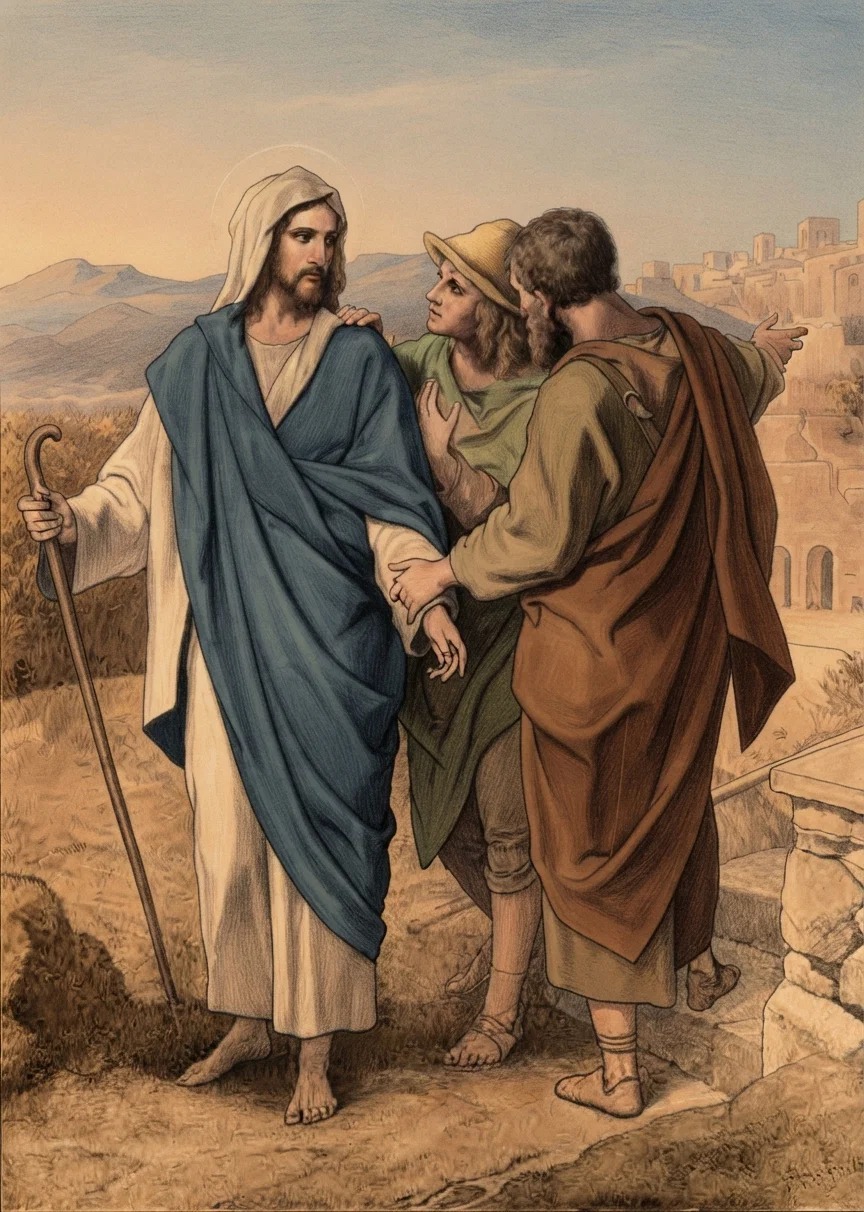
ABIDE WITH US. Hofmann.
"He said unto them, What manner of communications are these that ye have one to another, as ye walk, and are sad? And the one of them, whose name was Cleopas, answering said unto Him, Art Thou only a stranger in Jerusalem, and hast not known the things that are come to pass there in these days?" They told Him of their disappointment in regard to their Master, "which was a prophet mighty in word and deed before God and all the people;" "but the chief priests and our rulers," they said, "delivered Him to be condemned to death, and have crucified Him." With hearts sore with disappointment, and with quivering lips, they added, "We trusted that it had been He which should have redeemed Israel: and beside all this, to-day is the third day since these things were done."
Strange that the disciples did not remember Christ's words, and realize that He had foretold the events which had come to pass! They did not realize that the last part of His disclosure would be just as verily fulfilled as the first part, and that the thirdday He would arise again. This was the part they should have remembered. The priests and rulers did not forget this. On the day "that followed the day of preparation, the chief priests and Pharisees came together unto Pilate, saying, Sir, we remember that that deceiver said, while He was yet alive, After three days I will rise again." But the disciples did not remember these words.
"Then said He unto them, O fools, and slow of heart to believe all that the prophets have spoken; ought not Christ to have suffered these things, and to enter into His glory?" The disciples wondered who this Stranger could be, that He should penetrate to their very souls, and speak with such earnestness, tenderness, and sympathy, and with such hopefulness. For the first time since Christ's betrayal, they began to feel hopeful. Often they looked earnestly at their Companion, and thought that His words were just the words that Christ would have spoken. They were filled with amazement, and their hearts began to throb with joyful expectation.
Beginning at Moses, the very alpha of Bible history, Christ expounded in all the Scriptures the things concerning Himself. Had He first made Himself known to them, their hearts would have been satisfied. In the fulness of their joy they would have hungered for nothing more. But it was necessary for them to understand the witness borne to Him by the types and prophecies of the Old Testament. Upon these their faith must be established. Christ performed no miracle to convince them, but it was His first work to explain the Scriptures. They had looked upon His death as the destruction of all their hopes. Now He showed from the prophets that this was the very strongest evidence for their faith.
In teaching these disciples, Jesus showed the importance of the Old Testament as a witness to His mission. Many professed Christians now discard the Old Testament, claiming that it is no longer of any use. But such is not Christ's teaching. So highly did He value it, that at one time He said, "If they hear not Moses and the prophets, neither would they be persuaded tho one rose from the dead!"
It is the voice of Christ that speaks thru patriarchs and prophets, from the days of Adam even to the closing scenes of time. The Saviour is revealed in the Old Testament as clearly as in the New. It is the light from the prophetic past that brings out the life of Christ and the teachings of the New Testament with clearness and beauty. The miracles of Christ are a proof of His divinity; but a strong proof that He is the world's Redeemer is found in comparing the prophecies of the Old Testament with the history of the New.
Reasoning from prophecy, Christ gave to His disciples a correct idea of what He was to be to humanity. Their expectation of a Messiah who was to take His throne and kingly power in accordance with the desires of men had been misleading. It would interfere with a correct apprehension of His descent from the highest to the lowest position that could be occupied. Christ desired that the ideas of His disciples might be pure and true in every specification. They must understand as far as possible in regard to the cup of suffering that had been apportioned to Him. He showed them that the awful conflict which they could not yet comprehend was the fulfilment of the covenant made before the foundation of the world was laid. Christ must die, as every transgressor of the law must die if he continues in sin. All this was to be, but was not to end in defeat, but in glorious, eternal victory.
During the journey the sun had gone down, and before the travelers reached their place of rest, the laborers in the field had left their work. As the disciples were about to enter their home, the Stranger appeared as tho He would continue His journey. But the disciples felt drawn to Him. Their souls hungered to hear more from Him. "Abide with us," they said. He did not seem to accept the invitation, but they pressed it upon Him, urging, "It is toward evening, and the day is far spent." Christ yielded to this entreaty, and "went in to tarry with them."
Had the disciples failed to press their invitation, they would not have known that their traveling companion was the risen Lord. Christ never forces His company upon any one. He interests Himself in those who need Him. Gladly will He enter the humblest home and cheer the lowliest heart. But if men are too indifferent to think of the heavenly Guest, or ask Him to abide with them, He passes on. Thus many meet with great loss. They do not know Christ any more than did the disciples as He walked with them by the way.
The simple evening meal of bread is soon prepared. It is placed before the Guest, who has taken His seat at the head of the table. Now He puts forth His hand to bless the food. The disciples start back in astonishment. Their companion spreads forth His hands in exactly the same way as their Master used to do. They look again, and lo, they see in the hands the print of nails. Both exclaim at once, It is the Lord Jesus! He is risen from the dead.
They rise to cast themselves at His feet and worship Him, but He has vanished out of sight. They look at the place which had been occupied by One whose body had lately lain in the grave, and say to each other, "Did not our heart burn within us, while He talked with us by the way, and while He opened to us the Scriptures?"
But with this great news to communicate they can not sit and talk. Their weariness and hunger are gone. They leave their meal untasted, and full of joy immediately set out again on the same path by which they came, hurrying to tell the tidings to the disciples in the city. In some parts the road is not safe, but they climb over the steep places, slipping on the smooth rocks. They do not see, they do not know, that they have the protection of Him who is traveling the road with them. With their pilgrim staff in hand they press on, desiring to go faster than they dare. They lose their track, but find it again. Sometimes running, sometimes stumbling, they press forward, their unseen Companion close beside them all the way.
The night is dark, but the Sun of Righteousness is shining upon them. Their hearts leap for joy. They seem to be in a new world. Christ is a living Saviour. They no longer mourn over Him as dead. Christ is risen—over and over again they repeat it. This is the message they are carrying to the sorrowing ones. They must tell them the wonderful story of the walk to Emmaus. They must tell who joined them by the way. They carry the greatest tidings ever given to the world, a message of glad tidings upon which the hopes of the human family for time and for eternity depend.

The Goodness of God.

O THAT our lives were one sweet song, One anthem of continued praise To Him who bought us with His blood, And crowns with good our passing days!
What earthly potentate e'er gave His only well-beloved son An ignominious death to die For crimes that he had never done?
Good do we say?—Alas for words, For fitting words to speak His praise! We only know and see and feel The love that shines thru all His ways!
That love has crowned our every hour Since first we learned to lisp His name; A tender Father, merciful, To-day as yesterday the same. SUSAN BIRDSALL ROBERTS.

Open the Heart to the Spirit.

He who loves Christ most will do the greatest amount of good. There is no limit to the usefulness of one who, by putting self aside, makes room for the working of the Holy Spirit upon his heart, and lives a life wholly consecrated to God. If men will endure the necessary discipline, without complaining, or fainting by the way, God will teach them hour by hour, and day by day. He longs to reveal His grace. If His people will remove the obstructions, He will pour forth the waters of salvation in abundant streams thru the human channels. If men in humble life were encouraged to do all the good they could, if restraining hands were not laid upon them to repress their zeal, there would be a hundred workers for Christ where now there is one.
God takes men as they are, and educates them for His service, if they will yield themselves to Him. The Spirit of God, received into the soul, will quicken all its faculties. Under the guidance of the Holy Spirit, the mind that is devoted unreservedly to God, develops harmoniously, and is strengthened to comprehend and fulfil the requirements of God. The weak, vacillating character becomes changed to one of strength and steadfastness. Continual devotion establishes so close a relation between Jesus and His disciple that the Christian becomes like Him in mind and character. Thru a connection with Christ he will have clearer and broader views. His discernment will be more penetrative, his judgment better balanced. He who longs to be of service to Christ is so quickened by the life-giving power of the Sun of Righteousness that he is enabled to bear much fruit to the glory of God.—Desire of Ages.

The Bible.

EIGHTEEN centuries have passed since the Bible was finished. They have been centuries of great changes. In their course the world has been wrought over into newness at almost every point. But to-day the text of the Scriptures has copyings almost innumerable and after having been tossed about thru ages of ignorance and tumult, is found by exhaustive criticism to be unaltered in every important particular—there being not a single doctrine, nor duty, nor fact of any grade, that is brought into question by variations of readings—a fact that stands alone in the history of such ancient literature.—E. F. Burr.

How Our Methodist Friends Regard Us.

"THE CHRISTIAN ADVOCATE," the leading paper of the Methodist Episcopal denomination, edited by Rev. James Buckley, D.D., LL.D., in its issue of June 18 has an editorial headed "The Seventh-day Adventists and the Protection of Sunday." The editor refers to the position of Seventh-day Adventists respecting religious legislation as stated by Mr. A. G. Daniells, the president of the General Conference of Seventh-day Adventists; namely, that we do not believe in religious legislation, either in the protection of Sunday by law, or the protection of the seventh-day Sabbath by law; that the civil law would be detrimental to the sanctity and the observance of the seventh day, and continues:
"We are pleased to have the opportunity of stating their case in the words of an authoritative representative. We differ with him and his colleagues on these grounds:
"1. Sunday laws in this country do not require any person to worship God or to attend any church whatsoever. So far as the laws of the states or the federal government go, a man may freely stay away from religious services all the days of his life and never mention the name of God or think of Him.
"2. It is necessary to the welfare of the people of the United States that there be a general sentiment of respect for religion.
"3. For the physical and intellectual welfare of the people it is desirable that one day in SEVEN shall be a legal holiday.
"4. Special protection for such days is necessary, that those who wish to use them for religious purposes can do so without disturbance, and those who would make the day a corrupting day may be held in check.
"5. With due regard to laws for the purpose stated in the preceding paragraph, citizens may make the day a HOLY day or a holiday, or partly a holy day and partly a holiday, according to their consciences or tastes.
"Such a law is not unconstitutional and is not dangerous.
"If the ideas of the Seventh-day Adventists were fully carried out, it would not be long before Sunday would become an evil day, a day of clamor, a day of dispute, a day of rollicking and noisy amusements, a day to be feared by every mother and every conscientious father. We have sometimes sympathized with the Seventh-day Baptists because their day had no protection, while those who believe in Sunday have such protection. But having discovered by the statement of the president of the Seventh-day Adventists that they do not believe in any kind of protection, our heart-strings will no longer vibrate in sympathy with them upon this point.
"Meanwhile we rejoice to see their devotion to their conscientious views and principles. In matters of this kind we would rather be wrong and unpopular, conscientiously, than to be right merely for popularity’s sake. We bow to every one who stands up for what he believes to be right, unless he attacks the rights or, unjustly, the characters and reputations of his fellow citizens. Any person of the latter class deserves contempt, and if he becomes too unbearable he should feel the full force of the law."
The Advocate presents no new positions or any particularly striking, self-evident, Christian logic, and yet from the position that it occupies as the leading exponent of a great denomination, its comments are worthy of notice. Therefore we refer to the above paragraphs as they are there numbered.

Infringement of Religious Rights.

1. It is true that Sunday laws at the present time do not require any person to worship God or to attend any church, but that is the ultimate object, however, of many Sunday-law advocates. Further than this, it is the religion of some individuals that God does require a man to work six days in the week and rest one. They religiously and conscientiously can not believe that it is duty to abstain from labor two days in the week. There are many, very many more, who can not afford to do this. Even if the law of God is not mandatory regarding work, it certainly is permissive; it gives the man the right to work six days as well as to rest the seventh; and it is an infringement on one’s religious liberty to demand that he shall, after observing a day according to his own conscience unto God, observe a day out of deference to the wishes of his fellow men. And it would be utterly intolerant and unjust on the part of Sunday-keepers or Sabbath-keepers to demand it. Why are not the conscientious scruples of the seventh-day man just as sacred as those of the first-day man? In matters of conscience numbers matter nothing. Error has ever been in a majority in this world. The conscience of the one is as sacred as that of the million. Moreover, a law demanding the observance of a weekly rest day is unjust. God gives to all men the full week of time; He asks that man shall voluntarily yield one seventh of that time to Him, but He has placed no man or set of men on the judgment-seat to say how that time shall be rendered to God, or when, and to say that after one has rendered that amount of time to the Lord in harmony with his conscientious scruples he should observe another day in deference to the wishes of his fellows, who may at the time be in a majority. To do that is to place a tax of sixteen and two-thirds per cent upon that individual simply and solely because of the wishes of his fellow men, who are in no wise better citizens or neighbors. It would seem as tho the justly minded Sunday-keeper would see the utter inequality and injustice of such a law.

“Respect” and Legislation.

2. It is necessary to the welfare of the people of the United States and every other country that there be a general sentiment of respect for religion, but it does not follow that that respect can be obtained by legislation. The restriction of our rights does not lead to added respect for the one who restricts them. The highwayman who, by bludgeon or pistol, holds us up in the highway may command our subjection for a little time, but he does not increase our respect for him. No respect for religion was ever obtained thru enforcement of law. If there is not enough of inherent worth in the religion itself and those who profess it to command the respect of man, that respect will never be gained by endeavoring to enforce it. It will simply result in making men hypocrites.
The Lord Jesus Christ and the motives that actuated Him and His disciples awakened and perpetuated more respect for religion than all the laws of His opposers who persecuted Him, but who felt that it was necessary that there be “a general sentiment of respect” for

Welfare and Legislation.

3. It may be necessary for the physical and intellectual welfare of the people that one day in seven should be observed; but it is absurd to say that because it is thus necessary, it shall be a legal holiday. One might as well argue that for the physical and intellectual welfare of the people, it is desirable that eight hours for sleep shall be constituted a legal requirement, that the law should provide certain kinds of clothing, certain kinds of food; in other words, that the country itself shall be a great big mother for the enforcing of everything which is thought good for the welfare of the people. It would be pitiable Christian logic to contend for such a law, and it would develop even more pitiable characters.

Legal Protection for Human Rights Not for Institutions.

4. Why is “special protection for such days necessary”? We have laws guarding the religious worshippers in their rights now, without any regard to the holiness of the day on which their worship may be held. It is made, so far as we know, in every state of the Union a punishable offense to disturb a religious meeting. Such laws as that are proper for the protection of human rights. The Christian Advocate proposes to turn from the only true fundamental principle of government, the protection of human rights, and place the protection upon a religious institution, thereby exalting those who may keep it resulting in class legislation, class laws, and governmental intolerance. There is nothing in this world to hinder a single soul from observing any day of the week religiously if he so chooses, and has the manhood to do his duty.
There are one hundred thousand people, or more, in this country who observe the seventh day of the week as the Sabbath. They do not feel that that day needs any other “protection” than what God has Himself invested it with. They do not find their worship disturbed by others to such an extent that they feel that it is necessary to give up that worship, and they also feel that the strongest influence that can possibly be exerted to lead men to respect that day is to lead a Christian life that is worthy of respect.

Unconstitutional.

5. Man can not make a “holy day;” he can not make himself holy, and only a holy man can keep holy a holy day. By no act of his can he sanctify a day which is notholy; only God can make holy. He has made one day holy, and only one. Sinful man can desecrate that day; he can not desecrate a day which is not sacred; he can not make a day “partly holy” and “partly a holiday.” It is an utter misconception of the Biblical Sabbath to conceive of such a thing as that. In the very spirit of the Constitution, all Sunday laws or all Sabbath laws are unconstitutional. All laws for the protection or promotion of a religious institution, tenet, or creed are unconstitutional. Just as soon as a people gets to legislating upon the thing, and for the thing instead of for the man, it departs from the fundamental principle of what a democracy ought to be. Governments are instituted to conserve the equal rights of mankind, not the supposed sacredness of some institution, or some sect or combination of sects which regard the institution. If Sunday people would observe the day as some of them feel that it ought to be observed, would live the life of the Master, would leave the world and its amusements, they would do more to make Sunday respected than any amount of laws could do. If the ideas of Seventh-day Adventists were carried out, Sunday would be a sober working-day, in which all rights of all men would be regarded.

The Full Force of the Law.

From editorials of the past we have learned how deep the heart-strings of the editor of The Christian Advocate have been affected. We note also what is stated in the last sentence quoted above; we can easily see how one who teaches the Bible Sabbath, and in that very teaching shows that Sunday is not the Sabbath and has no Biblical claims upon the people, would be regarded as contentious, one who was attacking the rights of his fellow men, and would therefore be deserving of contempt, and if continued, “should feel the full force of the law.” That has always been the case; it was that cumulative evidence which the Jews piled up against our Lord which led at last to His death as a Sabbath-breaker.
It is a strange thing to us that Protestant Christians should ever desire any help whatsoever from the state for the support of their tenets or creeds. Why can they not see that the strongest influence conceivable for the upholding of every Christian institution is the pious example of its members? Why can they not also see that if that example be lacking, no human law which it is possible for men to frame can ever command the respect of those who are without? If it is proper and just to secure laws for the protection of Sunday as a Christian institution, why not for every other Christian dogma or institution?
These and a score of other questions ought to come home to the heart of every true believer in the Lord Jesus Christ. The power of Christianity lies not in the laws which it is able to obtain by influencing legislators but in the devoted lives of its followers, in the out-breathing of the spirit of Christ from within, in the benevolence and devotion of its members to the principles of the religion of Christ. These wanting, all are wanting. If these are held, it matters not what may come upon the church from without, she will grow and win souls for the Master. But religious legislation of any and every form has been a blight and a curse to the church thruout all the ages. And the lesson that we ought to read in the gruesome light of the past centuries ought to be that like causes produce like effects, and that the recrudescence of the laws of the early centuries will produce the Dark Ages now as truly as they did then.
ABDIEL.
Continue reading: The Controversy and Its Outcome