Your ShelfYour Projects

Review and Herald, Vol. 81, No. 17.

It Will Soon Be Ready

Review and Herald

Apr 28, 1904

Review and Herald Publishing Association · Washington, D.C. · Apr 28, 1904

It Will Soon Be Ready
SIGNALS NUMBER 1
SIGNALS NUMBER 1
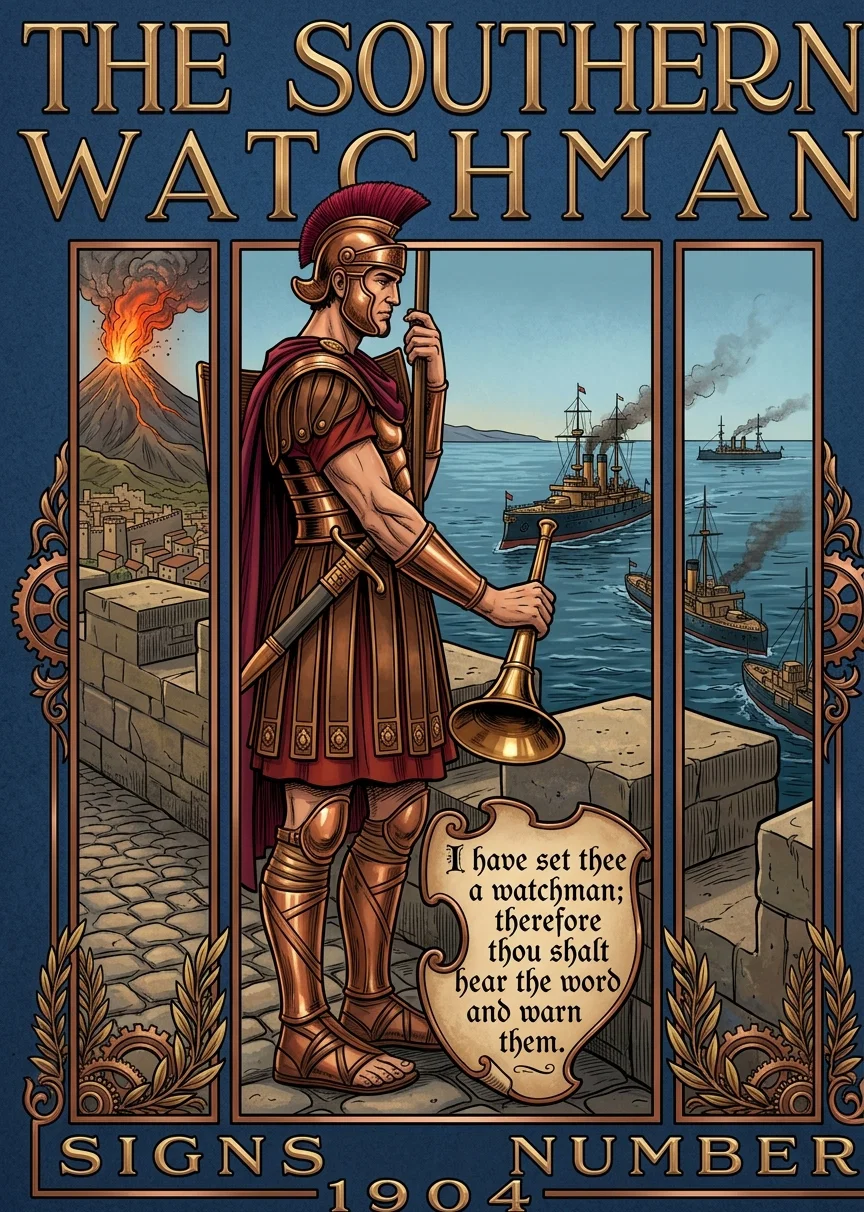
The accompanying cut is a miniature reproduction of the cover design for the special number of The Southern Watchman.
The flames of the city conflagration shown in the picture, as well as those issuing from the volcano, are given a fire effect when printed in two colors, and this adds much to the attractiveness of the design. This, together with the armed, expectant attitude of the watchman, and the war-ships on the right, when it appears in colors, presents a scene that is both striking and suggestive. It is certain to attract the attention of the people.

Object

If the opportunity is given them, there are many who can be made to see the real meaning of the events now taking place, and who could not be interested in the truth in any other way. They believe that the world is on the verge of some great event, they know not what. Already men's hearts are beginning to “fail them for fear, and for looking after those things which are coming upon the earth.” Now, while they are in this expectant condition, is it not the time to show them the true meaning of all these things, and to lead them, if possible, to an acceptance of the truth for this time? This is the object of the forthcoming special number. Do you not want to do all you can to give it a wide circulation?

Contents

The following are a few of the clear-cut articles that will appear: “I Will Come Again;” “Manner of Christ’s Coming;” “The Second Coming of Christ the Hope of the Church;” “The Last Generation,” “A Warning Message,” “Evangelization of the World a Sign of the End,” “The Testimony of the Prophets,” “Rumors of Wars and Distress of Nations,” “Capital and Labor,” “The Money Question,” “Present Truth,” “That Day,” “The Day of Recompense,” “Second Advent,” “Disasters by Land and Sea,” “The Millennium,” etc., etc.

Pictures of Pioneer Workers

In connection with the articles there will be photographs of Elder James White, Mrs. E. G. White, and other pioneer workers. These will be especially appreciated by our own people, and will also assist in the sale of the paper to others.

Size, Two Colors, Etc.

As has been previously announced, this number will contain twenty-four pages, be printed in two colors, and profusely illustrated throughout. The illustrations will be new and forcible, and will help to make more vivid the articles with which they appear.

Rates

Notwithstanding the extra number of pages, its numerous illustrations, the high grade of the paper that will be used, and other additional features, this issue will be furnished at the following rates: To one address, 5 to 24 copies, 4 cents a copy; 25 or more copies, 3 cents a copy.

List of Names

Those who can not go out and sell the paper, but who would like to furnish it free to some of their acquaintances or others, may send in a list of names, and single copies will be addressed and mailed directly to the names given, as follows: 1-24 copies, 5 cents each; 25-99 copies, 4 cents each; 100 or more copies, 3½ cents each. Ministers, doctors, lawyers, teachers, business men, as well as the laboring classes, should all have this number.

A Rapid Seller

The retail price of this special issue will be five cents a copy, although in many sections of the country it can be sold for ten cents just as readily as for five, thus giving a profit of seven dollars a hundred to the person selling it.
This number will be one that the people will want. It is sure to interest the busy man and woman. Its numerous illustrations are of such a character as to attract the attention of nearly every one, and there are many who will buy it because of the pictures it contains, if for nothing else. In this way we hope that many may be led to a study of the truth who would not otherwise be reached.

Ordering

Every mail brings orders for this special number from all parts of the United States and Canada. One good brother has sent in his order for 10,000 copies, while many others are ordering as high as 1,000. We are also receiving some very large orders from conferences and tract societies, and the outlook grows brighter every day for a half-million circulation. Copies will soon be ready.
Order of State Tract Societies; Review and Herald, Battle Creek, Mich.; Review and Herald, Washington, D. C.; Pacific Press, Oakland, Cal.; Kansas City, Mo.; Southern Publishing Assn., Nashville, Tenn.

Publishers' Page

Conducted by the Department of Circulation of the Review and Herald Publishing Company

Announcement of the Revision and Completion of the Series Easy Steps in the Bible Story

For a number of years the publishers have been studying how to meet the growing demand indicated practically in the following oft-repeated expressions written them by parents in search of a simple, pure, and connected story of the whole Bible:—
“We want a book that will give our children a clear, clean, and connected conception of the Bible story. We wish the children were taught the story of the Bible in a simple, connected way. When we were children, we were taught the Bible consecutively from Genesis to Revelation, and we knew it, too.”
In the study of the books now published by the denominational press one was found in which the supplying of this demand was contemplated and successfully begun, but through the oversight or neglect of the publishers it had never been completed. After bestowing careful study on the plan and the nature of the book, and receiving safe counsel, it was decided to ask the author of this book, “Easy Steps in the Bible Story,” to complete her first plan, and to produce a full story of the Bible for children, in a series of six books, 6½ x 9⅜ x ½ inches in size, printed on good quality of paper, in new, large, open-face type, profusely illustrated with original, full-page drawings, colored plates, and new attractive marginal illustrations that really illustrate the text, every page to contain a picture made especially for illustrating and impressing the story recorded on that page, and a beautiful new cover design for the entire series.
The first volume is to cover that part of the Bible story from the creation of the world to the giving of the law—the old book revised and four new chapters added.
Volume two will resume the narrative, and give the story of Israel in the building of the Tabernacle and establishing its services, The Sin of Nadab and Abihu, The Numbering of the People, Israel Leaving Mount Sinai, The Sending of the Quails, The Sin of Mariam and Aaron, The Report of the Spies, The Sin of Korah, Dathan, and Abiram, Moses and Aaron Dishonor God, The Fiery Serpent, The Victory over Sihon and Og, Balaam, Death of Moses, The People Cross the River Jordan, The taking of Jericho, The Sin of Achan, and the Defeat of Ai, The Sun and the Moon Obey Joshua, The Land Divided, The Last Words of Joshua, Gideon, Samson, Story of Ruth, Child Samuel, The Ark Taken by the Philistines, The Ark Sent Back to Israel.
The other volumes will cover the remaining story of the entire Bible, with the wars, intricate and complicated narrations, only necessary for adults, eliminated, and practical moral lessons woven in where the child would not be able to draw them from the text without the aid of a more mature mind.
The work on the first two volumes is far advanced, and we are pleased to be able at this date to announce that they will be completed by August 1, and that the remaining volumes will be published as early thereafter as possible. This series of the “Child's Bible” will be bound in two styles, board and cloth, and will sell for 50 and 75 cents a copy.
Undoubtedly these will be the best books on the story of the Bible that have ever been produced for children, and the price is low for the quality.

Editorial

“A Strong Encouragement”

OUR hope of salvation from sin, of present and eternal deliverance from its galling bondage, rests upon the certainty of the existence of God. As certain as we are that God lives, so certain we may be that he will save all that call upon him for salvation through faith in Christ. The assurance of this is found in the following scripture: “For when God made promise to Abraham, since he could sware by none greater, he sware by himself, saying, Surely blessing I will bless thee, and multiplying I will multiply thee. . . . For men swear by the greater: and in every dispute of theirs the oath is final for confirmation. Wherein God, being minded to show more abundantly unto the heirs of the promise the immutability of his counsel, interposed with an oath; that by two immutable things, in which it is impossible for God to lie, we may have a strong encouragement, who have fled for refuge to lay hold of the hope set before us.” Do you see the real force of these statements? “God points to himself,—his divine being, his glory, his power,—and pledges himself, gives himself as security, as hostage, that, as sure as he lives, he will fulfil his promise. O, if we would but take time to tarry in the presence of this God, and to listen to him swearing to us that he will be faithful, surely we should fall down in confusion that we ever harbored for a moment the doubt which thinks it possible that he may be untrue and not keep his word.” When we contemplate the wondrous love of the God as shown in the gospel of his grace, it seems surprising that we could ever grieve him by yielding to the temptation to doubt and disbelieve him. But such is the deceitfulness of sin, and such is the desperately wicked heart. It is the purpose of Satan so to fill our minds with the cares and anxieties of this fleeting life that we shall forget the “exceeding great and precious promises,” and thus neglect “so great salvation.” Take time to meditate upon these things. “The words of Jesus are the seeds sent down from heaven, that plants of heavenly joy, peace, love, knowledge, and power may take root in humanity.” In these words you will find many reasons for “a strong encouragement.”

“The Lord’s Christ”

THERE was one mark which clearly distinguished Jesus of Nazareth, the true Messiah, from all the false messiahs who claimed his title. This was indicated in the name bestowed upon him before his birth. “Thou shalt call his name Jesus; for it is he that shall save his people from their sins.” When Simeon, “righteous and devout,” to whom it had been revealed “that he should not see death, before he had seen the Lord’s Christ,” recognized the child Jesus as “the Desire of all nations,” he emphasized the character and work of “the Lord’s Christ” in these words: “Mine eyes have seen thy salvation, . . . a light for revelation to the Gentiles, and the glory of thy people Israel.” The true Christ saves from sin. The false christ, or the false conception of Christ, leaves men in their sins. And it is very necessary to-day that we should distinguish between “the Lord’s Christ,” who is a Saviour from sin, and the christ of the higher critics, the scientists, and the philosophers. This is well expressed by The Signs of the Times: “What much of the talk about Christ to-day means is not a personal Saviour, but a condition of soul, an inherent life within. It is the exaltation of humanity, and the hiding of the real Christ of the gospel.” In this religio-philosophical christ there is no salvation from sin, no “power of an endless life.” He is simply Baal, or Buddha, or Confucius presented to a professedly Christian people under the sacred name familiar to them. Many are being thus deceived, and having exchanged “the Lord’s Christ” for “a god that can not save,” they are left to the cruel buffetings of Satan. The true gospel is “the power of God unto salvation.” This power is revealed in us through our faith in that Christ who is “the power of God, and the wisdom of God.” This is the Christ through whom all things were created. “In him dwelleth all the fulness of the Godhead bodily, and in him ye are made full, who is the head of all principality and power.” The genuine preaching of the everlasting gospel now exalts this Christ by calling upon all to worship “him that made the heaven and the earth and sea and fountains of waters.” The true message for this time says, “Behold your God” as revealed in “the Lord’s Christ.” “Behold, the Lamb of God, that taketh away the sin of the world.”

The Annual Sermon

IN this northern hemisphere the trees are now preaching their annual sermon on the coming of the Lord. They are calling attention to the words of our Saviour: “Behold the fig tree, and all the trees: when they now shoot forth, ye see it and know of your own selves that the summer is now nigh. Even so ye also, when ye see these things coming to pass, know ye that the kingdom of God is nigh. Verily I say unto you, This generation shall not pass away, till all things be accomplished.” The signs of his coming which our Lord included in “these things” have been fulfilled. The generation now living has seen them, and as certainly as the putting forth of leaves by the trees is an unmistakable sign of the near approach of summer, so certainly are “these things” a sign of the nearness of the time when the God of heaven shall set up “a kingdom which . . . shall stand forever.” Some who were living when “these things” were presented to the world as signs of the near advent will witness the glory of that great day. Listen to the sermon which the trees are preaching. “The time is at hand.”

“In Derision”

IN the second psalm we read of certain persons of whom it is said that “the Lord will have them in derision.” These are they who “meditate a vain thing.” These are they who “take counsel together,against Jehovah, and against his anointed.” These are they who say, “Let us break their bonds asunder, and cast away their cords from us.” The Lord is long-suffering, “not willing that any should perish,” but love derided by the sinner will become righteous wrath, and those who choose derision will themselves be held “in derision.” But others besides the mocking sinner will be held “in derision” by the King of the universe. The so-called great men of to-day who are setting themselves against the Lord by disparaging portions of his Word as “a pack of lies, too gross for toleration,” will be judged by that same Word which they have held “in derision,” and will be found worthy of themselves being held “in derision.” Of what value then will be the pride of human opinion? How much better it is to tremble at his Word now than then!

Orthodoxy and Heresy

Three quarters of a century ago the so-called orthodox churches stood for something definite. They defended the plenary inspiration of the Scriptures. They appealed to the Bible as the final authority in matters of faith and practise. There were men who upheld with much clearness and force, as against the attacks of the professed infidel or the scientific atheist, the doctrine of the atonement and the necessity of personal faith in the death, resurrection, ascension, and priestly ministry of Christ as the basis of salvation from sin. Teachers were not permitted to occupy the pulpits in these churches who compromised these fundamental principles of truth and surrendered the strongholds of Christianity at the demand of the enemy. There was still left in these churches sufficient spiritual vitality to resist the encroachments of infidelity, and to cast out from their midst those who were seeking to undermine the very foundations of Christian belief while professing to be its defenders.
To the churches in this condition came the advent message—a message of preparation for the soon-coming Saviour. This was the opportunity for these orthodox churches. If the message had been received, additional power would have attended the ministry of the word, hypocrites would have trembled, and the teachings of the enemies of the gospel would have been recognized at once, regardless of their pretended loyalty to truth. The light of the advent message shining in the churches would have revealed all the sophistries of the enemy of all righteousness, and a pure doctrine would have been fully restored. Orthodoxy, a genuine orthodoxy, would have conquered heresy.
But the churches rejected the advent message. They refused to accept the very truth which would have been to them a defense against the insidious attacks of Satan in the last generation of the conflict, and thus the light which was in them became darkness.
To the churches whose spiritual discernment had been in a large degree dulled by this experience came the demands of a false science, claiming that the teachings of nature overthrew the Biblical account of creation. Not recognizing that this was the decisive battle-ground of a genuine orthodoxy, and that the fundamental principles of Christianity were really at stake, those who were originally set for the defense of the gospel surrendered the very citadel of faith, and received as orthodox teaching the essential principle of all heresy and heathenism—a false view of God in his relation to his created works. It only remained for this false teaching to bear its inevitable fruit, and in due course of time this has appeared, until now the professed leaders of orthodoxy are openly inculcating such teachings concerning God and his relation to the chief of his created works—man—as set aside the doctrine of the atonement as “a survival from barbarous times.” All this was involved in the first claims of evolution; but in that twilight where truth and error commingle, the far-reaching consequences of this kind of nature teaching were not perceived. Under the cloak of modern science there was thus introduced into the churches the leaven of ancient heathenism, and when it became sufficiently developed so that some uncorrupted minds began to appreciate its true nature, behold, it has gained sufficient influence so that it now refuses to be called heresy, and claims to be orthodoxy. Thus the heresy of a century ago has become the orthodoxy of to-day.
These principles are well illustrated in the recent trial of Prof. Borden P. Bowne, of Boston University, for heresy, before a committee of the New York East Conference of the Methodist Church.
The complainant is reported in the daily press as saying:—
After much careful study into the writings of Professor Bowne, I am compelled by my interest in the cause of Christ, to express the opinion that he teaches rationalism in its most subtle and dangerous form, and that he has organized a propaganda within the Methodist Church for the promotion of his views. The Methodist Church is strictly and rigidly orthodox and intensely evangelical in its theology. Why should Professor Bowne remain in the fellowship of a church whose creed he does not teach? That is a hard question to answer. When we are told of the great influence that Professor Bowne already has secured within the church, the question naturally comes to mind. Is it his game to remain in our church until he has so thoroughly demoralized officers and crew that he can make away with the entire denomination? I have studied his writings with considerable care, and I am prepared to say that to my knowledge he has never defended nor advocated a single doctrine of the Methodist Church. He is against us, and all his influence is against us.
There is little doubt in the mind of any well-informed man that the teachings of Professor Bowne are directly contrary to the principles of Methodism as interpreted by its leading advocates of half a century or more ago. This is recognized in the following editorial comment which appeared in the New York Sun:—
The unanimous acquittal by the Brooklyn Methodist Conference of Dr. Bowne, a professor of philosophy in the Boston University of that religious denomination, after a trial on charges of heresy, was a result of the proceedings which might have been expected as almost a foregone conclusion. The charges against Dr. Bowne presented as specifications extracts from books written by him, in which he was accused of having denied or questioned the dogmas of the Trinity, the atonement, miracles, future punishment, and other doctrines of the Methodist Church. He spent two years in the study of theology in Germany, and evidently his mind, or at least his manner of treatment of the subjects he has discussed in the half dozen or more books on philosophy and theology published by him, was affected by the methods of the newer German theological school. But to anathematize him as a heretic would be to condemn the present teaching of our Protestant theological seminaries very generally. If he is a heretic, the prevailing tone of the teaching in those schools of divinity and in pulpits is heretical also, and heresy trials will have to go on, long and continuously, in order that all the offenders may be brought to book.
The simple fact in the case is that the teachings of the new theology have so fully permeated the minds of the representatives of Methodism to-day that there does not remain in the body sufficient power to defeat and cast out these perversions of the truth. This church, in common with all the others, declined to receive that message of the everlasting gospel which is to be proclaimed to this generation in such a setting as to save the believers from the special snare for these last days—a flood of skepticism and false philosophy concerning the being of God and his relation to the things which he has made. The simple advent message, the message from heaven for this time, is the sure defense, and the only sure defense, against these errors. To reject this message is to reject the only way of escape from the snare of the enemy. For this reason the Methodist Church is unable to purge itself from the leaven of heathen philosophy, and to the surprise of no one Professor Bowne was acquitted unanimously of all the charges against him. So it has been, and so it will be, in the other churches. Orthodoxy has surrendered. Heresy rules in the churches.
But what about the advent messageitself? Will any effort be made to corrupt this teaching with the same evil principles of a false philosophy? We need not look far afield for the answer to this question. We have been brought face to face with this experience. The present situation is briefly and authoritatively summarized in the following paragraph from 'Testimonies for the Church,' Vol. VIII:—
The enemy is seeking to divert the minds of our brethren and sisters from the work of preparing a people to stand in these last days. His sophistries are designed to lead minds away from the perils and duties of the hour. They estimate as nothing the light which Christ came from heaven to give to John for his people. They teach that the scenes just before us are not of sufficient importance to receive special attention. They make of no effect the truth of heavenly origin, and rob the people of God of their past experience, giving them instead a false science.
Has this church, to which was committed this advent message, retained the truth as it is in Jesus in such a measure that it will be able to recognize and reject the same heresy which has become orthodoxy in the other churches? The future of this advent movement depends upon the answer which the future gives to this question. In this time of crisis it is the plain duty of every loyal believer in this final message to refuse any compromise with the sophistries of the day, no matter who teaches them, or in what pleasing dress they may appear. “False theories, clothed with garments of light, will be presented to God’s people. Thus Satan will try to deceive, if possible, the very elect. Most seducing influences will be exerted; minds will be hypnotized.” This is no ordinary time. This is no ordinary crisis. The call of the Commander is, “Come into line.” Happy are those who hear and obey the call.

The Nature of Sunday Legislation

The central idea in all Sunday legislation is that Sunday is a sacred day, the divinely appointed weekly rest day of the Christian world. But for this idea, no Sunday legislation would ever have been enacted.
But for those who believe this idea to be true—who favor Sunday as a religious day—present-day movements for Sunday legislation would at once fall to the ground, divested of all their support. The most earnest and persistent advocates of such legislation are clergymen, whose business it is as such to advocate Sunday observance as a religious duty, disregard of which will invite the judgments of heaven.
At the present time the religious idea is frequently kept in the background, perhaps wholly concealed beneath a secular covering, in Sunday law movements. The present effort for Sunday closing of butchers’ and grocers’ stores in the District of Columbia is an example. But the religious idea is there. The idea of Sunday as a religious institution established and for centuries observed by the Christian church, is the root idea of such as of all Sunday legislation, and by it the real character of such legislation is to be known.
There is much in history to enlighten us on this point. Growing out of this idea of the sacred character of Sunday, there has been in past times legislation not only enjoining the observance of Sunday as a day of rest, but prohibiting under severe penalties the observance of the seventh day. On another page of this paper, in the article “Sabbath-keepers in Scandinavia,” some very interesting and instructive quotations are given from historical documents bearing on this point. They reveal the spirit that pertains to the idea that Sunday as the Christian day of rest should be protected by law. They show what was done in that day, and what may be done in this day, under the leading of this deceptive principle.
They show another thing also, and that is that the observance of one day of the week as the Sabbath was held to be contrary to, and an interference with, the observance of any other day of the week. It was contrary to Sunday-keeping to allow the keeping of the seventh day, and therefore its observance was strictly forbidden. It was plain enough to the Sunday adherents that Sabbath-keeping permitted of the observance of but one day in the week. Yet seventh-day observers are often told now that a law requiring them to observe Sunday does not interfere with them religiously at all.
But we do not have to go beyond recent times to find evidence of the evil character of the spirit of Sunday legislation. Only last winter, in the city of Philadelphia,—that city which, though its notoriety for corruptness in government has reached even to the shores of Europe, is hailed as the “most Christian city in the land” by the Sunday-law party in Pennsylvania on account of its strict Sunday enactments,—in this city there were prosecutions by the Pennsylvania “Sabbath Protective Association,” which were of a character so contrary to the common dictates of humanity and justice that the magistrate before whom the cases were brought finally refused to be a party to such proceedings. The Public Ledger, a reliable journal, published the details of some of these cases. In its issue of January 22 it said:—
“I am done,” said Magistrate South yesterday, when the last of the cases against cigar and candy dealers for keeping their places of business open on Sunday was brought before him. “I have seen enough of this persecution, and of the attempts to deprive poor people of their means of support, and I will have no more of it.”
“I had no idea when I issued the first warrants,” he said, “that the cases would drag along several months, or I would never have become engaged in them. I have seen evidences of suffering and heard pitiful appeals which are hard to forget. One poor widow came here with nine children. As soon as she entered, I asked her if the children were all hers. She said they were, and I told her to go. I would listen to no evidence against a woman who has a family of that size to support. The very poor have been brought here, and the blind who had to be led into the room. The prosecution of such persons is repugnant to me, and I discharged many of them, when there was positive evidence against them, because I did not think it right to fine them.
“The agents of the Sabbath Association attempted to have me issue warrants for dealers who sell ice-cream on Sunday. I told them that ice-cream was as much a food as milk, and that I would issue no warrants of this kind. The curtain has been rung down on the last act, so far as I am concerned, and I am glad of it.”
The Sunday trade of some of the very poor who have been made victims of Sunday legislation, is very essential to them, being sometimes their chief dependence for a livelihood. This was illustrated by the case of one poor woman, a widow, who kept a small store in the District of Columbia. Speaking of the prospective Sunday-closing law, she said, “I can not compete with the larger stores; they can underbuy and undersell me, and almost my whole dependence is on my Sunday trade. If they close me up, I don’t know what I am going to do.”
For fear that they might lose a trifle from their abundance, by reason of the few small shops that keep open on Sundays in the District, the Sunday-closing tradesmen would compel poor widows with children to support to lose their all.
All this legislation, from first to last, was built up around the idea that Sunday is a religious day, and that its observance is obligatory as a religious duty. Out of that idea grew in former times, the legislation prohibiting Saturday observance, and out of the same idea grows the milder legislation of our own time, but they are all branches of the same tree; they have all grown up from the same root; they are all in embryo in the seed which Sunday-law associations are trying to sow. We do not want such seed to be planted and grow up in this land. If it does, it will bear its fruit, and it will be the same that the tree has borne in former times.
There are mild and virulent forms of the same disease. History has seen virulent forms of Sunday legislation, and we need not be deceived by the mild forms characteristic of the present time. It is the same thing as of old, with the same nature and spirit that have been manifested in persecution for conscience’ sake. The nature of a disease is to bejudged by its worst forms, and not by its milder ones. There is a great deal of very mild smallpox at the present time, but people know smallpox not by these mild cases, but by what it has been in the past. It is all the same disease, and the mild form is liable at any time to revert to the virulent form. And if Sunday legislation is once begun, however mild the initial forms of it may be, it will revert at some time, sooner or later, into the virulent forms of old, and the most oppressive laws will be enacted.
Let the civil power be kept out of the domain of religious controversy. That is the only way to give religious bigotry no chance to re-enact the old-time scenes of religious persecution.
L. A. S.

The World Is Waiting For It

THE only hope of the world is the coming of the Lord. On the side of evil every element is apparently ready for the crisis. Now all things are held for the one purpose of heralding to every nation and tongue the last warning message. That message, we say truly, is represented in this advent movement. Not only the groaning creation, but all heaven is watching to see us, then, rise up and in the strength of God actually carry the message to the world.
The reports from the wide fields that we have spread before us week by week show that wherever the workers go, the preaching of this message converts souls and builds up a work that adds strength to our forces, and calls men and women into service. In whatever country we may go, in whatever tongue the message may be preached, the same fruit appears. And it is the same third angel’s message that truth-seeking souls are waiting for. In Christendom or heathendom, the one difficulty is sin; and the one remedy is the only hope, the gospel of salvation as set forth in the great threefold message that has made us a people.
In the latest field we have opened, China, the Lord has shown by abundant fruit how ready and prepared the way has been made for us. Souls have been waiting in the darkness for years, longing for genuine help, and they recognize the help when it comes. It is the same everywhere. Out over the vast fields there is felt the pressure of the closing harvest hour.
In a letter just in from China, Drs. Selmon and Miller speak of the urgent need of this one thing—the third angel’s message—as it has been pressed upon their hearts in the interior of that vast empire. They write:—
Many of the plans that we had in the States have been greatly changed since coming here. Although we came with the purpose of making gospel work primary, yet we did not see as we do now that the gospel work is the all-important thing. While we could with profit devote our time entirely to medical work, yet because of our limited numbers, we feel that it is of far greater importance that we simply use the medical work in making an opening for us, and spend the larger portion of our time in giving the special message of truth for this time.
It is a good testimony, for, as the letter states, these young men went out to China having very definitely settled it that they went only as preachers of the third angel’s message. But the pressure of the overwhelming need in the field emphasizes the importance of the one thing as no argument from principles can do. It is a fact that gives no one rest when once the terrible truth is burned into the soul, that this perishing world is waiting for the third angel’s message to finish its work. No other thing can bring help to souls in darkness who long for light, and the heralding of the truth through every land is the only thing that can bring to an end the awful woe and suffering of a hopeless world. May each believer remember it in gifts and prayers for missions, and in surrender for personal service as God may call. W. A. S.

Saving Sunday

THE question of how to save Sunday has long troubled Protestants who believe that day to be the Christian sabbath; and as time goes on, developments in the church and in the world seem to make it more and more a matter of anxious concern. This was the theme of several speakers at a recent Sunday service in Mendelssohn Hall, New York City. One of these, the Rev. W. R. Huntington, spoke of the “growing disregard of the Sabbath,” and connected it with the increasing lawlessness of the times. The question now is how we shall save the institution, rather than how we shall observe the day, he said. “There are two bonds holding together the Christians of the world—the Holy Bible and the Sabbath day. If one wants to preserve and keep these bonds, he must keep the Sabbath as a reminder of the Almighty.”
This last statement touches the root of the difficulty. That Sabbath which is a reminder of the Almighty and is observed as such, is in no danger of being overthrown and lost. God himself is its guardian. The reason of the perishable nature of Sunday is that it rests on a perishable foundation. It rests only on human authority and tradition. When that foundation gives way, the institution must of necessity fall to the ground. Sunday is not a reminder of the Creator, and can not be kept as such. That reminder is the seventh-day Sabbath, which though opposed by popular custom in both the church and the world, is steadily making progress and gaining adherents in every land to-day.
It is interesting to note the reply called forth from a Catholic priest by this Protestant agitation over the question of preserving Sunday. The day following the report of this discussion, “Father” Tiernan, of Camden, N. Y., sent to the Sun, in reply, this statement of the Roman Catholic position regarding the character of Sunday and the authority on which it rests as a religious day:—
The Lord’s day, or Sunday, is not the Sabbath of the Bible, nor has it been made by the principle of private judgment, nor by the Bible; for it is the holy mass, the supreme act of worship, with the general law of the Catholic Church for ages binding on the Lord’s day, that has made the holy observance of the day in Christendom.
The consequences which these reverend gentlemen strive to remedy were initiated by the ancestral founders of the denominations to which they belong. Neither the Rev. W. R. Huntington nor the Bible can ever repair the floodgates thus opened to unsacrificial observance of the Lord’s day, the day of nearly twenty centuries.
Neither men nor the Bible, it is true, can furnish any good foundation for the popular Protestant position regarding Sunday. The Word of God declares the seventh day to be the Sabbath; the word of the papacy sets up the first day of the week in place of the seventh. It is for Protestants to decide whether the Lord, or whether Baal, is God. There is nothing to be gained by longer halting between two opinions.
It is true that the Bible and the Sabbath are two bonds holding together the Christians of the world, but this is true of the Bible received by faith, and not through the higher criticism, or the “new thought;” and it is true of the Sabbath of the Bible, and not of Sunday. The Sunday binds Christians only to Rome.
L. A. S.
Continue reading: The Central Union Conference