Your ShelfYour Projects

Signs of the Times, Vol. 24, No. 28.

RESURRECTED FOR SERVICE

Signs of the Times

Jul 14, 1898

Pacific Press Publishing Company · Oakland, California · Jul 14, 1898

RESURRECTED FOR SERVICE.
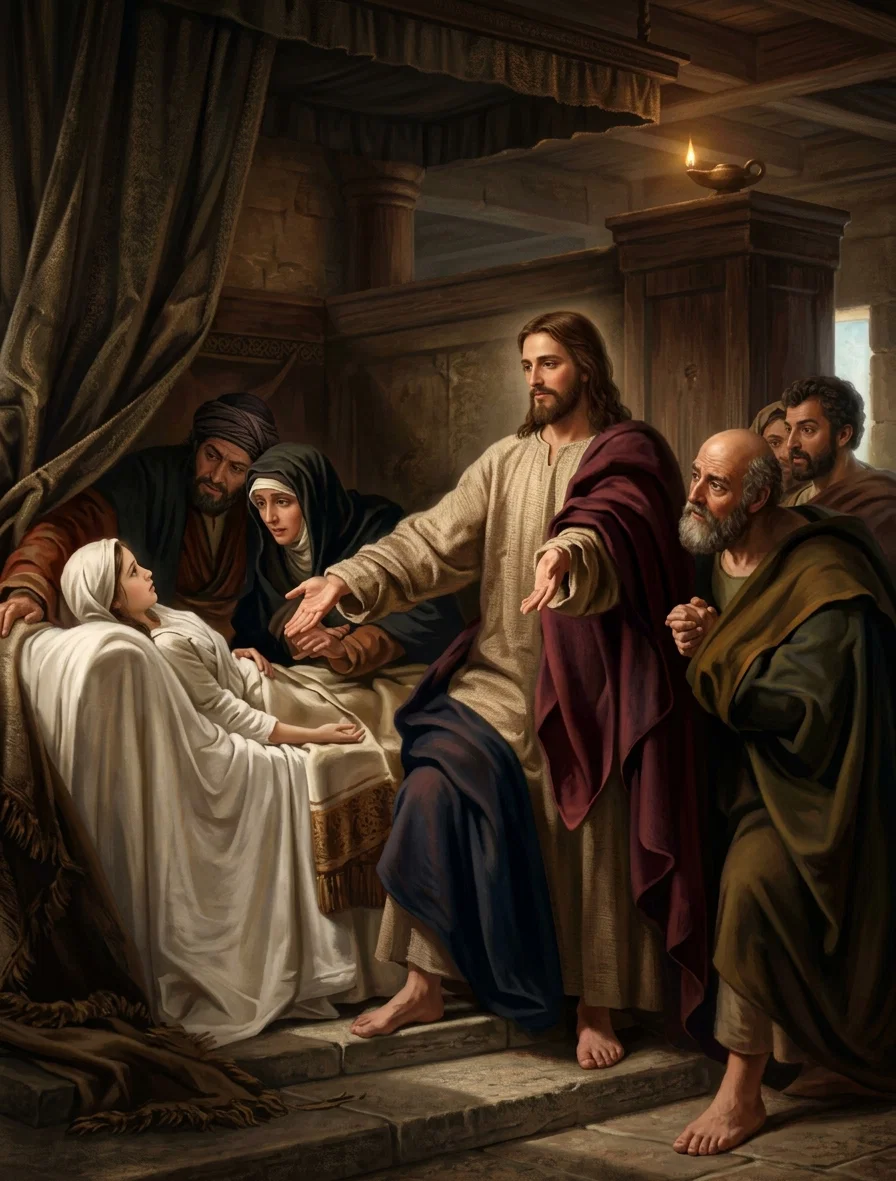
“I say unto thee, arise.” Mark 5:41.
“Awake thou that sleepest, and arise from the dead, and Christ shall give thee light.” Eph. 5:14.
“Arise, shine; for thy light is come, and the glory of the Lord is risen upon thee.” Isa. 60:1.
The illustration presented herewith pictures the raising to life of the daughter of Jairus.
“Damsel (I say unto thee), arise; and straightway the damsel arose, and walked.” Mark 5:41, 42.
The essential facts connected with the incident are familiar to all, and are quickly told. The ruler’s daughter lies dying; the anxious father presses his way to Jesus and asks Him to come and heal her; the Master consents, but arrives too late,—so the friends believe,—the maid is dead; only the father and the mother, with Peter, James, and John, are permitted to remain with Jesus in the room; and Jesus, taking the child by the hand, says, “Damsel (I say unto thee), arise. And straightway the damsel arose, and walked.”
The two great factors appearing in this incident are life and death, standing for righteousness and the power of God, and sin and its dread power, the working of Satan. Through sin, death has passed upon the whole race of mankind. All are by nature sinners since the fall of Adam. Death is the wages of all sin; and whether or not one wills to receive the pay, it is dealt out, sooner or later, by an inexorable law of nature, and forced upon every son and daughter of Adam. This is so not only respecting human beings but respecting the whole earth. The seeds of the wicked thing, as tho borne upon blasts from the bottomless pit, have spread hither and yon, fastening upon and working destruction in every animate and inanimate thing. “The whole creation groaneth.” There is absolutely no escaping it. These bodies of ours, all things that we behold, rich or poor, great or small, everything pertaining in anywise, direct or remote, to this sin-cursed earth—and the earth itself—must pass away because of sin.
If there were nothing else entering into the question, we should look to the bitter end and reckon ourselves, even now, the same as dead. And this is exactly the condition of the sinner, as defined in the inspired Word, “dead in trespasses and sins.” Eph. 2:1. Again, were there nothing limiting the execution of the sentence, the death would be eternal. The future would be utterly without hope, and dreadfully drear.
But Jesus Christ has redeemed the race and the whole dominion from the hopelessness of eternal death. Through the efficacy of His great work there is hope beyond the grave for every one that accepts His salvation. He is the resurrection and the life. At that time, in the glad resurrection morn, the redeemed of the Lord will stand with traces of sin forever removed from soul and body. Then those physically dead by reason of the inherited body of sin will come forth from the grave to a joyful immortality.
But there is joy for the Christian before that time. There is great joy even now, for we have the promise of Him whose word can not fail that the redemption is sure, and, more, that it is near. By faith in that word, we deal safely, and without fear of failure, in futures for our present stock in trade. Resting on the absolute stability of that promise, we shake off the dismal sentence of eternal death that has rested upon us while in trespasses and sins, and boldly reckon ourselves to be even now as good as raised from the dead.
But note the purpose of death. It is to destroy sin, and everything connected with it. So if we reckon even now that sin destroys us, then it has accomplished its purpose in us, and can by right have no more claims upon us. This is the purpose of the resurrection in Christ. Then if we reckon ourselves as raised from the dead by the power of our Redeemer, sin is not to have further dominion over us. “For he that is dead is freed from sin;” “Likewise reckon ye also yourselves to be dead indeed unto sin, but alive unto God through Jesus Christ our Lord.” Rom. 6:7, 11. “You hath He quickened [made alive], who were dead in trespasses and sins;” “But God, who is rich in mercy, for His great love wherewith He loved us, even when we were dead in sins, hath quickened us together with Christ.” Eph. 2:1,4, 5. “He that heareth My word, and believeth on Him that sent Me, . . . is passed from death unto life.” John 5:24. “Yield yourselves unto God, as those that are alive from the dead.” Rom. 6:13. “If ye then be risen with Christ, seek those things which are above.” Col. 3:1.
Not only is Jesus Christ the resurrection and the life, but in close relation He is the light of the world. He is the Sun of Righteousness, at whose approach the shades of the night must flee. In the presence of that great light, which is also life, there is no place for death’s dark night. So, at the word of power, “Arise,” the sleeping child awoke; the night became day. And to every one dead in trespasses and sins, asleep in the night of moral darkness, there comes the word, “Awake thou that sleepest, and arise from the dead, and Christ shall give thee light.”
This is a miracle, no less than the other. At first thought it might seem less, but the word puts it in the same category with the raising of the physically dead, as we have just studied. Still, you say, this last word is the preaching of the Gospel; it is for men not physically dead, and the Gospel message is placed in the hands of finite men to proclaim. Can it be possible, if the two are equally important, that the same almighty power necessary in the resurrection of the physically dead, must work in a similar manner through the Gospel minister in winning souls to Christ?—Why, certainly it is so. It is, all the way through, a work purely and simply of raising the dead, and this itself is one of the great ends of the Gospel.
How many, even among the named ministers of Christ, realize the tremendous import of their work? Do you realize it? How many would stand appalled at the thought of being the instruments through which God Almighty would raise the physically dead, who engage in precisely the same work, expecting identically the same power to work through them in raising souls from moral death to the light of life! Why is it that faith in the one part is less than faith in the other part? It was not so in the early church. Christ is not a Christ of yesterday only, but a Christ of to-day, and forever. How little do men realize their privileges as sons of the living God!
And this means every individual, man, woman, or child. The same call reaches the ears of every one, “Awake, arise.” If they are physically dead, the resurrection depends upon their faith before death; if physically alive, the moral resurrection depends still upon their faith, but of their own free choice. But all who hear the call and accept the redemption, henceforth become representatives of the God of heaven, servants of the Master of life. To such is the command given, “Arise, shine; for thy light is come, and the glory of the Lord is risen upon thee.”
Raised to newness of life, standing free from sin, in the full shining of the Sun of Righteousness, they are to reflect all that that light and life are and mean into the moral darkness around them. And the light and the life will do the same work for others through them as they did for them when they were yet in the bondage of sin and death. Have you been awakened? Are you shining? Is the glory of the Lord seen upon you? It is all yours for the willing to have, and the having. If you have it not, try it, when you hear the call of the compassionate Saviour. L. A. P.

THE SABBATH, A SIGN OF SANCTIFICATION.

It has been truly said that if the Sabbath of the Lord had always been observed by the human family in accordance with divine instructions, there never would have existed an infidel or a heathen in this world. This we believe is the truth. The institution of the Sabbath in the beginning, and the commandment as given at Sinai, call direct attention to the Creator of the heavens and the earth, and to His creative power as manifested in forming this earth, as a reason why the institution should be observed. Hence, had the day always been regarded, the minds of men would have been turned to and held to the worship of the one true God.
God evidently designed the Sabbath as His great distinguishing mark or characteristic in all ages and among all people. By its observance man would recognize the Lord not alone as Creator, but also as Redeemer. The Sabbath was to be observed forever, not alone as a memorial of the creation of man, but also as a sign of the sanctifying process wrought in man’s heart by the regenerating grace of the Spirit of God. In being a memorial of creation, it became in the very nature of the case a sign of sanctification; for sanctification is nothing more or less than re-creation. The psalmist prays, “Create within me a clean heart, O God.”
In the thirty-first chapter of Exodus, the particular purpose the Sabbath of the Lord was to serve is thus set forth: “Speak thou also unto the children of Israel, saying, Verily My Sabbaths ye shall keep; for it is a sign between Me and you throughout your generations; that ye may know that I am the Lord that doth sanctify you. . . . Wherefore the children of Israel shall keep the Sabbath, to observe the Sabbath throughout their generations, for a perpetual covenant. It is a sign between Me and the children of Israel forever; for in six days the Lord made heaven and earth, and on the seventh day He rested, and was refreshed.”
The question naturally arises whether in making the Sabbath a sign of sanctification, the Lord designed it alone for the Jewish nation. This can be determined only by an understanding of who are comprehended in the term Israel. If it be found that the term Israel applies only to the literal descendants of Jacob, then this distinguishing feature connected with the Sabbath is not applicable to other nations. But if it be found that the term Israel is more general in its application, and includes not the children of Abraham, Isaac, and Jacob after the flesh, but their children according to faith, then it must be admitted that the Sabbath as a sign of sanctification is as closely connected with the children of faith among the Gentiles as with the children of faith from among the literal descendants of Abraham. The apostle Paul offers a solution to this problem.
In his Epistle to the Romans he says, “For he is not a Jew, which is one outwardly; neither is that circumcision, which is outward in the flesh; but he is a Jew, which is one inwardly; and circumcision is that of the heart, in the spirit, and not in the letter.” Rom. 2:28, 29. Again he says of Abraham, “It is written, I have made thee a father of many nations,” a father “of all them that believe, tho they be not circumcised.” Rom. 4:17, 11. And in his letter to the church in Galatia, the apostle further says, “Know ye therefore that they which are of faith, the same are the children of Abraham.” Gal. 3:7.
The promises made to Abraham, the promises confirmed with an oath, were to the father of the faithful and to his seed. The seed of Abraham to whom the promise was made was Christ, as is proven by the words of Paul in this same epistle, when he says: “Now to Abraham and his seed were the promises made. He saith not, And to seeds [plural], as of many; but as of one, And to thy seed [singular], which is Christ.” And to sum up his argument, he says, “And if ye be Christ’s, then are ye Abraham’s seed, and heirs according to the promise.” Gal. 3:16, 29.
Scripture might be multiplied in further proof of this proposition. Enough has already been noted to satisfy every inquiring mind as to those who are included in the term Israel.
This feature, however, might be suggested further, that in the city of God, the heavenly Jerusalem, every one who enters the pearly portals must enter through one of the gates of the twelve tribes. Thus God counts as a true Israelite that man who has accepted of Christ Jesus as his Saviour, and in whose heart the regenerating, re-creating grace of His dear Son has done its work. And this is true whether that man be white or black, Jew or Gentile, of lineal descent from Abraham or of foreign and distinct blood and ancestry.
Another question naturally suggests itself in this connection, What is sanctification?—“To sanctify” is to set apart to a holy or sacred use. The man who is sanctified to the service of God is God’s man. He has accepted of Christ as his Saviour and Redeemer. In his heart the Holy Ghost is operating, and he is walking in the light and liberty of the Lord. Numerous scriptures might be cited in verification of this. Read John 17:17; Rom. 15:16; Eph. 5:26; 2 Tim. 2:21. It will thus be seen that no man, either in the old dispensation or the new, could be sanctified outside of the grace of God through the Lord Jesus Christ and the operation of His Spirit. Hence the sanctified of God are those in every age which are in Christ Jesus, in other words, Christians.
We are now prepared from the foregoing considerations to draw the following conclusion, which all must admit to be warranted by the argument:—
1. That the Sabbath of the Lord, the Sabbath having its origin at creation, the one observed by the Creator, the one sanctified or set apart for the use of the human family, was made by Christ Jesus, the great sign of the sanctification of Israel.
2. That Israel embraces the believers in the Lord Jesus Christ in all ages of this world’s history. Christians to-day belong quite as much to the stock of Israel as Christians in the days of Abraham, Isaac, and Jacob.
3. Therefore God designed that His one universal Sabbath should be the distinguishing mark of the Christian church in all ages, and to-day it stands as the sign of His people as fully as in the ages of the past.
This admission forever sets at rest the argument so often advanced in the religious worldto-day, that the Christian is above the law and is not required to observe the Sabbath of the Lord. None but the Christian can observe the Sabbath. It is not a sign to the worldling, but a sign to the Christian. Rather, is it a sign to the world of the sanctification of the man who bears the name of Christ. Outward Sabbath observance will not bring sanctification, but the Christian will be able to say with the Psalmist, “How love I Thy law!” And the outward form of observance will be but the indication of the love that exists within. F. M. W.

The Blessedness of Work

BLESSED is he who has found his work; let him ask no other blessedness.—Carlyle.

FREEDOM

To do as conscience dictates, without fear, To give a kindly word, to help and cheer Some one for whom the world has but a sneer, This is the freedom my soul holds as dear;
Freedom to walk my quiet way in peace, To grow in grace as the swift years increase, From selfishness to find a quick release, To know some good in bitter dregs of lees;
Freedom of words, if wisdom bids them go; Freedom of thought, wherein perchance may grow A word of warning, whispered soft and low, Will reach some heart, tho we may never know;
Freedom to do the duties of to-day Regardless of that dread, “what others say!” Freedom to use my life as best I may, Strengthened and helped in God’s own loving way. —May Phillips Tatro.

THE FINAL ABODE OF THE RIGHTEOUS.

Where Is Heaven?

THERE is no sure doctrine but such as is conformable to the Word of God. . . . This Word is the only truth; it is the sure rule of all doctrine and of all life, and can never fail or deceive us. He who builds on this foundation shall stand against all the powers of hell, whilst all the human vanities that are set up against it shall fall before the face of God.—D’Aubigné’s History of the Reformation, book 13, chapter 6, par. 13.
Whatever, therefore, the idea of any may be upon any subject, if it does not conform to the Bible strictly, it is of no real value to the seeker after truth. But if one shall adopt the plainly expressed scriptural idea, even tho it should differ from the popular belief, it is still the truth; for “Thy Word is truth.” John 17:17.
The word “heaven” among Christians is used to represent the final abode of the righteous, as well as the habitation of God. As we are most concerned in the former, this phase of the subject will engage our attention for the present.
“In the beginning God created the heaven and the earth.” “And God saw everything that He had made, and, behold, it was very good.” Gen. 1:1, 31.
“And the Lord God planted a garden eastward in Eden; and there He put the man whom He had formed. And out of the ground made the Lord God to grow every tree that is pleasant to the sight, and good for food; the tree of life also in the midst of the garden.” Gen. 2:8, 9.
“Thou madest him [man] a little while inferior to the angels; Thou crownedst him with glory and honor, and didst set him over the works of Thy hands.” Heb. 2:7, margin
Thus was the earth beautified and adorned by the hand of the great Creator, and given to man as the place of his abode (Isa. 45:18); but man sold himself for naught (Isa. 52:3), and with this sale lost all his possessions. Notwithstanding this, the promise immediately follows, “Ye shall be redeemed without money.” So we read the words of our Saviour, “The Son of man is come to save that which was lost.” Matt. 18:11. And, again, Paul speaks of the “redemption of the purchased possession.” The Gospel plan is, therefore, sufficiently broad to include the “restitution of all things.” Acts 3:21. “Restitution is made by restoring a specific thing taken away orlost.”—Webster. The restitution of all things embraces the complete redemption of man and his lost possessions, the restoration of the world to a holy and happy state.
“Blessed are the meek; for they shall inherit the earth,” were the gracious words of the Saviour as He addressed the multitudes upon the subject of eschatology. Be silent before the Lord, and we shall hear these words of good cheer from the “sweet psalmist of Israel:” “Evil-doers shall be cut off; but those that wait upon the Lord, they shall inherit the earth.” “The meek shall inherit the earth; and shall delight themselves in the abundance of peace.” Ps. 37:9, 11.
But some one may say, “Can it be possible that this old earth, groaning and trembling under the curse of sin, will ever be heaven for the redeemed saints?” I would answer: Not in its present condition, no more than man could inherit glory in his unrenewed state. The earth, like man, must be regenerated. The curse which was placed upon it for man’s sake must be removed; so we read further in the Word of inspiration: “We, according to His promise, look for new heavens and a new earth, wherein dwelleth righteousness.” 2 Peter 3:13. In the interpretation of the parable of the tares, our Lord said: “As therefore the tares are gathered and burned in the fire; so shall it be in the end of this world. The Son of man shall send forth His angels, and they shall gather out of His kingdom all things that offend, and them which do iniquity.” Matt. 13:40, 41.
“The kingdoms of this world are [to] become the kingdoms of our Lord, and of His Christ; and He shall reign forever and ever” (Rev. 19:16), removing every offensive element, and destroying the works of the devil. Then will be fulfilled the words of inspiration, “And there shall be no more curse.” Rev. 22:3.
Inspired by this blessed hope, Abraham, the “friend of God,” left his home in Ur of the Chaldees, and his father’s house, and “by faith he sojourned in the land of promise, as in a strange country, dwelling in tabernacles with Isaac and Jacob, the heirs with him of the same promise;” and by so doing declared plainly that he sought a country, yea, “a better country, that is, an heavenly.” Heb. 11:9, 16.
Tho “these all died in faith, not having received the promises,” which embrace the heirship to the world (Rom. 4:13), and tho it may seem that their “hope is lost,” it shall yet be known that God the Lord hath spoken it; for “thus saith the Lord God: Behold, O my people, I will open your graves, and cause you to come up out of your graves, and bring you into the land of Israel.” Eze. 37:11, 12. “And if ye be Christ’s, then are ye Abraham’s seed, and heirs according to the promise.” Gal. 3:29. Read also Isaiah 35 and Revelation 21 and 22.
And then when from all over this old earth the dead in Christ shall rise, in incorruption, in glory, in power; when the “eyes of the blind shall be opened,” and “the ears of the deaf shall be unstopped;” when “the lame man [shall] leap as an hart, and the tongue of the dumb sing;” when “the wilderness and the solitary place shall be glad for them; and the desert shall rejoice, and blossom as the rose;” when “God will wipe away tears from off all faces;” when “there shall be no more death, neither sorrow, nor crying, neither shall there be any more pain; for the former things are passed away;” when the city of God—all resplendent and glorious, with its pearly gates and golden streets and mansions fair, with the throne of God and of the Lamb in the midst of it, with the River of Life proceeding from the throne, and the tree of life on either side of the river—shall come down from God out of heaven and be with men; when the redeemed of the Lord shall come from all over the new earth to Zion “with songs and everlasting joy upon their heads,” and shall only “obtain joy and gladness, and sorrow and sighing shall flee away;” when they shall bathe in the crystal waters of the River of Life, and shall pluck the life-giving fruit of the tree from which Adam was driven; when they shall see the face of their God, and bask in the sunlight of His presence forever; when “the Lord shall be King over all the earth; in that day shall there be one Lord, and His name one” (Zech. 14:9); when “every creature which is in heaven, and on the earth, and under the earth, and such as are in the sea, and all that are in them,” shall say, “Blessing, and honor, and glory, and power, be unto Him that sitteth upon the throne, and unto the Lamb forever and ever” (Rev. 5:13). O, that will be heaven for me! E. E. ANDROSS.
San Francisco, Cal.

TRUE FASTING.

  • (Concluded.) *
The disciples were not to fast and mourn after the ascension of Christ; for this was just what the prince of darkness wanted. He desired that they should give to the world the impression that they had been deceived and disappointed, that their expectations had not been realized. Before His ascension Christ had declared: “Verily, verily, I say unto you, He that believeth on Me, the works that I do shall he do also; and greater works than these shall he do; because I go unto My Father. And whatsoever ye shall ask in My name, that will I do, that the Father may be glorified in the Son. If ye shall ask anything in My name, I will do it. If ye love Me, keep My commandments. And I will pray the Father, and He shall give you another Comforter, that He may abide with you forever.”
If by faith they would accept and practise the teachings of Christ, they would have, not a cloud of heaviness and mourning, but the peace of Christ. Said Christ: “The Comforter, which is the Holy Ghost, whom the Father will send in My name, He shall teach you all things, and bring all things to your remembrance, whatsoever I have said unto you. Peace I leave with you, My peace I give unto you; not as the world giveth, give I unto you. Let not your heart be troubled, neither let it be afraid. Ye have heard how I said unto you, I go away, and come again unto you. If ye loved Me, ye would rejoice, because I said, I go unto the Father; for My Father is greater than I.”
Christ had told His disciples: “Behold, I send you forth as sheep in the midst of wolves; be ye therefore wise as serpents, and harmless as doves. But beware of men; for they will deliver you up to the councils, and they will scourge you in their synagogs; and ye shall be brought before governors and kings for My sake, for a testimony against them and the Gentiles. But when they shall deliver you up, take no thought how or what ye shall speak; for it shall be given you in that same hour what ye shall speak. For it is not ye that speak, but the Spirit of your Father which speaketh in you.”
After enumerating the persecutions they should meet for His name’s sake, Christ said: “It is enough for the disciple that he be as his master, and the servant as his lord. If they have called the master of the house Beelzebub, how much more shall they call them of his household?”
There are times before us that will try the souls of men, and there will be need of watchfulness, of the right kind of fasting. This will not be like the fasting of the Pharisees. Their seasons of fasting were occasions of outward ceremony. They did not humble their hearts before God. They were filled with bitterness, envy, malice, strife, selfishness, and self-righteousness. While their heads were bowed in pretended humiliation, they were covetous, full of self-esteem, self-importance. They were oppressive, exacting, proud in spirit.
Everything in the Jewish service had been misinterpreted and misapplied. The purpose of the sacrifice offerings had been perverted. They were to symbolize Christ and His mission, that when He should come in the flesh, the world might recognize God in Him, and accept Him as the world’s Redeemer. But their lack of true heart service for God had blinded the Jews to a knowledge of God. Exactions and ceremonies and traditions were the sum total of their religion.
The Pharisees had yet to learn that righteousness exalts a nation, that form and ceremony can not take the place of righteousness. Christ was teaching the people as verily when enshrouded in the pillar of cloud as when seated on the mount. The same compassionate consideration for the poor was enjoined as in the lessons given to the disciples. But the responsibility of every individual in the sight of God, His mercy, love, and compassion, were not included in the lessons given to the people by the rulers in Israel. Said Christ, “No man putteth a piece of new cloth unto an old garment, for that which is put in to fill it up taketh from the garment, and the rent is made worse.” The truth, the life, the light, which should characterize true godliness, could not be united with the manufactured religion of the Pharisees.
The scribes and Pharisees were annoyed that Christ did not approve of their pretension. Instead, Christ reproved them for depending upon forms and ceremonies for salvation, while their hearts were full of wickedness. “Ye pay tithe of mint and anise and cummin,” He said, “and have omitted the weightier matters of the law, judgment, mercy, and faith; these ought ye to have done, and not to leave the other undone.” Ye teach “for doctrines the commandments of men.”
Thus it is in our day. Forms and outward ceremonies pass for true religion. But through His servant Christ presents before us true Christianity. “Seek ye the Lord while He may be found, call ye upon Him while He is near; let the wicked forsake his way, and the unrighteous man his thoughts; and let him return unto the Lord, and He will have mercy upon him; and to our God, for He will abundantly pardon.” “Thus saith the high and lofty One that inhabiteth eternity, whose name is Holy: I dwell in the high and holy place, with him also that is of a contrite and humble spirit, to revive the spirit of the humble, and to revive the heart of the contrite ones.”
The lesson given to the Pharisees and the disciples of John is for us. There is a work to do in seeking to bring sinners to repentance. The time spent in needless mourning and bodily humiliation might far better be devoted to merciful acts for suffering humanity. So long as souls are under the dominion of Satan, there must be no saving of self. There is stern, practical work to be done. The works of righteousness revealed in showing kindness to the needy, clothing the naked, relieving the oppressed, give evidence that the Spirit of God is operating on the heart. In the place of advancing and enriching ourselves, oppressing others, and neglecting the simple duties of life; in the place of putting on an appearance of great devotion and afflicting our bodies, we should humble our hearts before God. “Go ye,” says Christ, “and learn what that meaneth, I will have mercy, and not sacrifice; for I am not come to call the righteous, but sinners to repentance.”
“Is it such a fast that I have chosen?” God says, “a day for a man to afflict his soul? is it to bow down his head as a bulrush, and to spread sackcloth and ashes under him? wilt thou call this a fast, and an acceptable day to the Lord? Is not this the fast that I have chosen? to loose the bands of wickedness, to undo the heavy burdens, and to let the oppressed go free, and that ye break every yoke? Is it not to deal thy bread to the hungry, and that thou bring the poor that are cast out to thy house? when thou seest the naked, that thou cover him; and that thou hide not thyself from thine own flesh? Then shall thy light break forth as the morning, and thine health shall spring forth speedily; and thy righteousness shall go before thee; the glory of the Lord shall be their reward. Then shalt thou call, and the Lord shall answer; thou shalt cry, and He shall say, Here I am. If thou take away from the midst of thee the yoke, the putting forth of the finger, and speaking vanity; and if thou draw out thy soul to the hungry, and satisfy the afflicted soul; then shall thy light rise in obscurity, and thy darkness be as the noonday; and the Lord shall guide thee continually, and satisfy thy soul in drought, and make fat thy bones; and thou shalt be like a watered garden, and like a spring of water, whose waters fail not.” Mrs. E. G. White.

The Works of Babylon the Second

THE THREE BABYLONS. No. II.

The Works of Babylon the Second.

The church having left the Word of God and taken their own way, must develop the same works that Babylon the first developed. This they did, as we will shortly show. The devil, gaining wisdom by experience, shaped another apostasy that could do greater work against the truth of God than the former. Let us see briefly what was developed, and then how he sought to make the apostasy permanent.
As the church had left the power of God, they had no power to regenerate the hearts of men so that they would of themselves stop sinning. They were, therefore, never entirely successful in getting men to leave off their heathen ways till they instituted other ways very much like them.
For the mysteries of the ancient religions they instituted mysteries; baptism and the Lord’s supper were made to act as such mysteries. And as the “blood of Jesus Christ His Son cleanseth us” not “from all sin,” since the Word was left, they concluded that the baptismal waters cleansed them. One needs to be cleansed entire, so no one who was able was allowed to be baptized in any other way than to entirely unrobe. Do we not know what effect it would have on men and women whose only cleansing was that which water could give, to be initiated into religion by unrobing in each other’s presence? Such an effect it had there. Baptism was performed on Easter and whit Sunday, and on the vigils of Easter and whit Sunday things not fit to speak of were done, if we may believe the historian.
Instead of hero-worship, the worship of the heathen gods, the church instituted martyr-worship. The martyrs were worshiped in different ways, but the worshipers were allowed to worship the martyrs in the way they had worshiped their gods; that is, they were allowed to get drunk, commit adultery, etc.
It came to be thought that martyrs had more righteousness than they really needed, and so prayers to the dead were begun. A man who needed righteousness sought some martyr for it instead of obtaining it from God. It was thought that a martyr was sure of heaven, so many sought martyrdom as a means of washing away their sins and exalting self. But if prayers could be offered to the dead, why not for the dead? This led to the idea of purgatory. It is a good device to fill the coffers of the church, but a poor way to be saved.
This excessive veneration for martyrs led to the idea that their bones were sacred. So the bones of the martyrs, or even a hair, was highly prized, and veneration of relics came in.
The church had left the Word of God and accepted heathen philosophy. Did they profit thereby? Philosophy taught them that it was right to lie, and so bones of any one, even of murderers, were sold as the bones of martyrs! But the deception did not stop here. Monks traveled around the country and deceived the multitudes into believing that they were working all kinds of miracles. Besides this, hundreds of spurious books were written, and the name of some holy man of apostolic days appended. This was to give currency to erroneous ideas that were thought to be right. Such books are those attributed to Barnabas, Ignatius, the Apocryphal Gospels, and many others.
Images of Jesus, Mary, and various saints were also brought into the church and worshiped, instead of the images of the heathen gods.
I know the church did not claim to worship the image, but neither did the heathen nation ever claim to worship the image. It is always what it represents.
As a person could be better than the Lord required, it was decided that a celibate, a man who was never married—who lived a single life—was more holy than one who married. Hence arose celibacy of priests, monks, and nuns. From this also came into the church the idea of spiritual marriage.
So we see the church had other gods, would lie, cheat, commit adultery, and do everything that heathenism ever did, with one exception. They never burned people as a sacrifice to Molech. But even that was yet to come.
Now notice how Satan tried to make this apostasy more enduring than the former one. In the first, he got men to give up the Word of God in profession, but when it was again preached, it knocked his structure into atoms. He now purposes to guard against that by perverting the Gospel, and get men to think they are very loyal to the Word, while they are loyal only to their own opinions of the Word. The allegories of their own vain imaginations instead of the Word were their standard. Then, as long as one should take the church’s interpretation of the Word, there could be no danger of their being led right.
But some might not follow the church. He therefore devised and carried out the plan of having the church domineer the State, so that if one was obstinate enough to think for himself instead of as the church said, he was compelled to recant, or yield his life as a forfeit. So, as long as a man followed the church, he was held in darkness, and as soon as he refused to follow the church, he was killed. Surely, thought Satan, “I have it so I can control things now.” And he would eternally have had his own way among men had there not been One in the heavens who could counterwork all his finely-laid schemes.
But in this scheme for the suppression of the Word, the devil brought that murder which was in the ancient heathenisms to a greater development than he ever did in Phœnicia. So Babylon the second was worse than Babylon the first, in that it enforced its apostasy. When it had apostatized, it was simply Babylon; but when it enforced its apostasy by means of civil law, it became the beast. Any people who leave the Word of God and yet keep up a church organization and profess to be Christian, can not fail to develop a beast or a beast’s image. Proof later.
C. L. EMERSON.
Continue reading: OPPRESSIVE SLAVERY