Your ShelfYour Projects

Review and Herald, Vol. 90, No. 6.

WHEN THE DAY IS DONE

Review and Herald

Feb 6, 1913

Review and Herald Publishing Association · Takoma Park Station, Washington, D. C. · Feb 6, 1913

WHEN THE DAY IS DONE

WORTHIE HARRIS HOLDEN
When the day is done and the reaping Has ended forevermore, Shall you wish you wrought less for the Master As you reckon your labors o’er? Shall you sigh for earth-pleasures denied you As you toiled for Him early and late, Or rejoice in the “Well done” recorded And the welcome you have at the gate?
When the day is done! Can you dream it? Forever our Jesus to see,— As one ’mong the chosen beloved To follow wherever He be? O let us at evening and morning Be zealous, courageous, and true To work with a heart that is willing And anxious His bidding to do.

PROTESTANTISM IS THE MESSAGE!

“I saw another angel . . . having THE EVERLASTING GOSPEL . . . saying with a loud voice, FEAR GOD, and give glory to HIM. . . .
“There followed another angel, saying, BABYLON IS FALLEN, is fallen, that great city. . . .
“The third angel followed them, saying with a loud voice, If any man worship THE BEAST and HIS IMAGE, . . . the same shall drink of the wine of the wrath of God.” Rev. 14: 6-10.
DURING the year 1913 every issue of the “Protestant Magazine” will continue to give the Great Threefold Message trumpet A CERTAIN SOUND. It will point out the three great dangers to mankind mentioned by the three angels: (1) the worship of MAN instead of GOD; (2) the apostasy of the “Christian” churches; and (3) the worship of the PAPACY and of FALSE PROTESTANTISM. With fearless dignity the editors will continue to throw the BIBLE SEARCHLIGHT upon the evil TEACHINGS and evil DOINGS of Romanism and Apostate Protestantism. It will press the claims of GOD’S LAW, and no phase of THE EVERLASTING GOSPEL will be avoided.
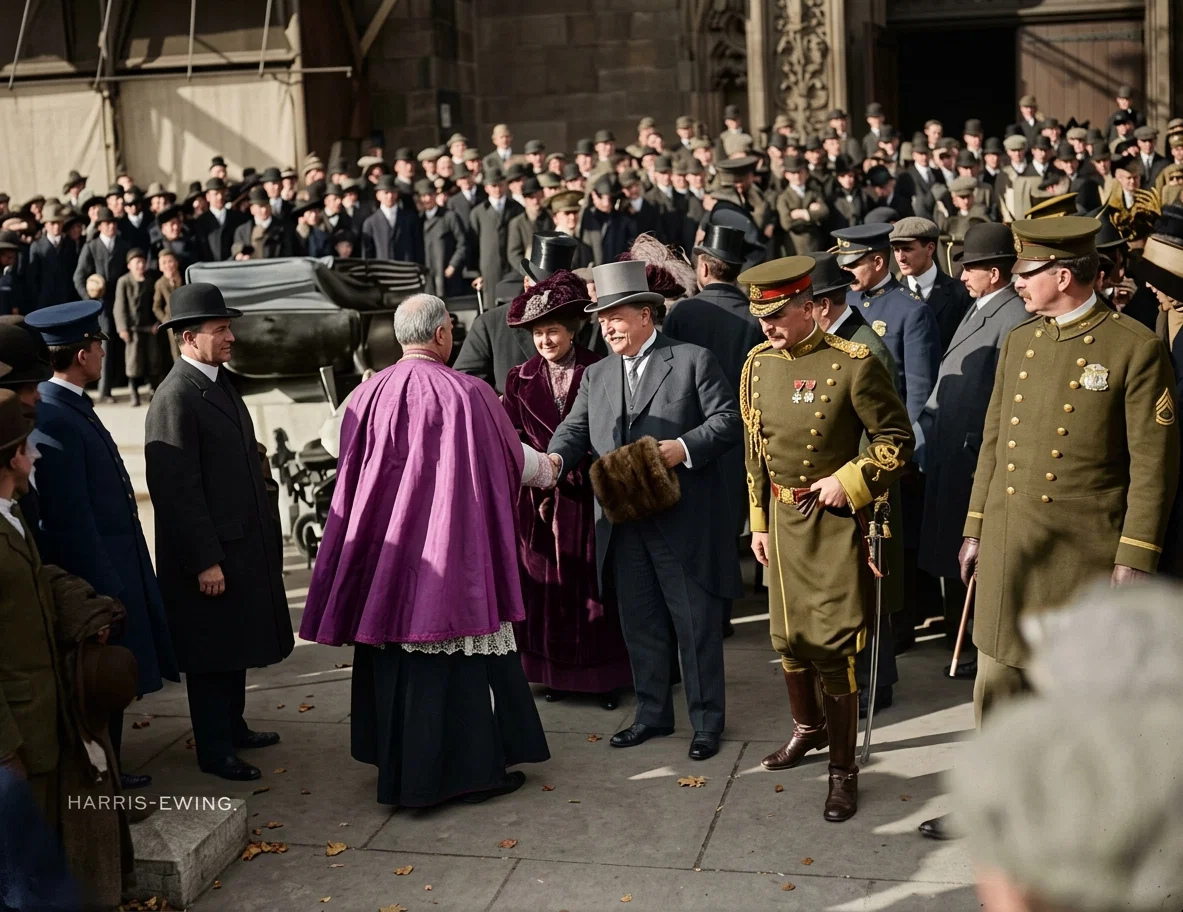
THE THANKSGIVING SERVICE AT ST. PATRICK'S CHURCH, WASHINGTON, D. C.
President and Mrs. Taft Greeted by Monsignor Russell
THE THANKSGIVING SERVICE AT ST. PATRICK'S CHURCH, WASHINGTON, D. C. President and Mrs. Taft Greeted by Monsignor Russell

PARTIAL JANUARY CONTENTS

Double Frontispiece: Photograph of Cardinal O’Connell’s procession in Lowell, Mass. Also photograph of Apostolic Delegate Bonzano’s remarkable letter to a Catholic, advising political submission. Rome Versus the Bible The Life-Giving Word Rome and the Bible Societies Bishop Wordsworth on Rome the Apocalyptic Babylon Rome and the Reading of the Bible United States Troops in Cardinal Farley’s Parade The Pope and the Recent Election The Mediation of Christ — An Exposition of Daniel 8 Religion in Politics Romanism in South America Catholic Notice Served on President-Elect Wilson

PARTIAL FEBRUARY CONTENTS

Double Frontispiece: Vasari’s St. Bartholomew Massacre Frescoes in the Vatican The Persecution of Heretics “Heresy” Officially Defined The Great Papal Persecutions Roman Catholic Testimony Concerning Persecution and Tradition Responsibility for the Civil Punishment of “Heresy” Attempting to Reverse History The Sin of Cain and Salvation by Works The New Interpretation of History A Challenge to Roman Catholics

PARTIAL MARCH CONTENTS

A Convent Tragedy (Part 1) Roman Domination — Views of Prominent Americans How Catholic Oaths May Be Evaded The Hope of the Church Protestantism — What It Means Romanism in Peru — The Putumayo Atrocities The Pope’s Unlimited Authority Bishop Wordsworth on “Apocalyptic Babylon” The Roman Church in Politics

THE MARCH, APRIL, AND MAY NUMBERS WILL CONTAIN THE STARTLING COURT RECORDS

of the kidnaping of a girl under the title “A Convent Tragedy.” These articles will tell why an outraged Catholic mother was awarded a verdict of $23,000 damages by the jury. If you want to have COURT EVIDENCE showing that with Rome “THE END JUSTIFIES THE MEANS,” do not fail to secure these and the following numbers.

SPECIAL OFFER ON TEN, SIX MONTHS!

For $3.00 we will send 10 copies for six months (or 5, one year) to one or more separate addresses. Sender may include his own name. Every Congressman, State Legislator, Editor, Attorney, Clergyman, Public-school Teacher, and City and County Official should have this Magazine during 1913. If you do not have their names and addresses, we can supply you. Begin these subscriptions with the January number.
The twelve numbers for 1913 will be thrilling and convincing. While our limited supply LASTS we will begin all subscriptions with the January or “Rome Versus the Bible” and “Papacy in Politics” number. Note the partial contents of the January, February, and March numbers.

YOUR OWN SUBSCRIPTION FREE

By sending us two yearly subscriptions accompanied by $1.00 each, you will be entitled to your own subscription FREE OF CHARGE.
One Year, $1.00                 Per Copy, 10 cents

ORDER THROUGH OUR NEAREST AGENCY

(If you do not know the address of our Agency, ask the “Protestant Magazine,” Washington, D. C.

The Character of Peter

MRS. E. G. WHITE
Although Peter and John were chosen disciples of Christ, and were counted among the twelve, they were still imperfect in character. Peter was of a zealous, ardent temperament, and ever manifested great earnestness in the cause of Christ. At one time the disciples were on the sea, and the record declares that the ship was in the midst of the sea, tossed with waves, for the wind was contrary; “and in the fourth watch of the night Jesus went unto them, walking on the sea. And when the disciples saw him walking on the sea, they were troubled, saying, It is a spirit; and they cried out for fear. But straightway Jesus spake unto them, saying, Be of good cheer; it is I; be not afraid. And Peter answered him and said, Lord, if it be thou, bid me come unto thee on the water. And he said, Come. And when Peter was come down out of the ship, he walked on the water, to go to Jesus. But when he saw the wind boisterous, he was afraid; and beginning to sink, he cried, saying, Lord, save me. And immediately Jesus stretched forth his hand, and caught him, and said unto him, O thou of little faith, wherefore didst thou doubt?”
This incident illustrates much of the character of impulsive Peter. Faith and unbelief were blended in his words and actions. He said, “Lord, if it be thou, bid me come unto thee on the water.” The Lord had assured the disciples, “It is I; be not afraid.” And when Peter saw the waves around him, saw the boisterous winds, he forgot the power of his Lord, and began to sink; but at his cry of weakness, Jesus was at his side to grasp his outstretched hand, and lift him from the billows.
When the Lord sought to prepare the minds of his disciples for their last great trial in his betrayal and crucifixion, Peter felt that he could not bear to have the words of the Lord fulfilled; and, stirred with indignation at the thought of the injustice so soon to come upon Christ and his followers, he exclaimed, “Be it far from thee, Lord: this shall not be unto thee.” The impression which Christ desired to make upon the minds of his followers was one directly opposed to the impression that Peter’s words would make, and he rebuked his disciple with the sternest rebuke that ever fell from his lips. He said, “Get thee behind me, Satan: thou art an offense unto me: for thou savorest not the things that be of God, but those that be of men.”
Although Peter had been long with the Master, he had a very imperfect conception of the plan of salvation. He did not desire to see the cross in the work of Christ; but it was through the cross that life and hope were to come to dying men.
When Jesus had spoken of his death, declaring that all his disciples would be offended because of him, Peter had said, “Though all men shall be offended because of thee, yet will I never be offended.” He assured his Lord that he would go with him both to prison and to death; but Jesus knew Peter much better than the disciple knew himself, and he said to him, “Verily I say unto thee, That this night, before the cock crow, thou shalt deny me thrice.”
At the very first trial, Peter failed. While Jesus was bowed in agony in the garden of Gethsemane, Peter was sleeping with the other disciples, and could not watch with his suffering Lord one hour. The thrice-repeated prayer was uttered that the bitter cup of woe might pass from the Saviour. Borne down with superhuman agony, Jesus staggered to his disciples, longing for human sympathy; but he found that instead of watching they were sleeping. From his quivering lips came the mild rebuke to Peter, “What, could ye not watch with me one hour?” Then he framed this tender excuse: “The spirit indeed is willing, but the flesh is weak.”
Jesus had said many things concerning the hour of trial that was to come upon his disciples when he should be made the object of mockery and reproach. He had told them, “All ye shall be offended because of me.” But the disciples could not believe that they would manifest such unfaithfulness, and Peter especially had assured the Master that he would never leave him, but would be true to him even if it should lead him to prison and to death.
When Jesus was actually in the hands of the armed men, where were the boastful disciples? — They had fled. Even Peter was in the rear, far from his suffering Lord. When the cruel trial began in the judgment-hall, had Jesus a defender in the ardent Peter? Was he then by the side of his deserted Lord? — No, but with those who were mocking and reviling. It is true that Peter had a deep interest in the trial, and he did desire to be at the side of his Lord; but he could not endure the scorn, the reproach, that would fall upon him if he should take his place as a disciple of Christ. When one of the women of the palace said to Peter, “Thou also wast with Jesus of Galilee,” he denied before all the company, saying, “I know not what thou sayest.” He who had made so confident a statement of his fidelity to Christ, now denied his Lord at the question of a maid in the palace. Did he now move nearer to his Lord? — No; he pushed his way out to the porch, seeking to escape the prying eyes of the enemies of his Lord; but again he was recognized, and another said to him, “This fellow was also with Jesus of Nazareth.” And again he denied with an oath, “I do not know the man.” Peter was irritated that he could not find an escape from the eyes of his enemies, and he returned to the hall, where he could better view the trial, but he stood among the mockers and revilers of Christ. The third time he was recognized, and they said to him, “Surely thou also art one of them; for thy speech bewrayeth thee.” Peter had been ready to take up arms in defense of Christ, but to acknowledge the Lord when he was the object of scorn and derision was more than he had courage to do. He was a moral coward, and with curses and oaths he denied that he knew his Master.
Peter had been warned of this temptation; but he did not realize his danger, and therefore had not prepared himself for the trial. He had been filled withself-confidence, and deemed that he was able to withstand any temptation, assuring the Lord that though all others should be offended, he would be ready to go with him to prison and to death. When he took his stand with the revilers of Christ, he placed himself on the enemy’s ground, and he fell.
At his third denial of his Lord the cock crew, and Jesus turned his eyes upon Peter with a look of peculiar sadness, and the words that Christ had spoken to him came quickly to his mind. All through his life the memory of that look was with Peter. His sinful boasting, his Lord’s warning, his denial of the Saviour, all came to him like a flash of lightning; and casting one pitiful look upon his suffering, insulted Lord, he hurried away from the sound of false accusation and reproach, rushed from the palace, plunged into the darkness, and weeping bitterly, hurried to Gethsemane. He began to see himself as he really was. Memory was alive, and his sins were pictured before him in all their heinous light. Peter threw himself on the spot where a few hours before Jesus had prayed and wept in agony, and there the disciple prayed as he never before had prayed. With deep repentance and terrible remorse he pleaded for forgiveness, and he rose a converted man; but he felt that although Jesus would forgive him, he could never forgive himself.
Jesus knew all the sorrow and remorse of his erring disciple; and when the heavenly messengers appeared to the women at the sepulcher, they told them of Christ’s resurrection, and bade them tell the disciples and Peter that he went before them into Galilee. How eagerly did Peter receive this word of love and compassion! He knew that his Lord still thought of him, still loved him, and he took this message as a sign of forgiveness.
After his resurrection, Jesus showed himself to his disciples at the Sea of Tiberias, “and on this wise showed he himself. There were together Simon Peter, and Thomas called Didymus, and Nathanael of Cana in Galilee, and the sons of Zebedee, and two other of his disciples. Simon Peter saith unto them, I go a fishing. They say unto him, We also go with thee. They went forth, and entered into a ship immediately; and that night they caught nothing. But when the morning was now come, Jesus stood on the shore: but the disciples knew not that it was Jesus. Then Jesus saith unto them, Children, have ye any meat? They answered him, No. And he said unto them, Cast the net on the right side of the ship, and ye shall find. They cast therefore, and now they were not able to draw it for the multitude of fishes. Therefore that disciple whom Jesus loved saith unto Peter, It is the Lord. Now when Simon Peter heard that it was the Lord, he girt his fisher’s coat unto him, (for he was naked,) and did cast himself into the sea.” When the disciples came to land, they found that Jesus had prepared them fish and bread. “So when they had dined, Jesus saith to Simon Peter, Simon, son of Jonas, lovest thou me more than these? He saith unto him, Yea, Lord; thou knowest that I love thee. He saith unto him, Feed my lambs. He saith to him again the second time, Simon, son of Jonas, lovest thou me? He saith unto him, Yea, Lord; thou knowest that I love thee. He saith unto him, Feed my sheep. He saith unto him the third time, Simon, son of Jonas, lovest thou me? Peter was grieved because he said unto him the third time, Lovest thou me? And he said unto him, Lord, thou knowest all things; thou knowest that I love thee. Jesus saith unto him, Feed my sheep.”
In the answers that Peter gave to the Lord’s thrice-repeated question, a different spirit is manifested from what we find in the boastful assurances before the crucifixion of Christ. Peter was a converted man, and showed in his life that transforming grace had taken possession of his heart. As firm as a rock, he ever after stood up boldly to witness for Christ. Jesus had said to Peter, “Simon, behold, Satan hath desired to have you, that he may sift you as wheat: but I have prayed for thee, that thy faith fail not: and when thou art converted, strengthen thy brethren.” Peter had severe trials to pass through, but although he was called to go to prison and to death for Christ’s sake, never again did he waver from his allegiance.

Walking With the World

THE Church and the World walked far apart On the changing shore of Time; The World was singing a giddy song, And the Church a hymn sublime.
“Come, give me your hand,” cried the merry World, “And walk with me this way;” But the good Church hid her snowy hands, And solemnly answered, “Nay: I will not give you my hand at all, And I will not walk with you; Your way is the way to endless death; Your words are all untrue.”
“Nay, walk with me but a little space,” Said the World with a kindly air; “The road I walk is a pleasant road, And the sun shines always there. Your path is thorny, and rough, and rude, And mine is broad and plain; My road is paved with flowers and dews, And yours with tears and pain. The sky above me is always blue; No want, no toil, I know: The sky above you is always dark, Your lot is a lot of woe. My path, you see, is a broad, fair one And my gate is high and wide; There is room enough for you and for me To travel side by side.”
Half shyly the Church approached the World, And gave him her hand of snow; The old World quick grasped it and walked along, Saying in accents low: “Your dress is too simple to please my taste; I will give you pearls to wear, Rich velvets and silks for your graceful form, And diamonds to deck your hair.”
The Church looked down at her plain white robes And then at the dazzling World, And blushed as she saw his handsome lip With a smile contemptuous curled. “I will change my dress for a costlier one,” Said the Church with a smile of grace; Then the pure white garments drifted away, And the World gave in their place Beautiful silks and shining satins, And roses, and gems, and pearls, And over her forehead her bright hair fell, Crisped in a thousand curls.
“Your house is too plain,” said the proud old World; “I’ll build you one like mine,— Carpets of Brussels, and curtains of lace, And furniture ever so fine.” So he built her a costly and beautiful house, Splendid it was to behold; Her sons and her beautiful daughters dwelt there, Gleaming in purple and gold; And fairs and shows in the halls were held, And the World and his children were there; And laughter and music and feasts were heard In the place that was meant for prayer. She had cushioned pews for the rich and great To sit in their pomp and pride; While the poor folk, clad in their shabby suits, Sat meekly down outside.
The Angel of Mercy flew over the Church, And whispered, “I know thy sin:” Then the Church looked back with a sigh, and longed To gather her children in; But some were off at the midnight ball, And some were off at the play, And some were drinking in gay saloons, So she quietly went her way.
Then the sly World gallantly said to her: “Your children mean no harm, Merely indulging in innocent sports;” So she leaned on his proffered arm, And smiled and chatted and gathered flowers, As she walked along with the World; While millions and millions of sorrowing souls To eternal death were hurled.
“Your preachers are all too old and plain,” Said the World to the Church with a sneer, “They frighten my children with dreadful tales, Which I like not for them to hear. They talk of brimstone and fire and pain And the night of an endless death; They talk of a place which may only be Mentioned with bated breath. I will send you some of the better stamp,— Brilliant and gay and fast,— Who will tell them that people may live as they list And go to heaven at last. The Father is merciful, great, and good,Tender and true and kind; Do you think he would take one child to heaven, And leave the other behind?”
So he filled her house with gay divines,— Gifted and great and learned,— And the plain old men that preached the cross Were out of her pulpits turned.
“You give too much to the poor,” said the world, “Far more than you ought to do; If the poor need shelter and food and clothes, Why need it trouble you? Go, take your money and buy rich robes, And horses and carriages fine, And pearls and jewels and dainty foods, And the rarest and costliest wine! My children, they dote on all such things; And if you their love would win, You must do as they do and walk in the ways That they are walking in.”
Then the Church held tightly the strings of her purse And gracefully lowered her head, And simpered, “I’ve given too much away; ‘I’ll do, sir, as you have said.’”
So the poor were turned from her door in scorn, And she heard not the orphan’s cry; And she drew her beautiful robes aside As the widows went weeping by; And the sons of the World and the sons of the Church Walked closely hand and heart, And only the Master who knoweth all Could tell the two apart.
Then the Church sat down at her ease, and said, “I am rich, and in goods increased; I have need of nothing, and naught to do But to laugh and dance and feast.” And the sly World heard her and laughed in his sleeve, And mockingly said aside: “The Church is fallen, the beautiful Church, And her shame is her boast and pride.”
The Angel drew near to the mercy-seat, And whispered in sighs her name, And the saints their anthems of rapture hushed, And covered their heads with shame; And a voice came down through the hush of heaven From Him who sat on the throne: “I know thy works, and how thou hast said, ‘I am rich,’ and hast not known That thou art naked, and poor, and blind, And wretched before my face. So from my presence I cast thee out, And blot thy name from its place.”
— Selected.

Christ and the Spirit

The Holy Spirit — No. 4

Christ and the Spirit

G. B. THOMPSON
WHEN Christ came into the world to redeem the race, he stood as the second Adam, with all the weaknesses and degeneracy of four thousand years of sin resting upon him. He came clothed in human nature to fight the battle against sin, as every child of God must fight it. He took the nature of man, with the possibility of yielding to temptation. And as the Son of man, he used no power in battling with the powers of darkness that every child of Adam can not use. He said of himself, “The Son can do nothing of himself, but what he seeth the Father do: for what things soever he doeth, these also doeth the Son likewise.” John 5:19. Again he said, “I can of mine own self do nothing” (verse 30); and again, “I do nothing of myself; but as my Father hath taught me, I speak these things.” John 8:28.
He stood as a man, using no power other than man can lay hold of, in resisting temptation. As Son of man he was as weak as man. As Son of God he was as strong as God. He was not a Unitarian’s Christ. He was God. Divinity and humanity were centered in him. More than a man hung on the cross. Unfathomable mystery, God died.
“He voluntarily assumed human nature. It was his own act, and by his own consent. He clothed his divinity with humanity. He was all the while as God, but he did not appear as God. He veiled the demonstrations of Deity, which had commanded the homage and called forth the admiration of the universe of God. He was God while upon earth, but he divested himself of the form of God, and in its stead took the form and fashion of a man. He walked the earth as a man. For our sakes he became poor, that we through his poverty might be made rich. He laid aside his glory and his majesty. He was God, but the glories of the form of God he for a while relinquished. Though he walked among men in poverty, scattering his blessings wherever he went, at his word legions of angels would surround their Redeemer, and do him homage. But he walked the earth unrecognized, unconfessed, with but few exceptions, by his creatures. The atmosphere was polluted with sin and curses, in place of the anthem of praise. His lot was poverty and humiliation. As he passed to and fro upon his mission of mercy to relieve the sick, to lift up the depressed, scarcely a solitary voice called him blessed, and the very greatest of the nation passed him by with disdain.
“Contrast this with the riches of glory, the wealth of praise pouring forth from immortal tongues, the millions of rich voices in the universe of God in anthems of adoration. But he humbled himself, and took mortality upon him. As a member of the human family, he was mortal; but as a God, he was the fountain of life to the world. He could, in his divine person, ever have withstood the advances of death, and refused to come under its dominion; but he voluntarily laid down his life, that in so doing he might give life and bring immortality to light. He bore the sins of the world, and endured the penalty, which rolled like a mountain upon his divine soul. He yielded up his life a sacrifice, that man should not eternally die. He died, not through being compelled to die, but by his own free will. This was humility. The whole treasure of heaven was poured out in one gift to save fallen man. He brought into his human nature all the life-giving energies that human beings will need and must receive.
“Wondrous combination of man and God! He might have helped his human nature to withstand the inroads of disease by pouring from his divine nature vitality and undecaying vigor to the human. But he humbled himself to man’s nature. He did this that the Scripture might be fulfilled; and the plan was entered into by the Son of God, knowing all the steps in his humiliation, that he must descend to make an expiation for the sins of a condemned, groaning world.”—Mrs. E. G. White, in Review and Herald, July 5, 1887.
During his entire life Christ communed with the Spirit. “From hours spent with God he came forth morning by morning, to bring the light of heaven to men. Daily he received a fresh baptism of the Holy Spirit. In the early hours of the new day the Lord awakened him from his slumbers, and his soul and his lips were anointed with grace, that he might impart to others.”—“Christ’s Object Lessons,” page 139.
But when Jesus began his ministry, although he was begotten of the Holy Spirit, he received a special anointing, or baptism, of the Spirit for the work of the ministry.
“Thou hast loved righteousness, and hated iniquity; therefore God, even thy God, hath anointed thee with the oil of gladness above thy fellows.” Heb. 1:9.
Peter in his sermon at Cæsarea told “how God anointed Jesus of Nazareth with the Holy Ghost and with power: who went about doing good, and healing all that were oppressed of the devil; for God was with him.” Acts 10:38. It was by this spiritual anointing that Jesus was strengthened for his work. He received, as the Son of man, his equipment for service in the same way that we do, by a daily baptism of the Spirit and power. We read that Jesus was tempted, even to the point of suffering (Heb. 2:18), and that he “was in all points tempted like as we are, yet without sin.” Heb. 4:15. But he “through the eternal Spirit offered himself without spot to God.” Heb. 9:14. He met these temptations in our flesh and overcame by the power of the Holy Spirit, and closed his life’s work “without spot.”
The time when he received this spiritual anointing, or baptism, of the Spirit for service, was at his baptism, when he stood at the threshold of his ministry. As he knelt on the banks of the Jordan after being baptized by John, he poured out a prayer that pierced the heavens with its power, and “the heaven was opened, and the Holy Ghost descended in a bodily shape like a dove upon him, and a voice came from heaven, which said, Thou art my beloved Son; in thee I am well pleased.” Luke 3:21, 22.
This anointing was a mighty event in the life and ministry of our Lord. In a fuller sense he was now to unsheath his sword in his controversy with Satan. The very names given him in Holy Writ are expressive of this experience. Inthe Old Testament he is called the Messiah. The word Messiah means the Anointed One. The corresponding name in the New Testament is Christ. This word also means the Anointed. John the Baptist said, “I am not the Christ,” that is, “the Anointed.” John 1:20. Peter said, “Thou art the Christ,” that is, “the Anointed One.” Mark 8:29. “These are written, that ye might believe that Jesus is the Christ,” or “the Anointed One.” John 20:31.
“How striking, then, is the thought that we are the anointed ones of God! . . . ‘Ye have an anointing,’ the same anointing as the Lord had. And we bear it in our names, as he did. He was called Christ, and we are called Christians, the anointed followers of the Anointed One.”—“The Eternal Spirit,” page 215.
It is of great interest to note in the ministry of Christ the results which followed the anointing of the Holy Spirit received at his baptism. He was anointed to preach. “The Spirit of the Lord is upon me, because he hath anointed me to preach the gospel to the poor; he hath sent me to heal the broken-hearted, to preach deliverance to the captives, and recovering of sight to the blind, to set at liberty them that are bruised, to preach the acceptable year of the Lord.” Luke 4:18, 19. And surely if our divine Master, who was born of the Spirit, needed to be anointed with the Spirit to preach the word, those of his followers who are ordained to do the same work, should also be anointed. The words, “Tarry ye in the city of Jerusalem, until ye be endued with power from on high,” reach down to our time.
Immediately after his baptism, “Jesus being full of the Holy Ghost returned from Jordan, and was led by the Spirit into the wilderness, being forty days tempted of the devil.” Luke 4:1, 2. But “he was fitted for the conflict by the indwelling of the Holy Spirit.”—“Desire of Ages,” page 123. He unsheathed the “sword of the Spirit,” and conquered the prince of devils. The principalities of hell were so thoroughly overcome that we read, “And when the devil had ended all the temptation, he departed from him for a season.” Luke 4:13. The question was now settled. Satanic resources were exhausted; Christ had resisted the greatest temptation Satan could bring upon him; his decision was irrevocably made. Through the power of the Spirit he came forth from the conflict with the powers of darkness a conquering hero.
Concerning his return to Galilee from a triumphant ministry in Judea, where some notable miracles had been performed, we read, “And Jesus returned in the power of the Spirit into Galilee: and there went out a fame of him through all the region round about.” Luke 4:14. The Spirit was not given to him “by measure;” he could be entrusted with it in the fulness of its power. When it came upon him at his baptism, we are told that it “abode” upon him. It was with him continually as his guide and companion. It was “through the Holy Ghost” that he gave “commandments unto the apostles whom he had chosen.” Acts 1:2.
All that the Holy Spirit was to Jesus it may be to his followers. “There is no limit to the usefulness of one who, by putting self aside, makes room for the working of the Holy Spirit upon his heart, and lives a life wholly consecrated to God. If men will endure the necessary discipline without complaining or fainting by the way, God will teach them hour by hour and day by day. He longs to reveal his grace. If his people will remove the obstructions, he will pour forth the waters of salvation in abundant streams through the human channels.”—“Desire of Ages,” pages 250, 251.

The Rod of Power

MRS. LURA E. DAVIDSON
When Moses was called of heaven to do a great work, God gave him an instrument of power by which miracles were wrought, deliverances brought about, and the physical needs of human beings supplied.
The simple rod in the hand of Moses was used of God through which to manifest his power. In our day God is calling every true Seventh-day Adventist to a mighty work for him; does he, then, withhold the rod of power?—No, the prayer of faith is the mighty instrument in our hands which removes mountains of difficulty, divides the waters of perplexity and fear, conquers the hindering Pharaohs, and brings forth sweet waters of joy and consolation from rocks apparently dry and barren.
Prayer and faith go hand in hand. The man of great faith is the man of much prayer; and the man of much prayer is the man of great faith.
But there is much to learn about prayer. To many it is a perplexing thing when the Bible tells us that “if we ask anything according to his will, he heareth us; and if we know that he hear us, whatsoever we ask, we know that we have the petitions that we desired of him.” And yet perhaps we have been praying for years for things we know to be his will, and do not see the realization of our hopes. Perhaps we may be praying for relatives and friends. (Who of us is not?) We know this to be according to his will “who will have all men to be saved, and to come unto the knowledge of the truth.” We know that we have the petitions we desired of him. There is a difference between having a petition granted, and realizing that petition in tangible form. An illustration will make this clear:—
Some years ago a poor man and his family were struggling for a living on a farm in a region of drought, and under other adverse circumstances. Besides a burden of debt, the father, who had served in the civil war, was suffering from disease contracted during his years of service. But for a small monthly pension granted by the government their suffering would have been greater. At this time Congress passed a law giving back pensions to all soldiers whose service complied with certain conditions. These conditions seemed to fit the service of our friend; and accordingly the legal application was quickly made out and forwarded to the proper authorities. Then came weeks of suspense hard to endure. Would the petition be granted? At last came the assurance in printed form duly signed, that the petition had been granted, and a remittance of several thousand dollars was promised. Was there any fear that the government would not make good?—None whatever. The promise of the United States government had been often tested, so that perfect confidence prevailed; and later the check came to hand.
Can we not at least exercise as much faith in God’s promises as we should in any earthly government however strong? God says our petitions are granted; do we fear that he will not make good? Many times our very lack of faith hinders the fulfilment; and though “with God nothing shall be impossible,” yet it may take more or less time for him to bring about the fulfilment, for he will in no case force men to believe on him or his truth. When Daniel prayed, an angel was sent at once to answer, but the angel strove three full weeks with the prince of Persia to lead him to do the things that would answer Daniel’s prayer.
But even though we know our petitions are granted, we are to continue to pray for the realization,—the fulfilment of them in our own lives or in others,—because prayer is the very life of the soul, and the more we pray the stronger will our faith become.
In “Early Writings,” page 73, we are told why there is so little faith and power in Israel. Said the angel, “Ye let go of the arm of the Lord too soon. Press your petitions to the throne, and hold on by strong faith.” We have a right to “come boldly unto the throne of grace, that we may obtain mercy, and find grace to help in time of need.”
There is but one condition to those prayers in which we know we are asking according to his will; and most of our prayers come under this head,—prayers for the salvation of others, for our own cleansing, for the work of God in the earth, etc.,—but to other prayers must be added, “Thy will be done.”
A great work lies before us; this can not be done without prayer, which brings in its train every needed blessing.
Seguatepeque, Honduras.

True Consecration

M. E. BOAZ
CONSECRATION in the service of the Lord should be the attitude of every Christian. Every one who is called by the name of Christian should try clearly to understand what is the duty as well as the privilege of every child of God.
In true consecration our every faculty will be surrendered to God's service, and our time will be spent in studying the Word, and not occupied in light and trifling reading or conversation of that character. Heavenly themes should fill our minds; we have no time for anything less in this period of earth's history.
If we have laid all on the altar, our means will be used for God's cause and for his glory, instead of being spent to gratify self in worldly pleasure. If our lives are truly consecrated to God, worldly pleasures will have lost their charm, and we will not be lovers of pleasures more than lovers of God. We will engage in trying to bring some soul to a knowledge of the Saviour's love, and will be imparting each little ray of light we receive to others. Our time is too precious to squander in folly, our means too limited to waste in pandering to selfish pleasures, while souls are perishing for the bread of life.
Then, as we pass along the pathway of life, let us bring every talent we possess and all the influence we have, and consecrate all to God, as this is only our reasonable service.
Sulphur Springs, Ark.
Continue reading: W. H. BRANSON