Your ShelfYour Projects

Signs of the Times, Vol. 26, No. 6.

SOME . . . ; BUT WE . .

Signs of the Times

Feb 7, 1900

Pacific Press Publishing Company · Oakland, California · Feb 7, 1900

"SOME . . . ; BUT WE . . ."
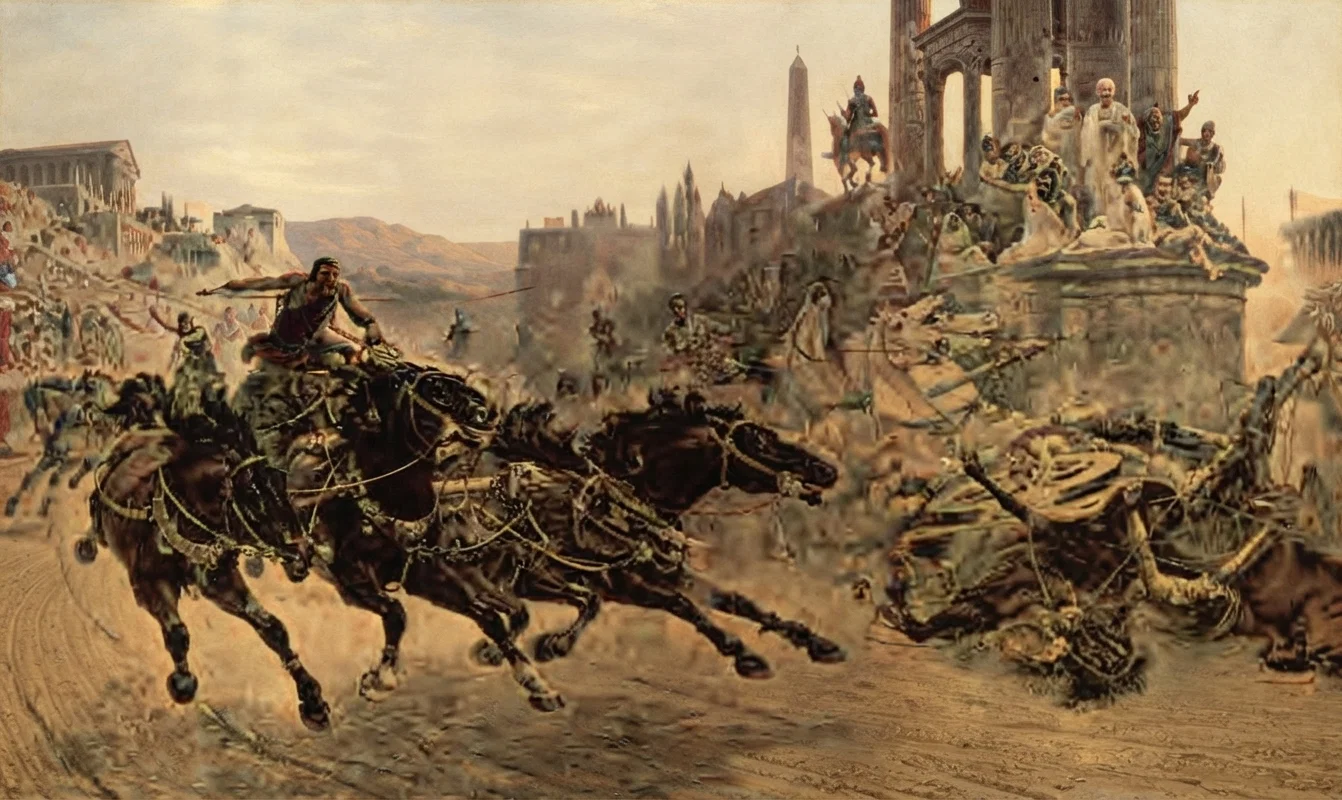
THE most popular, the most thrilling, the grandest in gorgeous setting and associations of all ancient games, sports, or contests, was the chariot race, depicted in our illustration. Kings and princes could condescend to witness other contests of skill, strength, or endurance; they took part personally in this, and prized next to their crown, the fading wreath of victory. Chariot-racing was pre-eminently a royal sport.
Rival kings and princes strove for the mastery. Armed chariots were among the most effectual weapons for the great pitched battles on level ground and open country; kings and princes and generals and those who aspired to lead must learn how to guide the spirited horses, and keep cool heads where all else was excitement. By the chariot race the youthful warrior strove to acquire fame; by its use in battle the king hoped to win victory and greater empire. The chariot may well stand, therefore, as one of the types of earthly contest, fame, power, and glory.
THE world's contests are invariably selfish. Where unselfishness creeps in, it is the result of divine impulses or education. But normally—if a degenerate thing can be said to act normally—the striving in the world is for selfish gain, selfish rule; that self may in some way be pleased. So selfish is it that it many times expects success only because of some other person's downfall or utter ruin. The striver does not wish to destroy honor or property or life; but his own interests demand that himself shall succeed, and all in the way of success must go down.
AN ANCIENT CHARIOT RACE.
GREAT thrones are erected on once happy but now ruined smaller states, living only in history. Thousands of businesses are built up on the ruin of many thousands more. The great trusts mean utter ruin to myriads of small traders. Noble souls protest against it; but the hardened, brutal answer is frequently, "It's the way of trade; the big fish eat the little ones." So God has said selfish man would do. "The wicked devoureth the man that is more righteous than he." He makes "men as the fishes of the sea, as the creeping things, that have no ruler over them." He enlarges "his desire as hell, and is as death, and can not be satisfied, but gathereth unto him all nations, and heapeth unto him all people." Hab. 1:13 to 2:5. Like the chariot driver, men race on. What matter that their rival's horses lie dead, and he crushed and bleeding among the ruins of his once gorgeous chariot? Success is so much more certain. This is the nature of the contest of strife.
"BUT men become famous." Yes, they do. They wear for a little while the laurel wreath of the victor. They listen awhile to the insincere plaudits of an excited populace. They are fêted and wined and dined by the rich and noble of earth. But only for a little while. The laurel wreath withers. The sweetness of the applause becomes bitter when it is given to some soon-coming new hero. The laudation of the festive board becomes insipid, the wine sour, the food nauseating. The "pleasures of sin" are but for "a season."
"BUT men and nations become powerful." Yes, they do. They sway for a time the multitudes, mold the policy of State or Church, ruin and crush nations, and build kingdoms; and the great world bows before them. But it is only for a little while. Powers of mind and body fail. Young, fresh, and vigorous men enter the lists, and conquer. The applause is transferred to the new hero; the power to sway slips from the weak, nerveless grasp. The end has come, and the erstwhile ruler broods, a disappointed Bismarck, or meets the death of a Cicero or a Thomas Cromwell. So ends the mightiest power of earthly rule.
AND all the glory is but earthly, temporal, fading. A kingdom may last for centuries, but it will sometime crumble and decay. A dynasty may exist for several generations, but it finally becomes extinct and passes to another. And, however great the earthly glory of the greatest, the truth of God is written upon everything human: "All flesh is as grass, and all the glory of man as the flower of grass." It perishes, and is gone. It is not to the spirited horses and exultant driver that we are to look, but at the ruined horses, the broken chariot, and the royal driver underneath. In his selfish contest for superiority he has met the end of his fame, his power, his glory, soon. His rivals may not meet it his way; but the undesirable end will as surely come to them as to him.
WILL not mortals learn the lesson? It is as true in the small things of life as in the great. Fame which is achieved by others' downfall is but infamy. Power that is gotten by enslaving, fettering, brutalizing others will sometime recoil with crushing weight upon the head of him who used it.
"O! it is excellent To have a giant's strength; but it is tyrannous To use it like a giant."
And upon the tyrants of these last days, the Word declares, will return in double measure the crimes of their oppression. After the passage quoted in the fourth paragraph of this article, from the prophet of old, he continues: "Shall they not rise up suddenly that shall bite thee, and awake that shall vex thee, and thou [the oppressor, which counted men "as the fishes of the sea"] shalt be for booties unto them? Because thou hast spoiled many nations, all the remnant of the people shall spoil thee." Selfishness is sin; and all the pleasures, the gains, the glories of sin are but "for a season." We may read them all in the wreck of the chariot race.
WHAT is the lesson? It is written in God's Word; it is written in human experience; it will be revealed for all eternity in glorified humanity, even as it was manifest in a glorified Christ. Here is the blessed truth which it is the privilege of every soul to make his own: "Some trust in chariots, and some in horses; but we will remember the name of the Lord our God." Ps. 20:7. And the opposite is written: "Woe to them that go down to Egypt for help; and stay on horses, and trust in chariots, because they are many; and in horsemen, because they are very strong; but they look not unto the Holy One of Israel, neither seek the Lord!" The name of the Lord our God is His glorious character of unselfishness, of goodness. He wishes with infinite longing to name it upon us. He waits for our consent. He would make us, by His infinite power, like Himself. He would give us the disposition to strive for others' good,—to lift up the fallen, to bind up the broken-hearted, to proclaim liberty to the captives and oppressed, to open the prison-house to them that are bound, to preach good tidings to the meek, to manifest the blessed, uplifting Christ-character here, and share His eternal glory hereafter.

THE OLD TESTAMENT.

How shall I describe to you what I found in the Old Testament? I had not read it for many years, and was prejudiced against it before I took it in hand. The light which struck Paul with blindness on his way to Damascus was not more strange, more surprising to him than it was to me when I suddenly discovered the fulfilment of all hopes, the highest perfection of philosophy, the explanation of all the revelations, the key to all the seeming contradictions of the physical and moral world. I saw religion appear at the moment most favorable to its appearance and in a manner most adapted to its acceptance. The whole world seemed to be ordered for the sole purpose of furthering the religion of the Redeemer, and if this religion is not divine, I understand nothing at all. I have read no books on the subject, but in all my studies of the ancient times I have always felt the want of something, and it was not till I knew our Lord that all was clear to me. With Him there is nothing I am not able to solve.—Max Muller.

"THAT THEY ALL MAY BE ONE."

Strength in Christian Unity—Each a Part of the Whole—Life and Love the Tie that Binds—The Sure Guide—The Need of the Spirit.
CHRISTIAN unity is a mighty agency. It tells in a powerful manner that those who possess it are children of God. It has an irresistible influence upon the world, showing that man in his humanity may be a partaker of the divine nature, having escaped the corruption that is in the world through lust. We are to be one with our fellow-men and with Christ, and in Christ one with God. Then of us can be spoken the words, "Ye are complete in Him."
In the plan of redemption a place is allotted to every soul. To each man is given his work. No one can be a member of Christ's body and yet be inactive. Different lines of work are committed to different men, according to their several ability. The work of God's people may and will be varied, but one Spirit is the mover in it all. All the work done for the Master is to be connected with the great whole. The workers are to labor together in concert, each one controlled by divine power, putting forth undivided effort to draw those around them to Christ. All must move like parts of well-adjusted machinery, each part dependent on the other part, yet standing distinct in action. And each one is to take the place assigned him and do the work appointed him. God calls upon the members of His church to receive the Holy Spirit, to come together in unity and brotherly sympathy, to bind their interests together in love.

A False Union Versus the True.

Strange, eventful history is being recorded in the books of heaven. Everything in our world is in agitation. Events are changing to bring about the day of God, which hasteth greatly. The world is filled with storm and war and variance. Under one head, the papal power, it has united to oppose God in the person of His faithful witnesses. This union is cemented by the great apostate. All jealousy, evil surmising, and evil speaking are of him, and tend to produce discord and disunion. Then shall God's people be at variance with one another? Shall they not be cemented together by the Holy Spirit, each worker filled with love and sympathy for his fellow-worker, each filling his appointment with faithful effort, seeking earnestly to prepare the way of the Lord? In the general discord there should be one place where harmony and unity should exist because the Bible is the guide. When the principles of God's Word are followed, it becomes a bright light shining in a dark place. All who build on this Rock can be sure that their house will stand amid the tempest.
The sword of the Spirit, which cuts both ways, is to be in the hands of God's servants. His inspiration is to be upon them, leading them

All to Speak as the Voice of One.

The Holy Spirit will work with the consecrated human instrument; for this is God's purpose. God has opened a door between heaven and earth, which no power can close. He calls upon every human being to be pure, holy, sanctified, in order that the work for this time may be accomplished. When God's people place themselves in proper relation to Him and to one another, there will be a full impartation of the Holy Spirit for the harmonious combination of the whole body.

Weakness of Disunion.

Nothing so manifestly weakens a church as disunion and strife. Nothing so wars against Christ and the truth as this spirit. "By their fruits ye shall know them." "Doth a fountain send forth at the same place sweet water and bitter? Can the fig tree, my brethren, bear olive berries? either a vine, figs? so can no fountain both yield salt water and fresh. Who is a wise man and endued with knowledge among you? let him show out of a good conversation his works with meekness of wisdom." "Wherefore lift up the hands which hang down, and the feeble knees; and make straight paths for your feet, lest that which is lame be turned out of the way; but let it rather be healed. Follow peace with all men, and holiness, without which no man shall see the Lord; looking diligently lest any man fail of the grace of God; lest any root of bitterness springing up trouble you, and thereby many be defiled."
As long as we are in this world we must be linked with one another. Humanity is interlaced and interwoven with humanity. As Christians we are members one of another. The Lord has made us thus, and when disappointments come, we are not to think the worse of one another. We are individual members of the general body. In helplessness and disappointment we are fighting the battles of life, and the Lord designs us, as His sons and daughters, whom He calls His friends, to help one another. This is to be a part of our practical Christian work. Who is my neighbor? Read and understand. It is

The Very One Who Needs Help the Most.

Thy brother, sick in spirit, needs thee as thou once needed him. He needs the experience of one who has been as weak as himself, onewho can sympathize with him and help him. The very knowledge of our own weakness helps us to help another in his weakness. Let it not be that the sympathetic chords, which should be quick to vibrate at the least touch, shall be as cold as steel, frozen as it were, and unable to help where help is needed. There is a work to be done in human hearts to make them keen and true and sensitive to another's needs.
We can be united with one another only as we are united with Christ. He declared, "I, if I be lifted up from the earth, will draw all men unto Me." Christ must be uplifted. His name is all-powerful. Many who have dwelt much upon doctrinal subjects, but who have not learned of Christ, have been found unable to control themselves. They need the Holy Spirit's power. We should seek to understand what it means to be in complete union with Christ, who is the propitiation for our sins and for the sins of the whole world. Our life should be bound up with His life. We should draw constantly from Him, partaking of the living bread which came down from heaven, drinking from a fountain ever fresh, ever giving forth its abundant treasure. When this is in truth the experience of the Christian, there is seen in his life a freshness, a simplicity, a humility, a meekness and lowliness of heart, that show all with whom he associates that he has been with Jesus and learned of Him.

Christ Is the Only True Center.

When He draws us to Himself, we are hidden with Him in God, and we show to the world that God loves us as He loves His Son. God imparts His Spirit to us. Truth, with its divine power and influence, takes possession of us, making of believers one harmonious whole, of which Christ is seen to be the soul. Every element is working in right lines. Every worker who fills his appointed place is helping to uplift the cross of Calvary.
This is the unity God requires in His service. When God's chosen people are of one mind, barriers of selfishness will disappear as by magic, and many, many more souls will be converted because of the unity which exists among believers. There is one body and one spirit. Those who have been building territorial lines of distinction, barriers of color and caste, might better take these down much faster than they put them up.
He in whose heart Christ abides recognizes Christ abiding in the heart of his brother. Christ never wars against Christ. Christ never exerts an influence against Christ. Christians are to do their work, whatever it may be, in the unity of the Spirit, for the perfecting of the whole body. The church is to be purified, refined, ennobled. The members are to cast from their hearts the idols which have hindered their advancement in spirituality. By the influence of the Spirit, the most discordant may be brought into harmony. Unselfishness is to bind God's people together with firm, tender bonds. There is a vast power in the church when the energies of the members are under the control of the Spirit, gathering good from every source, educating, training, and disciplining self. Thus is presented to God a powerful organization, through which He can work for the conversion of sinners. Thus heaven and earth are connected, and all the divine agencies co-operate with human instrumentalities.
MRS. E. G. WHITE.

"THOU SHALT NOT BE AFRAID."

CEASE doubting, O soul, tho the sea be a-roar With the billows of strife, and tho legions of war Are treading to dust the green of the lea, And red'ning the rivers that run to the sea! There's a bow in the sky, and its jewel-wrought rim Is the pledge of our hope, and that hope is in Him Who holdeth the world in the cup of His hand, And bindeth the sea with a shackle of sand.
What need that I cherish the tremor of dread While the bow of His word bends bright overhead? Tho the sea may be red with the blood of the slain, And the dead be piled high on the slippery plain; Tho the arrows of death fly on every hand, And the specter of pestilence stalk through the land, I will trust in Him still; for my anchor will hold, And my soul be at peace in His heavenly fold.
I'll fear not the gloom of that terrible day When the hopes of the heedless are smitten away; When the face of the sinner is blackened with dread, And the angels of wrath on their mission have sped; For swift o'er the shuddering, tremulous sod Come the chariot wheels of my Saviour and God, And bright in the heart that is trusting in Him Glows the lamp of His word, which no terror can dim. Oakland, Cal.

THE BEQUEST OF AN ATHEIST.

Not long ago a man died in Kansas City who had for years professed to be an atheist. In his last will and testament he bequeathed his property, estimated at $150,000, to different denominational institutions, all except $40,000.
He wanted to leave his money to benevolent institutions, but as the infidels had established no such institutions, he was necessitated to bequeath it to the Christians. Is this not a striking evidence of the truth and value of the Christian religion?—The Christian's Guide.

IS DEATH A PROMOTION?

THE marvelous growth of Spiritualism is easily accounted for when we read such sentences as the following, in a popular Christian journal:—
The tender sympathy of a large circle of white-ribboners and personal friends in this land and in others, is extended to — , whose eldest son, — , has recently been translated to the heavenly home.
The obituary article from which this expression is taken is headed 'Promoted.' The question arises, Is death a promotion? We find these definitions in the 'Standard Dictionary':—
Promote. 1. To cause to move forward toward some desired end; contribute to the development, establishment, increase, or influence of; foster; further; forward; encourage; advance; as to promote a business enterprise. 2. To advance to a higher position, grade, or rank; raise to greater dignity or honor; elevate; exalt; prefer; as to promote a pupil to a higher class.
Death. 1. Cessation of physical life. (1) The total and permanent cessation of the functions or vital actions of an organism, as in the complete stoppage of the functions of the brain and the organs of respiration and circulation. (2) Such cessation in any of the parts of an organism or in its ultimate structural elements. . . . 2. The final extinction or destruction of anything; decay; destruction; a figurative use; as the death of friendship.
A comparison of these definitions shows nothing synonymous in promotion and death. One would not think of killing a business enterprise in order to promote it; nor would he think of taking the life of a pupil in order to promote him to a higher class. The death of friendship would not be deemed a promotion of friendship. But let us note the use of the words in the Scriptures.
When King Balak solicited the prophet Balaam to curse Israel, he said, 'I will promote thee unto very great honor, and I will do whatsoever thou sayest unto me.' Num. 22:17. Did the king mean that he would put the prophet to death? Balaam failed to earn his promotion, because the Lord would not allow him to curse Israel. But some time afterward, when the Israelites fought the Midianites, Balaam was slain. Was he then promoted?
In the obituary sentence we have quoted, the individual spoken of is said to have been 'translated to the heavenly home.' But further on in the article we learn that he died and was buried. Now the Scripture says that 'Enoch was translated that he should not see death; and was not found, because God had translated him.' Heb. 11:5. Also Elijah, when he was translated, was taken up alive, bodily, in a whirlwind, in plain view of his servant and successor, Elisha. 2 Kings 2:9-12.
When David died, he was not promoted, nor translated. See Peter's testimony on the day of Pentecost, under the influence of that great outpouring of the Holy Spirit: 'Men and brethren, let me freely speak unto you of the patriarch David, that he is both dead and buried, and his sepulcher is with us unto this day.' Acts 2:29. 'For David is not ascended into the heavens.' Verse 34. When nearing the close of his life, David said, 'I go the way of all the earth.' 1 Kings 2:1, 2. Are all 'promoted,' or 'translated to the heavenly home,' when they die? The record further says, 'So David slept with his fathers, and was buried in the city of David.' Verse 10. But this testimony concerning David does not indicate that he was lost, and therefore was in a state of conscious existence somewhere else. The 'last words of David' were words of faith and hope. 2 Sam. 23:1-7.
Even Jesus Christ was not 'promoted' when He died. This event was the very depth of His humiliation. 'Being found in fashion as a man, He humbled Himself, and became obedient unto death, even the death of the cross.' Phil. 2:8. True, for this cause 'God hath highly exalted Him' (verse 9); but it was by a resurrection from the dead, and not by a 'translation' in death. While He was dead, He was in Joseph's tomb. John 19:41.
This doctrine of promotion, or translation, or any conscious existence at all in death, is the root and ground of all the delusions and vagaries of Modern Spiritualism. The Scriptures teach that 'the dead know not anything;' that 'their love, and their hatred, and their envy, is now perished.' Eccl. 9:5, 6. They also teach that the hope of the Gospel is the resurrection of the dead. 'For since by man came death, by man came also the resurrection of the dead. For as in Adam all die, even so in Christ shall all be made alive. But every man in his own order; Christ the first-fruits; afterward they that are Christ's at His coming. Then cometh the end.' 1 Cor. 15:21-24. This shows that, as in the case of the Master, the exaltation (the promotion) comes to the righteous after the resurrection, at the coming of the Lord in glory. 'For the Lord Himself shall descend from heaven with a shout, with the voice of the Archangel, and with the trump of God;and the dead in Christ shall rise first; then we which are alive and remain shall be caught up together with them in the clouds, to meet the Lord in the air; and so shall we ever be with the Lord. Wherefore comfort one another with these words.' 1 Thess. 4:16-18. Yes, these are the words with which to comfort Christians who have lost Christian sons, and not the words of false comfort, based upon the erroneous doctrines of Spiritualism.
In harmony with the doctrine here enunciated, Paul gives his experience and his faith when nearing his execution: 'I am now ready to be offered, and the time of my departure is at hand. I have fought a good fight, I have finished my course, I have kept the faith; Henceforth there is laid up for me a crown of righteousness, which the Lord, the righteous Judge, shall give me at that day; and not to me only, but unto all them also that love His appearing.' 2 Tim. 4:6-8. W. N. G.

THE LAST MESSAGE.

[Tune, "Sleeping on Guard."]
BLOW ye the trumpet in Zion, echo a joyful refrain, Quickly proclaim the glad tidings, Jesus is coming again. Christian, awake from thy slumber; sound it o'er mountain and plain; Tell to a world robed in darkness, Jesus is coming again.

CHORUS:

Yes, coming again, coming again. Go, joyfully tell the glad tidings, Jesus is coming again.
Bear it to each waiting nation, tell to the rich and the poor, Tell to the gay and the careless, soon will probation be o'er. Seek in the highways and hedges those who are buried in sin, Tell them that mercy still lingers, bid them all freely come in.

CHORUS.

Tell to the daughter of Zion, soon will thy conflicts be o'er, Soon will thy trials be ended—Christ is e'en now at the door, Patiently waiting to give thee garments all spotless and clean, Shining with heavenly glory. Rise, then, and welcome Him in.

CHORUS.

Tell to the sorrowful mourner, death can oppress us no more; Jesus will come in His glory, loved ones who sleep to restore, Tell it to thousands who languish, helpless in sorrow and pain, Joy to a groaning creation, Jesus is coming again.

CHORUS.

Battle Creek, Mich. MRS. S. M. SWAN.

CONSIDER CHRIST JESUS.

IN these days of hero-worship, when men are elated, praised, and honored, when the world is absorbed in pleasure-seeking, and the eager search for wealth, how refreshing to turn from it all and consider Christ Jesus, the sinner's Friend! The only thing that will keep us from becoming weary and faint-hearted is to have our eyes fixed on Him. "For consider Him that endured such contradiction of sinners against Himself, lest ye be wearied and faint in your minds." Heb. 12:3.
The world is ever looking for the ideal, but the longing of the human heart will never be truly satisfied until it finds and knows Him; for He is "the Desire of all nations." Hag. 2:7. Each grace, and every noble quality, are combined in our Saviour in the superlative degree.
Do you admire one who excels in noble deeds? "He is the chiefest among ten thousand." Cant. 5:10.
When or where was there ever such a victory as He won when He rose triumphant over death and the grave after having defeated Satan at every turn? He who was highly exalted, whom angels delighted to honor, while enjoying equal glory with His Father, chose to renounce it all, and humbled Himself, to become one with the human race. He overcame for us, and, through the merits of His own blood, bought eternal redemption for those who were lost and without hope. Such a victory commands our highest admiration.
Surely He merits our loving service. As for beauty, He presents it in its most perfect form: He is "the Rose of Sharon, and the Lily of the valleys." Cant. 2:1. "He is altogether lovely." Cant. 5:16. Best of all, He bestows this same beauty on His people: "He will beautify the meek with salvation." Ps. 149:4.
Where can we find a character that will compare with His? So pure and upright was His life, so free from every taint of evil, that He could truly say, "The prince of this world cometh, and hath nothing in Me." John 14:30.
The satisfaction to be found in His service is more by far than can be gained from all the wealth, pleasure, and splendor of the world combined. The pleasures which the world offers are poor, shallow, and fleeting at best, but that which He gives is rich, deep, and enduring. Every child of God can say, with the psalmist of old, "In Thy presence is fulness of joy; at Thy right hand there are pleasures forevermore." Ps. 16:11.
When we come to speak and think of His love, "it is more than tongue can tell." To those who find Him and know Him, He is "all, and in all." And the redeemed will unite with the loyal universe of God in praising Him through all eternity. Truly He is worthy to receive honor, and glory, and praise.
In these busy times, when so much is taking place to perplex the mind and take the attention, how important that we keep our eyes fixed on Him and have our minds filled with the words and teachings of the One who spake as never man spake!
Soon He is coming to take His people home.
If we are truly looking for the "blessed hope" of Christ's "glorious appearing," our minds will not be absorbed with the groveling things of earth. No darling sin will be cherished in preference to Him; for he "that hath this hope in him purifieth himself, even as He is pure." 1 John 3:3. M. C. GUILD.
Pontiac, Mich.

THE SABBATH A SIGN OF GOD'S EVERLASTING COVENANT.

What Makes Holy—God's Presence in the Sabbath—The Sabbath Eternal.

GOD alone is holy and righteous in all His ways. Only through Christ can we be partakers of His holiness. God's presence makes holy, whether it be in man or in objects of nature. The burning bush in which Christ appeared to Moses, revealed God. It was a lowly shrub, but God was there. The very ground upon which Moses stood became holy because of the divine presence of the great "I AM." "Draw not nigh hither," were the words of God; "put off thy shoes from off thy feet, for the place whereon thou standest is holy ground." He then adds, "I am the God of thy father, the God of Abraham, the God of Isaac, and the God of Jacob. And Moses hid his face; for he was afraid to look upon God." When the Captain of the Lord's host appeared to Joshua, He said, "Loose thy shoe from off thy foot; for the place whereon thou standest is holy. And Joshua did so."
Mount Sinai furnishes a striking illustration of this fact. In blazing glory Christ proclaimed the law of God. Bounds were set around about the mount to prevent the people or cattle touching even the border of it. "Whosoever toucheth the mount shall be surely put to death. There shall not a hand touch it, but he shall be stoned, or shot through; whether it be beast or man, it shall not live." The ground, the rocks, the trees were made holy by the special presence of God. It was the same ground as before, but God's presence sanctified the spot.
It was thus that God made holy the seventh day of the week, upon which He rested. "And God blessed the seventh day, and sanctified it; because that in it He had rested from all His work which God created and made." Thus the seventh day became as holy as the burning bush, or the ground upon which Moses or Joshua stood, because of the presence of God. So of the seventh day God said: "Speak thou also unto the children of Israel, saying, Verily My Sabbaths ye shall keep; for it is a sign between Me and you throughout your generations; that ye may know that I AM the Lord that doth sanctify you. Ye shall keep the Sabbath therefore; for it is holy unto you; every one that defileth it shall surely be put to death; for whosoever doeth any work therein, that soul shall be cut off from among his people. Six days may work be done; but in the seventh is the Sabbath of rest, holy to the Lord; whosoever doeth any work in the Sabbath day, he shall surely be put to death. Wherefore the children of Israel shall keep the Sabbath, to observe the Sabbath throughout their generations, for a perpetual covenant. It is a sign between Me and the children of Israel forever; for in six days the Lord made heaven and earth, and on the seventh day He rested, and was refreshed." Ex. 31:13-17.
It should be noticed that the Sabbath, the seventh day, is to be observed because upon it "He rested and was refreshed." His presence was as much in that day as in the bush. Men do not die now when they desecrate the Sabbath, because of God's mercy. But in the day of retribution, when Mercy has taken her everlasting flight from this world, when God arises to shake terribly this earth, then it will be found that "the wages of sin is death." Man will not then be left to inflict the penalty, but God who knew no sin, will administer the penalty of transgressing His holy law.
The Sabbath was placed in the midst of God's holy law, like a golden clasp to bind together our duty to God and to our fellow-men. It also connects the soul with the great "I AM." It not only is a sign of God in outward obedience, but to the heart of the believer it reveals God; for God is in it. His rest, sanctification, and blessing are in it. The prophet Ezekiel speaks upon this point in such plain words that none can misunderstand it: "Moreover also I gave them My Sabbaths, to be a sign between Me and them, that they might know that I AM the Lord that sanctify them." "And hallow My Sabbaths; and they shall be a sign between Me and you, that ye may know that I AM the Lord your God." Eze. 20:12, 20. There is a knowledge of the true God in the Sabbath of the Lord. To know of His sanctifying power is to know God. It is one of the Ten Commandments which expresses the character of God, and it carries in itself the divine credentials, namely, the knowledge of the true and the living God.
The language of the prophet Isaiah associates the sons of the stranger and the eunuchs with the keeping of the Sabbath and taking hold of God's covenant: "Blessed is the man that doeth this, and the son of man that layeth hold on it; that keepeth the Sabbath from polluting it, and keepeth his hand from doing any evil. Neither let the son of the stranger, that hath joined himself to the Lord, speak, saying, The Lord hath utterly separated me from His people; neither let the eunuch say, Behold, I am a dry tree. For thus saith the Lord unto the eunuchs that keep My Sabbaths, and choose the things that please Me, and take hold of My covenant: Even unto them will I give in Mine house and within My walls a place and a name better than of sons and of daughters; I will give them an everlasting name, that shall not be cut off. Also the sons of the stranger, that join themselves to theLord, to serve Him, and to love the name of the Lord, to be His servants, every one that keepeth the Sabbath from polluting it, and taketh hold of My covenant." Isa. 56:2-6.
Sin had so separated man from God that the commandment that was ordained unto life was found to be unto death. The blessings of the Sabbath could not reach man, nor could man reach the blessings in the Sabbath until Christ by virtue of His blood raised man to a condition where the Sabbath, with all of its blessings, comes to him as it came to Adam in the Garden of Eden. It then to man becomes a sign of that covenant which had its origin before the Garden of Eden. It towers above sin, bringing the blessings of Eden to the one who, through Christ, is made holy, so that he can keep the Sabbath holy. And in the fruition of the Christian's hope when the eternal purpose of God has been carried out and the kingdom is given up to the Father, then man will sustain the same relation to the Sabbath that he would have sustained if man never had sinned. "And it shall come to pass, from one new moon to another, and from one Sabbath to another, shall all flesh come to worship before Me, saith the Lord." Isa. 66:23.
S. N. HASKELL.

THE UNIVERSE IS HEAVEN.

STAR-STILL, breeze-cool, lake-silent, and the flowers In drowsy whispers waving leafy hands; A peaceful sea of slumber o'er the lands, And angel sentries guarding all of ours. Earth mirrors heaven, heaven fills all space beside. God's might, calm, peaceful, to all worlds is guide.
The universe is heaven; this planet here, Lit by Antares, Myra, and Atair, And bright Orion, frowns alone with care, Girt in with calmness thrills alone with fear. O morn of God, come with thy glory tide, Heaven fills all else, here too let heaven abide!
Oakland, Cal. ROBERT WILLIAMSON.
Continue reading: THE GOSPEL OF HEALTH IN THE OLD DISPENSATION