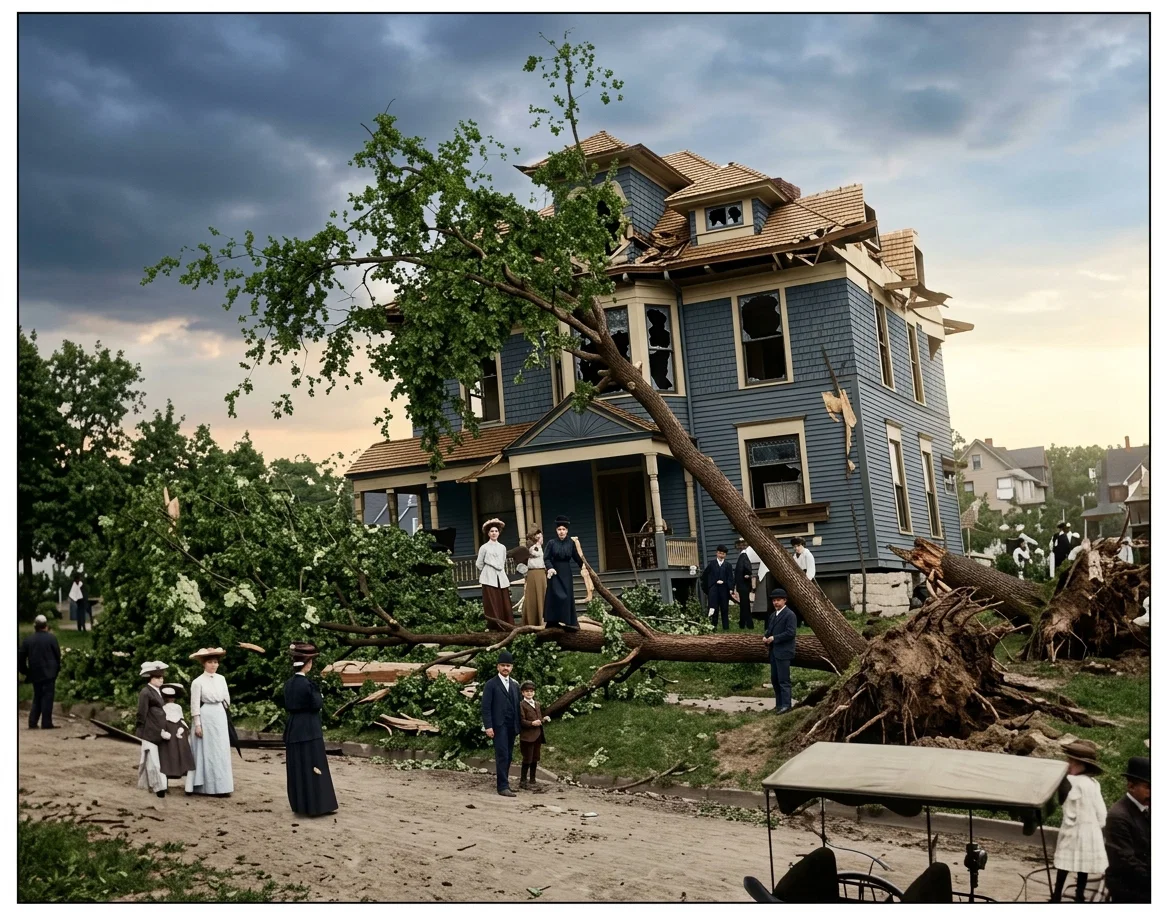
The Awful Destruction of the Angry Elements a Fulfilment of Prophecy.
BY O. O. BERNSTEIN.
On the evening of August 20, the northern Mississippi Valley experienced the worst storm in its history. Death and destruction followed in its path for hundreds of miles from Dakota to Wisconsin. St. Paul became the center of the wind-wrecked territory.
A Demolished Home at the Foot of De Soto Street.
Lafayette Park After the Cyclone.
It was at 8:56 that the death-dealing blast reached the center of the saintly city. The sharp play of lightning, accompanied by a brisk shower, preceded the tremendous gale, and caused the frightened people to leave the streets. Six minutes later came the whirlwind with the velocity of 180 miles an hour, when the recording apparatus at the weather bureau broke. This speed is the highest ever recorded, being three times faster than the swiftest limited trains, and about sixty miles faster than any previous velocity recorded by the United States Weather Bureau. The anemometer recording the speed was owned by the St. Paul Weather Bureau, and its record must therefore be taken as authentic.
One can scarcely grasp this rate of speed—one hundred eighty miles per hour. Well did the seer prophecy, “Stormy winds fulfilling His word.”
The brisk shower preceding the storm seemed a providential forerunner, and sounded the alarm. Had not the people heeded and cleared the streets, hundreds would have been killed, for, a moment later, the cyclonic gale came tearing along the valley of the Mississippi with a screaming noise above the roar of the thunder, meeting its first obstruction in the aerial heights of the high bridge which spans the river. Nearly 400 feet of this massive iron and steel superstructure was picked up, twisted into a shapeless mass, and then hurled into the abyss below. The storm threw itself against the tall bluff on the west side and was hurled back undaunted. It skipped across Harriet Island, cutting off the tree tops, as if with a reaper’s scythe. It carried away the minor buildings along the bank, picking up one here and there. At the city end of the Wabasha Street Bridge stood the Tivola Theater, an old structure, but aglow with light and resounding with popular music and the laughter of several hundred people. The awful roar of the coming storm brought a moment of breathless silence. The poor, powdered, painted creatures of the stage stopped their jokes and shrieked with terror, and there was a general rush made for the exits. Before the doors were reached, however, the storm was upon the place. In a moment it was laid low to the bluff upon which it stood, but while many were injured, only two were killed. The frailty of the building was the salvation of the people.
The storm’s course was now toward the heart of the city, and it passed on, doing its awful work of destruction. Everywhere, amid its deafening roar, the crashing of glass, and the din of falling timbers, people quaked with terror.
How strikingly were the Lord’s words fulfilled when He mentioned, among other signs enumerated in Luke 21:25, 26, roaring storms, and “men’s hearts failing them for fear.” Surely God’s children can not fail to read such signs. The day of the Lord cometh; it is nigh at hand.
Rain fell in torrents, as, whirling and swirling, carrying everything before it in the black vortex, the cyclone swept over the city.
A Wrecked Residence on Monroe Place.
The storm was a blow struck in the night, and a realization of its extent and details did not come until St. Paul awoke Sunday morning to a scene of devastation unparalleled in the history of the city. Hundreds of buildings were unroofed, wrecked, or demolished; thousands of beautiful trees uprooted or broken to the ground; parks effectually destroyed and made barren; telephone and telegraph wires a tangled mass.
Looking Up at the High Bridge Wrecked by the Cyclone.
The total damage, saying nothing about the dozen dead and one hundred injured, was immense, and is particularly difficult to estimate, owing to the innumerable small houses scattered over the large storm area. A conservative estimate of the loss is one and one-half millions.
In conclusion the writer wishes to say that, since passing through this storm and experiencing its power, in the racking and unroofing of his home, he is better able to appreciate the sentiments of that beautiful hymn:—
“The Lord’s our Rock, in Him we hide,
A shelter in the time of storm;
Secure whatever may betide,
A shelter in the time of storm.
“A shade by day, defense by night,
A shelter in the time of storm;
No fears alarm, no foes affright,
A shelter in the time of storm.
“The raging floods may ’round us beat,
A shelter in the time of storm;
We find in Him a safe retreat,
A shelter in the time of storm.”
SUNDAY TRIALS IN BAKER CITY, OREGON.
CONCERNING the crusade against the business men of Baker City, Oregon, who keep their establishments open on Sunday, the Herald notes that the jury in the first case returned a verdict of acquittal. Public opinion is said to be adverse to the enforcement of the Sunday law. The Herald says: “The general belief seems to prevail that the district attorney will not allow any man or men to use the law as an instrument of persecution, and that, should he discover that any one is simply filing complaints as a matter of vindication for a course of action, he would throw such complaints out of court. Such a9course would be exercising good judgment, and would receive the indorsement of the people, who feel that their rights are being trampled upon for no other reason than to gratify the spleen of some imprudent person or persons.”
It is a fact, however, that the principal use of Sunday laws is the gratification of religious prejudice, and this prejudice is quite liable to descend to a matter of personal or sectarian spite. Any law that can be used in this manner has in it the element of injustice, and therefore has no legitimate excuse for existence.
POLITICS CORRUPTED BY RELIGION.
THE Christian Statesman quotes Dr. J. H. McIlvaine, of Princeton, as saying, “Men exclaim against the mingling of religion and politics, and fear that religion will be corrupted; but who will tell us how politics can be kept pure, when separated from religion?” But it seems not to have occurred to him that it is not the religion so much as the politics that is corrupted by the union of the two. History testifies that the politics of Rome was far more corrupt after it became nominally Christian than it was before. True Christianity does not go into politics. The example of Christ and His apostles settles that fact. So any other religion, of whatsoever name, is intrinsically false and corrupt, and therefore can only work corruption in any sphere where it may enter. From almost every quarter comes the complaint that the political arena in this country is continually growing more and more corrupt, yet there never has been a time in our history as a nation when professed Christians took more interest in politics than at the present time; and there never was a time when a greater proportion of officeholders were nominal Christians. It would be next to impossible for a man who was not a member of some “Christian” church to be elected President of the United States at the present time.
Not only the logic of the doctrine of Christ—“My kingdom is not of this world”—but the history of all full-fledged church-and-state governments—Papal Rome, Russia, etc., testify that the religion that enters the domain of politics for the purpose of gaining political control as religion, is not the religion of Christ. Hence men who go into politics on the strength of any such religion can only add to the corruption already at work. This government or any other human government will never be made righteous. When Christ comes again He will find the world as it was in the days of Noah—ready for the fire, as the old world was for the Deluge. And all who will be attached to it by the ties of political religion at that crucial period will inevitably share in its doom. For the “Stone” kingdom, cut out without hands, will fall upon all other kingdoms, breaking them to pieces and grinding them to powder. See Dan. 2:34, 35, 44, 45. Therefore no kingdom of this world ever can become the kingdom of Christ for any other purpose than utter destruction. See Rev. 11:15; Ps. 2:7-9.
THE TRUTH NOT ENOUGH.
By Editor
We noticed recently in the press report of a gathering of ministers that one of them, in a burst of eloquence, said, “I make a plea for pulpit exaggeration.” He then made his plea, declaring that in these days the people were not attracted by the simple truth. It must be exaggerated or it would not attract. Now truth exaggerated is falsehood, and the kingdom of Christ is not advanced through the methods adopted by him who is the father of all that is false. Christ’s instruction upon this point is, “Let your yea be yea; and your nay, nay.” And again: “Ye shall know the truth, and the truth shall make you free.” It does not require an exaggeration of the truth to make men free. One of the very last statements made by our Saviour before His crucifixion was this: “To this end was I born, and for this cause came I into the world, that I should bear witness unto the truth. Every one that is of the truth heareth My voice.” John 18 : 37. If there were any question of the necessity of pulpit exaggeration, this statement of our Saviour ought to settle the matter forever. The truth, the absolute truth, is what is needed in the advancement of the cause of Christ, and it is needed now as never before, because of the very circumstances that caused the speaker above referred to, to consider exaggeration necessary. It is refreshing to hear the following sensible opinion in the matter from a secular journal:—
No man who has the love of God in his heart can defend exaggeration in the pulpit, much less plead for it. The field for exaggeration is already too well filled. The theatrical illusion, the newspaper sensations, the political boast and bluster, and the spectacular performances of the society “smart set,” furnish all demands for hypocritical embellishments and ornamentations of language and conduct. We still have a notion, old-fashioned, perhaps, that we have a right to expect from the pulpit the Gospel and the word of the heart without translation into exaggerated sensationalism.—Washington Post.
In other words, we can not use the devil’s methods in carrying forward the cause of Christ. The church has lost its bearings and soiled its garments whenever it has attempted it.
Volcanic Activity in the Caribbean
The great volcano of Mount Pelée on the Island of Martinique is reported to be in active operation, tho no damage on the island has been reported. La Soufrière, on the Island of St. Vincent, is also displaying signs of activity, and the cable service between the various islands has been interrupted to a considerable extent, showing that the disturbance is not local.
SAVAGERY AT THE SEATS OF LEARNING.
By Editor
We are compelled from time to time to witness or read of displays of the most reasonless savagery where we should be permitted to look for culture. In foot-ball games, in annual college rushes, and in brutal “initiations” into academic or collegiate secret societies, this tendency to revert to the savage is frequently seen. Many of those in responsible positions have labored to prevent these brutal exhibitions, but to little or no purpose; and it is frequently a question whether these bands of students have not imbibed the spirit that actuates these displays directly from some of those who have been set to instruct them.
One of these deplorable exhibitions took place at Columbia University, New York, on September 30, in what is termed a “rush” between the sophomores and freshmen. It was a pitched battle between the two classes. The report states: “When the fight came to an end, the big field resembled a battle-ground. Men with half their clothes torn off were lying insensible on the grass. Those who were able to walk were covered with blood. The battle to-day was the culmination of the annual ‘rough house’ which attends the opening of the class season. When the sophomores walked out on the field with a torn shirt as their flag, and hoisted it in an old oak tree, the freshmen were quick to accept the challenge. In the battle that followed the freshmen were defeated, altho the victors suffered so badly that they were glad to stop.”
There certainly is need in the world to-day of Christian education, of Christian colleges, and Christian church schools, which will not pander to, nor permit the indulgence of, the perversities and cruelties of a carnal nature.
THE ORIENTAL WAR.
The work of the war correspondents at the seat of hostilities is so circumscribed at the present time by both parties that little or no news is permitted to reach the outside world.
From the present temper of both governments it is certain that no proposition looking toward peace negotiations will be considered by either. Japanese officials are warning their people to prepare for a long and taxing struggle, and arrangements are being made by the governments for the raising of funds for the further prosecution of the war. In Russia, official sentiment at the present time will not tolerate the idea of peace until Japan has been beaten and humiliated. Reserves are being called out, and every possible facility will be used for getting troops and supplies to the front in the shortest time. The winter months when active campaigning is practically impossible will be used in forwarding troops and supplies to the front, so that if possible an overwhelming army may be launched against Japan in the spring. On the other hand, there is no reason for supposing that the Japanese will display any less activity during this time than do the Russians; and unless something unforeseen should develop, the terrible war will open with greater intensity early in the coming year.
Both Russia and Japan are arranging for the construction of war-ships of various classes in other countries, especially in France and the United States.
It is the intention of President Roosevelt soon to call another Peace Congress to convene at The Hague. The various nations are being sounded at the present time to ascertain how the proposition would be entertained. It is also reported that the emperor of Germany had intended soon to issue such a call. In view of that fact the call may be a joint one. Advices from St. Petersburg indicate that Russia would not look with favor upon the calling of the Peace Congress at the present time, as there will be numerous questions growing out of the war which she would not choose to have settled on plans proposed by the congress.
The Open Shop Movement
The open shop movement seems to be gaining some headway in Chicago and San Francisco. In the former place a number of strikes of ordinary proportions have failed recently, and 9,000 men have returned to work in the factories of two large concerns which have just adopted the “open shop” principle. In San Francisco the principal butcher shops have taken out their union cards and established “open shop.” The movement is looked upon by the unions in a rather serious light, especially since the injunction against boycotting a livery stable has been made permanent.
CHEERFULNESS IN THE HOME.
By Mrs. L. D. Avery-Stuttle
BY MRS. L. D. AVERY-STUTTLE.
(“A merry heart doeth good like a medicine.”)
I REALLY wonder how it would seem for all those ministers who carry long faces and whose constant expression is one of dejection and gloom, if they were obliged to preach a sermon at least once every month from the above text. I think it would do them good and their hearers as well.
But I sometimes doubt if those long-faced people know that there is such a text as this in the Bible. They can tell us where the Ten Commandments are,—O yes,—and can give chapter and verse for all the threatenings in the Book. But they are apt to forget the blessed promises. Now if this text were not to be found in the Book of inspiration, it would be apt to get considerable criticism. As it is, this blessed proverb, than which there is not a truer or a sweeter in the whole Book, is left severely alone. I wonder who ever heard a sermon preached from it. Did you? I wonder who ever had it framed and hung up in their room, as a beautiful motto to live by,—yes, and to die by, if it be God’s will.
“O, but you are sacreligious. How can you talk of a merry heart on a sick-bed, or a bed of pain, or a couch of death? You might talk of being calm, or resigned, or even cheerful; but ‘merry’! who could be merry when one is suffering?”—This is the time to be merry, for we are then in need of medicine; because, you see, a merry heart—so says Inspiration,—will do you as much good as all the medicine of the apothecary.
I never remember of reading of but one instance when the Apostle Paul ever sang. I don’t know whether he was ordinarily much of a singer or not. But he could sing behind prison bars as sweetly and as loudly as any one,—he, and Silas, too. And they must have been exceedingly uncomfortable, for they were lying on their bruised backs on the bare, hard floor of that dungeon at Philippi, with their feet in the stocks!
“But suppose we are sick unto death!” Well, suppose we are. Is that any time to hang our harps on the willows?
Suppose Death speaks to us. Shall we not make him a brave—nay, a cheerful—answer in the name of Him who holds the keys of death and hell?
“Are you ready to come with me,” says Death. “If not, get ready quickly. I am come for your soul. I shall lay my hand upon you, and an icy chill will pierce your heart. I shall breathe my chill breath upon you, and I shall clasp you in my arms and bear you away; Ah, when I do this, who shall redeem you out of my hand?”
Then let us make answer: “In the name of Him who has said, ‘I am the resurrection and the life,’ we do not fear you. Our King has entered your dark domain. We will smile triumphantly even in the midst of the valley of the shadow. Death can only claim the victory for a brief moment, but yet in our flesh shall we see God. We meet and defy the grim terror, with a countenance that shines like the sun. Aye, the worm may feed upon our body, and the chill prison-house claim us for a little moment—but only for a moment. Glory to the Lord! No place, no time, for despondency. Nothing but a merry heart; nothing but a continual feast.”
“Well,” says one, “I think I might be able to triumph over adversity, and, I trust, even over death, in the name of the Lord; but how am I to meet the little trials of home life, with a cheerful face and a merry heart? Now Mrs. Happyface is the most philosophical woman I ever met. The other day the baby spilled a whole bottle of black ink all over his pretty new white dress. I declare, Mrs. Happyface laughed—actually laughed till the tears came. But I happened to know that she had worked hard to finish that frock for baby in time for the picnic. Of course after that, neither baby nor his mother went.”
Ah, my friend; you call Mrs. Happyface a philosophical woman. Let me assure you it was something better than philosophy which gave her grace to smile in the face of a real trial like that.
“What! do you call such little things trials?”—Surely; and some of them the hardest which we must learn to meet and conquer.
“Well,” says Mrs. Worry, “I find those very things exceedingly wearing to my temper—or, rather, my nerves;—I prefer the latter word. The other day Johnnie spilled his plate of soup in his lap; and, before I had time to think twice, I had slapped the poor child; so that, together with the burn and the correction, he must have suffered considerably.”
“But,” says Brother Poorman, “I find no trouble in being cheerful under such circumstances as these; why, my little Jack does a deal of mischief, but, really, neither wife nor I would think of scolding the little fellow; but I’ll tell you what troubles me. Neighbor Richman is able to provide every luxury for his family. His wife rides out every day, and has servants galore; but my wife is much more delicate in health, and, besides, she is educated and refined, much more so than Mrs. Richman. But I can not afford the luxury of a carriage or servants; and I tell you, to-day when I saw my poor wife trudging off over the dusty road to bring me my dinner in the field, just as Mrs. Richman’s carriage rolled along,—well, I admit I felt anything but cheerful. I didn’t even feel amiable. I felt very cross.”
And still, my brother, I think you can pray yourself into a cheerful frame of mind, in spite of your poverty. Why, you are surely no poorer than the Master, who became poor for your sake. I tell you,—and I mean myself as well—I care not what the provocation may be, it is always best to cultivate a cheerful disposition.
But, if we must be gloomy and morose, if our brow must wear a frown, let us learn to cheer up at home, in the bosom of our own family. Let our countenance resemble a thunder cloud anywhere but at home!
But O, for the sacred precincts of home, let us reserve our sweetest smile and our best behavior,—ALWAYS.
THE PAINTER AND THE GIPSY GIRL.
By E. P. Hammond
[This little story from the well-known Evangelist, Dr. E. P. Hammond, author of “The Reaper and the Harvest,” and other works, while printed before, will bear a re-reading.]
Come with me, young friends, and look at these two pictures—one of a wild gipsy girl, and another of the Lord Jesus, who “gave Himself for us.” The gipsy girl lived the wild life of her tribe, and had been called in by a German painter, that he might paint her pretty face. She had never been in an artist’s studio before, and did not fail to notice on the other side of the room an unfinished painting of the crucifixion of our Lord.
One day she asked, “Master, who is that hanging there?”
“That is Jesus Christ,” replied the painter, carelessly.
“But was He a bad man that they treated Him so cruelly?”
“O, no; He was the best man that ever lived.”
“Tell me more about Him.” And so he did, tho’ half unwilling to do so.
Day by day, as this young gipsy girl came into the studio to have her picture painted, her face was fixed upon this painting of Christ. As the last sitting was over, and as she was turning to leave the room, she whispered, “Master, how can you help loving Him who, you say, has died for you? If anybody had loved me like that, O, I’d like to die for him!” And then, with a sad heart, she went back to her people.
And the painter? He was struck as with an arrow. God’s Spirit sent the words home to his heart. He sought out a mission-preacher who could tell him of Jesus, and in the little mission room he fell on his knees, and, covering his face with his hands, confessed before God’s blessed Son how for many years he had neglected Him and sinned against Him; and, looking to God for pardon, he gave his life to Him.
His life was filled with a new joy, and he then became a worker for Christ. He put aside the half-finished picture, in which he had only thought of depicting the sufferings of Christ, and began a fresh one, with his heart full of fresh love toward the Saviour who had died for him. He felt the Lord helped him as never before.
When the painting was finished, it was placed in the gallery at Dusseldorf. Crowds came to gaze upon it. To one heart at least that story went home, for beneath the picture the painter had placed the words:—
“I did all this for thee;
What hast thou done for me?”
Count Zinzendorf tells us that he felt he would not be able to answer very much, and prayed to the Saviour to draw him into the communion of His sufferings. Tho’ I believe Zinzendorf became a Christian when he was a child, yet the sight of this painting led him to live for the Lord as he had not done before. As the father of the United Brethren in Moravia, we know how well he kept his promise.
The gipsy girl came to see the picture, too, and the artist, happening to be there, found her weeping before it.
“O, master!” she cried, “He died for you, I know; but did He die for me—a poor gipsy girl?”
And now, this painter, knowing by experience something about the love of Jesus, could, out of a full heart, and with a deep interest in that dying Saviour, tell her, as he could not have done before, the story of His sufferings and death in our stead; and, pointing to the picture, he said, “Yes, He died for you. I love Him now; won’t you?” 1 John 4: 9, 10; 1 Peter 2: 24; 2 Cor. 5: 20, 21.
With tears in her eyes, she asked, “Did He really die for a poor gipsy girl? Then I will love Him, too.”
Some time after, a stranger came to him with a11message from a gipsy girl, who was dying, to ask him to come to her, as she wished at once to see him. He went, following the guide to the forest; and there in a poor hut lay the gipsy girl. It was his old friend, no longer in her dark beauty, but pale and wan and dying. Her eyes were closed, but when she heard his voice, she opened them, and, with a smile, she slowly said, “O, master—I know now—He—died—for—me,—I—love—Him—and—I—am—going—to—live—with—Him.” And thus she died.
We do not need any picture of the crucifixion. The simple Bible story of Christ’s death for us is enough to melt our hearts. Only let us, each one, be sure that we can say of the Lord Jesus, “He loved me, and gave Himself for me, and now I love Him.” If we do, the next thing will be that we shall hear Him saying to us, as He did to Count Zinzendorf:—
“I did all this for thee;
What hast thou done for Me?”
Thus, if we are Christians, will our love for Christ grow stronger day by day, and we shall find something to do for Him who has done so much for us.
But what shall I say to those of you who have never loved Jesus? You see, this gipsy girl had never heard of Christ; but you have heard of Him all your life, and yet have turned away from Him and rejected Him many times. She could not believe that He really loved her, and had taken the punishment she deserved on account of her sins.
But when she stood weeping before the Crucifixion of Christ in that picture-gallery, and the artist explained to her how it was that, because He was wounded for our transgressions (Isa. 53: 4-6), God could forgive our sins, then it seems that she trusted in Christ and found peace by believing in Him. Rom. 5: 1.
Will not you, young friend, do the same? Then you will be fitted to live the life of a happy Christian, and you, too, can say: “I know He died for me—I love Him—and I hope, by-and-by, to live with Him in His kingdom.” Matt. 25: 34.
May I repeat to you the question of this gipsy girl to the German painter: “How can you help loving Him who died for you?”
“O, Lamb of God, who died for me,
I consecrate my life to Thee;
Yea, all, for this I surely know,
He died because He loved me so.”
EASILY GIVEN.
By Anon.
It was only a sunny smile,
And little it cost in the giving,
But it scattered the night
Like morning light
And made the day worth living.
Through life's dull warp a woof it wove
In shining colors of light and love,
And the angels smiled as they watched above,
Yet little it cost in giving.
It was only a kindly word,
And a word that was lightly spoken,
Yet not in vain,
For it stilled the pain
Of a heart that was nearly broken.
It strengthened a fate beset by fears
And groping blindly through mists of tears
For light to brighten the coming years,
Altho it was lightly spoken.
It was only a helping hand,
And it seemed of little availing,
But its clasps were warm,
And it saved from harm
A brother whose strength was failing.
Its touch was tender as angels' wings,
But it rolled the stone from the hidden springs
And pointed the way to higher things,
Tho it seemed of little availing.
A smile, a word, or a touch,
And each is easily given,
Yet one may win
A soul from sin,
Or smooth the way to heaven.
A smile may lighten the falling heart,
A word may soften pain's keenest smart,
A touch may lead us from sin apart—
How easily each is given!
—Anon.
THE FREE GIFT; HAVE YOU TAKEN IT?
By Josiah Spiers
“Whosoever will, let him take the water of life freely.” Rev. 22:17.
A LADY, who had been for months very anxious about her soul, met her minister one afternoon, who asked her if she had got the great question settled, and knew that her sins were forgiven.
“Not yet,” she replied, “I have been reading my Bible and praying a good deal, but I can not find any comfort.”
The minister said how sorry he was, and tried to explain again to her how salvation was a free gift, being offered by God; that all she had to do was to take this gift and be thankful.
But the lady only shook her head, and said she could not understand it.
When it was five o’clock, the lady asked her minister to come in to tea with her, which he did, hoping to have further conversation upon the way of life.
The servant was dismissed, the blessing of God asked on the meal, and the lady, pouring out a cup of tea, handed it to the minister. Instead of taking it, he said, “Will you please give me a cup of tea?”
“Will you take this?” said the lady, still holding out the cup.
“I wish you would give me a cup of tea,” he replied.
“I have poured this out on purpose for you,” answered the lady.
“O, do, I beseech you, give me a cup of tea,” said the minister, falling down on his knees.
The lady was quite startled by her minister’s strange conduct, and rose from her chair, fearing that his mind was giving way. I think she would have rung the bell for the servant, had he not reassured her by saying, “It is all right. I am only trying to teach you a lesson. You thought it very strange because I did not take the cup of tea, but kept on asking for it, and that is just how you have been treating God all this time. You have been begging and entreating Him to give you pardon and salvation, when all the time He has been holding out to you in His Word, the gift of eternal life, saying, ‘Whosoever will, let him take the water of life freely.’ Rev. 22:17.
The Spirit of God applied this truth to the lady’s soul, and she at once received Jesus, kneeling down and thanking God for this great salvation.
O, that every reader of this incident would cry out with the Psalmist, “I will take the cup of salvation, and call upon the name of the Lord.” Ps. 116:13.
The Lord Jesus says, “Verily, verily (or, truly, truly), I say unto you, He that believeth on Me hath everlasting life.” John 6:47.—Josiah Spiers.
Sulphur Baths
Their benefits have been recognized for centuries in skin diseases and rheumatism.
Glenn’s Sulphur Soap makes a copious lather and is the only fine toilet soap that contains enough pure sulphur to produce an effective sulphur bath.
Be sure and get the genuine
Glenn’s Sulphur Soap
25c. a cake at all drug stores or mailed for 30c. by The C. N. Crittenton Co., 115 Fulton St., New York.
Washing a Pleasure
By Alfred Mallett
Mrs. E. N. Morley, Reads Wharf, Va., writes:—“I enclose $1 for E-Z Washing Tablets. I have never used anything like it. Washing is now a pleasure instead of a dread.” Agents make money. Send 10 cents for samples and prices to
ALFRED MALLETT
Elkridge Station Baltimore, Md.
THE NORTH-WESTERN LINE RUSSIA-JAPAN ATLAS.
Send ten cents in stamps to R. R. Ritchie, No. 617 Market Street, San Francisco, for Russo-Japanese War Atlas, issued by the Chicago & North-Western Railway, three fine colored maps each 14x20, bound in convenient form for reference. The Eastern Situation shown in detail with tables showing relative military and naval strength and financial resources of Russia and Japan.
OLIVOILINE
Is the Hygienic Cooking Oil of To-day
A Pure Vegetable Shortening. No Animal Fat. No Taste and No Chemicals.
Like Olive Oil, and Keeps in Any Climate
Price, F. O. B., Cash with order.
5 gal. can, $3.50; 10 gal. can (75 lbs.), $6.75. Write for circulars on Bbl. and ½-Bbl. lots.
(Refined Cotton Seed Oil, 10 Gallons, $5.50)
Address O. C. GODSMARK
2005 Magazine St.
LOUISVILLE, KY
Mountain View Acre Lots for Sale
MOUNTAIN VIEW—10 Acre Lots for Sale—$160 to $225 per acre. Two miles from R. R. Electric Cars projected through the tract from Stanford University to San Jose. Desirable for Fruit Vineyard or Homes. 32 Lots in tract, 14 of which are sold to neighbors. $50.00 per acre cash; balance, 1, 2, and 3 years, 7 per cent. Address, B. E. & R. V. Burns, Mountain View, Cal., or I. J. Truman, Call Building, San Francisco, Cal.
Who Is Macbeth?
Who is MACBETH? The maker who isn't afraid of his lamp-chimneys.
The Index tells you, in ten minutes, all you need to know for comfort with lamps and the saving of chimney-money; sent free; do you want it?
MACBETH, Pittsburgh.
WHAT A GRAND BOOK IT IS!
NORTHFIELD HYMNAL
By GEO. C. STEBBINS, of "Gospel Hymns" fame.
Full of new songs that enthuse and inspire.
Cloth bound, $25 per 100; 30 cents each by mail.
A returnable copy for examination will be mailed on request.