Your ShelfYour Projects

Signs of the Times, Vol. 25, No. 34.

The Evilness of Sin

Signs of the Times

Aug 23, 1899

Pacific Press Publishing Company · Oakland, California · Aug 23, 1899

The Evilness of Sin

Sin.—The root idea of sin is "missing the mark." God's mark of character is His own perfection. His requirement is, "Ye shall be holy; for I Jehovah your God am holy." Lev. 19:2; 1 Peter 1:15, 16. As a rule of action, a standard of character, God gave man His holy law; for "the law is holy." Rom. 7:12. Missing this mark is sin; for "sin is the transgression of the law"—an inspired definition. 1 John 3:4. As the law covers all holiness, any departure from it is sin. The same great truth is expressed in these words: "They are all gone out of the way;" "For all have sinned, and come short of the glory of God." Rom. 3:12, 23. The glory of God is His goodness, His holiness. Ex. 33:18, 19. Coming short of God's glory is missing the mark.

The Evilness of Sin.

No one paragraph can describe its satanic deceitfulness, its awful badness. Suffice to say, in the language of Scripture, that "all unrighteousness is sin;" and "sin, when it is finished, bringeth forth death." As the tempter presents sin, oftentimes clad in gorgeous beauty, oftentimes the picture of slumbrous and dreamy ease, of great wealth and luxury, of pomp and power, of fame, of pleasure, it does not seem death. Its first deviation is so small, the stultification of conscience so slight, and the reward seemingly so great and full of possibilities for good to a self-blinded vision—sin does not look to be evil. And yet, the beautiful dress is but a cloaking of corruption. Under the fair mask of the tempter is the hideous, repulsive form of death. Its soft, pleading voice is but the breathing of incipient decay, luring to a destruction as deadly as itself. Sin is the leprosy of the soul. It comes so stealthily, so deceptively, so insidiously, paralyzing the nerves—thus stupefying those sentinels of warning—that the soul is loth to believe it present till its ravages are apparent; and then oftentimes leaden despair or damnable lust dooms the brightness of life remaining. Sin is satanic. Its fruit is a devil and his angels.
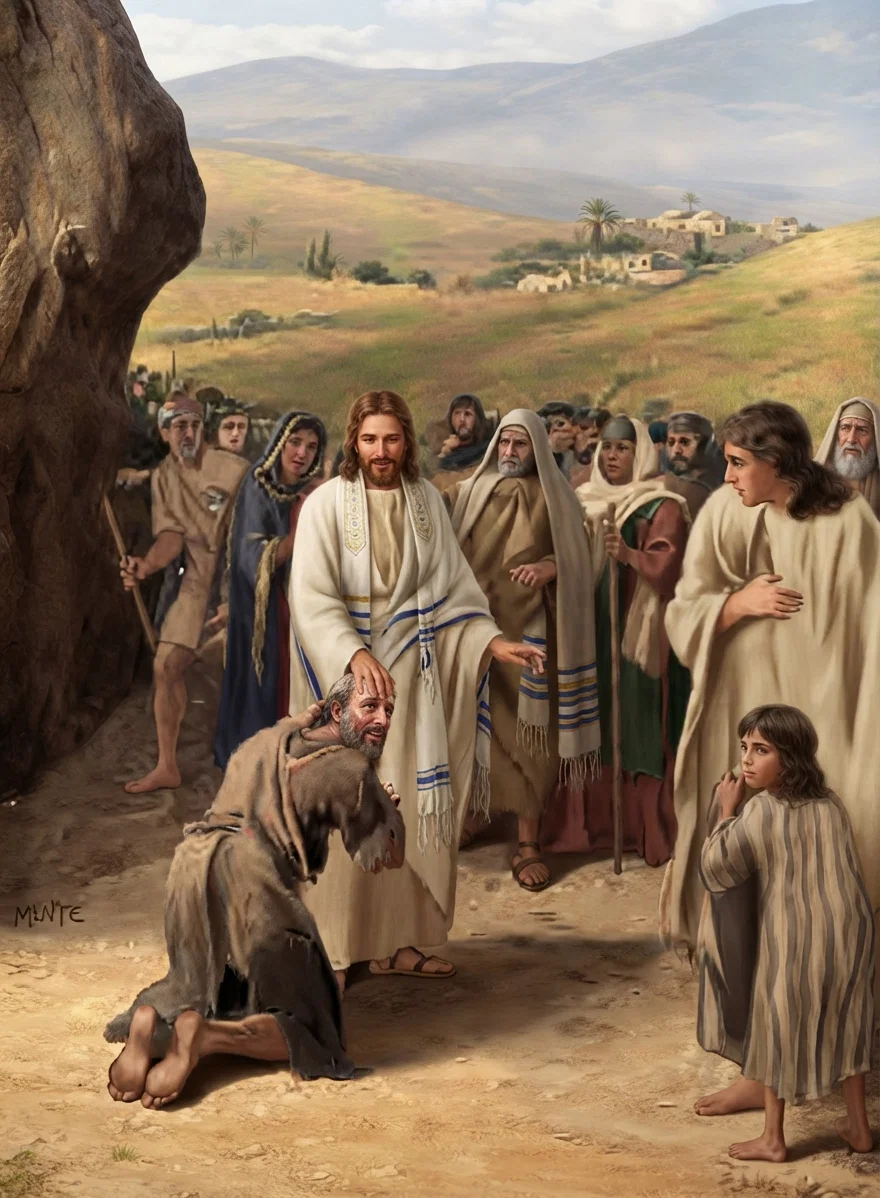
Jesus put forth His hand, and touched him, saying, I will; be thou clean. And immediately his leprosy was cleansed.
All that Satan is in deception, in craft, in malice, in cruel malignity, to be ended at last in eternal death, sin is responsible for.

Its Detector.

There is but one detector of sin in all the universe—God's Word, God's law, as it is in Jesus. "By the law is the knowledge of sin." Rom. 3:20. "Nay, I had not known sin, but by the law; for I had not known lust [coveting], except the law had said, Thou shalt not covet." Rom. 7:7. Man may by his own light seek his own heart; he will return deceived and disappointed. "The heart is deceitful above all things, and it is desperately sick; who can know it?" Jer. 17:9, R.V. Only God, as the next verse declares: "I the Lord search the heart." "For the Word of God is living, and active, and sharper than any two-edged sword, and piercing even to the dividing of soul and spirit, of both joints and marrow, and quick to discern the thoughts and intents of the heart." Heb. 4:12. Would you know sin?—With open heart study God's law, the great moral mirror. Let the living active word reveal the condition. Take in simple trust the diagnosis of the Great Physician.

Not flattering

Not flattering to any soul of man is the result of God's examination. Many an ailing body fears to go to the skilful physician, fearing that the verdict will be tuberculosis,—the great white plague,—Bright's disease, leprosy, or some other "incurable" malady. But if such a course is unwise in a physical matter, how much more in the spiritual world! Go, then, to the Great Physician. He will say first of all that you are "desperately sick," with all the rest of humanity; for "all have sinned." All are afflicted with themoral leprosy. And in many cases, "the whole head is sick, and the whole heart faint. From the soul of the foot even unto the head there is no soundness in it; but wounds, and bruises, and putrefying sores." Isa. 1:5, 6. Believe it; this Physician will not deceive; and He points out your true condition that He may heal you; yea, your "incurable" disease He will heal, if you will only believe. He will save even "to the uttermost."

Will He Do It?

Will He Do It?—Most surely He will. Speaking of the sinner, He declares, “I have seen his ways, and will heal him.” Sinful tho we are, how we naturally repulse the vile and base and criminal! Mankind in all ages have fled from the leper. But when Jesus Christ walked the earth He revealed His wondrous love and power in His treatment of this type of sinner. Among those who came to Christ, in whose hearts His name and work had kindled hope, was a leper. Others were brought by friends; the leper was forced to come alone. Those who saw him approach, shrank from his presence, the disciples of Christ among the rest. But the leper sees but one Person, Jesus, the Great Physician. He presses forward as rapidly as his decaying body will permit. Jesus does not flee from him; hope kindles. He falls at the Master’s feet, with the half-doubting prayer, “Lord, if Thou wilt, Thou canst make me clean.” And the merciful Jesus puts forth the hand ever extended to bless, and touches the leper, and with voice which thrilled every diseased fiber, responded, “I will, be thou clean. And immediately his leprosy was cleansed.”
For you, sinful soul, is this written. You are the leper; Jesus is the Great Physician. Go to Him in all your uncleanness, and you shall have cleansing. “If we confess our sins, He is faithful and just to forgive us our sins, and to cleanse us from all unrighteousness.” You do not need to wait. The leper was immediately cleansed. The word of Christ cleansed him through and through. So Jesus said to His disciples, “Now are ye clean through the word which I have spoken unto you.” God’s cleansing is yours now, by the power of His grace, if you will appropriate it by faith. With open arms and nail-pierced hands He freely offers the treasures of His grace, purchased at an infinite price, that you might be free from sin; and “if the Son shall make you free, ye shall be free indeed.” X.

IS IT PEACE?

WILL this wicked old world, composed of a thousand different States and peoples, bristling with bayonets and booming with battle-ships, ever find anchorage in the beautiful harbor of peace? Will the war drums beat only muffled dirges for the dead, and the weapons of war be known only as relics of a long-past age? So some have dreamed and some have sung.
The basis of dream and song is the desire. The world longs for peace. It was a noted fighter who declared, "War is hell." The bravest warriors who ever marshaled men on the battle-field have been the first to rejoice when peace was declared. No people desire to see their country laid waste, its buildings burned, its grain fields trodden down, its people demoralized, its women ravaged, and the flower of its manhood slain. All this has never been desired, save by incarnate demons.
Why then war? The answer lies just here. Man is in rebellion against "the God of peace." "Because the carnal mind is enmity against God; for it is not subject to the law of God, neither indeed can be." Here lies the secret of all the strife in the world.
He who is subject to God's law, seeks to do the will of God. He is concerned for God's honor and the success of God's cause. He will do all in his power for its advancement, and he will do it in God's way. He will not seek to force his opponents, but to "persuade" them. He will know that it is not by human armies or human power that God's kingdom is carried forward, "but by My Spirit, saith the Lord of Hosts." The true Christian has yielded his heart, his flesh, his all, to God; the carnal mind is crucified, Christ, the Prince of Peace, comes into the heart, and man is a warrior for God, not against Him. The weapons of his "warfare are not carnal," but spiritual, and "mighty through God to the pulling down of strongholds, casting down imaginations, and every high thing that exalteth itself against the knowledge of God, and bringing into captivity every thought to the obedience of Christ."
Jesus Christ said: "Put up again thy sword into its place; for all they that take the sword shall perish with the sword."
Jesus Christ said: "For the Son of man is not come to destroy men's lives, but to save them."
Again He said: "My kingdom is not of this world; if My kingdom were of this world, then would My servants fight; . . . but now is My kingdom not from hence."
The warfare of the Christian lies in the thought realm. The carnal mind, with all its evil, selfish imaginations and devices, must die and be cast out by the presence and power of Christ, who "abolished in His flesh the enmity," that He might abolish it in ours.
Now if all were thus Christian, if all were thus in obedience to Christ, there would be no bloody wars; there could be none. There would be no separated nations; no jealous, ambitious kings. There would be no human tigers lying in wait for prey, no human vampires longing for a brother's blood, no human vultures scenting the battle afar off. All would be peace, and Christ, the Prince of Peace, would reign. And then it would be said: "And the work of righteousness shall be peace; and the effect of righteousness quietness and assurance forever."
But the world is carnal. Every carnal man desires peace, but he wants it in his own selfish way. Every political party wants peace, but according to its own selfish policies. Every nation wants peace, as the response to the recent Peace Conference proved, but each wants it in harmony with its own selfish aspirations, as the farce of the "peace" proceedings demonstrate.
Peace is impossible while human hearts remain unchanged. Just as long as men's hearts are ruled by selfishness, just so long the demons of lust and of greed and of war will control; they will heap high the burdens of standing armies and increased pensions for mutilated manhood, of heavier taxation, and the increase of all that is evil, cloaking all under the names of martial glory, patriotism, manifest destiny, benevolent assimilation, and similar pretty phrases.
We are not condemning the world for doing just what is the inevitable logic of the carnal mind. For war is but one of "the works of the flesh." But we are saying by the authority of the Word of God that in the world—even tho it may be called "Christian," in whole or in part—there is no peace.
War preparations are increasing mightily. The strong and the weak nations of earth are borne down with their armor. In the medley of the nations the seductive voice of optimists sing of peace, while the serious statesmen predict the on-coming war. It is a strange bewildering chorus, and only the soul in harmony with God's law, the great harmonic chord of the universe, can hear amid all the discords, the trumpet of the eternal God pealing forth the truth for this generation.
War is inevitable. Notwithstanding the profession of Christianity, there are more men trained for war now than any other generation of men ever saw, and the strongest armies are composed of professed followers of Him who said: "For the Son of man is not come to destroy men's lives, but to save them."
All nations have drunken of the wine of Babylon, and imbibed her warlike spirit. The trio of demons are out into the world among the nations of earth "to gather them to the battle of that great day of God Almighty." Rev. 16:13. We are living in the time foretold by the weeping prophet, when the nations are drinking from "the wine cup" of God's fury—the result of sin, "and they shall drink, and be moved, and be mad." See Jeremiah 25.
Men may cry, "Peace, peace;" but there is no peace save in Christ Jesus. They who know His peace, after the short strife of this world is over, will reign with Him forever, and "delight themselves in the abundance of peace."

THE WORD MADE FLESH.

THE influence of words is not comprehended as it should be. We do not, as a general thing, realize that there is a real power in simple words.
And yet, when we stop to think about it, we are made to sense the fact that our words may bring good cheer that gives healing and life to a weary soul; or, on the contrary, we may speak words that fill the heart of the hearer with sadness and desponding gloom.
Words are nothing more than the articulate sounds or the written expressions by which an idea is carried from one mind to another. And it is the ideas that we harbor in our minds that form our characters. Hence the great necessity for thinking right; to have pure and exalted ideas and ideals if we would be pure and noble and Christlike. "For as he thinketh in his heart, so is he." Prov. 23:7.
"A good man out of the good treasure of the heart bringeth forth good things; and an evil men out of the evil treasure bringeth forth evil things. But I say unto you, That every idle word that men shall speak, they shall give account thereof in the day of judgment. For by thy words thou shalt be justified, and by thy words thou shalt be condemned." Matt. 12:35-37.
Words are but the expression of the character within. A man will talk about what he thinks about. He will do this in spite of himself. And so "by thy words thou shalt be justified, and by thy words thou shalt be condemned."
That which we read most will have a molding effect upon our lives. It is next to impossible to read anything without in some way having it affect and change us from what we would have been if we had never read it. And if we are particular to know only the good, and to confine our reading and thinking to that, we may be sure that our characters will be right.
Every one acknowledges that the life of the Lord Jesus Christ was perfectly beautiful, and perfectly strong. Men who are not believers in Christianity will vie with each other in extolling the virtues of the Christ-life.
This perfect, this great, this beautiful life of the Master was builded, in all its symmetrical characteristics, by the Word of God. The Saviour's life is a perfect expression of the Word of God. Christ spoke the words of God so as to perfectly express the ideas of God. And Christ lived the words of God so as to perfectly express the character of God. Hence it is written, "The Word was made flesh, and dwelt among us (and we beheld His glory, the glory as of the Only-begotten of the Father), full of grace and truth." John 1:14.
We read the expression, "The Word was made flesh," and then proceed at once to make a great mystery of it without comprehendingthe divine truth that these words so beautifully express. God had expressed Himself to mankind in His spoken and written Word, but this was persistently misconstrued, and hence was not understood. Then the loving Father came still closer and expressed Himself in the literal person of His own Son.
In this act of giving Christ, it is as if the Father said to the world: "You have refused to receive the depth and power of My words, now I give you My Son. He is My Word in actual human life. I have clothed Him with your weak human flesh. Yet, behold His life —His character! All this beautiful life of Jesus, My Son, is sustained by the power of My Word."
The Word was truly made flesh in Christ. But this was only that we might see the power and beauty of it, so that we would yearn to have the same Word made flesh in us. It does not express it strong enough for us to say that it is possible for us to have the character of Christ by feeding upon the words of God. We should know of a surety that the beautiful character of Christ is the invariable and sure result when we feed upon the living Word of God. There is no chance for failure, because God Himself sees to it that the character appears in response to His indwelling Word.
O, we do not begin to realize the power and efficiency of the Word of God. We do not feed upon that Word. We choose the husks of the world instead. Then let us come to the living fountain of the Word, and by ever drinking its knowledge, its power, and its purity we will be assimilated by divine grace into the likeness of Christ, our Elder Brother.

EVERLASTING BURNINGS AND FIRE.

SOME persons may think that Isa. 33:14 teaches endless suffering. It reads: "Who among us shall dwell with everlasting burnings?" This text certainly shows what the effect of fire will be upon sinners, for it implies that they can not dwell in it; while the context and answer to the question, "He that walketh righteously," etc., clearly teaches that the righteous will not be affected by the fire. Even in this life the children in the fiery furnace (Dan. 3:27) were not burned, "nor was an hair of their heads singed."
The expression "unquenchable fire," in Matt. 3:12, will throw light on Isa. 33:14. Eusebius, an ancient learned Greek, who certainly had understood the original as his mother tongue, in his "Ecclesiastical History," book 6, chapter 41, uses the original words rendered unquenchable fire, puri asbesto, in giving an account of the martyrdom of Julian and Cronon, and certain others. He says: "They were destroyed in an immense puri asbesto, unquenchable fire." On this language of Eusebius, H. L. Hastings very forcibly comments, as follows:—
"Eusebius declares that those martyrs were consumed and destroyed in 'unquenchable fire.' If unquenchable fire could burn up saints, according to the words of Eusebius, could it not burn up sinners, according to the words of Christ?" It is plain that the words of the prophet Isaiah accord with the words of Christ in teaching what the effect of the fire will be upon the wicked, and more especially as in one case the chaff (the wicked) is represented as being burned up, and in the other question is given, "Who among us shall dwell with the devouring fire?" etc., plainly implying that the righteous will not be affected by it, but that it will devour or destroy the chaff, or the wicked, as they can not dwell, remain, or exist in it.
What a blessed thing it is that the children of God can claim the promise (Isa. 43:2): "When thou passest through the waters, I will be with thee; and through the rivers, they shall not overflow thee; when thou walkest through the fire, thou shalt not be burned; neither shall the flame kindle upon thee"?
WM. PENNIMAN. Woodburn, Ill.

"GIVE TO HIM THAT ASKETH."

THE thirtieth verse of the sixth chapter of Luke is a passage of Scripture that gives some people considerable trouble. Let us read it. "Give to every man that asketh of thee; and of him that taketh away thy goods ask them not again." How are we going to be able to do this?—Simply by continually receiving new supplies from God. When the Saviour was here He was always able to give to those who asked of Him, and we ought to be able to do the same thing.
There was a missionary in Africa who was translating the book of Luke into the native language; when he came to this verse, his first thought was to leave it out, fearing that the natives would at once put it into practical application, by asking for all the things that he had, and he could do nothing else but to grant their requests. But he did not feel free to leave it out, and so translated it along with the rest. The natives came and asked him for all the little comforts and conveniences he had; last of all they asked for his bed, and as they were carrying this off, the chief noticed it, and asked the reason. The natives replied that the missionary had a religion which compelled him to give to every man that asked of him, and so they had asked for and received all the property that he had. The chief was deeply impressed. He said to himself, "There must be something to this religion." By his order all the goods of the missionary were restored, and the chief himself, and his leading counselors asked the missionary to instruct them in his religion. The result was a great revival in that place; hundreds were converted.
Still, we are not required to give the people exactly the things they ask of us, for it would not be best for them. The lame man asked alms of Peter and John; they did not give him any money, but they did give him something better than money. So we may meet people to-day who ask us for money or other earthly gifts, and we may not be able to give them exactly what they ask for, but we can always give them something, and that should always be the thing they need most. Perhaps they need to be told the same as the lame man: "Arise and walk." So many people are born weak; they need strength, sympathy, and gentle words of encouragement; a good warm hand grasp, a kind brotherly word, are worth more than money. We may not always know at the moment just what kind of help is most needed; then we should do as Job did. He says: "The cause of him I knew not, I used to investigate."—Jewish Version. God has given us all the means which we possess, and we should be careful in the use of the same, knowing that we must give an account of it.
But this verse which I have read from the sixth chapter of Luke is perfectly practicable. There is a rich experience for all those who accept it as such, and put it into practise. Dr. Dow and myself first began to practise it when we were in New York City a few years ago. We could not always give men just the things that they asked us for, but we always gave them something, even though it required some self-sacrifice, because we felt that every man who appealed to us had some providence connected with his case in some way which we would spoil if we turned a deaf ear to him. Sometimes when we were nearing home after a hard day's work, we would meet a man who would ask for ten cents to pay for a night's lodging. We would not feel free to give him the money, lest he should be tempted to spend it in a saloon. So we would walk back with him for a mile, perhaps, and put him in some mission lodging-house and pay for his night's accommodation. Sometimes we would meet children begging for money or food, and in order to make sure that their story was true, would follow them to their homes. We had many rich experiences in this way, and the Lord always enabled us to carry out the instruction of this verse.
The young man who roomed next door to us also adopted the plan, and was richly blessed in doing so. He was a poor student, paying for his tuition at the school in work. Before he adopted this plan he would often go for weeks without any money, but as soon as he stepped out on faith, to carry out the instruction "Give to every man that asketh of thee," and claimed the promise, money began to come to him in a wonderful way. He always had sufficient for his own needs and for others. While walking along the street, people would come up to him and hand him a dollar, two dollars or five dollars. Letters would come signed, "From a friend," enclosing various amounts of money. Thus, the Lord provided for him, and he realized the fulfilment of the scripture, "The liberal soul shall be made fat."
God cares for each of His children individually. If He impresses me to give money or other help to somebody, it is because He wants to give me a rich blessing in its place. When we use the things that He has given us to help others, He stands ready to give us more. God is anxious to make every one of His children channels through which He can let His boundless love flow out to all the world. Let us not waste time in worrying about our own spiritual advancement; God will take care of that if we will simply leave ourselves in His hands, and do the things that He wants us to do.
DAVID PAULSON, M.D. Battle Creek, Mich.

REJOICING IN TRIBULATION.

Does the trial seem a great one? "I will wait upon the Lord;" He has promised grace sufficient, And I'm trusting in His word.
'Tis the word that spoke creation, And that set the sinner free; I believe that He is able Also to deliver me.
I'll rejoice then in the trial, And the thorn which doth me wound; For it's when I feel my weakness That the strength of God is found.
In infirmities I'll glory, And will gladly suffer wrong, That His power may rest upon me— "When I'm weak, then am I strong." Asa Smith.

Faith That Right Makes Might

LET us have faith that right makes might; and in that faith let us dare to do our duty as we understand it.—Abraham Lincoln.

The Perfect Victory

The perfect victory is to "put ye on the Lord Jesus Christ," and thus to triumph over one's self. Rom. 13:4.

Witnesses Must Testify

"Of what benefit to God's cause is a witness who won't testify?"

"LIKE ALL THE NATIONS."

GOD had said of Israel, "Lo, the people shall dwell alone, and shall not be reckoned among the nations."
But, contrary to His expressed will, and against His solemn protest, Israel set up a kingdom and established a State.
They did this, they plainly said, that they might be "like all the nations." Contrary to all the Lord's wishes, the people would "be reckoned among the nations."
But Israel was the church, while all the nations were States. Israel, therefore, could not be like all the nations without forming themselves into a State.
But Israel being the church, could not possibly form themselves into a State without at the same time, and in the very doing of it, forming a union of Church and State.
They did form themselves into a State, and did thus unite Church and State. But as this was contrary to the Lord's plain Word, and against His solemn protest, it certainly stands as the truth that any union of Church and State is against the plain Word and the solemn protest of God.
Israel as "the church," which is "the pillar and ground of the truth," was the depository and the representative of the true religion in the world. Then when Israel formed themselves into a State, this was nothing else than a union of religion and the State. And as their forming of a State was contrary to the expressed will and the solemn protest of the Lord, it is clearly the truth that any connection between religion—and above all the true religion—and the State is positively against the expressed will and the solemn protest of God.
And as Israel, the depository and representative of the true religion, in order to form a union of religion and the State, had to reject God, it is certainly true that every other people, in forming a union of religion and the State, do, in the very doing of it, reject God.
Nothing can be plainer, therefore, than that the God of heaven and earth, the God and Father of our Lord Jesus Christ, is eternally opposed to a union of religion and the State. He will never be a party to any such transaction.
This is why He desired that "the people should dwell alone." This is why He would have it that they should "not be reckoned among the nations." He desired that they should abide with Him, and have Him their only God, their only King, their only Ruler, their only Lawgiver—their "all in all."
God wanted not only that Israel, but that all people on the earth, should know that He is better than all other gods, that He is a better King than all other kings, that He is a better Ruler than all other rulers, that He is a better Lawgiver than all other lawgivers, that His law is better than all other laws, and that His government is better than all other governments.
For this reason He would station Israel in Palestine, at the pivot of the highway of the nations; with the God of heaven as their only King, Ruler and Lawgiver; with His law their only law, and His government their only government; the people dwelling alone and not reckoned among the nations—a holy, happy people; a glorious church.
Dwelling thus in the sight of all the nations that had forgotten God, those nations would be constantly taught the goodness of God and would be once more drawn to Him. Accordingly He told them: "Behold, I have taught you statutes and judgments, . . . that ye should do so in the land whither ye go to possess it. Keep therefore and do them; for this is your wisdom and your understanding in the sight of the nations, which shall hear all these statutes, and say, Surely this great nation is a wise and understanding people." Deut. 4:5,6.
But Israel would not have it so. Israel would "be reckoned among the nations." Israel would be "like all the nations." And so it has been, from that day to this. God has never been allowed by His professed people to reveal Himself to the world as He really is. His church has always been too willing to "be reckoned among the nations," too willing to be "like all the nations." She has always been too willing to be joined to the State, to be a part of the State, to have religion a matter of State and government, "like all the nations." And so it is with the church in all the world today.
"Like all the nations." The Israelites did not realize that to be in this respect unlike other nations was a special privilege and blessing. God had separated the Israelites from every other people, to make them His own peculiar treasure. But they, disregarding this high honor, eagerly desired to imitate the example of the heathen.
"And still the longing to conform to worldly customs and practises exists among the professed people of God. As they depart from the Lord they become ambitious for the gains and honors of the world. Christians are constantly seeking to imitate the practises of those who worship the god of this world. Many urge that by uniting with worldlings and conforming to their customs, they might exert a stronger influence over the ungodly.
"But all who pursue this course thereby separate from the Source of their strength. Becoming the friends of the world, they are the enemies of God. For the sake of earthly distinction they sacrifice the unspeakable honor to which God has called them, of showing forth the praises of Him who hath called us out of darkness into His marvelous light.
"The days of Israel's greatest prosperity were those in which they acknowledged Jehovah as their King—when the laws and government which He established were regarded as superior to those of all other nations."—Patriarchs and Prophets, chap. lii., par. 8-13. And such will be the days of any people's greatest prosperity.
God's laws, just as they stand, without any re-enactment, without any adding to or diminishing from, are superior to all other laws. His government, administered by Himself through the operation of His own eternal Spirit, is superior to every other government.
But how shall the people know this, who know not God, so long as His own people will not have it so? How shall the nations know this, when His own professed church will not recognize it or have it so?
Instead of holding fast God's laws and government as superior to those of all States and nations, the professed people of God consider that they must enter the politics and shape the policies, that they must tinker the laws and manipulate the governments, of the States and nations of the world.
Instead of magnifying God's laws and government before all the world, as superior to the laws and governments of all the nations, and showing unswerving allegiance to them as such, the people of the professed churches of God seek to mingle heavenly citizenship with earthly citizenship, and to bring down from their superior place the laws and government of God, and mix them up with the laws and governments of all the nations in an unseemly and ungodly union of religion and the State.
And thus the people of the professed churches of God, of the young people's societies and leagues of Christian Endeavor—of all the combined church elements of the land—are following directly in the track of the church of ancient Israel: they will not dwell alone; they will be reckoned among the nations; they will be like all the nations; they will join themselves to the State; they will form a union of religion and the State; they will reject God, that He should not reign over them.
Continue reading: ROGER WILLIAMS—AMERICA'S LUTHER. No. 5.