Your ShelfYour Projects

Review and Herald, Vol. 79, No. 23.

The Great Nations of To-day

Review and Herald

Jun 10, 1902

Seventh-day Adventist Publishing Association · Battle Creek, Mich. · Jun 10, 1902

The Great Nations of To-day.
By Alonzo T. Jones.
A presentation of the great nations of the present time, their rise, relations, career, and their destiny, in connection with a clear and concise treatise on the Seven Trumpets, the Three Woes, the Third Angel’s Message, the Threefold Messages, Babylon, the Beast of Revelation 13, its Image in all its phases and workings, the Commandments, the Hour of the Judgment Come, and the Setting up of the Everlasting Kingdom of God.
An excellent volume to loan and to place in general circulation.
257 pages; paper covers, 25 cents.
Order of the State Tract Societies.

The Two Republics.

By Alonzo T. Jones.
A COMPREHENSIVE HISTORY OF THE Two Great Republics, Rome and the United States.
The errors of the great Roman republic are cited, and lessons of warning drawn for the guidance of the people in the present republic of the United States. The true principles of religious liberty are contrasted with the enforced religious observances.
Of great importance to every American citizen.
“It seems to us as though it has left nothing unsaid which needed to be said on the subject.”—New York Sun.
896 octavo pages. Prices, $2.50 to $4.75.
Order of the State Tract Societies.

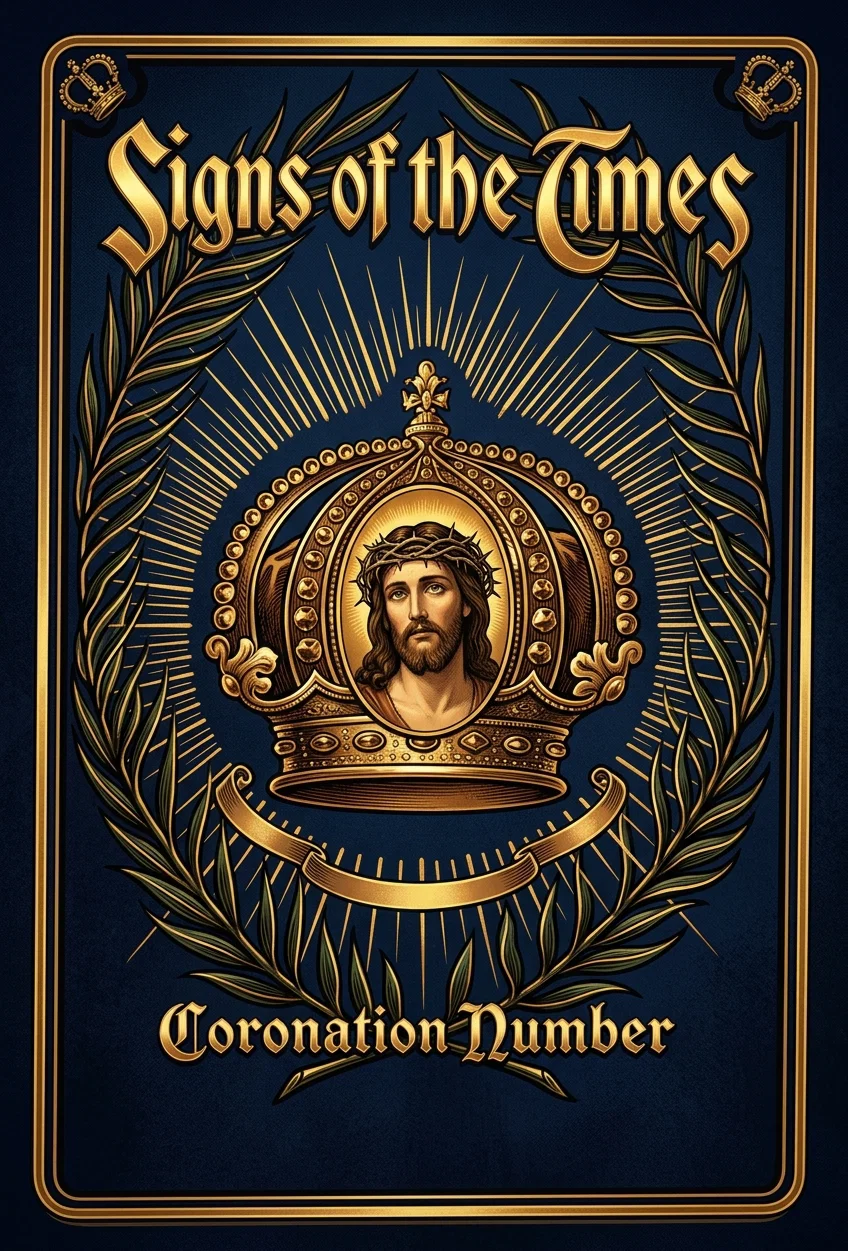
Signs of the Times

Coronation Number
DATED JUNE 11  READY JUNE 5

Coronation Number

Taking advantage of the great coming occasion that is attracting the attention of the world, the coronation of Edward VII King of Great Britain and Ireland, a special number of the

Signs of the Times

will be issued under date of June 11, in which this world-renowned event will be used to herald forth that far greater and soon-coming coronation of the King of kings and Lord of lords.
The accompanying cut is a reduced facsimile of the front cover of this special number. It will be NICELY ILLUSTRATED and well adapted in every particular, in the use of present circumstances, to teach the truths for this time.
1 copy, 5 cents; 10 copies, 25 cents; 25 or more copies, 2 cents per copy.
Order of the Pacific Press Pub. Co., Oakland, Cal., or of the State Tract Societies.

The Marshaling of the Nations

By Alonzo T. Jones
A brief yet comprehensive outline of Assyria, Babylon, Medo-Persia, Grecia, and the division of the Roman empire into the ten kingdoms; the source and gradual development of the great powers of to-day; their strategical positions on the maps of the world, and their part in the great Eastern question; the United States as a prophetic nation, and the Scriptural predictions pertaining to the part that each of the great governments is to act in the coming conflict.
An important publication for this time.
Pamphlet, 44 pages; price, 10c. postpaid.
Order of the State Tract Societies.
Photo-Reduction of First Page
5c Single Copy 10 Copies, 25c 25 or Over, 2c
ORDER EARLY

THE EMPIRES OF THE BIBLE.

FROM THE FLOOD TO THE CAPTIVITY OF BABYLON.
By Alonzo T. Jones
A THOROUGH yet concise history of the peopling of the earth, the origin of nations and of the state, and the course of empire from the time of Nimrod to the captivity of Judah. The courses of empires are fully shown by 21 especially prepared maps. The design of the book is excellent, and the classified arrangement of the subject matter is especially helpful to all Bible and history students.
410 large pages, neatly bound in cloth; $1.50, postpaid.
Order of the State Tract Societies.

GREAT EMPIRES OF PROPHECY.

FROM BABYLON TO THE FALL OF ROME.
THE GREAT empires of prophecy are Babylon, Medo-Persia, Grecia, Rome, and the ten divisions of the Roman empire. The history of these is foretold in the prophecy of Daniel, and to this Biblical record, the “Great Empires of Prophecy” adds over eighty testimonials of the best historians, thus rendering this volume a cyclopedia of prophetic history fulfilled.
712 large pages; 22 full-page colored maps made especially for “Great Empires of Prophecy.” Price, $2.
Order of the State Tract Societies.

Sin and Its Deceitfulness

Editorial

Sin

THE most terrible thing in the world is sin, and the most terrible feature of this most terrible thing is its deceitfulness. There is constant danger of being “hardened through the deceitfulness of sin.” It is only a variation of the same old story which is told to-day: “Ye shall not surely die: for God doth know that in the day ye eat thereof, . . . ye shall be as God.” But disobedience to God did not impart the divine attributes. On the contrary, instead of becoming as God, they became as the tempter himself, and the slaves of sin. And to-day there are many who, through the deceitfulness of sin, profess to be as God, but really reveal the attributes of Satan. “By their fruits ye shall know them. Not every one that saith unto me, Lord, Lord, shall enter into the kingdom of heaven; but he that doeth the will of my Father which is in heaven.” It was to those who professed much religion but possessed little that Jesus said, “Ye are like unto whited sepulchers, which indeed appear beautiful outward, but are within full of dead men’s bones, and of all uncleanness. Even so ye also outwardly appear righteous unto men, but within ye are full of hypocrisy and iniquity.” Such is the deceitfulness of sin.

Death

SIN carries with itself and in itself its own result. “Sin, when it is finished, bringeth forth death.” Sinning is dying. To choose to sin is to choose to die. “He that sinneth against me wrongeth his own soul: all they that hate me love death.” If there had been no sin, there would have been no death in either the vegetable or the animal kingdom. The dead branches which in this wonderful spring season are not clothed with living green, and the dead leaves which cover the ground in the autumn, are testifying to the result of sin, just as much as the funeral processions and the cities of the dead. Those are really dead who are “dead in trespasses and sins.” Of the church in Sardis it was said, “I know thy works, that thou hast a name that thou livest, and art dead.” “She that liveth in pleasure is dead while she liveth.” This is a living death indeed! To have all the appearance of life, and yet to be dead! What a terrible disappointment to some when they awaken to the fact that, although they professed to have life, they really did not have it. Life was manifested in them for a time, but they did not “lay hold on the life which is life indeed.” “He that hath the Son hath life; and he that hath not the Son of God hath not life.” “He that believeth on the Son hath everlasting life.” “The wages of sin is death; but the gift of God is eternal life through Jesus Christ our Lord.”

Salvation

WHAT a blessed thing it is that there is a remedy for sin and its consequences!
“Salvation! O, the joyful sound! 'Tis pleasure to our ears; A sovereign balm for every wound, A cordial for our fears.”
The gospel is the good news of the gift of Jesus as the means of salvation from sin and death. “He shall save his people from their sins.” “I will also give thee for a light to the Gentiles, that thou mayest be my salvation unto the end of the earth.” “The Lord is my light and my salvation; whom shall I fear? the Lord is the strength of my life; of whom shall I be afraid?” But all this wonderful provision is in vain unless we actually accept it. Because of the terrible deceitfulness of sin, many refuse the offer of salvation. They make light of it, and go their ways, “one to his farm, another to his merchandise.” They tread under foot the Son of God, and do despite to the Spirit of grace. What wondrous love it is which renews the offer of salvation even after it has long been refused. Again and again the voice is heard saying, “As I live, saith the Lord God, I have no pleasure in the death of the wicked; but that the wicked turn from his way and live: turn ye, turn ye from your evil ways; for why will ye die, O house of Israel?” “For God hath not appointed us to wrath, but to obtain salvation by our Lord Jesus Christ.” “How shall we escape, if we neglect so great salvation?”

Immortality

THERE is only one life, and that is the life of God. He is the eternal God, and his life is eternal life. In the gift of Jesus that eternal life has been freely given to all, but is received only by believing. When this life has been refused until there is no hope that it will ever be received, the fixed choice results in the withdrawal of the offered life, and then comes eternal death. “He, that being often reproved hardeneth his neck, shall suddenly be destroyed, and that without remedy.” “Because I have called, and ye have refused; I have stretched out my hand, and no man regarded; but ye have set at naught all my counsel, and would none of my reproof: I also will laugh at your calamity; I will mock when your fear cometh; when your fear cometh as desolation, and your destruction cometh as a whirlwind; when distress and anguish cometh upon you.” But every one who chooses eternal life may have it freely, and “when he is tried, he shall receive the crown of life.” At the coming of the Lord all those who have made the unchangeable choice of life will have that choice sealed upon them by the change to immortality. “For this corruptible must put on incorruption, and this mortal must put on immortality. So when this corruptible shall have put on incorruption, and this mortal shall have put on immortality, then shall be brought to pass the saying that is written, Death is swallowed up in victory. . . . Thanks be to God, which giveth us the victory through our Lord Jesus Christ.” Thus is mortality swallowed up of life. Sin, death; salvation, immortality—how can we hesitate in the choice which we make? “Choose you this day whom ye will serve; . . . but as for me and my house, we will serve the Lord.”

Self-Deception Through Religious Knowledge

“How many are deceiving themselves with regard to their true condition simply because of their religious knowledge!”

A Lesson from the Life of Esau

THE New Testament speaks of Esau in this manner: “Looking diligently lest any man fail of the grace of God; . . . lest there be any fornicator, or profane person, as Esau, who for one morsel of meat sold his birthright. For ye know how that afterward, when he would have inherited the blessing, he was rejected.” The Old Testament account of the matter runs after this tenor: Jacob had prepared a savory vegetarian stew of bread and lentils. Esau just at that time came in from a hunting trip, faint and hungry, and asked Jacob to give him some of that same red pottage which he had prepared. Therefore was his name called Edom. Jacob, ever ready to take advantage of the situation, and drive a sharp bargain, said, “Sell me this day thy birthright. And Esau said, Behold, I am at the point to die: and what profit shall this birthright do to me? And Jacob said, Swear to me this day; and he swore unto him: and he sold his birthright unto Jacob. Then Jacob gave Esau bread and pottage of lentils; and he did eat and drink, and rose up, and went his way: thus Esau despised his birthright.” The whole record of this transaction and the circumstances attending the birth of the children is found in Gen. 25:21-34.
Esau stands forth as the type of those who, in all the ages, are ready to exchange for some sensuous and supposed benefit, some apparent advantage and gratification, all the blessings and spiritual privileges held up to the eye of faith, and thus within the reach of all who will believe. “What profit,” exclaimed Esau, “shall this birthright do to me? Behold I am at the point to die.” So he barters away for a little good which is at hand and in sight, great future good, and possibilities which his faith could not grasp. Paul speaks of “the deceitfulness of sin” (Heb. 3:13); and all these examples are written for our instruction upon whom the ends of the world are come. Who would pay such a price for a little mess of pottage? Who would be so foolish as to make such a bargain? But men have always done so, and are doing the same thing to-day. “Wherefore do ye spend money,” says the Lord, “for that which is not bread? and your labor for that which satisfieth not?” Isa. 55:2. But this is always the way of sin. Esau sold for a morsel of food his birthright. Eve forfeited the world's dominion for a taste of the forbidden fruit. Balaam sold himself for a promise which was never fulfilled, but instead came death on the battlefield among the foes of God. Achan sold his birthright for a dress that he never put on, and a few pieces of coin hid beneath the sod of his tent. Judas sold his Lord for thirty pieces of silver, which he never spent, but shortly threw down in horror, at the feet of the high priests, on the temple floor. The prodigal bartered his inheritance for a banquet, which began with revelry, and ended with feeding on husks with the swine. Ahab sold his birthright for a vineyard, on the threshold of which the prophet of the Lord met him, and denounced against him the judgment that the dogs should lick his blood in the same place where they had licked up the blood of Naboth, whom Ahab destroyed by perjury and murder. 1 Kings 21:1-19.
Of Esau the record says: “Thus Esau despised his birthright.” Gen. 25:34. The Lord uses language with strict accuracy. But there is venom in that word “despised.” Aristotle says that human actions, though done under compulsion or ignorance, are to be considered voluntary when the person is free to realize what he has done, and can repudiate it if he chooses. The climax of Esau’s guilt was not in the moment of his necessity. When he recovered his strength, he ought to have realized what he had done, and repudiated the disgraceful bargain; but he showed no godly sorrow for what he had done. Had he done this, we might have pitied him for his folly; but he despised his birthright at other times when he was not at the point of death. He was utterly careless and indifferent. He thought he might recover the birthright by further solicitation from his father, or if not in that way, by violence against his brother, which he was contemplating.
But what did Esau intend to sell, and Jacob to buy? The answer is that, in patriarchal times, the birthright involved a controlling influence in the family, and especially succession to those spiritual blessings, which, through Abraham, were to flow out to all the world, by which all nations were to be blessed. These we may readily believe Esau discredited and despised. And for the appeasing of the lowest kind of an appetite, temporarily supplied, he was ready to barter away such unspeakable blessings. This is why he is denominated a “profane person,” in Heb. 12:16. Esau, after his birthright was sold, did eat and drink, and rose up, and went his way, confirming his indifference. After he had recovered, he might have realized and repudiated the nature of his presumptuous sale, extracted from him in his dire extremity. For more than forty years, Esau had space for repentance, but he despised his opportunity, and let the time go by unimproved. Paul says that “when he would have inherited the blessing, he was rejected.” And the record in Genesis shows that it was the blessing, selfishly considered as a personal loss, that he regretted, and for which he lifted up his voice in strong crying and tears. But there was no godly sorrow to show that he did not despise his birthright.
The great lesson that the case of Esau impresses upon us, is the danger of sacrificing a future and higher blessing, which is to be secured by faith, for a present and lower gratification, under the plea of expediency or necessity. In the light of the eternal world, when the real condition of things flashes upon us, how small and insignificant will the little messes of pottage for which we have bartered away eternal riches, appear to us. For in that day the wealth of the whole world will disappear as vanity, in comparison with the worth of the soul. “Look not at the things which are seen, but at the things which are not seen.” 2 Cor. 4:18. U. S.

An Opportunity for an Investment

In the issue of the REVIEW for May 27 there appeared “An Appeal for the Southern Work,” which was introduced by a brief note from Brother Geo. I. Butler. We desire to call attention again to this matter, and to remind those who are interested in that needy field that there is pressing need of some immediate help. We will quote a few paragraphs from the appeal already mentioned:—
We thank the Lord that he has aroused some of the brethren to establish and sustain the publishing house in Nashville. The establishment of this institution is an advance movement, and will accomplish much good. This institution will still need to be sustained by gifts and offerings, just as the publishing houses in Battle Creek and Oakland were sustained when they were first established. . . .
Words have come to me from the One highest in authority. My Instructor asked, “In establishing the work in the Southern field, will you do less than you have done in more favorable places,—less than you have done in Michigan and on the Pacific Coast?” I responded, “No, Lord.” Then the word came: “You have no time to lose in establishing the work in the Southern field. Many are saying in their hearts, ‘My Lord delayeth his coming.’”
God desires his people to do far more for the establishment of his church, far more for the maintenance of the cause of truth. . . . Nothing so refreshes the spirit as giving gladly and willingly of the blessings God has so freely given us. . . .
My brethren, what are you going to do in regard to the Southern field? With earnest effort, you are to strive to establish memorials for God throughout the Southern States. A great work is before us in the South. . . .
I am instructed to call upon my brethren in the different conferences of America to take a greater interest in the Southern work than you have taken. . . . The Lord has blessed you with means to help carry forward his work, and he now calls upon you to be faithful in your stewardship by helping advance the work in this long-neglected portion of the vineyard. Let the churches arise as one, and work earnestly, as those who are walking in the full light of truth for these last days. In the name of the Lord, I call upon my brethrento do something to strengthen the publishing interests, and to help establish other lines of work in the South, and to do it now. . . . Brethren and sisters, now is the time to make haste to do something. Will you now give of your means to advance the work in the South?
Surely a call like this would not come just at this time unless the Lord had the means intrusted to his people with which to meet this urgent appeal. It must be that there are those who will read these lines who have money which the Lord wishes them to invest in his work in the South, and that this can be done without working injury to any other interest of his work in other fields. We can only present the call to his people, and leave it with them. We are confident that some will respond, and that they will be blessed in so doing.
All donations should be sent to the Southern Publishing Association, 1025 Jefferson St., Nashville, Tenn. Brother Butler is now the president of this association.

In One of the World's Great Gateways

I recently had the privilege of spending a Sabbath in New York City, and caught a glimpse of the interesting work going forward in that quarter.
It was not many years ago that, in passing out through the great gateway of the West to other lands, our workers going abroad had to regret the fact that practically nothing was being done in this city, which, in itself, is a little world of divers races and tongues and peoples. In those days there was a church in Brooklyn, and a ship missionary in the New York docks. Aside from this, we thought of the great city as one of the unentered fields.
Now it is a pleasing thing to find several churches in the city itself,—three, I believe,—and other companies in the surrounding cities which go to make up Greater New York.
The oldest and largest company in the city, I think, now meet in a hall at 125th Street, but hope soon to secure a church building of their own. They desire a direct connection with the mission fields beyond, and have taken upon themselves the support of a native teacher in Nyassaland.
The newest company is the growing church being gathered out by the Bible mission workers associated with Elders Haskell and Warren, whose meetings are held in the Metropolitan Lyceum on Fifty-ninth Street. This hall is under the complete control of the mission. In addition to the facilities for the ordinary public meetings, I found an upper gallery, in the rear, furnished with a gas stove, well adapted for the cooking school and for lectures on foods. Still above this, in small though not inconvenient quarters, is the mission printing office, which produces the announcements and small literature needed.
The mission home and training school occupies a flat on Fifty-seventh Street. On the same street is the Carnegie Lyceum where Elder Franke has conducted Sunday evening lectures through the winter and spring. On Sixty-second Street there is a mission for the poorer people, among whom the little hall is located. It is impossible to get the ear of a vast community like New York, but the various enterprises on foot have been surely planting the leaven of truth in the great mass of people. One of the workers writes, in a letter just received:—
We expect to push our meetings in the Metropolitan Lyceum with more vigor now, as the large churches are closing for the summer. Then we are pushing our health school and children's meetings on Fifty-ninth Street, and our cooking school on Sixty-second Street. There will be three tents, and perhaps four, running in Greater New York this season. Our Bible workers and nurses are working from house to house steadily. A canvassers' school will soon open in the Bronx, in charge of an expert trainer. This is a part of our plan of campaign for the summer.
The doings of the meat trust have set people in New York to talking about vegetarianism. The papers were continually writing about it. Brother Carl Rasmussen has a vegetarian restaurant in Brooklyn, near the bridge, and has had no little free advertising. Reporters from the leading papers sampled his dishes, and wrote up long and favorable notices. Vegetarian restaurants in New York City itself would without doubt secure a large patronage, and be splendid factors in teaching the people the better way of living.
The Scandinavian and German interests are actively represented in Greater New York. Altogether, it is most encouraging to survey this populous field. The workers seem but a little band, but we think of Nineveh and its one messenger of warning, and of other proofs that God can save with few as well as with many.
It is according to the present spirit of the work that the conferences should be reaching out to set the leaven of truth working in unentered countries and in the great cities at home. Let a few witnesses at least be standing for the truth in all parts of the field, ready to respond when God calls for all the people to rise and bear the final testimony. The waste and neglected places are to receive attention, and when the witness is borne through every district, at home and abroad, the Lord will come. W. A. S.

Studies in the Gospel Message

THE subject of the Sabbath-school lesson for June 21, the twelfth in the present series, is Building the House of David.
The Lord’s promises to David were, “I will build thee an house,” and “thine house . . . shall be established forever.” The fulfillment of these promises involved the gift of the “only begotten Son, that whosoever believeth in him should not perish, but have everlasting life.” It meant that the Lord pledged that his Son should be “born of the seed of David according to the flesh,” and that he would retain his human nature forever. All this will plainly appear from a study of the scriptures which deal with this subject.
The real house is not the building in which the people live, but the people themselves. The Lord said to Noah, “Come thou and all thy house into the ark.” When the jailor inquired the way of salvation, Paul said, “Believe on the Lord Jesus Christ, and thou shalt be saved, and thy house.” In both these instances it is clear that “thy house” meant the family of which the person addressed was the head. A house or family is builded and continued when children are born into the family. Thus when Boaz took Ruth to be his wife, the elders of the city said, “The Lord make the woman that is come into thine house like Rachael and like Leah, which two did build the house of Israel.” To build a house or family so that it would be established forever would evidently be to give to that house or family one who would remain as head of the house forever, and whose children would live as long as he did. This is exactly what the Lord has done for David’s house. Isaiah prophesied of this when he said, “Unto us a child is born, unto us a son is given: and the government shall be upon his shoulder: and his name shall be called Wonderful, Counselor, The mighty God, The everlasting Father, The Prince of Peace. Of the increase of his government and peace there shall be no end, upon the throne of David, and upon his kingdom, to order it, and to establish it with judgment and with justice from henceforth even forever.” When this prophecy was fulfilled, the angel said, “Behold, I bring you good tidings of great joy, which shall be to all people. For unto you is born this day in the city of David a Saviour, which is Christ the Lord.” This was he whose birth was foretold to Mary in these words: “Thou shalt . . . bring forth a son, and shalt call his name Jesus. He shall be great, and shall be called the Son of the Highest: and the Lord God shall give unto him the throne of his father David.” David’s son is also “the Son of the Highest,” and is therefore David’s Lord, even as Davidthe prophet declared, “The Lord said unto my Lord.”
The gospel is the good news that the Son of God has become the Son of man, the last Adam, the head of a new humanity, having been born of the seed of David according to the flesh. And so the Son of God was born of the flesh in order that we might be born of the Spirit, and those who are thus “born again” become members of that house which the Lord is building; “whose house are we.”
The promise to Abraham was, “In thy seed shall all the families of the earth be blessed,” and the promise to David was none the less broad, as is shown by the interpretation given by the Holy Spirit to a prophecy whose real meaning might otherwise have been overlooked. At the time of the first conference at Jerusalem, the apostle James, after hearing the statements of the different brethren, said, “Simeon hath declared how God at the first did visit the Gentiles, to take out of them a people for his name. And to this agree the words of the prophets; as it is written, After this I will return, and will build again the tabernacle of David, which is fallen down; and I will build again the ruins thereof, and I will set it up: that the residue of men might seek after the Lord, and all the Gentiles, upon whom my name is called, saith the Lord, who doeth all these things.” From this it is clear that the material with which the house, or tabernacle, of David is to be built will be gathered out of “every nation, and kindred, and tongue, and people,” and the means by which this will be accomplished will be the preaching of “the everlasting gospel.”
It is well to remember that “except the Lord build the house, they labor in vain that build it.” This same truth is put in another form in these words: “Not by works of righteousness which we have done, but according to his mercy he saved us, by the washing of regeneration, and renewing of the Holy Ghost; which he shed on us abundantly through Jesus Christ our Saviour; that being justified by his grace, we should be made heirs according to the hope of eternal life.”
The Head of the house or family of David is the one “of whom the whole family in heaven and earth is named,” “the head of all principality and power,” “the head of the body, the church.” The building of the house is the building of his body, the church. To accomplish this he has given special gifts. “When he ascended on high, he . . . gave gifts unto men. . . . And he gave some to be apostles; and some, prophets; and some, evangelists; and some, pastors and teachers; for the perfecting of the saints, unto the work of ministering, unto the building up of the body of Christ: till we all attain . . . unto a full-grown man . . . that we may be no longer children . . . but . . . may grow up in all things into him, which is the head, even Christ; from whom all the body fitly framed and knit together through that which every joint supplieth, according to the working in due measure of each several part, maketh the increase of the body, unto the building up of itself in love.” The work of preaching the everlasting gospel in these last days so as to build up the house of David cannot be done except through the gifts which were imparted for “the building up of the body of Christ.”
In the light of the scriptures which we have read, it is plain that the Lord’s promise that he would establish the house of David forever must be the assurance that the gift of his Son to the flesh would never be withdrawn. In this fact is the certainty of our eternal salvation. We are the body of Christ. So long as he remains in the body, so long is humanity the temple of the Holy Ghost, and we are saved by his life. Should he withdraw himself from the flesh, then he is separated from us, and the gospel is no longer “Christ in you, the hope of glory.” But there can be no other gospel than that of the revelation of Christ in the flesh. “He that hath the Son hath the life.”
And so we may each one adopt the words of the psalmist: “I said, O my God, take me not away in the midst of my days: thy years are throughout all generations. Of old hast thou laid the foundation of the earth: and the heavens are the work of thy hands. They shall perish, but thou shalt endure: yea, all of them shall wax old like a garment; as a vesture shalt thou change them, and they shall be changed: but thou art the same, and thy years shall have no end. The children of thy servants shall continue, and their seed shall be established before thee.”

The Believer Lives as Christ Lives

“THE believer lives not as other men live, but as Christ lives. The Spirit of truth is the Spirit of life, connecting each believer with his risen Lord and also with all other believers.”
Continue reading: One More Offering for Christiania