Pacific Press Publishing Company · Oakland, California · Nov 13, 1901
“IF ANY MAN THIRST, LET HIM COME.”
AMONG all the material blessings of earth, air possibly excepted, the greatest is water. It forms the vast restless, rolling, roving body of the sea, and the mighty mass of overhanging clouds. It roars in Niagara, and soothes to sleep in the soft music of the rain. In fancier, filmier lace than skilful fingers ever made it crests the mighty wave, and sparkles like a diamond in the tiny dewdrop. The luscious, fragrant fruits of all lands and climes are filled from its fountain. The wide-stretching lake, the rushing river, the babbling brook, and the crystal spring are all alike fed from its flowing fulness. Tree and moss, blade and root, bird and fish, man and beast, drink daily life from its flowing streams; and leaf and plant, and flower and fruit spring up in response to its magic touch. It scintillates in the frost pictures, builds fairy forms in crystal white in the snowflake, and with the pencil of light limns on the heavens God's covenant bow. O beautiful, blessed water, the liquid of life, what wonder that Inspiration used thee as a symbol of the all-pervading, all-beneficent Spirit of God!
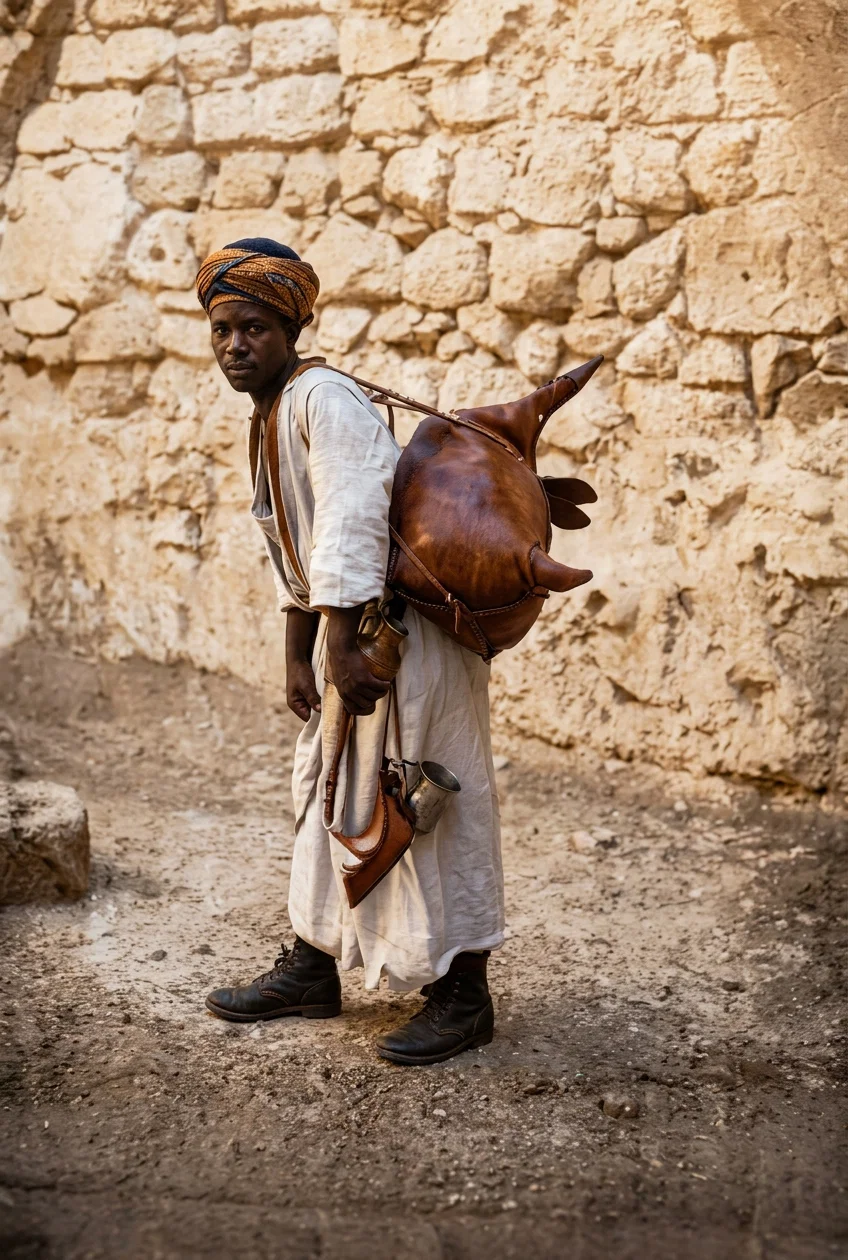
AN ARAB WATER-CARRIER IN JERUSALEM.
THAT bodily sensation which longs for water we call thirst. Hunger does not compare with it. Men suffer and pine and die from lack of food; but they become insane, when deprived of water. So suffering men will open veins in their own arm, drink the warm life-blood from slain beasts, and even take the lives of their fellow-companions, driven mad by thirst, or by both hunger and thirst.
AND every one thirsts. Every one must have drink to preserve the health, from the tiny, helpless infant to the aged, tottering grandsire; water must be had to quench the thirst, to cleanse the tissues. Some persons, for their physical needs, substitute for water various decoctions, mixtures, and distillations, more or less harmful. One must have his tea, another his coffee, another his beer, another his wine, another his brandy, or gin, or whisky, or champagne. Men sometimes boast that they never drink water. But they do; they all do; for the good of every one of these substitutes, mild or strong, moderately injurious or vile, is found in the water base. The more water there is in them, the less harm they do. Tea and coffee poison the water a little. Alcohol in its various forms poisons it much more. Poisons set on fire the tissues, and thirst is nature's demand for water to quench the fire and wash out the intruder. Water, pure water, satisfies. Alcohol—whether in wine, beer, whisky, etc., can never satisfy thirst; for the poisoned tissues call for more and more to quench their burning fire, eliminate the poisons, and soothe the sick and irritated organs.
JESUS CHRIST calls to the physical man, If any man thirst, let him drink of water, pure water. Even the brackish waters of the slime-covered pools are not so potent in death-dealing potions as the wretched intoxicating substitutes that millions are daily pouring down their throats. Better the warm, insipid water from the Arabian's goat-skin bottle than the champagne in the costly cut glasses of the millionaire. There is more life in the heeded cry, “In 'the name of the prophet, water,” than in the accepted invitation of the highest and fairest of earth to drink of the beverage which intoxicates, blunts the sensibilities, and destroys both soul and body.
WATER, blessed water, there is no drink like it. No shattered constitutions, ruined fortunes, wrecked characters, blasted reputations,2blighted homes, weeping, hopeless, worse than widowed wives, shame-faced, ragged, worse than orphaned children, drunkard's graves, and lost souls are charged to thy account, blessed water, free gift of God. All the fearful category, too long for mention, are chargeable to thy substitutes, the devilish delusions by which Satan and his agents would deceive and destroy the thirsty of the world. Heed them not. Drink water, pure water.
Water is the symbol of God's blessed Spirit which He is more willing to give to them that ask Him than earthly parents are to give good gifts to their children. Luke 11:9–13. He is saying now as of old, “If any man thirst, let him come unto Me, and drink.”John 7:37. By every device of words and figure of speech He appeals to the thirsty to drink of life's water. “And the Spirit and the bride say, ‘Come. And let him that heareth say, Come. And let him that is ‘athirst come. And whosoever will, let him take the water of life ‘freely.’” Rev. 22:17. It is as free as the air.
But here, as with the physical man, Satan brings his substitutes, his counterfeits, his perversions, of the water of life. He asks men to drink from the ancient poisoned brewings of Babylon, preserved through ages of paganism, to quaff the sense-destroying, septic infusions of Buddhism, to sip from the more refined champagne cups of higher criticism and evolution; to take any mixture, any substitute, rather than the pure Spirit of God, direct from the great Father.
Jesus calls to you, thirsty soul, “Come unto Me.” Why not come and drink? The Fountain flows free. It will not only quench your thirst, but it will make you a fountain, and forth from you streams of living water will flow, blessing the thirsty. You are thirsty; leave the substitutes that poison; drink of the life-giving Spirit, and live forevermore. Jesus says to you, whoever you are, “If any man thirst, let him come unto Me, and drink.”
THE DIVINE GUARDIAN OF THE CHURCH.
By Ellen G. White
SATAN’S work is represented in the third chapter of Zechariah. We read: “He showed me Joshua the high priest standing ‘beside the angel of the Lord, and Satan standing at his right ‘hand to resist him. And the Lord said unto Satan, The Lord rebuke ‘thee, O Satan; even the Lord that hath chosen Jerusalem rebuke ‘thee: is not this a brand plucked out of the fire? Now Joshua was ‘clothed with filthy garments, and stood before the angel.”
Satan comes to God’s people with temptation, the temptation gains the victory, and those claiming to follow Christ fall a prey to the devices of the enemy, giving him an excuse to point at God’s people as clothed with filthy garments. He points to the defects of such ones as a sample of what is done by God’s commandment-keeping people.
The Lord may seem to have forgotten the perils of His church, and the injury done to her by those who follow principles which He can not indorse. But God has not forgotten. Nothing in this world is so dear to the heart of God as His church. He marks every action of the members. It is not His will that worldly policy shall corrupt her record as a representative of heaven. Nothing so offends the heart of Christ as injury done those whom He died to save. His heart of love is grieved when the lame are turned out of the way by the crooked paths made by others. God does not leave His people to be overcome by Satan’s temptations. He will chastise those who misrepresent Him. But He will be gracious to all who sincerely repent.
“He answered and spake unto those that stood before Him, saying, Take away the filthy garments from him. And unto him he said, Behold, I have caused thine iniquity to pass from thee, and I will clothe thee with change of raiment. And I said, Let them set a fair miter upon his head. So they set a fair miter upon his head, and clothed him with garments. And the angel of the Lord stood by. And the angel of the Lord protested unto Joshua, saying, Thus saith the Lord of hosts: If thou wilt walk in My ways, and if thou wilt keep My charge, then thou shalt also judge My house, and shalt also keep My courts, and I will give thee places to walk among these that stand by.”
Standing before God in filthy garments, Joshua well represents the condition of God’s ministers and the lay members of the church. They need to be revived and reformed. They need to be sanctified by the Holy Spirit. But God will rebuke Satan, refusing to hear his accusations against His church, even tho she is far from what she should be.
Those who continue in the service of God will, through the revival of God’s appointed agencies, return to whole-hearted obedience, depending on the merits of a crucified Saviour, and trusting in His atonement for salvation. The righteous will continually follow righteousness, because Christ, who is formed within, is righteousness and truth. They will be imbued with a pure, fervent love, a love begotten by the love of God. Their transgressions will be forgiven, and their sins pardoned. And God will look upon them with pleasure.
Christ loves His church. He will give all needed help to those who call upon Him for strength for the development of Christlike character. But His love is not weakness. He will not serve with their sins, nor give them prosperity while they continue to follow a wrong course of action. Only through faithful repentance will their sins be forgiven; for God will not cover evil with the robe of His righteousness. He will honor faithful service. He will abundantly bless those who reveal to their fellow-men His justice, mercy, and love. Let those who are engaged in His service walk before Him in true humility, following faithfully in His footsteps, cherishing the holy principles which will live through the eternal ages. Let them in word and action show that they obey the laws which are obeyed in heaven.
Remember that those who are truly united to Christ will show Christlike sympathy for one another. Are they not members of His body? Should they not show a kindly interest in their fellow-laborers, and rejoice in helping them? Such believers will exert an influence which produces the fruits of righteousness. Their light will shine forth to others, and the church will feel the benefit of the sanctifying power of the grace of Christ.
The way of the world is to begin with pomp and boasting, exalting human agents. But all this will come to naught. God’s way is to make the day of small things the beginning of the glorious triumph of truth and righteousness. Bear in mind that human power and human inventions did not establish the church, and neither will they destroy her. The Holy Spirit will keep every one who in faith and trust is committed to His charge. The overflowing fountain of life is for God’s servants to enjoy. It makes them more than conquerors, victorious over all opposition.
I present the following scripture to those who claim to respect the law of Jehovah:—
“Listen, O isles, unto me; and hearken, ye people, from far: The Lord hath called me from the womb; from the bowels of my mother hath He made mention of my name. And He hath made my mouth like a sharp sword; in the shadow of His hand hath He hid me, and made me a polished shaft; in His quiver hath He hid me; and said unto me, Thou art My servant, O Israel, in whom I will be glorified. Then I said, I have labored in vain, I have spent my strength for naught, and in vain; yet surely my judgment is with the Lord, and my work with my God. And now, saith the Lord that formed me from the womb to be His servant, to bring Jacob again to Him, Tho Israel be not gathered, yet shall I be glorious in the eyes of the Lord, and my God shall be my strength. And He said, It is a light thing that Thou shouldst be My servant, to raise up the tribes of Jacob, and to restore the preserved of Israel; I will also give Thee for a light to the Gentiles, that Thou mayest be My salvation unto the end of the earth. Thus saith the Lord, the Redeemer of Israel, and His Holy One, to Him whom man despiseth, to Him whom the nation abhorreth, to a servant of rulers, Kings shall see and arise, princes also shall worship because of the Lord that is faithful, and the Holy One of Israel, and He shall choose thee. Thus saith the Lord, In an acceptable time have I heard thee, and in a day of salvation have I helped thee; and I will preserve thee, and give thee for a covenant of the people, to establish the earth, to cause to inherit the desolate heritages; that thou mayest say to the prisoners, Go forth; to them that are in darkness, Show yourselves. They shall feed in the ways, and their pastures shall be in all high places. They shall not hunger nor thirst; neither shall the heat nor sun smite them; for He that hath mercy on them shall lead them, even by the springs of water shall He guide them. And I will make all My mountains a way, and My highways shall be exalted. Behold, these shall come from far; and, lo, these from the north and from the west, and these from the land of Sinim. Sing, O heavens; and be joyful, O earth; and break forth into singing, O mountains; for the Lord hath comforted His people, and will have mercy upon His afflicted. But Zion said, The Lord hath forsaken me, and my Lord hath forgotten me. Can a woman forget her sucking child, that she should not have compassion on the son of her womb? Yea, they may forget, yet will I not forget thee. Behold, I have graven thee upon the palms of My hands; thy walls are continually before Me.”
God means every word that He says. He continues to carry forward His work of redemption in the hearts of those who will repent and be converted. The church has failed, sadly failed, to meet the expectations of her Redeemer, and yet the Lord does not withdraw Himself from His people. He bears with them still, not because of any goodness found in them, but that His name may not be dishonored before the enemies of truth and righteousness, that the Satanic agencies may not triumph in the destruction of God’s people. He has borne long with their waywardness, unbelief, and folly. With wonderful forbearance and compassion He has disciplined them. If they will heed His instruction, He will cleanse away their perverse tendencies, saving them with an everlasting salvation, and making them eternal monuments of the power of His grace. Under His superintending care, they will carry forward His work without misrepresenting Him in any line. His glorious work, founded on eternal principles, will never decay. It will shine with the light of the Sun of Righteousness, and there will be shoutings of Grace, grace unto it.
MRS. E. G. WHITE.
AN UNNATURAL KINGDOM.
The Little Horn of Chapter 7.
READ again the chapter under consideration. The four beasts are symbols of Babylon, Medo-Persia, Grecia, and Rome. Upon this there is general agreement. Even the notes in the Douay Bible, or Roman Catholic standard translation, say on verse 3: “Four great beasts, viz., the Chaldean, Persian, Grecian, and Roman ‘empires.’”
Each succeeding kingdom of the four possessed territory peculiarly its own. When Medo-Persia conquered Babylon, these nations had existed in territory peculiarly their own, to the north and east of Babylonia; and Babylonia, as a part of the Medo-Persian empire, continued to exist after her subjection by Medo-Persia. Grecia arose out of territory peculiarly her own to the west of Medo-Persia. When Grecia conquered Persia, that nation continued to occupy territory, tho subject to Greece. Rome, the fourth kingdom, arose out of territory peculiarly her own, west of that of Greece; and while all the territory of these preceding empires was subject to her sway, yet as nations and peoples they still continued to exist. So the prophecy declares: “And as for the rest of the beasts, their ‘dominion was taken away; yet a prolonging in life was given them.”
Of the fourth beast, “dreadful and ‘terrible,’” we read that “it had ten ‘horns.’” These horns, we are told in verse 24, “are ten kings [or kingdoms] ‘that shall arise’ ‘out of this kingdom’” represented by the beast. In other words, they represent divisions of the Roman empire, the part distinctively Roman. This division is represented in Daniel 2, not by any parts of the image, but by the intermingling of clay with iron. “Whereas thou sawest the feet and toes, ‘part of potter’s clay and part of iron, the ‘kingdom shall be divided,’ and ‘they ‘shall not cleave one to another, even as ‘iron is not mixed with clay.’” We do not wait for the division till we come to the toes; it begins in the feet and continues to the end. It is not that the toes will not cleave together, but that the divisions of imperialism and democracy will not cleave one to another, even as iron doth not mix with clay. In chapter 2 it is declared that the kingdom will be divided; but we are not told the number of parts. In chapter 7 we are distinctly told that the parts finally become just ten. These ten divisions, if symbolized by the toes, naturally ten, would exist as ten to the very end; but according to chapter 7, where the horns are specifically said to represent kingdoms, three of these kingdoms are plucked up at least a millennium and a half before the end. And this also clearly shows that the division of the fourth kingdom, as indicated in chapter 2, is symbolized by the intermingling of the iron and the clay, and not by the parts of the image.
These ten divisions we gave last week. We give them again from the “Great Empires of Prophecy,” the author of which admirably summarizes Gibbon’s irrefutable testimony as follows:—
Alemanni, about A. D. 300, in Agri Decumates from the river Main to Basel and the Lake of Constance; A. D. 351, take Alsace Lorraine in addition; A. D. 455, extend to the Seine.
Franks, A. D. 351, northeast Gaul; early in the fifth century spread to the Somme; middle of the fifth century, A. D. 455, to the Seine; and gradually progress till in the sixth century they take all Gaul north and west of the Moselle and the mountains of the Vosges and the Cevennes.
Burgundians, Dec. 31, A. D. 406; in Burgundy, A. D. 420; spread over West Switzerland and the whole valley of the Rhone, A. D. 443–476.
Suevi, Oct. 13, A. D. 409 in Spain; A. D. 428 in Galicia in Spain; A. D. 466, held the kingdom of Galicia, and shortly afterward spread to what is now Portugal.
Vandals, Dec. 31, 406; in Spain, A. D. 409; in Africa, May, A. D. 429.
Visigoths, A. D. 408, Italy; in southwest Gaul (Aquitaine), A. D. 419; spread into Spain, A. D. 466.
Saxons, A. D. 449, Britain.
Ostrogoths, A. D. 451, under Attila; A. D. 453, in Pannonia; A. D. 489, in Italy.
Lombards, A. D. 451, under Attila; A. D. 453, in Noricum.
Heruli, A. D. 431, under Attila; A. D. 475, in Italy.
The ten divisions of Rome were complete in A. D. 476. At this very time the prophet, in considering the ten horns, sees coming up “among them another horn, a little one, before which three of the first ‘horns were plucked up by the roots.’” What does this horn represent? Read again from the chapter in this page the following verses concerning this little horn: Verses 8, 11, 19, 20, 21, 22, 24, 25, 26. Note these particular specifications:—
(1) It arose among the ten horns, v. 8; (2) It was a little horn at first, v. 8; (3) In order that it might be established, three of the first horns are plucked up before it, v. 8; (4) It had eyes like the eyes of a man, vs. 8, 20; (5) It had a mouth which uttered not the meaningless noise of a beast, but great boastings, such as could be uttered only by a being above a beast, vs. 8, 11, 25; (6) It was a different horn in character from those around it, v. 24; (7) It became strong, so that its look was more stout than its fellows, v. 20; (8) It made war upon the saints, or people of God, v. 21; (9) It was to prevail against them till the Lord should come and take judgment to Himself, vs. 21, 22; (10) It should presume, or think, to change “the times and the law” of God, v. 25, R. V.; (11) It should continue for a “time and times and half a time,” or three and one-half years, v. 25, R. V.; (12) It would lose its temporal dominion as a horn, v. 26; (13) Its greatest words come in the very closing part of its career.
Here are thirteen definite, specific characteristics given of the power symbolized by this little horn. In the very nature of the case it would be a certain impossibility to find two powers to which these specifications applied. But the prophecy tells us that this little-horn kingdom is diverse from those among which it rose. These specifications reveal wherein it is diverse. Two or three might apply to several powers of earth, but it is another, an utter impossibility to find but one to which they all apply. Thus specific is God in His “sure word of prophecy.”
Let us ask the reader in this study to divest himself of all prejudice, and receive just what the Word says. In its application to us, the only application which can be made, it does not deal with persons, but with systems. It is the evil system and its consequences against which God warns us. It is submission to an evil system based on evil principles which makes the most conscientious man do evil. It is to warn all, within the system and without, that God gives us this Gospel of Daniel 7. Let us examine the specifications, or ear-marks, of this power.
1. The little horn arose among the ten horns. What power, different in character from the civil divisions of Rome, rose to a position of prominence in Western Rome in the fourth century? There was but one—the Papacy, centering in the bishop’s see at Rome. Primarily there was no pre-eminence of one bishop over another in the early church. “One is your Master, even Christ, and all ye are brethren,” were the words of our Lord. But at an early date the bishops of Rome began to put forth great claims for the see at Rome. Rome being the political capital of the empire, and the church becoming more or less political, it was demanded that the bishops of Rome should have the pre-eminence. This was the horn that the prophet saw coming up among the ten.4
2. It was a little power at first, in the eyes of man. It did not look as tho it would amount to any great thing. Other bishops were as great and learned. Its claim to authority was not thought to be serious. Other bishops considered their own sees as important and as influential as Rome. In its organized form the Papacy was at first a little power.
3. Three horns were plucked up before this little horn. In the midst of the great controversy between Arianism and trinitarianism the Papacy arose. In brief, the bishop of Rome stood on the trinitarian side of the controversy, waging relentless war against Arius and his followers. In the finality of the conflict three of the ten kingdoms—the Heruli, the Vandals, the Ostrogoths—opposed the rising power of the Papacy, and its coalition with the State. The last of the ten kingdoms was established in A. D. 476; the first of the three, the Vandals, was “plucked up” in March, A. D. 493; the last of them in March, A. D. 538. In that very year the bishop of Rome, by decree of Justinian, became “head over all the holy churches,” and “true and only ‘corrector of heretics.’”
4. The little horn had “eyes like the eyes of a man.” It would be a strange thing to see a horn with eyes at all. But if eyes were given it, it would naturally be the eyes of the beast who wore the horn. But this horn of a beast had eyes, not of a beast, seeing only what is near, but the eyes of a man,—far-sighted eyes, that see the future,—indicative of the mind behind, that thinks, and plans, and schemes.
How true is this of the Papacy, as compared with the kingdoms of earth. Like blind beasts, they have seen only what is present and near. They have planned for the present. They have lived for the present. Present power, present glory, present prestige, have been the rule, and the future is often sacrificed for the present. Not so the Papacy. She has planned for generations ahead. Pain, toil, sacrifice, have been taught her children, that she might enlarge, expand, and be established. Thus has her diplomacy been more than a match for all Europe.
5. Great words have been spoken. In the great claim which the Papacy has made, as the one sole authority in all religious matters, above conscience and the Bible; in its right to dethrone and set up kings and rulers, and to absolve their subjects from obedience; in the titles assumed for the bishop of Rome—as for instance, “Lord God the ‘Pope,’” “Vicar of Jesus Christ,” “Arbiter of the World,” “the Light ‘of the World,’” etc., etc., it has surely spoken great words, and “great words against the Most High,” in assuming prerogatives and authority which belong only to God, and which Jesus Himself did not even assume.
6. It was diverse in character from the kingdoms among which it arose. The ten kingdoms were civil governments. The State was at the head, even if religion was connected with it. The only true idea of government, the Christian idea, is that civil government has no right to meddle in the things of religion. Its duty is to protect all its subjects equally without respect to religion. It is to prevent as far as possible incivility to all, irrespective of creed. Many nations of the past had departed from this, but the State had been kept paramount. Religion was subject.
When the Papacy came in, a different theory was taught; the church should be dominant, the State subject. The church should define heresy and its punishment, the State should execute it at the behest of the church.
The Roman Catholic Church is set before us in the prophetic Word in three phases: (1) As the apostate church, in which are many honest, earnest, self-sacrificing souls, longing for light, and living according to their best knowledge. This apostate church, beginning in organized form, markedly in the days of Constantine, exists to the end as an ecclesiastical organization. (2) The Papacy, to which is granted the power by the State to define heresy and its punishment, the State placing itself at the disposal of the Papacy to execute the sentence of the church. This phase of the Papacy, acknowledged by the civil powers, began in A. D. 538 and ended in 1798. (3) The Papacy as a civil kingdom, limited to the States of the Church, beginning in the middle of the eighth century and terminating in 1870. All these are contrary to, and subversive of, the Gospel of Christ. The last two phases are presented in this chapter.
7. The little horn became strong, so that its look was more stout than its fellows. At first it sued for power, for prestige, for favors; it came to command. The Chaldee word rab, translated “stout,” is rendered chief, captain, great, lord, master. The look of the Papacy, or its representative, became more masterful than that of his fellows. The Papacy became chief. Jesus said, “I am among you as one that ‘serveth;’” the Papacy became as one that ruled.
8. It made war. Logically, it could not do otherwise and be true to the system. Jesus Christ said, “If any man hear My words, and ‘believe not, I judge him not; for I came not to judge the world, but ‘to save the world.’” John 12:47. The Papacy assumed to be judge, or arbiter. It defined the faith without regard to conscience. It stepped between the individual soul and its God, to whom each one must give an account. It separated the child from its Father. It placed between the human subject and the divine-human Redeemer, who invites all to “Come unto Me,” a cordon of ecclesiastical police. Assuming all this, it must, to maintain its dignity and power, punish infractions of its law. It logically argues, from its false premises always, that the very honor of God’s throne demands that heretics (those who dare disobey the Papacy’s interpretation of God’s will) should be punished with death, if need be. And therefore the Papacy could do naught but make war, and, too, with the saints. For the saints of God are free souls, who receive their law, not in the cold, dead creeds of men, but in living words of truth from heaven. Of course they could not yield their life to an organization that had departed from the Fount of Life, and therefore they were, by that organization,—the Papacy,—adjudged heretics.
9. It prevailed against God’s people. It put to death in mistaken zeal, countless thousands of the—
“Whitest of the saints of God;”
and it will continue to make war, so far as its power lies, till the Master comes again.
10. The little horn should think to change times and laws. Not that it should be able to do this, but it would think itself able—it would assume to do this. The Septuagint reads “the law,” the Revised Version, “the times and the law;” Spurrell’s translation, “the appointed times and the law.” All these point to the times of God’s appointment, the law of His giving. And the Papacy has thought to do this. It has substituted for the Sabbath of the Decalogue, the seventh day, the first day of the week; a day which has absolutely no claim to Scriptural authority.
11. It was to continue for a time, times, and a half. A “time” is a year. See Dan. 11:13, margin. “Times,” dual, the least number that can be expressed by the plural, is two years. The total is three and one-half years, or forty-two months,—twelve hundred and sixty days. As God uses short-lived beasts to represent long-existing dynasties, so He uses brief periods of time to represent longer periods. A day in prophecy symbolizes a year. The 1,260 days of the prophecy represents 1,260 literal years. These years began in A. D. 538, when the last Arian power was plucked up, and the Papacy became the head of Christendom generally recognized by the States of Europe. In 1798 these days expired. The corruptions of the Papacy and the light of the Gospel through the Reformation took from Europe the fear of the pope, and its final blow as corrector of heretics, as the acknowledged head of the church, came when the army of the French directory, under Berthier, entered Rome and took the pope prisoner, in February, 1798. The dominancy of the Papacy over the other horns then received a deadly blow. The ecclesiastical organization of the Roman Church was not affected, nor did its own dominion over its own territory here come to an end. The deadly wound and its healing is more fully set forth in the Revelation. Daniel sees the whole career of the little horn as a persecutor till the coming of the Ancient of Days. He notes the pre-eminent power for 1,260 years. But he does not mention the restoration which makes it a persecutor to the end, as indicated in verse 21. This is reserved for John.
12. The little horn was to lose its own dominion as a little horn. “The judgment shall sit,” the prophet declares, “and they shall take ‘away his dominion, to consume and to destroy it unto the end;’” not the end of the world or age, but to the end of his dominion, the last of it. Her dread judgment, prior to Christ’s coming, is presented before us in verses 9 to 14. That judgment is, in connection with the closing of Christ’s priestly work, a subject to be treated later. It began in 1844. Immediately after this is the removal of the dominion of the little horn. “They” evidently refers to the other horn-powers. In 1844 the States of the Church covered an area of 16,000 square miles, with a population of 3,000,000. Four years afterward revolution broke out in France and northern Italy. In 1849 they revolted, but were brought back by France. In 1859 Romagna revolted, and was annexed to Sardinia in 1860. The same year Umbria and Marches revolted, and placed themselves under the standard of Victor Emmanuel. These were annexed to Sardinia. From 1848 to 1860 the consuming process had reduced the Papal States from 16,000 square miles to54,500, and from 3,000,000 population to 700,000. In 1870 the last vestige of temporal power was swept away. The end of his dominion as a horn had come.
13. Verse 11 indicates that the greatest words, the greatest assumptions of the little horn, come near the end of all earthly dominion, close down to the burning day of God. We have seen a partial fulfilment in the utterance of the dogma of the Immaculate Conception in 1854, and of Infallibility in 1870. Doubtless the world will listen to still greater words; they will be the logical result of the system, the perverted Gospel of the Papacy.
Every one of these specifications is met in the Papacy; they are met in no other power. God has warned us in His Word of its evil. He has portrayed its career and end. Great tho it has been, mighty above all the kingdoms of earth, daring, even, to substitute its law for that of Jehovah, before that mighty truth of God, “the Most High ‘ruleth in the kingdom of men,’” it falls and falls forever. Not knowing God, it has blasphemed His name, usurped His throne, persecuted His people. It has seemed to triumph, and those who walk by sight, and are guided by sense, have yielded to its kingdom of outward pomp and show. If they continue with it, they will reap its fruitage.
But those who, as free men, have dared to worship God according to the dictates of conscience, who have dared to be non-conformists, who have dared excommunication, proscription, anathema, execration, banishment, torture, death, are in God’s hands, held in remembrance by Him; and when it has been demonstrated to the world and to worlds what the fruit of exalting man to the place of God is, then the Lord will come, and save those who have acknowledged His rule in their own hearts. There it must begin. And then, when earth’s struggle is over, “the kingdom and the dominion, and the greatness ‘of the kingdoms under the whole heaven, shall be given to the people ‘of the saints of the Most High; His kingdom is an everlasting kingdom, and all dominions shall serve and obey Him.”