Your ShelfYour Projects

Signs of the Times, Vol. 23, No. 50.

Editorial

Signs of the Times

Dec 23, 1897

Pacific Press Publishing Company · Oakland, California · Dec 23, 1897

Editorial

"Where Is He?"—This is the question asked by the searchers of light of Herod of old. "Where is He that is born King of the Jews? for we have seen his star in the east, and are come to worship him." Matt. 2:2.

Who Were They?

Who these wise men, or magi, were we need not now stop to inquire. Suffice to say they were searchers after truth; they were looking for the Truth, Jesus, the Son of God. Following perhaps the light of Balaam's prophecy (Num. 24:17), and other predictions of Holy Writ, they became convinced that the coming of a Saviour (Isa. 9:6), the Anointed of God, the Messiah (Dan 9:25), "the Desire of all nations" (Hag. 2:7), was at hand; and following the supernatural light, doubtless a cohort of shining angels from the courts of glory, they were led to Jerusalem. They represent seekers for light in all ages.

To Whom They Came.

Where should they come save to those in the providence of God high in authority? Herod had greatly enlarged and beautified the earthly temple of the Jews; why should he not know of Him who was coming to that temple to glorify it with his own presence? Yet he did not know. Was it a mistake that the magi were led to him?—Not at all; for God wanted Herod to know and receive Jesus. He gave him the privilege of finding and worshiping with the learned wise men. So also Naaman the Syrian was in the providence of God sent to the king of Israel to find divine deliverance from the leprosy. (See 2 Kings 5:1-8.) The king could not do it; moreover, he was ignorant of God or his prophet. The Lord wanted to teach the king that God yet lived to deliver, and so lead him to turn to the one only true God. To high and low God gives light and the privilege of choice.

The Result of the Inquiry.

Herod was troubled; his throne he thought was in danger.
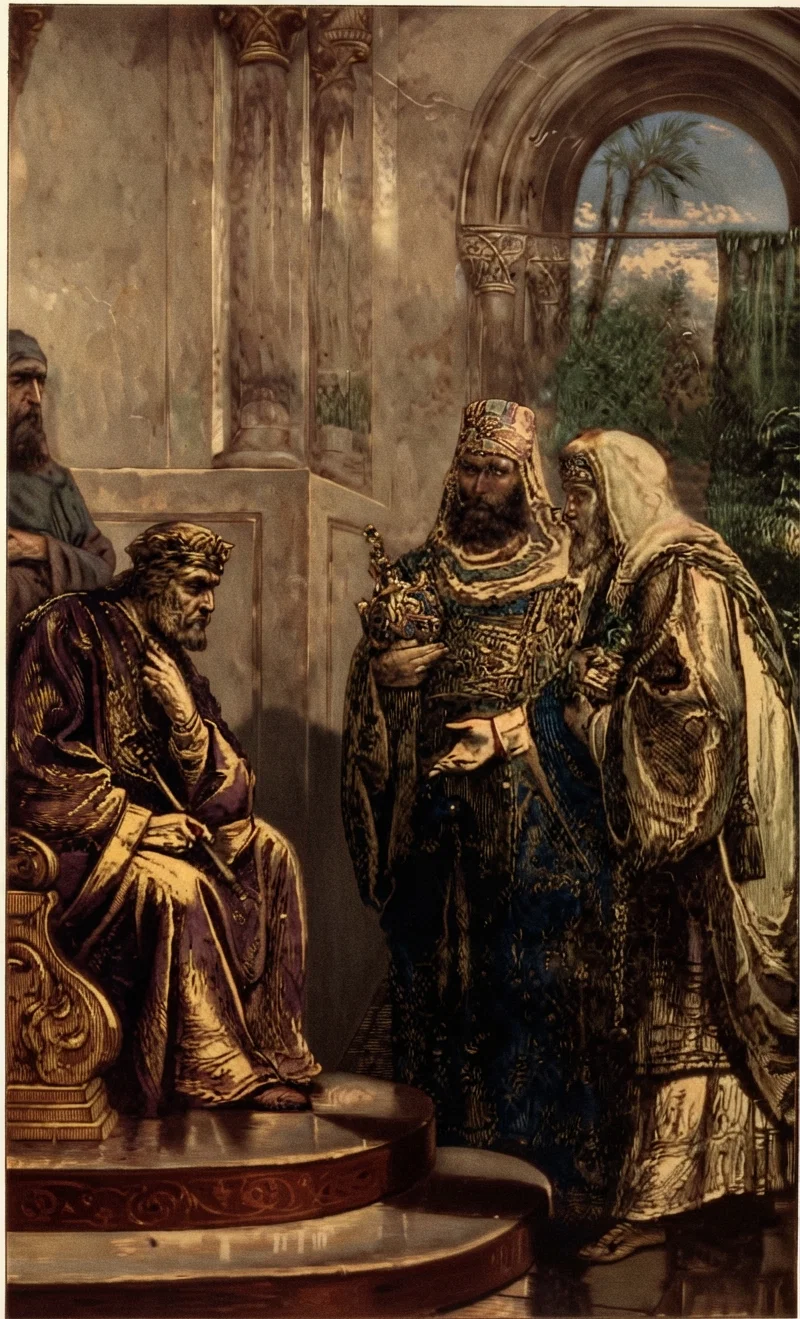
Not knowing in himself the principles of the divine government, he feared the government itself and hated its Ruler, as subsequent events demonstrated. Matt. 2:16. Yet he manifests a show of interest. He feigns loyalty to God. He calls those who are versed in the prophetic writings, and asks where the Messiah should be born. They tell him in the little city of Bethlehem, and Herod tells the magi, bidding them when they had found the young child to let him know that he might "come and worship him also." And this Herod might have done if that Child had come in transcendent glory and mighty power. But his submission would have been feigned; for immediately after he sought the young Child to destroy him. He could brook no rival to his plaything of a throne, and he bartered the eternal reign with Christ, and shed we know not how much innocent blood, that he might retain his brief place. A high position and great opportunity do not make men divinely wise, but it leaves them without excuse before the bar of God.
THE WISE MEN BEFORE HEROD.

The Finding of Jesus.

But the magi found the infant Saviour. When priests and rulers will not guide the earnest searcher, God will send his angels. When the magi departed from the king, the star went before them and stood over the place where the young Child lay. They found him hemmed in by no earthly guard. He was surrounded by no insignia or tokens of royalty. He came to be one among his brethren, Divinity vailed in humanity; and before him these learned men bowed in humble adoration, feeling themselves honored with the privilege. They then opened their treasures, and poured out gifts fitted for a monarch, gold and frankincense and myrrh. It did not seem to surprise them that they found Jesus so humbly situated and so meanly environed; they were not looking for outward pomp or glory, but for truth and holiness, and they found both in the Babe of Bethlehem. They did not come to receive honors from him, but to give him themselves, to acknowledge his right to rule.
"Where Is He?"—Men are asking the same old question to-day, "Where is Jesus?" Thousands are pointing at this season of the year to a day called Christmas. Is Jesus in the festival? We have no objection to the telling on December 25 of the sweet old story of God's love in giving his Son for the children of men; let it be told on that day and all days. But this is not the lesson which Christmas teaches, as it is generally, almost universally, observed. There are several reasons why the festival can not teach the true lesson, and it will not hurt the Christian readers of the SIGNS OF THE TIMES to pause for a moment in the mad rush of the world to inquire as to the truth of the matter, and to learn whether or not a day should be set apart for such service.

Not Born on That Day.

In the first place, Jesus was not born on December 25. This is shown from two facts: (1) The shepherds were watching their flocks in the field (Luke 2:8); which they would not have been doing in the cold days of midwinter. (2) The ministry of Jesus lasted three and one-half years. Dan. 9:25-27. He began his public ministry according to the law when thirty years of age. Luke 3:23. He was crucified at the last Passover he attended, in A.D. 31. Matthew 27 and "Hale's Chronology," vol. 1, pp. 69, 70; vol. 3, p. 230. He therefore began his ministry six months before the first Passover he attended, John 2:13. At this time he was thirty years of age. The Passover occurred probably about the last of March in the month Abib. Six months previous to this would be at that season of the year indicated by the month Tisri, probably in our September. Christ came in "the fulness of the time" not only as regards the time of the ages, but the time of the year. His birth was in the season of fruitage, and he the most precious fruit of the earth.

Not Remembered by a Day.

God has not revealed to us the day of Christ's birth either in the week or month or year. He reveals the great fact that the Word was made flesh; that God became incarnate in Christ Jesus; and he did this that through Christ he might become incarnate in every one of us. He was the Son of man, as well as the Son of God; and God would through him have us become the sons of God as well as the sons of men. "But when the fulness of the time came, God sent forth his Son, born of a woman, born under the law, that he might redeem them which were under the law, that we might receive the adoption of sons. And because ye are sons, God sent forth the Spirit of his Son into our hearts, crying, Abba, Father." Gal. 4:4-6, R. V. But this great and blessed truth is not for one day in the year, but all days, and all hours of all days. And for that reason God never designed that the remembrance of his great gift should in any sense be confined to a day.

The Origin of Christmas.

"But what is the origin of Christmas?" asks one who has come to think the day is almost holy. "Did it not come down from Christ and the apostles?"—No, it did not. We have not even the slightest trace of it in the Scriptures. Its first mention in "Christian" literature is said by Schaff to be in Clement's "Miscellanies," written about A.D. 200. But Clement was a half-converted heathen philosopher. Says Neander, in speaking of the second century of the Christian era: "The idea of a birthday festival was foreign to the Christians of this period generally; they regarded the second birth as man's true birth. . . . It was, in truth, unknown at what definite time the celebration of the remembrance of Christ's birth should be placed, as nothing definite was ascertained respecting the date of his birth."—Vol. 1, p. 301 (Houghton and Osgood). The simple fact is that teachers like Clement, Eusebius, and others wished to conform to heathen customs as much as possible, so as the more easily to convert the heathen. For every heathen festival of note they invented a corresponding festival in the Christian church. For the pagan Easter festival the apostatizing church set apart a yearly day in remembrance of our Lord's resurrection, but retained many pagan customs and the pagan name. For the day or the customs they had no Scripture.
Christmas, first called "The Nativity," was the counterpart of the great day of the Roman Saturnalia, a feast connected with the grossest sun-worship, connected with which was the giving of gifts, feasting and revelry, and the grossest licentiousness. About December 20 the Saturnalia began, when the days were the shortest, and life in the vegetable world least manifest. Beyond that the days lengthened, the sun seemed to smile with favor upon the world, and the heathen celebrated the lengthening day with the wild orgies and indecencies of nature-worship. The giving of gifts, the Yule-tree and Yule-log, the holly berries and evergreens, are all of pagan origin, and certainly no one can deny but that the day is frequently kept in a purely pagan spirit, ministering only to selfish pleasure.

The Spirit of Christianity.

The Spirit of Christianity is a spirit of self-denial for others' good; and there is much of this manifest, especially among the poor, at this season of the year. Children deny themselves for parents, and parents for children, or both for some poor unfortunates of earth, expecting nothing again. This is the true Christ-spirit. But how much more frequently persons give that they may receive! They receive oftentimes selfishly, enviously. They purchase and prepare and feast gluttonously, and gorgingly, to minister to the lusts of the flesh, and the gluttony is not infrequently followed by drunkenness and licentiousness. How many during this festival season would be glad to have the holy Christ as a guest, a personal witness to all the doings of the day or night—to not only know that he was looking upon all outward acts, but that he saw deep down into the secret recesses of the heart! This question, dear reader, may be a good test of how much of true Christian motive is in your celebration of the day. Would you welcome him with a glad heart? Would it make any difference in your preparations and expenditures if you knew that he was going to be there personally? But he will see it all, tho you may not see him. More than this: Are you looking for Jesus on that day? If you have found some of his sweetness and light, are you still seeking for more? Are you inquiring, "Where is he that is born King of the Jews, my King? for I would worship him." And then are you ready to pour out before him, whether you find him in a hovel, a stable, a prison, or anywhere in need, the heart's best homage and your stewardship's best treasures? If you are, you will find Jesus, not only on December 25, but on all days of the year, precious to your soul, and you will receive from him more than you gave, even life, joy, and salvation.

SIGNS OF THE TIMES

"But as we were allowed of God to be put in trust with the Gospel even so we speak; not as pleasing men, but God, which trieth our hearts."
Volume 23. Number 50. Fifty Numbers a Volume. OAKLAND, CALIFORNIA, DECEMBER 23, 1897. Weekly, $1.00 per year. Single Copy, Five Cents.

ONLY A SHADOW.

EVERY shadow of darkness, every cloud of gloom, every fear of whatever kind, is simply the shadow of death, and of the devil. He has cast his hellish shadow over the world. Now, as Zacharias prophesied by the Holy Ghost at the birth of his son, the Lord has visited us and delivered us out of the hand of our enemies that we 'might serve him without fear.'
He has delivered us from every tremor of fear, and hath sent the Dayspring from on high 'to give light to them that sit in darkness and in the shadow of death.' If you have his life you have his light. What is there to be afraid of? To the one in Christ death itself is only a shadow. The sting is gone. Satan can cast the shadow over him, but there is nothing in a shadow to be afraid of. He is delivered from the power of darkness. He is going through an enemy's land, whose weapons are all broken. He is going into a nest of scorpions, whose stings have been removed. He is going into a prison-house, the key of which is held by One who loves him.
E. J. W.

"HE HATH BLINDED THEIR EYES."

"THEREFORE they could not believe, because that Esaias said again, He hath blinded their eyes, and hardened their heart; that they should not see with their eyes, nor understand with their heart, and be converted, and I should heal them." John 11:39, 40.
Many people are more inclined to find doubt and despair in the Bible, than to find hope and comfort, altho the Bible contains none of the former, and is full of the latter; so when they read the words of the prophet Isaiah, they at once begin to complain against God, and to say that he is unjust and partial, and they will feel sure that they can not believe, because God has made it impossible.
Now the Bible claims to be the Word of God. It exists for the sole purpose of revealing God to men, that they may see in him the One altogether worthy of worship and affection. Everybody knows that this is the object of the Bible, whether they believe what it says or not. That being the case, how can it be supposed that anything can be found in the Bible that would tend to depreciate God in the estimation of men? Considered from a human standpoint, and as a merely human production, no one would be so foolish as to write things derogatory to his hero, in a book published for the sole purpose of honoring him. We may therefore be sure that none of the men who had to do with the production of the Bible saw in such statements as the one first quoted anything except such goodness and mercy as is consistent with the character of an all-merciful God, a God who not only loves, but who is love.
That there is comfort in even such texts as that quoted from Isaiah, and that they were written for the sole purpose of producing hope and comfort, is proved by Rom. 15:4: "For whatsoever things were written aforetime were written for our learning, that we through patience and comfort of the Scriptures might have hope." And that the words of the prophet Isaiah do not teach that there are some who can not be saved even tho they wish to, is shown by the inspired words of Peter, concerning Christ: "To him give all the prophets witness, that through his name whosoever believeth in him shall receive remission of sins." Acts 10:43.
When we read that God has hardened the heart of any person, then we should read the story of Pharaoh. God hardened his heart; but every one who reads the account carefully, will see that it was only by the manifestation of kindness and mercy that he did it. When God sent judgments upon Pharaoh and his land, he humbled himself, and confessed his sin, promising repentance; but as soon as God showed him favor and prosperity came again, then his heart was hardened. It was because Pharaoh hated truth and righteousness that as soon as special mercy was manifested towardhim he took advantage of it to sin yet more. "Let favor be showed to the wicked, yet will he not learn righteousness; in the land of uprightness will he deal unjustly, and will not behold the majesty of the Lord." Isa. 26:10.
Read the verses in connection with John 12:39, 40, together with the eleventh chapter, and you will see that the way the Lord blinded the eyes of the people was by sending great light to them, which was not according to their previous experience. Jesus declared himself to be the Light, and his mighty works had showed how great was the light. But the greater the work that he did, the more the people hated him and his teaching. Everybody knows the effect that great light has upon the eyes of those who are not accustomed to it; it blinds them, or causes them to close their eyes. The more they have accustomed themselves to live in the darkness, the more does the light blind them.
The Jews, like all the rest of the world, sat in darkness; but their blindness was even greater than that of the rest of mankind, because they had had great light; and everybody knows that the darkness is much more intense to one who goes out of the light into it, than to one who has always been in the dark. But while others came to the light that shone in the darkness when Jesus came, the Pharisees and the principal part of the Jews rejected him. "He came unto his own, and his own received him not." John 1:11. "For every one that doeth evil hateth the light, neither cometh to the light, lest his deeds should be reproved. But he that doeth truth cometh to the light, that his deeds may be made manifest, that they are wrought in God." John 3:20, 21. The Jews had loved darkness, and persisted in walking in darkness so long that the light was much more blinding to them than the darkness itself.
The very same statement by the prophet Isaiah we find thus quoted in Matt. 13:13-15: "They seeing see not; and hearing they hear not, neither do they understand. And in them is fulfilled the prophecy of Esaias, which saith, By hearing ye shall hear, and shall not understand; and seeing ye shall see, and shall not perceive; for this people's heart is waxed gross, and their ears are dull of hearing, and their eyes they have closed; lest at any time they should see with their eyes, and hear with their ears, and should understand with their heart, and should be converted, and I should heal them." The same spirit of truth prompted Matthew to make this quotation from Isaiah, that moved Isaiah to write the words in the first place; therefore we know that what we read in Matthew is the exact meaning of what we read in Isaiah. God blinded the eyes of men, only by sending them wonderful light.
Is it therefore God's fault that they can not see?—Not by any means. How can it be? If men complain because God shows mercy, what would they say if he manifested wrath? If they reject the love and mercy of God, what can he do for them? Shall we complain of God for sending light that caused men to close their eyes? Shall we say that if he had not sent light, they would not have closed their eyes? Well, what then? is it better to have one's eyes open in the pitchy darkness, where there is not a ray of light, than to have them shut in the sunshine? The last condition of the man is just the same as the first, and his possibilities are infinitely greater; for nobody can possibly see in the darkness, but all can see in the light if they will accustom their eyes to it. Let us open our eyes, and praise the Lord for bringing us "out of darkness into his marvelous light."
E. J. W.

CRIME AND SIN.

"Odd Philosophy."

WHAT an odd philosophy religion brings about sometimes! Take Clara Fallmer's case, for instance. Before she murdered La Due she was a sinner of the most crimson brand and her chances for heaven were nit, according to the teachings of the theologians. Then came her crime, and her incarceration in jail has led to her embracing Christianity in the most fervid manner. According to every accepted theory of religion she is therefore now eligible for heaven, from which she was barred before. It may be said in consequence that the committing of a murder has brought about her eternal happiness. The same conditions apply to Ben Hill, and lots of other noted criminals.—Oakland Tribune.
As compared with the philosophy, or the logic, or the reasoning, or the judgment, of the world, Christianity or the plan of salvation is indeed an "odd philosophy." There is nothing like it in nature. Theoretically, and sometimes practically, the world's judgment grades crime and grades the penalty. The lesser crimes bring light punishment, or are passed over, and the greater ones the heavier retribution. This is the theory, and the correct theory regarding crime, and it is crime only that civil authority has a right to punish.
The philosophy of the world confounds crime with sin, and reasons from that standpoint in its criticism of God's dealing with sin and sinners. But crime is not always sin. It was crime when Peter and John disobeyed the order of the rulers that they should not preach in the name of Jesus; but it was not sin; for, as Peter said, "We ought to obey God rather than men." Now the penalty of all sin, whether men deem it great or small, is death. Whether the sinner be beaten with few stripes or many, his end is death. But "the blood of Jesus Christ cleanseth us from all sin." The plan of salvation, which was conceived in the love, grace, and mercy of God, includes in its scope the chief of sinners. "Tho your sins be as scarlet, they shall be as white as snow; tho they be red like crimson, they shall be as wool."
It is possible, then, for the vilest sinner to be justified by faith in the Lord Jesus Christ. Tho it be deemed necessary for the protection of society that he suffer life-imprisonment or even the penalty of the gallows, his sin may be all washed away in the blood of Christ. True, this is "odd philosophy," for it is the "mystery of godliness." God has not asked us to comprehend it; he appeals to us to believe it, because it is his Word, and our faith will be counted for righteousness.
The thief on the cross is a case in point. He was convicted of crime, and by his own confession he was suffering justly. His act was also sin against God, being a violation of the law of God, the penalty of which is eternal death. He was not converted till he was hung upon the cross, and knew that his profession of faith would bring only derision from the greater part of those who heard it. Yet, great as was his sin, and late as was the hour of his profession of faith, it was accepted by the Lord, and he was assured of a place in the eternal kingdom. As a matter of "philosophy," the incident was indeed "odd;" but as a manifestation of the love and saving power of God, through Jesus Christ, there was nothing strange about it, for "God is love," and has all power.
In giving his life for sinners, Christ certainly proved his willingness, and in his resurrection was demonstrated his power, "to save to the uttermost all who come unto God by him." The fact that God has set such a hope before us, should be a matter of rejoicing rather than a cause of encouraging skepticism in regard to his promises. Whether Clara Fallmer, or Ben Hill, or any other "noted criminal" is "eligible for heaven," depends entirely upon the completeness of their surrender to God, the genuineness of the conversion, and the continuance of faith, and not upon the philosophy of the world or the judgment of man.

The Secret of Life.

Dr. Virchow, one of the greatest of the world's physicians, is reported to have said that he firmly believes that the time will soon come when man will have obtained the key to the prolonging of life. Dr. Cyrus Edson says:—
Any physician can enormously lengthen the life of any physically perfect man who will agree to abstain entirely from intemperate and vicious habits. The difficulty is to find the man who is willing to sacrifice his inclination for vice to his mere wish to live a long life. But, given a man and woman who are willing to devote themselves to such purely hygienic lives, and whom these appliances show to be minutely physically and mentally perfect, their offspring will be healthier than the average man, and consequently longer lived.
The secret of life is with God, tho Dr. Edson hints at it. But God has not kept the secret to himself. He has revealed it in his Word. "In the way of righteousness is life, and in the pathway thereof, there is no death." On the contrary, "The wages of sin is death." Sinful tho mortal man may be, if he is willing to conform his physical life to the laws of health and hygiene, he will greatly prolong it. Vice, sin, transgression of law, shortens it. But God proposes by the mighty power of the law of his love in Christ Jesus to transform man's character from sin to righteousness, and so to life, even to life forevermore through a resurrection of the dead. In God is the secret of righteousness and life, and he will bestow the gracious gifts upon all who will come to him by faith.

God's Wonderful Law Written.

Sometimes the Ten Commandments are written on large charts or walls, so that they may be easily read at a long distance. Sometimes they are in ordinary print, and recently, in New York City, Mr. William Miller has engraved them on the inside of a ladies' watch-case in a space scarcely more than a half an inch square, and under the microscope the letters are clear and distinct. So God writes that law on the heart of every one—great or small—who will submit to him. In the life of Jesus they were as tho they had been written on a great mountain in letters miles long. In his common followers they are inscribed in common characters which all may read if they will. In many little hearts the Spirit of God has engraved the same precious law, equally distinct to spiritual vision. It is equally adapted to all ages and all nations, if the subject will but submit to let the Spirit of God write the law.

THE LOVE OF GOD.

"BUT I have a baptism to be baptized with; and how am I straitened till it be accomplished!" "O sing unto the Lord a new song; for he hath done marvelous things: his right hand, and his holy arm, hath gotten him the victory."
The great plan of redemption was laid before the foundation of the world. And Christ, our Substitute and Surety, did not stand alone in the wondrous undertaking of the ransom of man. In the plan to save a lost world, the counsel was between them both; the covenant of peace was between the Father and the Son. "For God so loved the world, that he gave his only-begotten Son, that whosoever believeth in him should not perish, but have everlasting life." The Majesty of heaven, the King of glory, would become a servant. The only-begotten Son, in whom the Father delighted, was given for the ransom of a fallen race.
Those who represent God the Father as unloving, ready to break forth on his sinful creatures in vindictive wrath, do not speak the truth. In his prayer to his Father, Christ said, "O righteous Father, the world hath not known thee: but I have known thee." The world has measured God by their own finite measurement. They have misjudged and misinterpreted his truth and righteousness. But Christ could say, "I have known thee, for I have been in the secret chambers of the Most High." If the world had been admitted into the counsels of God, they would have one and only one testimony to bear, and that is, "God is love."
The Father gave himself to the world in the gift of his Son. It was the love of the Father for fallen man that devised in union with the Son the plan of redemption. And in this great gift the character of God is exemplified to all who shall receive the world's Redeemer by faith, as a God of holiness and a God of love. In the crucifixion of his dear Son upon the cross of Calvary, he gives to all the sons and daughters of Adam an expression of his justice and his love. This offering made manifest the immutability of the holiness of his law. In the cross of Calvary justice and truth have met together, righteousness and peace have kissed each other.
The Lord God omnipotent is the God of his people. He is also a tender, loving Father, ready to hear their prayers; for God was in Christ, reconciling the world unto himself, not imputing their trespasses unto them. God sent forth his Son to be the propitiation for them through faith in his atoning blood.

The Cause of Christ's Suffering.

What was the cause of the suffering of God's dear Son in the garden of Gethsemane—suffering so intense that it forced from his lips words that revealed the greatest mental distress: "My soul is exceeding sorrowful, even unto death?" Christ had often sought the Father in his trouble and anguish of Spirit, as he beheld with keen distress the situation of the inhabitants of Jerusalem. Often in the lonely mountains he had prayed most earnestly, with strong crying and tears, because of all the people on the face of the earth, none were so filled with bitterness and hatred against him as were those who had been favored with every temporal and spiritual advantage. This was the people for whom the Son of God had done so much, in order that they might become a treasure-house of rich truth, to impart the same to the world. And this people, who claimed to know God, were opening their hearts to the attributes of Satan.
To Christ these things were a terrible trial. He had suffered insult from the hands of the men whom he came to bless and save, he had been charged with being linked with Beelzebub, that his miracles of healing were wrought through Satanic agencies, but these things did not cause him the intense agony of soul that he was now suffering. He was bearing the penalty of transgression for a guilty world. This proceeded not from Satan nor from man. It is best described in the words of the prophet, "Awake, O sword, against my shepherd, and against the man that is my fellow, saith the Lord of hosts; smite the shepherd, and the sheep shall be scattered; and I will turn mine hand upon the little ones."
The spirit that the Pharisees manifested toward Christ has been manifested through all ages by those who claim to believe present truth. They have watched for some word or action which they could use to the disadvantage of the messengers whom God has sent to reprove, rebuke, and reform them from their evil works. And when sin has been reproved, their hatred has become as deeply rooted as it was in the hearts of the Pharisees.
"And when he was come nigh, even now at the descent of the Mount of Olives, the whole multitude of the disciples began to rejoice and praise God with a loud voice for all the mighty works that they had seen; saying, Blessed be the King that cometh in the name of the Lord; peace in heaven, and glory in the highest. And some of the Pharisees from among the multitude said unto him, Master, rebuke thy disciples. And he answered and said unto them, I tell you that, if these should hold their peace, the stones would immediately cry out."
This demonstration on this occasion was answering to the prophetic past: "O Zion, that bringest good tidings, get thee up into the high mountain; O Jerusalem, that bringest good tidings, lift up thy voice with strength; lift it up, be not afraid; say unto the cities of Judah, Behold your God!" The priests and elders would fain have robbed Jesus of this adoration, but prophecy must be fulfilled. If the voice of his people were silent, Christ declared God would put a voice in the stones, and the proclamation would be made in his behalf, "Behold your God."
"And when he was come near, he beheld the city, and wept over it, saying, If thou hadst known, even thou, at least in this thy day, the things which belong unto thy peace! but now they are hid from thine eyes." At the time when the enthusiastic multitude were gazing upon Jerusalem, the metropolis of the world, the temple with its towers rising toward heaven, gilded with the rays of the fast westerling sun, a strange note was brought in amid the general rejoicing, a cry of human agony, followed by the irrevocable sentence upon Jerusalem. Jerusalem's day will soon be ended.

God's Message Now.

Who now will hold their peace when the very work which God has foretold should be done is being accomplished? "I Jesus have sent mine angel to testify unto you these things in the churches. I am the root and the offspring of David, and the bright and morning star. And the Spirit and the bride say, Come. And let him that heareth say, Come. And let him that is athirst come. And whosoever will, let him take the water of life freely."
The truth of the third angel's message has been proclaimed by some as a dry theory. But we must all place in that message Christ, as the first and the last, the I AM, the bright and morning Star. The message must be given, "Behold the Lamb of God, that taketh away the sin of the world." The second coming of Christ is near, even at the door. Who are prepared to look upon the bright and Morning-star? Who are ready to glorify God? Who will bring the bright and morning-star of hope, of mercy, of forgiveness, and of peace into their own hearts, and proclaim the last message of mercy to be given to the world? "O Jerusalem, that bringest good tidings, lift up thy voice with strength; lift it up, be not afraid; say unto the cities of Judah, Behold your God!"
God's people must give to the world a representation of the character of God in Jesus Christ. The Christian churches are fast losing their knowledge of God. His character has been misunderstood and misinterpreted. But a message has come from God which must be proclaimed. The trumpet must give a certain sound. "I Jesus have sent mine angel to proclaim these things to the churches." The truth, the revelation which Jesus gave to John, must be sounded forth everywhere. "Lift up thy voice with strength; lift it up, be not afraid; say unto the cities of Judah, Behold your God! Behold, the Lord God will come with strong hand, and his arm shall rule for him: behold, his reward is with him, and his work before him. He shall feed his flock like a shepherd: he shall gather the lambs with his arm, and carry them in his bosom, and shall gently lead those that are with young."
"I Jesus have sent mine angel to testify unto you that these things shall come unto this generation. 'O Jerusalem, Jerusalem, thou that killest the prophets, and stonest them which are sent unto thee, how often would I have gathered thy children together, even as a hen gathereth her chickens under her wings, and ye would not! Behold, your house is left unto you desolate.'"
Our work is now to rouse the people. Satan with all his angels has come down with great power, to work with every conceivable deception to counterwork the work of God. The Lord has a message for his people. This message will be borne, whether men will accept or reject it. As in the days of Christ, there will be the deep plottings of the powers of darkness, but the message must not be muffled with smooth words or fair speeches, crying, Peace, peace, when there is no peace, to those who are turning away from God. "There is no peace, saith my God, to the wicked." "Cry aloud, spare not, lift up thy voice like a trumpet, and show my people their transgression, and the house of Jacob their sins. Yet they seek me daily, and delight to know my ways, as a nation that did righteousness, and forsook not the ordinance of their God; they ask of me the ordinances of justice; they take delight in approaching to God."

A Warning Example.

This whole chapter is applicable to those who are living in this period of the earth's history. Consider this chapter attentively; for it will be fulfilled. At this time the message is to come to the people to warn them against being one of the number represented by Jesus Christ as fulfilling the prophecy: "As the days of Noe were, so shall also the coming of the Son of man be. For as in the days that were before the flood they were eating and drinking, marrying and giving in marriage, until the day that Noe entered into the ark, and knew not until the flood came, and took them all away; so shall also the coming of the Son of man be." "Watch therefore; for ye know not what hour your Lord doth come. But know this, that if the good man of the house had known in what watch the thief would come, he would have watched, and would not have suffered his house to be broken up. Therefore be ye also ready; for in such an hour as ye think not the Son of man cometh. Who then is a faithful and wise servant, whom his lord hath made ruler over his household, to give them meat in due season? Blessed is that servant, whom his lord when he cometh shall find so doing. Verily I say unto you, That he shall make him ruler over all his goods. But and if that evil servant shall say in his heart, My lord delayeth his coming; and shall begin to smite his fellow-servants, and to eat and drink with the drunken; the lord of that servant shall come in a day when he looketh not for him, and in an hour that he is not aware of, and shall cut him asunder, and appoint him his portion with the hypocrites; there shall be weeping and gnashing of teeth."
The life of Christ, in its self-denial and self-sacrifice, is to be made manifest at this time. This is the time when there should be decided testimonies borne by all of God's commandment-keeping people. "Therefore be ye also ready; for in such an hour as ye think not, the Son of man cometh." This is our message to every family who claims to know the truth, "Be ye also ready." Self must die. The appetites and passions must be brought into strict conformity to the Word of God. Selfish indulgence is weakening physical, mental, and moral power, so that there is no distinction between the sacred and the common. "Then they that feared the Lord spake often one to another; and the Lord hearkened, and heard it, and a book of remembrance was written before him for them that feared the Lord, and that thought upon his name. And they shall be mine, saith the Lord of hosts, in that day when I make up my jewels; and I will spare them, as a man spareth his own son that serveth him. Then shall ye return, and discern between the righteous and the wicked, between him that serveth God and him that serveth him not."
MRS. E. G. WHITE.

THE END.

THE twilight is fading, And the night is shading The earth with gloom. A day disappearing! How fast we are nearing Earth's final doom!
All nature is speaking That we should be seeking Christ and His way. God's Word is declaring That we should be wearing White robes to-day.
Soon Christ will be reaping; And then—lo! what weeping! What sad regret! Sinner, time is flying! Are you still denying His mercy yet?
Earth reels, tumbling, shaking! The dead are awakening! How the seas roar! What terrible groanings, Sobs, curses, and moanings! Lost, evermore!
From dense clouds the lightning The lost of earth frightening, Foretells God's wrath. Great mountains are crashing, Seas, foaming and lashing, Threaten thy path.
Fear-stricken and flying, Some fainting and dying,— O, what a sight! O sinner, 'tis coming! Turn! turn! from thy roaming, And seek the light.
Then "peace as a river" Will bear and deliver Thy soul from death. Come! come! you are needing; While Jesus is pleading,— Turn thee from death.
ARTHUR C. BEAUCHAMP.
Continue reading: THE COVENANTS AND THE SABBATH