Your ShelfYour Projects

Signs of the Times, Vol. 28, No. 19.

A PILLAR IN THE TEMPLE OF MY GOD

Signs of the Times

May 7, 1902

Pacific Press Publishing Company · Oakland, California · May 7, 1902

“A PILLAR IN THE TEMPLE OF MY GOD.”
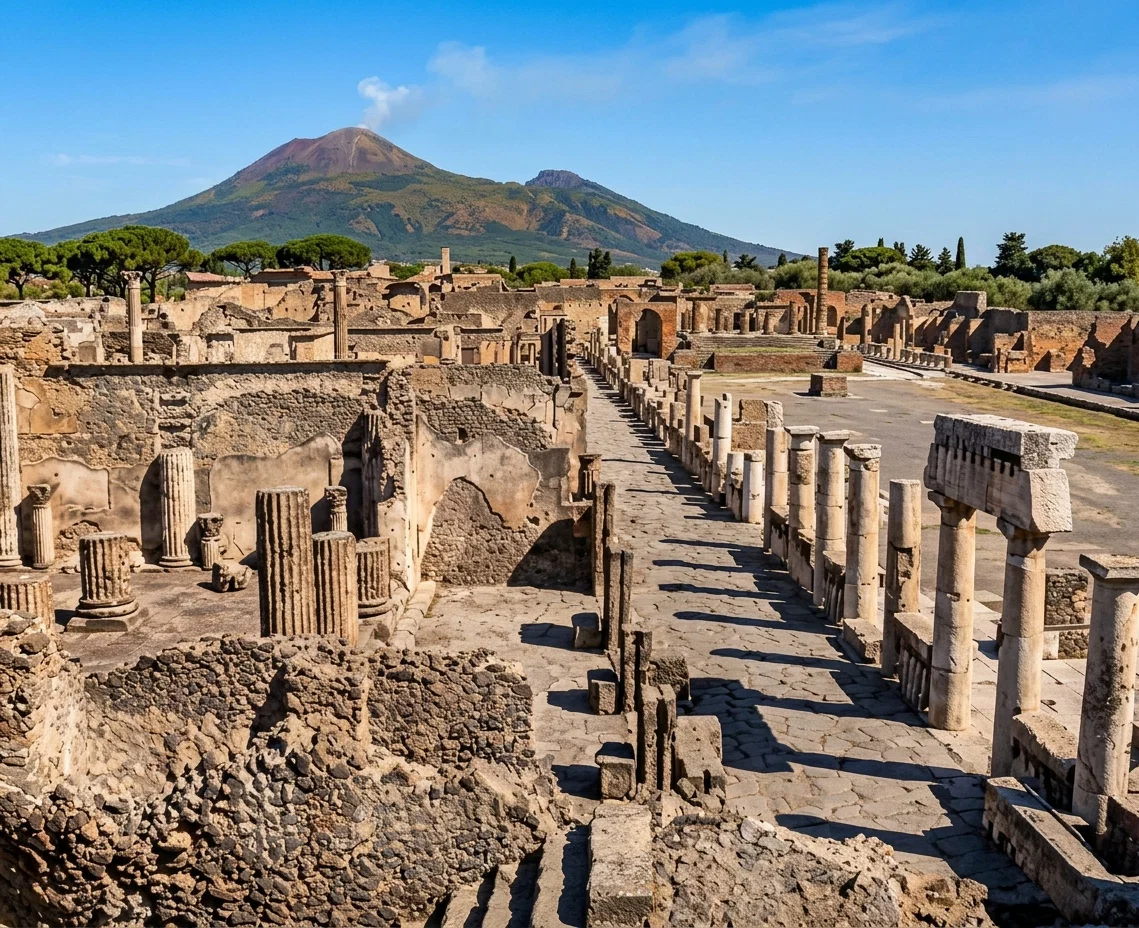
OUR illustrative cut is replete with melancholy, yet, withal, profitable suggestion. It puts under the eye a sad monument of the evanescence of merely human glory and achievement. Not only the poet’s “It might have been,” but also “It was and is not,” are among the saddest of all sad words of tongue or pen. Greece, Rome, Babylon—where are they?—In the dust. The proud architects and conquerors of empire—Alexander, Cæsar, Bonaparte—where are they?—They have long since become brothers to the cold clod.
POMPEII.
Forum and Mt. Vesuvius.
POMPEII. Forum and Mt. Vesuvius.
NINETEEN hundred years ago, under the soft, blue skies of southern Italy, hard by the limpid, lazy waters of the Sarnus, and nestling under the protecting (?) sweep of proud Vesuvius, lay Pompeii—splendid, opulent, festive. Perhaps fifty thousand souls lived, wrought, and hoped within her walls. Of the ancient world, Pompeii was one of the mistresses of architectural achievement. There was her amphitheater, with a seating capacity for twenty thousand persons; her temples of Mercury and Jupiter, adorned with magnificent Corinthian columns; her pantheon of Augustus, rich in frescoes and statuary; her Forum Triangulare, with an area enclosed by one hundred Doric columns; her marble temple of Venus; her luxurious thermæ, or baths;—all these attested her wealth, her culture, her splendor, her voluptuous luxuriousness. Not only these public edifices, but also many private dwellings were embellished with statues, statuettes, frescoes, vases, candelabras, and mosaics. Upon the outlying country nature had showered her benefits with unstinted hand. Her climate was balmy and salubrious. Everything seemed bursting into blossoms of promise. Naturally, then, the people were prosperous, happy, hopeful.
BUT her Nemesis was even then at her door. At the very hour when her votaries of fashion and luxury were assembled at a public festival, Mount Vesuvius, which had been inactive for centuries, suddenly, without a note of warning, shot forth clouds of smoke, and soon Pompeii was buried fathoms deep under volcanic ashes, sand, and scoriæ. All was over. Pompeii was no more.
HER temples, tho built of marble and adamant, were resting upon sand—the sand of idolatry and pride. And when “the floods came and the winds blew,” they fell, and the place thereof knew them no more forever. They were of the things that “may be shaken,” because they were not resting upon the Rock of Ages, Jesus the Christ, “by whom all things consist” (cohere), who upholds “all things by the word of His power.”
This one great, glorious truth, that there is a foundation Stone, a timeless Rock that can not be moved, and upon which every soul is invited to plant his feet, for time and for eternity—this, I say, is the star of hope that glows in the firmament of brass that spans our dark world.
HERE is the promise: “We have a building of God, an house not made with hands, ETERNAL in the heavens.” Verily there is a temple,“a city which hath FOUNDATIONS, whose builder and maker is God.” It is the everlasting refuge, the eternal abode of all conquerors in the “strife of truth with falsehood.” We are living in a world of moral struggle, and to every struggler Jesus makes this inspiring promise: “Him that overcometh will I make a pillar in the temple of My God, and he shall go no more out; and I will write upon him the name of My God, and the name of the city of My God, . . . and My new name.” Rev. 3:12. We need to note that this promise is not to all strugglers. It is not to the many who are struggling for wealth, ease, fame, power. It is given to the few—the very few—who, in love of Christ, are struggling against sin—struggling for victory over the powers of evil. How superlative the incentive to press the battle for truth and righteousness to its eternally triumphant consummation!
THIS temple, in which our Lord proposes to make every overcomer in the cause of righteousness a pillar, is not composed of mere inert materials, not a temple of wood or stone. It is a living, spiritual temple. The materials that enter into it are redeemed souls, hearts cleansed and sanctified by the blood of the Lamb. It is the living church of the living God—the habitation of the Most High, of Him who “dwelleth not in temples made with hands.” It is a temple resting “upon the foundation of the apostles and prophets, Jesus Christ Himself being the chief corner-stone: in whom all the building fitly framed together groweth unto an holy temple in the Lord. In whom ye also are builded together for an habitation of God through the Spirit.” Eph. 2:20–22. Ah! it is God’s peculiar dwelling-place. It is His home, His house, where He rests in His love; where He finds solace in His ransomed, blood-bought children. It is here, in His home, that He manifests Himself unto His children—the apple of His eye—as He does not unto the world. It is here that He bends over each confiding child with the sweet assuring words: “I have loved thee with an everlasting love; therefore with loving-kindness have I drawn thee.” It is here in His temple, glorious in the beauty of holiness, that He takes His children to His bosom, that they may know that He is “the Lord, the Lord God, merciful and gracious!”
HOW wondrously unique this temple—every part of it instinct with life! He who stretched out the heavens, and laid the foundations of the earth, is its Architect, its Builder. Of old He devised it. Before the worlds were made, He ordained its length and breadth, appointed its doors and gates, determined the size and shape of every stone, and the place it should occupy in the completed structure. Through the eye of faith and reason I see Him choosing the corner-stone. He looks first at those glittering stones, the angels, from Gabriel down. Tho glorious in power and resplendent in light, not one of them is adequate, not one will suffice. This temple of matchless proportions, this temple all-glorious for beauty, this temple meet for the indwelling of Jehovah—such a temple must needs rest upon a corner-stone of the same material as the other living stones of the structure, and yet have the strength, the might, the infinity of God.
MARK how Infinite Wisdom solved the difficulty. My Son shall become man, very man, and so shall be of the same substance as the other stones of the temple; yet shall He be God, and therefore abundantly able to bear the weight of a structure the top whereof shall reach to heaven. Do you see that foundation Stone laid? That Stone must be laid in the crimson cement drawn from its own veins; it is imbedded in blood. Through the awful ordeal of self-immolation it is eternally fastened to the living stones which it forever bears aloft.
AND now out of the hillsides of crucified pride; deep in the darkness of conquered despair; in the fretting, dusty atmosphere of petty cares; wherever souls are being tried and ripened—there are the strange quarries where God is hewing out and chiseling and polishing and quickening the stones for His temple. Each soul, as it becomes truly obedient to the Master-Builder, loving and hating in truest unison of sympathy with Him, with no purpose but His purpose, takes its place in the slowly-rising temple of God’s eternal purpose, which He purposed in Christ Jesus our Lord. Wherever a soul in this world, by repentance and faith, catches the fire of God’s likeness, it is placed a pillar in the temple of Zion, and it “shall go no more out.”
AND now mark how these living, holy stones rest one upon another, and all upon the “elect, precious” Corner Stone! How they bear one another’s burdens; and how the “sure Foundation” bears the burdens of all. Each stone binds and secures the others. The Corner Stone secures and binds them all. “How glorious is Zion!” Note her impregnable strength. God is in her midst, and she can never be moved. The kings of the earth stood up, and the rulers took counsel together,—they came against her, every one with mighty men of war, each man with his sword drawn,—but the Almighty scattered kings in Hermon like snow in Salmon. Ah! that temple is SAFE. The shafts of her enemies can never touch her. Let her foes come on and break themselves in pieces. Let them dash themselves against walls of rock. They shall be ground to powder. “He that sitteth in the heavens shall laugh; the Lord shall have them in derision.” They shall “perish from the way when His wrath is kindled but a little.”
“A PILLAR in the temple of My God”! O what a promise is this! I, a shining pillar in Zion—in Zion “glorious for situation”? O, how shall I not “praise the Lord for His goodness, and for His wonderful works to the children of men”?
THE life that we now live—how unreal, how illusory, evanescent, short. To the question of the apostle James, “What is your life?” Inspiration gives not fewer than eighteen answers. All these answers metaphorically declare that life is short, uncertain, shadowy. Your life is “even a vapor;” “a tale that is told;” “a swift post;” “a handbreadth;” “water spilt on the ground;” “a dream;” “wind;” “a shadow;” “a swift ship;” “a thread cut by a weaver;” etc. These are a few of God’s answers to the apostle’s, “What is your life?” Note the last answer here given,—the grim image of the weaver’s thread suspended in the air, and the keen blade of the lifted knife touching it with its edge. It means that I may die at any moment. The thread of my life may be cut to-morrow, to-day, even now. One pressure of the hand of Fate, and my life is done. When Pompeii dreamed that “it is yet three months till the harvest,” at that very hour the “Weaver’s” knife descended upon her “thread” of security.
BUT there is another life—a long life—with which God has promised to satisfy His children. In His temple He will make you and me a pillar, and we shall go no more out. There is everlasting safety, endless security. For God is there, and “that syllable is central.” He is our habitation, and He inhabiteth eternity. With Him there “is no parallax or eclipse.”
O CHURCH of the living God, temple of the Holy One! remember that thy Redeemer “in the midst of thee is mighty; He will save, He will rejoice over thee with joy; He will rest in His love, He will joy over thee with singing.”
GEO. W. RINE.

EARLY CHRISTIAN MISSIONS.

FOILED in his attempt to win popular applause at the cost of one of God’s tried instruments of propagating truth in the earth, Herod put to death all the guards of the prison whence Peter escaped. The king then, under a certain pretense, made a journey into Phoenicia, where, after a blasphemous oration, he suddenly died, and so the church at Jerusalem was relieved from further attempts to make political capital for himself at its expense. The church thus freed from its tormentor, had opportunity to propagate the Word of God unrestricted. Acts 12: 19-23.
Paul and Barnabas, coming from Antioch to bring that church’s bounty of brotherly love to the poor brethren at Jerusalem, were probably in the latter city at the time of Peter’s miraculous deliverance from prison and the incidents which followed. Having fulfilled their ministry there, these heralds of the cross returned to Antioch, taking with them John Mark. Verse 25. Arriving at Antioch, they found that the faithful devotion of that church had developed several teachers with prophetic gifts, some of whom had held prominent places in the affairs of the world. Acts 13: 1.
In connection with the protracted effort consequent upon the return of the two evangelists, these men held special communion with God by means of a season of fasting. While thus engaged, the Holy Spirit directed them to “separate,” or border off, for special service, Barnabas and Saul. Verse 2.
It was plain that the Lord had other work for these men than that of ministering to the church at Antioch, since within its own fold that church had developed men capable of leading its members into the higher life. To rid Jerusalem of its superabundance of men capable of carrying the message to “regions beyond,” God had permitted a general persecution to scatter them. Acts 8:1. It was through this very happening that the church at Antioch had been established, and now the Lord indicated His purpose to have this church, in turn, contribute toward establishing churches where the people were sitting in moral darkness.
So, in harmony with the direction of the Holy Spirit, the leading men of Antioch fasted in preparation, and then laid holy hands on Barnabas and Saul, setting them apart for their mission to the heathen. Verse 3. It seems to have been about this time that Saul, the “sought for,” assumed the name of Paul,the “little.” Verse 9. No doubt he was small in his own sight, when brought to a realizing sense of the obligation laid on him by a special dispensation of heaven. Eph. 3:2; Col. 1:25; 1 Cor. 9:16, 17.
Being thus sent forth by express direction of the Holy Ghost, these men knew that God had some particular field for them to reach, and a special work for them to do. Without being able to see the end from the beginning, they started westward to the seacoast. On arriving at Seleucia, they found a vessel upon which they embarked, and sailed to the island of Cyprus. Landing at Salamis, on the extreme eastern end of the island, they there preached the Gospel in the Jewish synagogue.
Probably nothing of note was accomplished at that point. It may be that the evangelists only sought to have a single meeting while they halted for a night, or they may have found a lack of interest in the message they had to bear. At any rate, they soon found their way to Paphos, at the extreme western end of the island. Here they met a sorcerer named Bar-jesus. He was a knowing, self-assertive man, who, by means of his false predictions, had made for himself a place with the deputy-governor of the town. Hearing of the presence of the evangelists, Sergius Paulus, the deputy, sent for them, desiring to hear the word of the Lord.
When they came before the deputy, this sorcerer opposed them, with the purpose of turning the mind of the deputy from the faith, probably scenting the fact that, with a knowledge of the Lord’s Word, the deputy would have no further use for his services. This act on the part of the sorcerer aroused Paul to such a degree of boldness that he administered the following stinging rebuke: “O full of all subtilty, and all mischief, thou child of the devil, thou enemy of all righteousness, wilt thou not cease to pervert the right ways of the Lord? And now, behold, the hand of the Lord is upon thee, and thou shalt be blind, not seeing the sun for a season.” Verses 7-11.
During this flow of words, the eyes of the apostle were set on the sorcerer, as if they would pierce him through. The Jewish impostor quailed before his steady gaze; and as the sentence was finished, a misty darkness enshrouded him, causing him to cast about for some one to lead him by the hand. The deputy saw by the effect of the apostle’s words that God in heaven had sealed them on his former prophet, and was greatly astonished at the power accompanying the Lord’s doctrine as expounded by the messengers before him. He could do no less than believe, and so joined himself to those who chose the Lord Jesus for their portion.
It would seem that the conversion of this one man was the sole object of the Spirit in leading these apostles across the island of Cyprus to Paphos; for soon after that they sailed from that place to Perga in Pamphylia, a seaport of Asia Minor. We shall hear more of this missionary tour in another study.
J. O. CORLISS.

RESTORATION from BABYLON

BY ALONZO TREVIER JONES

THE SECOND RETURN.

From the time of Satan’s master-stroke by Haman the Amalekite against the people and the work of God in the earth, unto the next recorded event in their history, was fifteen years—from the twelfth year of Xerxes to the seventh year of Artaxerxes Longimanus. Esther 3: 7; Ezra 7: 1–7. Yet it must not be supposed that in all these years Satan had been idle or had in any wise slacked his efforts; he only changed his tactics, and plied his efforts in another and more insidious way. He insinuated himself, his spirit, and his ways, into the individual life of the Jews in Palestine.
When the people of Israel came up first from the captivity, the Samaritans and other people of the land sought alliance with them. By the faithfulness of Zerubbabel and Joshua, that proposed alliance was rejected and prevented. By the faithfulness of these devoted men, and by their noble example, the people were held in faithfulness and devotion to God, and so to the rejection of all form of alliance with the mixed peoples around them. But when these devoted men had passed away, they were not succeeded by men of equal devotion. As a consequence the people, not having before them a good example in the men in chief responsibility, drifted into looseness of life; faithfulness and integrity were forgotten; and the alliance which the mixed peoples sought with them was secured, and by that Satan accomplished his purpose of putting a stop to the work of God in the rebuilding of Jerusalem.
The alliance of the mixed peoples with Israel was accomplished by the new leaders in Israel forgetting their integrity and true responsibility, and intermarrying with the mixed peoples around them. “The people of Israel, and the priests, and the Levites,” and “the princes and rulers,” did not keep themselves separate “from the people of the lands;” but did “according to their abominations, even of the Canaanites, the Hittites, the Perizzites, the Jebusites, the Ammonites, the Moabites, the Egyptians, and the Amorites.” For they took “of their daughters for themselves, and for their sons; so that the holy seed mingled themselves with the people of those lands: yea, the hand of the princes and rulers hath been chief in this trespass.” Ezra 9: 1, 2.
As a natural and very easy consequence the work of rebuilding the city, the streets, and the walls of Jerusalem was neglected, and finally was left off entirely, and even the temple that had been built and dedicated was neglected, and allowed to fall into decay. But thank the Lord, in captivity down in Babylon there were yet some faithful ones whose hearts were seeking the law of the Lord to do it. Of these Ezra was the chief; for “Ezra had prepared his heart to seek the law of the Lord to do it, and to teach in Israel statutes and judgments.” Ezra 7: 10. This right spirit and true example drew others to the right way; and in the seventh year of Artaxerxes Longimanus, B. C. 457, a decree was issued by that king of Persia in favor of Ezra and whosoever was minded to go with him, for the building of the city and wall of Jerusalem, and the repair of the house of God; and commanding all the people beyond the Euphrates to pay toll, tribute, and custom for the work of the Lord in Jerusalem. This decree is recorded in Ezra 7: 12–26.
In gratitude for this blessed favor, Ezra wrote:—
“Blessed be the Lord God of our fathers, which hath put such a thing as this in the king’s heart, to beautify the house of the Lord which is in Jerusalem; and hath extended mercy unto me before the king, and his counselors, and before all the king’s mighty princes. And I was strengthened as the hand of the Lord my God was upon me, and I gathered together out of Israel chief men to go up with me.” Ezra 7: 27, 28.
The number of those who went up from Babylon with Ezra was about six thousand, as enumerated in the Scriptures. On the first day of the first month in the year 457 B. C., they started from Babylon. When they had reached the river of Ahava, about a day’s journey from Babylon, Ezra reviewed the people, and found that in all the company there was not a single Levite. As the Levites were essential to the ministry of the house of God when they should reach Jerusalem, Ezra was obliged to send messengers back to the Jewish colony at Babylon to find some Levites who would come with them to Jerusalem. In response to Ezra’s call, there came two hundred and fifty-eight men. When those had arrived, “then,” says Ezra,—
“I proclaimed a fast there, at the river of Ahava, that we might afflict ourselves before our God, to seek of Him a right way for us, and for our little ones, and for all our substance. For I was ashamed to require of the king a band of soldiers and horsemen to help us against the enemy in the way; because we had spoken unto the king, saying, The hand of our God is upon all them for good that seek Him; but His power and His wrath is against all them that forsake Him. So we fasted and besought our God for this, and He was entreated of us.” Ezra 8: 21–23.
This reviewing of the people, the sending back to Babylon for the Levites, and the time of fasting and prayer, occupied eleven days. “Then we departed from the river of Ahava on the twelfth day of the first month, to go unto Jerusalem; and the hand of our God was upon us, and He delivered us from the hand of the enemy, and of such as lay in wait by the way.” And “on the first day of the fifth month” they arrived safely at Jerusalem, “according to the good hand of God” upon them. On the fourth day after their arrival at Jerusalem, the gold and silver and the vessels for the house of God which they had brought as offerings, were weighed into the house of God and entered in writing; they offered burnt-offerings according to the twelve tribes of Israel; “and they delivered the king’s commissions unto the king’s lieutenants, and to the governors on this side the river; and they furthered the people, and the house of God.” The temple was immediately repaired, and beautified, and caused once more to stand worthy of the divine purpose to which it was devoted, and to which it had been dedicated. Ezra 6: 14, last clause.
This work of repairing and building the temple occupied about eight months. When that work was all done, and Ezra turned his attention to restoring and organizing the full worship and service of God in the temple, there was made the discovery of the mixed marriages and other abominations into which had entered the Jews who had first returned from Babylon.
The princes who had come with Ezra, and who were his assistants, discovered this deplorable condition, and came to Ezra, saying:—
“The people of Israel, and the priests and the Levites, have not separated themselves from the people of the lands, doing according to their abominations, even of the Canaanites, the Hittites, the Perizzites, the Jebusites, the Ammonites, the Moabites, the Egyptians, and the Amorites. For they have taken of their daughters for themselves, and for their sons; so that the holy seed have mingled themselves with the people of the lands: yea, the hand of the princes and rulers hath been chief in this trespass.”
This was so fully true that no fewer than four of the very sons of Joshua the son of Jozadak “had taken strange wives.”
When the full truth of the dismal situation burst upon the devoted Ezra, he was so overcome that he was utterly speechless all the remaining part of the day.
“When I heard this thing, I rent my garment and my mantle, and plucked off the hair of my head and of my beard, and sat down astonished [like stone, petrified]. Then were assembled unto me every one that trembled at the words of the God of Israel, because of the transgression of those that had been carried away; and I sat astonied until the evening sacrifice. And at the evening sacrifice I arose up from my heaviness, and having rent my garment and my mantle, I fell upon my knees, and spread out my hands unto the Lord my God, and said:—
“O my God, I am ashamed and blush to lift up my face to Thee, my God; for our iniquities are increased over our head, and our trespass is grown up unto the heavens. Since the days of our fathers have we been in a great trespass unto this day; and for our iniquities have we, our kings, and our priests, been delivered into the hand of the kings of the lands, to the sword, to captivity, and to a spoil, and to confusion of face, as it is this day. And now for a little space grace hath been showed from the Lord our God, to leave us a remnant to escape, and to give us a nail in His holy place, that our God may lighten our eyes, and give us a little reviving in our bondage. For we were bondmen; yet our God hath not forsaken us in our bondage, but hath extended mercy unto us in the sight of the kings of Persia, to give us a reviving, to set up the house of our God, and to repair the desolations thereof, and to give us a wall in Judah and in Jerusalem. And now, O our God, what shall we say after this? for we have forsaken Thy commandments, which Thou hast commanded by Thy servants the prophets, saying, The land, unto which ye go to possess it, is an unclean land with the filthiness of the people of the lands, with their abominations, which have filled it from one end to another with their uncleanness. Now therefore give not your daughters unto their sons, neither take their daughters unto your sons, nor seek their peace or their wealth forever; that ye may be strong, and eat the good of the land, and leave it for an inheritance to your children forever. And after all that is come upon us for our evil deeds, and for our great trespass, seeing that Thou our God hast punished us less than our iniquities deserve, and hast given us such deliverance as this; should we again break Thy commandments, and join in affinity with the people of these abominations? wouldst not Thou be angry with us till Thou hadst consumed us, so that there should be no remnant nor escaping? O Lord God of Israel, Thou art righteous; for we remain yet escaped, as it is this day; behold, we are before Thee in our trespasses; for we can not stand before Thee because of this.”
“Now when Ezra had prayed, and when he had confessed, weeping and casting himself down before the house of God, there assembled unto him out of Israel a very great congregation of men and women and children; for the people wept very sore.”
Then spoke one for all,—
“We have trespassed against our God, and have taken strange wives of the people of the land; yet now there is hope in Israel concerning this thing. Now therefore let us make a covenant with our God to put away all the wives, and such as are born of them, according to the counsel of my lord, and of those that tremble at the commandment of our God; and let it be done according to the law. Arise; for this matter belongeth unto thee; we also will be with thee: be of good courage, and do it.”
This proposal was accepted by all. Then Ezra arose up from before the house of God, and went into one of the chambers of the priests; but “he did eat no bread, nor drink water; for he mourned because of the transgression of them that had been carried away.” Then a call was sent throughout Jerusalem and all the land, that all should assemble at Jerusalem; “and that whosoever would not come within three days, according to the counsel of the princes and the elders, all his substance should be forfeited, and himself separated from the congregation.”
Within the three days all were assembled in Jerusalem. “It was the ninth month, on the twentieth day of the month; and all the people sat in the street of the house of God, trembling because of this matter, and for the great rain.” Ezra addressed them:—
“Ye have transgressed, and have taken strange wives, to increase the trespass of Israel. Now therefore make confession unto the Lord God of your fathers, and do His pleasure; and separate yourselves from the people of the land, and from the strange wives.”
The people answered, “As thou hast said, so must we do.” But since the people were many, and it was a time of much rain, and they were not able to stand without, neither was this “a work of one day or two; for we are many that have transgressed in this thing,” they advised that portions of the people come respectively at appointed times, until all who were in the transgression had cleared themselves. This suggestion was adopted. And the time required to accomplish the work was two whole months—from the first day of the tenth month until the first day of the first month.
By this record there is made plain at least one very important lesson. Looseness in the individual life of the people of God gives to Satan advantage and victory over the people and cause of God, which it is impossible for him, by any possible power or machination, to gain, while they maintain integrity and true devotion to God. In the day of the false Smerdis, all that Satan, in possession of imperial power, could do against the work and people of God was, in reality, to produce a condition which only the more helped it forward. In the day of Haman the Amalekite, all that Satan, in possession of the very supremacy of worldly power, could do against the work and people of God, was only to demonstrate the absolute impotence of it all. And all this, simply because the people of God were walking in singleness of heart before Him, in true faith and integrity. But when they neglected all this, and so gave place to Satan in the individual life, then Satan gained the victory for which he had so long striven, and which, with all the power of earth in his hands, he had utterly failed to gain.
Individual faithfulness is the victory of the people of God; individual unfaithfulness is the victory of Satan over the people of God.
[The next article is “The Third Return.”]

Treasures Hidden in Scripture

“THE truths of the Bible are like gold in the soil. Whole generations walk over it, and know not what treasures are hidden beneath. So centuries of men pass over the Scriptures; and know not what riches lie under the feet of their interpretation. Sometimes, when they discover them, they call them new truths. One might as well call gold, newly dug, new gold.”

Duty at Every Moment

THERE is not a moment without some duty. —Cicero.
Continue reading: HIS GLORY SHALL BE SEEN