Your ShelfYour Projects

Review and Herald, Vol. 79, No. 9.

GOD DWELLETH IN US

Review and Herald

Mar 4, 1902

Seventh-day Adventist Publishing Association · Battle Creek, Mich. · Mar 4, 1902

GOD DWELLETH IN US.

But God is never so far off As even to be near; He is within: our spirit is The home He holds most dear.
To think of Him as by our side Is almost as untrue As to remove His throne beyond Those skies of starry blue.
So all the while I thought myself Homeless, forlorn, and weary, Missing my joy, I walked the earth Myself God's sanctuary. — Faber.

The Need of Medical Missionaries.

Mrs. E. G. White.
The Lord’s people are to be as true as steel to principle. He has pointed out the work devolving on every church-member. He declares that the church-members are faithfully to do their duty to those within their own borders. They are generously to support their own poor. They are to engage in systematic missionary work, teaching their children to keep the way of the Lord, and to do judgment and justice.
But the light which for years has been before the churches has been disregarded. The work that ought to have been done for suffering humanity in every church has not been done. Church-members have failed to heed the word of the Lord, and this has deprived them of an experience they should have gained in gospel work.
There is a great work to be done in the cities throughout the States, and especially in the cities of the Southern States, so many of which are unworked. In this work there are many difficulties to meet, and the Lord calls for wise and understanding workers, who will surmount these difficulties. Little can be done in large cities unless the workers are humble and teachable, daily looking to the Lord for guidance.
Many have stood off to criticise and condemn; but what have they done to help in the great necessity? Had those claiming to believe the truth taken up the work of health reform, and gone forth to do missionary work in the cities of the South, a harvest of souls would have been gathered for the Lord. Men and women ought to be working in this field, preparing colored workers to labor for the colored people. This work must be done with the greatest caution. No careless, headstrong movements should be made. Medical missionary work,—Christlike ministry for the suffering,—this is the work that will remove the mist of ignorance and superstition which for so long has hung over the Southern field.
If God’s workers had labored in new fields as they should, if they had done medical missionary work as they should, much fruit would now be seen in places that are yet barren. Had they sought the Lord diligently, He would have given them places in which to work.
The instruction the Lord has given me is that a field should not be shunned because it has objectionable features. This world was seared and marred by the curse, but still Christ came to it. He, the Son of the most high God, was made flesh, and dwelt among us. He willingly left His high command to take His place at the head of a fallen race, becoming poor, that through His poverty we might be made rich. He is the greatest medical missionary who ever blessed the world. He gave His disciples practical lessons, teaching them how to work in such a way that souls would be made glad in the truth. Constantly He went about doing good, sympathizing with the weary, the heavy laden, the oppressed, feeding the hungry and healing the sick. By His loving words and kindly deeds, He interpreted the gospel. Intelligence and virtue marked His work. Benevolence, compassion, and love were revealed wherever He went. He gave His life to save the world. His example rebukes our half-hearted efforts. How can He acknowledge us as laborers together with Him?
We read of Christ, “And leaving Nazareth, He came and dwelt in Capernaum, which is upon the seacoast, in the borders of Zabulon and Nephthalim: that it might be fulfilled which was spoken by Esaias the prophet, saying, The land of Zabulon, and the land of Nephthalim, by the way of the sea, beyond Jordan, Galilee of the Gentiles: the people which sat in darkness saw great light; and to them which sat in the region and shadow of death light is sprung up. . . . And Jesus went about all Galilee, teaching in their synagogues, and preaching the gospel of the kingdom, and healing all manner of sickness and all manner of disease among the people. And His fame went throughout all Syria: and they brought unto Him all sick people that were taken with divers diseases and torments, and those which were possessed with devils, and those which were lunatic, and those that had the palsy; and He healed them.”
The Lord continually performed deeds of loving ministry, and this every minister of the gospel should do. He has appointed us to be His ambassadors, to carry forward His work in the world. To every true, self-sacrificing worker is given the commission, “Go ye into all the world, and preach the gospel to every creature.” Read carefully the instruction given in the New Testament. The work that the Great Teacher did in connection with His disciples is the example we are to follow in our medical missionary work. But have we followed this example? The glad tidings of salvation are to be proclaimed in every village, town, and city. But where are the missionaries? In the name of God I ask, Where are the laborers together with God?
It is only by an unselfish interest in those in need of help that we can give a practical demonstration of the truths of the gospel. “If a brother or sister be naked, and destitute of daily food, and one of you say unto them, Depart in peace, be ye warmed and filled; notwithstanding ye give them not those things which are needful to the body; what doth it profit? Even so faith, if it hath not works, is dead, being alone.” “And now abideth faith, hope, charity, these three; but the greatest of these is charity.”
Much more than mere sermonizing is included in preaching the gospel. The ignorant are to be enlightened; the discouraged are to be uplifted; the sick are to be healed. The human voice is to act its part in God’s work. Words of tenderness, sympathy, and love are to witness to the truth. Earnest, heartfelt prayers are to bring the angels near.
The evangelization of the world is the work that God has given to those who go forth in His name. They are to be co-laborers with Christ, revealing to those ready to perish His tender, pitying love. God calls for thousands to work for Him, not by preaching to those who know the truth, going over and over the same ground, but by warning those who have never heard the last message of mercy. Work, with a heart filled with an earnest longing for souls. Do medical missionary work. Thus you will gain access to the hearts of the people. The way will be prepared for more decided proclamation of the truth. You will find that relieving their physical suffering gives you opportunity to minister to their spiritual needs.
The Lord will give you success in this work; for the gospel is the power of God unto salvation when it is interwoven with the practical life, when it is lived and practiced. The union of Christlike work for the body and Christlike work for the soul is the true interpretation of the gospel.

The Stone in the Road

A STORY is told of a king who tested his subjects by placing a large stone in the center of the street near his palace. Various people avoided it, or stumbled over it, each complaining of “the lazy people” who left it there. When it was clear that no one would remove it voluntarily, the king called those who had avoided the stone to the place, and, with his own hands, removed the stone, while they looked on. Under the stone was a box containing gold and treasures marked, “For him who moves this stone.” The application to your life is plain. Never shun a duty. Never complain because somebody else has not done what you ought to do. Grapple with difficulties for the sake of the treasures they conceal.—Sabbath Recorder.

COMBINATION OF THE EVANGELICAL AND THE MEDICAL MISSIONARY WORK.

A. T. JONES.
The medical missionary work and the evangelical missionary work are the same thing. The preachers are to have all they can possibly get of the principles of health and temperance—the medical missionary work; and the physicians, nurses, etc., are to have all they can possibly get of the gospel—the evangelical work. So now please let every conference worker make an actual study of everything that is presented in this convention, so that he will know what to do when he goes out into the field; for we, as ministers of the gospel, are to teach to the people the gospel of complete health, the complete gospel of health.
Each one of us—each one of the canvassers, wherever he goes; each preacher, each licentiate—who goes out into the field, is to do that. And this phase of the work is to receive its share of consideration in our convention. I cannot make any distinction between health and gospel. In truth, the gospel is health; and true health is the gospel. For this reason, truly, the gospel of health is all the gospel there is. I want you to see this. The other day I had an opportunity to trace the meaning of the word “health,” and I do not know that I can do better than to call your attention to it, so that you may see for yourselves that there is nothing but the gospel of health,—that the gospel is health, and that health is the gospel.
The word “health” is an abstract noun, from “whole,” not from “heal.” The real meaning of the word “whole” is “hale, sound, entire, complete.” The original sense of the word “whole” is “hale,” which signifies “in sound health.” This is confirmed by that verse of Scripture: “They that be whole need not a physician, but they that are sick.”
The original form of the present word “hale” is “hal.” And its descent is “hal, hol, hool, hole, hwole, whole.” Thus the spelling “h-a-l-e” is only a later Scandinavian form of the word “whole.” The present Norwegian word for “whole” is “hel.” Indeed, the “w” in the word “whole” has been in use only about four hundred years; and the English Philological Society has recommended the dropping of the “w,” so as to restore the word to its connection with its related words, “holy,” “heal,” “health,” etc.
Thus the descent of our word “whole,” in that line, from the original “hal,” shows it to mean “in sound health.”
This word has another line of descent, which presents an additional and very important idea. It runs thus: hal, hol, hool, hole, holy, hole-ness, holy-ness, holi-ness; for our present word “holy” is “nothing but Middle English ‘hool’ (now spelled w-h-o-l-e), with suffix ‘y.’” The Anglo-Saxon runs the same: “hal,” with suffix “ig,” forming “halig.” This suffix “ig” corresponds exactly to our modern English “y,” so that the Anglo-Saxon “halig” is precisely our modern word “holy.” Corresponding to the Anglo-Saxon “halig” is the German “heilig,” which also corresponds precisely to our present word “holy.” And that German word “heilig” is from the word “heil,” which signifies “health, happiness, safety, salvation.” The descent and family of the word in German is this:— Heil, signifying hale, whole, healthy. Heiland, signifying the Saviour, from “old present participle—the healing or saving One.” Heilig, signifying (healthful, bringing the highest welfare; hence) holy, sacred. Heiligkeit, signifying holiness. Heiliglich, signifying holy-like, holily, in a holy manner. Heiligthum, signifying holy place. Heiligen, signifying to make holy, hallow, sanctify. Heilsam, signifying wholesome, healing.
The German of Isa. 12:2 is, “Siehe, Gott ist mein Heil. . . . Gott der Herr ist meine Stärke und mein Psalm, und ist mein Heil.”
The Scandinavian languages—indeed, the whole Teutonic family of languages—tell the same story. And that story is that in the true conception of health, both holiness and its resultant—salvation—are comprehended.
Then health is wholeness, and true wholeness is holiness. The preacher cannot teach true holiness without teaching true health; neither can the doctor teach true health without teaching holiness. In what, then, does the work of the preacher differ from that of the doctor? How can the work of the medical missionary be one thing, and that of the minister in the field preaching the gospel be another thing?
By the way, we have been told that the medical missionary work and the preaching should be combined. How shall they be combined? Shall it be by sending out a preacher and a doctor to work together? Will that truly combine these two things, unless these two things are combined in each of the two men?—Plainly not. Therefore the only true way to combine the medical missionary work with all the other work of the Third Angel’s Message, is to have these all combined in each individual. In the very language in which we speak in our own native and ancestral Anglo-Saxon, this combination already exists. In the words in which we speak on the subject these two things are combined. Then, not to have them combined in our work demonstrates that we do not truly know the language in which we speak, that we do not comprehend the meaning of the very words which we use when we speak on the subject.
The Bible says this same thing. In it, as in our language itself, these two things are combined in a single verse and in the same words. In 2 Cor. 7:1 we read, “Let us cleanse ourselves from all filthiness of the flesh and spirit, perfecting holiness in the fear of God.”
But what is “holiness”?—“Only another form of the word ‘health.’ ‘Let us cleanse ourselves from all filthiness of the flesh and spirit, perfecting health in the fear of God.’” And health, wholeness, holiness, is salvation. The physician or the nurse who fails to preach salvation, fails to preach true health; and the minister or the Bible worker who fails to preach health, fails to preach true salvation. “Without holiness no man shall see the Lord.” Let us read it, “Without health no man shall see the Lord;” for that expresses the same thought. The people who see the Lord while they stand alive on the earth, are going to be holy; they are going to be sound, whole, healthy; they are going to have salvation, holiness; they are going to be sanctified wholly—body, soul, and spirit preserved blameless unto the coming of the Lord. And so it is written: “I am the Lord that healeth thee.” God has yet much truth for you and me on the subject of salvation, holiness, health.
Where our further-back mother tongue says “heil,” our immediate mother tongue says “salvation.” Now our own English Bible says that same thing—that health and salvation are the same thing. In Ps. 67:1, 2, we read: “God be merciful unto us, and bless us; and cause His face to shine upon us; that thy way may be known upon earth, thy saving health among all nations.” What kind of health?—Saving. Then what is connected with true health, God’s health?—Salvation. Health means salvation. It means holiness; and salvation because of holiness.
“That thy way may be known upon earth.” What is His “way”?—“Thy saving health;” salvation. Then there is salvation in health, is there? Is there salvation in the health that you preach and teach? And there is health in salvation, is there? Is there health in the salvation that you preach? In studying the Bible, watch the parallels of expression, and catch the thought that is conveyed in the parallel, and you will find worlds upon worlds opening up to you.
“That thy way may be known upon earth, thy saving health unto all nations.” Turn back to Ps. 42:5: “Why art thou cast down, O my soul? and why art thou disquieted in me? hope thou in God: for I shall yet praise Him for the help of His countenance.” The Hebrew words in English letters say, “For His presence is salvation.” There is salvation in His presence. But what is salvation?—Health. What is the difference between saving health and salvation?—They are the same.
Now the eleventh verse: “I shall yet praise Him, who is the health of my countenance, and my God.” The help of His countenance is the health of my countenance. His presence is salvation, and His presence is health. Then by the Scriptures, true salvation is health, and true health is salvation. See also Ps. 43:5.
Now another verse (Isa. 33:24): “The inhabitant shall not say: I am sick.” Why?—Because “the people that dwell therein shall be forgiven their iniquity.” What, then, is the root of sickness?—Iniquity. What is the true way to cure sickness?—Get rid of iniquity. Then if I am a preacher, and a sick person calls me to pray for his recovery, what is to be done for him?—His sin must be forgiven, his iniquity must be put away. But suppose I am a doctor or a medical missionary, not a preacher. A sick person calls me, and wishes me to cure him. How am I to do it?—In the same way. Does not that test apply to the doctor as well as to the preacher? Can it be said that the preacher’s work is to get the people’s sins forgiven, and that he has nothing to do with sickness?—No; for healing and forgiveness are inseparably blended in the Bible. Can it be said that the doctor’s work is to teach the principles of health, and that he has nothing to do with salvation?—Not if he be a Christian, for Christianity is the inseparable blending of these two things. Therefore when the preacher goes out to preach forgiveness of sins, does he do that properly unless he teaches the people that iniquity is the root of sickness, and that forgiveness of iniquity is the way to health?
When I have told people that iniquity lies at the root of sickness, and that forgiveness of iniquity is the only true way to true health, does it necessarily follow that he who accepts forgiveness of iniquity should expect, or should be expected, to walk off in perfect health without any further thought as to health?—No. Then would it be proper for him, yes, would it be proper to teach him, to make the proper application of those Christianly rational treatments, etc., that might be necessary to help him physically up to health and strength, even after his sins are forgiven, as a way to health?—Yes. Would that be proper for a preacher?—Yes. But suppose I am a doctor. If a person is sick, and I am called to tell him how to get well, and to help him get well, am I doing my duty when I make only the Christianly rational, physical, medicinal applications?—No; for the forgiveness of sins lies at the foundation of the true cure of the sickness that I am treating.
But when the doctor has made the proper Christianly rational applications, is he contradicting himself, undermining his profession, and going contrary to scientific principles, if he says to his patient: “This will relieve you, but you can never have true health until you get rid of sin, the root of all sickness. You have called me as a physician; but there is a Physician greater than I. It is He who taught me all the medicine that I know. There is a part of your disease that I cannot reach; that is iniquity. But the Great Physician can cure that as well as all the rest.I make these applications; but it is He alone who gives even to these all their virtue; it is He alone who heals. Yet with all this there is still a part of this difficulty that I cannot touch at all: I cannot forgive your sins, and sin is the root of your disease, and of all disease. So if you wish to be truly cured, take from Him the forgiveness of sins just as you are taking from Him the cure of this physical part of your disease”?
Possibly the patient might say: “I did not call you to preach to me.” But the true physician can reply: “You called me to prescribe for your disease. I have done it strictly within my profession. If you do not wish to take the medicine, you need not do it; but that is the only way to true health.” Now all will admit that he does not contradict his profession, nor violate scientific principles, when he makes that combination, or rather, when he recognizes the combination which the Lord has already made.
Then is the preacher going contrary to his profession? is he undermining all faith, or throwing away the true science of salvation, when he teaches the forgiveness of sins, and then recommends or applies Christianly rational treatments?—No. If the preacher separates these things, he fails to preach true holiness; if the doctor separates them, he does not teach true health. If the preacher separates them, he has not true holiness; if the doctor separates them, he has not true health. So the preacher lacks the very thing that he professes to preach, and the doctor lacks the very thing that he professes to practice, if either separates health and holiness.
This is Christianity, and should be possessed by each person. Whether we be preachers, doctors, or only plain Christians, pure, simple Christianity requires that we “cleanse ourselves from all filthiness of the flesh and spirit, perfecting holiness in the fear of God.”
What is filthiness of the flesh?—It is tobacco using; opium eating; tea, coffee, beer, or whisky drinking; eating unclean and unwholesome food; unclean habits of living. From all such things the Christian cleanses himself. But when that is done, only half of the man is reached. He must also cleanse himself from “all filthiness of the Spirit.” The man must do both to attain to true holiness, haleness, health, salvation. And what God has so joined together, how can any man do well in putting asunder?

THE SANITARIUM AT MOLINE, ILL.

J. E. FROOM.
(1213 Fifteenth St., Moline, Ill.)
God's providence in directing the medical missionary work in the cities of Davenport, Rock Island, and Moline forms a very interesting chain of circumstances, the recital of which never fails to inspire us.
Only about two years ago the work was begun in this part of the Mississippi Valley by the sale of our health books. During a slack season at the Battle Creek Sanitarium, over thirty of their nurses came to this place, and spent a few months in missionary canvassing. Without expense to either the Illinois or the Iowa Conference, over twenty thousand dollars' worth of our health books was sold, and most of the homes in the four counties adjoining were visited by devoted, intelligent nurses. Three health schools have been held. These, together with the visits of our canvassers, have sown liberally, and the harvest is already being reaped.
Without friends or donations, the Moline Sanitarium was opened in an eight-room, rented house, and was gradually equipped and furnished from its earnings. From this building we were crowded out by the patronage of appreciative patients. Loyal friends of temperance and reform were raised up, and an excellent property has been purchased, and donated to the Medical Missionary and Benevolent Association, in which to carry on a larger and more representative work.
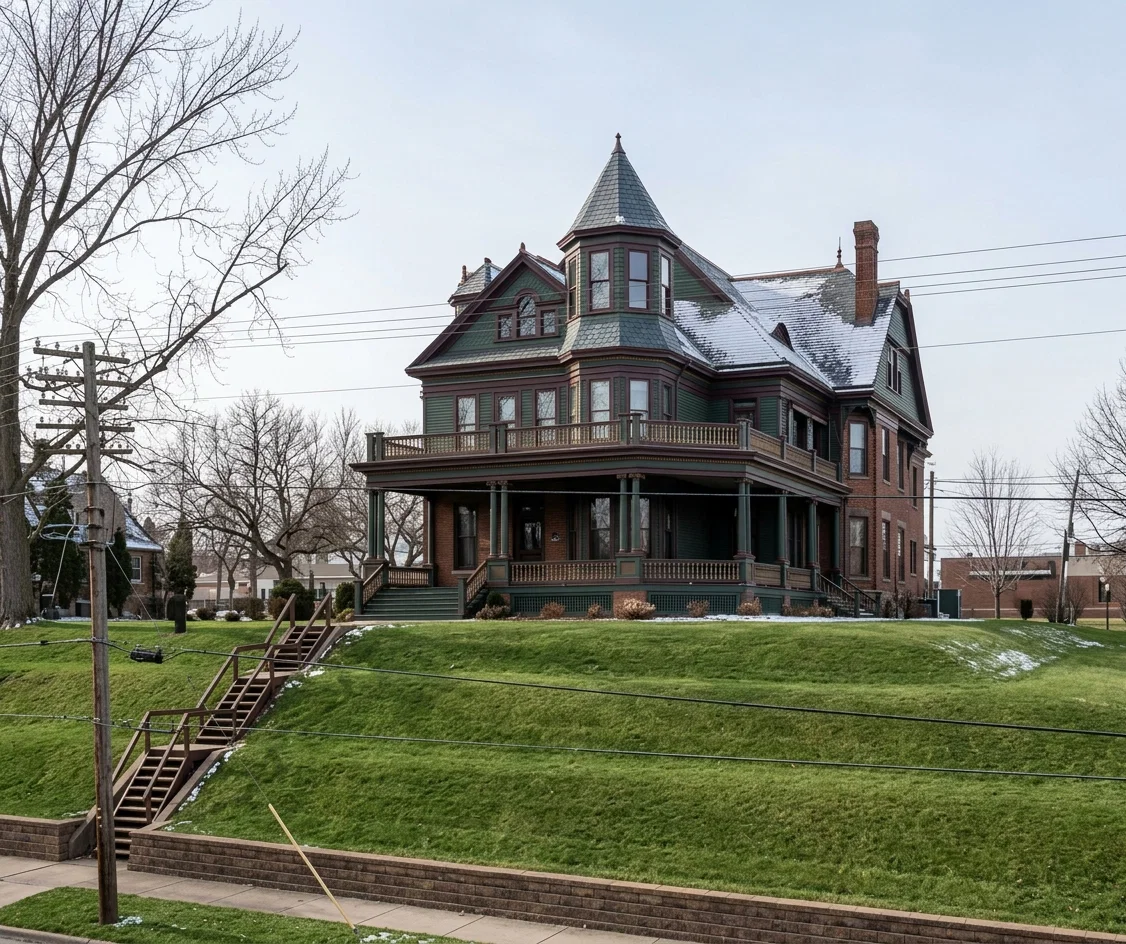
The building, shown very imperfectly in the accompanying illustration, together with its beautiful, terraced lawn, cost its builder twenty-eight thousand dollars. Completed only five years ago, it is in good condition, simply needing to be painted on the exterior. The house has eighteen rooms, and a large, unfinished third floor, which is now occupied by the nurses. Its interior is finished in beautiful hard wood of the finest grade, which makes elaborate furnishings unnecessary. As we see how perfectly adapted to our needs it is, with a few alterations in the plumbing, it really seems as if the Lord had directed in the planning and building of it for its present use.
THE SANITARIUM AT MOLINE, ILL.
It is only four blocks from the heart of the city, on the car line, and is removed from the noise and dust of the street by its elevation. All the rooms are light, and most of them are furnished with a good grade of furniture. We are now taxed to our limit in caring for patients, and the debt against this sanitarium is less than one thousand dollars. As soon as a larger connection with the city water main is finished, we shall be able to give thirty treatments each day, to care for ten house patients, and to serve meals to thirty-two boarders. All this has been accomplished in the short space of two and one-half years, and we think it is but the beginning of good things.
Only one death has occurred in our house, and the work is in good repute.
Many things are still lacking which a sanitarium ought to have. We need a first-class operating room. So far all the surgical operations have been performed in the bath room or in my office, yet their success has added to the reputation of the sanitarium. Citizens are ready to assist us in making the necessary improvements, and have already pledged eighteen hundred dollars toward the erection of an addition, and the work of adapting the building to convenient and attractive sanitarium work.
We need a convenient approach from the street to the building, which is situated on a bluff, with level ground stretching away to the west and south. By purchasing a small piece of land on the south, we can have an entrance on nearly level ground. We have a very reasonable option on this property for six months.
If the friends of the cause in Illinois wish to help this enterprise, there are other ways than the giving of large sums of money toward building the addition. We would greatly appreciate the gift of a good cow, a limited amount of bedding, new comfortables, pillows, mattress pads, blankets, sheets (both old and new). A small gift from many would lighten the heavy expense of getting started. We know there are many friends in Illinois who would gladly assist, and who would be greatly blessed in so doing. We shall be glad to hear from them.
Continue reading: A SPECIAL SERVICE