Your ShelfYour Projects

Signs of the Times, Vol. 28, No. 8.

THE STONING OF STEPHEN

Signs of the Times

Feb 19, 1902

Pacific Press Publishing Company · Oakland, California · Feb 19, 1902

THE STONING OF STEPHEN.
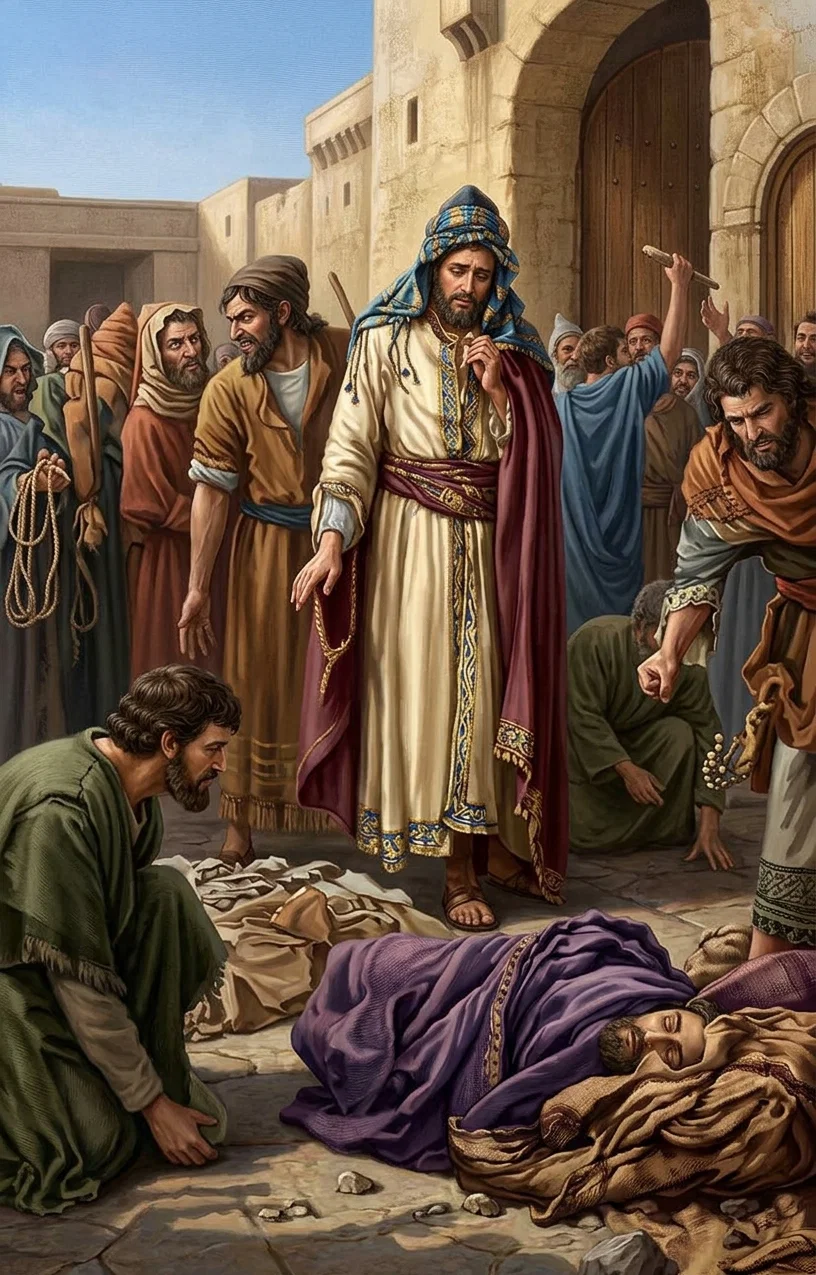
WHEN brought before the Jewish council, Stephen was given but a mock trial, false witnesses having been hired to give prejudicial testimony in his case. The very same story was told against him, in fact, that was employed to condemn Christ to the cross. After listening with mock gravity to the pitiless falsehood of the priestly hirelings, the high priest turned to Stephen with feigned surprise, and asked, “Are these things so?” Acts 7:1.
The artist's conception of the death of Stephen. His murderers still stand by with malignant attitude; the “devout men” are coming to give him honorable burial.
He well knew that they were not so, but tried to appear impartial in the matter. And altho the condemnation of the prisoner was doubtless assured from the first, and Stephen understood it thus: yet notwithstanding this was to be his last testimony, he was ready to reply to this question in a way to leave himself entirely out of the controversy. Being a witness for Christ, he was more concerned to bear a testimony which would set forth the claim of Jesus to the Messiahship.
He therefore began by calling attention to those points of history to which he knew they would not object, in order to reach his favorite theme. Starting with Abraham, he recited the promise of God to that patriarch, and showed its application to Isaac, Jacob, and Joseph, then to Moses and David, the lineal descendants of Abraham. Referring to the deliverance of Israel from Egyptian bondage, he testified that Christ was their invisible leader and benefactor, from whom they turned to worship false gods. After reviewing the whole course of God’s providence toward His people, the devoted witness, under the impulse of the Spirit, cried out: “Ye stiff-necked and uncircumcised in heart and ears, ye do always resist the Holy Ghost; as your fathers did, so do ye. Which of the prophets have not your fathers persecuted? and they have slain them which showed before of the coming of the Just One; of whom ye have been now the betrayers and murderers.” Verses 51, 52.
The effect of this climax was far different from that produced on the multitude of common people at Pentecost when Peter uttered substantially the same sentiment. Ch. 2:22, 23. They, when “pricked in their heart,” repented, and were baptized; but these, when “cut to the heart,” gnashed on the speaker “with their teeth,” like angry dogs. This was the signal that they were ready to take his life, but their threatening attitude caused no tremor of fear in the breast of Christ’s loyal deponent. There was at that time something which attracted his attention more. The Holy Ghost, with which he was filled, drew his gaze upward toward where Christ was standing, by the brightness of the glory of God. Just then a rift appeared in the vail which shut heaven away from earth, and glory shone through upon the face of the persecuted witness for Christ. Acts 6:15. With the strength of sight provided by the Holy Ghost, Stephen was permitted to behold Him for whom he had so boldly witnessed, and for whom he was about to die. By this view his faith was doubly rewarded, and he received strength with which to pass the terrible ordeal just before him. As the angel in the garden of Gethsemane had presented the cup of strength to Christ (Luke 22:43), so the Holy Ghost on this occasion had provided the martyr a view of glory for his encouragement.
The ecstatic joy of the occasion was the incentive which drew forth from Stephen his final testimony in behalf of Christ. He had before declared Him exalted to a place in heaven, and now he exclaims, “I see the heavens opened, and the Son of Man standing on the right hand of God.” Acts 7:56. These were the words that sealed the fate of Stephen. So long as he had confined his testimony to a question of mere faith, his hearers could bear with him, tho made angry at his statements; but when his upturned face caught the rays of glory from heaven’s throne, in plain view of all the council, and it was seen to shine like the face of an angel, whose dwelling is in glory, and this view was accompanied by the positive testimony that his eyes were looking on his Beloved, his enraged auditors stopped their ears and cried aloud, to break the force of hiswords. With one accord they then rushed upon him, and dragged him out of the city, where he was stoned to death.
As his Master, for whom he had witnessed, was taken out of the city to die (Heb. 13:12), so His devoted follower was led along the same path, which had been consecrated by Christ’s earthly pilgrimage for all His adherents. Heb. 10:20. As his Master had died with a prayer of forgiveness on His lips for His persecutors, so Stephen, the faithful witness for Christ, testified under tortures to having the same spirit as his Master. Kneeling on the ground in the place of his execution, the martyr first committed his life to Jesus, and then, while receiving upon his devoted body the murderous missiles, his last sentence was a fervent prayer for his tormentors, that their sin might not be laid to their charge. Verses 59, 60.
The life and death of Stephen had been so Christlike that he was beloved by all who knew him. His burial was therefore the occasion of the greatest lamentation. Even tho his life had paid the forfeit of his faithfulness, he being dead yet speaketh. It is thus that God makes one’s testimony ring out through all the ages. Heb. 11:4.
It is evident from the course of Stephen that he was “filled with the Holy Ghost,” by virtue of which he was able so boldly and truly to testify for Christ. That power did not desert him in his dying moments, and when he prayed for the sin committed in his murder, not to be laid to those who were about him, it must have been dictated by the Holy Ghost, which is the power and mind of Jehovah. But why release those actors from responsibility in the matter?—Because their minds were so blinded by Satan that they were really made to believe, in their ignorance, that they were doing God service in putting Stephen to death. For this reason God pitied them, and the same pity was so fully felt by him who was filled with God’s Spirit, that he expressed it as his last earthly request. Doubtless this prayer covered the thought that their murderous act, under the circumstances, might not be permitted to hinder them from receiving forgiveness in case they repented. In other words, the dying martyr so desired their salvation that notwithstanding they were putting him to death in the face of the Spirit’s mighty protest, he wished their sin might not be counted as unpardonable. See Matt. 12:31, 32.
Dictated, as this prayer must have been, by the Holy Spirit, it shows the mind of God toward those poor benighted souls, who, while professing to be His children, were lending themselves to the work of Satan, the sworn enemy of God and of all who are loyal to Him. The danger of repeating the sin of the church of that day is by no means past. Power had been committed to the Jewish church of that time, by which it might visit corporal punishment upon those accounted heretics, and it was simply used in a way to suit the carnal feelings of those who composed that church. The same power in the hands of the church now would bring the same results, because unregenerate human nature is the same now as then. It can not be denied that many of the present-day church-members do not show regenerate lives, altho their influence is strong in the councils of the church. In view of this, it is best for the church not to exchange what little of the power of God it does have, for the power of civil law. God’s power converts men’s hearts, but civil power can not convert men, especially when it is controlled by the church; then, it only persecutes. God’s power alone is sufficient for the guidance and maintenance of the church. J. O. CORLISS.

WHAT IT MEANS TO BE A CHRISTIAN.

In all the details of life, Christians are to follow the principles of strict integrity. These are not the principles that govern the world; for there Satan is master, and his principles of deception and oppression bear sway. But Christians serve under a different master, and their actions must be wrought in God. They must put aside all desire for selfish gain.
To some, deviation from perfect fairness in business deal may look like a small thing, but our Saviour does not thus regard it. His words on this point are plain and explicit: “He that is faithful in that which is least is faithful also in much; and he that is unjust in the least is unjust also in much.” A man who will overreach in a small matter will overreach in a large matter if the temptation comes to him.
Christ’s followers are obliged to be more or less connected with the world in business matters. In His prayer for them the Saviour says, “I pray not that thou shouldst take them out of the world, but that thou shouldst keep them from the evil.” Christians are to buy and sell with the realization that the eye of God is upon them. Never are they to use false balances or deceitful weights. God says:—
“Thou shalt not have in thy bag divers weights, a great and a small. . . . But thou shalt have a perfect and just weight, a perfect and just measure shalt thou have: that thy days may be lengthened in the land which the Lord thy God giveth thee. For all that do such things, and all that do unrighteously, are an abomination unto the Lord thy God.” “Thou shalt not oppress an hired servant that is poor and needy, whether he be of thy brethren, or of thy strangers that are in thy land within thy gates; at his day thou shalt give him his hire, neither shall the sun go down upon it; for he is poor, and setteth his heart upon it; lest he cry against thee unto the Lord, and it be sin unto thee. . . . Thou shalt not pervert the judgment of the stranger nor of the fatherless; nor take a widow’s raiment to pledge. . . . When thou cuttest down thine harvest in thy field, and hast forgot a sheaf in the field, thou shalt not go again to fetch it; it shall be for the stranger, for the fatherless, and for the widow; that the Lord thy God may bless thee in all the work of thine hands. When thou beatest thine olive tree, thou shalt not go over the boughs again; it shall be for the stranger, for the fatherless, and for the widow. When thou gatherest the grapes of thy vineyard, thou shalt not glean it afterward; it shall be for the stranger, for the fatherless, and for the widow.”
In every action of life the true Christian is just what he desires those around him to think he is. He is guided by truth and uprightness. He does not scheme; therefore he has nothing to gloss over. He may be criticized, he may be tested; but through all, his unbending integrity shines out like pure gold. He is a friend and benefactor to all connected with him; and his fellow-men place confidence in him; for he is trustworthy. Does he employ laborers to gather in his harvest? He does not keep back their hard-earned money. Has he means for which he has no immediate use? He relieves the necessities of his less fortunate brother. He does not seek to enlarge his possessions by taking advantage of the untoward circumstances of his neighbor. He accepts only a fair price for that which he sells. If there are defects in the articles sold, he frankly tells the buyer, even tho by so doing he may seem to work against his own pecuniary interests.
A man may not have a pleasant exterior; but if he has a reputation for straightforward, honest dealing, he is respected. Stern integrity covers many unpleasant traits of character. A man who steadfastly adheres to the truth wins the confidence of all. Not only do Christians trust him; worldlings are constrained to acknowledge the worth of his character.
Satan knows full well what a power for good is the life of a man of unbending integrity, and he puts forth zealous efforts to prevent men from living such lives. He comes to them with alluring temptations, promising them wealth, position, worldly honor, if they will but yield the principles of righteousness. And he has much success. Thousands yield to his bribery. The desire for wealth, for fame, for position, is too powerful for them to resist. Forgetting God, they withdraw their affection from Him, and worship mammon.
From the sad history of many who have failed we learn the danger of prosperity. It is not those who have lost their property who are in greatest danger, but those who have obtained a fortune. Adversity may depress, but prosperity frequently elevates to presumption. Prayer is often requested for men and women in affliction; and this is right. But those in prosperity are more in need of the prayers of God’s servants; for they are in greater danger of losing salvation. In the valley of humiliation men walk securely whilethey reverence God and make Him their trust. On the lofty pinnacle, where praise is heard, they need the help of special power from above.
Seeing the fearful danger of love of gain, Paul writes: “They that will be rich fall into temptation and a snare, and into many foolish and hurtful lusts, which drown men in destruction and perdition. For the love of money is the root of all evil; which while some coveted after, they have erred from the faith, and pierced themselves through with many sorrows. But thou, O man of God, flee these things; and follow after righteousness, godliness, faith, love, patience, meekness. . . . Charge them that are rich in this world, that they be not highminded, nor trust in uncertain riches, but in the living God, who giveth us richly all things to enjoy; that they do good, that they be rich in good works, ready to distribute, willing to communicate; laying up in store for themselves a good foundation against the time to come, that they may lay hold on eternal life.”
The temptation comes to a man to pursue a wrong course for the sake of gaining money. He yields, and commits himself to that which the Lord can not indorse. And daily the spiritual life of that man grows weaker. Daily he wanders farther from true happiness.
The sad history of Judas is a lesson for all. Judas was blessed with wonderful opportunities. He was with Christ during the entire period of the Saviour’s ministry. Day by day for three years he listened to His instruction and witnessed His marvelous works. Had he been willing to renounce all selfishness, the Lord would have used him to advance His kingdom. But Judas loved gain. He was a speculator. He thought that he could manage the finances of the church, and so make money. Stronger and stronger grew his covetousness, till at last he sold his Master for thirty pieces of silver.
How many to-day are like Judas betraying their Lord! How many are sacrificing principle for the sake of worldly gain! Thus they crucify Christ afresh, and put Him to open shame.
In the smallest as well as the largest affairs of life the first question should be, “What is God’s will?” “To obey is better than sacrifice, and to hearken than the fat of rams.” Christ calls upon His children to rid themselves of all selfishness, all covetousness, all impurity. “Come unto Me,” He says, “and I will give you rest.” Yield yourselves to My training. Submit your will to My will, your way to My way. Let your life be one with My life. So shall you gain treasure that will endure unto life eternal.
True religion is not an experiment. It is an actual imitation of Christ. God keeps a personal account with every man, testing him by the practical results of his work. Soon will be heard the call, “Give an account of thy stewardship.” MRS. E. G. WHITE.

THE LORD OF LIGHT.

Are ye born to daily dying, are ye heritors of loss? Are ye aliens to your heartstones for the friendship of the cross? Are ye stars of transient meaning to the children of the night? Ye are read as sons eternal by the living Lord of light.
Have ye caught a winged glory with a coronet of thorns, And the shrine of fame forsaken for a hut where sorrow mourns? Go ye softly, softly, softly, all your days into the night? By the twinkling of your footpath some shall trace the Lord of light.
Have ye crushed the baser courage? have ye chosen nobler fear? Faithful reverence of serving for the doubt of daring seer? To the poverty of trusting have ye humbled pride of sight? Ye are built a bridge of wonder laid unto the Lord of light.
Have ye sold a golden secret for a hungered righteousness, And the bitter, bitter sweetness of the gain of unsuccess? Have ye dropped the wreath of victor, have ye left a winning fight? Ye shall find your crown of living, losing for the Lord of light.
Have ye bartered glorious cunning for a child's simplicity? Have ye paid a dear experience for a hope ye can not see? Are ye hostage to a future crowded with the slaves of night? By your fiat ye shall free them in the living Lord of light.
Have ye spurned a fulsome honor for the praises of the rod? Have ye spat on clogging comforts for the healing stripes of God? Have ye blessed the blame that smote you from a triumph's toppling height? In the depths ye shall be lightened, lifted by the Lord of light.
Are ye blinded by the vision? are ye babes unto the wise? Are ye misers hoarding patience? have ye hope instead of eyes? Seem ye darker than their darkness to the children of the night? Ye have earned the higher duty, ye shall see the Lord of light.
Colorado Springs, Col. W. S. BISSONNETTE.

THE GLORY OF THE LORD.

“And the glory of the Lord shall be revealed, and all flesh shall see it together; for the mouth of the Lord hath spoken it.” Isa. 40:5.
THE Lord’s glory is His character. Ex. 33:18, 19.
The Lord proclaimed His character to Moses as “the Lord God, merciful and gracious, long-suffering, and abundant in mercy and truth.” Satan, the enemy of God, has always striven mightily to hide from mankind the glory of the Creator; but God declares it “shall be revealed.”
So He gave His only-begotten Son, and revealed His character in the meek and lowly Man of Galilee, the loving Sympathizer, the gentle Helper, the powerful Redeemer.
And now God “hath shined in our hearts, to give the light of the knowledge of the glory of God in the face of Jesus Christ,” that we, who were created for His glory, and who have been redeemed for His glory, may consummate the grand Illumination of heaven, and lighten the land of the enemy with the glory of the great King.
“Arise, shine; for thy light is come, and the glory of the Lord is risen upon THEE.”
W. H. B. MILLER.

APPRECIATION BORN OF EXPERIENCE.

There is nothing so convincing as a practical personal experience.
The child may be taught abstractly that two and two make four; but until he has experimented, and found that result by actually putting two things with two things, it is a very vague concept of his mind.
You tell the baby that the fire will burn him, that he must not touch it. But baby has observed the fire a great deal from his own standpoint. The fire is pretty and bright. It cooks nice food for baby. It crackles and roars to amuse him, and he can see no harm in it. He must prove it by that most inquisitive of the senses, touch. In an unguarded moment he puts the matter to the proof. O, the pain and astonishment of that revelation! Convinced and thoroughly punished, he takes refuge in mother's arms, to be cured as only the mother knows how to cure the body and the heart-wounds of her child, and to point the sufferer to Jesus, who only can heal the sin-wounded spirit. Baby has had an experience that has convinced him that mama is wise, that her word is true, and that he is deservedly punished for his disobedience.
We are all children in the great experiment station of this world. For our guidance and safety, we have the plain, clear warnings of our Father's faithful Word. Yet He, all-wise, fore-knowing that we would not hearken, has placed us here on experimental ground, and given us a little lease of time to prove these things for ourselves—to come into actual contact with sin and feel the sting of death, that we may know to abhor and shun it forever, and to prize the precious life we forfeited when we gave it opportunity to fulfil the purposes of the enemy.
Knowing that we would certainly do this very thing, and that He had all-power to restore all the ruined lives that our experiment would cost us, having prepared the remedy in the greatest sacrifice that love could make—the offering of the sinless One for the transgressors of God's law—knowing all the consequences and preparing the way of escape from our own self-ruin, yet does His great Father heart mourn, as, looking down the prophetic years, He sees His children struggling in the toils of the enemy, wounded, and bruised, and broken by running against the sharp corners of the broken law; and in these sorrowful words He takes up His lamentation for them: “O that thou hadst hearkened to My commandments! then had thy peace been as a river, and thy righteousness as the waves of the sea.”
What bitter pangs of sorrow we would be spared if we could only take our Father at His word without the test of proof. Happy indeed is he, who, trusting the truth and the wisdom of God, is willing to follow where he can not understand, knowing that all is well.
But here stands the great deceiver, waiting for every young soul. Casting a rosy glamour over their eyes, he can almost make white look black, and black white—right look wrong, and wrong right. We can not believe that there is any harm or wrong in that beautiful siren-faced Sin, who promises us such pleasure and freedom, till we are snared and taken, and the serpent's tooth has entered our very soul.
It was not necessary for our first parents to “know good and evil.” They were happy and blessed in knowing only the good, and the enlightenment brought only shame and misery into their lives and the lives of all their children; but they could not appreciate that happiness until they lost it, and learned, by cold contrast, to prize the blessings, the favor, and the purity they had lost.
It is only by contrast of opposites that we learn to appreciate the difference between good and evil. Darkness is dispelled by the rising light, and we are glad the darkness is gone. The extremes of heat and cold make us appreciate a comfortable medium. The hardships of winter give an added welcome to the coming of spring. There is no one who appreciates freedom as he who has been a prisoner; no one appreciates life and health as he who has just come back from the very gate of death. We learn to prize our blessings by losing them, and to appreciate the good and pure and beautiful by contrasting them with the evil. And that is just what we are here, in this world of sin and sickness and sorrow, for.
“Be ye not unequally yoked together with unbelievers,” commands the Word. “For what fellowship hath righteousness with unrighteousness? and what communion hath light with darkness? and what concord hath Christ with Belial? or what part hath he that believeth with an infidel? And what agreement hath the temple of God with idols? for ye are the temple of the living God,” pleads the Word.
But we can not believe that that scripture could possibly apply to our hero. He is so good and noble and true. The command is too hard. It is the story of Eve’s temptation again, trusting the word of another against the plain testimony of the Word of our God. She can not believe that the serpent lurks in so fair and godlike a form, so God, foreseeing all the bitter lesson before her, lets her go on and prove by actual experience the truth of that unfailing Word.
Nothing else will do. So she rears her castle in the air—a wondrous fabric, built of fondest hopes and beautiful dream-pictures of an ideal home, and a strong arm and a loyal heart to lean upon. Thus she rears her dream-temple, and enshrines her idol there. A romantic halo, rainbow-tinted and glorious, rests upon it. Yet because of that warning voice, her heart is not at peace. The Spirit of God strives to save her; but she must prove this rosy wine, so full of promise, and drink the cup to the very dregs. She stills the voice of conscience by promising that she will be faithful to her religion whatever comes, and launches her fairy bark, freighted with precious hopes, on an unknown sea.
Ah, trusting heart! if you had not made that vow of allegiance to God and His truth, you might have been serving your hero-god yet, under the mask and veneer of society, politeness, and good fellowship. But self-love brooks no rival, and acknowledges no higher allegiance than the little self-centered kingdom wherein he rules absolute monarch. All hearts must bow at the popular shrine, and she who would stand true to a higher allegiance must be cast into the fiery furnace of criticism, scathing denunciation, and social ostracism.
Need I say that her castle fell, having no other foundation than the vows of a selfishhuman heart? Years later, her beautiful dream-hopes blighted, the rainbow of promise gone, her idol shattered, or—worse—turned into a hideous inquisitorial, persecuting despot, she turns to the One whose name is “Faithful and True,” casting her wounded and broken spirit at His feet, acknowledging the truth of the warning (2 Cor. 6:14–18) she could not have believed if an angel from heaven had told her. But now it is wrought into the very fibers of her being. She has proved that God’s Word is verity and truth, and her heart can say amen to all the rest without the actual proof-test.
RUTH GARDNER.
(Concluded next week.)

A LAY DISCURSUS ON THE SOUL

BY PROF. J.A.L. DERBY

3. Testimony on Soul-survival.

Not infrequently science finds it necessary to determine the value of testimony. If any one can be found claiming to have seen an incorporeal soul, we are bound scientifically to give their words dispassionate consideration. There is some evidence of this nature, and it may be divided into two kinds, (a) spiritualistic, (b) non-spiritualistic. The former class is large; the latter we shall confine to the testimony of two persons—Jesus Christ and the apostle John.
As there are some things which purely physical science can not decide without the aid of revelation, and believing the value of spiritualistic evidence to be of this nature, we waive all such testimony, including the witch of Endor, until we come to the Scriptural argument. We can not, like Huxley, pass over with a sneer the phenomena of spiritism. They are facts, and a truly scientific method can not fail to deal with them. We shall therefore notice them later.
The evidence of Jesus and John, tho strictly a question of interpretation, is nevertheless testimony of persons well qualified to speak truthfully of what they had seen, and therefore we use it under the scientific heading rather than under the Scriptural.
As a matter of fact, John is the only person of the two who asserts positively that he saw the souls of certain dead men. That Jesus had such a view (let it be here remarked), is purely an inference from His words, based upon our belief that, being divine, He could look into the unseen world.

Souls under the Altar.

“When he had opened the fifth seal, I saw under the altar the souls of them that were slain for the Word of God, and for the testimony which they held.” Rev. 6:9.
This is the positive assertion of a truthful witness. That can not be denied.
“And they cried with a loud voice, saying, How long, O Lord, holy and true, dost Thou not judge and avenge our blood on them that dwell on the earth? And white robes were given unto every one of them; and it was said unto them,” etc. Verses 10, 11.
Here it is plainly stated,—
  1. That these were souls;
  2. Of dead men, because slain.
  3. They speak, are answered, receive white robes.
This would certainly be decisive in favor of the survival of conscious souls after death, if we did not take into consideration the condition of the witness at the time, the purpose he had in view, and the nature of the language. Let us emphasize the importance of these three things.
Oliver Wendell Holmes, a man whose veracity no one questions, tells how one time a comet came near the earth. So hot did our atmosphere become, that the sea boiled, and forests were set on fire. The eye of a man who attempted to view through a glass the fiery thing, was burned out; the soldiers’ guns discharged with the heat, and magazines exploded. One man’s brain was literally fried. A poor cripple’s leg caught afire, and his hand was scorched. Birds flying through the air fell to the earth burned to death, and oxen in the field writhed in the blistering rays.
All this must be taken literally unless we ask what was his condition at the time of seeing these things, what his purpose, and what the kind of language used. But when we find that all this was merely a dyspeptic dream, the language poetry, the purpose stated thus,—
“Stranger! if through thy reeling brain Such midnight visions sweep, Spare, spare, O, spare thine evening meal, And sweet shall be thy sleep!”
the reality of the scene dissolves into metaphoric teaching.
The whole Christian world has the firmest possible belief in the truthfulness of John Bunyan; but no one thinks of putting a literal interpretation upon his “Pilgrim’s Progress.” Now as to the apostle John, every one knows that his condition at the time he saw the vision of the souls was one of prophetic trance, or vision; his purpose to reveal the events of ages future to him; his language prophetic symbolism. These facts in themselves would deter any judicious person from attempting to build any theory of the soul, or to construct any other element of his creed, upon this language, until he was certain he understood the meaning of the symbols; but any person determined to know the truth of this matter, if he will possess himself of a little of the literature on the nature of man (which he can cheaply do, procurable of the house publishing this paper), may satisfy himself in a very short time that the apostle has no such idea in mind as even to suggest the inferences concerning the immortality of the soul usually drawn from this scripture.
Prophecy is full of symbolic figures; especially is this true of the books of Daniel and Revelation; beasts standing for kingdoms, horns for powers, eyes for intelligence, women for churches, and many others—dragons, serpents, candlesticks, horses, locusts, etc. Common sense suggests that no more irrational way of dealing with symbols and parables could be imagined than to found doctrine on their literal interpretation. Surely if one wished to establish for himself the reputation of a religious lunatic, no better method could be thought of than to spend even a few minutes a day for a week or so preaching to an ordinary audience a literal interpretation of just a few of the above symbols. Truly in symbolic prophecy a man conscious after death, is no less a monstrosity than a scarlet-colored beast “having seven heads and ten horns, and upon his horns ten crowns, and upon his heads the name of blasphemy.” Rev. 13:1.
Therefore without giving a detailed explanation, contenting ourself by referring the sincere truth-seeker to the works on this subject, let us rather try, by a retrospective vision, to deepen the interest of the reader in the true meaning of John’s proleptic prophecy.

A Retrospective Vision.

It is a high day in old Seville! a day of triumph and of exaltation! a day of victory for the cause of Christ and for the peace of the reign of his vicar on earth, our most blessed father, the pope! The Holy Inquisition is to hold a grand fete to-day.
Let the church bells ring, And the children sing, And the heart of the saints be gay; For we’ll offer the blood Of heresy’s brood In the flames of the auto da fé!
Let the people rejoice With unanimous voice, And gather in bright array; For the pious friars Shall fry the liars In the flames of the auto da fé!
Let the mandate sound To the kingdoms round; Let all their rulers obey The papacy’s word To unsheathe the sword, And kindle the auto da fé!
Let an altar stand At divine command From Rome to the farthest bay, And the rebels that rise We will sacrifice In the flames of the auto da fé!
Then the smell shall be sweet, Of this offering meet, In the nostrils of God for aye; Their bodies we’ll lave (That their souls we may save) In the flames of the auto da fé!
Then the land shall have rest From this impious pest, And the kingdom of Christ have sway, And mercy will smile On the heretics vile In the flames of the auto da fé!
High carnival of our holy mother the church! See, there comes the procession now! Like the wild and ravenous beasts they are, the condemned heretics are driven along in chains. How fittingly the character and destiny of these base disturbers of our sacred doctrine are represented by the dragons and devils on their gowns and hats!
And now they are chained to the stake! How the merry flames gnaw at their quivering flesh!
“Come, my little daughter, look and see how the enemies of our holy religion perish.”
“But, mama, what have these poor men, women, and little children done?”
“They are haters of Mary, the blessed mother of God, and they despise the sacred images, and many other things. They are sinners exceedingly.” And the shuddering child wonders what kind of a being God is.

Sequel.

But time rolls on, as time has a habit of doing. The light of the Reformation pierces the gloom of the Dark Ages. Luther and his coadjutors tear the mask of piety from the face of diabolism.
“Time hath reward in store, And the demons of our sires become The saints that we adore.”
It may not be a special source of courage and inspiration to the martyr spirit; but we of coarser nature are glad to know that time has a memory; that an eternal Nemesis presides,—
“And ever the truth comes uppermost And ever is justice done.”
Not now the blood of godless schismatics corrupting beneath the altar of sacrifice, but in this clearer light revealed to be the blood of holy martyrs, crying to heaven, like the blood of Abel. Now no longer clad in the ignominious garb of abandoned despisers of religion, but seen in their true character, saints and children of the Most High, to them are given white robes, which the Word declares is “the righteousness of saints.” Rev. 19:8.
Tho we shall have a word to say further on in regard to the literal interpretation of this prophetic vision, we trust that the above excursion may suggest to students of the sixth chapter of Revelation that it contains something more edifying and not less spiritual than the doctrine of incorporeal souls shivering or roasting in the mysterious recesses of hades.
[“The Rich Man and Lazarus” will be considered in the next article.]
Continue reading: FALLEN ANGELS