Your ShelfYour Projects

Signs of the Times, Vol. 26, No. 26.

THE SINNER'S HOPE
Earlier text: THE BAPTISTS

SPECIAL NOTICE.

AFTER July 1 the price of the Missionary Magazine will be 50 cents per year; to foreign countries, 75 cents. This decision was reached at the recent meeting of the Foreign Mission Board, after carefully considering the question in all its phases.
The Missionary Magazine has been published at a loss from its first issue, this heritage having been received from the Home Missionary, out of which it emerged. The subscription list has more than doubled, and yet the cost of the paper has been about twice the subscription price, and it will be impossible to ever secure a list sufficiently large to make it self-supporting at 25 cents. Because of this, the price was raised to 50 cents, which will practically pay the cost of publication.
The Magazine has been before our people more than two years, so that they can judge of its value. It has been printed on better paper than the Home Missionary, and bound with good paper covers. And, besides this, it has been materially enlarged, and made more valuable by the addition of illustrations and other important information. It is the aim of the publishers to endeavor to increase rather than diminish its value.
We are now offering our people, for 50 cents a year, a good forty-eight-page monthly, equal in value and size to many missionary journals which range in price from 75 cents to $1.50.
The Missionary Magazine and Sentinel of Liberty—formerly the American Sentinel—will be clubbed together for $1.25. Let all orders be sent as heretofore—either through the state tract society or direct to the Foreign Mission Board of Seventh-day Adventists, Room 1906, 150 Nassau St., New York, N. Y. FOREIGN MISSION BOARD.

You Have Been Wanting a College Education

Do You Want One Still? Then Read Our Offer

We will give you a free scholarship of one year, including board, room, and tuition, in any one of the following colleges or academies:—
Battle Creek College, Battle Creek, Mich. Union College, Lincoln, Neb. Walla Walla College, College Place, Wash. Healdsburg College, Healdsburg, Cal. South Lancaster Academy, S. Lancaster, Mass. Mt. Vernon Academy, Mt. Vernon, Ohio Keene Industrial Academy, Keene, Texas Southern Industrial School, Graysville, Tenn.
Upon the condition that you secure for us a certain number of yearly subscriptions for THE SIGNS OF THE TIMES, at one dollar ($1.00) each.
The number of subscriptions required to entitle you to a scholarship in Battle Creek College, Union College, Healdsburg College, Walla Walla College, South Lancaster Academy, Mt. Vernon Academy, and Keene Industrial Academy, is 140. One hundred subscriptions will entitle you to a scholarship in the Southern Industrial School, at Graysville, Tennessee. These subscriptions must be accompanied by the cash, $1.00 for each subscription, and must be sent to us direct.
If you are interested in securing an education without financial expense to yourself, write us for particulars and instructions. We are making you an offer of great intrinsic value,—an offer whose acceptance will mean much in your future usefulness, whatever your field of labor. Send to the schools named above for catalogs, and write us at once, in order that you may begin work without delay.
ADDRESS SIGNS OF THE TIMES Subscription Department Oakland, Cal.

INDIA'S ONLY HOPE.

To the dweller in India, the figures of the census are not the impressive facts. He feels the immensity of the field rather than sees it. He only knows that he is on the shore of a vast sea of peoples and nations and tribes and tongues. There is sorrow on this sea, and it can not rest.
Just outside the compound, as I write, a little group sings loudly (the sound seems to proclaim full lungs and empty minds), keeping time to the sounding brass and tinkling cymbal. They are doing honor to the gods, to secure, from the kindly-disposed deities, protection from plague, and to pacify the malevolent. They represent the ideas and religious activities of so many millions that the mind wearies of figures. But what a burden of heart weariness they represent, of hopelessness of God, and fear of demons who require propitiation throughout man's life, from the cradle to the grave!
The sore trials through which India is passing are almost staggering. The plague that has ravaged Bombay, and still does so, has passed across the entire northern country, and now Bengal, formerly clear of it, is the chief sufferer. The more destructive but less fearsome diseases, malarial fever and cholera, have been slaying day and night in Bengal, and in some parts last cool season whole families were said to have been wiped out. And now the plague comes in to take its toll of life. In Calcutta the burning inclosures have had to be enlarged to meet the increased demands for cremating the dead, and faces wear often a more anxious look. Thousands have left the city, but with the plague in the country villages the majority apparently decide to remain where they are.
There is no such exodus as took place last year, when the cases of plague were very few. Then the people feared isolation and infringement of caste rules, and above all the inspection of the female quarters in their houses. The suggestion of house-to-house visitation by the sanitary authorities sent about 300,000 people out of Calcutta in one week, we are told. Streets near the railway stations were crowded with fugitives, riding and on foot, accompanied by coolies loaded with necessary household goods hastily gathered for the flight. Government had hastily to send out town criers with their drums to assure the public that it contemplated no really practical measures in dealing with the plague. Now, with the fear of the medical authorities removed, people wait stoically or even cheerfully for the dread visitor to take its victims and pass on.
And now again the famine covers large territories. Nearly five million people are in the relief camps established by government, and missionaries up country in the famine districts say that the terrors of the visitation are but beginning. In endeavoring to dispose of its resources for relief of the famine sufferers, government has to reckon on the fact that the people whom they are trying to preserve alive do not always consider life the most desirable thing. Where life is so great a struggle that it becomes almost unbearable, people lose the fear of death. The government was better prepared for the present famine than it was for the previous one, but outside of all that can be done by public and private and missionary effort, the suffering is unthinkable.
An Indian Town Crier.
We seem really to be so near the end that the three calamities of famine, or plague, or war are always to be working in the earth. "When Thy judgments are in the earth," said the prophet, "the inhabitants of the world will learn righteousness." These things make many think, who otherwise would not. But it is true also, as the prophet added, "Let favor be showed to the wicked, yet will he not learn righteousness." To the vast majority these conditions sound no warning. Hearts get hardened as the times get harder.
Last season two of our colporters worked in Bombay, which has been in the hands of the plague for four years. They were continually impressed with the fact that the people at large seemed hardened and indifferent to spiritual things above any other city in India. The degradation spiritually in heathenism, so called, is ever increasing, and in calamity the masses seem wedded more than ever to the superstitions which drag them down. And in the European communities, which would resent the word "heathen" as they understand it, the reign of pleasure and self-seeking goes on proclaiming an ignorance of God that makes unbelievers one, by whatever name they are called.
The only hope for India is the coming of the Lord. It is the hope of the world. The ship is a wreck, hopelessly shattered, and is sinking. We are to work not simply to make people comfortable as they are for a little time. The work is to get people into the life-boat and set their feet on the solid rock. The question as to whether the ship is inevitably sinking or not makes all the difference in the world in the methods which people will adopt.
The message, "Fear God, and give glory to Him; for the hour of His judgment is come; and worship Him that made heaven, and earth, and the sea, and the fountains of waters," is the message needed in India among all classes, from the missionary who has not yet become aware of the glorious fact of a special judgment-day message, to the poor Hindu who needs, ere it is forever too late, to get acquainted with this God who made the heavens and the earth. And there is something in this message that makes itself heard. W. A. SPICER.

WHAT IS WRONG WITH THE BIBLES?

CALL them Bibles if you will, these Vedas, and Shastras, and Avestas, and Kings, and Koran. But what is wrong with them? Call them Bibles, but judge them by their fruits and say if you can why they mingle such a maximum of bitterness with their minimum of sweetness. These are the great books of the East, and they have been so for centuries. Why are Japan and China and Burma and India and Turkey what they are now, if these books are altogether wholesome? Why does China stand with her face to the past, worshiping her ancestors, whenever she worships gods that are no worse? Why is her government hopelessly corrupt? And why has she no provision for popular education? And why are the masses of her people hopelessly illiterate? And why are they helpless in the presence of disease and hopeless in the presence of death?
The Vedas are older than the New Testament by several centuries. Why are women so degraded in India?—They are the slaves of the zenanas. Only one out of 173 can read. Widows are scorned and oppressed. Cows are honored and worshiped. Monkeys are popular gods. Everything is worshiped according to the whim of the superstition of the worshiper. Sudras are scorned by Brahmans, but snakes are sacred. As in ancient Athens, so in modern India, it is easier to find a god than a man. By penances or pilgrimages, devotees think to merit salvation, regardless of repentance, character, or kinship with a holy God. Temple roofs are the shelter at once of the formal worship and physical defilement of priests and their people. Something must be wrong with the Vedas and the Shastras.
Here is a picture of temple worship in Calcutta sufficiently shocking to emphasize our reflection that something must be wrong with the Bibles of that land. It is from an article in this May number of the Missionary Review of the World. The very pious and well-known B. F. Meyer made, last winter, a tour of India, and this is one of the scenes he describes:
'Visit the temple of Uali in Calcutta. It is a gruesome and terrible spectacle. It is well to have seen it once, but I have no desire to repeat the experience. We saw the image of the goddess with her red tongue protruding as it is said to have done on that bloody field of battle, when she discovered she was treading on the dead body of her spouse. The temple, filthy in the extreme, is beset with beggars, especially women, and is the rendezvous of villainous people of all kinds. Scores of worshipers may be seen carrying or leading kids,which are on sale in the neighborhood. Before the British Government stopped it, children were sacrificed to this horrible deity, but now kids are substituted. Whilst we were standing there, one was brought, its head fixed in a cross-piece of wood, and with one blow severed from its body. Then, as its warm blood covered the pavement, a fakir, with matted hair, came and danced in it, bathing his feet in the gore."
What can be wrong with the Koran? The Turk is essentially a barbarian. His recent atrocities in Armenia will not soon be forgotten. They are blood-curdling and indescribable. It was not warfare, not even decent, wholesale murder, but brutal butchery of men, women, children, and communities. And that not in violation of the Turkish faith but under the commendation of it. Slave-stealing and slave-trading in Africa and Arabia are carried on by Mohammedans almost exclusively, and that in the interest of slave-holding Mohammedans in Arabia and Persia. Abysinnian boys and girls in the market of Shiraz are worth about as much as riding horses and baggage mules. At Mecca, where all the Mohammedans go to pray, there is a slave market and an immense trade. The horrors of this slave-raiding in Africa, and slave-trading in Arabia, can not be told in one page or many; but, however horrible it is, however repulsive and cruel and murderous, the Koran does not forbid it. It is a privilege of the Mohammedan religion. Mohammed himself was a slave-holder. There must be something vitally, mightily wrong with the Bible of the Mohammedans.
We spoke recently of Christianity as a peerless religion. Our Bible is a peerless Bible. The New Testament teaching of the Golden Rule and the brotherhood of man and the Fatherhood of God are par excellence. There is no defect in the character of Christ; there is nothing to add to His precept; there is nothing to subtract from His practises. He is wholly sweet and helpful and wholesome. "The astounding fact is that the Bible is the only book in the world that will bear full and permanent translation into life. We all feel sure that it would be better than well for the world if the precepts of this volume were absorbed and transmuted into the actions of men." Our students are asked to keep these questions in mind while studying the religions of the lands where we have planted missions. —W. J. Lhamon, in Bethany C. E. Readings.

PRAY AND WAIT.

"I know not by what methods rare, But this I know, God answers prayer. I know not when He sends the word That tells us fervent prayer is heard. I know it cometh soon or late; Therefore, we need to pray and wait. I know not if the blessing sought Will come in just the guise I thought. I leave my prayers with Him alone Whose will is wiser than my own."

OUR WORK AND WORKERS.

AT Durango, Colo., the addition of four persons to our ranks is reported by Brother H. M. J. Richards.
AT North Grove, Iowa, five converts are reported by Brother P. P. Adams. He also notes a Sabbath-school with an attendance of twenty.
AS A result of labor at Jerseyville, Ill., by Brethren J. P. Henderson and W. M. Lewsadder, since last fall, fifty persons have become obedient to the truth.
THE baptism of four candidates at North Willow, Colo., and two at Cripple Creek is noted by Brother J. M. Rees, president of the conference, in a report to Echoes from the Field.
MAY 12 a church of ten members was organized at Columbus Junction, Iowa, where Brother U. P. Long has been laboring. Brother H. Nicola officiated at the organization. Two others were subsequently baptized. Brethren Nicola and U. P. Long also visited the church at Bard, and five candidates were baptized.
TENT-MEETINGS recently held at Redding and Palocedro, Cal., have so far resulted in twenty-six persons accepting the truths presented from the Word of God. The laborers have been C. N. Martin, A. J. Osborne and wife, C. E. Knight and wife, and Milton St. John. The SIGNS was circulated in both places, which are in close proximity, previous to the meetings.
A CHURCH has been organized at Chico, Cal., with a membership of twenty-four. This consummation is mainly the result of labor by Brethren A. J. Osborne and W. L. Sims, in which the SIGNS was freely used as a pioneer by Brother Sims and Brother C. E. Knight and wife. The organization was completed by Brother C. N. Martin.
OF the work at Yazoo City, Miss., Brother J. E. White writes: "School work has been an important factor at this place. There is a flourishing day and night school at Lintonia, and another at Wilsonia, both suburbs of Yazoo City. In these schools the usual public school readers have been discarded, and their place supplied with the "Gospel Primer," "Gospel Reader," "Christ Our Saviour," and the Bible."
WRITING of jail work in Denver, to Echoes from the Field, Brother E. C. Clark says: "Out of seven young men here in the jail, six of them were won by the love of Christ, and are now working for others behind the bars." Amongst other things that call for reflection, he continues: "Ninety-nine per cent. of all that are turned out of the prisons have made up their minds to do right, but they find every one against them—no friend that cares for them. If they get work, they lose it just as soon as they are found to be jail birds. There is no one to give them a helping hand or a kind word, no one to encourage them to do right, so the devil has no trouble to get them started down the hill again."
IN the Workers' Bulletin, of Des Moines, Iowa, of May 29 is an interesting report of labor in Finland, where Brother John Hoffman and thirteen canvassers are at work, all of whom are said to be doing well. Of the country, writing from Helsingfors, the capital, he says: "We are in a land where the heat doesn't trouble us much. This is May 1, but big snow banks are all around the house where we live, and the water is freezing now out-of-doors at four o'clock P.M. The ice breaker came in yesterday to open up navigation, coming to the harbor through ice three feet thick. These ice breakers are very powerful ships, with two screws in the stern and one in the bow. At Hauge, Finland's winter port, they have been assisting vessels through pack ice twenty feet deep this winter. The university students march up and down the streets to-day wearing white caps, celebrating the 1st of May."

LESSON I.—SABBATH, JULY 7, 1900

OUR SINS PURCHASED.

Lesson Scripture, Gal. 1:1-5, R.V.
1 "PAUL, an apostle (not from men, neither through man, but through Jesus Christ, and God the Father, who raised Him from the dead), and all the brethren which are with me, unto the churches of Galatia: Grace to you and peace from God the Father, and our Lord Jesus Christ, who gave Himself for our sins, that He might deliver us out of this present evil world, according to the will of our God and Father; to whom be the glory forever and ever. Amen."
NOTE.—No lesson should be considered learned until, as the result of cross-questioning, the text, the whole of it, is indelibly fixed in the mind, and every distinct thought flashes forth, and can be mentally noted, as one reads or repeats the whole. While every teacher, as well as every pupil, ought to have his Bible in hand, no one ought to presume to attempt to teach the lesson before he has the Scripture text so thoroughly mastered that he can, by questions, without the open Bible before him, draw out from the class every item of it in the exact language of the Scripture, and can know whether or not the answers are correctly given.

QUESTIONS.

  1. Who wrote the Epistle that we are studying?—"Paul."
  2. To whom was it addressed?—"To the churches of Galatia."
  3. Who did he say joined with him in the greeting and the sentiments expressed in the Epistle?—"All the brethren which are with me."
  4. Who was this Paul?—"An apostle."
  5. What is the meaning of the word "apostle"?
  6. By whom was Paul sent?—"By Jesus Christ, and God the Father."
  7. From whom did he not receive his commission?—"Not from men."
  8. Was there any man concerned in his being made an apostle?—"Neither by man."
  9. What shows the high authority of his apostleship?—He was sent "by Jesus Christ, and God the Father, who raised Him from the dead."
  10. What is proclaimed to all who read this Epistle?—"Grace to you and peace."
  11. From whom does this gift come?—"From God the Father."
  12. Who is associated with God the Father in bestowing this gift?—"Our Lord Jesus Christ."
  13. What has He done to procure us this gift of grace and peace?—He "gave Himself."
  14. For what did Jesus give Himself?—He "gave Himself for our sins."
  15. Why did He do this?—"That He might deliver us from this present evil world."
  16. From what does the gift of Christ deliver us?—"From this present evil world."
  17. Whose will is it that we should be delivered from this evil world?—"The will of our God and Father."
  18. What is, therefore, due to Him?—"The glory."
  19. For how long is the glory due to God?—"Forever and ever. Amen."

NOTES.

  1. NOTE how in this greeting the divinity of Christ is accepted as a matter of course. What shows this?
  2. IT is worth noting that the apostle Paul did not ignore the brethren, altho he derived no authority from them. He did not disdain to give credit to all the brethren that were with him, as being associated with him in the sentiments of the Epistle. What circumstances in Paul's experience made it very natural that he should incidentally indicate that "the brethren" were agreed with him?
  3. THE Word of God is living. The Epistle to the Galatians has as direct application to us as it had to "the churches of Galatia," more than 1,800 years ago. The things that called out the Epistle were not peculiar to the Galatians. We can read it as tho it were written to-day and addressed to us, and not to the churches of Galatia.
  4. STUDY "the peace of God." Look up scriptures mentioning it, and note how it is bestowed, and what is involved in it. What does the grace of God bring?
  5. WHAT relation is there between "our sins" and "this present evil world"? Show it from the text that we are studying, and from other portions of Scripture.
  6. WHAT is the will of God in Christ Jesus concerning us? Where do we learn God's will? What special advantage is there to us in knowing God's will? These questions all admit of direct answers in the exact language of Scripture. Find them. 7. To WHOM do our sins belong? What comfort does this afford to those who think that because of their sins the Lord will not accept them?
  7. WHAT expression in this introduction to the Epistle stamps it as a part of the last message? Compare verse 5 and Rev. 14:6, 7. How much glory is to be given to God? Why? How do we give the glory to God?

PERIODICALS WANTED.

CLEAN copies of any of our periodicals for missionary work. Address, post-paid, F. Gush, Dewatto, Mason County, Wash.
LATE copies of any of our periodicals, for missionary work. Address, post-paid, Mrs. G. W. Johnson, Ben Lomond, Santa Cruz County, Cal.

"THE GOSPEL HERALD."

THIS is a truly missionary paper, and the only one published in the interests of the colored work in the South. It is a live sheet, giving illustrated descriptions of this important advancing work, pointing out the needs of the field, and containing practical instructions in regard to methods of work.
Each issue contains some otherwise unpublished article, selected from letters received from Mrs. E. G. White. Beginning with January, 1900, two series of Bible readings are running through the paper, one by Elder S. N. Haskell, on the "Third Angel's Message," and the other by Mrs. S. N. Haskell, on the "Sanctuary." These will continue through all of volume two, and are not published in any other form. None can afford to miss them. They are worth many times the price of the paper. Back numbers from the beginning of these Bible readings can be furnished new subscribers if requested.
A special spring number will be issued during the month of June, giving an illustrated description of the work being done in different parts of the field, with plans for future work, and several important articles regarding the southern field. Price of special spring number, 5 cents.
The Gospel Herald is published by the Southern Missionary Society, 1908 Grand Avenue, Nashville, Tenn. Price, 25 cents a year.

MISSIONARY MAP OF THE WORLD.

WE are pleased to announce that a missionary map of the world, representing our work in organized conferences and mission fields throughout the world, is now in course of preparation. It will be printed upon good, substantial cloth, in black and two colors. Price, 75 cents. It will be ready for delivery about July 1. Foreign Mission Board of Seventh-day Adventists, 150 Nassau Street, New York, N. Y.

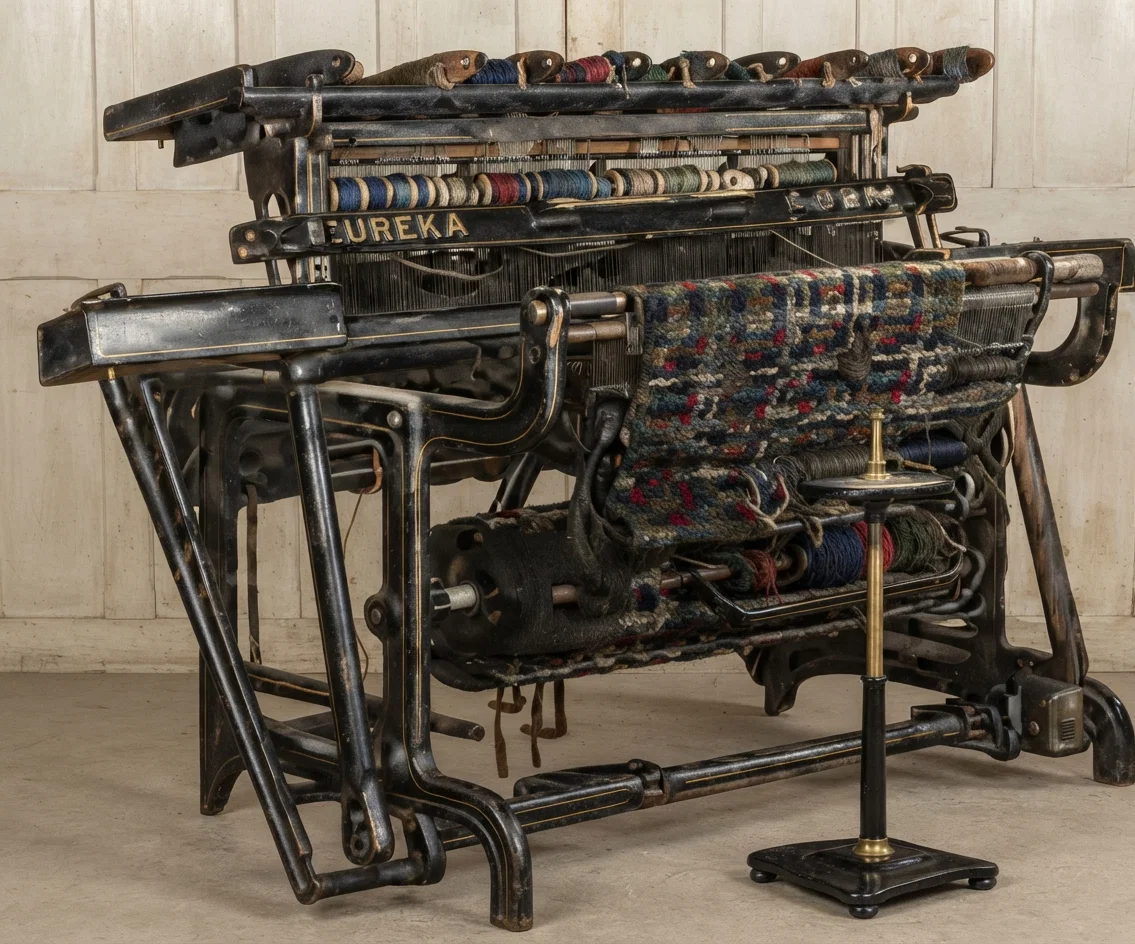
FLY SHUTTLE CARPET LOOM

The best, handiest, easiest running, cheapest, and most durable

FLY SHUTTLE CARPET LOOM

In the world,—100 yards a day. Catalogue free. EUREKA LOOM CO. 5018 Main St., Battle Creek, Mich.
When you write, please mention the SIGNS OF THE TIMES.

LESSON II.—SUNDAY, JULY 8, 1900.

JESUS THE BREAD OF LIFE.

Lesson Scripture, John 6:22-40, R.V.

22 "On the morrow the multitude which stood on the other side of the sea saw that there was none other boat there, save one, and that Jesus entered not with His disciples into the boat, but that His disciples went away alone (howbeit there came boats from Tiberias nigh unto the place where they ate 24 the bread after the Lord had given thanks); when the multitude therefore saw that Jesus was not there, neither His disciples, they themselves got into the boats, and came to Caper-25 naum, seeking Jesus. And when they found Him on the other side of the sea, they said unto Him, Rabbi, when camest Thou 26 hither? Jesus answered them and said, Verily, verily, I say unto you, Ye seek Me, not because ye saw signs, but because 27 ye ate of the loaves, and were filled. Work not for the meat which perisheth, but for the meat which abideth unto eternal life, which the Son of man shall give unto you; for Him the 28 Father, even God, hath sealed. They said therefore unto 29 Him, What must we do, that we may work the works of God? 30 Jesus answered and said unto them, This is the work of God, that ye believe on Him whom He hath sent. They said therefore unto Him, What then doest Thou for a sign, that we may 31 see, and believe Thee? what workest Thou? Our fathers ate the 32 manna in the wilderness; as it is written, He gave them bread out of heaven to eat. Jesus therefore said unto them, Verily, verily, I say unto you, It was not Moses that gave you the 33 bread out of heaven; but My Father giveth you the true bread 34 out of heaven. For the bread of God is that which cometh 35 down out of heaven, and giveth life unto the world. They said therefore unto Him, Lord, evermore give us this bread. Jesus 36 said unto them, I am the bread of life; he that cometh to Me shall not hunger, and he that believeth on Me shall never 37 thirst. But I said unto you, that ye have seen Me, and yet be-38 lieve not. All that which the Father giveth Me shall come 39 unto Me; and him that cometh to Me I will in nowise cast out. 40 For I am come down from heaven, not to do Mine own will, but the will of Him that sent Me. And this is the will of Him that sent Me, that of all that which He hath given Me I should lose nothing, but should raise it up at the last day. For this is the will of My Father, that every one that beholdeth the Son, and believeth on Him, should have eternal life; and I will raise Him up at the last day."
NOTE.—The lesson section includes the miracle of last week and the whole of Christ's discourse on the feeding of the five thousand. John 6:22-71. Learn by heart verses 35-37. Read Ex. 16:14-36 and Ps. 78:24.
Golden Text: "Jesus said unto them, I am the bread of life." John 6:35.

SUGGESTIVE QUESTIONS.

(1) What reasonings did the multitude have among themselves on the day after they had eaten of the loaves and fishes? V. 22. (2) What explanatory statement is made in verse 23? Note 1. (3) Not finding Jesus or His disciples there, what did the multitude do? To what place did they go? For what purpose? V. 24. Note 2. (4) Whom did they find after crossing the sea? What question did they at once ask Him? V. 25. (5) Did Jesus answer their question? For what purpose did He say they had sought Him? V. 26. (6) What admonition did He give them in regard to the true aim in labor? Through whom would they receive this meat that would abide unto everlasting life? By whose authority had Christ been set apart for this work? V. 27. Note 3. (7) What question did this lead the people to ask of Jesus? V. 28. (8) In what did Jesus say the work of God consisted? V. 29. (9) What did the people demand of the Saviour? V. 30. Note 4. (10) To what did they refer in the history of their nation to show that the feeding of the five thousand was not a great work? V. 31. Note 5. (11) What did Christ say in reference to their conception of the gift of manna? From whom must the true bread out of heaven come? V. 32. (12) What was that true bread? What was that true bread to do? V. 33. Note 6. (13) What request did the people then make of Christ? V. 34. (14) What did Jesus reply to this? What would be the condition of those who came to Him and believed on Him? V. 35. (15) What statement did He reiterate to show them their real condition? V. 36. (16) How many did the Saviour say would come to Him? How many does this include? (Isa. 45:22; Matt. 11:28.) How would they be received by Him? V. 37. (17) For what purpose did Christ then declare He had left heaven? V. 38. (18) What was God's purpose concerning Christ? V. 39. (19) What is the Father's will concerning mankind? What does Christ declare that He Himself will do for those who die believing in Him? When will He do this?

NOTES.

1. Boats from Tiberias.—These boats were not at the place where Jesus had fed the five thousand, and from which the disciples' boat had put off for Bethsaida and Capernaum; but they were near there—near enough so that those who wished to cross the sea had little or no difficulty in reaching them. It shows that there is no inharmony between the statements, "there was none other boat there," and "they themselves got into the boats."
2. Got into the boats.—The boats that had come over from Tiberias, on the western shore of Galilee, some distance south of Capernaum.
3. The meat which abideth unto eternal life.—"The figure which Christ used was a familiar one to the Jews. Moses, by the inspiration of the Holy Spirit, had said, 'Man doth not live by bread only, but by every word that proceedeth out of the mouth of the Lord.' And the prophet Jeremiah had written, 'Thy words were found, and I did eat them.' The rabbis themselves had a saying, that the eating of bread, in its spiritual significance, was the study of the law and the practise of good works; and it was often said that at the Messiah's coming all Israel would be fed."—Desire of Ages.
4. What doest Thou for a sign?—They had witnessed, many of them, the various miracles which Christ had performed from the beginning of His ministry, had seen the sick healed, the lame and maimed restored to soundness, the eyes of the blind opened, had themselves partaken of the bread and fish which multiplied under the Saviour's hand, and knew of His crossing the sea upon the water. They had listened to His gracious words, spoken as "never man spake," and still were asking for a sign to prove that He was what He claimed to be. And yet many to-day, with all the accumulation of evidence, are doubting, questioning, asking for a sign.
5. Our fathers ate the manna.—That is to say, the supplying of manna through all the wanderings of Israel in the wilderness was a much greater miracle than what Christ had done on the preceding day. Jesus must do a greater thing than this to prove His Messiahship; but Christ shows how meager was that gift compared with the bread of life which He had come to give them. Their fathers had eaten manna, and were dead; whereas those who partook of the bread of life would live forever. But even the manna had not come through Moses. Christ had furnished that typical bread also, but they had failed to learn the spiritual lesson in that bread, and had perished. The same will be true of those who fail to partake of Christ as the bread of life. If He is nothing to us but "a good man and a great teacher," we are lost.
6. Giveth life unto the world.—"As our own physical life is sustained by food, so our spiritual life is sustained by the Word of God; and every soul is to receive life from God's Word for himself. As we must eat for ourselves to obtain nourishment, so we must receive the Word for ourselves. We are not to obtain it merely through the medium of another's mind. We should carefully study the Bible, asking God for the aid of the Holy Spirit, that we may understand His Word."—Desire of Ages.

Looking unto Jesus

A remarkably impressive little tract translated from the French. It aims to lead souls so to behold Him that they will ask not, "What can I do?" but "What can He not do?" A. G. L. No. 1. 50 cents per 100.

PACIFIC PRESS PUBLISHING CO.

New York City Oakland, Cal. Kansas City, Mo.

Choose Ye This Day

Presents in an impressive manner the fact that it is ours to choose whom we will serve, and represents what will be the result of our choice. A. G. L. No. 14. 50 cents per 100.

PACIFIC PRESS PUBLISHING CO

New York City Oakland, Cal. Kansas City, Mo.

VIRGINIA HOMES.

You learn all about Virginia lands, soil, water, climate, resources, products, fruits, berries, mode of cultivation, prices, etc., by reading the Virginia Farmer. Send 10 cents, for three months' subscription, to FARMER CO., Emporia, Va.
Continue reading: Instructions for Ordering