Your ShelfYour Projects

Signs of the Times, Vol. 29, No. 9.

THE SANCTUARY

Signs of the Times

Mar 4, 1903

Pacific Press Publishing Company · Oakland, California · Mar 4, 1903

THE SANCTUARY.
BY MRS. E. G. WHITE.
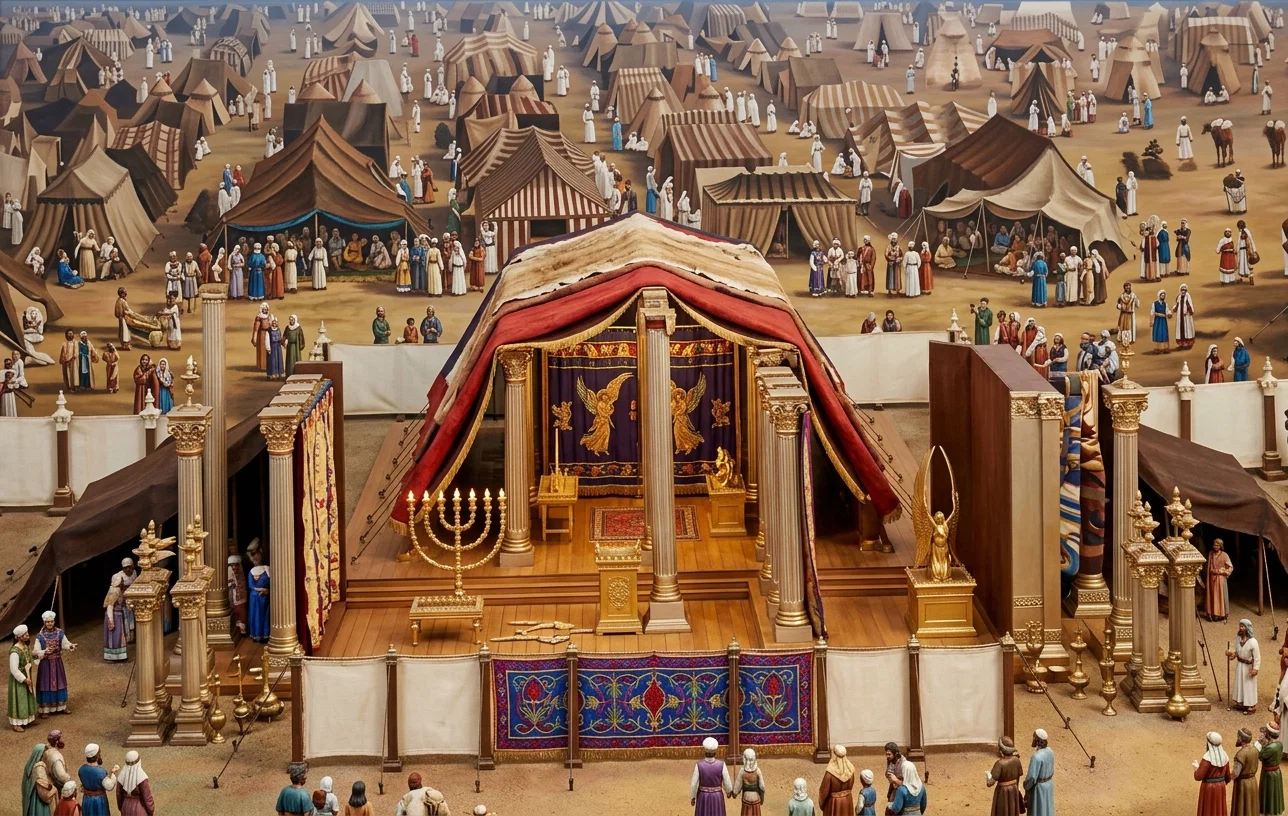
The tabernacle constructed by the Hebrews in the wilderness was made according to the divine command. Men called of God for this purpose were endowed by Him with more than natural abilities to perform the most ingenious work. Yet neither Moses nor these workmen were left to plan the form and workmanship of the building. God Himself devised and gave to Moses the plan of that sacred structure, with particular directions as to its size and form, the materials to be used, and every article of furniture which it was to contain. He presented before Moses a miniature model of the heavenly sanctuary, and commanded him to make all things according to the pattern showed him in the mount. And Moses wrote all the directions in a book, and read them to the most influential of the people.
Then the Lord required the people to bring a free-will offering, to make Him a sanctuary, that He might dwell among them. “And all the congregation of the children of Israel departed from the presence of Moses. And they came, every one whose heart stirred him up, and every one whom his spirit made willing, and they brought the Lord’s offering to the work of the tabernacle of the congregation, and for all His service, and for the holy garments. And they came, both men and women, as many as were willing-hearted, and brought bracelets, and earrings, and rings, and tablets, all jewels of gold; and every man that offered offered an offering of gold unto the Lord.”
“And every man, with whom was found blue, and purple, and scarlet, and fine linen, and goat’s hair, and rams’ skins dyed red, and sealskins, brought them. Every one that did offer an offering of silver and brass brought Jehovah’s offering; and every man, with whom was found acacia wood for any work of the service, brought it. And all the women that were wise-hearted did spin with their hands, and brought that which they had spun, the blue, and the purple, the scarlet, and the fine linen. And all the women whose heart stirred them up in wisdom spun the goats’ hair. And the rulers brought the onyx stones, and the stones to be set, for the ephod, and for the breastplate; and the spice, and the oil; for the light, and for the anointing oil, and for the sweet incense.” Ex. 35:23-28.
Great and expensive preparations were necessary. Precious and costly materials must be collected, but the Lord accepted only the free-will offerings. Devotion to the work of God and sacrifice from the heart were first required in preparing a dwelling-place for the Most High. And while the building of the sanctuary was going on, the Israelites, old and young, men, women, and children, brought their offerings, until those in charge of the work decided that the people had brought enough, and even more than could be used. And Moses proclaimed throughout the camp, saying, “Let neither man nor woman make any more work for the offering of the sanctuary. So the people were restrained from bringing.” Ex. 36:6.
The repeated murmurings of the Israelites, and the visitations of divine wrath because of their transgressions, are recorded in sacred history for the benefit of God’s people who should afterward live upon the earth; but more especially to prove a warning to those who should live near the close of time. Also their acts of devotion, their energy, and liberality in bringing their free-will offerings to Moses, are recorded as an example for all who truly love the worship of God. If God’s people prize the blessing of His sacred presence, they will manifest zeal and liberality in preparing a house where He may meet with them. And their interest in this work will be as much greater than that shown in preparing dwellings for themselves as heavenly blessings are esteemed of more value than earthly comforts.
Many will expend means freely to erect comfortable and even elegant houses for themselves; but when they would prepare a place in which to receive the presence of the high and holy One their offerings are bestowed grudgingly, and they are continually studying in what manner the sacred building can be made to cost the least, and yet answer the purpose as a house of worship. Some manifest more interest in building barns for their cattle,than they do in preparing a place for the worship of God. Such persons value sacred privileges just in the proportion which their works show. And their prosperity and spiritual strength will be according to their works. God will not cause His blessing to rest upon those who have so little appreciation of the value of divine things. Unwilling and stinted offerings are not accepted of God. Those who manifest an earnestness to bring to the Lord acceptable offerings, of the very best they have, as did the children of Israel in bringing their gifts to Moses, will be blessed in proportion to their estimate of the value of sacred things.
It is of some consequence that a building prepared expressly for divine service should be arranged with care,—made comfortable, neat, and convenient; for it is to be dedicated to God; He is to be entreated to abide in that house, and make it sacred by His holy presence. An amount sufficient to accomplish the work should be freely given, and the workmen be able to say, Bring no more offerings. A house built for God should never be left in debt, for He would thereby be dishonored. He is acquainted with every heart, and will reward all who freely return to Him, when He requires that which He has given them. If any withhold that which belongs to God, He will afflict them in their families, and cause decrease in their possessions, just according to their disposition to rob Him.
The tabernacle was so constructed that it could be taken apart and borne with the Israelites in all their journeyings. Yet it was a structure of extraordinary magnificence. The walls consisted of upright boards heavily plated with purest gold. The sacred building was composed of two apartments, separated by a rich and beautiful curtain, or veil. A similar veil closed the entrance of the first apartment. These veils, with the curtain which formed the ceiling of the tabernacle, were of a variety of colors, most beautifully arranged; while inwrought with threads of gold and silver were cherubim, to represent the angelic host, who are connected with the work of the heavenly sanctuary, and who are ministering angels to the saints upon the earth.
In the inner apartment was the ark, which was the most sacred object connected with that system of worship. It was a chest of precious wood, overlaid within and without with pure gold, and having a crown of gold about the top. In the ark were placed the tables of stone upon which God had engraved with His own finger the Ten Commandments. It was made expressly for this purpose, and hence was called the ark of the covenant, and the ark of the testament, since the Ten Commandments were God’s covenant, and the basis of the covenant made between God and Israel.
The cover of this sacred chest was called the mercy-seat. This was a costly and magnificent piece of workmanship. It was beaten out of one solid piece of gold, and two cherubim were made, one standing on each end, beaten out of the same piece of gold. Their faces were turned toward each other, and were looking reverently downward toward the mercy-seat, which represents all the heavenly angels looking with interest and reverence to the law of God deposited in the ark in the heavenly sanctuary. One wing of each angel was stretched forth on high, while the other covered their forms. The ark of the earthly sanctuary was the pattern of the true ark in heaven. There, beside the heavenly ark, stand living angels, each with one wing overshadowing the mercy-seat, and stretching forth on high, while the other wings are folded over their forms in token of reverence and humility.
The veil of the sanctuary did not reach to the top of the building. The glory of God, which was manifested above the mercy-seat, was partially visible from the first apartment. Directly before the ark, but separated by the curtain, was the golden altar of incense. The fire upon this altar was kindled by the Lord Himself, and was sacredly cherished by feeding it with holy incense, which filled the sanctuary with its fragrant cloud, day and night. Its fragrance extended far around the tabernacle. When the priest offered the incense before the Lord, he looked toward the mercy-seat. Altho he could not see it, he knew it was there; and as the incense arose like a cloud, the glory of the Lord descended upon the mercy-seat, and filled the most holy place, and often so filled both apartments that the priest was unable to officiate. As the priest in the holy place directed his prayer by faith to the mercy-seat, which he could not see, so the people of God direct their prayers to Christ before the mercy-seat in the heavenly sanctuary. They can not behold their Mediator with the natural eye, but with the eye of faith they see Christ before the mercy-seat, and direct their prayers to Him, and with assurance claim the benefits of His mediation.
These sacred apartments had no windows to admit light. The candlestick, beaten out of one solid piece of gold, was kept burning day and night, and gave light to both apartments. The gold-plated walls, reflecting the light from the seven lamps of the golden candlestick, the richly embroidered curtains of blue and purple and scarlet, with their shining cherubim, the table of show-bread and the altar of incense, glittering like burnished gold, presented a scene of magnificence and glory which no words can describe.
No mortal eye but that of the high priest could look upon the sacred grandeur of the inner apartment, the especial dwelling-place of God’s visible glory. Only once a year could the high priest enter there, after the most careful and solemn preparation. With trembling he went in before God, and the people in solemn silence waited his return, their hearts uplifted to God in earnest prayer for the divine blessing.
Before the mercy-seat, God conversed with the high priest. If he remained an unusual time in the most holy, the people were terrified, fearing that because of their sins, or some sin of the priest, the glory of the Lord had slain him. But when the sound of the tinkling of the bells upon his garments was heard, they were greatly relieved. He then came forth and blessed the people.
After the building of the tabernacle was completed, Moses examined all the work, comparing it with the pattern shown him in the mount and the directions he had received of God, and all the multitude of Israel pressed in crowds around the tabernacle, set upon an eminence, to view it with critical eye. They regarded it perfect. They saw the golden furniture carried in, the altar and laver put in position, and while they were contemplating the full effect with reverent satisfaction, suddenly their attention was attracted to the pillar of cloud which had conducted their travels through the wilderness. The cloud arose and floated over the tabernacle, then descended and embraced it. There was a revealing of divine majesty, and the dazzling splendor was overwhelming; even Moses was not able to enter the burning glory which enshrouded the tabernacle until the cloud had in a measure hid the exceeding brightness, for every human eye had been shaded. Thus the Lord signified that He accepted the tabernacle built for His presence; and ever after this manifestation, when the children of Israel encamped, directly over the tabernacle rested the pillar of cloud by day and the bright glory in the pillar of fire by night. When the cloud ascended they knew this was the signal for them to resume their march onward. When it continued to rest over the tabernacle they were to rest from their journeying. When the Lord signified His acceptance of their work in the manifestation of His glory, the hearts of the people were inspired with awe and with gratitude. There were no noisy demonstrations of joy, but with softened hearts and flowing tears they murmured low, yet earnest words of thankfulness that God had approved the work of their hands, and had condescended to dwell more directly with them than ever before.
The Lord directed the Israelites in all their travels through the wilderness. When it was for His glory and the good of the people, that they should pitch their tents in a certain place, and there abide, God signified His will to them by permitting the pillar of cloud to rest directly over the tabernacle. And there it remained until God would have them journey again. Then the cloud was lifted up high above the tabernacle, and they journeyed again. In all their journeyings they observed perfect order. Every tribe bore a standard with the sign of its father’s house upon it, and every tribe was commanded to pitch by its own standard. And when they traveled, the different tribes marched in order, every tribe under its own standard. When they rested from their journeyings, the tabernacle was erected, and the different tribes pitched their tents in order, in just such a position as God had commanded, around the tabernacle, at a distance from it.
When the people journeyed, the ark of the covenant was borne before them. “And the cloud of the Lord was upon them by day, when they went out of the camp. And it came to pass, when the ark set forward, that Moses said, Rise up, Lord, and let Thine enemies be scattered; and let them that hate Thee flee before Thee. And when it rested, he said, Return, O Lord, unto the many thousands of Israel.”

LOVE THE TRANSFORMER.

“The greatest of these is love.” A worker in the Manchester slums tells the story of a whole family completely changed by the presence of a deformed child. The father was a rude, working man, the boys were coarse and uncouth, and the mother, overworked and far from strong, had fallen into untidy habits. But there was born into that home a crippled child, and that deformed baby was the means of drawing out the sympathy, and love, and tenderness of the whole family. The man nursed and petted his child in the evenings; the boys made playthings for her, and showed their affection in all sorts of pleasant ways; the mother kept the window clean, that her child, pillowed on the table, might look out on the court. The visitor declared that she witnessed a complete transformation in the family,—an elevating and refining process went right through the whole household. Surely, love is the great transformer.—S. S. Times.

Imitate Christ

CONCRETE examples of the virtues are more easy to follow than abstract ideas, but human attainment falls so far short of the ideal that there is always danger in selecting a model by which to limit one's progress. But one Character which flowered centuries ago, in what has since been called the Holy Land, has never yet had a flaw picked in it. Imitate Christ.— Success.

XVI. THE SEAL OF THE LIVING GOD.

Chapter 7.

The fifth and sixth chapters of Revelation present before us the opening of the great plan of redemption in a world cursed by sin, groaning under that curse and travailing for deliverance. As each seal is broken some new phase of the world’s disease of sin, some new manifestation of God’s remedy in the Gospel, some way by which He uses the wrath of men to praise Him, is disclosed. Above all the troubles of earth rises the fourfold cry of a groaning earth under its four sore judgments, “Come.” The event of the sixth seal carries us to the Lord’s response and His coming again.
The seventh chapter, the events of which are shown to John later, predicts God’s work among the nations of earth during the time of the events of the sixth seal, just preceding the opening of the seventh seal and the coming of Christ. This is evident from the following considerations: (1) Such a work has not taken place in past generations; (2) it comes at the close of the sixth seal and before the opening of the seventh; (3) as probation will close before Christ comes the second time (Rev. 22: 11, 12), and as the sealing work is done among a people who are yet on trial, this work must precede His coming. The purpose and teaching of the chapter will be developed by study of the scriptures which follow.

Questions on the Text.

What did John first see?
“After this I saw four angels standing at the four corners of the earth.” Verse 1.
What were these angels doing?
“Holding the four winds of the earth, that no wind should blow on the earth, or on the sea, or upon any tree.” Verse 1.
What did the prophet next see?
“And I saw another angel ascend from the sun-rising.” Verse 2.
What did he bear?
“Having the seal of the living God.” Verse 2.
What message did he bear to the four angels?
“And he cried with a great voice to the four angels to whom it was given to hurt the earth and the sea, saying, Hurt not the earth, neither the sea, nor the trees till we shall have sealed the servants of our God on their foreheads.” Verses 2, 3.
How many were sealed?
“And I heard the number of them that were sealed, a hundred and forty and four thousand, sealed out of every tribe of the children of Israel.” Verse 4.
What does the prophet next see?
“After these things I saw, and behold, a great multitude, which no man could number, out of every nation and of all tribes and peoples and tongues, standing before the throne and before the Lamb, arrayed in white robes, and palms in their hands.” Verse 9.
What do they say?
“And they cry with a great voice, saying, Salvation unto our God who sitteth on the throne, and unto the Lamb.” Verse 10.
What next occurs?
“And all the angels were standing round about the throne, and about the elders and the four living creatures; and they fell before the throne on their faces, and worshiped God.” Verse 11.
What ascription of praise do they offer?
“Saying, Amen: Blessing, and glory, and wisdom, and thanksgiving, and honor, and power, and might, be unto our God forever and ever. Amen.” Verse 12.
What question is asked the prophet?
“And one of the elders answered, saying unto me, These that are arrayed in the white robes, who are they, and whence came they?” Verse 13.
What reply did John make, and what response did he receive?
“And I say unto him, My lord, thou knowest. And he said to me, These are they that come out of the great tribulation, and they washed their robes, and made them white in the blood of the Lamb.” Verse 14.
Where are they? and what do they do?
“Therefore are they before the throne of God: and they serve Him day and night in His temple.” Verse 15.
What will God do for them?
“And He that sitteth on the throne shall spread His tabernacle over them.” Verse 15.
What will they suffer no more?
“They shall hunger no more, neither thirst any more; neither shall the sun strike upon them, nor any heat.” Verse 16.
What glorious privileges will be theirs?
“For the Lamb that is in the midst of the throne shall be their shepherd, and shall guide them unto fountains of waters of life; and God shall wipe away every tear from their eyes.” Verse 17.

Note and Topic.

1. Angels.—The word “angel” is an anglicized Greek word meaning “messenger.” The word “angels” is usually applied to those heavenly spirits used of God as His messengers, who have part in every work of God in the earth, leading out and co-operating with man. So God’s host went before and encompassed Jacob and Moses and Joshua and David and Elisha. (See Gen. 32: 1; Ex. 23: 20, 21; Deut. 33: 2; Joshua 5: 13–15; 1 Chron. 14: 13–16; Ps. 34: 7; 2 Kings 6: 16, 17.) Angels of God brought the tidings of the birth of Christ to the shepherds. How frequently the Word tells us of messages borne to the children of earth by them, the angels always being co-workers with God’s children. The word “angel,” “messenger,” is applied to Christ and to His true followers. When, therefore, the Lord would symbolize a great work which is to be done in the earth, He uses as a type of that work His highest servants connected with the work, the angels. Therefore, again, when God speaks of His angels as sent to do any work in the earth, we may know that God is using every earthly agency possible to co-operate with His heavenly messengers.
2. Holding the Winds.—“Winds” in prophecy is a symbol of strife and war. See Dan. 7: 2, where as a result of the blowing of the four winds of earth, four great empires arise. See also, Jer. 25: 32, 33, wherein is predicted the blowing of the four winds at one time, in consequence of which a great “whirlwind” is raised, symbolizing the battle of Armageddon, when the slain shall be from one end of the earth to the other. The prophecy we are studying represents God’s agencies as “holding the winds,” allaying strife, preventing imminent war. How applicable has been the prophecy for the last two-thirds of a century! Again and again universal strife has seemed to threaten, especially among the ruling nations of earth, but, contrary to all expectation nearly, the winds have been held and general peace has prevailed. “The nations are angry,” but God holds the winds by His strong angels, striving with rulers, even as Gabriel and Michael strove with the prince of Persia. Dan. 10: 13, 20. God’s purpose in holding back the strife of earth is that the earth may hear His warning message, and that every soul who will may be “hall-marked” for the eternal treasure-house of God. The winds are still held, and will be till God’s work is done.
3. The Fifth Angel.—The angel which bears this seal represents another department of God’s work in the earth. In God’s host is perfect organization. To some are given one work, to some another; various intelligences, forces, and talents are organized, in order that all may be trained in the work of God. To four angels with their forces—heavenly and earthly—are given the task of holding in check the angry nations, urged on by the demons of war. Rev. 11: 18; 16: 14, 16. To the fifth is given the sealing work of God among men. “Ascend from the sun-rising,” doubtless refers to the manner of the work and the manifestation of the power of the work, small and weak at first, but finally flooding all the earth with glory.
4. “The Seal of the Living God.”—Surely the work must be important, and knowledge of it of moment. A seal is an instrument or device which, attached to a document, renders it valid or binding. In ancient times it was a stamp of stone or metal, sometimes upon a ring, by which soft clay, plaster, or wax was stamped when it was soft, retaining the impression when it was hard. Used by rulers, the seal was connected with laws or decrees to render them authoritative or valid. Ahab’s seal was necessary to Jezebel before Naboth’s vineyard could be taken. 1 Kings 21: 8. When Haman’s decree was signed with the king’s name and sealed with the king’s ring it became unchangeable law. Esther 3: 12. The signing of the writing by Darius was equivalent to sealing the decree. Dan. 6: 8, 9. According to the entire Bible usage, the seal of a ruler became a sign, token, or mark of his authority. “The seal of the living God” must therefore be the mark or stamp of His authority upon the living epistles, the human documents, sealed of God,—the mark or bondage by which they would be recognized as worshipers of the God of the Bible.
5. What Is God’s Seal?—(1) It must be connected with His law. (2) It must have to do with character, for it stamps God’s servants. (3) It must be a distinctive mark, distinguishing the true God, the living God, from all false gods. We have seen that it must be a sign or token of His authority, acknowledged by His servants. See Rom. 4: 11 where it is stated that the sign of circumcision was God’s seal of Abraham’s righteousness by faith. God’s seal must, therefore, be connected with His law, must be a sign between Him and His people, and must be that which, even in form, would differentiate Him from all other so-called gods.
Turn we then to the law of God. What may we learn there as to God’s seal? The first precept of that law tells us what God’s name is and what He did for His people—Jehovah, who brought them out of Egypt. Apart from this His name is mentioned in the second, third, and fifth commandments; but none of these tell us who Jehovah is. Butwhen we turn to the very heart of the law to the Fourth Commandment, we find not only God’s name, but who He is, the Creator of the heavens and the earth. So the true God is ever distinguished from the false gods. (See Ps. 96: 4, 5; Jer. 10: 10–12; Acts 14: 15; 17: 23–27.)
“Remember the Sabbath day, to keep it holy. Six days shalt thou labor, and do all thy work; but the seventh day is the Sabbath of the Lord thy God; in it thou shalt not do any work, thou, nor thy son, nor thy daughter, thy man servant, nor thy maid servant, nor thy cattle, nor thy stranger that is within thy gates; for in six days the Lord made heaven and earth, the sea, and all that in them is, and rested the seventh day; wherefore the Lord blessed the Sabbath day, and hallowed it.” Ex. 20: 8–11.
The Sabbath is, therefore, the seal of God’s law, that which is a distinguishing sign between Him and His people:—
“Wherefore the children of Israel shall keep the Sabbath, to observe the Sabbath throughout their generations, for a perpetual covenant. It is a sign between Me and the children of Israel for ever; for in six days the Lord made heaven and earth, and on the seventh day He rested, and was refreshed.” Ex. 31: 16, 17.
“And hallow My Sabbaths; and they shall be a sign between Me and you, that ye may know that I am the Lord your God.” Eze. 20: 20.
“Moreover also I gave them My Sabbaths, to be a sign between Me and them, that they might know that I am the Lord that sanctify them.” Eze. 20: 12.
These proofs are conclusive that the seal of God’s law, that which distinguishes Him from all false gods—creative power,—that part of the law that designates the jurisdiction and authority of the Lawgiver, is the seventh-day Sabbath. It is not only a sign that He is God, but that He is the living God; not alone that He is the Creator, but the Sanctifier of His people; the One who recreates and stamps man anew with His own character. And in the last days, as the church is coming out of the wilderness of papal error, more and more will this be evident.
6. Who Are Sealed?—“The children of Israel.” But who are Israel? The origin of the term will reveal its meaning. The record is found in Gen. 32: 24–28. When Jacob, “the supplanter,” met and wrestled with the angel of Jehovah, on that eventful night, by the river of Jabbok, by confession of sin and faith in God, he gained the victory over his selfish, overreaching nature. “What is thy name?” said the Angel. “Jacob,” replied the penitent, persistent suppliant for God’s blessing. “Thy name shall be called no more Jacob, but Israel; for thou hast striven with God and with men, and hast prevailed.” Israel, therefore, means “prevailer with God” by living faith. And this is the only true idea of Israel. The backslidden Jews obtained the idea that Israel “according to the flesh,” were the true Israel; but the “Israelite indeed” (John 1: 47) is a true believer. Therefore the apostle says: “They are not all [the true] Israel, that are of Israel [according to the flesh].” Rom. 9: 6–8. Those who embrace the promises in Christ are the Israel of God, whether they be born of Jacob’s seed or born Gentiles. In Christ Jesus are they “made nigh,” so that the Gentile born are “no more strangers [from the commonwealth of Israel] and sojourners, but ye are fellow citizens with the saints, and of the household of God.” Eph. 2: 11–20. In the faith the “Gentiles are fellow-heirs, and fellow members of the body, and fellow partakers of the promise in Christ Jesus.” Eph. 3: 6. So James, writing to his “brethren” in Christ, addresses them as “the twelve tribes.” James 1: 1. And John in describing the city of the redeemed, tells us that the twelve gates, in which all the redeemed shall enter, are named after the twelve tribes of the children of Israel. Rev. 21: 12; 22: 14. All of God’s children are of Israel, written in heaven among the twelve tribes. Out of these is this last remnant company gathered. Whether the 144,000 are a representative number, as was the numbering of Israel when they left Egypt, we do not know. In nearly all cases only the males of a certain age were numbered, beside the women and children. See Numbers 1 to 3; Matt. 14: 21; 15: 38; Acts 4: 4. The 144,000 are the typical characters which shall be gathered out of the last generation. They know Christ Jesus. They have His rest in their heart from sin and strife, wrought by His own creative sanctifying power, and they observe His Sabbath as the ever-blessed, glorious sign of that rest, and token of allegiance to Him. And when received with all the heart it is God’s stamp or seal of character, impressed upon His children by the Holy Spirit. The tribes of the true Israel are, therefore, those recorded in heaven, not those claimed by men on earth. Among the heavenly scribes there are no mistakes, and all the Israel of God will be saved; while all who are not prevailers with God will be shut out whether born of Gentile or Jacob. This same work with other additional features, is set forth in Ezekiel 9. It is God’s work for this time, dear reader. This world-wide agitation of the Sabbath question, this persistent campaign for true, Bible Sabbath observance, is not of men, but of God. Every soul now engaged in it could cease, and cease forever to work in its behalf to-day, but the work would go forward still. If it were necessary, God would raise up stones to carry forward His work. It can not be suppressed by antagonistic law; the sealing movement is of God.
7. God’s Finished Work.—In the close of this chapter we are again carried forward to the eternal salvation of all the redeemed. The prophet sees the great multitude from all climes and ages white-robed conquerors in Jesus Christ, ascribing all the glory of their salvation to God and the Lamb. In that song of praise the angels, the elders and living creatures join. The tribulation of the centuries is over. No more shall God’s people be clothed with contumely and reproach; they are clad in the royal robes of the righteousness of God. God’s dwelling-place overspreads them. No more do they hunger and thirst; no more do they suffer from earth calamities caused by sin. They are forever with the all-conquering Lamb, their Shepherd. To the eternally flowing fountains of perennial life will He guide them; and forever more shall all tears be washed away. May that glorious day soon come.
Continue reading: TWENTY CENTURIES IN FORTY MINUTES