Your ShelfYour Projects

Signs of the Times, Vol. 27, No. 40.

THE POOL OF SILOAM

Signs of the Times

Oct 2, 1901

Pacific Press Publishing Company · Oakland, California · Oct 2, 1901

THE POOL OF SILOAM.
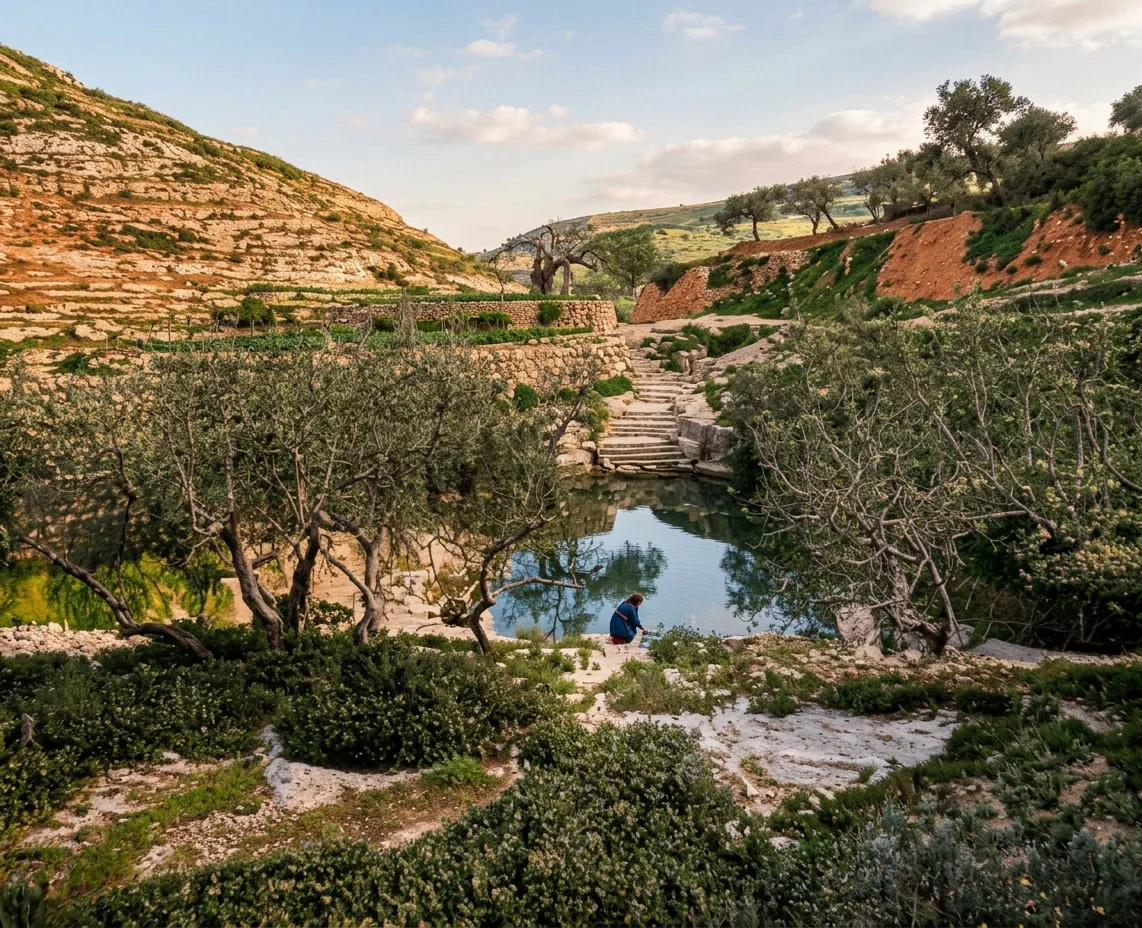
THIS is one of the landmarks of ancient Jerusalem whose location is certainly known. Different authorities speak of the locality as undisputed. It still retains its old name in the Arabic modification, Silwân. Josephus locates it at the mouth of the valley of Tyropœon, and with this Kitto’s Cyclopædia agrees, and adds: “The water flows out of a small artificial basin under the cliff, the entrance to which is excavated in the form of an arch, and is immediately received into a larger reservoir, fifty-three feet in length by eighteen feet in width. A flight of steps leads down to the bottom of the reservoir, which is nineteen feet deep. This large receptacle is faced with a wall of stone.” As the water runs out of the pool, it is utilized in irrigating several gardens in the valley of Jehoshaphat.
SILOAM is the New Testament form, Siloah, or Shiloah, being the Hebrew or Old Testament word, meaning “sent,” or “sending forth.” When the wall of Jerusalem was being repaired by Nehemiah, portions were placed in charge of certain individuals. “The gate of the fountain repaired Shallun the son of Colhozeh, the ruler of part of Mizpah; he built it, and covered it, and set up the doors thereof, the locks thereof, and the bars thereof, and the wall of the pool of Siloah by the king’s garden, and unto the stairs that go down from the city of David.” Neh. 3:15.
ISAIAH refers to Shiloah figuratively, in dwelling upon the apostasy of Israel and their humiliation by the Assyrians: “Forasmuch as this people refuseth the waters of Shiloah that go softly, and rejoice in Rezin and Remaliah’s son; now therefore, behold, the Lord bringeth up upon them the waters of the river, strong and many, even the king of Assyria, and all his glory; and he shall come up over all his channels, and go over all his banks; and he shall pass through Judah; he shall overflow and go over, he shall reach even to the neck; and the stretching out of his wings shall fill the breadth of Thy land, O Immanuel.” Isa. 8:6–8. “Here Shiloah stands for the government of God, and Rezin was king of Syria (not Assyria) while Remaliah’s son was Pekah, king of Israel (called Ephraim in the previous chapter), at Samaria. Refusing the sweet government of God, they invited the overflow of Assyria’s haughty turbulence and destruction.
BUT the Siloam of the New Testament (John 9) is the mostfamiliar name, as most people are more familiar with the New Testament than with the Old. The noted miracle of Christ in restoring sight to a man who had been born blind, by sending him to wash in the pool of Siloam, has indelibly fixed the name in the minds of all believers in the Gospel and its story. But there are some valuable lessons connected with this miracle that are of much greater importance than the locality of the pool, or the present locality of any ancient object of note, however interesting their memory.
WHEN they saw this blind man, the disciples asked Jesus, “Who did sin, this man, or his parents, that he was born blind?” The question was based on two erroneous doctrines: (1) That the blind man had had a previous existence, and (2) that his blindness must have been the direct result of some heinous offense committed in his former state, or by his parents previous to his birth. Either cause was sufficient to place the family under a kind of social ban. Both these doctrines were held among the Jews, but Jesus here exposed the fallacy of both. “Neither hath this man sinned, nor his parents; but that the works of God should be made manifest in him.” Thus it is shown that obscure persons may have the privilege of suffering affliction and thus becoming co-workers with God. Yet there are many poor sufferers among God’s people who imagine that their affliction is a great hindrance to the work. Would it not be better to study how it is possible for even their sufferings to be made a help in the cause? The Captain of our salvation was made perfect through sufferings. Heb. 2:10.
JESUS then proclaimed Himself the “Light of the world.” This being the case, it would be a small matter for Him to give sight to one creature. So “He spat on the ground, and made clay of the spittle, and He anointed the eyes of the blind man with the clay, and said unto him, Go, wash in the pool of Siloam.” Here was a test of the man’s faith, and he had more faith than those who were looking upon him as suffering the judgment of God. “He went his way therefore, and washed, and came seeing.”
THE man soon found, however, that with the blessing of God and faith in Jesus Christ there comes also the opposition of the enemies of Christ. “Yea, and all that will live godly in Christ Jesus shall suffer persecution.” 2 Tim. 3:12. When the people began to inquire about the One who had done such a wonderful work, the jealousy of the Pharisees was aroused. The first point of objection was that the good deed was done on the Sabbath day; therefore He who performed the work was not of God. But others reasoned that a sinner could not do such a miracle. The blind man was asked what he thought of the Man who had opened his eyes, and he promptly answered, “He is a prophet.” His faith was firm. He had suffered blindness all his life for the very purpose of giving this testimony to the power of God through Christ.
THEN the Pharisees pretended not to believe that the man had been born blind, and had received his sight. So they called his parents and asked them about him, and they acknowledged him as their son, and that he had been born blind. But they denied all knowledge as to how he received his sight. They were afraid of the Jews, so they said their son was of age and could answer for himself. They lacked the courage of their son, who not only had received physical sight, but through his faith had been spiritually enlightened as well. Therefore he had no fear of man. The testimony of his parents that he was of age shows that he was at least thirty years old.
THEN the Jews counseled him to give glory to God, for they knew that Jesus was a sinner. But his faith could not be shaken, either by their arguments or their revilings of himself. When they asserted that they did not know whence Jesus had come, this new disciple, just come into the faith, was ready to meet their illogical reasoning. He said, “Why herein is a marvelous thing, that ye know not from whence He is, and yet He hath opened mine eyes. . . . Since the world began was it not heard that any man opened the eyes of one that was born blind. If this man were not of God, he could do nothing.”
WHEN the Pharisees could not meet the truth by their sophistries and ridicule, their next move was to cast out of the synagogue the one who would not acknowledge their learning and authority as superior to all others. Error’s last resort is force, but true faith will not fear what man can do. So the man that was born blind, and was healed by the obedience of faith, became a faithful follower of the Lord Jesus Christ, despite the adverse action of the church that professed to be looking for the very One whom they rejected. Their blindness to the truth and hardness of heart were the result of their having made void the law through their traditions. W. N. GLENN.

LOVE TO GOD AND MAN.

Every Christian should be determined that he will not, in word or action, dishonor the law of God. This law is an expression of the character of God, a revelation of what every minister of the Gospel, every teacher, every man, woman, and child, should be. The Christian will become excellent in wisdom, if he will surrender himself to the guidance of the principles of God’s law. This is not to be an influence among many influences. God designs the heaven-born principles of His law to be the all-powerful influence in the lives of His children, sanctifying and purifying them. It is God’s purpose that these principles shall be followed in our homes, our institutions, our churches. They are His everlasting truths, proclaimed in righteousness, mercy, and love.
Supreme love for God, and unselfish love for one another,—these are the two great arms on which hang all the law and the prophets. The greatest of all gifts, all talents, is true, Christlike love. It is the brightest evidence of the power of religion. By it, a daily witness for Christ is borne to the world. The Lord calls upon His churches to manifest this love.
“Thou shalt love the Lord thy God with all thy heart, and with ‘all thy soul, and with all thy strength, and with all thy mind; and ‘thy neighbor as thyself.” This was the answer the lawyer gave when Christ asked, “What is written in the law? how readest thou?” And before priests and rulers Christ replied, “Thou hast answered ‘right; this do, and thou shalt live.” Thus He forever settled the great question, “What shall I do to inherit eternal life?”
Christ has expressly enjoined His followers to respect and love one another. He says, “A new commandment I give unto you, ‘That ye love one another; as I have loved you, that ye also love ‘one another. By this shall all men know that ye are My disciples, ‘if ye have love one to another.”
He who takes the position of teacher, yet fails to show a tender regard for his brethren, might better cease his labors until the converting power of God teaches him the lessons he must learn in order to do successful work. He who really desires to be a vessel meet for the Master’s use must submit to the molding and polishing process carried on by the wheel of God’s providence, until all unshapeliness and roughness have vanished. Only thus can he become a vessel unto honor.
No man should take up the work of a minister of Jesus Christ until he has complied with the invitation, “Take My yoke upon you, ‘and learn of Me; for I am meek and lowly in heart, and ye shall ‘find rest unto your souls.” God’s ministers are to show forth in their lives the unselfish love which Christ constantly taught and perfectly exemplified. Thus is to be shown the marked distinction between those who love God and keep His commandments, and those who are standing under the black banner of Satan.
No man can separate fellowship with God from a life of holiness. Sanctification takes in the whole being. To walk in the light is to know and obey the truth. To have fellowship with God is to treat one another as children of God. “If we say that we have fellowship ‘with Him, and walk in darkness, we lie, and do not the truth; but ‘if we walk in the light as He is in the light, we have fellowship one ‘with another, and the blood of Jesus Christ His Son cleanseth us ‘from all sin.”
Many in this our day claim fellowship with God while by their lives they deny the claim. They do not love God supremely and their neighbor as themselves. They are not willing to do to others as they wish them to do to them. Selfishness is shown in the use of God’s money. Extravagance is seen where economy should be practised in order that the cause of God may be advanced. Man ventures to use for self-indulgence means which should be used for the Lord. This is entirely contrary to the lessons Christ has given. It is impossible to harmonize a selfish use of the Lord’s money with the principles of Christ’s life.
He whose mind is so filled with his own devisings that he has little time to study the Word of God, no time to find out, by looking into the Divine Mirror, what kind of character he is forming, should not think that he is fitted to hold forth the Word of life to others. Perhaps he catches a glimpse of the mistakes he is making. He sees that his building is unlike the design given him. But he is so absorbed in correcting others that he has no time to correct his owndefects, and therefore continues to present before angels and men a miserable representation of Christ. He knows not what it is to feel the saving power of divine grace. He is too busy to act like a Christian, too busy to give expression by courteous words and kindly deeds to Christlike love. Angels veil their faces in sorrow. Men see that he is not what he professes to be, and they turn from him as a counterfeit.
The acceptance of Christ’s atonement is the ground-work of true faith. To those who repent and confess their sins, the Holy Spirit, the Author of all sanctification, will give grace to speak kind, tender, respectful words. Those who will look long enough into the Divine Mirror to see and despise their unlikeness to the meek and lowly Saviour, will have strength to overcome. All who truly believe will confess and forsake their sins. They will co-operate with Christ in the work of bringing their hereditary and cultivated tendencies to wrong under the control of the Divine Will, so that sin shall not have dominion over them. Looking to Jesus, the Author and Finisher of their faith, they will be changed into His likeness. They will grow up to the full stature of men and women in Christ.
MRS. E. G. WHITE.

God the Revealer.

Daniel Two.

A Troubled King Unsatisfied, Enraged—Vain Philosophy—God Revealed to Men—His Goodness and Wisdom Acknowledged—The Mystery Revealed—Its Meaning.
There was a troubled king in the ancient and mighty empire of Chaldea,—not a strange thing. This one, however, was troubled for cause. As he had looked backward over the kaleidoscopic history of earth to his time; as he had viewed the rise and fall of empire, the exaltation and abasement of man, his mind had turned to his own mighty, growing, world-renowned, world-governing empire. Would it fall into decay and perish as had others? Would it in turn be subjected by some mighty conqueror, even as Babylon had brought other nations under her iron yoke? Or would Babylon, glorious above all her predecessors, stand forever?
The great God is interested in the affairs of men. He has a purpose in this world, which He is working out despite of sin and rebellion. In the working out of this purpose He seeks to use for His own eternal glory and the everlasting good of all His creatures, every human soul, to the fullest extent of that soul’s capability. He will use every soul which will respond to Him. He will enter every avenue to heart or mind which may be left open to Him, in order to seek the salvation and co-operation of that soul. God has not revealed His working in behalf of all, but He works in behalf of all; and He leaves on record typical cases for the encouragement and instruction of those who come after.
Among the kings of earth Pharaoh was one of such, who rejected God’s revelation, hardened himself against God’s mercy, and defied God’s power. Nebuchadnezzar was another ruler, who at last yielded to the Divine Goodness. Through both of these kings God showed His power and glory; through the one despite his hardness and rebellion; through the other by blessed final co-operation. The one hardened under reproof and instruction; the other yielded.

The Second Lesson.

God had shown the proud king of Babylon that the educational system of Babylon at its best was not to be compared with the divine system at the worst; but Nebuchadnezzar had not heeded this, the first lesson. Now the king’s desire to know the future was the channel by which God the second time sought to teach Nebuchadnezzar the folly of all human wisdom, and the only true source of knowledge. He therefore came to the idolatrous king in the most impressive possible way,—in a strange and startling dream, which roused the king from his sleep, prevented further slumber, and troubled his spirit greatly.

A Vain Quest.

He sought for the meaning of the dream, so unlike any others of which he had ever heard, and naturally to the wise men of his council,—the magicians, enchanters, sorcerers, and Chaldeans. But that he might be assured of the true interpretation, he demanded that they should first tell his dream. The youthful Judean students had caused him to doubt the great teachers of his realm, and he thought it wise to demand more than the ambiguous replies of the scholars of mysticism, the school-men, or the priests. More than this, he demanded a satisfactory reply to his request under the penalty of destruction of property and loss of life. “If ye make not known unto me the dream and the ‘interpretation thereof, ye shall be cut in pieces, and your houses ‘shall be made a dunghill.’” On the other hand, if they made known the dream and its interpretation, they should be loaded with gifts and honor. The king thus placed before these worldly-wise men the strongest incentives to reveal their right to be regarded as counselors in his realm. They again ask that the dream be made known.
But the requirement is beyond their wisdom. No philosophy they possess, no science of which they are masters, no process of reasoning, no authority of master or tradition, no incantation or spell, can reveal the dream or its meaning. They know this; and in the light of the king’s sentence they confess the futility of their knowledge, and seek to excuse themselves, and to persuade the king by precedent. The record tells us:—
“The Chaldeans answered before the king, and said, There is not a man upon the earth that can show the king’s matter: forasmuch as no king, lord, nor ruler hath asked such a thing of any magician, or enchanter, or Chaldean. And it is a rare thing that the king requireth, and there is none other that can show it before the king, except the gods, whose dwelling is not with flesh. For this cause the king was angry and very furious, and commanded to destroy all the wise men of Babylon.” Dan. 2:10–12, R.V.
Viewed from the ground of their great claims and pretensions, the king’s decree was not unjust. Here were men who boasted that they were the keepers of the gate of heaven; that with them was the fulness of knowledge; and yet they were deceivers of men, and destroyers of nations. Their lying interpretations and flattering counsel would lull a ruler to ease when he ought to be stirred to repentance and action. They were brought to a test, and were found wanting.
When the wise men were called before the king who had honors to bestow, the unpopular worshipers of Jehovah were not invited; but when the decree went forth that the wise men should be slain, “they ‘sought Daniel and his companions.’”
Prudently and wisely Daniel inquires of Arioch, the executioner, “Wherefore is the decree so urgent from the king?” Arioch tells him. Daniel goes to the king and asks, not for the dream, not for time to escape, but for time to make known the interpretation. Then follows a prayer-meeting. Daniel tells his godly companions, and they seek God together, that He, the only Revealer of the veiled future, should make known the mystery. They make no demands on their merits, or because of their faithfulness; but desire “mercies of the God ‘of heaven.’” Here is the result with Daniel’s thanksgiving:—
“Then was the secret revealed unto Daniel in a vision of the night. Then Daniel blessed the God of heaven. Daniel answered and said, Blessed be the name of God forever and ever: for wisdom and might are His; and He changeth the times and the seasons: He removeth kings, and setteth up kings: He giveth wisdom unto the wise, and knowledge to them that know understanding: He revealeth the deep and secret things; He knoweth what is in the darkness, and the light dwelleth with Him. I thank Thee, and praise Thee, O Thou God of my fathers, who hast given me wisdom and might, and hast now made known unto me what we desired of Thee; for Thou hast made known unto us the king’s matter.” Dan. 2:19–23, R.V.
Daniel tells Arioch, Arioch tells the king, the king sends for Daniel; and here is Daniel’s Gospel message to that king, and all other kings who desire to know the future:—
“The secret which the king hath demanded can neither wise men, enchanters, magicians, nor soothsayers show unto the king; but there is a God in heaven that revealeth secrets, and He hath made known to the king Nebuchadnezzar what shall be in the latter days.” Verses 27, 28, R.V.
God is the Revealer of the mysteries of the future. He “is ‘Light, and in Him is no darkness at all.’” He desires that men shall be His sons, “children of light,” knowing of the evil to come, and the sure refuge,—Christ Jesus. He would not have kings, or rulers, or presidents, or statesmen blinded to these things; and His revelation to Nebuchadnezzar is left on record for all who live afterward. It is recorded in order that rulers now may know “what shall be in the ‘latter days,’” “what should come to pass hereafter; and He that ‘revealeth secrets hath made known to thee [whomsoever you are] ‘what shall come to pass.’”

The Dream.

Daniel then tells the dream. It is neither guesswork nor conjecture nor mediumship nor mind-reading. It is the revelation of God, told with the conviction of truth:—
“Thou, O king, sawest, and behold a great image. This image, which was mighty, and whose brightness was excellent, stood before thee; and the aspect thereofwas terrible. As for this image, his head was of fine gold, his breast and his arms of silver, his belly and his thighs of brass, his legs of iron, his feet part of iron, and part of clay. Thou sawest till that a stone was cut out without hands, which smote the image upon his feet that were of iron and clay, and break them in pieces. Then was the iron, the clay, the brass, the silver, and the gold broken in pieces together, and became like the chaff of the summer threshing-floors; and the wind carried them away, that no place was found for them: and the stone that smote the image became a great mountain, and filled the whole earth.” Verses 31 to 35.
In these five verses, of less than one hundred and fifty words, is given in epitome the history of the world in time, and the outlook of eternity. It is the alphabet of all symbolic prophecy. From that kingdom of earth, most far-reaching in its influence, with its evanescent splendor, it sweeps forward to the eternally glorious kingdom of Jesus Christ.

The Interpretation.

“This is the dream; and we will tell the interpretation thereof before the king. Thou, O king, art king of kings, unto whom the God of heaven hath given the kingdom, the power, and the strength, and the glory; and wheresoever the children of men dwell, the beasts of the field and the fowls of the heaven hath He given into thine hand, and hath made thee to rule over them all: thou art the head of gold.
“And after thee shall arise another kingdom inferior to thee; and another third kingdom of brass, which shall bear rule over all the earth.
“And the fourth kingdom shall be strong as iron: forasmuch as iron breaketh in pieces and subdueth all things; and as iron that crusheth all these, shall it break in pieces and crush. And whereas thou sawest the feet and toes, part of potter’s clay, and part of iron, it shall be a divided kingdom; but there shall be in it of the strength of the iron, forasmuch as thou sawest the iron mixed with miry clay. And as the toes of the feet were part of iron, and part of clay, so the kingdom shall be partly strong and partly broken. And whereas thou sawest the iron mixed with miry clay, they shall mingle themselves with the seed of men; but they shall not cleave one to another, even as iron doth not mingle with clay.
“And in the days of those kings shall the God of heaven set up a kingdom, which shall never be destroyed, nor shall the sovereignty thereof be left to another people; but it shall break in pieces and consume all these kingdoms, and it shall stand forever. Forasmuch as thou sawest that a stone was cut out of the mountain without hands, and that it brake in pieces the iron, the brass, the clay, the silver, and the gold, the great God hath made known to the king what shall come to pass hereafter; and the dream is certain, and the interpretation thereof sure.” Verses 36 to 45.
“Thou art the head of gold,” clearly shows the application of the beginning of the prophecy. Nebuchadnezzar, Babylon’s greatest ruler, represented the Babylonian empire, the “golden kingdom of a golden ‘age,’” standing in barbaric splendor at the head of four successive world-wide empires, which it would infuse and fashion with its principles for all time. Rogers tells us: “No capital in the world has ever ‘been the center of so much power, wealth, and culture for a period so ‘vast. It is indeed a brilliant cycle of centuries.’” God’s prophet has told us: “Babylon hath been a golden cup in the Lord’s hand, that ‘made all the earth drunken; the nations have drunk of her wine; ‘therefore the nations are mad.’” Yet God would heal Babylon, and He began, as He doubtless had before, with her mightiest king.
But Babylon, despite her mighty protecting walls; despite her abundant supply of water; despite her proud kings, her rich and splendid palaces, her glorious temples to her gods, must pass away. Only the righteous-by-choice shall exist forever. Only love incarnate is fitted to reign forever. But the golden kingdom was alloyed by the rust of depraving idolatry, cankered by selfishness, and eaten by the leprosy of sin, and it must pass away. “In the way of righteousness ‘is life; and in the pathway thereof there is no death.’” It is the work of the Gospel to restore man to righteousness; “for therein [in the ‘Gospel] is the righteousness of God revealed from faith to faith.” God was most emphatically preaching the Gospel to Nebuchadnezzar, and through him to all generations. Babylon’s continued reign depended on Babylon’s acceptance, as individuals, of God’s righteousness; Babylon’s rejection of the Gospel meant that that kingdom should be superseded by another. The golden kingdom must pass away. The riches, the splendor, the glory, the growing weakness, and effeminacy, and licentiousness of the tropical Euphratean valley were succeeded by the hardy frugality of the mountaineer peoples of Persia, combined with Media, in B.C. 538, symbolized by the breast and arms of silver.
Following Medo-Persia came Grecia, B.C. 331, symbolized by the belly and thighs of brass, reaching to the knees. The successor of Grecia, of which the symbols were the legs of iron, and the feet and toes of iron and clay, was Rome, in united and divided state to the end.
Note particularly that the different empires are symbolized, not by any special features of the anatomical parts of the body mentioned, but by the different metals. The image was materially that of a man; it naturally had a head, a breast, arms, sides, thighs, legs, feet, and toes; but it was the head of gold which symbolized Babylon; the breast and arms of silver which represented Medo-Persia. The two arms did not indicate the union of the two powers; this is indicated elsewhere. The arms are incidental, not objective, the same as the two thighs in Grecia, and the two legs in Rome. If the two legs represent Eastern and Western Rome, as some suppose, Rome should have been divided from the beginning, even as the legs, which begin at the knees. But for the greater part of its most glorious career, Rome was a unit.
Rome’s union and strength are fitly represented by the iron. Iron can be fused together, even as gold and silver; it can be welded. It fitly represents a strong, imperial empire, even as was Rome when she came in fullest connection with the people and work of God.
Rome became a divided kingdom. As a matter of prophecy and history, she became divided into ten kingdoms; but take particular notice that this division is no more symbolized by the toes, than Eastern and Western Rome were by the two legs. The division of the fourth kingdom is symbolized by the coming in of the clay. “And ‘whereas thou sawest the feet and toes, part of potter’s clay and part of ‘iron, it shall be a divided kingdom.’” And as the toes of the feet were part of iron and part of clay, the kingdom shall be partly strong and partly broken. Men would try to unite the divided parts. Marriage and intermarriage should take place; they would intermix themselves with men of any nation (Boothroyd) to endeavor to unite the discordant elements; “but they shall not cleave one to another, even as iron ‘doth not mingle with clay.’”
The clay is of the earth. It represents republicanism, democracy, socialism; plenteous, but weak and brittle. It can not unite with imperialism and retain its nature. Iron will not mix with clay. From the first division of Rome, beginning in the fourth century, the clay entered as a constituent element. From that time to the present the old Roman Empire, the European States, are partly strong and partly broken. Men have tried to unite them in one great empire, as Charlemagne and Napoleon; princes and diplomats have endeavored to unite them by intermarriages of royal families; but they shall not cleave one to another, even as iron doth not mingle with clay. The Word of God is mightier than all the ingenuity and diplomacy and wisdom of man. Imperialism and socialism will not mix, and this divided state will continue even unto the end. If the toes symbolized the kingdoms and were all of iron, they would unite. If all of clay, they would unite; but the diverse elements continue to the very end.

The Last Kingdom of Earth.

All these powers, diverse in nation and form and manner, each in turn demonstrates by its unrighteousness that it possesses no right to exist forever. The seeds of decay and death in each and every one have been sown and tended with care, and have borne the sure crop—ruin. But this earth shall not continue to be cursed. When the last divisions of the Roman kingdom demonstrate their unfitness to reign; when lawlessness, anarchy, and ruin shall sweep over the earth in spite of all their power, God will interpose and erect His kingdom. “In ‘the days of these kings shall the God of heaven set up a kingdom.’” Note particularly,—
1. That this kingdom was not set up at the first advent, nor at Pentecost; for Rome was not then divided. It does not mean that it will grow through the influence of the church till it converts the world; for it breaks in pieces and consumes all these kingdoms. It is founded upon the utter ruin of all earthly rule, demonstrated to be unfit to reign forever.
2. The Stone of that kingdom is Christ Jesus, “the Tried Stone,” “the Sure Foundation.” He is now, as priest upon His Father’s throne, gathering out the subjects of His everlasting kingdom. Those are His subjects who submit to His reign here,—in whose hearts is set the throne of Christ Jesus,—upon whose hearts are inscribed God’s holy law. Thus choosing God from among all nations, tongues, and kings; in the midst of all temptations to the contrary, they are fitted to reign with Him.
3. It is to be a literal, earthly kingdom, tho not the less spiritual. It covers the territory of the four great empires. This earth, its children who receive Christ, is regenerated, recreated, made a spiritual home for a spiritual people.
4. It will be an everlasting kingdom. “Nor shall the sovereignty ‘thereof be left to another people; . . . it shall stand forever.’” Its inhabitant shall not say, “I am sick.” No fearful dream of futurechange shall trouble its King. No monarch shall oppress its people. No sorrow or sighing will be there; for sin and death are banished. Jesus Christ, the Saviour of men, the King of peace, shall reign forever over the children of tribulation, now and forever shining immortals. “The dream is certain, and the interpretation thereof sure.”
Nebuchadnezzar has taken another lesson in the Gospel school. He acknowledges that Daniel’s “God is the God of gods, and the ‘Lord of kings, and a Revealer of secrets, seeing thou hast been able to ‘reveal this secret.’” But the haughty king does not yield himself to God. He honors Daniel, he admits the superiority of the prophet’s God, but no more. He is like many others, who, in a political way, are Christians. The heart and ambition of the king are not yielded to God.
Nevertheless God’s Gospel is preached before the courts of Babylon and the world. Daniel, His servant, is honored, and given wider opportunity to preach the Word. His three companions arise from obscurity to assist the prophet in the work. The people of God may prove false and deny Him, His law, His Gospel, yet will His glorious truth be preached, and will, by winning souls, vindicate His Word.
The same God is Revealer to-day. To-day is He telling rulers and statesmen that earthly kingdoms are soon to pass away, with all their ephemeral and evanescent glory. The kingdom of God is at hand. And He beseeches all of them to learn the lessons He taught the proud king of Babylon, and share in the glorious, eternal kingdom to come.
Our next lesson will be “God the Deliverer.”
M. C. WILCOX.
Continue reading: MODERN SPIRITISM.—No 5