Signs of the Times, Vol. 40, No. 23.

Our Bible Band

Signs of the Times

Jun 10, 1913

Pacific Press Publishing Association · Mountain View, California · Jun 10, 1913

Our Bible Band

Schedule for Week Ending June 14, 1913

Day Date Reading
Sunday June 8 2 Kings 25; Ezra 1; 2:1, 2, 64-70
Monday June 9 Ezra 3, 4, 5
Tuesday June 10 Ezra 6, 7
Wednesday June 11 Ezra 8:21-36; 9; 10:1-17
Thursday June 12 Esther 1, 2, 3
Friday June 13 Esther 4, 5, 6
Sabbath June 14 Psalms 42, 43, 44
We close the history of the kingdom of Judah with the 25th chapter of 2 Kings. We have the story of the laying waste of Jerusalem, the despoiling of the temple, the captives slain at Riblah, the capture of Zedekiah the last king, and the appointment of Gedaliah as governor, who was slain through treachery; and the remnant, contrary to the counsel of Jeremiah, went to Egypt. Then is recorded the kind treatment that was shown Jehoiachin by the king of Babylon.
We omit Chronicles, because the story is told practically in 2 Kings, and proceed direct to Ezra, at the close of the Babylonian captivity. The first chapter tells us of the decree of Cyrus, which had been before predicted by Isaiah, for the restoration of the Jews. We omit in these readings in Ezra the multitude of names of those who returned, the readings including chapter 1, verses 1 and 2 and 64-70 of chapter 2, and chapters 3 to 7 inclusive, omitting the first 20 verses of Ezra 8, reading the remainder of the chapter, chapter 9, and the first 17 verses of chapter 10. The decree of Cyrus was given in 536. Zerubbabel was governor of Judea. The foundation of the second temple was laid in 535 B.C. The accession of Cambyses as ruler over Persia occurred in 529. He is the Ahasuerus of Ezra 4:6. In 522 the pseudo Smerdis the Magian, called Artaxerxes in Ezra 4:7, came to the throne, under whom the Jews stopped building, at the complaint of the Samaritans. The next year the usurper was slain, and Darius Hystaspes, one of the greatest of the Persian rulers, came to the throne. Stirring appeals of Haggai and Zechariah came in at this time, and the temple was completed. The decree for the restoration of Jerusalem and the building of the temple by Artaxerxes Longimanus, given in his seventh year (see Ezra 7:7), was B.C. 457.
Then follow readings of Esther, chapters 1-6. The chronology of the book of Esther is placed by some at a later date. The Ahasuerus of that book is considered identical with Xerxes, who, Josephus tells us in “Antiquities” 11, was very friendly to the Jews. The purpose of the book seems to be the revelation of the plot against the people of God by the Amalekites, and God's overruling power to prevent it. The “Companion Bible” makes this Ahasuerus the same as Astyages, the brother-in-law of Nebuchadnezzar. It would place in chronological order the following books: first, Daniel; second, Esther; third, Nehemiah; fourth, Ezra. “Ahasuerus” is a title meaning “the venerable king”—not a name. The extent of his kingdom is indicated by the 127 provinces, “from India even unto Ethiopia.” This book records the first world's fair that was ever held, where Ahasuerus showed the glory of his kingdom for six months, as described in chapter 1, verses 4-8. We close the week with the excellent Psalms 42, 43, 44.

Question Corner

"IF YE WILL INQUIRE, INQUIRE YE."
This Inquirers' Department is conducted for the purpose of helping those who are studying the Bible. The answers are oftentimes only suggestive. They are never to be considered infallible, only as they agree with the infallible Word. The writer who may answer them does not consider that his opinion is infallible. He will simply give the best that he has, and plead with the inquirer to search the Word. Such questions only will be answered as, to the editors, seem to minister to the good of the readers and to the mission of the paper. We can not answer repeatedly in the same volume questions upon the same scripture. The name and address must accompany question, not for publication, but as an evidence of good faith, and that answer may be made by letter if deemed advisable. No letters are answered which do not contain the name of the writer. It is well always to enclose stamp for reply.

4093 — Worship in the New Jerusalem

Will there be no place of worship in the city of the New Jerusalem? Rev. 21:22; Isa. 66:23. C. M.
The Holy City will be a place of worship. One of the best definitions which the Bible gives of worship is service. See Matt. 4:10, "Thou shalt worship the Lord thy God, and Him only shalt thou serve." God's children will come up to worship Him from week to week and from month to month. The expression in Rev. 21:22 simply means that there will be no temple of sacrifice in the Holy City. Our Lord has finished His ministrations for sinful man, and there will be no more ministrations for sin; but the temple is there, we are told, better than any building,—the presence of the Lord Almighty and the Lamb.

4094 — First-Born, Col. 1:15-17

Please explain Col. 1:15-17, in which Jesus is called "the first-born of every creature," and also the Creator of the universe. G. D.
"The first-born of every creature" is an expression that is used to indicate preeminence. He is the Preeminent One who rose from the dead, and through whose resurrection all others rise. So the psalmist predicted of Christ, the Son of David, "I will make Him My first-born, higher than the kings of the earth." This is placed after that other prophecy, "He shall cry unto Me, Thou art My Father, My God, and the rock of My salvation." Ps. 89:26, 27. We read also in Ps. 2:7, "Thou art My Son; this day have I begotten Thee." See also Heb. 1:5, 6. He was the Preeminent One among all God's children, and the One through whom all others are saved; and yet previous to this He had been God's "fellow." Zech. 13:7. He is also the "Word" that was "in the beginning with God," and was God, through whom all things were made. John 1:1-3. And this Being who, under God, created the heavens and the earth, also became sin for us, was made in the likeness of the flesh, and died that we might have life. What the apostle wants to do in Col. 1:15-17 is to assure us that this Being who died for us is the One who has creative power and is able to save to the uttermost.

4095 — Children in the New Earth

Will children be born in the new earth? or will women bring forth at all, according to Isa. 65:23 and 11:6-8, which says they shall not bring forth for trouble? Does that mean they shall not bring forth at all? or that they will bring forth, but not for trouble? It speaks of the sucking child—present tense. D. P.
The only proper way to understand all these Old Testament prophecies is in the light of the New. God wanted to do for the children of Israel back in those days what they would not let Him do because of their unbelief. He desired to give them rest when they went into the promised land; and yet we are told, in Joshua, He did not give them that rest which He designed. He declares, in the 11th chapter of Deuteronomy, that He would make their days as the days of heaven upon earth; in other words, give them eternal life. But they in their unbelief would not accept of the eternal life. Moses himself was characteristic of what God would have done for all His children. At the age of 120 "his eye was not dim, nor his natural force abated." He was as young as he was when he came out of Egypt, with the exception of years. So also was Caleb. He could say at the end of that period that he was as able to go out and to come in to war as he was when he was sent to spy out the land forty years before. So God would have given power and strength and life to all His children had they but believed. Then in the days of Ezekiel, in that restoration from Babylon, He would have done wonderful work for them again. The presentation of that sanctuary which Ezekiel saw, as recorded in the last chapters of his prophecy, was a pledge from God of what He would do for His children. The land would be healed of sin, and His people be healed of all plagues, and God's glory would have rested in that temple as it never had rested upon the earth since sin marred His creation. The name of that place would have been "JEHOVAH IS THERE," and the very conditions
predicted in Isaiah 11 and 65 would have been fulfilled among God's children; but, in the language of Ezekiel, "they would not be ashamed." They did not turn from their sins. A partial fulfilment of the prophecy was seen in the return from Babylon and in the building of the little temple over which the old men wept; but the temple of Ezekiel was never seen, nor will it ever be seen on this earth.
It was a conditional prophecy; and those who are saved under the new covenant will enter into eternal blessings far more glorious than those even that were promised in the past, for it will not be simply a little land of Palestine that will be given to them, but the whole earth, of which that land was a type. And therefore we read in Eph. 3:5, of that mystery "which in other ages was not made known unto the sons of men, as it is now revealed unto His holy apostles and prophets by the Spirit: that the Gentiles should be fellow heirs, and of the same body, and partakers of His promise in Christ by the gospel." Our Lord tells us that in that new world they that shall be counted worthy to have a part in the resurrection out from among the dead, "neither marry, nor are given in marriage: neither can they die any more: for they are equal unto the angels; and are the children of God, being the children of the resurrection." Luke 20:35, 36. We therefore conclude that the promise in Isaiah includes what God would have done for His people back there, and looks forward even to a better and more glorious fulfilment in the new earth.

4096 — Sprinkling with Clean Water

Will you please explain Eze. 36:25? and is this among those scriptures of Ezekiel that are not fulfilled? E. S. J.
This is among the promises of God to Israel that are not fulfilled, and never can be fulfilled to the literal tribes of Israel, or Israel according to the flesh, and yet this promise is true to every single soul who will enter into covenant relationship with God through Christ. The figure "the sprinkling of clean water" is taken from the ceremonial cleansing by the priest. See Lev. 14:51: "And he shall take the cedar wood, and the hyssop, and the scarlet, and the living bird, and dip them in the blood of the slain bird, and in the running water, and sprinkle the house seven times." So the leper was cleansed. It is to this that the psalmist refers in Ps. 51:7: "Purge me with hyssop, and I shall be clean." The cleansing was a judicial cleansing, a judicial pronouncement that the defiled person had become clean. That is what the Lord declares He will do with those who will yield to Him. Water is a symbol of the Word, for it is by the Word that we are cleansed,—"Now ye are clean through the Word which I have spoken unto you." John 15:3. "That He might sanctify and cleanse it with the washing of water by the Word." Eph. 5:26. It does not refer to baptism. It is simply God's cleansing of the soul of those who will yield themselves to Him, and that is shown by what follows,—"From all your filthiness, and from all your idols, will I cleanse you. A new heart also will I give you, and a new spirit will I put within you," etc. Baptism, in the New Testament, is a sign to the world that the individual is joined to Christ.

4097 — "Let the Dead Bury Their Dead"

What is the meaning of the passage, "Let the dead bury their dead"? Luke 9:60. Ada.
Read the context. The great thought of verses 57-62 is loyalty and love to God, giving up all for His work as against human expediency. One would follow Jesus for gain. Jesus let him know that He had no earthly wealth to give, not even a place to lay His own head. Others would follow, but they wished to do something else first. One wanted to visit all his relatives and get what he could from them, and then go. Another wanted to stay at home till his father died, and then bury him, before he did God's work. These were all excuses. Following Jesus was more important than all things else. Those who could not see this, were dead to their own real interests, dead to the demands of duty. Leave the aged ones with them. They can not help God's cause with such hearts. Let them stay at home to bury the dead. Let those who are dead to the
interests of God's work and their own salvation, bury the physically dead. Let those who understand, do God's work.

4098 — The Jew

Please explain Zech. 8:23. Has that reference to the last days? and what is meant by the Jew? Z.
There is an evident reference to the Christian dispensation, and the Jew is He who is of the tribe of Judah, our Lord Jesus Christ. "Salvation is of the Jews." John 4:22. The expression is a general one. While the Jews have been rejected and cast out, the time will come when the Jew will be high above all others. Of course this is fulfilled in Christ.

What Shall It Profit?

By Mrs. E. G. White
The question is asked, “What shall it profit a man, if he shall gain the whole world, and lose his own soul? or what shall a man give in exchange for his soul?” It is dangerous to give time, thought, and strength to the pursuit of worldly gain, even if success follows persevering effort; for in thus doing there is danger of making God and His righteousness secondary. It is better for us to be in poverty, to endure disappointment, and have our earthly hopes shattered, than to have our eternal interests imperiled. Flattering inducements may be presented to us, and we may think to obtain wealth and honor, and so set our heart and soul on worldly enterprises. But as we can not serve God and mammon, we are led to give up the service of God.

Money the Measure of the Man

Money has become the measure of manhood in the world, and men are estimated, not by their integrity, but by the amount of wealth they possess. Thus it was in the days before the Flood. “And God saw that the wickedness of man was great in the earth, and that every imagination of the thoughts of his heart was only evil continually. And it repented the Lord that He had made man on the earth, and it grieved Him at His heart. . . . And God looked upon the earth, and, behold, it was corrupt; for all flesh had corrupted his way upon the earth. And God said unto Noah, The end of all flesh is come before Me; for the earth is filled with violence through them; and, behold, I will destroy them with the earth.” “But as the days of Noah were, so shall also the coming of the Son of Man be. For as in the days that were before the Flood they were eating and drinking, marrying and giving in marriage, until the day that Noah entered into the ark, and knew not until the Flood came, and took them all away; so shall also the coming of the Son of Man be.”
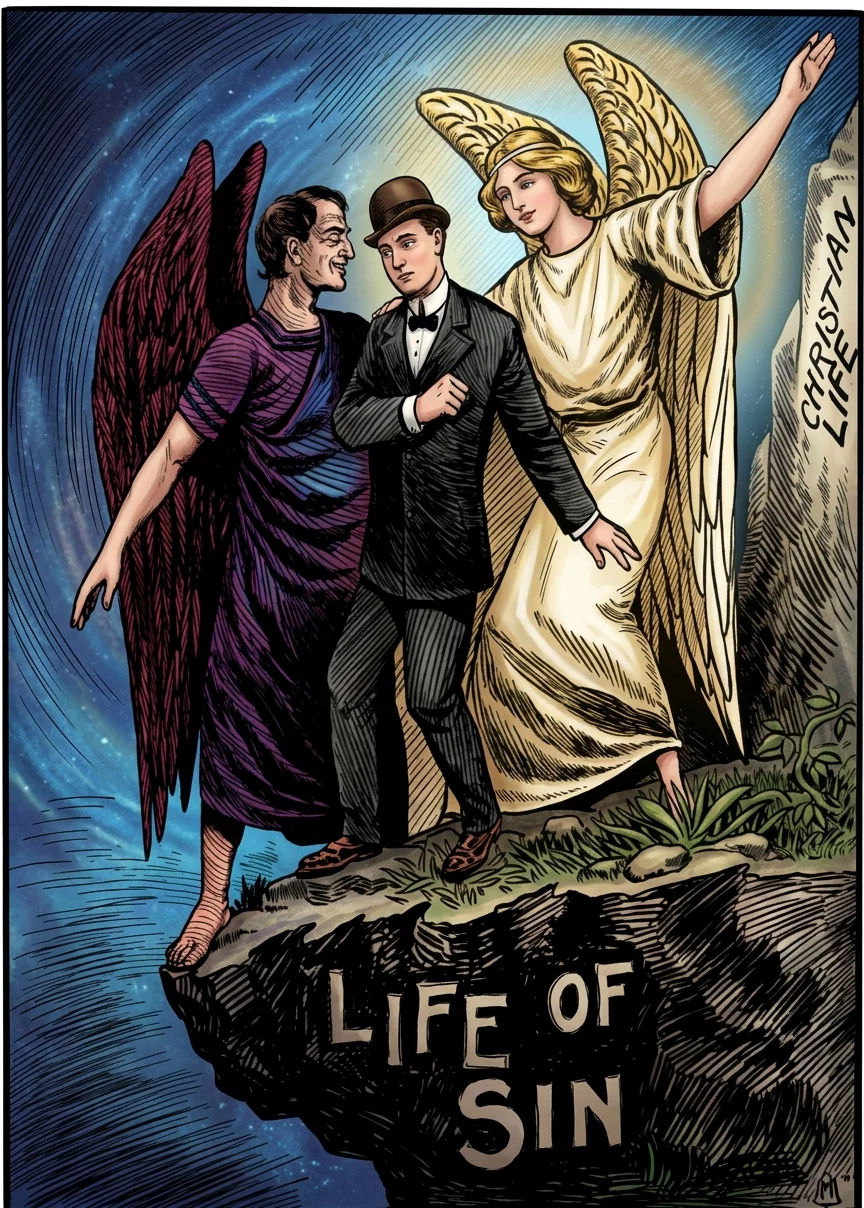
THE TWO VOICES
THE TWO VOICES
Let us not be determined to get rich. If we see that poverty will be our portion in abiding in the simple truth, let us abide by the truth and enter into life. Jesus said that “man shall not live by bread alone, but by every word of God.” The devotees of the world may smile at this statement, but it is nevertheless the counsel of eternal wisdom. Jesus has left His followers a legacy of peace. He says, “Peace I leave with you, My peace I give unto you: not as the world giveth, give I unto you. Let not your heart be troubled, neither let it be afraid.”
The Christian who is called into the world by his business, if he follows Christ, will bear his cross and meet his perplexities in the spirit of Christ. He will not make the world his god, and give brain and bone and muscle to the service of mammon. He will realize that Heaven is looking upon him, and whatever success attends him, he will give glory to God. He will realize that God knows, as man does not, that a few more years will roll by, and the treasures of earth be no more.

A Plan for the Highest Attainment

Our Saviour came to the world to adjust the claims between heaven and earth. He knows that man, formed in His image, has been endowed by his Creator in such a way that he may rise to the highest eminence of moral efficiency through coöperation with divine agency provided for his assistance. With what sorrow Jesus looks upon man wasting his energies in pursuit of that which profiteth nothing! In tones of sorrow in which mingle tears, Jesus asks, “What could have been done more to My vineyard, that I have not done in it?” The arch-deceiver has inspired in man, by his temptations, by his presentation of flattering inducements, an inordinate desire to get the riches of this world, and he leads men to practise every form of sin in order that they may gain every earthly treasure. In the acquirement of this world’s wealth, the precious promises of God are cast aside as worthless. Through the service of mammon, the love of God has been expelled from the heart, and the love of the world has rushed in to fill the vacuum, and to enthrone itself firmly in the heart, to rule and reign in the life. The power of God alone can force it from its usurped position. Through love of the world, the spiritual vision is blinded, and the pleasures and attractions of the future world are hidden from sight.

Get Visions of the World to Come

It is the vision of the world to come that balances the mind, so that the things which are seen do not obtain control over the affections, which have been bought with an infinite price by the world’s Redeemer.
Through the agency of the Holy Spirit, the things unseen and eternal are brought before the soul, and the advantages of the eternal, imperishable treasure are made to appear before the mind’s eye in their attractive beauty. In this way we learn to look to the unseen and the eternal, and to esteem the reproaches of Christ of greater value than the treasures of the world.
The angels are the servants of Christ, and there are ten thousand times ten thousand and thousands of thousands who are sent to minister unto them that shall be heirs of salvation. Angels that excel in strength minister to those who shall be heirs of salvation, and impart to them divine power; for they become partakers of the divine nature, escaping the corruption that is in the world through lust. Heavenly agencies are ever at the side of him who is wrestling for the victory, in order that while lawfully striving for the mastery, he may not be worsted in the conflict.
But if the human agent places little value upon the precious things which God, through the gift of His only-begotten Son, has made possible for man to obtain,—if he loses eternity out of his reckoning, and listens to Satan’s false representation, and is attracted to the things of earth instead of heaven,—he sustains great loss, so cultivating the powers of his mind and soul that he will not have a fitness for eternal life. In this way he not only concentrates his mind and affection upon that which can not possibly bring him happiness in this life, but through the idolizing of the most contemptible things, he degrades himself to a low moral level. In his insane pursuit after earthly gain, he accepts Satan’s method, and practises dishonest ways, and is blind to the result. Why should he not do this way when he disconnects himself from Him who is the source of all good, all righteousness and truth? Why will not Satan give him his mind and his attributes, and so mold him by his influence that he shall reflect the image of the earthly?
The mind of him who follows the suggestion of Satan becomes like his leader; evil propensities gradually take him captive, and he becomes a slave of Satan. He is led on into deeper idolatry, beholding not the celestial imagery, but the deceiving representation of the enemy. Satan pictures before him the advantage of worldly gain, and fills memory’s hall with false representations. The mind looks upon these, and becomes debased according to the subjects presented.

“The Most High Ruleth”

By K. C. Russell
Following the miraculous deliverance of Shadrach, Meshach, and Abednego from the fiery furnace, the king Nebuchadnezzar made a proclamation in which he exalted the name of God because of the wonders He had wrought in his behalf. Among the things to which the king made reference was the revealing and interpreting of the remarkable dream outlined in Daniel 2. He then proceeded to tell Daniel of another significant dream which had been given to him, concerning a tree which grew to enormous proportions and then was hewn down until nothing but the stump remained, and the heart of it was changed from a man's heart to that of a beast until seven times had passed over it. It appears that Daniel was astonished at the dream, but did not hesitate to interpret the same fearlessly, altho he well understood what it involved.
He proceeded to say that the tree represented the Babylonian kingdom, and that the king himself was signified by the heart which was transformed from a man's heart to that of a beast, which was to be driven into the field for a period of seven years.
The reason assigned by the Lord for these terrible judgments to befall Nebuchadnezzar and his kingdom was that he might learn “that the Most High ruleth in the kingdom of men, and giveth it to whomsoever He will;” and further, that he might demonstrate that he had forsaken sin, by showing mercy toward the poor.

Strange Heedlessness

In view of a warning of so serious a character, especially in the face of such signal manifestations of God's foreknowledge, it seems strange that Nebuchadnezzar would not take heed. But, alas, we read that at the expiration of one short year subsequent to this warning, he walked in the palace of his kingdom, saying, “Is not this great Babylon, that I have built for the house of the kingdom by the might of my power, and for the honor of my majesty!” Dan. 4:30. And scarcely had these proud and boastful words escaped his lips when a voice proceeded from heaven, saying to him, “The kingdom is departed from thee;” and he was further informed that the terrible judgment which had been revealed to him in the dream, and interpreted by the faithful Daniel, was to befall him, in order that he might learn the important lesson “that the Most High ruleth in the kingdom of men, and giveth it to whomsoever He will.”
After being bereft of his reason for a period of seven long years, and living as the beasts of the field, his mind was restored, and he blessed the Most High, and acknowledged that God's kingdom, and not his, was an everlasting one. He also recognized that no power could stay God's purpose; and further, that the Lord was able to abase the proud.
This remarkable lesson is left on record to teach all subsequent rulers the folly of pursuing a course contrary to God's will. Notwithstanding other terrible warnings of God to Nebuchadnezzar recorded in the Bible, rulers have ignored these lessons. We have but to scan the history of the three universal empires that succeeded that of Nebuchadnezzar, to observe how they too failed to learn the lesson that was taught Nebuchadnezzar,—“that the Most High ruleth in the kingdom of men.”

God Not Recognized

As one reviews the history of the great empires of the world, it is plainly to be seen that God was not recognized by them as the sovereign ruler. Had the rulers of the other three succeeding universal empires understood completely the fate of their kingdoms which was clearly and forcibly announced by the Lord through the prophet Ezekiel to the king Zedekiah, they would have escaped the terrible judgment and ruin that befell them. Eze. 21:25-27 says: “And thou, profane wicked prince of Israel, whose day is come, when iniquity shall have an end, thus saith the Lord God; Remove the diadem, and take off the crown: this shall not be the same: exalt him that is low, and abase him that is high. I will overturn, overturn, overturn, it: and it shall be no more, until he come whose right it is; and I will give it him.”
One of the most remarkable illustrations demonstrating that the Most High rules in the kingdom of men is recorded in the Second Psalm as follows: “The kings of the earth set themselves, and the rulers take counsel together, against the Lord, and against His anointed, saying, Let us break their bands asunder, and cast away their cords from us.” The foregoing language is a most remarkable prophetic outline of how the kings and rulers of earthly governments arrayed themselves against the God of heaven and the Saviour of mankind in their vain attempt to thwart the everlasting gospel by the crucifixion of Jesus Christ. How well this prediction of the psalmist David was fulfilled by the Roman government delivering Jesus into the hands of the Jews to be crucified by them!

He That Sitteth in the Heavens Shall Laugh

It is evident that the powers of earth felt confident that they had dealt the final blow to the plan of salvation in their assassination of the Son of God. But the psalmist continues, “He that sitteth in the heavens shall laugh; the Lord shall have them in derision.” It would appear that this language was partially fulfilled, and in a most signal manner, by the resurrection of Jesus Christ, while a Roman guard, consisting of one hundred stalwart Roman soldiers, were closely watching the tomb where He had been buried. “Shall laugh,” or in other words, shall confound their devices, beat down their pride, and utterly contemn their puny efforts to interrupt the plan of the Most High.
What greater lesson than this could the Lord give to teach earthly rulers that the Most High rules in the kingdoms of men? The great purpose of God in His dealings with kings and rulers is not only to teach them that He rules, but that they might obtain salvation; for we read in Ps. 2:10, 11: “Be wise now therefore, O ye kings: be instructed, ye judges of the earth. Serve the Lord with fear, and rejoice with trembling.” When rulers or others refuse to be taught, and to receive the gospel of Jesus Christ, and to fear the Most High, who rules among the children of men, they have reached the limit of God's forbearance and love, and the only alternative left is their destruction.

“Righteousness Exalteth a Nation”

This is one great lesson that stands paramount in God's dealings with both nations and men throughout the world's history. Truly the wise man has said in Prov. 14:34, “Righteousness exalteth a nation: but sin is a reproach to any people.” The righteousness, however, that exalts a nation is voluntary, and not forced; for the moment that any government seeks to enforce righteousness by civil enactment, it sins, and such a course is a reproach instead of an honor to the nation.
(Continued on page 6)

“The Most High Ruleth”

(Continued from page 4)
Perhaps there is no nation in modern times that prides herself more than does the United States of America on her righteous government. But upon the authority of the infallible word of God, this country's limit will be reached when she repudiates the true principles that every civil government should maintain. Space will not permit the outlining of how this government is fast departing from the heaven-born principles upon which it was established, as voiced in the first amendment of the Constitution of the United States, which says, “Congress shall make no law respecting an establishment of religion or prohibiting the free exercise thereof.” This departure is to be brought about by the introduction of laws both state and federal which invade the natural rights of man, and which are destined in the last analysis to result in intolerance and persecution. When our nation takes this step, then she, like all nations that have preceded her, will have forgotten that the Most High rules in the kingdoms of men.
The great kingdom of Babylon, with her magnificent metropolis, in the height of her prosperity, felt her security; but in this lay her very danger. So it is with this government. The very time when she is enjoying the greatest prosperity, God's judgment will be visited, and her downfall will follow, if she turn her back on the principles upon which she was founded, by stepping out from her rightful sphere, which is that pertaining to things of a civil character, and assuming the place of the Most High, which has never been committed to earthly governments.
Continue reading: THE WITNESSING OF GOD