Signs of the Times, Vol. 34, No. 23.

Ye Say and Do Not

Signs of the Times

Jun 3, 1908

Pacific Press Publishing Company · Mountain View, California · Jun 3, 1908

Ye Say and Do Not

By Eliza H. Morton
Ye say ye love the Lord, and yet Not words but deeds Are what will tell on other lives Far more than creeds.
The son that said “I go,” when called, Yet never went, Found out too late his life a blank, His days misspent.
O Pharisees, in Christian lands, Ye know the way; And yet ye walk not in the path To endless day.
Ye can not enter in, and why? No fruits appear, Ye claim to do and yet do not; Ye're not sincere.
Self-righteousness will close the doors Of mansions bright, The careless indolence of drones Will dim the light.
“Thy will, O God,” must be our song, “Thy law within,” And then the heart will have the power To conquer sin.
The Lord will prove and test and try; Who will obey? Give evidence of faith and love, And when you pray, Ask for the strength to do just right, Tho all alone; Not living day by day a lie Before God’s throne.

With Our Inquirers

“If ye will inquire, inquire ye.”
This Inquirers' Department is conducted for the purpose of helping those who are studying the Bible. The answers are oftentimes only suggestive. They are never to be considered infallible, only as they agree with the infallible word. The writer who may answer them does not consider that his opinion is infallible. He will simply give the best that he has, and plead with the inquirer to search the word. Such questions only will be answered which, to the editors, seem to minister to the good of the readers and to the mission of the paper. We can not answer repeatedly in the same volume questions upon the same scripture. The name and address must accompany question, not for publication, but as an evidence of good faith, and that answer may be made by letter if deemed advisable. No letters are answered which do not contain the name of the writer. It is well always to enclose stamp for reply.

2522.—Salvation of the Heathen.

According to the Bible, will the heathen, who, ages ago, did not have the light of the Gospel or any knowledge of the law, or of Christ, be saved in heaven? I understand that those living when Christ comes, who have heard the sound of the Gospel, will be destroyed by the brightness of His coming, and will be as tho they were not. But how about those who have lived ages in the past and knew not of the Christ? T. H.
In the first place, God has given sufficient light to every intelligent, responsible soul in the world; so we read in John 1:9, “That was the true Light, which lighteth every man that cometh into the world.” Now to that there can be no exception. God, by His providence, in various ways, will bring light to every soul. So again we read in Rom. 1:20: “For the invisible things of Him since the creation of the world are clearly seen, being perceived thru the things that are made, even His everlasting power and divinity; that they may be without excuse.” We read also in Ps. 19: 1, 2: “The heavens declare the glory of God; and the firmament showeth His handiwork. Day unto day uttereth speech, and night unto night showeth knowledge.” Every thoughtful, devout soul who desires the light must be impressed with the wonderful power of the Creator, as manifested in His marvelous works, and if one cares enough for eternal living, he certainly would be led to seek after God thru the highest manifestation which God gives. These works speak of God’s power, of God’s wisdom. If He has wisdom and power, He also has love, and having love, He also has mercy. While the soul may not know the name “Jesus,” or “Christ,” or “Jehovah” (the mere literal names are nothing), he may know of the Creator, of that God who is revealed to us by those names, and giving himself to that God will bring to his soul the light which saves from sin.
One ray of light, if followed, will bring us to the Source of light, and that one ray of light will, if allowed to dominate and control our lives, as effectually save as the whole flood of light. It will not develop as strong a character, nor so much knowledge, but it will save. Therefore, we read that “the eyes of the Lord run to and fro throout the whole earth, to show Himself strong in the behalf of them whose heart is perfect toward Him.” 2 Chron. 16:9. God’s power to reach the heathen in this way is also manifested in the history of His own work in the earth. Again and again we read of those in the very darkest of darkest heathendom, who have found the light and the truth by giving themselves to God, and when God could not reveal Himself to them in any other way, He has sent His angels to them to tell them that their prayers are accepted. We need not therefore worry about the heathen. God is caring for them. Nor need we build up a hypothetical future, in which some other plan or modification of the plan of salvation will be open to them, because God in all His works, as well as in His word, has been calling men to Him from the foundation of the world.
The story is told of an out-and-out infidel, who had utterly rejected the Bible, and believed that everything came by chance. While resting one day on the green sward in the state of Texas, he saw growing around him many of the little flowers called the “Texas Star.” He reasoned with himself, if things came by chance, the parts of every flower would not be the same. He began to dissect the flower, to count its petals and stamens. He repeated it over and over again in a number of flowers, but he found in every one the same wonderful design, the same perfection of detail, the same evidences of a great, overruling God, who
is as much at home in the little things of nature as He is in its great things. He therefore turned his face from the little Texas Star to heaven, and said, “Little flower, there is a God.” Of course that led him to the fuller revelation of God in His word. Even so have heathen in the past been led, and so God has gathered them out, despite the unfaithfulness of His own children in the giving of His message.

2523.—The Second Commandment.

I would like to know if it would be a sin to draw birds, fish, and animals. It says in the Bible, “Thou shalt not make unto thee any graven image, or any likeness of anything that is in heaven above, or that is in the earth beneath, or that is in the water under the earth.” I am nine years of age, and a reader of the SIGNS OF THE TIMES. P. B.
First of all we would like to ask our young inquirer if he is going to worship the things that he draws. If he is drawing them to make his hand skilful, and to understand better these wonderful things which the Lord makes, that is one thing. If he is making them in order that he may bow before them and worship, that is another thing. The commandment forbids the making of these things to worship. It is an utter perversion of God’s truth to say that we should make none of these things. Human life would hardly be worth living at all if we made no things. The clothes we wear, the houses in which we live, the furniture we use, the very food we may eat, are all images of some other thing similar. This is not that which the Lord forbids. He forbids our making in order to worship.
If you will read the book of Exodus, chapters 25-40, you will read there how God instructed His children to make a house for His worship, and that, too, was made after a pattern. They were not to worship that house, they were not to worship the beautiful figures of the cherubim which they wove into those curtains, but they were to glorify God in the use of these things which He instructed them to make. So in the temple built by Solomon, it was adorned with various things. The pomegranate, a fruit, was used over and over as one of the adornments. The bell was used as another. Lions and cattle were not to worship, however, but to make beautiful the house of the Lord.
We read in Eze. 4:1-3 of how the Lord told the prophet to take a tile and portray, or picture, upon that tile an image of Jerusalem, and of battering-rams that were to be set against it; and by such illustrations as this, show the people of the judgments that were to come upon the city. All these things show that it is very proper to make things that will be of use, and of use to glorify God, but when we get to worshiping the work of our own hands, that is another thing. We must make nothing whatever, the likeness of anything in heaven or earth, to worship.

2524.—The Child and the Sinner. Isa. 65: 20.

Will you in your question corner please give me some information on Isa. 65:20? I do not think I understand it properly. W. W. P.
Isa. 65:20 is one of the many texts which puzzle earnest souls, the understanding of which does not matter so very much after all. There are so many more important scriptures in the word that it is hardly worth while to give so much attention and thought to some passage of this kind when more important ones are waiting; rather it is better to leave it, and let its meaning come to us thru other scriptures, which frequently is the
case. Some passage that we may puzzle over for years, and still have locked to our understanding, will be opened when we least expect it by light from another scripture.
Verses 17 to 19 of Isaiah 65 are a description of the glorious new heavens and the new earth; when former sufferings shall not be remembered with sorrow, or weigh upon the heart; when God’s people will rejoice in the New Jerusalem, and where He shall joy in His people; and where no more shall be heard the voice of weeping, and the voice of crying.
Verse 20 then declares, “There shall be no more thence an infant of days, nor an old man that hath not filled his days.” That is true of the cities of this world. That will not be true of the eternal city of God. Then He tells us why. If we will read in connection with this the 20th chapter of Revelation, it will give us a better understanding of the text in question. When the new heavens and the new earth are spread out before God’s people, the judgment will have taken place, and all who have identified themselves with sin will have been destroyed with the sin. In the second resurrection at the end of the thousand years, the wicked are raised; they come up before the city which descends from God, led by Satan in an endeavor to take it. For “a little season” they are permitted to be deceived by him. This “little season” may be the hundred years which is mentioned in Isa. 65:20. During that hundred years, the wicked manifest that they have no desire to be saved in God’s way, and those children who have reached the age of accountability before dying also show that they themselves are linked with the wicked; consequently, the sinner being a hundred years old, or living during that period of the hundred years, shall be accursed, and the child also shall die in that same period.
That will close all such conditions as that to all eternity. No more from that time will there be any death of sinner or child, but “they shall build houses, and inhabit them, and plant vineyards and eat the fruit of them. They shall not build, and another inhabit; they shall not plant, and another eat: for as the days of the tree shall be the days of My people;” that is, the days of the tree of life. God’s children will live forever. That hundred years of the closing of judgment, that “little season” after the second resurrection, will demonstrate to all the ages, in all the worlds, that God’s judgments are just and right; that God’s salvation was sufficient for all, and that those who have rebelled against Him, and who perish in their sin, and because of their sin, have received the wages for which they have labored.

2525.—Times of the Gentiles. Luke 21: 24.

Please answer thru the SIGNS OF THE TIMES the latter clause of the 21st chapter of Luke, verse 24, “until the times of the Gentiles be fulfilled.” G. S.
The “times of the Gentiles” here named are evidently the times referred to in the prophecies of the Old Testament concerning the Gentiles, during which the kingdom was taken from God’s people, as it was in the captivity of Babylon. The prophet Ezekiel tells us, in the twenty-first chapter, that it would be overturned three times after that, and would be no more under the control of the Lord’s people, “until He come whose right it is; and I will give it Him.” The times of the Gentiles are the times when Gentile power shall dominate God’s heritage, the earth; and when those times are fulfilled, then no longer will God’s city be trodden down, but His people will be taken to the New Jerusalem, where there will be no more sorrow or trouble or affliction. The times of the Gentiles reach to the second coming of our Lord.

2526.—Baldness. Amos 8: 10.

Is baldness to be a sign of the last days? Amos 8:10. W. G. W.
We do not know that it is any more than any other physical deterioration. There are several passages of Scripture which indicate that baldness was not uncommon in the centuries before Christ.

True Happiness in Service

By Mrs. E. G. White
THE man whose experience is least to be envied is the one who shuts up his sympathies within his own heart. Those who get the most good out of life, who feel the truest satisfaction, are those who receive to give. Those who live for self are always in want; for they are never satisfied. There is no Christianity in shutting our sympathies up in our own selfish hearts. We are to bring brightness and blessing into the lives of others. The Lord has chosen us as His channels thru which to communicate His blessings.
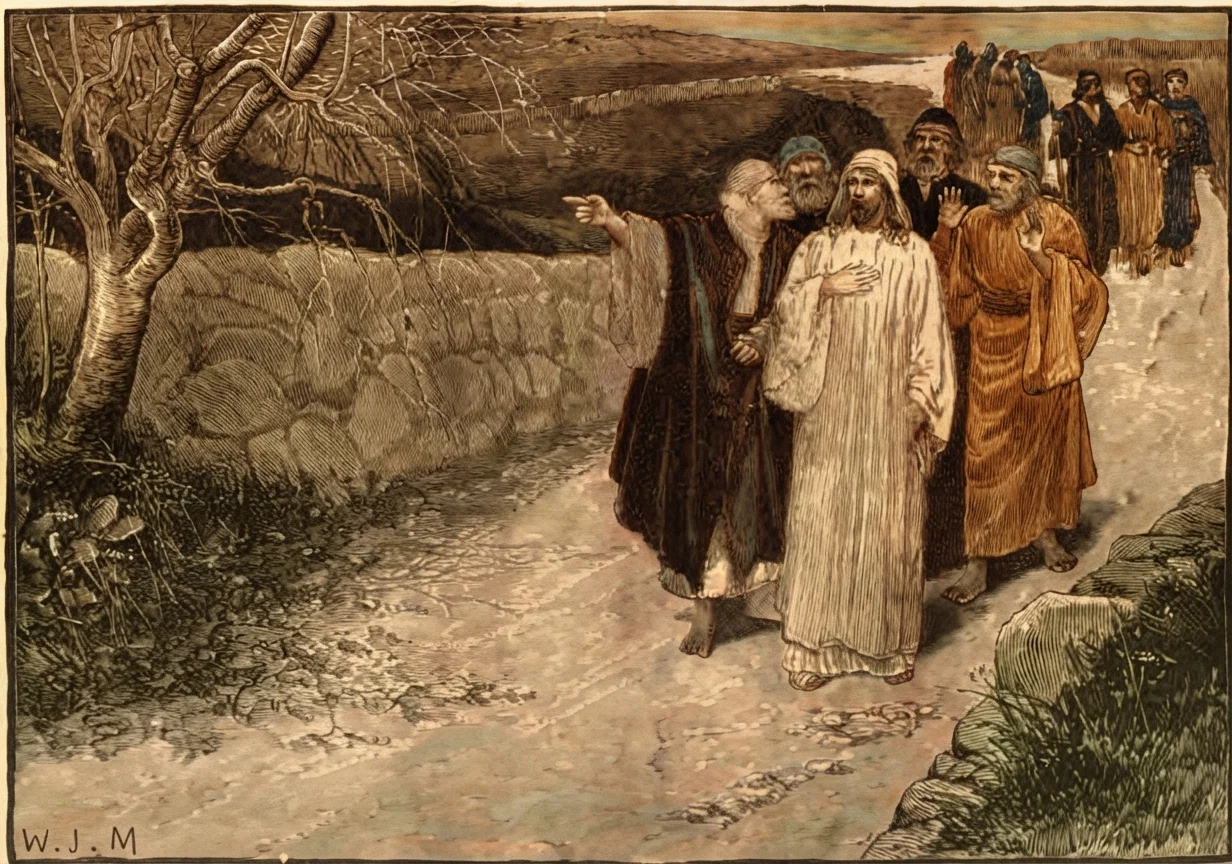
Jesus and His Disciples on a Mission of Ministry.
The Lord has provided for every one pleasure that may be enjoyed by rich and poor alike,—the pleasure found in cultivating pureness of thought and unselfishness of action, the pleasure that comes from speaking sympathizing words and doing kindly deeds. From those who perform such service, the light of Christ shines forth to brighten lives darkened by shadows.
Christ bound men to His heart by the ties of love and devotion; and by the same ties He bound them to their fellow men. With Him love was life, and life was service. "Freely ye have received," He said, "freely give."
It was not on the cross only that Christ sacrificed Himself for humanity. As "He went about doing good," every day's experience was an outpouring of His life. In one way only could such a life be sustained. Jesus lived in dependence upon God and communion with Him. To the secret place of the Most High, under the shadow of the Almighty, men now and then repair; they abide for a season, and the result is manifest in noble deeds; then their life fails, the communion is interrupted, and the life-work marred. But the life of Jesus was a life of constant trust, sustained by continual communion; and His service for heaven and earth was without failure or faltering.
"God sent not His Son into the world to condemn the world; but that the world thru Him might be saved." Looking upon men in their suffering and degradation, Christ perceived ground for hope where appeared only despair and ruin. Wherever there existed a sense of need, there He saw opportunity for uplifting. Souls tempted, defeated, feeling themselves lost, ready to perish, He met, not with denunciation, but with blessing.
The beatitudes were His greeting to the whole human family. Looking upon the vast throng gathered to listen to the Sermon on the Mount, He seemed to have forgotten for the moment that He was not in heaven, and He used the familiar salutation of the world of light. From His lips flowed blessings as the gushing forth of a long-sealed fountain.
Turning from the ambitious, self-satisfied favorites of this world, He declared that those were blessed who, however great their need, would receive His light and love. To the poor in spirit, the sorrowing, the persecuted, He stretched out His arms, saying, "Come unto me, . . . and I will give you rest."
In every human being He discerned infinite possibilities. He saw men as they might be, transfigured by His grace,—in "the beauty of the Lord our God." Looking upon them with hope, He inspired hope. Meeting them with confidence, He inspired trust. Revealing in Himself man's true ideal, He awakened, for its attainment, both desire and faith. In His presence, souls despised and fallen realized that they still were men, and they longed to prove themselves worthy of His regard. In many a heart that seemed dead to all things holy were awakened new impulses. To many a despairing one there opened the possibility of a new life.
Every true, self-sacrificing worker is willing to spend and be spent for the sake of others. Christ says, "He that loveth his life shall lose it; and he that hateth his life in this world shall keep it unto life eternal. If any man serve Me, let him follow Me; and where I am, there shall also My servant be: if any man serve Me, him will My Father honor." By earnest, thoughtful efforts to help where help is needed, the true Christianshows his love for God and for his fellow beings. He may lose his life in service; but when Christ gathers His jewels to Himself, he will find it again.
There are many souls in perplexity, weighed down by a load of guilt. They desire to be delivered from sin. They have wandered from the springs of true happiness, and have poisoned their lives by drinking of the murky waters of transgression. They need the help of a friendly, outstretched hand. Teach them how to reach upward, how to live so that they will gain the respect of their fellow men. Altho the will has been depraved and weakened, there is hope for them in Christ. He will waken in their hearts higher impulses and holier desires.
They need to hear words of encouragement, that they may lay hold of the hope set before them in the Gospel. The promises of God's word will be to them as the leaves of the tree of life. Patiently continue your efforts, until with grateful joy the trembling hand grasps the hope of redemption thru Christ.
It is the one who has been tempted and tried, and whose hope was well-nigh gone, but who was saved by hearing a message of love, who can best understand the message of soul-saving. He whose heart is filled with the love of Christ, because he has been sought for by the Saviour, and brought back to the fold, knows how to work for others. He can point sinners to the Lamb of God. He has given himself without reserve to God, and has been accepted in the Beloved. The hand that in his weakness he held out for help has been grasped. By the ministry of such ones many prodigals will be brought to the Father, to present themselves before Him in contrition and penitence.

Christ the Angel of Jehovah

By C. L. Taylor
FROM Genesis to Revelation, the Bible record, with all its wonderful variations and kaleidoscopic revelations, is but the forthshining of the glory of the Divine One,—the story of "the Lamb slain from the foundation of the world."
When God gave His Son to the world as its offering for sin, then, also, the fate of the world rested upon Him. To the Lord Jesus Christ was given "power over all flesh" (John 17:2), to Him were committed all judgment and authority (John 5:22, 27).
In the stories of patriarch and prophet, of priest and prince, of ruler and ruled, are, therefore, only glimpses of the Christ who, as a simple man, as a mighty warrior, as a flaming angel, or as Jehovah, God, sought to accomplish in and for and thru mankind the beneficent designs of the great plan of salvation. Understanding that from the very beginning only God the Son, with but one or two exceptions, has been the One seen and heard, then indeed the word of God assumes a new beauty, and wonderfully plain but comprehensive and suggestive is the record of earth which Heaven has been pleased to give.

The Purpose of the Writing.

In the light of the foregoing, it is easy to understand that "whatsoever things were written aforetime were written for our learning, that we thru patience and comfort of the Scriptures might have hope." Rom. 15:4. The basis of hope for to-day is that He who worked for Noah, for Abraham, for Jacob, lives and works now. Seeing what our Christ did in those days of long ago, we may see what He will do, tho in a larger way, in this present time.
Said Jesus, "Abraham rejoiced to see My day: and he saw it, and was glad." John 8:56. By faith Abraham became acquainted with the Lord Jesus, accepted Him as his Saviour from sin and sinning, and so entered into covenant relation with Him. Heb. 11:8-10; Gen. 15:1-6. Thru faith in the gift of the only-begotten Son of God, he was able to offer up his only son, Isaac. Heb. 11:17-19.
But it was as "the Angel of Jehovah,"—Jehovah's messenger—that the Son of God visited men in those patriarchal days. Malachi refers to Him as "the Messenger [or angel] of the covenant." Mal. 3:1. God's covenant of peace was laid in Jesus Christ. Therefore as the angel of Jehovah's covenant, the Son of God ministered especially to those who by faith had entered into covenant relation with Heaven.

Christ Meeting Men on Common Ground.

What a beautiful, yea glorious thought that all thru the ages the Son of God, as His Father's messenger of love and power, has condescended to meet man on common ground, as it were, and to enter into all the various details of his life and work as Friend and Helper, as Counselor and Guide! But even so it was.
To poor, discouraged Hagar "the Angel of Jehovah" came with comforting advice and sweet assurance, and that Hagar might know Him as she ought, He evidenced His divinity in a promise that only the Divine could make or keep. Gen. 16:7-13. She heard His voice, and recognized His nature; and out of the fulness of her heart she said, "Thou art a God that seeth." The Angel of Jehovah was the Son of God.
To Abraham "the friend of God," the Angel of Jehovah came at various times and under different forms. As the patriarch sat in his tent door in the heat of the day, "Jehovah appeared unto him." And how?—As a man among men. "Lo, three men stood over against him," and one was the Son of God. From the heavenly courts, where ten thousand times ten thousand holy ones paid Him adoration, Jehovah's messenger came to converse with a man—a creature of dust! He had come to take that man into Heaven's confidence! And Jehovah said, "Shall I hide from Abraham that which I do?" And then He told him of Sodom's doom, and listened patiently while again and again the man of faith pleaded for the benighted city. Genesis 18.

The Test of Abraham.

Then, again, read the story of the test of faith in Abraham's later years. Genesis 22. Who was it that so carefully and tenderly watched over the aged man of God as from his Hebron home he wended his way to Mount Moriah there to offer up the son of promise? Ah, listen! When the father raised the knife in obedience to God's command, "the angel of Jehovah [the Son of God] called unto him out of heaven, and said, . . . Now I know that thou fearest God." Yes, it was the Lord Jesus Christ who that day heralded to an expectant universe the love and faith of one of His children. It was He who one day would actually die as man's ransom, One from whom the stroke of wrath would not be turned away.
It was the Angel of Jehovah who, during that night of distress and temptation, wrestled with the man Jacob. Wonderful indeed it is that the Christ of God should enter into such relationship with one of His own creatures. But as Jehovah's Messenger, that was the work of His choice. But if the relationship seemed humble, the results were divinely glorious. That night Jacob "the supplanter" became the Israel of God. That night of wrestling brought him a new nature and a new name. Genesis 32.
Let us thank God for such a Messenger. As the Hagars still need comfort, the Abrahams testing, the Jacobs new natures, so the Angel of Jehovah's covenant still lives. He visits men to-day, He enters into all their life experiences, and by His Spirit makes known to them the secrets of Heaven.

A Song of the Heart.

We can sing away our cares easier than we can reason them away. The birds are the earliest to sing in the morning; the birds are more without care than anything else I know of. Sing in the evening. Singing is the last thing that robins do. When they have done their daily work, when they have flown their last flight, and picked up their last morsel of food and cleaned their bills on the napkin of a bough, then on the top twig they sing one song of praise. I know they sleep sweeter for it. O, that we might sing every evening and morning, and let song touch song all the way thru! O, that we could put song under our burden! O, that we could extract the sense of sorrow by song! Then sad things would not poison so much. When troubles come, go at them with song. When griefs arise, sing them down. Lift the voice of praise against cares. Praise God by singing; that will lift you above trials of every sort. Attempt it. They sing in heaven; and among God's people on earth, song is the appropriate language of Christian feeling.—Henry Ward Beecher.

Gold Tried in the Fire.

HE gold tried in the fire is the same faith and love that Jesus had when He came to this lost world to live man's example, and die man's sacrifice. It is the faith and love that Jesus took into the fire, with which He went thru the fire, and came out of the fire.
Jesus wants to sell us this gold. "Buy of Me," He entreats. Jesus asks from us no good thing, only the things that make us wretched, miserable, poor, blind, and naked. O, what a bargain is here offered us! to give the things that will sink us down to eternal ruin for the things that will lift us up to eternal glory.
The opportunity to make this exchange will not always last. God offers now the final chance and choice. Be zealous, O, be zealous and repent, and thus give all to Christ, and receive all from Him.
It is the possession of this gold tried in the fire that constitutes the highest and most indispensable qualification for a colporteur, a missionary, a doctor, a teacher, a preacher, or any one else in the Master's vineyard. O why do we halt and hesitate! Let us arise and break the fearful spell of lethargy and lukewarmness that has settled upon us. If we do thus arise, open the door of our hearts, and let Jesus come in, bringing with Him the true riches, we will truly and surely "arise and shine." For with the "gold tried in the fire" will come the beautiful garment of salvation, clean and white. Then will follow the anointing of the eyes with the eye-salve of the Holy Spirit. What wonderful discernment and insight into spiritual truth and all spiritual things that will give us! O how precious then will become the word of God and the messages of God to us! We will feed and feast upon them continually, and thus grow up into Jesus our living Head in all things.It is the fearful delusion and lukewarmness that are holding us back from listening to the last earnest entreaty of our beloved Lord, the faithful and true Witness. With deep yearning of soul Jesus is saying to every lukewarm professor, "Why will you die? You will not come unto Me that you might have life."
If we will only heed the counsel of Jesus, it will be but a short period of walking with Jesus in light here, followed by an eternity of walking with Him in white hereafter; a short period of sitting with Jesus here in heavenly places, and an eternity of sitting with Jesus on His throne hereafter; joyous cross-bearing for time, followed by glorious crown-wearing for eternity.
Jesus, the great Head of the church, is now giving His last and final counsel to His remnant church on earth. The destiny of the church, and hence of each individual believer, hangs on His testimony. By many, thus far, this closing counsel is being entirely disregarded, and by a very large number only half heeded. But few, indeed, have really taken it to heart and been sanctified body, soul, and spirit by it. May the reader and the writer be among the sanctified ones who are thus made meet for the Master's use, and who will hear the "Well done," when Jesus comes.
H. A. ST. JOHN.

Barabbas or Christ?

"Whom will ye that I release unto you? Barabbas, or Jesus which is called Christ?" Matt. 27: 17.
THIS question asked by Pilate two thousand years ago is pertinent to every age.
While it is true that the scenery of the stage on which this drama was enacted is laid aside, that the actors have passed away and given place to others, yet the principles which Barabbas and Christ represented are still with us.
It is important to understand clearly that we are not called upon to decide this question for Pilate, the mob has already done this.
We must in our attempt to answer this remember that we are making a choice of principles which are vital in their results.
There are many who despise the Barabbas of Pilate's time, who under present conditions would never clamor for his release, yet enthusiastically uphold the principles which he represented. And on the other hand, there are many who sympathize with Christ before His enemies, who weep because of His sufferings and death, who at the same time crucify Him anew by denying the principles for which He lived and died.
In deciding for Christ, there is ever the danger of confounding the sentiment which provokes sympathy in behalf of the innocent Sufferer with that loyalty and devotion of truth and principle without which all else is futile.

The Meaning of the Decision.

What, then, does it really mean to decide between Barabbas and Christ? Mark 15: 7 and John 18: 40 tell us that Barabbas was a murderer, a robber, and a mover of insurrection. Heb. 4: 15 and 1 Peter 2: 22 tell us that Christ was without sin and was guileless. We read in 1 John 3: 4 that "sin is the transgression of the law."
First: The decision between Barabbas and Christ is the decision between lawlessness and lawfulness.
Barabbas had taken human life, had taken by violence that which did not belong to him; he had disregarded God's holy law.
The prevailing tendency of the present age is a disregard for God's law, to set at naught the very foundation principles of God's government.
Christ told us that He kept His Father's commandments (John 15: 10), and His life was an unfolding of their divine principles. He died to show their immutability. His life was in harmony with the great standard of righteousness; therefore, sinless. Which principle shall our lives pursue?
Secondly: The choice between Barabbas and Christ is the choice between carnal and spiritual methods in our endeavors to establish the kingdom of Christ. Barabbas apparently belonged to a party who wished to overthrow the Roman government and reestablish the Jewish kingdom. Many such efforts were made which had for their object a worthy cause. But they were not willing to accomplish this in God's way. The Jewish people had waited long and expectantly for the dawn of a brighter day, but their night was only growing darker. Would it not be wiser and better, thought Barabbas, to take matters in our hands and usher the kingdom in by force? Barabbas' kingdom was earthly, as were his methods. Why not do a little wrong to bring about a great right?
Are there not conditions existing to-day in which to many it may appear that God is not interested in His work or else that He long delays it? Many will say, "All ought to acknowledge Christ, religious institutions should be maintained, Christ's kingdom must be established on this earth." Instead of a brightening hope, "darkness covers the earth and gross darkness the people." Isa. 60: 2.
What, then? instead of awaiting God's time and following His methods, a movement is created, its object being to reform the government and establish Christ's kingdom. We still hear it said, "Would it not be wiser and better to take matters in our own hands, and usher the kingdom in by force?" Casting about for power, the arm of flesh, the civil power, force, carnal methods, are resorted to.

Power for the Work.

Christ says, "My kingdom is not of this world." John 18: 36. My kingdom is "righteousness, peace, and joy in the Holy Ghost." Rom. 14: 17. "Ye shall receive power, after that the Holy Ghost is come upon you." Acts 1: 8. "Tarry until ye be endued with power from on high." Luke 24: 49. O, that men might choose Christ's methods instead of those of Barabbas!
Thirdly: The choice between Barabbas and Christ is the choice between selfishness and unselfishness. Little did Barabbas care for the suffering of his substitute so long as he was allowed to escape.
This is the spirit which is found at the root of all the misery of mankind. Self asserts its claims regardless of the claims of others; pushes to the front while trampling on the rights of a brother; rejoices in its success, which has meant the failure of some one else; reaps the profits of the toilsome and wearisome lives of the less fortunate in life's struggle and suffers no discomfort because of their misery. Capital is arrayed against Labor, the rich oppressing the poor. The small investor becomes the prey of the capitalist in times of financial distress.
Christ stands for unselfishness. He gave His life for the lives of men. Christ says, Do unto others as ye wish others to do unto you. The strong should defend the weak, the rich help the poor, the men of high gifts spend themselves for the handicapped in the race. This is the spirit of Christ. When son or daughter steps out of the way that leads to fame and ease for the sake of a parent in poverty, or when a man refuses the offer which implies distinction, and for the sake of the right identifies himself with the unpopular or obscure, in such cases the choice is made of Christian principles.
This deciding is a daily task. May it be ours to discern between the spirits that govern men's actions, between Barabbas and Christ, and ever follow the truthful principles of the Master. GEO. H. SKINNER.

"Behold, I Send You Forth."

"Behold, I send you forth as sheep in the midst of wolves." Matt. 10: 16.
THE disciples had been called to follow the Master in His earthly wanderings. By faith they had followed Him, leaving all. From the very first they had seen the wonderful things which He did, the miracles of healing, the stilling of the tempest, the power of His word. Day by day they were learning of His mission; day by day He instructed them concerning His kingdom. And then came the time for a richer experience; He would send them out to preach the Gospel, to heal the sick, to meet the enemy, to do His work in the earth.
But first of all He would fortify them against the evils they were to meet; even before the commission was given, "He called unto Him His twelve disciples, and gave them authority over unclean spirits, to cast them out, and to heal all manner of disease and all manner of sickness." And then came the charge: "As ye go, preach, saying, The kingdom of heaven is at hand. Heal the sick, raise the dead, cleanse the lepers, cast out demons." It was a mighty undertaking for men whose lives hitherto had been spent in private pursuits, whose training had been so brief; but already they knew much of the power of God; "freely ye received," He told them, "freely give."
And thus it was that He sent them forth "as sheep in the midst of wolves." He knew they would meet the enemy in all his strength and sophistry; He knew they would be tried and tempted; He knew their faith would be taxed to its limit, and that, do the best they could, they would find trials that would bear them down. But with it all they might ever look to the Giver of all blessings and knowledge, and receive of Him the thing most needed in the most needy hour.
So it has always been with the children of God. Moses in Egypt, Daniel in Babylon, Esther in Persia, the disciples of Jesus, Luther, Wesley, Knox, Miller, and scores of others,—all have had to go into the world as sheep amidst wolves. These have been tried and tested. All have had messages to bear. But no more is it true of these striking characters in the history of God's work in the earth than it has been and ever is true of every child of God. But always and ever, back of the commission to go is the authority, the power of God. With such a commission, backed by such authority, why will any soul hesitate to do His bidding? The duty is clear, the commission is definite, the reward is eternal; and the need is just as great, just as pitiful, just as imperative, "Go ye therefore, and make disciples of all nations." And the promise is eternally true, "Lo, I am with you always, even unto the end of the world."
H.
Continue reading: The Gethsemane of Life