Signs of the Times, Vol. 22, No. 26.

Bondage and Freedom

Signs of the Times

Jul 2, 1896

Pacific Press Publishing Company · Oakland, California · Jul 2, 1896

Bondage and Freedom

There is bondage that is bitter, and there is bondage that is sweet. The bondage of bitterness to some is a bondage of sweetness to others. There is a freedom that is bitterness and a freedom that is sweetness; and the sweetness to some is bitterness to others. There is a freedom which is the bitterest bondage and a bondage which is the sweetest freedom. That condition which ends in the absolute freedom of life is freedom indeed; and that condition, whatever it may be called, which ends in the absolute bondage of death, is bondage indeed. Both these conditions are set forth in God’s word.

Bitter Bondage

The bondage of debt or pain or sickness is bitter. The bondage of Egyptian, or Russian, or American slavery was more bitter. The hopeless bondage of Roman slavery was, if possible, more bitter still. But the bondage of sin is the bitterest of all bondage. All of the human race know bondage of some kind. Some are in the bondage of debt, and have struggled for years to be free. Some are in bondage to disease and pain, and have spent all their living on physicians and remedies, and have incurred the bondage of debt to be free from disease, but are still in its bondage. Others there are in the bondage of serfdom, as were Israel in Egypt, or the children of Ham in America, a few years since.

The Universal Bondage

But there is a bondage to which all mankind are subject, namely, the bondage of sin, the worst and bitterest of all bondages; for it includes all others. It was brought upon the race by our first father, Adam. When he yielded himself to Satan, he brought himself and all under him and all the race after him, into the bitter bondage of Satan. “Know ye not, that to whom ye present yourselves as bond-servants unto obedience, his bond-servants ye are whom ye obey; whether of sin unto death, or of obedience unto righteousness?” (Rom. 6:16, R. V., margin.) More than this: Adam’s seed have justified him in that they have presented themselves bond-servants to sin. Paul says, “I am carnal, sold under sin.” (Rom. 7:14.) God says to his people, “Ye have sold yourselves for naught.” (Isa. 52:3.) This well expresses the condition of the human race,—bought bond-slaves of sin,—a condition of itself utterly hopeless; for sin ends in death, and death is cessation of existence. What therefore tends to death is unprofitable. Not only is the work of one slave unprofitable, but the work of all is unprofitable, because all is of sin, or infected by sin, and sin is ever tending to death. This is the condition of every man and woman by nature, bond-slaves of sin, doomed to death. A few short years, however full of temporal good things they may be, is the lot of earth’s proudest, and then death and the grave—nothingness—ends the once false-promising career of the slave of sin. This is as it is at the best. There are millions whose whole lives are bitterness, the end of which is death. Truly may God say to the whole world, “Ye have sold yourselves for naught.”

Incurable and Hopeless

Sin is not only an outward condition, it is like disease, inherent. The physical slave has often asserted and won his freedom by the sheer force of mental and physical manhood; but the slave of sin is hopelessly sick in a sick world, and he can not cure himself. He may show but little of the leprosy of sin in his appearance, but the deadly disease is there, not local, but universal, not bodily alone, but spiritual, and so we read: “The whole head is sick; and the whole heart faint. From the sole of the foot even unto the head there is no soundness in it; but wounds, and bruises, and putrefying sores; they have not been closed, neither bound up, neither mollified with ointment.” (Isa. 1:5, 6.) “The heart is deceitful above all things, and it is desperately sick, who can know it?” (Jer. 17:9.) Moreover, the disease deceives the sinner, and leads him to imagine he is free. Like the man-eating tree of Madagascar, sin intoxicates by its potent draughts, and excites to mirth, hilarity, and drunken security its victim, while its soft, steel-strong tentacles are entwining him in their deadly embrace. Such is sin. No words can portray its bondage, no illustration can convey any just impression of its deceivableness and power. Its devotees promise themselves liberty, but “they themselves are the servants [slaves] of corruption.” (2 Peter 2:19.) Its liberty is pleasant to the wicked in its flowering; it is despair and death at its fruitage. It has in it no element of life, or no power of repair. It enslaves the faithless in utterly hopeless bondage.

Freedom

Liberty is precious. How men rejoice when released from the bondage of debt or disease! How the memorials of freedom are cherished in those nations the people of which have once known physical bondage or serfdom! How the Israelite loved the Passover, because of the memories which it cherished of freedom from Egyptian bondage!How America cherishes the Declaration of Independence and the flag, which meant outward freedom in both civil and religious matters! But more precious than all these, because it delivers from a greater bondage, is freedom from sin, the freedom which can come only from God through the truth as it is in Jesus. It is in this way that the Lord expresses it:—
“And ye shall know the truth, and the truth shall make you free.” “If the Son therefore shall make you free, ye shall be free indeed.” (John 8:32, 36.)
That freedom comes by yielding all up to God, and receiving the life and power of Jesus Christ into our hearts. If we give to God our way, our sins, our lusts, our longings, our desires, in fact, empty ourselves of ourselves for his sake; if we choose forever his law, his word, his way, his righteousness; if we submit to be cleansed, to obey, to wait, to suffer, to die if need be,—if we are willing to do all this, and do do this, Christ comes into our heart and life; he cleanses the soul temple from its pollution, he breaks the bonds of sin, he strikes the gyves from ankle and wrist, and bids in all sufficient power the erstwhile shackled slave go free. And O what freedom! There is no joy that equals the joy of liberty in Christ. There is no freedom like the freedom which God gives to the soul that trusts him, even as there is no bondage like that which Satan places upon those who are his. And this freedom is for every one, even as the bondage is upon every one. God is no respecter of persons. Whosoever will may come. He has purchased freedom for us at the infinite sacrifice of the Son of God, but it cost us nothing. “Ye have sold yourselves for naught; and ye shall be redeemed without money.” (Isa. 52:3.) “For He [God] hath made Him [Christ] to be sin for us, that knew no sin, that we might be made the righteousness of God in him.” He became a slave, that we might be free. He purchased for all; whosoever will may take “freely;” for “God is no respecter of persons.” We may take it without money, and without price, freely, freely. He bought us that he might free us. Do we wish the freedom?

Freedom a Bondage

That is what Satan says the freedom of Christ is. He says that the law of God is a hardship, the Sabbath is a yoke of bondage. But to the soul that is free in Christ all God’s requirements are the bondage of love. “His commandments are not grievous” (1 John 5:3); his Sabbath is a “delight, the holy of the Lord, honorable” (Isa. 58:13); it is delight to do his will (Ps. 40:7, 8), even as it was to Jesus our Lord.

Freedom for All

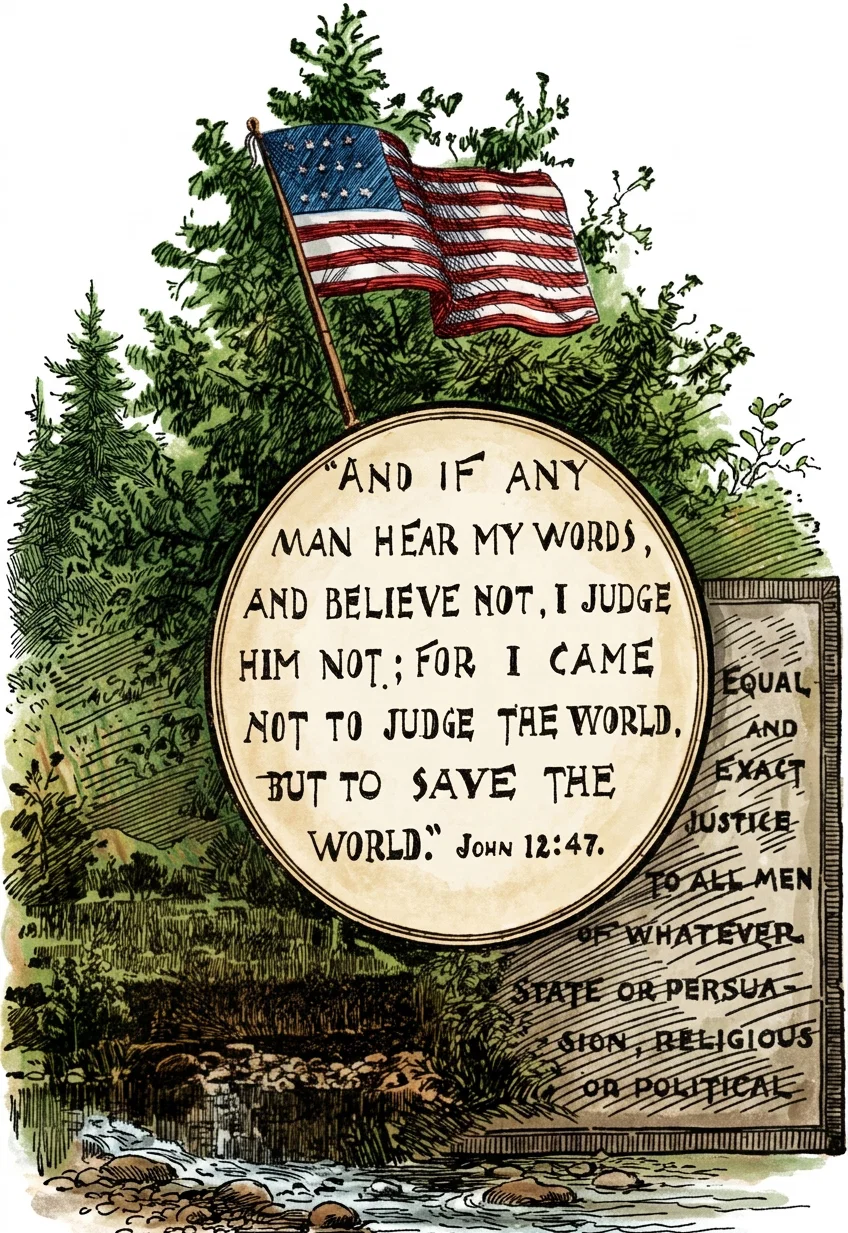
Those who are free in Christ will desire to bind no one else in body or conscience save by the bands of love. Men may believe in Christ; the child of freedom rejoices. Men may refuse to believe; he will pity but not coerce. He will not try to compel conscience by anathema, or enforce religious dogmas by law. Christ did not; he can not. Jesus said, “If any man hear my words, and believe not, I judge him not; for I came not to judge the world, but to save the world.” (John 12:47.) The child of true freedom will never persecute. He knows that mere outward act is not righteousness, and that unshackled physical limbs are not freedom. He knows that he was never won from bondage save only by the voice of Love; that he was never set free only by the power of Christ in the soul; and therefore he knows that only the persuasion of love and the power of Christ will free his brother men. He will therefore never appeal to civil power, but only to the God of heaven, by faith, and the hearts of men, by love. Sinner, go free in Christ Jesus. Christian, “stand fast therefore in the liberty wherewith Christ hath made us free, and be not entangled again with the yoke of bondage” of sin, the only bondage that can ensnare the soul.
Continue reading: What is Patriotism in America?