Your ShelfYour Projects

Signs of the Times, Vol. 39, No. 25.

To the Reader

Signs of the Times

Jun 25, 1912

Pacific Press Publishing Association · Mountain View, California · Jun 25, 1912

To the Reader
TO THE READER.—This paper is published in the interests of LIBERTY—YOUR liberty as well as ours. We believe that our liberties, yours as well as ours, are in danger; that inalienable rights are jeopardized by movements and influences now operating. Some friend may send you this paper. You will not be asked to pay for it; but we do plead with you to read and weigh what it contains. We should be glad to hear from you either favorably or adversely.
"Every one of us shall give account of himself to God."—Paul.
"Ye were bought with a price; become not bond-servants of men."—Paul.

The New Nation and Christianity

No one thought of vindicating liberty of religion for the conscience of the individual till a voice in Judea, breaking day for the greatest epoch in the life of humanity by establishing for all mankind a pure, spiritual, and universal religion, enjoined to render to Cæsar only that which is Cæsar’s. The rule was upheld during the infancy of the Gospel for all men. . . . The new nation, . . . when it came to establish a government for the United States, refused to treat faith as a matter to be regulated by a corporate body, or having a headship in a monarch or a State.
Vindicating the right of individuality even in religion, and in religion above all, the new nation dared to set the example of accepting in its relations to God the principle first divinely ordained in Judea. It left the management of temporal things to the temporal power; but the American Constitution, in harmony with the people of the several States, withheld from the Federal Government the power to invade the home of reason, the citadel of conscience, the sanctuary of the soul; and not from indifference, but that the infinite spirit of eternal truth might move in its freedom and purity and power.—Bancroft.
Religious Liberty Series, No. 6

"IF YE WILL INQUIRE, INQUIRE YE."

This Inquirers' Department is conducted for the purpose of helping those who are studying the Bible. The answers are oftentimes only suggestive. They are never to be considered infallible, only as they agree with the infallible Word. The writer who may answer them does not consider that his opinion is infallible. He will simply give the best that he has, and plead with the inquirer to search the Word. Such questions only will be answered as, to the editors, seem to minister to the good of the readers and to the mission of the paper. We can not answer repeatedly in the same volume questions upon the same scripture. The name and address must accompany question, not for publication, but as an evidence of good faith, and that answer may be made by letter if deemed advisable. No letters are answered which do not contain the name of the writer. It is well always to enclose stamp for reply.

3789 — The Power of the Potter

Please give a full explanation of Rom. 9:21, 22. — A. W. C.
It is impossible for us to give full explanations of many of these passages. The "Question Corner" is insufficient to answer many of the questions which come to us for the question page, and we can therefore only give suggestive answers. The passage in question is simply showing God's right to do as He will with that which He Himself has made, just the same as the potter has the right over the clay to make one part to honor and another to dishonor. So much for verse 21. Now if the potter has that right, how much more has God the right to reject vessels which have fitted themselves for destruction! Really, the thought carries us back to verses 15, 16: "I will have mercy on whom I will have mercy, and I will have compassion on whom I will have compassion. So then it is not of him that willeth, nor of him that runneth, but of God that showeth mercy." And yet God has expressly told us on whom He will have mercy. For instance, we read in the second commandment of the Decalogue, "showing mercy unto thousands of them that love Me, and keep My commandments." It is very clear, then, that God has mercy upon those who will be obedient. But there is another class still. We read in Isa. 55:7, "Let the wicked forsake his way, and the unrighteous man his thoughts: and let him return unto the Lord, and He will have mercy upon him; and to our God, for He will abundantly pardon." Then it is the Lord's will to have mercy upon the wicked, isn't it? It is therefore His will to make of the clay under His hand every good thing that He can make. A helpful thought is expressed by the apostle in 2 Tim. 2:21: "If a man therefore purge himself from these, he shall be a vessel unto honor, sanctified, and meet for the Master's use, and prepared unto every good work." Verse 22 of Romans 9 clearly shows that God endured with much long-suffering vessels of wrath, fitted of themselves for destruction. Men had themselves taken such a course against God's long-suffering as to make them only vessels which ought to be destroyed. Now if the potter had the right over his clay to make any kind of vessel which he wished, surely God had a right to destroy those that would not yield to His requirements, and were determined to resist His goodness and His love. The whole doctrine of election with God centers around character. The soul who will yield to Him will develop the character which God has marked out for him; but the soul which, under the constant mercy and long-suffering of God, will not yield, must of course meet the fate which it invites, and be lost.

3792 — Observing the Sabbath

If one is living in a community where there is no Sabbath-school or church to attend, is he breaking the Sabbath by walking about in the city, or ought he to stay within his own gates?
The rule for keeping the Lord's Sabbath is found in Isa. 58:13: "If thou turn away thy foot from the Sabbath, from doing thy pleasure on My holy day; and call the Sabbath a delight, the holy of the Lord, honorable; and shalt honor Him, not doing thine own ways, nor finding thine own pleasure, nor speaking thine own words: then shalt thou delight thyself in the Lord." We do not see how any one could rightly worship God and be roaming around a busy city. It would seem as tho, if the man knows God, he would want to spend time in communing with God, and in the study of God's Word, or going on some errand of mercy, rather than mingling in a general, purposeless way with people of the world.

The Inspiration of Scripture

What rendering does the American Standard Revised Version give of 2 Tim. 3:14-17, and what is considered the correct rendering of the text? L. G. M.
"But abide thou in the things which thou hast learned and hast been assured of, knowing of whom thou hast learned them; and that from a babe thou hast known the Sacred Writings which are able to make thee wise, unto salvation through faith which is in Christ Jesus. Every scripture inspired of God is also profitable for teaching, for reproof, for correction, for instruction which is in righteousness: that the man of God may be complete, furnished completely unto every good work." For the margin, the Revised Version gives in verse 15, "Every scripture is inspired of God, and profitable," etc. The difference lies in the differences between Greek texts. Scholars have argued over it a great deal as to which is the preferable one, but it is yet unsettled. If we will take the whole scripture quoted, there can be no trouble about it at all. The Inspired Writings are defined by verse 15, "that from a child thou hast known the Holy Scriptures,"—"the Sacred Writings." "The Sacred Writings" must be the Inspired Writings, and the Sacred Writings that Timothy had known from a child were what are now known as the Old Testament. These are the Scriptures inspired of God, or God-breathed. If we take the Common Version, "All Scripture is given by inspiration of God," we must limit that by what is said in the verse before. "Scripture" simply means "writing," and we would not say that all writing is inspired of God, unqualifiedly. That is not what the apostle meant to say. There were many writings, even in the apostle's day, that were not of God, simply writings of the world, idolatrous writings, very erroneous and bad writings. These were not inspired of God. The apostle has under consideration simply the Holy Scriptures of the Old Testament as they came to him and as they have come to us. All these Scriptures are inspired of God in the originals, and every scripture so inspired is profitable for all the things which the apostle declares. We have no objection to either rendering. Either, if rightly understood, has the same force, as regard the Scriptures of truth.

3790 — The Heart of the Earth

What explanation do you give to "the heart of the earth" as given in Matt. 12:40?
A. W. C.
For a full explanation of this, see "Questions and Answers," pages 28-34. There is no passage in Scripture which directly defines what is meant by "the heart of the earth." It is assumed by some to mean the grave, and after assuming that, it is contended that for three whole days and three whole nights Jesus was in the tomb. But there are several serious objections to this. On the other hand, if we take into consideration the fact that by "the heart of the earth" our Lord may have meant the Roman power, the powers of earth, "the world rulers of this darkness" under Satan, the thing is perfectly plain. In all the predictions concerning His suffering, our Lord included not alone His death and burial, but His apprehension. "And He began to teach them, that the Son of Man must suffer many things, and be rejected of the elders, and of the chief priests, and scribes, and be killed, and after three days rise again;" the "after three days" including not simply His death, but His suffering and His rejection. Our Lord places the beginning of that trial at the time of His apprehension. Previous to that, they had no power to take Him,—His hour "had not yet come." But when that hour did come, and the soldiers came to arrest Him, Jesus said, "When I was daily with you in the temple, ye stretched forth no hands against Me: but this is your hour, and the power of darkness." This is in harmony with John 12:23, "The hour is come, that the Son of Man should be glorified." And again, verse 27, "Now is My soul troubled; and what shall I say? Father, save Me from this hour: but for this cause came I unto this hour." And there began the agony of Jesus. There began the time when He was delivered to the rulers of darkness of this world, and in their power would He be until God broke the chains of death, and delivered Him.

3791 — The Millennium

Is the millennium the thousand years mentioned in Rev. 20:5? What was God's intention of having the wicked lying on the earth a thousand years?
"Millennium" means "thousand years." We could speak of the last millennium, or the first millennium, or any other millennium, meaning simply a thousand years; but "the millennium" is generally understood as applying to the period of time mentioned in Revelation 20, during which time Satan will be confined to this earth, the wicked themselves will be dead, the saints will be in heaven, sitting in judgment with God. We do not suppose that the wicked lie on the earth during the thousand years. They are destroyed and go back to dust. At the end of the thousand years, they will be raised again. During the thousand years, the cases of the wicked will come before the righteous, according to 1 Cor. 6:2, 3. Evidently that time itself may be needed for the consideration of the cases of the wicked. Then, too, just as Palestine was desolate for seventy years because of the sins of Israel for 420 years, so this old earth will be desolate for a thousand years because of the sins of the world for the six thousand years. It will be the Sabbath of the earth, during which time it will rest. Men have rejected God, and have refused to keep His Sabbath, and the Lord will let the earth keep its Sabbath.

3793 — Where Judgment Begins

If judgment has already begun in heaven, with what class does it begin? Subscriber.
An apostle gives very clearly the answer to this question: "For the time has come that judgment must begin at the house of God: and if it first begin at us, what shall the end be of them that obey not the Gospel of God?" 1 Peter 4:17. In another scene of judgment presented in Ezekiel 9, it is said, "Then they began at the ancient men [the elders] which were before the house." Verse 6. The judgment which has now begun is that which pertains to those who have professed the name of Christ, who have sometime been His children, through all the ages of the past, those whose names have been recorded in the Lamb's Book of Life; and the question is, Shall those names be retained there, or will they be blotted out?
Schedule for Week Ending July 6

Schedule for Week Ending July 6

Sunday, June 30, Isaiah 40 Monday, July 1, Isaiah 41 Tuesday, July 2, Isaiah 42 Wednesday, July 3, Isaiah 43 Thursday, July 4, Isaiah 44 Friday, July 5, Isaiah 45 Sabbath, July 6, Psalms 63, 64, 65
The second part of Isaiah opens with wonderful consolation, so contrary to the comfort which the world offers to mankind. "Comfort ye, comfort ye My people, saith your God." And then the prophet proceeds to comfort by telling man that he is nothing but grass, and amounts to nothing in himself, but that God's Word and its power is everything, and that all God's power and wisdom and might and knowledge is pledged for those who will trust Him. If one will keep the thought of comfort in mind as he reads that marvelous 40th chapter, he will appreciate the promise at the end: "He giveth power to the faint; and to him that hath no might He increaseth strength." Chapters 41 to 45 are of the same character, pointing out the utter folly and weakness of idolatry, and the power and wisdom of God. Deliverance from Babylon is suggested in the prophecies concerning Cyrus, and the far greater deliverance in the predictions concerning our Lord Jesus Christ.
Psalms 63, 64, and 65 conclude the week's readings.

Schedule for Week Ending July 13

Schedule for Week Ending July 13
Sunday July 7 Isaiah 46, 47
Monday 8 48
Tuesday 9 49
Wednesday 10 50, 51
Thursday 11 52, 53
Friday 12 54, 55
Sabbath 13 Psalms 66, 67, 68
Our readings begin with that chapter in which is found one of the Lord's proofs that He is God: "I am God, and there is none like Me, declaring the end from the beginning, and from ancient times the things that are not yet done." Chapter 47 is a prophecy of the desolation of Babylon of old and of mystical Babylon to come. 48 and 49 are chapters of wonderful assurance of God's work among His children and in the various parts of the earth, as are also chapters 50, 51, and 52; 53 is a prediction of our Lord's sufferings. How marvelously true they were fulfilled in the experience of Jesus! What a testimony to the truth of Isaiah! 54 and 55 give us simply the result of our Lord's suffering, in the blessed things which come to His people. Very comforting and clear and strong are Psalms 66-68. Let the thought abide, "Who holdeth our soul and life, and suffereth not our feet to be moved." "God will bless us; and all the ends of the earth shall fear Him." "Thy God hath commanded thy strength: strengthen, O God, that which Thou hast wrought for us."

America and Religious Liberty

By Charles Miles Snow, Author of "Rise and Fall of Religious Liberty in America"

VI—Great Forces Uniting for the Enforcement of a Sabbath

IN the Gospel of Jesus Christ there is set before the world the principle of the equality of men and the right of choice in religious things. In the great Charter of Civil Rights which the barons of England forced King John to sign, men began to put into legal phraseology the first of those two Gospel principles. In the Constitution of the United States, the second of those principles began to receive legislative recognition.
In the famous Congressional Sunday Mail Reports, submitted in 1829 and 1830, the Congress of the United States, in most emphatic language, warned the people of the United States against "religious combinations to effect a political purpose," and pointed out in no uncertain language the disastrous result of any attempt by Congress to decide a religious controversy, such as the enforcement of a sabbath would be.

Progress of "National Reform"

Nevertheless, in spite of the terrible object-lessons of history, and despite the faithful warnings of our own national legislature, an organized movement has been in progress in this country for nearly half a century, whose success means the rejection, by the people and by the Government, of those principles so vitally inherent in the Gospel, and so necessary to the freedom, prosperity, and happiness of mankind. The leaders in that movement have been sowing broadcast among the people, for forty-eight years, the seeds of national disaster and of intellectual and spiritual bondage. Many of those seeds have fallen in receptive soil, and have begun to produce their baneful harvest. During those years, we have seen denomination after denomination throwing its influence in favor of religious oppression by favoring legislation of a religious character. We have seen also, as pointed out in a previous article, how the great body of united Protestantism—the Federal Council of the Churches of Christ in America—has definitely pledged itself to that policy of retrogression against which the Gospel protests, and against which our national Congress has warned us so faithfully and so eloquently. United Protestantism, as represented in that body, stands committed to that most dangerous principle, which would overturn the very basis of American liberties, and start the nation on the backward track toward the intolerance and religious oppression of colonial days and of the Dark Ages. For it must be admitted that when the door is opened to admit the evil principle of the control of conscience by law, there is no other goal at which to stop than the goal of persecution, and every human right is liable to invasion.
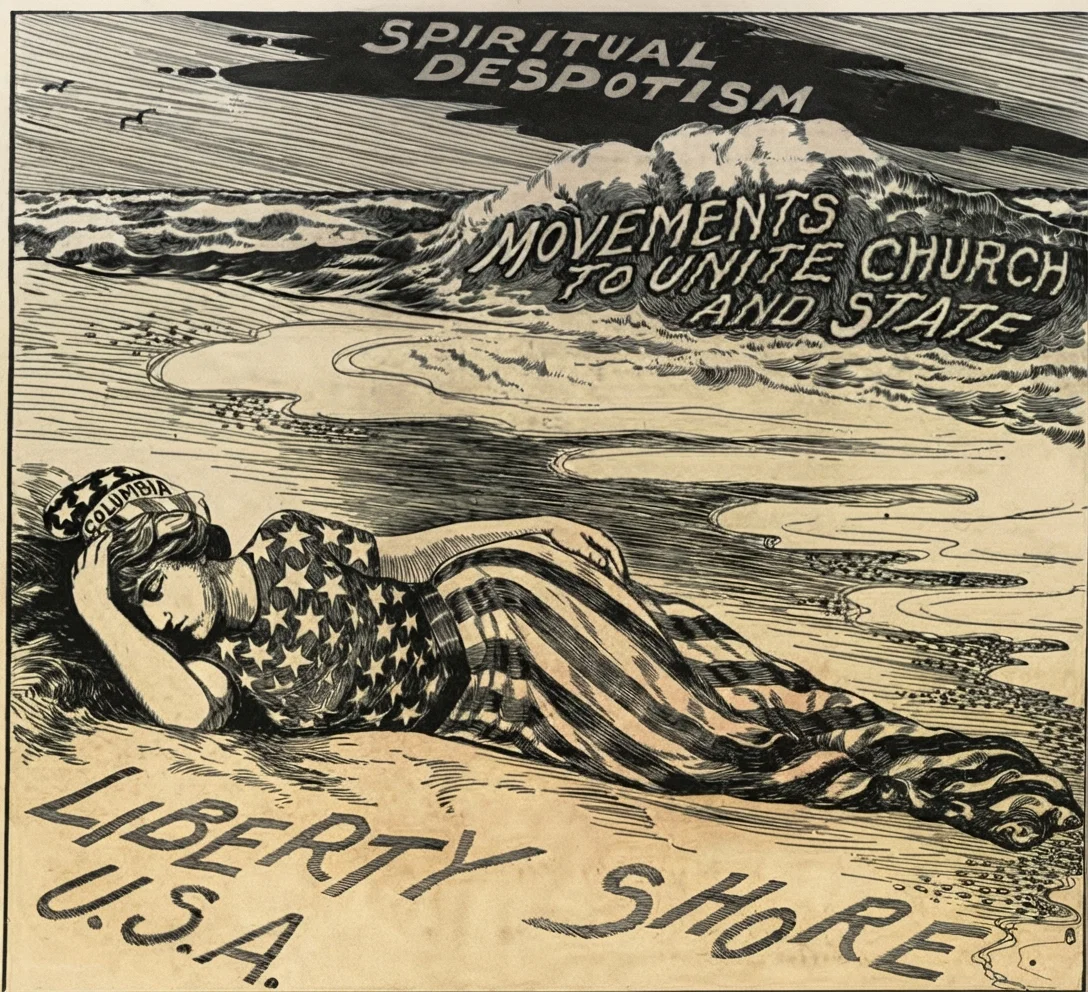
Columbia, trusting to a glorious past of Freedom, lies sleeping on the shore of liberty. She does not see the black cloud of spiritual despotism which is darkening the heavens. She does not hear the mighty roar of the on-coming billows. Awake, Columbia! Awake!

A Bid for Union with Catholics

Now with Protestantism definitely committed to that policy, it will be a matter of no small interest to know where that other great religious organization, the Roman Catholic Church, stands in reference to these un-American propositions espoused by the organizations previously named.
In 1884 the National Reform Association made a bid for the support of the Roman Catholic Church in carrying out its program. That bid was published in the Christian Statesman of December 11, and reads:
"Whenever they [the Roman Catholics] are willing to coöperate in resisting the progress of political atheism, we will gladly join hands with them."
What they meant by "political atheism" was nothing more nor less than the separation of religion from the functions of government—the separation of Church and State—and the nation's guaranty, to the individual, of the right to worship God according to the dictates of conscience. The right of the individual to worship God independent of the dominance of other men is "political atheism." The right to equality under the government without regard to our religious belief is "political atheism." The refusal of our Government to declare its preference for one religion above another is "political atheism." That ground being common to both the National Reform Association and the Roman Catholic Church, the latter took under favorable consideration the proposition of coöperation, and in the year 1889, at the Catholic Lay Congress held in Baltimore, Maryland, on November 12, issued the following pronunciamento:

Roman Catholic Response

"There are many Christian issues upon which Catholics could come together with non-Catholics and shape civil legislation for the public weal. In spite of rebuff and injustice, and overlooking zealotry, we should seek an alliance with non-Catholics for proper Sunday observance."—Quoted in "Religious Liberty Library," No. 6, page 62.
That was what the National Reformers were seeking, an alliance for the enforcement of "proper Sunday observance." And this action of the Catholic Lay Congress was taken, as announced by the National Reform Association, "after correspondence and conference with the American Sabbath Union." It was advocated by the editor of the Catholic Universe in these words:
"What we should seek is an en rapport with the Protestant Christians who desire to keep Sunday holy."—Paper read at the Lay Congress above mentioned, November 12, 1889.
The basis of union in both these proposals is the enforcement of a religious ordinance upon the people — the compulsory keeping of a sabbath. The pronunciamento issued as a result of the National Reform proposal and the “correspondence and conference with the American Sabbath Union,” declared in favor of such a union between Catholics and non-Catholics as would enable this combination to “shape civil legislation for the public weal;” and that “public weal” for which they were to unite in shaping legislation is principally comprehended in what they denominate “proper Sunday observance.” This attitude of the Catholic Lay Congress toward the enforcement of a religious ordinance upon the people, and toward general legislation of a religious character, had its basis in an encyclical of Pope Leo XIII issued four years earlier, in 1885, which reads:
“All Catholics should do all in their power to cause the constitutions of States, and legislation, to be modeled on the principles of the true church.”
The principle of “the true church” in reference to the proper relation between Church and State is that the two institutions should be joined, controlled by one head, and that head the head of the Roman Catholic Church, and that all heresy should be punished by pains and penalties. The principles of National Reformism, carried to their ultimate, involve just such an arrangement, tho they refuse as yet to acknowledge the headship of the pope. Both organizations believe in the union of religion and the State, which is the same as a union of Church and State; both believe in the State’s legislating upon religious matters; both believe in the enforcement of the Sunday institution by law, backed by legal punishment; both believe in setting up a standard of religion for the nation, and laying the hand of the law upon religions that do not conform to the standard. Why should they not join hands?

A Federation of Protestant Churches

But as there are other religious organizations that have espoused the principles of National Reformism, the horizon of possible union with Rome upon these issues is correspondingly enlarged. As these other religious organizations have now banded themselves together into one great combination, claiming to speak for united Protestantism, we will speak of them in this collective capacity. That organization is the Federal Council of the Churches of Christ in America, which claims to represent 18,000,000 communicants and to speak for practically one half the population of the United States. In view of the consolidation of power and influence represented by that organization, the position which it assumes upon any question is a matter of no little consequence. The following resolution passed by that body at its session in Philadelphia in December, 1908, demonstrates its attitude toward religious legislation, and incidentally toward the previously mentioned organizations which stand for the same thing. The resolution reads:
“RESOLVED, That all encroachments upon the claims and sanctities of the Lord’s day should be stoutly resisted through the press, the Lord’s Day Associations and Alliances, and by SUCH LEGISLATION AS MAY BE SECURED to protect and preserve this bulwark of our American Christianity; “That we rejoice in THE PROSPECT OF UNITY of action among the various ORGANIZATIONS striving in America for the preservation of the Lord’s day as a day for rest and worship.”

A Catholic Call

The first of these resolutions is a summons to Protestant organizations by an organization claiming to represent Protestantism. It summons them to the work of securing a sabbath, a religious ordinance, by compulsion of human law. In this connection it will be interesting to read a somewhat similar summons to Protestant organizations by a representative of Roman Catholicism:
“All W. C. T. U.’s and Y.’s, churches, pastors, young people’s societies, Law and Order Leagues, and individuals, are called upon to help maintain our sabbath as a day of the Lord for the people, without regard to race, sex, or condition, for a day of rest and worship. To this end let us make sabbath observance week in Minnesota marked by sermons, public meetings, Sunday-school exercises, distribution of literature, and prayer for the better enforcement of law against all infringement of the right of sabbath observance.”
This appeared in the Northwestern Chronicle of April 5, 1895, the official organ of Archbishop Ireland.
This summons is something unique in the history of Christendom — a Catholic archbishop calling Protestant organizations to the support of an institution established by the papal church. The summons has been heeded, and all these organizations, not only in Minnesota, but in all the country, are now having urged upon them, and are in turn urging upon legislators, the necessity of legislation for the enforcement of the Sunday institution.
It is a matter of no small significance that an archbishop of the Roman Catholic Church in America, and an organization representing so large a proportion of the Protestant church in America, should both be summoning Protestant organizations to rally to the defense of a certain religious institution by securing legislation in its behalf.
The second of the two resolutions quoted above from the proceedings of the Federal Council is broad in its scope. It does not specify either Protestant or Catholic organizations. It must be taken as including both, and as signifying the desire of that great organization to join with the Catholic hierarchy in America in the work of securing legislation enforcing upon the people the observance of a religious institution.

No Exceptions Allowed

During the discussion of the committee’s report at the above-mentioned council, a resolution was introduced to the effect that it was not the Federal Council’s intention that anything should be done to interfere with the convictions of their seventh-day brethren in the matter of the observance of the seventh-day Sabbath. The resolution raised a storm of protest, and was overwhelmingly defeated with a vigorous demonstration of satisfaction. The council thus put itself on record as opposed to religious liberty, and in favor of compulsion in religion, even for members of its own organization, the Seventh-day Baptists. In doing so, it took a position in harmony with the Church of Rome, so far as its attitude toward the fundamental principles of the Gospel and of the American nation are concerned.
Thus are these two great forces in America — Catholicism and federated Protestantism — united upon one great issue, the enforcement of the Sunday sabbath upon all the people, without regard to conscientious convictions. What God has separated, they have joined. What God has joined, they would separate, by thrusting in between man and his Maker a wall of human ceremony, human requirements, and human prohibitions. The religio-political unification of the whole country assumes the right to override conscience, lay an embargo upon its functions, and set itself in authority over men’s religious obligations and activities. When this unification has been fully accomplished, it will be found to be, for all practical purposes, the same machine that has operated to fill the earth with the graves of martyrs, and that Rome is leading the procession again toward that goal. On many matters, federated Protestantism stands opposed to Rome; but upon this one issue, the enforcement of the Sunday sabbath, forces will be joined, and “team work” will be done. Through a union thus effected, Rome expects to achieve her purpose in America, and through America to win back the world she has been losing, so that she may yet set her pontiffs over all the kings of the earth, and rule through them the people of every land, and dictate the religion of mankind. This is Rome’s declared intention; and Protestants who are helping her to override the religious rights of men by establishing and enforcing a sabbath of her making, are putting into her hands the machinery and the power with which to accomplish that hoary-headed purpose concerning both America and the world.

Freedom Ever Progressive

We are not free. Doth Freedom, then, consist In musing with our faces toward the Past, While petty cares and crawling interests twist Their spider-threads about us, which at last Grow strong as iron chains, to cramp and bind In formal narrowness heart, soul, and mind? Freedom is re-created year by year, In hearts wide open on the Godward side, In souls calm-cadenced as the whirling sphere, In minds that sway the future like a tide. No broadest creeds can hold her, and no codes; She chooses men for her august abodes, Building them fair and fronting to the dawn; Yet, when we seek her, we but find a few Light footprints, leading mornward through the dew; Before the day had risen, she was gone. —Lowell.

Christ, the Supreme Model

THE most destructive criticism has not been able to dethrone Christ as the incarnation of perfect holiness. The waves of a tossing and restless sea of unbelief break at His feet, and He stands still the supreme Model, the inspiration of great souls, the rest of the weary, the fragrance of all Christendom, the one divine flower in the garden of God.—Herrick Johnson.

Evangelizing the World

“If the evangelization of this world were a commercial proposition with a reward of even a ten per cent dividend, there would not be a village on earth to-day without a church.”

The Christian’s Great Object

THE great object of the Christian is duty; his predominant desire, to obey God.—Gardiner Spring.

A State Religion

By W. F. Martin, Religious Liberty Secretary of the North Pacific
VERY strong efforts are at the present time being put forth by prominent men to form a union of all the great religious bodies of the country. Back of this is the purpose to gain a prestige in the nation, that will secure a recognition from the Government, and that will compel the lawmakers to legislate in favor of certain tenets held by the dominant body of Christians.
Among the men who are seeking to bring this about, are many who are capable and honest. They see the deplorable condition of things, the almost universal disregard for Christianity, and have a sincere desire to remedy matters. In this desire, they have forgotten the history of the past. They do not take into account the fact that there is one and only one remedy for the existing evils. That remedy is the power of the Holy Spirit. When a body of religioniststurn to the power of the civil government for the support of their tenets, it is a sure sign that they have forgotten the great source of their power.
Besides this, there is a grave danger connected with such a movement. It means that some one has a desire to force some one else to worship, not as he may wish, but according to the dictates of a dominant party.
A noted jurist once said, "When the church descends to asking civil power to aid in its support, there is something dangerously carnal in the purpose."
When our Government was in its formative period, steps were taken that were intended to shut out forever the possibility of religious dominance. During the debates over the adoption of the first amendment to the Constitution, Mr. Madison, who had introduced this amendment, said he feared that in time "one sect might obtain a pre-eminence, or two or more combine together, and establish a religion to which they would compel others to conform." These words give the actual reason for the adoption of this amendment. It was to prevent any religion or a combination of religious bodies from dictating the policy of the State. Mr. Jefferson said of this some years later, that the adoption of this amendment "built a wall of separation between the church and the State."
In view of all this, all true citizens should look with disfavor upon the effort to form a combination of the great churches to secure a recognition from the Government. So surely as this aim is accomplished, it will result in religious dominance and its attendant persecution.
Continue reading: Not for Ourselves