Your ShelfYour Projects

Signs of the Times, Vol. 22, No. 3.

Blessed Are They That Mourn

Signs of the Times

Jan 16, 1896

Pacific Press Publishing Company · Oakland, California · Jan 16, 1896

Blessed Are They That Mourn
“BLESSED are they that mourn; for they shall be comforted.” Matt. 5:4.
THERE are two questions that one naturally wishes to have answered when reading this text, namely, What mourners shall be comforted? and, When shall they be comforted?
NOTE the fact that the promise is unlimited. Christ said that he was sent “to comfort all that mourn.” Isa. 61:2. God is no respecter of persons. He does not single out special cases to be the recipients of his grace. This promise is for every mourner.
THE first and most natural thought suggested by the word “mourn” is of sorrow caused by affliction and bereavement. That the Lord comforts such mourners is shown by his whole earthly life, and is specially manifest in the case of the widow of Nain, and at the grave of Lazarus. He has comfort for every manner of grief.
BUT death is the result of sin. “By one man sin entered into the world, and death by sin.” Rom. 5:12 “The sting of death is sin.” 1 Cor. 15:56. If it were not for sin, there would be no mourning. Therefore the Lord specially comforts those who mourn for their sins.
ONE thing, however, is necessary, and that is that the mourners should know this promise. It is self-evident that in order to be comforted one must know where comfort is to be obtained. The mourner must believe this promise of the Lord, and become acquainted with him through it. There is absolutely no limit to the promise, and no other qualification than that the mourner should believe and know the Lord. Whoever accepts the word of the Lord in good faith, shall be comforted, no matter for what he mourns.
WHEN shall they be comforted? Let the Scriptures answer: “Blessed be God, even the Father of our Lord Jesus Christ, the Father of mercies, and the God of all comfort; who comforteth us in all our tribulation, that we may be able to comfort them which are in any trouble, by the comfort wherewith we ourselves are comforted of God. For as the sufferings of Christ abound in us, so our consolation also aboundeth by Christ.” 2 Cor. 1:3–5.
WHOEVER is afflicted for any cause whatever, may know if he will that he is afflicted with Christ. “In all their affliction he was afflicted.” Isa. 63:9. Even tho the affliction be directly because of sin, we may have the same assurance, for we are told, “He was oppressed, and he was afflicted,” and, “For the transgression of my people was he stricken.” Isa. 53:7, 8. The thought alone that Christ bears with us the burden of grief or temptation, is enough to make it light, because it draws our minds away from ourselves.
BUT Christ can not be divided. The one who has Christ has him for all that there is in him. Therefore if our faith grasps him in his sufferings—that is, if we remember that “he hath borne our griefs, and carried our sorrows,” so that we bear them only in him—then it is most certain that we shall have at the same time all the comfort there is in him. As “the joy that was set before him” enabled him to endure the cross, and despise the shame, so the joy that there is in him enables us to rejoice in tribulation.
E. J. W.

GOD'S PURPOSE OF THE AGES.

The apostle Paul declared that the grace or gift of a minister of Jesus Christ was given unto him that he should “preach unto the gentiles [the nations of earth] the unsearchable riches of Christ; and to make all men see what is the dispensation [the stewardship] of the mystery which from all ages hath been hid in God who created all things; to the intent that now unto the principalities and the powers in the heavenly places might be made known through the church the manifold wisdom of God, according to the purpose of the ages which he [God] purposed in Christ Jesus our Lord.” Eph. 3:8–11, R. V.
We have not time, nor do we purpose at this time to even attempt, to develop this wonderful passage, in which is involved all the Gospel of Christ, the exceeding riches of God’s grace. Suffice to say that God has revealed this mystery in and through the apostle. Christ was revealed to him on his way to Damascus, and Paul was converted. Christ was revealed to him when he gave himself to God, and Paul was justified. And Christ was revealed in Paul that he might preach Christ and witness to his power to save. Gal. 1:16; Acts 26:16–18; 22:14, 15; 9:15, 16. This was Paul’s mission in word and life. He further tells us that this Gospel had not been revealed in the past as it had then, in his day, been revealed, but many of its wondrous riches had been hid in God, waiting the fullness of time (see Rom. 16:25–27; Eph. 3:5); that even then a new revelation was made known through the church even to heavenly beings of the manifold wisdom of God, and that all this revelation, or manifestation, was according to the purpose of the ages purposed in Christ Jesus in the beginning.

The One Purpose.

The purpose is ever the same, namely, the gathering into one all things in heaven and earth through Christ Jesus. That purpose is expressly declared to be the purposeof the ages, by which is meant those periods, or dispensations, of time in which the great plan of redemption has been divided. These dispensations, or ages, have shown progression in the manifestation of God’s plan of saving men, but unity in principle and purpose. While the purpose is the same, the manifestations of the ages have been different. All these were known of God in the beginning. All these were marked out by our Lord Jesus Christ. Two expressions in the book of Hebrews will make this plain. “God . . . hath in these last days spoken unto us by his Son, whom he hath appointed heir of all things by whom also he made [appointed, ordained] the worlds [ages].” Heb. 1:1, 2. The word rendered made is from the Greek poiēō, and is, by Strong and others, given the following definitions: “To make or do, in a very wide application.” It is translated “appoint” in Heb. 3:2, and “ordain” in Mark 3:14. The word from which “worlds” comes is aiōn, defined to be “duration, finite or infinite, a period of duration, past or future, a time, age, lifetime.” It is many times translated “world,” but its use and the context will always show that the principal thought is the period of time, or the state of the world during the period or age under consideration. So the Revised Version renders in the margin, “Greek ages.” Rotherham renders, “Through whom also he made the ages.” Young and Anderson similarly. The Emphatic Diaglott, “On account of whom also he constituted the ages.” The thought is that the various steps or periods of development in the great plan of salvation were ordained through our Lord Jesus Christ. This of necessity includes the creation of the material world, but the primary thought in the word is the time, the period, the age.
Another text is Heb. 11:3: “Through faith we understand that the worlds [ages] were framed [adjusted] by the word of God, so that things which are seen were not made of things which do appear.” The word “worlds” is from the same Greek word as “worlds” in Heb. 1:2, and “ages” in Eph. 2:7. It means ages, or dispensations. The word “framed” is from the Greek katartizō, defined, “to complete thoroughly, repair, adjust.” It is rendered in our common version by fit, frame, mend, prepare, restore. Young translates the text: “By faith we understand the ages to have been prepared by a saying of God, in regard to the things seen not having come out of things appearing.” Rotherham renders: “By faith we understand the ages to have been adjusted by declaration of God; to-the-end that not out of appearances should that which is seen have come into existence.” The Emphatic Diaglott reads: “In faith we perceive that the ages have been so thoroughly adjusted by God’s command that not from things then manifest the things now seen have come to pass.” That is, human sight could not see in the things manifested what God was working out. In the present appearances of each age the natural eye could not see the more glorious development of future ages. It is only by faith that it could or can be perceived or understood. The whole of the eleventh chapter is an illustration of this thought.

Concerning This Earth.

Let us consider the ages brought within the limit of man’s history. Before these periods were the eternal ages of God. “When the fullness of the time was come,” God called into existence the earth in which his purpose was to be demonstrated. That earth was made to be a home, an eternal home, for man, to be peopled by a certain number of an upright and holy race, who would choose life by choosing righteousness, peopled by a race whose characters, precious above all things else in the sight of God, beautifully and perfectly harmonizing in every particular, were named and written in the book of life before the foundation of the world. To one of these names and characters and crowns God calls every soul brought into being in this earth. If the soul submits to God, he will, through discipline, instruction, encouragement, be fitted for the eternal position in the kingdom of God which will best glorify his Creator, and bring him the most happiness. All these things has God “made known unto us” in “the mystery of his will, according to his good pleasure which he hath purposed.” Eph. 1:9.

Not Thwarted by Sin.

Nay, God’s plan, God’s purpose, can not be thwarted by sin. A great adversary has endeavored, and is endeavoring, to thwart God’s own purpose of redemption and eternal unity of the whole family of heaven and earth, but he has not accomplished it, nor will he. On the contrary, the manifestations of God’s grace will shine all the more brightly in the triumph of eternal righteousness over sin. The sin is but an incident, made necessarily possible by the fact that man is a free moral agent, and that free choice is necessary for development of character. But the incident did not take God’s government by surprise, nor find it wanting in resources to meet Satan’s assault. Every device of Satan, every attack which could be made on the government of God, were all met in God’s plan of the ages in the beginning.

By Faith.

Before sin entered it was by faith that man could attain to the character predestinated of God. The plan is the same now. He could not then see its end only as he saw it by faith in God’s promise; neither can he know it now, except by faith. In the patriarchal age, or period, of earth’s history it could not be seen by human eyes how man could be restored, how death could be abolished, by “the Seed of the woman,” but faith understood that out of the things not then seen God would bring to pass the things he had promised. And Abel and Enoch and Noah and others knew that the ages were in God’s power, and would work out God’s purpose, even as predicted by Enoch. Jude 14, 15. Abraham could not perceive by natural powers how God could bring forth from a barren wife him who would be the father of multitudes, but faith saw it and was rewarded. “When the fullness of the time was come,” God called Israel out of Egypt. Human wisdom was not consulted, but confounded. Human power was not sought. Human power could not accomplish, human knowledge could not perceive, nor human wisdom plan, all that God did in the redemption and deliverance of Israel. But faith understood that God could and would do it all. And he did, bringing the things that actually came to pass out of the things not seen.
“When the fullness of the time was come, God sent forth his Son, made of a woman, made under the law, to redeem them that were under the law, that we might receive the adoption of sons.” And here again was manifest the wonderful wisdom and power of God in bringing out of the things not seen the things which do appear. From the Babe of Bethlehem, from Jesus, the carpenter of Nazareth, from the cross, from the sealed grave, God brought triumphant victory for the entire race. Satan’s minions rejoiced when the voice of infinite searching was silenced. Satan and his angels laughed in hellish glee when the stone was rolled to the door of the sepulcher. But everlasting righteousness was triumphant over destructive sin. “He that sitteth in the heavens shall laugh; the Lord shall have them in derision.” The grave could not hold the Prince of Life. Out of what the natural man could not see, God brought again eternal victory. At this time was seen the vindictiveness of sin, which stopped not short of the destruction of the universe by destroying Him who in love came to save the lost. Here also was seen the wonderful love of God poured out upon a rebellious race. Here was a revelation of infinite love which even the dwellers in heavenly places had not before seen. It was the same purpose as in the beginning; it was in the succession of the ages a fuller development of the purpose than ages before had seen. The unbelieving rejected it, and died hopeless. The believing, even to him who believed in the darkest hour (Luke 23:43), sleep in the hope of the promise.
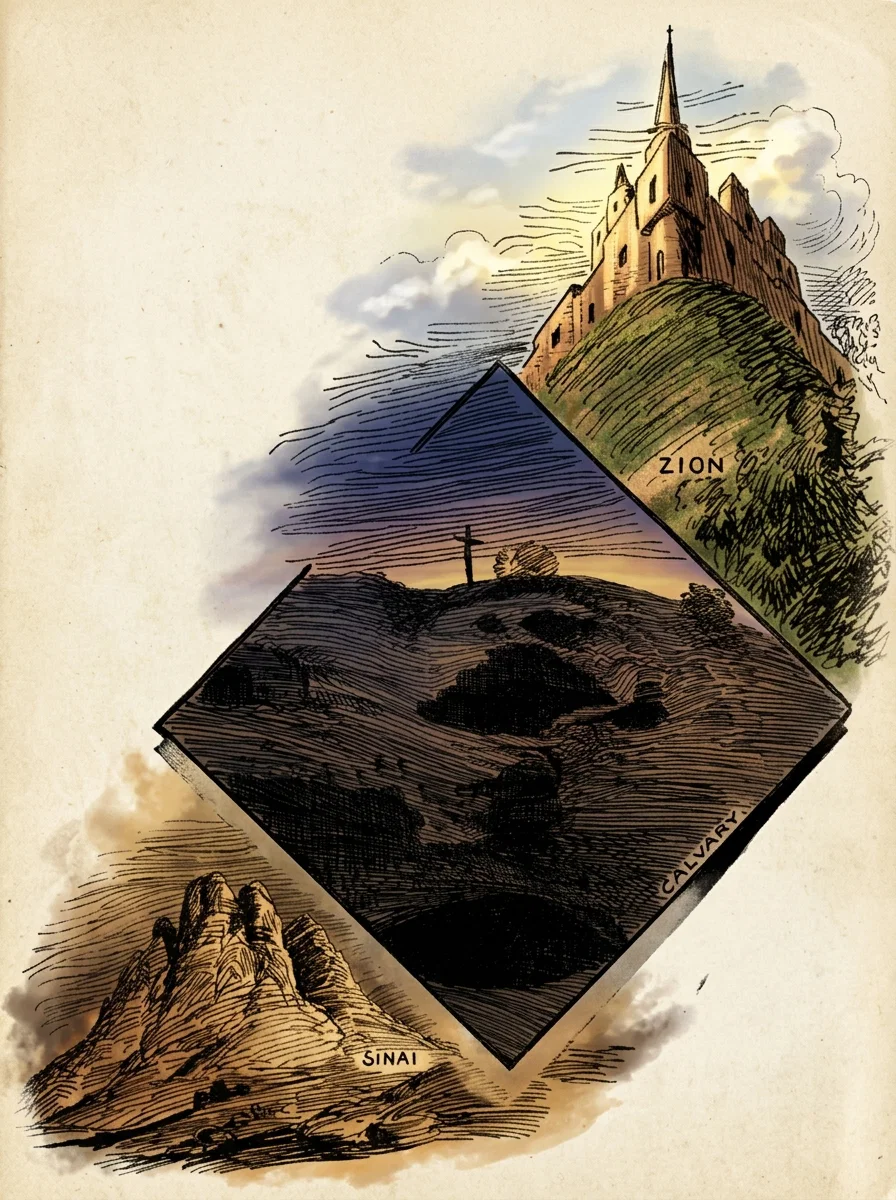
“When the fullness of the time” shall come that Christ our King shall return, then will be manifest the fullness of God’s purpose as never seen before. Then will the glory, possessed while here, be seen upon not only him but his. The word of his power will make all things new; the earth will be renovated from the curse, God’s people established (Isa. 45:17, 18), Mount Zion and the New Jerusalem, to which we are now come by faith, will be literally manifest, and throughout all “the ages to come,” God will “show the exceeding riches of his grace, in his kindness toward us, through Christ Jesus.” Eph. 2:7. The above, reader, are only slight hints concerning God’s purpose of the ages, a few rough-cut gems from the great mine. These ages may well be likened, as they have been, to a musical scale, vibrant with sad minor wails because of sin, and with grand major harmonies because of triumphs. Some of the great events in these periods rise like giant mountains, and some of them are well symbolized by Sinai, Calvary, and the Mount Zion to come,—sin and its condemnation, the infinite sacrifice of love for the sinner, and the eternal triumph of right over wrong.

The Value of Trustworthy Character

“To KNOW a man that can be trusted will do more for one’s moral nature than all the books of divinity that were ever written.”

A WONDERFUL MANIFESTATION.

The portion of Romans thus far studied has shown us both Jews and gentiles in the same sinful condition. No one has anything whereof to boast over another. Whoever, whether he is in the church or out, begins to judge and condemn another, no matter how bad that other one may be, thereby shows that he himself is guilty of the same things that he condemns in the other. Judgment belongs alone to God, and it shows a most daring spirit of usurpation for a man to presume to take the place of God. Those who have the law committed to them have a wonderful advantage over the heathen; nevertheless they must say: “Are we better than they? No, in nowise; for we have before proved both Jews and gentiles, that they are all under sin.” Rom. 3:9. And now we come to the beginning of
The Great Conclusion. Rom. 3:19-22.
“Now we know that what things soever the law saith, it saith to them who are under the law; that every mouth may be stopped, and all the world may become guilty before God. Therefore by the deeds of the law there shall no flesh be justified in his sight; for by the law is the knowledge of sin. But now the righteousness of God without the law is manifested, being witnessed by the law and the prophets; even the righteousness of God which is by faith of Jesus Christ unto all and upon all them that believe.”
What do we know?
“Now we know that what things soever the law saith, it saith to them who are under the law.”
To whom does it speak?
“To them who are under [within the sphere of] the law.”
What is the object of its speaking?
“That every mouth may be stopped.”
Under what circumstances only may every mouth be stopped?
“All the world may become guilty before God.”
What then is the conclusion?
“Therefore by the deeds of the law there shall no flesh be justified in his sight.”
Why not?
“For by the law is the knowledge of sin.”
What is now manifested?
“But now the righteousness of God without the law is manifested.”
How is righteousness manifested?
“Without the law.”
Whose righteousness is it that is thus manifested?
“The righteousness of God.”
What credentials has this righteousness?
“Being witnessed by the law and the prophets.”
Where is it manifested?
“Unto all and upon all them that believe.”
How is it manifested?
“By faith of Jesus Christ.”
Within the Law.—“Now we know that what things soever the law saith, it saith to them who are under the law.” This is not the place to consider the force of the term “under the law,” since it does not really occur here. It should be “in the law,” as in Rom. 2:12, for the Greek words are the same in both places. The words for “under the law” are entirely different. Why the translators have given us “under the law” in this place, and also in 1 Cor. 9:21, where the term is also “in the law,” as noted in Young’s Concordance, it is impossible to determine. There certainly is no reason for it. The rendering is purely arbitrary. What the verse before us really says is this, “Now we know that what things soever the law saith, it saith to them who are in the law,” or, “within the sphere or jurisdiction of the law.” This is an obvious fact, and in view of what immediately follows, it is a very important fact to keep in mind.
“What the Law Saith.”—The voice of the law is the voice of God. This is the truth, because it was spoken with God’s own voice. In the covenant which God made with the Jews concerning the Ten Commandments, he said of the law, “Now therefore, if ye will obey my voice,” etc. Ex. 19:5. The commandments were spoken “in the mount out of the midst of the fire, of the cloud, and of the thick darkness, with a great voice.” Deut. 5:22. Therefore when the law of God speaks to a man, it is God himself speaking to that man. Satan has invented a proverb, which he has induced many people to believe, to the effect that “the voice of the people is the voice of God.” This is a part of his great lie by which he causes many people to think themselves above the law of God. Let every one who loves the truth, substitute for that invention of Satan the truth that the voice of the law of God is the voice of God.
Every Mouth Stopped.—The law speaks that “every mouth may be stopped.” And so every mouth would be, if men would only consider that it is God that is speaking. If men realized that God himself speaks in the law, they would not be so ready to answer back when it speaks to them, and they would not frame so many excuses for not obeying it. When some servant of the Lord reads the law to people, they often seem to think that it is only man’s word to which they are listening, and so they feel themselves privileged to parley, and debate, and object, and to say that, although the words are all right, they do not feel under obligation to obey, or that it is not convenient. They would not think of doing this if they heard the voice of God speaking to them. But when the law is read, it is the voice of God now just as much as it was to the Israelites who stood at the base of Sinai. People often open their mouths against it now, but the time will come when every mouth will be stopped, because “our God shall come, and shall not keep silence.” Ps. 50:3.
The Law’s Jurisdiction.—What things soever the law saith, it saith to them who are within its sphere, or jurisdiction. What for?—“That every mouth may be stopped, and all the world may become guilty before God.” How extensive, then, is the jurisdiction of the law?—It includes every soul in the world. There is no one who is exempt from obedience to it. There is not a soul whom it does not declare to be guilty. The law is the standard of righteousness, and “there is none righteous, no, not one.”
No Justification by the Law.—“Therefore by the deeds of the law there shall no flesh be justified in His sight; for by the law is the knowledge of sin.” One of two things must be the case whenever a man is justified by the law, namely, either the man is not guilty, or else the law is a bad law. But neither of these things is true in this case. God’s law is perfectly righteous, and all men are sinners. “By the law is the knowledge of sin.” It is obvious that a man can not be declared righteous by the same law that declares him to be a sinner. Therefore it is a self-evident truth that by the deeds of the law there shall no flesh be justified.
A Double Reason.—There is a double reason why no one can be justified by the law. The first is that all have sinned. Therefore the law must continue to declare them guilty, no matter what their future life might be. No man can ever do more than his duty to God, and no possible amount of good deeds can undo one wrong act. But more than this, men have not only sinned, but they are sinful. “The carnal mind is enmity against God; for it is not subject to the law of God, neither indeed can be.” Rom. 8:7. “For the flesh lusteth against the Spirit, and the Spirit against the flesh; and these are contrary the one to the other; so that ye can not do the things that ye would.” Gal. 5:17. Therefore, no matter how much a man may try to do the righteousness of the law, he will fail to find justification by it.
Self-justification.—If a man were justified by the deeds of the law, it would be because he always did all that the law requires. Note well that it would be he that did it, and not the law. It is not that the law itself does something to justify the man, but that the man himself does the good deeds required. Therefore if a man were justified by the law, it would be because he has in him by nature all the righteousness that the law requires. He who imagines that he can do the righteousness of the law, imagines that he himself is as good as God is, because the law requires and is a statement of the righteousness of God. Therefore for a man to think that he can be justified by the law, is to think that he is so good that he needs no Saviour. Every self-righteous man, no matter what his profession, exalts himself above the law of God, and therefore identifies himself with the Papacy.
Righteousness without the Law.—Since, because of man’s weak and fallen condition, no one can get righteousness out of the law, it is evident that if any man ever has righteousness he must get it from some other source than the law. If left to themselves and the law, men would truly be in a deplorable condition. But here is hope. The righteousness of God without the law, or, as the Revised Version has it, apart from the law, is manifested.This reveals to man a way of salvation.
Righteousness “Manifested.”—Where?—Why, of course where it most needs to be manifested, in men, that is, in a certain class of men described in the next verse. But it does not originate in men. The Scriptures have already shown us that no righteousness can come from man. The righteousness of God is manifested in Jesus Christ. He himself said, through the prophet David: “I delight to do thy will, O my God; yea, thy law is within my heart. I have preached righteousness in the great congregation; lo, I have not refrained my lips, O Lord, thou knowest.” Ps. 40:8, 9.
“Witnessed by the Law.”—Let no one imagine that in the Gospel he can ignore the law of God. The righteousness of God which is manifested apart from the law, is witnessed by the law. It is such righteousness as the law witnesses to, and commends. It must be so, because it is the righteousness which Christ revealed, and that came from the law, which was in his heart. So, although the law of God has no righteousness to impart to any man, it does not cease to be the standard of righteousness. There can be no righteousness that does not stand the test of the law. The law of God must put its seal of approval upon every man who enters heaven.
Witnessed by the Prophets.—When Peter preached Christ to Cornelius and his family, he said, “To him give all the prophets witness, that through his name whosoever believeth in him shall receive remission of sins.” Acts 10:43. The prophets preached the same Gospel that the apostles did. See 1 Peter 1:12. There is but one foundation, and that is “the foundation of the apostles and prophets, Jesus Christ himself being the chief corner stone.” Eph. 2:20.
This also suggests another thought about “witnessed by the law.” It is not simply that the righteousness which is manifested in Christ is approved by the law, but it is proclaimed in the law. In the portion of Scripture specifically known as “the law,” the portion written by Moses, Christ is preached. Moses was a prophet, and therefore he testified of Christ, the same as the other prophets. “Had ye believed Moses, ye would have believed Me; for he wrote of Me.” John 5:46. More than this, the very giving of the law itself was a promise and an assurance of Christ. This will appear when we come to the fifth chapter of Romans.
The Righteousness of God.—While there is no chance for the despiser of God’s law to evade its claims under cover of the expression, “the righteousness of God apart from the law,” there is no need for the lover of that law to fear that the preaching of righteousness by faith will tend to bring in a spurious righteousness. That is guarded by the statement that the righteousness must be witnessed by the law, and further by the statement that the righteousness which is manifested apart from the law is the righteousness of God. No one need fear that he will be wrong if he has that righteousness. To seek the kingdom of God and his righteousness is the one thing required of men in this life. Matt. 6:33.
“By Faith of Jesus Christ.”—“Even the righteousness of God which is by faith of Jesus Christ.” Notice the wonderful expression, “faith of Jesus Christ.” In another place Paul expresses his desire to be found when the Lord comes, “not having mine own righteousness, which is of the law, but that which is through the faith of Christ, the righteousness which is of God by faith.” Phil. 3:9. Here again we have “the faith of Christ.” Still further, it is said of the saints, “Here are they that keep the commandments of God, and the faith of Jesus.” Rev. 14:12. God is faithful. 1 Cor. 1:9. Christ is faithful, and “he abideth faithful.” 2 Tim. 2:13. God deals to every man a measure of faith. Rom. 12:3; Eph. 2:8. He imparts to us his own faithfulness. This he does by giving us himself. So that we do not have to get righteousness by faith which we ourselves manufacture, but, to make the matter doubly sure, the Lord imparts to us in himself the faith by which we appropriate the righteousness. Thus the faith of Christ must bring the righteousness of God, because the possession of that faith is the possession of the Lord himself. This faith is dealt to every man, even as Christ gave himself to every man. Do you ask what then can prevent every man from being saved? The answer is, Nothing, except the fact that all men will not keep the faith. If all would keep all that God gives them, all would be saved.
Within and Without.—This righteousness of God, which is by the faith of Jesus Christ, is unto, literally into, and upon all them that believe. Man’s own righteousness, which is of the law, is only on the outside. Matt. 23:27, 28. But God desires truth in the inward parts. Ps. 51:6. “These words, which I command thee this day, shall be in thine heart.” Deut. 6:6. And so the promise of the new covenant is, “I will put my law in their inward parts, and write it in their hearts.” Jer. 31:33. He does it, because it is impossible for man to do it. The most that men can do is to make a fair show in the flesh, to gain the applause of their fellow men. God puts his glorious righteousness in the heart. But he does more than that—he covers men with it. “I will greatly rejoice in the Lord, my soul shall be joyful in my God; for he hath clothed me with the garments of salvation, he hath covered me with the robe of righteousness.” Isa. 51:10. “He will beautify the meek with salvation.” Ps. 149:4. Clothed with this glorious dress, which is not merely an outward covering, but the manifestation of that which is within, God’s people may go forth, “fair as the moon, clear as the sun, and terrible as an army with banners.” E. J. W.

Question Corner.

“Enquire, and make search, and ask diligently.”
[From time to time we will reply under this head, if deemed advisable, to such candid inquiries as may be sent us. Correspondents wishing a reply to their questions must give their full name and address, not for publication unless they wish, but as an evidence of good faith on their part, and to give us opportunity to reply by letter if deemed best. It is always well to inclose stamp. Let the questions be short and pointed, and such as may be answered in limited space. The questions will be numbered continuously.]

No. 254. Death and Sin.

1. AS DEATH came into the world in consequence of sin, and as death passed upon all because all have sinned, then, if there had been no person who had not sinned, would not that person have escaped death?
2. Is a person who has had his sin pardoned through Christ placed again on the same platform upon which man stood before the fall? And if from the time of his pardon he should thenceforth live without sin, would Satan have the power to bring him to the grave, provided, of course, that such a person had no hereditary or contracted ailment?
3. If he had such ailments, would not he who “healeth us of all our diseases,” in response to the petition of faith (James 5:15) heal him of his ailments? J. M. G.
1. The question is based on an impossible supposition. A stream can rise no higher than its source. From Adam all the race inherited a mortal, sinful nature. Such a person as implied in the question could not have been a descendant from Adam.
2. He is not placed on the same platform as regards his mortal nature. God’s grace abounded toward man before he fell, before he knew sinful flesh or mortality, but since sin abounded, grace has much more abounded. See Rom. 5:20, 21. Man’s condition through grace is as good as before the fall, but not the same. Christ was made in the likeness of sinful flesh that the power of the life of God over sin might be demonstrated. Rom. 8:1-4. Christ did this that the life of God in righteousness might be made manifest in our mortal flesh. See 2 Cor. 4:10, 11; Rom. 8:4. The promise to the faithful is that God will raise them up in the last day. See John 6:40, 54; Rev. 2:10. “As in Adam all die, even so in Christ shall all be made alive. Man dies the first death because he is mortal. From this Christ redeems all irrespective of character. Man dies the second death on account of his own sins. Of course Christ could translate the faithful as he did Enoch and Elijah, and as he will those who are his at his coming, but this translation is equivalent to a resurrection, because it is the exercise of the same power, the power that makes the sinner righteous. See 1 Cor. 15:51-53; Phil. 3:21; 1 Thess. 5:10.
3. God oftentimes heals disease. Sometimes it is not his will so to do. Paul, who healed by touching handkerchiefs, left Trophimus, a servant of the Lord, at Miletum sick, and told Timothy to take a little wine for his stomach’s sake and often infirmities. But tho God heals, he does not make immortal. He forgives sin. He does that when we believe. It is his declared will to do that. He heals disease now, but not always. When he comes, he will forever bind up the breach of his people and heal the stroke of their wound. Isa. 30:26. Then “the inhabitant shall not say, I am sick” (Isa. 33:24); and pain and death and sin will be no more (Rev. 21:4; 22:3).

No. 255. Raising and Selling Swine.

WOULD you please explain from the Bible if it is right to raise and sell swine for food? L. N. O.
The Bible gives no specific directions concerning such things. To Israel of old the Lord said concerning the swine, “Ye shall not eat of their flesh, nor touch their dead carcass.” Deut. 14:8. Personally we would not raise and sell swine. The swine is an unclean animal, and its flesh is unwholesome. The rules for all Christians to follow are briefly comprehended in 1 Cor. 10:31; Matt. 7:12; Rom. 14:13.

Strengthening Faith Helps Others Grow

You help a man in proportion as you strengthen his faith. You injure him in proportion as you weaken it.—J. D. Kilburn.
Continue reading: SIN CONDEMNED IN THE FLESH