Your ShelfYour Projects

Signs of the Times, Vol. 37, No. 33.

The Gospel and Its Power

Signs of the Times

Aug 23, 1910

Pacific Press Publishing Association · Mountain View, California · Aug 23, 1910

The Gospel and Its Power

"I am not ashamed of the Gospel of Christ; for it is the power of God unto salvation to every one that believeth; . . . for therein is the righteousness of God revealed." Rom. 1:16.
"But as we were allowed of God to be put in trust with the Gospel, even so we speak; not as pleasing men, but God, which trieth our hearts." 1 Thess. 2:4.
"In whom we have redemption through His blood, even the forgiveness of sins: who is the image of the invisible God, the First-born of every creature: for by Him were all things created, that are in heaven, and that are in earth, visible and invisible, whether they be thrones, or dominions, or principalities, or powers: all things were created by Him, and for Him: and He is before all things, and by Him all things consist: and He is the head of the body, the church: who is the beginning, the First-born from the dead; that in all things He might have the preeminence." Col. 1:14-18.

Redemption Through Christ

"In whom we have redemption through His blood, even the forgiveness of sins: who is the image of the invisible God, the First-born of every creature: for by Him were all things created, that are in heaven, and that are in earth, visible and invisible, whether they be thrones, or dominions, or principalities, or powers: all things were created by Him, and for Him: and He is before all things, and by Him all things consist: and He is the head of the body, the church: who is the beginning, the First-born from the dead; that in all things He might have the preeminence." Col. 1:14-18.
Question Corner
Question Corner

"IF YE WILL INQUIRE, INQUIRE YE."

This Inquirers' Department is conducted for the purpose of helping those who are studying the Bible. The answers are oftentimes only suggestive. They are never to be considered infallible, only as they agree with the infallible Word. The writer who may answer them does not consider that his opinion is infallible. He will simply give the best that he has, and plead with the inquirer to search the Word. Such questions only will be answered as, to the editors, seem to minister to the good of the readers and to the mission of the paper. We can not answer repeatedly in the same volume questions upon the same scripture. The name and address must accompany question, not for publication, but as an evidence of good faith, and that answer may be made by letter if deemed advisable. No letters are answered which do not contain the name of the writer. It is well always to enclose stamp for reply.

3224.—Marriage of Cousins

Can you prove from the Bible or by scientific reasons that first cousins should not marry, or the same of second cousins, and also of third cousins? What do you consider a second cousin, and what is a third cousin? H. B.
The definition which the Standard Dictionary gives of cousin is as follows: "One collaterally related by descent from a common ancestor, but not a brother or sister. The children of brothers and sisters are first cousins; the children of first cousins are second cousins, etc." "A first cousin once removed is sometimes called a second cousin; a second cousin a third cousin, and so on." Different ones have different ways of expressing it. The laws in this country are not just the same, we believe, as those in England respecting that.
There is nothing in Scripture regarding this. The marriage of first cousins it has not prohibited, so far as we understand. The general reason against such marriages is that too close relationships tend to degeneracy. There have been marriages of that kind that have issued well; no evidences of degeneration have been seen in the offspring at all. But on the other hand there have been cases where the weaknesses or prominent characteristics of individuals have been emphasized greatly, sometimes in physical deformity, sometimes in eccentricities of mind, sometimes in insanity, and sometimes in idiocy. This is also manifest in the interbreeding of cattle and horses. The very best stock-raisers feel that it is necessary to out-breed in order to keep the stock up to their strongest and best condition. There is one community in Northern New York in which there has been interbreeding for generations, and it is probably one of the lowest and most degraded communities to be found in civilized lands. Almost every one of the offspring is either a malicious criminal, a degenerate, an imbecile, or an idiot, or diseased, or abnormal in some way. It is well, it seems to us, that from these object-lessons thinking men and women should learn something. The best scientific reason is the observation of repeated facts, in the application of those facts to conditions; and men have found through observation of years that it is as a general thing not well for those closely related to intermarry.

3225.—Life Insurance

Shall a Christian insure his life in favor of his wife or family? If not, is there any Bible reason why not? R. N. H.
That which ought to be the best insurance company on the face of the earth is the church of the Lord Jesus Christ; and if that church were living where she ought to be, there would be no question about it at all. We are pointed to isolated cases of how much good insurance has done when the husband or the one upon whom the family depended passed away, and yet it is a very questionable thing whether broader and better blessings might not have come if money had been invested in some other way. Then, too, the insurance money might prove a curse to widow and children. There are many, many cases in which men have striven hard all their lives to keep up the insurance policy and the effort has gone for naught. God is our life and the length of our days, the Scripture tells us. He cares for the sparrows; He certainly cares for His own, for man is much better than the sparrow. If God notes the sparrow's fall, how much more does He note the fall of His own children. He also tells us that He is the God of the widow and the orphan and He cares for them. Would it not be better and wiser for the Christian so to relate himself to God, to plan so wisely under God, that he could better provide for his family in case of future demise, than to leave it with a purely worldly company? Sometime all the companies that are on the earth will fail; sometime life insurance companies may be brought just where fire insurance companies were at the time of the San Francisco earthquake. If our hope and trust are placed in these Egypts or Assyrias at such a time as that our hope will fail; it will prove a broken reed. But if our trust is placed in God He will not fail—He can not. We would plead with our brethren who are Christians, to give help to make the church such that that very church itself will care for widows and orphans and children when the time comes that any such thing as that is needed. If something more definite than that is needed, it seems to us that the church itself ought to form an insurance association for the benefit of its members.

3226.—The Veil of Moses

Please explain 2 Cor. 3:3, especially the thought of nailing the law written on stone to the cross, and the veil of Moses. C.
The passage in question does not refer to nailing the law written on stone to the cross. In fact it is utterly inconsistent to think of nailing a stone law to the cross. What are nailed to the cross are the human ordinances, as set forth in Colossians 2. What 2 Cor. 3:3 declares is that those converted Christians to whom Paul wrote were living epistles ministered by him, epistles written not with ink the same as other epistles are written, but with the Spirit of the living God, not in tables of stone where the law was written, but in fleshly tables of the heart. That is where God has wanted His law in all ages. That is what the psalmist declared, "Thy Word have I hid in mine heart, that I might not sin against Thee." That is the only place where the law will do us any good whatever, is in our heart. That is not against writing it on tables of stone, however. The Lord wrote it there in order that man might know what sin is; but when we learn what sin is, the only way to do is to go to the Saviour; have the sin forgiven, and that law which condemns the sin, written in our heart. It then becomes a power through Christ to keep us from sin. Then the apostle declares that they, the apostles, could not do this themselves; they were not sufficient, but their sufficiency was of God. With God they became able ministers not of the letter but of the Spirit. The letter killeth; the Spirit giveth life. This does not mean that the letter is wrong; the letter of the Ten Commandments is right in every respect. But just as long as they were held as a letter they were outside of the heart; and just so long as God's law is outside of the heart, it condemns, it does not justify; and when it condemns, it condemns to death, because "the wages of sin is death." That is what it did to Israel of old. When God came down and spoke the law, He wanted them to receive that law in their heart by faith; and if they had done so, it would have saved them, made them righteous, given them life and power and goodness. They would have become living epistles with the law written on the fleshly tables of the heart. But they said, "Let not God speak to us any more;" we do not want to hear His voice; and they went and stood afar off, and consequently became condemned. Moses said, "I beseech Thee, show me Thy glory," and God placed His glory upon him and within him so that Moses' face shone with the glory of the law that was written in his heart; but the children of Israel could not even bear that, and pleaded that Moses should put a veil over his face so that they would not see that glory which condemned them. See Ex. 34:29-35.
Moses told the children of Israel that God came down to give them that law because He loved them and wanted to do them good. And He loved the people; but they would not believe that, and they pleaded that God should not speak to them. They did not want to hear Him, but Moses. Just as soon as they took that attitude, they showed their unbelief in separating themselves from God, and that unbelief was represented by that veil. And so the man who does not believe in God, and who will not look for the end of justification, has the veil upon the heart; but when he will turn not to man but to the Lord, that veil shall be taken away. The law coming to us in its written form or as it was spoken from Sinai was glorious, but it was the glory which condemned. God wants us to see the greater glory, the glory which justifies. The children of Israel saw the one, the glory which condemned. Moses saw the glory which condemned, but beyond that the greater glory which justified; so the Corinthian brethren saw the glory which justified and wrote the law in their hearts. That is what God wants us to see. Then we will say with the psalmist, "O how love I Thy law! it is my meditation all the day."

3227.—Observers of Times

Will you please tell me what you think is the meaning of an "observer of times" found in Deut. 18:10?
It is one who followed the heathen times, believing that times devoted to different gods were sacred; times when certain incantations could be practised that would be effectual, which would not be effectual at other times. Light may be thrown upon this question by coupling the passage with Gal. 4:8-10. Paul tells the backsliding Galatians that there was a time when they did not know God and when they did service to them which by nature are no gods; that is, they were heathen. In their backsliding they went back to that heathenism; because he asks them, "After that ye have known God, or rather are known of God, how turn ye again to the weak and beggarly elements, whereunto ye desire again to be in bondage?" And then as an evidence that they had turned back to heathenism he declares, "Ye observe days, and months, and times, and years." They had gone back to the old practise of heathen times. They had their year marked, devoted to different deities, and so also their months in which they worshiped the moon. Among the ancient times, in fact one which goes away back into the obscurity of history, just as far as it can be traced, is the first day of the week devoted to the sun. One writer calls it "the wild solar holiday of all pagan times." That was one of the idolatries which the children of Israel had to meet in their time.

3228.—Death and Judgment

The answer given to Heb. 9:27 in question No. 3171 is not clear to me. If all have to give up this present life then comes the judgment, how is it that some will be living, both righteous and wicked, when Christ comes?
There are general statements in the Bible to which there are exceptions. It is a general truth to state that man is mortal and that all men die; and yet there have been exceptions to this, as in the case of Enoch and Elijah. So with the statement in Hebrews, "It is appointed unto men once to die, but after this the judgment." That is true, and nearly all do die; so many of the race that the few who will be alive when the Lord comes will form an exception; that is, as to physical death. But in a deeper sense than that all do die before they come to judgment. The righteous, those who are truly Christ's, have given up their life to Him; they have become dead to sin, and have passed through a spiritual change which is equivalent to death. Upon those the Lord will place immortality when He comes. The wicked, of course, who will perish in the glory of His presence, will come before God in the judgment during the thousand years, and will die the second death in the execution of that judgment after the thousand years are finished.

Man's Sin and Saviour

By E. J. Hibbard

VII. The Sanctuary a Type of Actual Things to Come
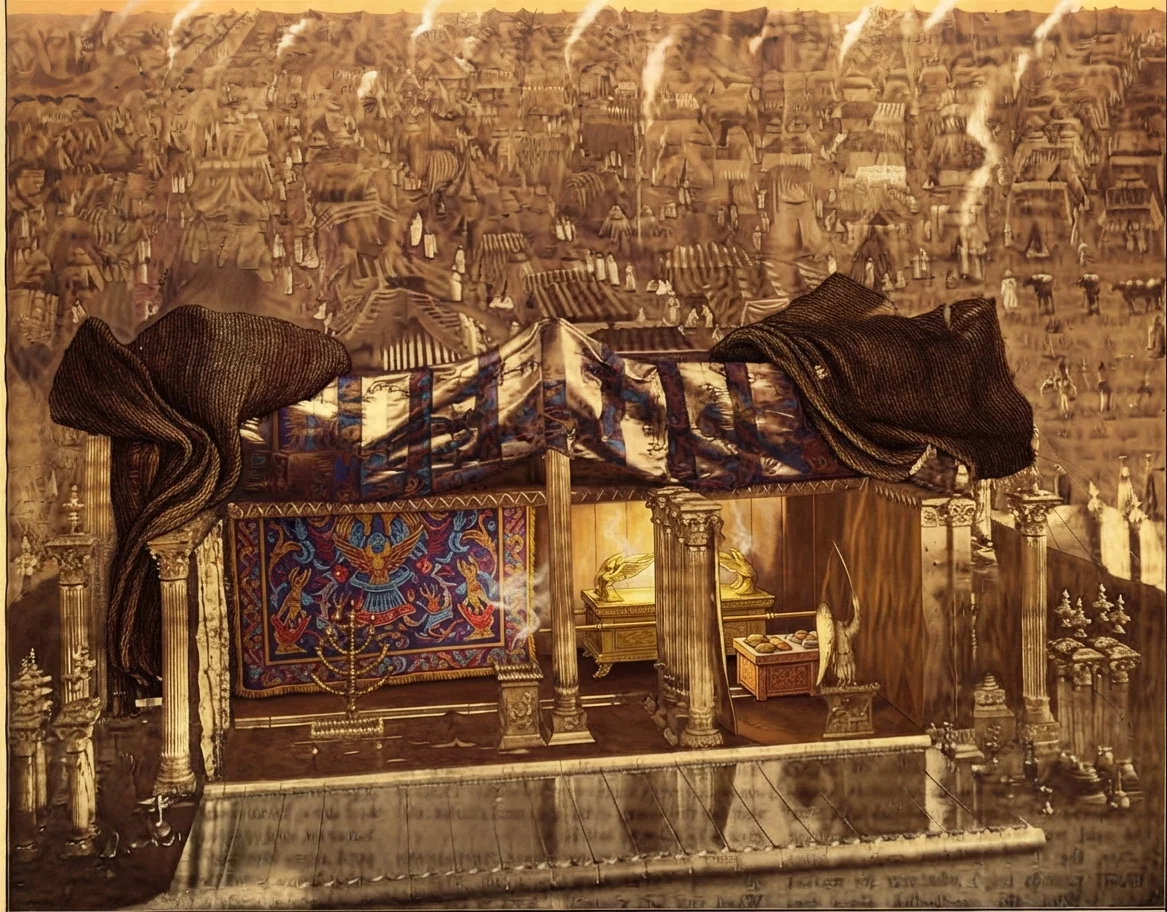
"According to all that I show thee, after the pattern of the tabernacle, and the pattern of all the instruments thereof, even so shall ye make it." Ex. 25:9. "And look that thou make them after their pattern, which was showed thee in the mount." Verse 40. "And thou shalt rear up the tabernacle according to the fashion thereof which was showed thee in the mount." Ex. 26:30.
THE SANCTUARY UNCOVERED, SHOWING FURNITURE, WITH TENTS OF ISRAEL IN BACKGROUND
It is here definitely and repeatedly demanded by Jehovah, that the tabernacle to be erected under the hand of Moses, and "all the instruments thereof," be made according to a "pattern." And that "pattern," we gather from other scriptures, is a real tabernacle, and an enduring, having its location in the heavens. For "we have such an high priest, who is set on the right hand of the throne of the Majesty in the heavens; a minister of the sanctuary, and of the true tabernacle, which the Lord pitched, and not man. . . . For if He were on earth, He should not be a priest, seeing that there are priests that offer gifts according to the law: who serve unto the example and shadow of heavenly things, as Moses was admonished of God when he was about to make the tabernacle: for, See, saith He, that thou make all things according to the pattern showed to thee in the mount." Heb. 8:1-5.
From these plain statements we glean that the sanctuary and priesthood ordained of God through Moses, were an exact pattern or shadow of the heavenly sanctuary and the priesthood of Christ. This in itself fills the matter, at once, with the most profound interest. But the details of these comparisons we reserve for future studies.Tho the sanctuary on earth was but about forty-five feet long, fifteen wide, and its height only equal to its breadth, yet on the inside, by means of the mirrored reflections, like that of any room set with mirrors on all sides, the expanse thereof was infinite, a fit symbol of the "greater and more perfect tabernacle, not made with hands." Heb. 9:11. In fact, instruments like those of the earthly sanctuary, such as the ark of the covenant, or testament, the seven lamps of fire, the incense, etc., have all been in the temple in heaven, and the record is left for our perusal and enlightenment. See Rev. 11:19; 4:5; and 8:3, 4.

The Ark of the Covenant

It is worthy of more than passing notice that, after the command had been given Moses to ask for a voluntary offering from the children of Israel, that material might be gathered for the tabernacle, the pattern of the true, and after the fashion had been first mentioned, the very first thing asked for in the whole elaborate affair, was the ark of the covenant. And more space is given to the details of this than of any other one thing. This account is found in Exodus 25, verses 10 to 22. Twice, also, in this account we read: "And thou shalt put into the ark the testimony which I shall give thee." Verses 16 and 21. The "mercy-seat" covering the ark shows that grace is offered the sinner before justice is exacted. The cherubim covering the ark are symbols of the real and living ones who stand continually in His presence and are often sent on errands of mercy, as was Gabriel to Daniel, to Zacharias, and to the virgin Mary. "And the angel answering said unto him [Zacharias], I am Gabriel, that stand in the presence of God." Luke 1:19. These few references are sufficient to indicate that the whole sanctuary service centered in, and radiated from, the ark of the testament, its contents and covering.

Continued in the Temple

This first sanctuary was supplanted by the magnificent temple built by Solomon; and this, in turn, by the one erected after the return from Babylonish captivity. But one and all of these, besides being a shadow of the heavenly sanctuary and ministry of Christ, were also shadows of His life on earth, His ministry and sacrifice here. This is doubtless what He meant when, after He had purged the temple of its traffickers, during the first Passover after His ministry began, and the people asked Him, saying, "What sign showest Thou unto us, that Thou doest these things? Jesus answered and said unto them, Destroy this temple, and in three days I will raise it up. Then said the Jews, Forty and six years was this temple in building, and wilt Thou rear it up in three days? But He spake of the temple of His body." John 2:18-21. As the first tabernacle was covered, outside, with badgers' skins, and was plain and unostentatious, so of Him it is written, "He hath no form for comeliness; and when we shall see Him, there is no beauty that we should desire Him." Isa. 53:2. But the beauty of Christ was within; and even so was it true of the tabernacle. It may be of interest, since the Israelites offered willingly the materials needed for the tabernacle in the wilderness, to know something of the value of their gifts, as money is now valued. The amounts of gold, silver, and brass are given in Ex. 38:24-29. The total weight of the three metals, avoirdupois, was more than ten and one half tons. The gold was worth more than a million dollars, the silver $225,000, and the brass (10,277 pounds troy) whatever its market value. Why, the candlestick alone was beaten from an entire talent of gold, and contained over $35,000 worth of the precious metal. This willing offering makes it plain that the Israelites of that age, whatever their defects, were at least generous toward the God of heaven whenever He made a request of them. And this is a state of mind rarely found, as God's professed worshipers average in this our day. A consideration of the sacrificial offerings will be subject-matter for our next.

Wilt Thou Be Made Whole?

(From Daniel March's "Walks and Homes of Jesus")
To you who read these lines, Jesus comes pityingly near as He came to the man in Bethesda. To you He speaks with a voice which blends so quietly with your own thought that it seems like the voice of your own heart. “'Wilt thou be made whole?' Wouldst thou have every faculty of thy spiritual nature restored to a sound and healthful life? Wouldst thou be brought into such a state of intelligent and happy agreement with thyself as that the lessons of experience, the deductions of reason, the monitions of conscience, shall be always and willingly obeyed? Wouldst thou have thy whole moral being so completely renovated and glorified as that to thee all things shall become new; the world shall be full of beauty; the pathway of life shall be strewn with blessing; every loss shall be attended with greater gain; every disappointment shall be the promise of greater good; every affliction shall be crowned with mercy?” All this would Jesus gladly do for every soul. It is not necessary for any one to give up his heart to be wasted with vain conflicts, to be consumed with unanswered desire. There is rest for the weary even here, and Christ will give it to all who ask Him.
Many times, in many forms, He puts the question, “'Wilt thou be made whole?'” When you felt yourself drawn to the book of God by a secret and gentle power, and a sudden light flashed upon the page as you read, and it seemed, for the moment, as if it had been all written for you; when the preaching of the divine Word and the ordinary service of the sanctuary made an unusually solemn and persuasive appeal to your heart; when the prayer that went up from human lips seemed, in very deed, to take hold on God, and to bring the awful realities of eternity near,—then Christ was stirring, in your own heart, the startling question which He put to the man in Bethesda, “'Wilt thou be made whole?'”
When the failure of worldly plans, the disappointment of cherished hopes, the death of beloved friends, the near approach of the eternal world under the shadow of sickness or danger, made all earthly things seem vain and incapable of satisfying the supreme necessities of the soul,—then Christ was drawing near, and putting the question seriously, tenderly, to your heart: “'Wilt thou be made whole?'”
When the love of Christ seemed to put on a new and strange beauty, and drew you to His cross with a resistless power, and conscience declared the sin of neglecting that power to be very great, and you could not repress the longing of your heart for a better portion than earth can give,—then Christ was looking upon you with tenderness and pity, as He looked on the wretched man at Bethesda, saying, “'Wilt thou be made whole?'”
When some strange light revealed the hidden depth of sin in your own heart, and you were so alarmed and horror-struck by the discovery that you were ready to cry out, “‘O wretched man that I am! who shall deliver me from the body of this death?’” —then the Friend of the friendless, the Saviour of sinners, was saying to you with such compassion as He showed to the afflicted on earth: “‘Look unto Me, and be ye saved.’ I was bruised for thine iniquities; and by the stripes laid upon Me thou canst be healed.”
So, in a thousand ways, is Christ ever urging upon every hearer of His Gospel the acceptance of the greatest possible blessing, a restored spiritual life, a sound, healthful, and happy exercise of the best and noblest faculties of the soul. Everything which can make existence a blessing, everything for which the soul was created, is staked upon obedience to the word of Christ, when He says, “‘Come unto Me.’” The glory, the blessedness, and the joy of an eternal life are his who looks to Christ, and to Him alone, for help. The conditions upon which He bestows infinite riches are such as to bring the gift of life within the reach of the poorest and the worst.

Clouds and Sunshine

By the late Milo D. Warfle, of Boulder, Colo.
"BEYOND the clouds the sun is shining;" What need is there for our repining? The clouds will drift away. We know the sunlight of Christ's glory, Reflected from redemption's story, Will light us on our way.
The clouds may be all dark and dreary, And we may feel all worn and weary, Yet there's a guiding Star; And nothing can His light conceal, For God His glory does reveal In gleamings from afar.
When all around the thunders roar, And lightning flashes o'er and o'er, We need not feel distressed; For all who trust in Father's love, Will have protection from above, For they're by Christ possessed.
The wind may blow, the rain may fall, And torrents lash around us all — Christ will the storm control. Yes, He who walked upon the sea, And calmed the stormy Galilee, Will save each trusting soul.
Then let us to the Father go With every joy and every wo — He's glad to have us come. He'll meet us at the throne of grace, And give us strength to run the race To that eternal home.

Well-Disposed Time

WHEN Drexelius was asked by his friend Faustinus how he could do so much as he had done, he answered: "The year has three hundred and sixty-five days, or eight thousand seven hundred and sixty hours. In so many hours great things may be done. The slow tortoise made a long journey by losing no time."—Bishop Horne.

The Cross Incontrovertible Evidence

By Mrs. E. G. White
CHRIST came to the world to convince men, by evidence that could not be controverted, that "God is love." This fact, so long disputed by Satan, is forever put at rest with unfallen worlds and with heavenly intelligences. It is put at rest with those who look upon an uplifted Saviour, who are convinced by the manifestation of the love of God displayed at Calvary. The wondrous condescension of God in giving Christ to the world to work out the principles of divine character, leaves every human intelligence without a shadow of excuse in withholding his allegiance from the God of heaven.
Jesus was one with the Father, and revealed the perfection of God, and yet He came to the world in the likeness of sinful flesh, and for sin, condemned sin in the flesh by His own life of perfect obedience to the law of God, showing that men may become partakers of the divine nature, and may through faith in Christ lay hold on moral power that has been brought within their reach through the love so abundantly expressed in their behalf. Human agents may form characters after the divine similitude because of the great love wherewith Christ has loved us. The Saviour said: "I am the Good Shepherd, and know My sheep, and am known of Mine. As the Father knoweth Me, even so know I the Father; and I lay down My life for the sheep." "The bread that I will give is My flesh, which I will give for the life of the world." "This commandment have I received of My Father."

Life of Jesus the Perfect Life

Here was the power that braced the human nature of Christ, and that showed itself mighty to save. In Christ was wisdom not born of earth, but of heavenly extraction, by which the plan of salvation was unfolded, which called forth the admiration of the universe of God. The plan of redemption unfolded in the practical life of the world's Redeemer. He held fast to man with His human arm, and would not let him go; and with His divine hand He grasped the throne of the Infinite. In all the details of His life He gave to earthly and heavenly intelligences an example of humility, of faithfulness in honoring and accepting every requirement of the law of God. He manifested holiness (wholeness) in accepting and expressing that law, in bringing it before the world, and in pressing close to His heart that violated law of God, planning for its honor, bidding those who would discern God's way to look up and rejoice, and saying, "Be of good cheer, I have overcome the world." Thrones and kingdoms shall be yours if you will endure testing and proving of God, for only the loyal shall enter the portals of bliss.
Jesus placed the cross in line with the light coming from heaven, for it is there that it shall catch the eye of man. The cross is in direct line with the shining of the divine countenances, so that

By Beholding the Cross

men may see and know God, and Jesus Christ, whom He hath sent. In beholding God we behold the One who poured out His soul unto death. In beholding the cross the view is extended to God, and His hatred of sin is discerned. But while we behold in the cross God's hatred of sin, we also behold His love for sinners, which is stronger than death. To the world the cross is the incontrovertible argument that God is truth and light and love.
Satan could establish pronounced enmity toward God only by bringing into contempt the laws of His government. In doing this he deceived many, and through his subtle reasonings he caused many to transgress. Thus he thought to cultivate so large a harvest of enmity toward God as to discourage the divine power, exhaust the forbearance of God, and counteract His love, so that
God would abandon man to his deceiver by withdrawing His mercy and grace. He thought so to work with human agents as to cause the last spark of love to die from the heart of God, and cause Him to lift the sword of justice and destroy the rebel race. Then Satan supposed that his claims would be vindicated before unfallen worlds, before unfallen angels.

Death of the Saviour a Testimony to the Law

But what was the result of his malignant workings? — The signals of mercy were continually exhibited, and, altho those who could have received the heavenly offers of love and mercy, continually answered back with defiance, and responded, "We want not Thy ways, O God; depart from us," and the principles of hatred to the law of God were continually increasing, yet the forbearance of God did not cease; He did not fail or become discouraged. Love and hatred stood face to face with each other. Were men to receive the annihilating stroke of an offended God? "Behold, what manner of love the Father hath bestowed upon us, that we should be called the sons of God." "For God so loved the world, that He gave His only-begotten Son, that whosoever believeth in Him should not perish, but have everlasting life."
At the crisis, when iniquity had overspread the world, and Satan seemed about to triumph, Jesus came with the ambassador of divine mercy. Satan exulted in the idea that he had led men to such a state of evil that God would destroy the world; but Jesus came, not to condemn but to save the world.
But was the law of God that pointed out man's transgression extinguished by the death of Christ? If that was so, Satan had gained everything he had aimed to obtain. No! truth, everlasting truth, was vindicated in the manifestation of the justice of God, which is in its true essence the love of God. The cross of Christ testifies to the immutability of the law of Jehovah. God could give His only-begotten Son, but He could not abolish one jot or tittle of His law, to meet man in his fallen condition. To set aside one tittle of the law would be to make null and void the whole law. The cross of Calvary for all time, through all eternity, is the unanswerable argument in regard to the immutability of the law of God.

Which Is Worth Most?

(Lee McCrae, in S. S. Times)
NCE upon a time there were two sisters, equal in talents, equal in opportunities.
Said one: "I can not teach. I do not know a thing about it." So she took up her needle and began to embroider a centerpiece for her table.
Said the other sister: "I can not teach. I do not know a thing about it. But I ought to do it." So she laid down her needle and went to a teachers' meeting.
At night-time one had a few inches of beautiful embroidery to put before the eye; the other's hands were empty, but there was an inspiration in her soul that made her say, "I ought and I will."
The next day one sister plied her needle in and out the linen, and at nightfall there were several inches of fine work to show when the other came from a great lecture, her note-book full of splendid instructions which she had labeled, "Keys to Child Nature."
When night came again the pattern showed bravely in the linen, while the sister had heard "the best way to tell a story."
A few weeks after, the centerpiece was spread proudly upon the family table for guests to exclaim over; and a boy was going home from Sunday-school happy because of a story told by his new teacher.
Just a few months, and the linen was in a washerwoman's careless hands. At the same moment a boy was pondering over and over a great truth that had been put into his mind.
When the months grew to be a year, one sister was tucking a tattered centerpiece into a rag-bag, and the other sister had the heart of a boy prepared to lay before the heavenly Father.
O, friends, don't you see? It is just a question of what is most worth our doing.

Greeting

By Edith Mary Parsons
BRIGHTNESS fills the year with gladness, Lighting up life's rugged way; Peace and calm through all the sadness, Bringing forth a fairer day.
Christ for us the path has trodden, Bearing all the curse and woes; That to us in Him be given Victory over all our foes.
He will lead us, He will guide us, Upward, onward evermore, Until all the darkness ceases On His bright eternal shore.
Continue reading: XX. Visions of the Golden Candlestick and the Flying Roll
