LEAVING the wonderful city of La Paz, whose walls Jehovah has built, our electric train wound its way upward, around hills, over little valleys, making loop after loop, ever upward to the “alto” fifteen hundred feet above. One last look at the beautiful city lying at the bottom of that great hole in the vast plain that stretches out in all directions, and we take our train for Lake Titicaca. Over mile after mile of almost barren plain we speed on our way. We pass native Indian huts here and there, sometimes in little groups and sometimes in large settlements, all made of adobe or mud, with thatched roofs. The llama, one of the most common domestic animals of the high altitudes, is often seen along the way in groups, with burdens tied to their backs, or feeding on the tough, wiry grass that grows in little bunches on these plains.
Our train stops at a small town, and on the right not far from the station can be seen the ruins of a once-famous Inca temple, some of the large stone pillars or columns still standing. Lying only a few feet from the track, and just where our car stopped, was a massive stone from the temple. A little farther on, and some distance back from the track, we could see on our left some large stone towers built on the low mountains just above the plain, where we were told that some of the Inca rulers were buried.
We reached Guaqui, which is located at the extreme southern end of the lake, in time to get aboard the steamer “Coya” before supper. We were pleased to learn that we were to take what is known as the Northern Route, sailing around the east side of the lake, stopping at several small ports by the way, to the northeast side, and then straight across to Puno, which lies on the west shore. This is the longer of the two routes, taking us two nights and a day to reach Puno, but it gave us an excellent view of this beautiful and famous body of water.
Lake Titicaca lies nearly two and one-third miles above sea level. It is nearly one hundred and twenty miles long and sixty miles wide, and is surrounded by mountains that rise in many places abruptly from the water’s edge. As one views the landscape from the steamer deck, it has in many places the appearance of a patchwork quilt, due to the fields and little plots of ground that have been terraced and walled with stone by the Indians. These plots are of all sizes and shapes, according to the lay of the ground, one above another to the very top of some of the mountains. Some of the valleys running back from the lake are very beautiful, with these terraces running up on either side and as far back into the hills as one can see. Not all is so beautiful, however, for above the timber line not a tree or a shrub can be seen. The Indians living around the lake are found in the valleys, and when our steamer was near the shore, their little adobe houses could be plainly seen. There are several islands in the lake, the two largest of which are named after the sun and the moon, both famous in Inca tradition. Several times we saw a mirage in the distance, beautiful trees or rocky islands rising out of the water and then disappearing as we drew near or as our boat changed its course.
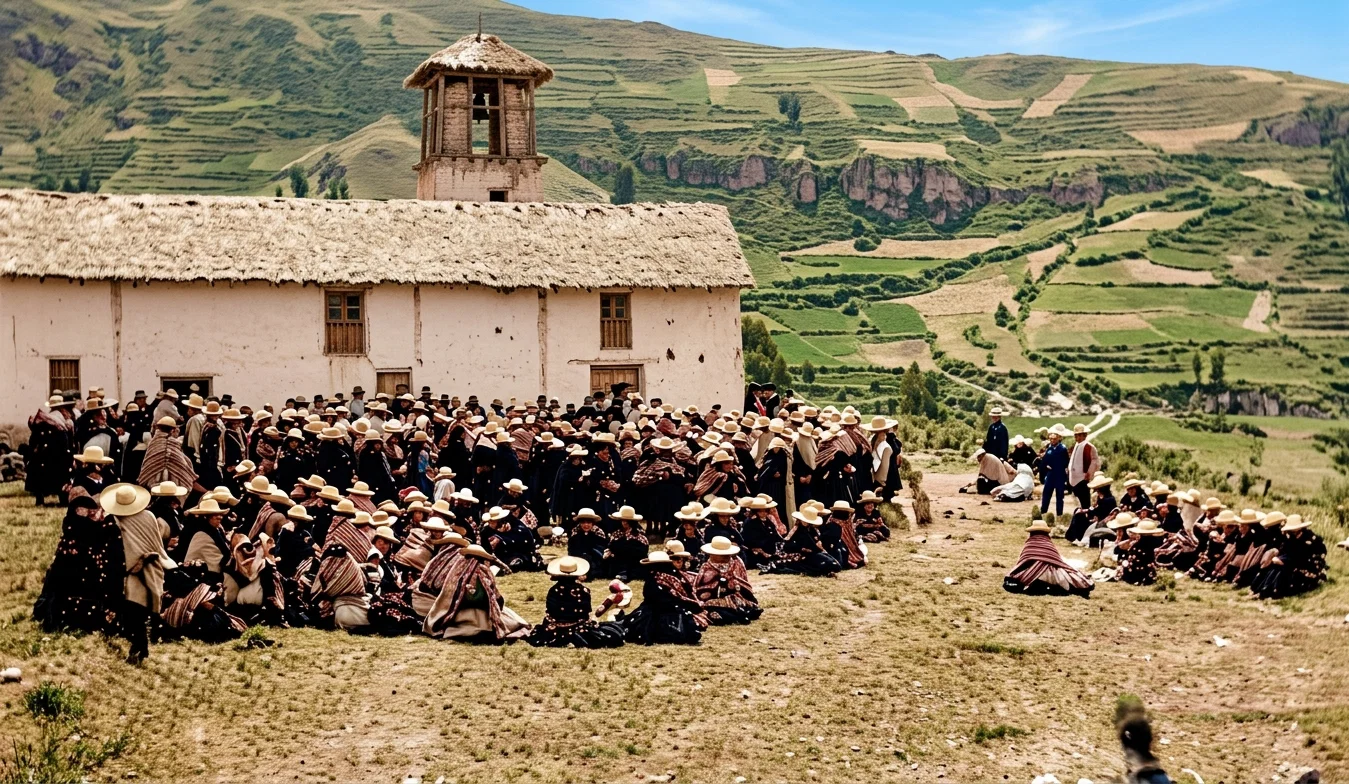
This shows a quarterly meeting in progress at our Indian mission at Plateria, Peru. The church building adjacent is not large enough to hold the congregation, so in this orderly manner these sacred ordinances are observed outside.
Early Friday morning we disembarked at Puno, and found Brother Stahl at the dock to meet us. Puno is the terminus of the railway that runs from Mollendo on the seacoast up over the mountains to Lake Titicaca. Like La Paz, the larger portion of its population are Indians. It is the port of entry from Bolivia, and one of the most important cities of that part of Peru. It is the trading point for our mission, which is located about twenty miles south and east along the lake shore. Brother Stahl took us to the home of Brother Arragon, where we enjoyed a good breakfast and arranged to leave the heavier part of our baggage. At the home of one of the sisters, the mission has a room rented that is used by the workers when they come into town, for they usually stay overnight. Here we found our horses waiting for us, in charge of two of our Indian brethren from the mission. Our passage through the town was filled with interest. The low adobe buildings; the narrow
streets paved with small cobblestones; the Indian merchants, traders, and venders, everywhere dressed in their gay colors and peculiar costumes; the pack trains of mules, with their burdens; many groups of llamas, their large, beautiful eyes filled with wonder and fear, timidly moving along, crowding close together and many times stopping, yet urged forward through the narrow streets by their Indian keepers,—all these were new and strange sights to us.
Professor Prescott was given the large roan horse, Brother Town had a fine little black one, Brother Maxwell had the favorite mule, Brother Stahl had his own mule, and I had the big bay horse. A few moments in adjusting saddles, lengthening stirrups, etc., etc., and we mounted and rode away at an easy pace, leaving the town at eleven o’clock. The road runs along the foot of the mountains, across low plains, and over low ranges of hills that run out to the lake.
As we came to the last range that we were to go over, we could see from a distance a group of men on top, each having a banner fastened to a long pole. They were an advance guard come to give us welcome. When we reached the top of the hill, we could see at a little distance on the plain a large number waiting for us with a brass band and many banners. We were soon met by a second company with banners and a band of native music; with this group were the members of the Plateria school, about one hundred pupils, besides teachers. Here the whole company was divided into two lines, one on either side of the road. The band with native instruments went ahead of us, and the brass band followed us, as with flying banners and much music we were escorted to the mission.
Upon our arrival at the mission, the Indians formed in a large circle in the yard, and we were each expected to make a short speech, which we did. Two or three of the leading Indians replied, bidding us welcome and giving a brief review of what had been done for them, and praising God for the blessed truth. Elder and Sister C. V. Achenbach, whom we had known in the States, Brother12J. M. Howell, whom we had met at Berrien Springs, Mich., and his wife, with Sister Stahl and daughter Frena, gave us a most warm and cordial welcome. They did not wave banners at us nor fill our ears with strange and plaintive music, but there was something in the expression of their eyes and in the grip of the handshake that spoke much to us. We were well cared for at the hospitable home of Brother and Sister Stahl.
The mission is nicely situated at the foot of a mountain, and overlooks the plain that stretches away to the lake, about a mile distant on the left, and to the mountain ranges some miles to the right. Scattered here and there over the plain are the Indian houses and settlements. The church building is on the lower side of the road, and just on the edge of the plain. On the upper side are the houses where the workers live. Brethren Achenbach and Howell occupy the house next to the road, each family having two rooms. Brother Stahl’s house is higher up on the hillside, with the dispensary building in the same yard. The Indian workers occupy a small building in the same yard with Brethren Achenbach and Howell, and the corrals are just back of this building. The situation is a commanding one, and the white mission buildings can be seen for miles from nearly every direction. The mission is well known throughout that whole country, for it is on the main road from Cuzco, the ancient capital of the Incas, to La Paz, Bolivia. We were told that this road was built by the Incas in the days of their strength.
When we went into the church Sabbath morning, we found the building full. Brother Stahl told us there were about seven hundred present, and there were many outside that could not get in. The women were all seated on the floor, with their babies tied to their backs; the men sat on the few benches around the sides and in the rear. After the Sabbath school Professor Prescott spoke, then I followed, and in the afternoon Brethren Town and Maxwell spoke. All the talks were interpreted in Spanish, and then in the Aymara, so each sentence had to pass through two interpreters to reach the people. Notwithstanding, the Lord blessed the meetings.
Early Sunday morning, before we were up, we heard music near by. I went to the window, and there were a large number of Indians in the yard with a band of native instruments, giving us a morning salute. This was the beginning of a busy day of work, and of study in regard to the present and future plans for the mission. Many different delegations of Indians were received, for they kept coming from every quarter until nearly midday, and all stayed until nearly night. We spent some time watching the dispensary work, as many of those who came needed medical help.
(Concluded next week)
Greetings of Our Missionaries from Across the Pacific
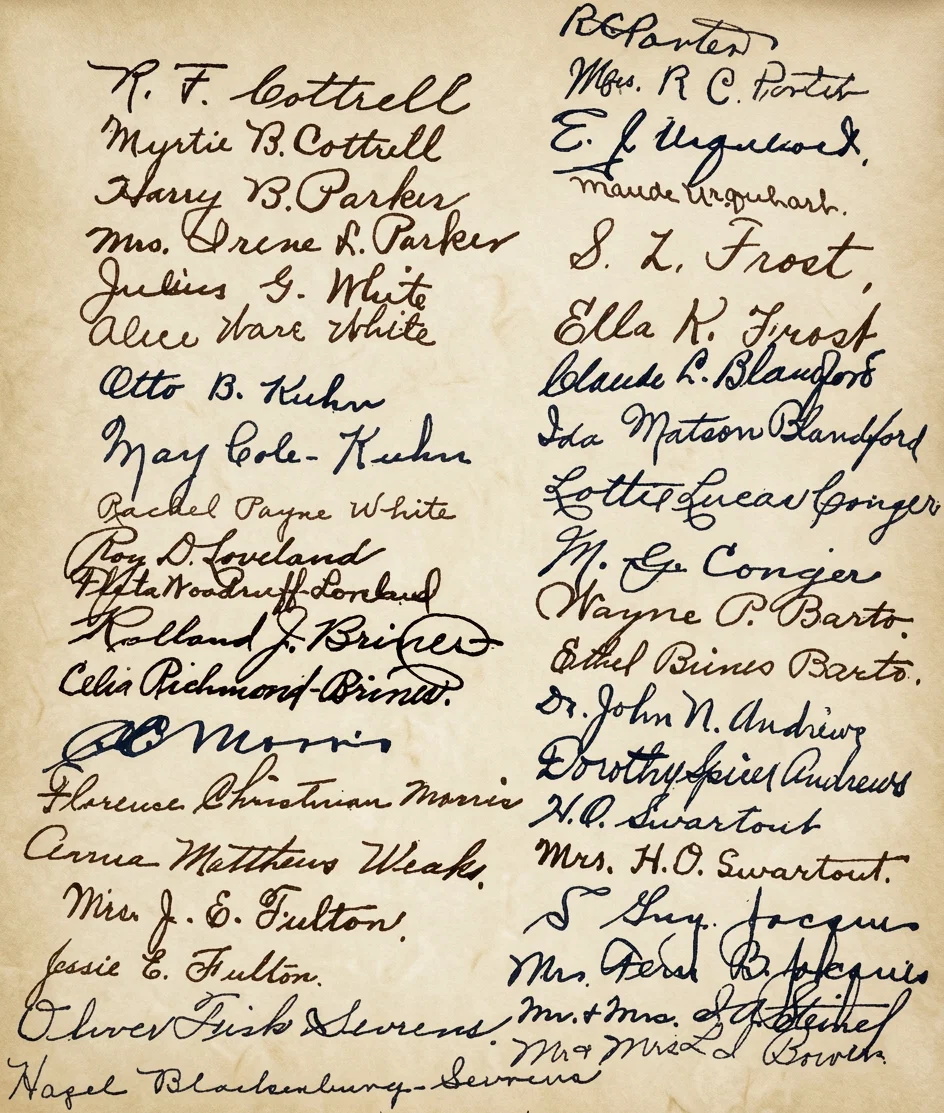
We, the members of the missionary party en route to the Far East, thinking you would appreciate a souvenir from the largest party of missionaries ever sent out by the Seventh-day Adventists, send you this letter with our signatures. Our party numbers forty-two adults and six children. A man and his wife will locate in Japan, one or two families in the Philippines, one in Malaysia, and the rest in China. Our voyage has been a safe and very pleasant one, with but little seasickness and few stormy days. We appreciate very much the privilege we have had of associating together for almost a month, and the ties of friendship formed will not soon be broken. We have enjoyed Elder Porter's Bible studies and Elder Cottrell's language lessons.
We were privileged to spend one day in Honolulu, where one hundred and twenty sat down and dined picnic fashion in the shade of a banyan tree; and we spent three days in Yokohama. In both places our brethren made our stay very pleasant and profitable.
Our experiences during this voyage have increased our faith in the promises of God, and have led us to understand better our mission to the lost. Realizing that there will be a glad reunion when the work is finished, we give ourselves heart and soul to our task, and feel assured that you will share in the reward for whatever success God may give us.
Calls in the Marovo Lagoon
By G. F. Jones
Pioneering Experiences in the Solomon Islands — No. 10
Calls in the Marovo Lagoon
G. F. JONES
Now that our work has been started among some tribes in the Solomon Islands, other tribes are interested and anxious to know our attitude toward the natives. They watch to see whether we are coercive in our methods, or whether we bring the gospel in gentleness and love. This latter method in time wins and conquers the stoutest savage. In all the mission work done among these islanders, there is nothing else that appeals to them as do the principles of religious liberty as we present them. No people are more eager for the assurance of perfect liberty to worship as they please than are these poor heathen. When the native understands that we do not compel him to adhere to a certain course of living, he soon promises that in time he will give up everything that is bad. The light of conversion is entering his soul, and he begins to have confidence in our work and teaching. After this he listens attentively to the truth, and in time he turns toward the light. “Not by might, nor by power, but by my Spirit, saith the Lord of hosts.” It is the Holy Spirit that has given us an entrance among the tribes of the Marovo Lagoon; and the news of our coming has been carried to the inhabitants of other islands hundreds of miles away.13
These also say, “Come over and help us.” Can you wonder that we are anxious as to the kind of workers sent us?
Our mission on Gatukai, in the southern end of the Marovo Lagoon, has been opened, with Brother Gray, from the Avondale school, in charge. The mission house, made with neat leaf walls, is nearly finished, and the natives are delighted to have a white missionary of their own. They had a large feast in honor of this, as marking a definite boundary line in their lives — the passing over from the old to the new. This is the custom of these people, and until it is done, they cannot freely join us. Some are very particular in regard to this feast, for it is considered a heinous offense to the spirits of their ancestors not to hold it. During the feast they remove the bones of their ancestors from one place to another and offer a sacrifice. This used to be a human sacrifice, and it may be yet, but it is done in secret, and only by the older people. Great mystery is connected with the ceremony, so we cannot find out much about it, neither is it wise or prudent to delve into the matter. However, now a new era has begun in their lives, and as far as they know they have done what they can to “cut the bridge.” Happy is the missionary who gains their confidence and their affections, for they will always remain faithful to him. Should he not reach their ideals, but show a life of self-interest, which they are quick to discern, then they are left in a sorry plight indeed.
The preparation for these feasts sometimes takes several months. Four of the feasts are in the past, which means that we have now four missions in the Solomon Islands, numbering over five hundred followers, and fifteen hundred people in other parts of the islands are waiting for us to take up work among them. Then there are territories inhabited by fierce cannibals. These also await the coming of our missionaries.
Should not our young people “be the head” in this pioneer mission work? To read and admire the lives of daring, faithful pioneer missionaries of past days is not enough; neither will “the heathen in his blindness” be reached by an ambitious aim in life merely to deliver pleasing sermons from the rostrum; nor is it honorable and brave to wait until some one else has first tamed the wild man of the bush. Now is the time when recruits are needed; just now is our grand opportunity.
Don’t Worry, Keep Hustling
‘Don’t worry, but put in your time hustling, so there will not be any need for worry.’
The Blessedness of Giving
By I. H. Evans
I. H. EVANS
The Bible always speaks approvingly of the spirit of liberality. It was this spirit which led the Father to give his Son to pay the ransom “which man from death redeems.” What was ever more effective in making the heart tender than the contemplation of the generosity of Heaven in sending Christ to save the world from sin? What scripture ever made a stronger appeal than the assurance that “God so loved the world, that he gave his only begotten Son, that whosoever believeth in him should not perish, but have everlasting life”?
Through this gift, God not only provided for the forgiveness of sin, but he did more; for “he that spared not his own Son, but delivered him up for us all, how shall he not with him also freely give us all things?” Christ himself also entered into this giving; for we read, “Grace be to you and peace from God the Father, and from our Lord Jesus Christ, who gave himself for our sins, that he might deliver us from this present evil world, according to the will of God and our Father.” And again, “Ye know the grace of our Lord Jesus Christ, that, though he was rich, yet for your sakes he became poor, that ye through his poverty might be rich.” Thus both the Father and the Son freely gave the best, all they had to give, for man’s salvation.
God does not sell the gospel. When the Lord does anything for man, it is always free. “I will give unto him that is athirst of the fountain of the water of life freely.” “Whosoever will, let him take the water of life freely.” “Come unto me, all ye that labor and are heavy laden, and I will give you rest.” “Ho, every one that thirsteth, come ye to the waters, and he that hath no money; come ye, buy, and eat; yea, come, buy wine and milk without money and without price.”
Nothing can be more free to man than the gifts of God. In return the Bible exhorts the Christian to be liberal with God. To his disciples the Lord Jesus said, “Freely ye have received, freely give.” Paul sent this earnest exhortation to the believers at Corinth: “This I say, He which soweth sparingly shall reap also sparingly; and he which soweth bountifully shall reap also bountifully. Every man according as he purposeth in his heart, so let him give; not grudgingly, or of necessity: for God loveth a cheerful giver. And God is able to make all grace abound toward you; that ye, always having all sufficiency in all things, may abound to every good work.” The wise man said, “Cast thy bread upon the waters: for thou shalt find it after many days. . . . In the morning sow thy seed, and in the evening withhold not thine hand: for thou knowest not ever whether shall prosper, either this or that, or whether they both shall be alike good.”
God cares less about the amount one gives than the spirit in which he gives. This is beautifully expressed in one of St. Paul’s epistles: “If there be first a willing mind, it is accepted according to that a man hath, and not according to that he hath not.” The Saviour drew a wonderful lesson from those who brought gifts to the temple. He emphasized the thought that it is not the amount one gives, but the spirit of the giver, that is precious in the eyes of his Father. Calling attention to the poor widow who cast in two mites, he declared that notwithstanding all the treasures of the rich who had poured into the treasury great gifts, this poor widow cast in more than they all. This proves that it is not the amount of the offering, but14the spirit actuating the giver and the sacrifice the gift entails upon the donor, that are precious in Heaven’s sight.
Giving ennobles the heart. Liberality is one of the virtues of our Father. The Bible sets forth liberality in these words: “There is that scattereth, and yet increaseth; and there is that withholdeth more than is meet, but it tendeth to poverty. The liberal soul shall be made fat; and he that watereth shall be watered also himself.”
The apostle Paul tried to impress the blessedness of giving when he said to the elders of Ephesus: “I have showed you all things, how that so laboring ye ought to support the weak, and to remember the words of the Lord Jesus, how he said, It is more blessed to give than to receive.” Again, we read, “The liberal deviseth liberal things; and by liberal things shall he stand.”
Noble men of all times have given high place to this grace. “In giving, a man receives more than he gives,” said MacDonald.
Howell said, “The disposition to give a cup of cold water to a disciple is a far nobler property than the finest intellect. Satan has a fine intellect, but not the image of God.”
Barrow made this strong statement concerning liberality: “In defiance of all the torture, of all the might, of all the malice of the world, the liberal man will ever be rich; for God’s providence is his estate, God’s wisdom and power his defense, God’s love and favor his reward, and God’s Word his security.”
“Never try to save out of God’s cause,” said Spurgeon on one occasion. “Such money will canker the rest. Giving to God is no loss; it is putting your substance in the best bank. Giving is true having, as the old gravestone said of the dead man, ‘What I spent, I had; what I saved, I lost; what I gave, I have.’”
Giving is somewhat temperamental, but is more a grace that can be cultivated. At first it may seem hard and a real trial; but when persevered in, it is capable of rapid growth, till to give brings a deeper and sweeter satisfaction to the giver than receiving does to the receiver. The blessings to be gained from giving must be experienced to be enjoyed. None can know the pleasures of liberality until he possesses its spirit. God rejoiced in giving the Son of God to man; so to the Christian it is not a trial to give to the poor or to the cause of God; for giving affords him the highest satisfaction. From his heart he sings,—
“Were the whole realm of nature mine,
That were a tribute far too small;
Love so amazing, so divine,
Demands my life, my soul, my all.”
The acquirement of the grace of giving weans our affections from earthly, material things, and teaches us that there are heart qualities far more valuable than possessions. “A man’s life consisteth not in the abundance of the things which he possesseth.” The Christian must never estimate the worth of a human soul by money standards. The heart is what God looks at, and we must prize the things of eternal value, rather than those which pass away with the using.
The spirit of benevolence is the spirit of the Master. As this grace abounds, the giver is kept from the spirit of this world. Less and less does he care for the things of earth, more and more does he long to help others who are in need. Shall we not, as we prize this grace, strive to cultivate the spirit of Christian liberality in our own lives?
Conducted by Mrs. I. H. Evans, Takoma Park, Washington, D. C
By Mrs. I. H. Evans; Miss Lora E. Clement
Assisted by Miss Lora E. Clement
Through the columns of this department, hints will be given on all matters pertaining to the home life. Short articles and letters are solicited from home makers, telling of their everyday experiences,— their joys and sorrows, their failures and successes.
How Shall We Give?
GIVE as the morning that flows out of heaven,
Give as the waves when their channel is riven,
Give as the free air and sunshine are given,
Lavishly, joyously, utterly give!
Not the waste drops from thy cup overflowing,
Not a faint spark from thy hearth ever glowing,
Not a pale bud from thy June roses blowing,—
Give as He gave thee who gave thee to live.
Pour out thy love like the rush of a river
Wasting its waters, forever and ever,
Through the burnt sands that reward not the giver;
Silent or songful, thou nearest the sea.
Scatter thy life as the summer showers pouring!
What if no bird through the pearled rain is soaring?
What if no blossom looks upward adoring?
Look to the life that was lavished for thee!
Give as the heart gives whose fetters are breaking,—
Life, love, and hope, all thy dreams and thy waking;
Soon at life's river thy soul-fever slaking,
Thou shalt know God and the gifts that he gave!
— Selected.
Brother F. A. Allum in East China
AFTER pioneering in Szechuan, west China, it has been deemed advisable for Brother F. A. Allum to come into east China, where conditions will be more favorable for him. He has been chosen to take oversight of the training school for Chinese workers established at Shanghai. His experience in field work will be of great value in the training of native evangelists and teachers to help answer the many calls coming in for workers from the various stations throughout China.
Look in the Throat
By Charles E. Stone, M. D.
THE arrival of the first cool weather, with the consequent shutting of doors and windows in both home and schoolhouse, is usually marked by a great increase in the number of cases of diphtheria.
The children who have been out of doors through the summer are now housed, either at home or in school, where in either case poor ventilation soon lowers their resistance to a point where they become very susceptible to contagion. It is now that the so-called “carrier” of diphtheria—that is, a child or adult who carries the germs of diphtheria in the throat or nose without manifest symptoms of having the disease—is to be dreaded.
If the carrier attends school, where he comes in contact with a large number of children, many serious cases may develop. If he happens to be an adult, the contagion may be spread in factory or tenement house. From this it is easily seen that a widespread epidemic may arise from a child or adult who unconsciously starts the trouble.
Again, there are numbers of children with mild cases of diphtheria, who may attend school one or more days before their condition becomes known to teacher or parents, and who may thus infect a number of classmates.
In street cars, railroad trains, or any other place where people crowd together, there may be carriers, or even well-defined cases of diphtheria at any time of year.
Recent investigations make it reasonably certain that fifty or sixty per cent of children and ninety per cent of adults are naturally immune to this disease. This, of course, explains why it is that in large epidemics a relatively small number of people are attacked, although a large number must have been in contact with those having the disease.
There are few diseases with so insidious an onset as diphtheria. Contrary to the usual belief, the invasion of this disease is slow and subtle until the patient is gradually prostrated. The symptoms in children frequently lead mothers to believe that the child affected has taken a slight cold, and is only a little dumpish and indisposed. As the temperature rarely is high, the child is apt to be pale rather than flushed, and to make few if any complaints. Cases are often beyond human aid before a physician is called.
In laryngeal diphtheria (membranous croup) the situation is different. On account of the membranes interfering with respiration, the symptoms of asphyxiation overshadow those of toxemia (poisoning). The face takes on a dusky hue, inspiration is prolonged and harsh. Here there is no dumpishness or apparent prostration; for in order to breathe, the child uses every muscle of respiration, and in drawing in his breath may often be heard all over the house, and even outside. As the battle progresses, the child gets purple in the face; there is a sinking in of the muscles above and below the collar bone and at the attachment of the diaphragm.
This form in the early stage has been mistaken for ordinary croup or even bronchitis. On account of the danger of asphyxiation, plus that of poisoning, we have a double foe to fight, which brooks no delay. For not only will the child need antitoxin, but a tube inserted in the windpipe as well.
In every instance when a child is sick, it is the duty of the mother or whoever may be in charge to “look in the throat.” If this had always been done, many lives might have been saved.
It is not always easy, even for physicians, to make an immediate diagnosis, but in every case where there are white, yellow, gray, or other colored deposits in spots or patches on the throat, a physician should be called; and if there is any doubt as to the diagnosis, a culture should be sent at once to the city or State laboratory.
These patches may be located in any part of the throat, and may vary in size from a spot as small as a pinhead to a mass entirely covering the throat. They may even occur on the roof of the mouth and on the soft palate. In certain cases the membranous deposit may be confined to the nasal passages, and may or may not be visible; but there is nearly always a foul-smelling discharge, which should always excite the suspicions of the mother.
The odor of any form of diphtheria is foul and characteristic. There is nothing else just like it, but in very mild cases it is sometimes absent.
Diphtheria today is both a preventable and a curable disease. Theoretically there should be no deaths, for it is one of the very few diseases that have a specific and infallible treatment. I have never known of a death to result where antitoxin was given in sufficiently large doses on the first day of the appearance of membrane or nasal discharge; and very rarely when it was given on the second day of the disease. After the second day, unless antitoxin has been administered, the chances of recovery are slight.
Cases so mild as to require cultures to determine whether they are diphtheria or tonsillitis may recover without treatment, as they did before the days of antitoxin; but there can be no assurance that such cases will not later develop into those of such serious import that not even antitoxin can aid them.
While antitoxin is a specific when given early in the disease, it rarely, and probably never, repairs damage already15done. In other words, the antitoxin must neutralize the toxins before the latter have time to poison the patient, just as an antidote for swallowed poison must be administered before the latter is absorbed.
Antitoxin is as much a preventive as a cure. I have never yet seen diphtheria develop in a child or adult where even the small dose of five hundred units had been given before any symptoms appeared, even though one or more members of the family had been two or more days sick with the disease. Of course natural immunity may prevent a large number from taking the infection, but if no test for immunity has been made, all should receive immunizing doses.
Until the time arrives when our government shall more closely guard the health of its citizens, we as individuals must be on the constant lookout for early diagnoses of contagious diseases. On mothers, school-teachers, school physicians, and school and district nurses will fall the burden of this responsibility.
Again I repeat, When children are ill, “look in the throat.”—Charles E. Stone, M. D., in The Mother’s Magazine.
The Knock-Box
THERE was more than average contentment and general “get-alongness” in a Connecticut family where I visited one summer. Back of the politeness and pleasant attitude of each to the other lay a secret of some sort, which was joked about and laughed over, but never divulged to the general public. The mystery hovered about a slitted box which stood on the parlor mantel. It resembled a mail box, and when it was emptied each evening, notes were handed around to mother, father, brothers, and sisters. Sometimes they were read with quiet gravity, sometimes with a smile. One morning a missive fell on my plate. Here is the message it held:—
“If our company would be good enough to phone when she decides not to return for luncheon, the cook would be exceedingly grateful.”
I reread it, mystified a trifle, also a bit ruffled, I confess, and a laugh went round the table.
“Mother,” cried one of the girls, “explain to the company about our knock-box. It was not exactly fair to discipline her without a warning.”
That forenoon while I helped to empty a darning basket, I suggested, “Now tell me about the knock-box.”
“The knock-box,” explained my hostess, “is an ancient and honorable institution of this family, but it was not fair to initiate you as we did.”
“It was perfectly fair. I felt guilty enough yesterday when I found you had waited luncheon for me. Now for the story.”
“When we were married,” she began, “I was a faultfinder, a petty, fussy housewife, picking on somebody about something all the time. One evening my husband took me to task, and I suddenly realized that if I did not take heed, I might develop into a genuine nagger like a woman next door, who is the terror of our neighborhood. He suggested as a cure that instead of blurting out every little fault I found in him, I should write it down each day, and drop my criticism in a box. He said he would do the same thing with me. We christened it the knock-box. The rule was made that complaints should be politely worded, and read over several times before being mailed. If they seemed too trivial for utterance, they were to be destroyed. I remember the first time we emptied the knock-box. I found a suggestion that coffee ought to be served steaming hot, and that when a man lent his knife to a lady, he expected it to be returned.”
“My husband had one solitary knock to read. I had destroyed ten or twelve during the day; on a second reading they had sounded petty. This one was about a man who left his belongings scattered all over a house when he dashed out to catch a car. It was seed sown in good ground. The work grew lighter each day after that, because my husband became tidier. It is years since he found a complaint in the knock-box about careless habits. When the children were old enough to read and write, they found little reminders in the box. They were also allowed to send knocks to us, and some of them were very funny. I remember one from Bobs about hanging the key of the preserve closet where he could not reach it. At the age of eight Margaret objected strenuously to wearing pinafores. All agreed that eight o’clock was much too early to go to bed. You have no idea how the knock-box saves a family from snarls. One little bit of faultfinding is capable of stirring up a storm of recrimination. Besides, a written hint sinks in as no amount of nagging can.”
Can you imagine what my first task was on reaching home? I instituted a family knock-box. It works; oh, it has worked like a charm!—Woman’s Home Companion.
Clean Hands
DISEASE germs lead a hand-to-mouth existence. If the human race would learn to keep the unwashed hand away from the mouth, many diseases would be greatly diminished. We handle infectious matter more or less constantly, and we continually carry the hands to the mouth. If the hand has recently been in contact with infectious matter, the germs of disease may in this way be introduced into the body. Many persons wet their fingers with saliva before counting money, turning the pages of a book, or performing similar acts. In this case the process is reversed, the infection being carried to the object handled, there to await carriage to the mouth of some other careless person. In view of these facts, the United States Public Health Service has formulated the following simple rules of personal hygiene, and recommends their adoption by every person in the United States:—
Wash the Hands Immediately —
Before eating.
Before handling, preparing, or serving food.
After using the toilet.
After attending the sick.
After handling anything dirty.
Do You Know That —
SMALLPOX is wholly preventable?
“Mouth breathing” makes children stupid?
Moderate exercise in the open air prolongs life?
Fish cannot live in foul water, nor man in foul air?
It is dangerous to put anything into the mouth except food and drink?
Sanitary instruction is even more important than sanitary legislation?
The United States Public Health Service issues free bulletins on tuberculosis?
The continuous liberal use of alcoholic beverages lowers efficiency and menaces longevity?
Two Clothes-Pin Holders
HERE are suggestions for two clothes-pin holders: First, a grape basket or a peach basket, with a piece of heavy wire bent like the letter S. The lower part of the S slips over the handle of the basket, and the upper part over the line. Second, an oblong bag of ticking, with one end mounted on an ordinary clothes hanger, and a circular opening cut in the front of the bag. The advantage of both these devices is that they can be slipped along the line in front of the one hanging out the clothes, and thus save endless stooping.
Keeping Rubbers Together
SOME wise mother suggests a plan that will help the children to keep track of their rubbers and overshoes at school. She advises sewing a good-sized hook to one rubber and a corresponding eye to the other. When the rubbers are removed, they are hooked together, and thus the danger of their being separated is minimized. Still another safeguard that might be used with this is to write the name of the owner on surgeon's adhesive tape, and fasten it firmly on the inside of the rubbers, where it will not be easily rubbed off.
Washing Fruit and Vegetables
ALL fruit bought from hucksters and at fruit stands should be thoroughly washed, as should also all vegetables to be eaten in the form of salads. An effective way to dry lettuce is to place it in a clean dish towel or folded square of cheesecloth, and whirl the bag thus made at arm’s length three or four times.
Making Cellar Stairs Visible
OFTEN the lower step of the cellar stairs is hard to see. If your cellar is dark, try painting the lower step white, or tacking a piece of white oilcloth firmly over it.
Cleaning Brass Articles
Putty powder used with sweet oil is recommended for cleaning brass articles. After rubbing, they should be thoroughly washed with warm soapsuds, and carefully dried.
Cleaning White Felt Hats
ORDINARY corn meal, heated, is used by milliners to clean white felt hats.
Oiling Screws
Dipping screws in oil will make them enter hard wood more easily.