Your ShelfYour Projects

Signs of the Times, Vol. 23, No. 20.

Editorial

Signs of the Times

May 20, 1897

Pacific Press Publishing Company · Oakland, California · May 20, 1897

Editorial

An Important Question.

In the fourth chapter of 1 Corinthians, the seventh verse, is asked a question which not only Christians but unbelievers would do well to consider. It is this: "What hast thou that thou didst not receive?" The evident answer from the context is that we have nothing; all that we have that is of worth came from God. This all Christians profess to believe.

"Why Dost Thou Glory?"

Then if this be true, if we did receive from God all that we have, why should we glory, or boast, as tho we did not receive it, as tho it all came of ourselves? This is the question which the apostle presses home upon Christians. There is frequently much boasting one against another. Our brother's talents are decried and belittled while one's own are exalted in comparison. Emulation and strife are everywhere prevalent. Now if we have clearer knowledge, greater wisdom, or superior talents, they came from God, the Giver of all good and perfect gifts. Why should we boast of them? If our brother has less, why should we glory over him? Why not rather rejoice that God has granted us great blessings, and gratefully strive to impart them to others? Why not be grateful that our brother also has talents, and endeavor to supply his lack by our fulness? To press the question further, How do we know—by what can we judge—that our talents are superior to his? God may decide differently as he weighs their true worth in the balances of the sanctuary. Let us be meekly modest, praising God for all that he has given not only to ourselves but others, and ever remember that he gives them to us not that we may boast in ourselves but in Jesus Christ, and thus be a blessing to others. To God belongs the glory, not to thee.

To the Unbeliever.

Oftentimes unbelievers ridicule the Bible, the New Testament, the writings of Moses and the prophets, the miracles, the vicarious atonement, the lives of professed Christians, and then boast of their own morality. They tell us, while Shakespeare and Byron adorn their libraries, that they would not have the Bible read in their homes by their children; that its morals are low, etc. The lives of insincere and inconsistent Christians, as well as the sins of inconsistent characters of the Bible, are held up as reasons why the Bible should be condemned. But in themselves, their morals, their teaching, they glory.
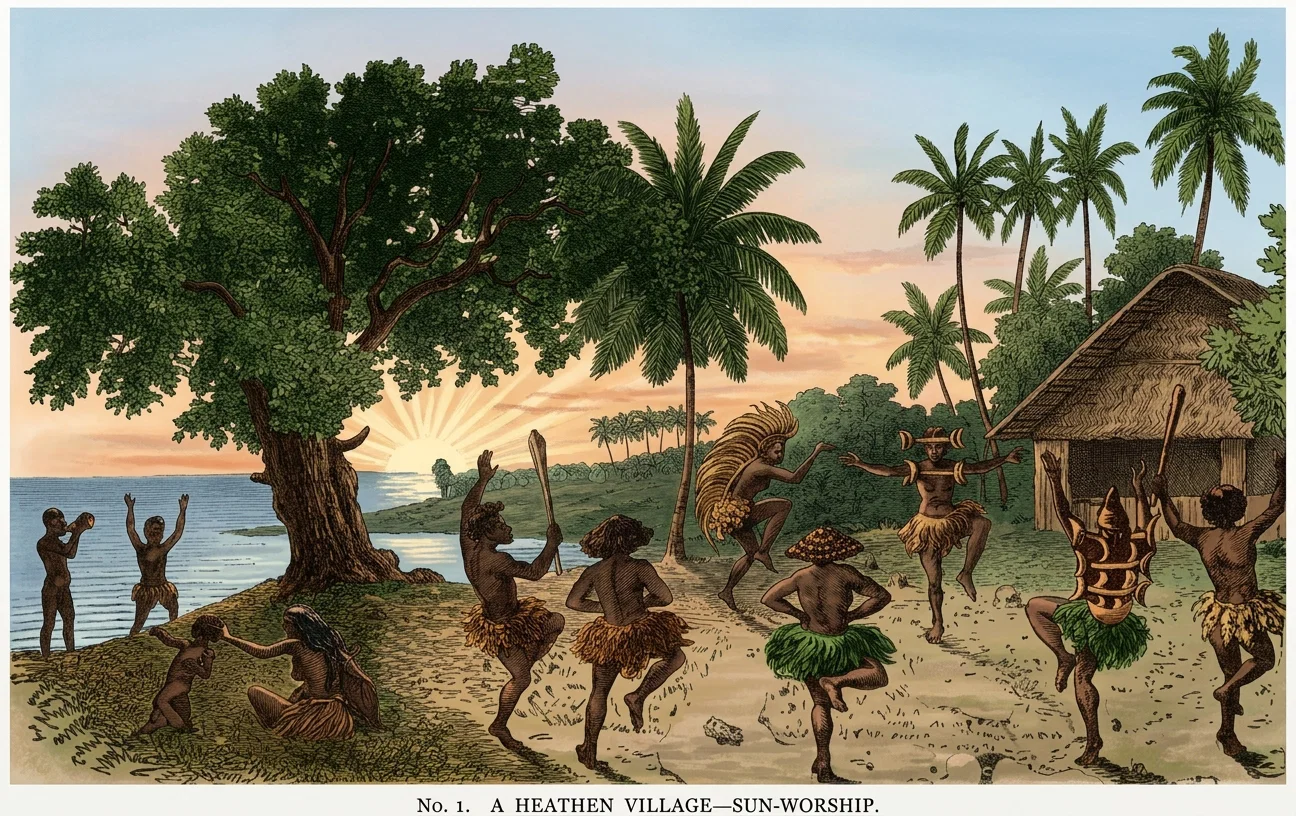
NO. 1. A HEATHEN VILLAGE—SUN-WORSHIP.
"Why Dost Thou Glory?"—The question may profitably be pressed home by each one of them to his own heart. "What hast thou that thou didst not receive?" Not many centuries ago those lands now called Christian, where these scoffing unbelievers dwell, were heathen lands. Most of the people were worshippers of nature in various forms. The most widespread and the most abominable of all these forms of worship was sun-worship. Our cut shows one of its milder and most harmless demonstrations. But every sin in the catalogcould find shelter under its broad mantle. It was noted for the most abominable licentiousness. Prostitution of female purity at its shrine was a part of its worship. Human life was frequently demanded as a part of its sacrifices. Our Anglo-Saxon ancestry were worshipers in these abominable idolatries. And had God allowed them to go on in their chosen blindness, there we would have been if we had been at all.
NO. 2. THE SAME VILLAGE UNDER CHRISTIANITY.
But Christianity, pure, fair-faced, white-winged, and clean-handed, born from above, strong in the strength of the Mighty One, with the love and pity of the Infinite, entered the dark forests of idolatry. Wherever she went, light streamed, day dawned, idol temples fell, heathen shrines crumbled, human life and virtue became sacred, and the whole face of the earth was changed. As the years passed on, while the power was sensibly diminished in its marked manifestations as seen in its earlier day, its teachings broadened and spread; and while many times the form exists without the power, even the form reveals its superiority over those of all false religions, the code of morality higher and purer. Its ethical teachings have permeated the world, and while those relating to God are abjured by many, those relating to men are accepted generally by all; and the innate force of these teachings has made the grosser sins and crimes of heathenism unpopular. The conclusion is, therefore, that all that is good and true and pure and noble and lovely in the teaching and life of the skeptic has come to him from Christianity, its source; for had it not been for Christianity, he would still be causing his son to pass through fire, and his daughters and wife would still lay down their virtue at the shrine of sun-worship. But now like an angry babe he smites the breast which gave him nourishment. He uses his God-given knowledge to curse God. He tramples on the Book, as his prototypes did its Author, which has brought him the best blessings of purity, home, and health. "What hast thou that thou did not receive?" Then "why dost thou boast?"

A Difference.

We are not defending the sins which have been committed in the name of Christianity. We are not defending the inconsistency of Christians. They have no defense. The loudest skeptics are themselves witnesses that the teachings of the Bible and the example of Christ do not justify the crime, the sin, the oppression, the persecution, the selfishness of professed Christians. It is a sad fact that the world is rapidly drifting backward, and much of professed Christianity is but heathenism disguised. What matters it whether our belief be carved in a cold, dead image, or penned in a cold, dead creed? When a matter of life or death faces us, what matters it even tho one form of worship be a little superior to another form? It is life the sick and dying world needs; and Christianity is that life. All that is good or pure or blessed or elevating or sanctifying comes from that, flows out from the ever-living, flowing Fountain to every thirsty soul who would drink.

The Supremely Sure Test.

This is the sure test, repeated in varied forms in the Book of God: "If any man will do his will, he shall know of the doctrine." This is the supreme test, the one sure proof of the truthfulness of God's word and the power of Christianity. He who thus makes proof will be satisfied. He will not boast himself. He will give all the glory to God, and God will bestow of his own glory upon him.

THE "MORE SURE WORD OF PROPHECY."

Through Christ.

"PROPHECY" as used in the Word of God covers foretelling future events and teaching by the Spirit. In a broad sense it permeates every part of the Word of God; but in a narrower sense, the prediction of future events, it comprises, either in described symbols or words, a great part of the Bible. Not alone do we have the predictions of events to come by Moses, Isaiah, Jeremiah, Daniel, Ezekiel, and others, but every sacrifice offered, every ceremonial in feast and offering ordained of God, was a type of the Great Sacrifice and the work and coming of him whose Spirit spoke through the prophets.
For all the Word of God came through Christ, the Logos. "In the beginning was the Word. . . . Without him was not anything made that was made. In him was life; and the life was the light of men." "But to us there is but one God, the Father, of whom are all things; . . . and one Lord Jesus Christ, by whom are all things." The world was therefore created by him; the Word of God was given through him; the light and life and Spirit that are in him he has placed in his Word; for he declares, "The words that I speak unto you, they are spirit, and they are life." "Thy Word," says the psalmist, "is a lamp unto my feet, and a light unto my path." "We have also a more sure word of prophecy; whereunto ye do well that ye take heed, as unto a light that shineth in a dark place, until the day dawn, and the day-star arise in your hearts." "Of which salvation the prophets have inquired and searched diligently, who prophesied of the grace that should come unto you; searching what, or what manner of time the Spirit of Christ which was in them did signify, when it testified beforehand the sufferingsof Christ, and the glory that should follow." Many more passages of Holy Writ might be quoted to prove that all the Word of God came through Christ, the divine Logos, whose Spirit spoke through prophet and apostle. The light is his light, and to slight it, ridicule it, or reject it, is to reject its Author, the anointed Son of God.
The prophetic word of God, therefore, reveals to us Christ Jesus; and the events it foretells are those in connection with his kingdom and work. He reveals them for the benefit of his children. He warns them of danger; he points out the delusions and snares of the enemy, and he directs them to the only sure refuge, the Word of God received into the heart by faith. "Surely the Lord God will do nothing, but he revealeth his secret unto his servants the prophets." In the darkness he lightens the way. In the Babel of voices and the uncertainty of sin Jesus Christ has thus given to the world through his people faithful warning.
One of these remarkable prophecies, in which God has condensed into a few short verses the rise and fall of mighty empires, spanning the history of civilization, is found in the second chapter of Daniel. The symbol was a dream given of God six centuries before Christ to Babylon’s proudest and greatest king, Nebuchadnezzar. The dream could not be interpreted by the heathen wise men or magi, and a servant of the Most High God was brought before the monarch for the purpose of meeting the test which he had imposed upon the pretended revealers of secrets,—the dream must be told as well as the interpretation, under penalty of death. Daniel and his companions seek God, and the Lord reveals to him the dream, as follows:—
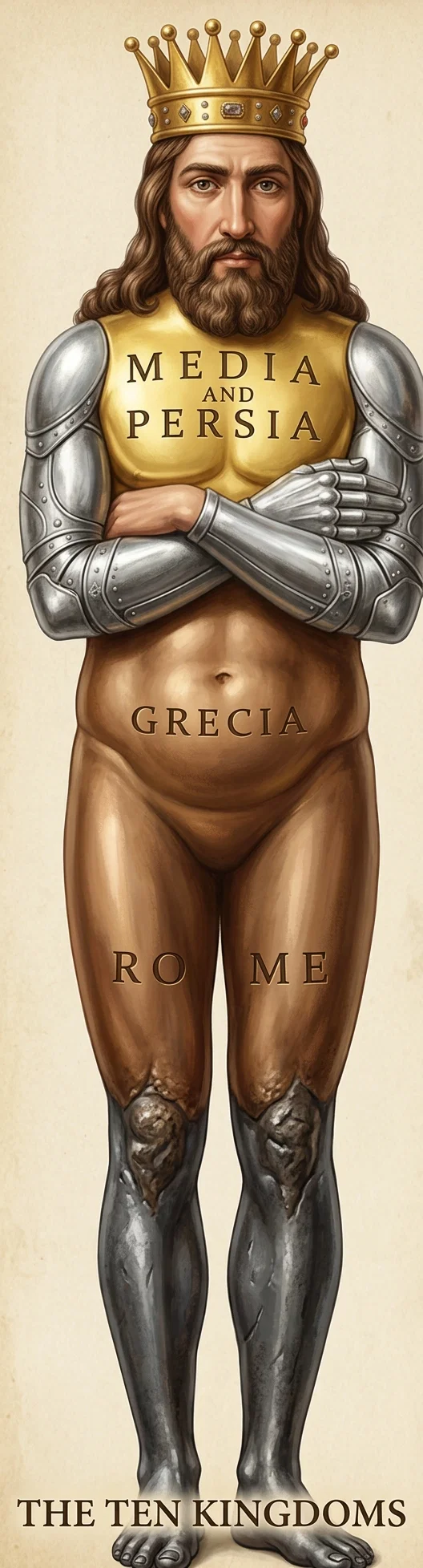
"Thou, O king, sawest, and behold a great image. This great image, whose brightness was excellent, stood before thee; and the form thereof was terrible. This image’s head was of fine gold, his breast and his arms of silver, his belly and his thighs of brass, his legs of iron, his feet part of iron and part of clay. Thou sawest till that a stone was cut out without hands, which smote the image upon his feet that were of iron and clay, and brake them to pieces. Then was the iron, the clay, the brass, the silver, and the gold, broken to pieces together, and became like the chaff of the summer threshing floors; and the wind carried them away, that no place was found for them; and the stone that smote the image became a great mountain, and filled the whole earth." Dan. 2:31-35.
This is the dream, the purpose of which, the prophet tells us, was that the king might know "what shall be in the latter days." Verse 28. It is written for us that "we through patience and comfort of the Scriptures might have hope." Rom. 15:4. After the dream, the prophet proceeds to tell to the king and the generations of the last days the meaning. He begins with the

Head of Gold,

which he applies to Nebuchadnezzar and his kingdom in the following words: "Thou, O king, art a king of kings; for the God of heaven hath given thee a kingdom, power, and strength, and glory. And wheresoever the children of men dwell, . . . hath he given into thine hand, and hath made thee ruler over them all. "Thou art this head of gold." This is a definite starting-point. In the shadowy past it carries us back to Nimrod, the mighty hunter of men, the leader in rebellion against God, the builder of the tower of Babel, and the founder of the kingdom of Babylon, the antitype of the great apostate powers which should afterward exist upon earth. (See Gen. 10:8-10; 11:1-9.) Nebuchadnezzar stood as the representative of the golden kingdom of the golden age of barbaric splendor and glittering pomp. The center of that kingdom was the city of Babylon, fifteen miles square, surrounded by moat and wall of gigantic proportions, containing the temple of Belus, three miles in circumference, and two royal palaces, respectively three and one-half and eight miles in circumference, the roofs to a portion of these covered with golden plates; the gates of brass, through the wall three hundred and fifty feet high, the hanging gardens luxuriant with tropical vegetation, and many other beauties we have not space to describe, made the royal city of Babylon what Inspiration has described it to be, "the Glory of Kingdoms, the Beauty of the Chaldees’ Excellency." Isa. 13:19.
But the same prophecy assures us that this city would pass away. While the principles of Babylon would remain, while the earth would become drunken by her fornication, her departure from God, her false doctrines respecting God and his government (Jer. 51:7), yet Babylon, mighty in her supposed strength and proud in her superficial glory, should pass away. "Babylon is fallen," says the weeping prophet (Jer. 51:8); "And after thee shall arise another kingdom inferior to thee," declares Daniel (chapter 2:39). To Babylon succeeded

Medo-Persia.

Isaiah predicted through whom that kingdom should fall two hundred years before it came to its doom. Before Cyrus the Persian, God would "loose the loins of kings, to open before him the two-leaved gates; . . . I will break in pieces the gates of brass, and cut in sunder the bars of iron." See Isa. 45:1-3. The last king of Babylon was the weak; bibulous, effeminate Belshazzar, who reigned conjointly with his father, Nabonidus, when the city fell. The account of the fall of the city is given in Daniel 5, Belshazzar’s doom being written before him by the hand of the angel in letters of fire on the night of his last inglorious, idolatrous, blasphemous debauch. "Mene, mene, tekel, upharzin," wrote the angel. "God hath numbered thy kingdom, and finished it; thou art weighed in the balances, and art found wanting; thy kingdom is divided, and given to the Medes and Persians," interpreted the prophet. And the sacred record continues: "In that night was Belshazzar the king of the Chaldeans slain. And Darius the Median took the kingdom." This occurred in B.C. 538, and the course of empire passed from Babylon to

Medo-Persia.

This empire is represented by the breast and arms of silver, a metal inferior to gold in value and beauty, but superior in strength. It is represented by the bear in Dan. 7:5, and by the two-horned ram in Dan. 8:3, 4. Of this dual empire Media at first was dominant, but it afterward became absorbed by Persia, the latest in point of time, but the greatest in point of power. Medo-Persian rule began in A.D. 538, and continued to B.C. 331, when the reigning king, Darius Codomannus, met his defeat at the battle of Arbela, before Alexander the Great. It was during the existence of the Medo-Persian Empire that the people of God were released from captivity, through Cyrus the Great. Jerusalem and the temple were rebuilt and the Jewish polity to a limited extent restored under the decrees of Cyrus Darius, and Artaxerxes. The decree of the last named went forth in B.C. 457, when began the 2,300 years of Dan. 8:14. To Medo-Persia succeeded

The Empire of Grecia,

the "third kingdom of brass, which shall bear rule over all the earth." It began its triumphant career to universal dominion under Alexander the Great, the conqueror of Darius Codomannus, B.C. 331, as before noted. In chapters 7 and 8 the same power is symbolized by a four-headed leopard and a rough goat respectively. This empire in the image extends from the breast to the knees. Tho united in the beginning, soon after the death of the greatest monarch, Alexander, it became divided, and thus weakened, until it was absorbed into the iron kingdom, represented by the legs and feet of the image. It was during the existence of the Grecian Empire—B.C. 331 to B.C. 161—that the knowledge of God was spread through the learned world by the translation of the Scriptures into the Greek. This translation is known as the Septuagint.

The Roman Empire.

"And the fourth kingdom shall be strong as iron; forasmuch as iron breaketh in pieces and subdueth all things; and as iron that breaketh all these, shall it break in pieces and bruise." Thus declares the prophet, of the fourth kingdom. The language can apply to but one kingdom, namely, Rome; for not only did Rome succeed Grecia, but the description of the character of the power applies to the character of the Roman Kingdom. For other symbols of the same power see the descriptionof the prophet in chapters 7 and 8, of the fourth beast and the little horn. Frequently, if not always, the kingdoms of earth are noted in the prophetic word when they become connected with the people of God, or in any way affect his work. A striking event in connection with the advancing empire of Rome was the conquering of Macedonia, B.C. 168. Seven years later came the Roman league with the Jews, and from that rapid progress was made to world-wide empire, completed by the conquest of Egypt, B.C. 30.

A Divided Kingdom.

"Iron" is the symbol of a strong centralized government, or imperialism. Clay, or earth, indicates that the people rule, and is a fitting symbol of democracy, division, and weakness. Of the fourth kingdom the prophet further says:—
"And whereas thou sawest the feet and toes, part of potters' clay, and part of iron, the kingdom shall be divided; but there shall be in it of the strength of iron, forasmuch as thou sawest the iron mixed with miry clay. And as the toes of the feet were part of iron, and part of clay, so the kingdom shall be partly strong, and partly broken." Note that the division is not indicated by the natural division of the extremity of the foot into the toes; for (1) the division begins above the toes, in the feet, and (2) the Word expressly declares that it is caused by the commingling of the iron and the clay. The two will not mix, or weld, or blend. The mixture indicates a division which can not be overcome. It will exist even to the end. The strength of imperialism will mingle with the clay of division and anarchy.
The Roman Empire remained a unit until the fourth century, when its breaking up began by dissatisfaction in the central territory, in the provinces, in the leaders in these provinces, and by the incursions of barbarous and warlike tribes, like the Huns, from without. Since that time the Roman Empire has been divided between the various powers of Europe; and the prophecy declares that its division will continue to the end. And yet many have endeavored to unite it. Charlemagne made the effort, and failed. Charles V. dreamed of a united empire, and his dream came to naught. Napoleon thought to weld together into one iron imperialism the nations of Europe, and through the power thus gained bear sway over the world, but his proud ambition was rebuked. God's providence fulfilled God's prophecy, or rather prevented puny man from making it void. The empire is divided still, and will be unto the end. "They shall mingle themselves with the seed of men," effort will be made to unite by intermarriage of royal families; "but they shall not cleave one to another, even as iron is not mixed with clay."
We are in the days of the divided kingdom still; but beyond that lies the everlasting kingdom of God, the rule of the Stone cut out of the mountains without hands. This we will consider next week. In the meantime let us consider not only the wisdom and power of God, which foreknew and foretold the history of the world, and the evanescence of earthly rule, in which there is no hope, but his goodness, that sets before us in contrast the everlasting kingdom, which is offered freely to all who will believe.

A LESSON FROM THE LIFE OF JUDAS.

JUDAS was one of the twelve disciples who were chosen to be coworkers with Christ. He was intrusted with the little fund made up from the contributions of the believers, but he had not been fitted for the position of trust which he occupied. Covetousness had not been cleansed from his heart, but was cherished and cultivated. By his unsanctified, subtle reasoning, he magnified his position to one of great importance. His avarice grew as it was indulged, until it was fast becoming the most prominent feature of his character.
The evils of covetousness and avarice, injustice and fraud, were plainly dwelt upon by the Saviour. And, altho the name of Judas was not called, nor direct application made to him, yet he felt himself guilty of these things. But he did not separate himself from sins so hateful, and purify his soul by obeying the words of Jesus. Instead of this, he took offense at the word spoken to correct the growing evils of the attributes of Satan.
The principles that should govern the heart made new were constantly the theme of the teachings of Christ. But they were not received by Judas. The lessons which the other disciples received and acted upon provoked Judas. Under the impulse of Satan, he acted directly contrary to the principles that Christ was endeavoring to inculcate as to what constitutes Christian character. A power was working from the heart that had been left unclean, unholy, and unsanctified. Tho Judas professed to be a disciple of Christ, this inward principle was constantly at work, and from time to time overmastered him, causing him to give expression to the propensity that was corrupting the whole man. The very principle of the Gospel enjoining mercy to the poor, was made an excuse for his covetousness. On the plea of waste, he made objection when Mary anointed the feet of her Master with the precious ointment.
Christ was in sympathy with suffering humanity. His efforts were always put forth to uplift and restore, never to weaken, to oppress, or destroy. The truly converted man will in heart and life make manifest the outworking of the divine life. The weak and unfortunate will ever awaken in his heart feelings of tender pity and Christlike compassion. There will be no hardness of heart, no harsh, coarse spirit. The water of life, as an inner spring, will be ever uprising to bless all within the sphere of his influence. By such, gifts and offerings are brought to God with a willing heart, a ready mind. They perform acts of mercy and benevolence, not because they are compelled to do so, but because they are partakers of the divine nature, partakers of the character of Christ.
Had Judas had that true life of which Christ is the substance and the source, he would have fed upon that which is conducive to growth in Christ, the bread of life. Cherishing in his heart the life of Christ, feeding on the bread which came down from heaven, he would have had the power of assimilation to Christ. He would have appropriated the nutriment of the living bread,—would have received into his own nature the spirit and life of the words of Christ, and thus would have become one with him. He would have become, in character, all that he professed to be.
True life is progressive; wherever there is life, there is growth. Had Judas been a doer of the words of Christ, had Christ been abiding in his heart by faith, this growth would first have been manifested in a downward course,—in lowly, humble acquaintance with himself and with God. He would have been learning the lessons that Christ gave to his disciples when he asked them, "What was it that ye disputed among yourselves by the way?" The subject of the conversation had been who should be the greatest in the kingdom of heaven. It was a matter that should never have come into their conversation, for its tendency was to arouse selfish feelings, selfish expressions, and eclipse the love of Christ in the soul.
Taking a little child, and setting him in the midst of them, Christ said: "Verily I say unto you, Except ye be converted [from your own natural, selfish characters], and become as little children [free from guile, hypocrisy, and all selfishness and unkindness], ye shall not enter into the kingdom of heaven. Whosoever therefore shall humble himself as this little child, the same is greatest in the kingdom of heaven. And whoso shall receive one such little child in my name receiveth me. But whoso shall offend one of these little ones which believe in me, it were better for him that a millstone were hanged about his neck, and that he were drowned in the depths of the sea." What a lesson is this, not only for the disciples and Judas, but also for all who believe on Christ to-day!
Judas heard all this, but he thought, as many think to-day, that such teaching was uncalled for. But if this were so, why did Christ dwell upon such themes? He further added: "Wo unto the world because of offenses! for it must needs be that offenses come; but wo to that man by whom the offense cometh! Wherefore if thy hand or thy foot offend thee, cut them off, and cast them from thee; it is better for thee to enter into life halt or maimed, rather than having two hands or two feet to be cast into everlasting fire. And if thine eye offend thee, pluck it out, and cast it from thee; it is better for thee to enter into life with one eye, rather than having two eyes to be cast into hell fire."
Here Christ would teach us that the character-building needs close and careful attention. This is the work that Judas' keen perception might have discerned if he had received the lessons which Christ sought to teach him. His objectionable traits of character would then have disappeared, and he would have become meek and lowly of heart, like his Master.
And this work is something that we as well as Judas must do. Those who have hereditary tendencies to evil, those who are putting forth thorn branches to wound all with whom they come in contact, should see that the offending members are cut away. Painful as this work may be of separating the evil from our character, it must be done. Selfishness and covetousness, which is idolatry; the harsh and unkind spirit, that, manifested in word or deed, will wound and destroy souls, must be taken out of the life, or the entire man will become offensive to himself and to God. His hard-heartedness will cause him to neglect the very ones who need his help.
"Seeing ye have purified your souls in obeying the truth through the Spirit unto unfeigned love of the brethren, see that ye love one another with a pure heart fervently; being born again, not of corruptible seed, but of incorruptible, by the Word of God, which liveth and abideth forever. For all flesh is as grass, and all the glory of man as the flower of grass. The grass withereth, and the flower thereof falleth away; but the Word of the Lord endureth forever. And this is the Word which by the Gospel is preached unto you."
This is the bread which came down from heaven, even the Word of God. And this Word, received and appropriated by the living agents, will produce that faith which works by love, and purifies the soul. It will cut away the hereditary tendencies to evil, and the wrong traits of character that have been strengthened by cultivation. However dearly we may prize these, it is better to separate them from our life practise now than to have their predominating power defiling and corrupting the whole man. And not only this, they destroy our influence for good, and, instead of being a savor of life unto life, we become a savor of death unto death.
"Wherefore laying aside all malice, and all guile, and hypocrisies, and envies, and all evil speakings, as new-born babes, desire the sincere milk of the Word, that ye may grow thereby; if so be ye have tasted that the Lord is gracious. To whom coming, as unto a living stone, disallowed indeed of men, but chosen of God, and precious, ye also, as lively stones, are built up a spiritual house, an holy priesthood, to offer up spiritual sacrifices, acceptable to God by Jesus Christ." Judas might have been all this. Blessed as he was with abundant opportunities of eating of the bread of life, he might have formed a firm, Christlike character.
"Wherefore also it is contained in the Scripture, Behold, I lay in Sion a chief corner-stone, elect, precious; and he that believeth on him shall not be confounded. Unto you therefore which believe he is precious; but unto them which be disobedient, the stone which the builders disallowed, the same is made the head of the corner, and a stone of stumbling, and a rock of offense, even to them which stumble at the Word, being disobedient; whereunto also they were appointed."
God has given his only-begotten Son to our world as our sin-bearer, that he might take away our iniquities. Through his divine merits, every son and daughter of Adam who will believe on him as the Way, the Truth, and the Life, will be presented faultless before the presence of his glory with exceeding joy. Those who return to their loyalty to God are precious in his sight; for Christ died to redeem these souls from the bondage of sin; he died to secure the eternal happiness of fallen man.
And "he that spared not his own Son, but delivered him up for us all, how shall he not with him also freely give us all things?" Our Redeemer has risen from the dead. He led captivity captive, and gave gifts unto men. And now he ever liveth to dispense his blessings in rich currents of grace and power as the circumstances of his believing children may require. And to the sinner his voice is heard in loving invitation: "Incline your ear, and come unto me; hear, and your soul shall live; and I will make an everlasting covenant with you, even the sure mercies of David." "As many as received him, to them gave he power to become the sons of God, even to them that believe on his name."
MRS. E. G. WHITE.

MY HOME BEYOND THE TIDE.

O my beautiful home beyond the tide, We yearn for thy silvery streams, But through the gathering gloom of earth A wonderful brightness gleams! O the blessed rest and perfect joy On heaven's immortal shore! As time goes by on fleeting wings, I long for it more and more.
A. R. WILCOX.
Athens, Vt.

Love Is Essential

WHATEVER we do or suffer without love profits us nothing.—John Wesley.

GOD MANIFEST IN THE FLESH.

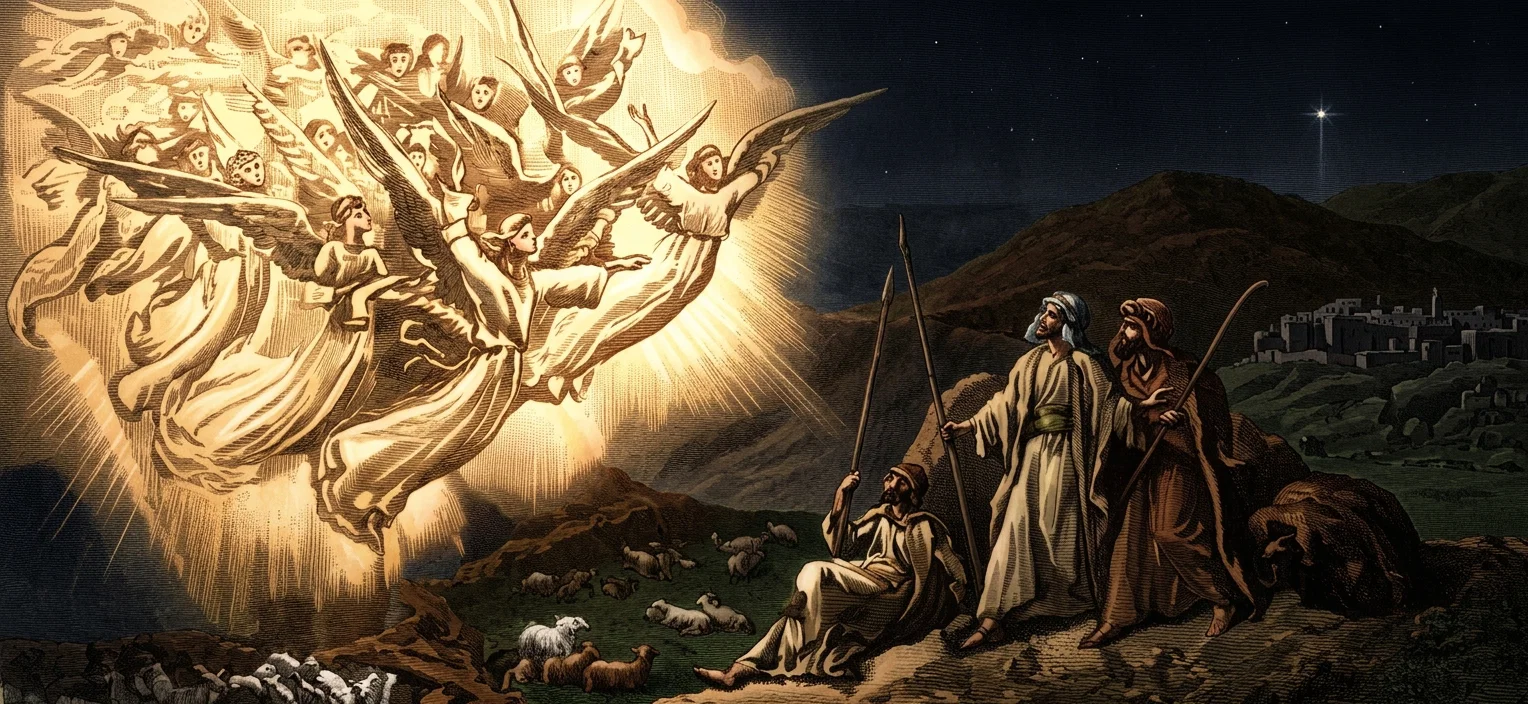
As CENTURIES rolled on and the generation appeared who were to witness the advent of the promised Messiah, there were devout men and women watching and waiting for "the consolation of Israel." Luke 2:25. And when the time was at last fulfilled, and the Creator of worlds appeared in human form, shepherds in the night watches on the silent hills of Judea heard heavenly music such as never had greeted mortal ears before, a chorus of angels, "praising God, and saying, Glory to God in the highest, and on earth peace, good-will toward men." Luke 2:14. The shepherds came in haste to the city of David, and found there the sinless Babe of Bethlehem lying in a manger, "because there was no room for them in the inn." Luke 2:7. Think of this, you who dwell in homes of affluence and ease. The Lord of worlds on high came to save a ruined race from eternal death, and there was no room for him. And this was the key-note of our Lord's life on earth. "He came unto his own, and his own received him not." John 1:11.
How many hearts are to-day like the inn of Bethlehem,—there is no room in them for the Christ! But, thank God, there are hearts who welcome the divine Guest. There came wise men from the far east, directed by a guiding star, and when they saw the young child, they fell down and worshiped him, and presented him with royal gifts, "gold, and frankincense, and myrrh." Matt. 2:11.
“And there were in the same country shepherds abiding in the field, keeping watch over their flock by night. And, lo, the angel of the Lord came upon them, and the glory of the Lord shone round about them; and they were sore afraid. And the angel said unto them, Fear not; for, behold, I bring you good tidings of great joy, which shall be to all people. For unto you is born this day in the city of David a Saviour, which is Christ the Lord. . . . And suddenly there was with the angel a multitude of the heavenly host praising God, and saying, Glory to God in the highest, and on earth peace, good-will toward men.” Luke 2:8-14.
And after eight days, the devout Simeon, unto whom the Holy Spirit had revealed that he should not see death until he had seen the Lord's Christ, came by the Spirit into the temple, and when he saw the infant Jesus, he took him in his arms and blessed God and said, "Lord, now lettest thou thy servant depart in peace; . . . for mine eyes have seen thy salvation; . . . a light to lighten the Gentiles, and the glory of thy people Israel." Luke 2:29-32. By the Holy Spirit, Simeon saw in this helpless babe the long-promised "Seed of the woman," he who should redeem Israel, and in whom all nations of the earth should be blessed, and looking forward, as the Spirit gave him utterance, he prophesied, "This child is set for the fall and rising again of many in Israel; and for a sign which shall be spoken against." Luke 2:34.
And thus the Christ child came to earth. The Lord himself was made flesh and dwelt among us. Let us in coming years contemplate the only one perfect character this world has ever witnessed, and drink in of his life.
And may the Lord grant us a meek and lowly heart, and through the blessed influence of the Holy Spirit, guide us into all truth.
"Calm, on the listening ear of night, Come heaven's melodious strains, Where wild Judea stretches far Her silver-mantled plains."
AUGUSTA W. HEALD.
Continue reading: FEDERATION, ALIAS TRUST