Your ShelfYour Projects

Review and Herald, Vol. 90, No. 34.

ICHABOD

Review and Herald

Aug 21, 1913

Review and Herald Publishing Association · Takoma Park, Washington, D. C. · Aug 21, 1913

ICHABOD

"The glory is departed." Israel's day Of woe has come. Eternity alone Can fathom all the depths of awful doom Those words reveal. Shadow of death where once was light of God; Well say the sorrowing women, Ichabod.
O Israel, thy tents had once been fair. How amiable thy tabernacles were! Thy situation beautiful, the joy Of all the earth. Mount Zion which God loved Had sent her daughters forth in song and dance To tell of all thy comeliness. The queen Of Sheba came to hear the wisdom of Thy mighty king, and witness gave to all That half had not been told. Thy goodly land and Lebanon were known Through all the earth, and marveled at, and praised.
From whence thy greatness, glory, knowledge, power? From whence such wisdom midst a band of slaves? From whence?—From heaven; for, in thee the God Of heaven had found a dwelling-place. In hearts Made humble and devoid of earthly pride The Almighty One did tabernacle, Dispensing heavenly fragrance o'er the earth.
O Israel, hadst thou known in thy great day The things pertaining to thy peace, thou still Hadst kept thy heart in all humility, And trusted in thy God. But, O, the pity! Lifted up in pride of borrowed beauty, Spoiled by vain philosophy of heathen rites, Thou hast forsaken all that made thee great. Thy God is driven from His dwelling-place. Despised and barred from entrance to thy heart, His presence has departed. Ichabod— Well say thy sorrowing women, Ichabod.
Ancon, C. Z.
PRICES, POST-PAID
PRICES, POST-PAID

"Digestive Disorders," "Good Bread," and "Pellagra" Number

DON'T MISS READING IT! AGENTS WILL FIND IT A RAPID SELLER
Sixty-five Articles Thirty Illustrations

SOME SEPTEMBER FEATURES

Beautiful Three-Color Cover Digestive Disorders The World's Bread The Staff of Life—No. 2 Proper Kneading of Good Bread Americanized Coffee Cakes—No. 1 Types of Digestive Disorders Causes of Pellagra Diet and Constipation Tuberculosis — Prevention of Correct Styles for Women Smoking in Public Places Nurse's Experience in Uruguay A Prayer for Efficiency Coffee Substitute News Notes Questions and Answers, etc.

BE OUR AGENT!

Send 10 cents for sample copy and particulars. Pleasant and profitable work the year round.
Remit $1.00 for 20 copies; $2.00 for 50; $4.00 for 100; $8.00 for 200. Fifty or more, 4 cents each, post-paid.

ORDER THROUGH OUR NEAREST AGENCY

(If you do not know the address of our Agency, ask "Life and Health," Washington, D. C.)

SEPTEMBER NUMBER NOW READY!

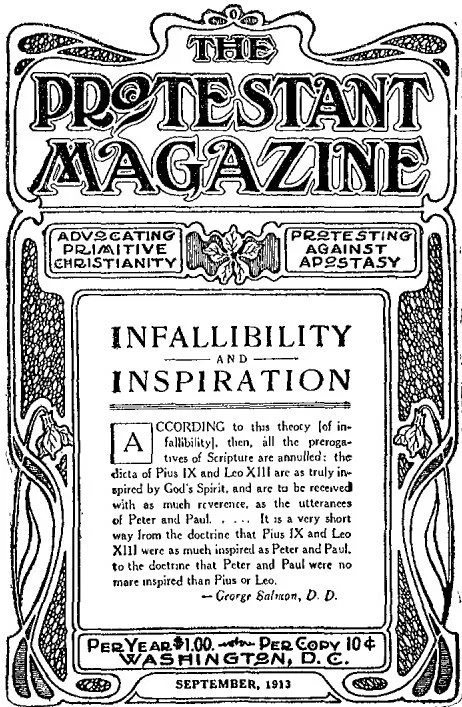
"Infallibility," "Religious Liberty," and "Papacy in Prophecy" Special Subscribe now! If you have never read this valuable magazine, send 10 cents in stamps for sample copy.

SOME SEPTEMBER FEATURES

Striking Double Frontispiece: "Roman Catholic Chaplains and Government Officials"—"The Luther of the Nineteenth Century" The Roman Catholic Perversion of Religious Liberty The Infallibility of the Pope The Dogma of Infallibility a Menace to the State What Becomes of the Peter's Pence Collection? The Papacy Foretold in Prophecy Reformation Teaching The Divine Origin of the Scriptures Condoning Mob Violence Another Military Mass A Catholic Event Demanding Pay for Valuable Services Romanizing America "Tenants at Will" A Catholic Germany Finding the Easiest Way to Heaven The Influence of Protestantism in Italy Twenty Editorial Briefs

Liberal terms to agents. Write for particulars.

TO TEN FRIENDS: You can send $3.00 for 10 six months' (or 5 yearly) subscriptions, in behalf of friends. Five or more copies, mailed by the publishers to five addresses, or to one address, post-paid, each, 5 cents.

ORDER THROUGH OUR NEAREST AGENCY

(If you do not know the address of our Agency, ask "Protestant Magazine," Washington, D. C.)
PRICES, POST-PAID
PRICES, POST-PAID

Elijah the Tishbite

(Concluded)

Divine Retribution

THE prophet's words went into immediate effect. Those who were at first inclined to scoff at the thought of calamity, soon had occasion for serious reflection; for after a few months the earth, unrefreshed by dew or rain, became dry, and vegetation began to wither. As time passed, streams that had never been known to fail, began to decrease, and the brooks to dry up. Yet the people were urged by their leaders to have confidence in the power of Baal, and to set aside as idle words the prophecy of Elijah.
The priests insisted that it was through the power of Baal that the showers of rain fell. Fear not the God of Elijah, nor tremble at his word, they urged; it is Baal who brings forth the harvest in its season, and provides for man and beast. The idols of wood and stone, representing him, should still be worshiped.
God's message to Ahab gave Jezebel and her priests and all the followers of Baal and Ashtoreth opportunity to test the power of their gods, and to prove the word of Elijah false. Against the assurances of hundreds of idolatrous priests, the prophecy of Elijah stood alone. His words had locked heaven. If, notwithstanding his declaration, Baal could still give dew and rain, causing the streams to continue to flow and vegetation to flourish, then let the king of Israel worship him, and the people say that he is God.
Determined to keep the people in deception, the prophets of Baal continue to offer sacrifices to their gods and to call upon them night and day to refresh the earth. With costly offerings the priests attempt to appease the anger of their gods; with a zeal and a perseverance worthy of a better cause they linger round their pagan altars, and pray earnestly for rain. Night after night, throughout the doomed land, their cries and entreaties arise. But no clouds appear in the heavens by day to hide the burning rays of the sun. No dew nor rain refreshes the thirsty earth. The word of the Lord stands unchanged by anything the priests of Baal can do.
A year passes, and yet there is no rain. The earth is parched as if with fire. The scorching heat of the sun destroys what little vegetation has survived. Streams dry up, and lowing herds and bleating flocks wander hither and thither in distress. Once flourishing fields have become like burning desert sands,—a desolate waste. The groves dedicated to idol-worship are leafless; the forest trees, gaunt skeletons of nature, afford no shade. The air is dry and suffocating; dust-storms blind the eyes and nearly stop the breath. Once prosperous cities and villages have become places of mourning. Hunger and thirst are telling upon man and beast with fearful mortality. Famine, with all its horrors, comes closer and still closer.
Yet, notwithstanding these evidences of God's power, Israel repented not, nor learned the lesson that God would have them learn. They did not see that he who created nature controls her laws, and can make of them instruments of blessing or of destruction. Proud-hearted, enamored of their false worship, they were unwilling to humble themselves under the mighty hand of God, and they began to cast about for some other cause to which to attribute their sufferings.
Jezebel utterly refused to recognize the drought as a judgment from Jehovah. Unyielding in her determination to defy the God of heaven, she and nearly the whole of Israel united in denouncing Elijah as the cause of all their misery. Had he not borne testimony against their forms of worship? If only he could be put out of the way, she urged, the anger of their gods would be appeased, and their troubles would end.
Urged on by the queen, Ahab instituted a most diligent search for the hiding-place of the prophet. To all the surrounding nations, far and near, he sent messengers to seek for the man whom he hated, yet feared; and in his anxiety to make the search as thorough as possible, he required of these kingdoms and nations an oath that they knew nothing of the whereabouts of the prophet. But the search was in vain. The prophet was safe from the malice of a king whose course had brought upon the land the denunciation of an offended God.
Failing in her purpose to destroy Elijah, Jezebel determined to avenge herself by slaying all the prophets of the Lord in Israel. Not one who claimed to be a prophet of the Lord should live. The infuriated woman carried out her purpose in the massacre of many of God's servants. Not all, however, perished. Obadiah, the governor of Ahab'shouse, yet faithful to God, "took a hundred prophets," and at the risk of his own life, "hid them by fifty in a cave, and fed them with bread and water."
The second year of famine passed, and still the pitiless heavens gave no sign of rain. Drought and famine continued their devastation throughout the kingdom. Fathers and mothers, powerless to relieve the sufferings of their children, were forced to see them die. Yet still apostate Israel refused to humble their hearts before God, and continued to murmur against the man by whose word these terrible judgments had been brought upon them. They seemed unable to discern, in their suffering and distress, a call to repentance. They failed to see in their calamity a divine interposition to save them from taking the fatal step beyond the boundary of Heaven's forgiveness.
The apostasy of Israel was an evil more dreadful than all the multiplied horrors of famine. God was seeking to free the people from their delusion, and lead them to understand their accountability to the One to whom they owed their life and all things. He was trying to help them to recover their lost faith, and he must needs bring upon them great affliction. "The Lord is gracious, and full of compassion; slow to anger, and of great mercy." "Though he cause grief, yet will he have compassion according to the multitude of his mercies. For he doth not afflict willingly nor grieve the children of men."
"Have I any pleasure at all that the wicked should die? saith the Lord God; and not that he should return from his ways, and live?" "Cast away from you all your transgressions, whereby ye have transgressed; and make you a new heart and a new spirit: for why will ye die, O house of Israel? for I have no pleasure in the death of him that dieth, saith the Lord God; wherefore turn yourselves, and live ye." "Turn ye, turn ye from your evil ways: for why will ye die, O house of Israel?"
God had sent messengers to Israel appealing to them to return to their allegiance. Had they heeded these appeals, had they turned from Baal to the living God, Elijah's message of judgment would never have been given. But the warnings that might have been a savor of life unto life, proved to them a savor of death unto death. They allowed the words of God's messengers to wound their pride, and their hatred was aroused against these messengers, and particularly against Elijah. In the face of calamity, they stood firm in their idolatry, and looked upon the prophet as the cause of all their troubles. Thus they added to the guilt that had brought the judgments of Heaven upon the land. If Elijah had been in their power, they would gladly have delivered him to Jezebel,—as if by silencing his voice they could stay the fulfilment of his words!
For stricken Israel there was but one remedy,—a turning away from the sins that had brought upon them the chastening hand of the Almighty, and a turning to the Lord with full purpose of heart. To them had been given the assurance, "If I shut up heaven that there be no rain, or if I command the locusts to devour the land, or if I send pestilence among my people; if my people, which are called by my name, shall humble themselves, and pray, and seek my face, and turn from their wicked ways; then will I hear from heaven, and will forgive their sin, and will heal their land." It was to bring to pass this blessed result that God continued to withhold from them the dew and the rain until a decided reformation should take place.

What Doest Thou Here?

WORTHIE HARRIS HOLDEN
WHY longest thou to flee away in hiding, O trembling soul, perplexed with doubt and fear? Why thus cast down, within His care abiding,— Is not thy Helper near?
Thou hast been zealous for the Lord of glory, Why then art thou so fraught with grim despair? Amidst the gloom the specter doubts full hoary Inspire thy plaintive prayer.
God calls thee forth. Then wrap thy mantle round thee; No soul can bear his awful, righteous gaze. Fierce winds have spent, the quaking earth surrounds thee, And fearful fires blaze.
A calm,—and standing now before thy Maker, His still, small voice is answering thine own. "What doest thou here? I God am thy defender; Thou art not left alone."
Erelong the chariots of God shall take thee E'en to thy mansion in the courts of light. No force of earth or hell can e'er deter thee If valiant in his might.
Portland, Oregon.

The Greatest Religious Movement of the Ages; Another Pentecost Due

The Reformation

AFTER Pentecost the next great world movement, in the order of Heaven, was the Reformation, under Martin Luther and his associates. In this movement at least two definite specifications of prophecy were fulfilled, and men of God were in readiness to proclaim the message, and were qualified for their work by the baptism of the Holy Spirit.
The specifications of prophecy that were fulfilled were these: Evidently referring to the long period of papal persecution known as the dark ages, Christ said, "Except those days should be shortened, there should no flesh be saved: but for the elect's sake those days shall be shortened." Matt. 24: 21, 22. And again, referring to the same period, he said through his angel to John, "I will give power unto my two witnesses, and they shall prophesy." Rev. 11: 3. Having made these prophecies, it devolved upon Heaven to insure their fulfilment.
Relative to the first of these, it is a historical fact that the Reformation broke the persecuting power of the Papacy, causing the whole system to tremble at its very foundations, shortened the days of persecution, and saved the "elect," the people of God, from being utterly blotted out.
Concerning the literal fulfilment of the second prophecy, John William Draper, a secular writer, in his work entitled "Intellectual Development of Europe" (page 491), in discoursing upon the scathing criticism to which all classes of literature were subjected as a natural result of the unchaining of thought produced by the Reformation, pays glowing tribute to the Bible in these words: "From this burning ordeal, one book alone came out unscathed. It was the Bible. It spontaneously vindicated for itself what Wyclif in former times, and Luther more lately, had claimed for it. And not only did it hold its ground, but it truly became incalculably more powerful than ever it had been before." God's "two witnesses" are the Old and New Testaments, which constitute the complete Bible.
The only things that can be said to weaken the Bible are unbelief and the curtailing of its circulation among the people. During the papal supremacy, unbelief ran riot, and the Bible was a forbidden book to the masses of the people. An occasional chained copy could be found. But even in this state, power was given to it to inaugurate the Reformation, for, from a copy thus chained, Luther, himself a monk, obtained the flaming sword which he wielded to accomplish the Reformation. If there was any one thing above another that was characteristic of the Reformation, it was the power given to the Word of God in the movement. Jesus had said, "I will give power unto my two witnesses," to which the historian responds that one result of the Reformation was that the Bible "truly became incalculably more powerful than ever it had been before." The Reformation, therefore, was the direct agency of Heaven in the preservation of the people and the Word of God from extinction. One of the prophecies mentioned referred to the people, and the other to the Word of God. Thus it is evident that the mightiest, the most far-reaching heaven-appointed religious movement that the world had ever seen up to that time, was foretold by at least two specific prophecies, and God-fearing men, chosen of Heaven for the movement, were filled with the Spirit to proclaim the message.

The Announcement of Judgment

Following the Reformation of the sixteenth century, the next specific, prophetic, heaven-ordained movement in the realm of religion, world-wide in extent, was what is known as the advent movement of 1838-44. By a study of Daniel 8: 14; 9: 20-27; Ezra 7; and Revelation 10, there is no room for reasonable doubt that this mighty religious awakening, otherwise known as the William Miller movement, was a matter not simply of prophecy, but of definite time prophecy. That God had human agents in waiting to proclaim it, is evident from the fact that three thousand clergymen joined in its proclamation, that it reached every missionary station on the globe, and that two hundred and fifty thousand persons were converted by it.

The World's History to Close With a Series of Mighty Religious Movements

In the fourteenth chapter of Revelation (verses 6-12) we find a prophetic announcement of a series of three world-wide religious movements, which, in point of time, immediately follow the movement of 1844, and continue their work until the second coming of Christ. Verse 14. Each of these thrilling movements is typified by a herald angel flying through the midst of heaven, proclaiming his message. Beginning with this fixed time period (1844), the last messages of Heaven to mankind follow consecutively, in regular order, with no break nor interval between them,—expanding, unfolding, till the end of time.

How We May Forecast the Power to Attend the Last Religious Movement

We may get a correct idea of the power attending each of the great messages proclaimed in the closing scenes of this world's history, by the prophetically inspired description of the manner in which each herald angel delivers his message, and in some instances by the characteristics of the angel himself and of the effects and the extent of his message, as outlined by the prophet. In the description of the angel which prefigured the beginning of the last series of heaven-appointed, world-wide religious movements, we find these specifications, indicative of the power attending the message: He was "a mighty angel," he came "down from heaven," and he "cried with a loud voice, as when a lion roareth." Rev. 10: 1, 3. A definite suggestion of the fact that his message was to be world-wide in extent is found in the statement that "he set his right foot upon the sea, and his left foot on the earth."To give further emphasis to the fact that great solemnity and power would attend the message, it is stated that he "lifted up his hand to heaven, and sware," by the Creator, "that there should be time no longer." Verses 5, 6. The work of this same angel is brought to view in Rev. 14: 6, 7. Aside from the extent of the proclamation of the message of this angel and the character of his message, the only indications of power connected with the message are that he was seen to "fly in the midst of heaven," and that he spoke "with a loud voice." Of the next (verse 8) we have no hint of any special power to accompany the presentation of his message, with the possible exception that his words are repeated; while of the next angel in the series, there is a suggestion of power in the delivery of his message in the statement that it was proclaimed "with a loud voice." Verse 9.
Any person who is at all familiar with the manner in which these messages have been proclaimed, will at once recognize that these prophetic descriptions have been perfectly fulfilled. The mightiest religious awakening of modern times was the William Miller movement of 1838-44, thus answering to the inspired description of "a mighty angel," who, in delivering his solemn message, "cried with a loud voice, as when a lion roareth." It is too well known to require proof, that the proclamation of the next two messages in the series has been attended with a less degree of power than was the Miller movement, and that as regards the second of the three, we have even been cautioned by the spirit of prophecy, instead of proclaiming it with a loud voice, to soften its presentation. Have we not given much more force and stress to the first and to the third in this series than we have to the second? And was not this fact indicated with the utmost accuracy in that the first and the third were each to be proclaimed "with a loud voice"?
For threescore years we have been fulfilling certain details of prophecy in regard to the manner in which the threefold message must be proclaimed, and yet have not been conscious of it. Therefore there has been no studied effort on our part to fulfil these specifications; it has all come spontaneously, being prompted by the very inspiring Spirit of the messages. Were it possible to turn the wheels of time backward three quarters of a century to start the advent movement over again at the exact time prophetically foretold, it would be absolutely impossible that the details of the prophecy relating to the movement could be more literally fulfilled by men than they have been in the giving of the threefold message since the year 1844. Consequently when we cast a backward glance over the movement and discover that all details foretold have been so definitely and clearly fulfilled,—and that all unconsciously on our part,—how profoundly are we impressed that the movement with which we are connected is of God, and that its early triumph is certain. No people in the history of the world, except the Seventh-day Adventists, have claimed to fulfil this great advent movement, and no others today make any claim to fulfilling it now; and starting at the exact point when its fulfilment must begin, no others have fulfilled the details prophetically foretold of Heaven's last series of religious movements.
(To be continued) Phoenix, Ariz.

A Commendable Example

IN the valuable instruction to ministers that has appeared in the columns of the REVIEW, reference has several times been made to the writings of Bishop Matthew Simpson. It was once my privilege to listen to that noted man, and some quite lasting impressions were made on my mind. I had already read his book on "Preaching," and consequently was quite desirous of hearing him, as I had received much benefit from reading his printed lectures.
An opportunity of this kind was afforded me in 1882, two years before Mr. Simpson's death. It was at the occasion of a great meeting at one of the leading theological colleges of the country, in the interest of education. Hundreds of clergymen were present. Bishop Simpson and Bishop Merrill were the prominent speakers. During a business session, there seemed to be a great rivalry among the many eloquent and witty orators to see who could say the smartest thing, exciting much laughter. Some of the retorts were so mirth-provoking as to compel nearly every one to join the universal outbursts of hilarity and glee. But Bishop Simpson, seated with others upon the rostrum, maintained his calm dignity without the slightest appearance of emotion, not even a smile appearing upon his countenance, entirely unaffected by the prevailing waves of laughter that filled the house. Even Bishop Merrill could not refrain from showing that his sense of humor was touched, though it was very evident he tried to do so. Bishop Simpson evidently did not consider it in keeping with the high calling of so many men,
chosen to minister in sacred things, to vie with one another in showing who was the sharpest joker, and so took no part whatever in this clerical pastime.
He was one of the most pleasant-appearing persons I ever met, with no semblance of a frown or haughty bearing, and yet a demeanor as far removed from the comical as from the sad or morose attitude. His look seemed to be a blending of dignity, kindness, and joy. His example showed that a person does not need to be a hilarious joker in order to be happy or to make those around him happy.
When, at some gatherings of Christian workers who have a more solemn message to bear than even the celebrated bishop had, I have seen the tendency, in some degree at least, to drift into the humorous channel that that great convention of thirty years ago was taking. I have thought of the silent rebuke administered by the exemplary attitude of that eminent preacher, and have felt that we might all take a lesson from his example.
"Things that are wrong often transpire in the sacred desk. One minister conversing with another in the desk before the congregation, laughing and appearing to have no burden of the work, or lacking a solemn sense of their sacred calling, dishonors the truth, and brings the sacred down upon the low level of common things."—"Testimonies for the Church," Vol. II, page 612. "Young men likewise exhort to be sober-minded. In all things showing thyself a pattern of good works: in doctrine showing uncorruptness, gravity, sincerity." Titus 2:6, 7.
Forest, Idaho.

The Tithing System

Gospel Order—No. 5

The Tithing System

"God's plan in the tithing system is beautiful in its simplicity and equality." In recent years ministers and leading church workers of different denominations have come to us with such statements as this: "We cannot agree with you on your peculiar points of faith, but we do admire your financial system." One man prominent in a certain church said, when told what our members were paying per capita in tithes and offerings: "How do you do this? We could never bring our people up to that. There must be considerable wealth in your denomination. Will you kindly give me the secret of your success in this thing in your church?" Our attention has at different times been called to instances where ministers of prominent denominations have been sent to our conference officers and workers to investigate the tithing system with a view to adopting it in their work. Some congregations, and even conferences, of other churches have voted to put it in practise.
All this goes to show how the plan appeals to others. It will be discovered, though, that more than a knowledge of the system is required for its successfuloperation in the church. The plan in itself is perfect and simple and equitable, but it can become operative in full only in the lives of those who commit themselves fully to the carrying out of God's plans concerning themselves and the world.
"The special system of tithing was founded upon a principle which is as enduring as the law of God."—Testimonies for the Church, Vol. III, page 404.
It has been dealt with altogether too lightly and too slightingly by many of God's people. It is a mistake to feel that it is merely a convenient arrangement, a basis of reckoning that we have consented to, that we can set aside at our option without involving anything more than a fluctuation of the funds. God deals with facts and time and material things in all that he requires of humanity; and in our relation to and use of these things, eternal principles are involved. As long as the law of God exists, the principle connected with the tithing system will endure. From time to time different individuals in the church have taken the position that it mattered little whether or not we conformed wholly to the requirements of this system; and we have in our churches today men and women who fail to comprehend the true basis of the tithing system. Persons holding such views, however, do not remain as consistent and helpful members of the church very long. Their relation to other vital truths, especially the spirit of prophecy, is soon seen to be at fault, and their love for the cause naturally wanes.
When we esteem the tithing system as merely a convenient financial arrangement or as a good plan for the support of the ministry, or as something which, seeming to be a desirable plan during the Levitical dispensation, had by our choice been adopted for this time, we mistake the bearing of this important truth. Some have chosen to remain in the dark relating to the matter, yet they will be without excuse. "It is a heaven-appointed plan that men should return to the Lord his own; and this is so plainly stated that men and women have no excuse for misunderstanding or evading the duties and responsibilities God has laid upon them. Those who claim that they cannot see this to be their duty reveal to the heavenly universe, to the church, and to the world that they do not want to see this plainly stated requirement."
We have reached a time in our work in which universal faithfulness should be practised in the payment of tithes; yet we know there are many who are not true in this respect. There will be no lack of funds when all are true. "If one and all would accept it, each would be made a vigilant and faithful treasurer for God; and there would be no want of means with which to carry forward the message of warning to the world. The treasury will be full if all will adopt this system, and the contributors will not be left the poorer." The fact that the treasury is not full and that there is a serious lack of funds indicates that many are withholding tithes. By this unfaithfulness the work has been retarded for lack of funds; but more serious than this is the lack of spirituality as a result of robbing God. "Those churches which are most systematic and liberal in sustaining the cause of God are the most prosperous spiritually." In this vital time when the magnitude of the work towers up before us and the shortness of time is so evident, when funds are so much needed and greater spirituality is imperative, shall we not recognize the need of all coming in line on this point in which so much is evidently involved?
Mount Vernon, Ohio.
Continue reading: Why Satan Exists