Review and Herald, Vol. 86, No. 24.

An Evening Prayer

Review and Herald

Jun 17, 1909

Review and Herald Publishing Association · Takoma Park Station, Washington, D. C. · Jun 17, 1909

An Evening Prayer

If I have wounded any soul to-day, If I have caused one foot to go astray, If I have walked in my own wilful way— Good Lord, forgive!
If I have uttered idle words or vain, If I have turned aside from want or pain, Lest I myself should suffer through the strain— Good Lord, forgive!
If I have craved for joys that are not mine, If I have let my wayward heart repine, Dwelling on things on earth, not things divine— Good Lord, forgive!
If I have been perverse, or hard, or cold, If I have longed for shelter in thy fold When thou hast given me some fort to hold— Good Lord, forgive!
Forgive the sins I have confessed to thee, Forgive the secret sins I do not see, That which I know not, Father, teach thou me— Help me to live!
— C. Maud Battersby.

THE WORK

— AND — THE WORKERS
ALWAYS treat your customer as though he were what he ought to be.
ONE of our lady agents has a life permit to sell Life and Health in one of the largest union stations in the country.
PLEASE order your magazines through, and arrange for territory with, your State tract society. If you must order direct, send cash with order.
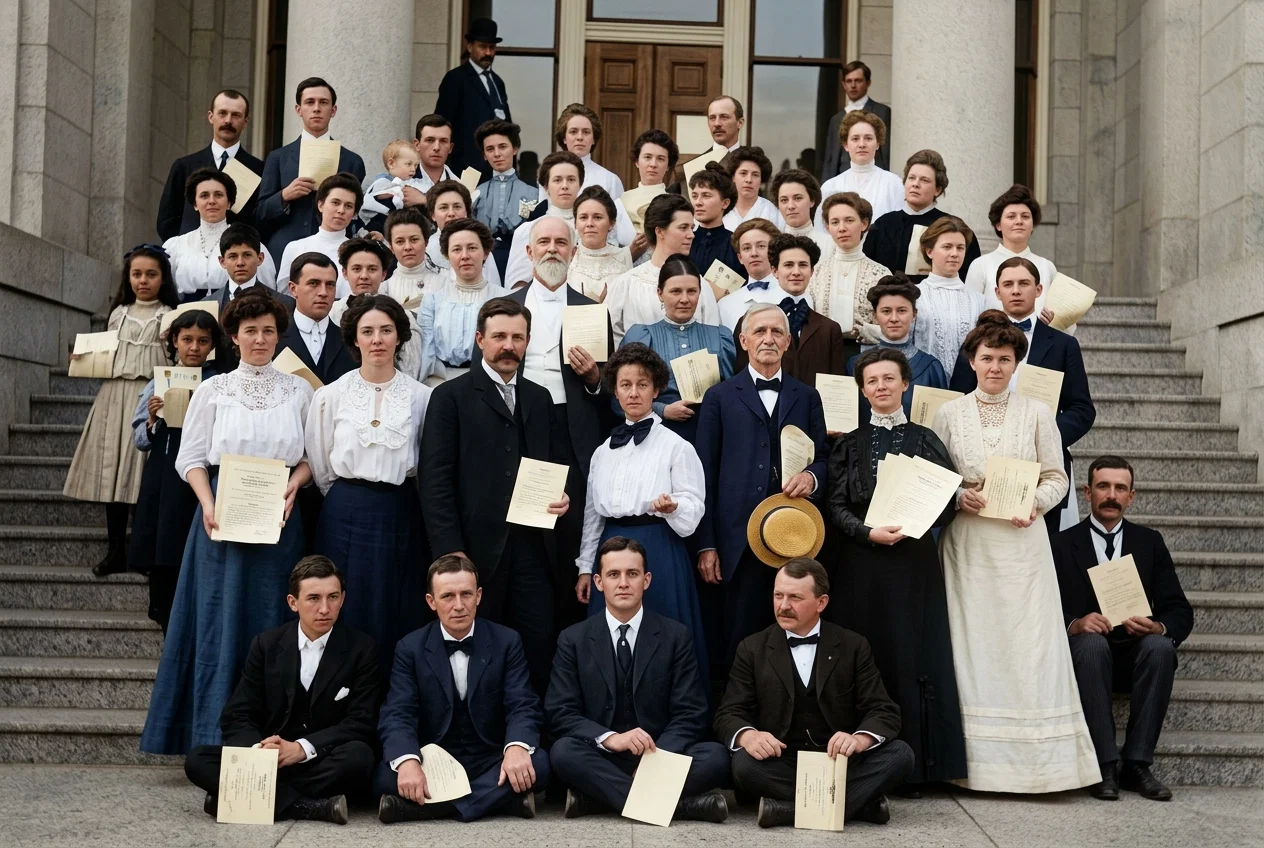
A REPRESENTATIVE GROUP OF MAGAZINE AGENTS
THE power of the printed page figured very largely in all of the reports from the home and foreign fields read at the recent General Conference.
WE are receiving splendid testimonials from some of the leading newspaper and magazine editors of the country who have examined the first number of the Protestant Magazine.
MANY of our lady agents attending the General Conference said they preferred to handle Liberty, because they could carry 50 copies at a time. They also spoke well of its neat appearance.
ELDER W. C. HANKINS, of China, sends us fifteen yearly subscriptions for the Protestant Magazine. He writes: “We hope we are not too late to have our names among the 24,999 charter subscribers.”
“WE are of good courage in the work,” write two Iowa agents for Life and Health, “and find that our sales increase as we go over the territory the second and third time.” If your territory is limited, learn to handle several magazines, selling them in rotation each month. Develop regular customers. Visit them with a new magazine two or three times each month.
CIRCULATION managers, tract society secretaries, missionary secretaries, and periodical agents repeatedly met for mutual counsel during the late General Conference. These two o’clock meetings were presided over by Brethren D. W. Reavis, A. J. S. Bourdeau, and O. K. Butler. Methods of gaining access to the people, sales points, the personal attitude of the agent, and scholarships were some of the items considered. The narration of actual experiences by the magazine agents themselves was especially helpful. Mrs. S. N. Haskell also assisted in outlining plans for the holding of institutes.
ONE young college student has just ordered 1,000 copies of the Temperance number of the Youth’s Instructor, and another, 500 copies, on the scholarship plan.
ARE you supplying your public library with yearly subscriptions to our leading denominational magazines, Life and Health, Liberty, Protestant Magazine, the Signs of the Times, the Watchman, and others?
THE varied experiences of the periodical agents whose smiling faces appear in the picture, would make an interesting volume. We regret that our secretary secured the names of only forty-two of the forty-seven. The photograph, of itself, however, is a graphic fulfilment of the statement made by the spirit of prophecy years ago concerning those who should become home-missionary workers: “Our sisters, the youth, the middle-aged, and those of advanced years, may act a part in the closing work for this time.”
Brother J. F. Bahler (holding straw hat), our blind brother, was, perhaps, the first of our periodical workers to insist that we should sell our magazines for ten cents instead of five. He finally induced Brother and Sister Haskell to issue a double number of their monthly magazine (thirty-two pages), a large edition of which he promptly purchased and sold. He and his daughter Grace still sell thousands of the various ten-cent magazines to all classes of people. Elder J. O. Corliss (center) holds the record on club subscriptions for our magazine, Liberty, having sent in 31 subscriptions for 10 copies each, one year. Mrs. S. N. Haskell (center), of the Northern California Conference, holds the record for the largest number of copies of Life and Health and Liberty ordered during one month (over 10,000 copies). Miss Myrtle Maxwell (second one in second row, reading from left to right) has broken at least two records in her sale
of Life and Health in several Southern States. Mrs. J. S. Chandler (right end of fifth row) has the honor of being the first agent to order 1,000 copies of our new quarterly, the Protestant Magazine. Miss Ida Lackey (center of second row) and Miss E. Macdonald (to right of Mrs. S. N. Haskell) have sold over 90,000 copies of the Bible Training School and donated $1,500 of their profits to mission work in India and the South. Miss Hilda Musick (left end of second row), Miss E. C. McPherson (same row, third from right end) are selling Good Tidings of the Messiah, published in the interests of the unconverted Jews. Brother C. N. Miller (below J. O. Corliss), though blind, was one of California’s most successful magazine agents. He is now editor of our paper for the
blind, the Christian Record. Brother A. J. Jean, a French-Canadian student attending South Lancaster Academy, holds the record for the earning of scholarships, having sold more than the number of ten-cent magazines required for a year’s schooling, last summer, in about three weeks. Brethren R. C. Spohr and Grover R. Fattic (left end of front row) have done excellent work as pioneer leaders of traveling companies of magazine agents, as already mentioned in these columns. The records mentioned are, of course, but a few of the many good ones made by other members of this group and by hundreds of other
agents scattered throughout the land. Over half of these workers are handling Life and Health; one fourth handle Liberty, and the remainder sell the Signs of the Times Monthly, the Watchman magazine, the Temperance number of the Youth’s Instructor, the Bible Training School, and Good Tidings of the Messiah. May God abundantly bless the circulation of these printed pages of truth to the salvation of many souls. The other persons in the group, not already mentioned, are T. D. Gibson (right end of front row), secretary of the Northern Union Conference, F. M. Dana (right end of second row), missionary secretary of the Atlantic Union Conference, Lora B. Duncan, Blanche E. Hicks, Elizabeth L. Kern, Mrs. C. N. Miller, C. F. Woertz, Bruce Griggs, Elsie Knebel, A. R. Sherman, Mrs. Reed Calvert, Pearl Calvert, Mina Andrews, Bertha Bartholomew, Ruth Meleen, Gladys Durning, Miss McGee, Mrs. Cecil Fitch, Ada E. Achor, Mr. and Mrs. C. C. Hunt and child, Ethel Hunt, Mrs. S. N. Williamson, Marie Macmillan, Louise Henley, Nellie Rothbaust, R. W. Leach, and Lowell M. Knapp.

Editorial

Truth’s Final Triumph

THE forces of evil may combine to thwart God’s purposes and hinder his workings. It may seem for a little time that their efforts are effective; but “he that sitteth in the heavens shall laugh: the Lord shall have them in derision.” His plans will carry, his purposes prevail. The divine arrow of truth may appear to be turned aside, but at last it will reach the mark, and accomplish its object. Evil may seem to triumph here, but truth will prevail throughout eternity. The knowledge through faith that this is indeed true, affords confidence and quietness in the conflict. We can calmly suffer apparent defeat to-day, if we know that to-morrow will bring the victory. We can meet the martyr’s fate in this world, if we know we may wear the martyr’s crown of glory in the world to come. It is this abiding faith in the final triumph of right which nerves the arm for the conflict, and makes strong and brave the heart to do and dare. Men may combine against God and his truth. They may propose, but the disposing is with him. He that says to the mighty deep, “Hitherto shalt thou come, and no further,” can cause even the wrath of man to praise him, and the remainder of wrath he will restrain. This Mighty One is the author of our faith, the God of our salvation. Surely we can trust to him all the future,—the finishing of his work in the earth, and his purpose in our lives. He will do all things well. We can securely trust to his wisdom and love.

God’s Victors

THAT God’s kingdom should not be a constant battle-ground, it was necessary that righteousness should be the characteristic of whatever or whoever was to be eternal. The everlasting Father would not make himself the slave of circumstance; therefore he would not establish in his realm a system which would make it necessary to immortalize iniquity; therefore the continued existence of all his creatures was made contingent upon their choice of righteousness.
Every individual to whom is finally sealed the gift of eternal life will receive that gift because of his choice of the ways of righteousness. That choice makes possible the bestowal of that gift.
Says the psalmist: “Blessed is the man unto whom Jehovah imputeth not iniquity, and in whose spirit there is no guile.” Ps. 32:2. Freedom from guile and sin is God’s greatest blessing. The opposite must bring his condemnation and the fruitage of sin—death. If there is guile in the spirit, the tongue will make it known and help to root it deeper and stimulate its growth. Therefore we have this divine admonition: “Keep thy heart with all diligence; for out of it are the issues of life.” Prov. 4:23. In perfect harmony with this is the following: “Keep thy tongue from evil, and thy lips from speaking guile. Depart from evil, and do good; seek peace, and pursue it. The eyes of Jehovah are toward the righteous, and his ears are open unto their cry. The face of Jehovah is against them that do evil, to cut off the remembrance of them from the earth.” Ps. 34:13-16.
Similarly does Inspiration exhort us through Peter: “Putting away therefore all wickedness, and all guile, and hypocrisies, and envies, and all evil speakings, as newborn babes, long for the spiritual milk which is without guile, that ye may grow thereby unto salvation.” 1 Peter 2:1. And further have we the example of our Sacrifice, whose steps we are commanded to follow: “Hereunto were ye called: because Christ also suffered for you, leaving you an example, that ye should follow his steps: who did no sin, neither was guile found in his mouth.” 1 Peter 2:21, 22.
Thus by both precept and example are we shown the way and the requirement. The lives of some will prove that the way has been followed, the requirement met; for we read of those who are among the redeemed host that “in their mouth was found no guile.” Rev. 14:5. As the words of the mouth are an indication of the condition of the heart, we know that the heart of such was guileless as well as the mouth.
Every one of whom that is said will be a victor, a conqueror in the name of God, an heir of eternity through the merits of Christ. The Lord himself so designates them in these words: “He that overcometh, I will give to him to sit down with me in my throne, as I also overcame, and sat down with my Father in his throne.” Rev. 3:21.
Every human heart is a battle-field, whereon truth and error, loyalty and disloyalty, sincerity and guile, righteousness and iniquity, life and death, meet in mortal struggle. In every individual struggle, heaven is intensely interested. “The eyes of Jehovah are toward the righteous, and his ears are open unto their cry.” We are assured that the eyes of the Lord “run to and fro through the whole earth.” Zech. 4:10. For what purpose if not to observe the progress of that contest in individual hearts? Every human being saved out of this sinful world is a jewel to shine in the crown of our Redeemer. Christ will not think the price too great when these jewels of his grace are garnered out of this rebellious realm. Then “he shall see of the travail of his soul, and shall be satisfied.” Isa. 53:11.
But let us not forget the prerequisites of being numbered among those jewels. They are the guileless mouth, the guileless heart, the choice of righteousness, the appropriation of Christ’s sacrifice in our behalf. The fountain must be pure if the stream is to be pure. The choice of righteousness must spring from a heart that loves righteousness. The guileless mouth is possessed by him only who has a guileless heart. The appropriation of Christ’s sacrifice is possible to him only in whose heart the love of Christ is deeply planted and gladly nurtured. The conversation of such an one will not be filled with gossip about the faults and eccentricities of his neighbor. Those “lying lips” which are “an abomination to the Lord” will not be his. His tongue will form no impure word nor take up any slanderous reproach. His words will be a constant testimony to the goodness and righteousness of God, a wellspring of hope, and a savor of life unto life.
God demands that his people, who give to the last generation of sinners the last message of salvation, shall be such apeople. It is no small requirement; and in human strength it is an utter impossibility; but in God there is strength sufficient to make it possible. It will do no good simply to know that strength is there. It must be drawn upon to the extent of our needs. To a people that are among the smallest of earth God has given a task that might well appall the strongest people in the world. Only in his strength is success possible, and we can not expect that strength while we nurture iniquity. If ever a people was called upon to deny “ungodliness and worldly lusts” and “live soberly and righteously and godly in this present world,” it is this people. Only thus can God make us a power for the accomplishment of his purpose, or crown us victors when his work is done.
C. M. S.

Hope Thou in God

The life of the practical Christian has in it but little of romance. It is not made up wholly of rapturous contemplation and day-dreams, nor yet of joyful realization of its highest purposes. Joy and sorrow, pain and pleasure, realization and disappointment, are intermingled and combined in varying degrees.
The child of God in this world is clothed with mortal flesh. He has to do with all its frailties and weaknesses. By nature and environment he is akin to the great multitude around him, the majority of whom know not God. Like them, he is the subject of disease, the prey to temptation, the object of Satan’s attacks. Unlike them, he possesses higher purposes and purer desires, and has working in his life a power which is seeking to enable him to attain his noblest ideals. But though yielding his heart to the divine influence of the Spirit, so long as he is in this present state, he is subject in some measure to the vicissitudes of human existence. He may resist sin, but he still will feel the strain of the conflict. He may trust to divine guidance, but will be beset by doubts and fears. He may triumph over evil, but will feel the power of temptation. It will be a constant warfare. Overcoming grace will strive against besetting sin. The forces of good and evil will hold conflict in the mind. There will be constant temptation to sin, and unceasing appeals of the Spirit to walk in the paths of obedience. Every heart will see hours of darkness. Every life will feel at times its utter loneliness. Sorrow will well-nigh overwhelm, and withered hopes will turn to ashes the fondest anticipations.
God permits these trials and experiences for a wise purpose. They are his workmen, shaping and molding the divine purpose in the life. We are not to consider them strange, nor doubt our experience in, or acceptance of, God because of them. It is through them that we become more fully acquainted with the divine character. Only he who has known sorrow, has come to know the sweetness of divine sympathy and consolation. It is only as we experience our own weakness, as did sinking Peter, that we are led to cry out for help. It is only as we realize our utter unworthiness, that we cast ourselves at the feet of divine mercy. It is when we see our own utter wretchedness and moral defilement, and in contrast the beauty of the divine character, that we desire to exchange our filthy rags for Christ’s righteousness. In despair, we are led to grasp the hand reached down to help; and when all alone and forsaken, we welcome the proffered companionship of the blessed Comforter.
It is for these reasons — that we may love him more, know him better, and trust him implicitly — that he permits the sorrow, the heartaches, the chastening of life’s experiences. To every despairing soul he says, “Hope thou in God.” To the straying and backslidden he sends the invitation, “Return unto me; for I have redeemed thee.” He invites the weary, “Come unto me, . . . and I will give you rest.” He promises to exchange “beauty for ashes, the oil of joy for mourning, the garment of praise for the spirit of heaviness.”
Poor discouraged soul, take hold of God anew. Accept and believe his promises. Turn your eyes from self-consideration to him. You can not obtain light by contemplating the darkness. You can not receive inspiration for to-morrow’s battles by dwelling upon to-day’s defeats. Look to Jesus. Cast yourself at his feet. Cry unto him for aid and succor. He will not cast you off. He will not turn a deaf ear to your entreaties. Though you have sinned ten thousand times, he will receive you, and help you to make up all the past. Then try once more. Let him be your courage, your strength, your power to resist. From all the past learn the lesson of your own foolishness, frailty, and utter lack of sufficiency, and take hold of his strength, and make peace with him. He waits to be gracious; he longs to reveal his power in your behalf. His Spirit invites you to-day; reject it not, nor grieve it from you, but accept the invitation of divine grace. God is able to save you.
There are no limitations to his power. He declares that his “hand is not shortened, that it can not save,” neither is his “ear heavy, that it can not hear.” He is able to do “exceeding abundantly above all that we ask or think.”
God does not mock you. The appeals of his Spirit are the evidence he offers that he wants you to return. Your case is not hopeless, for the Spirit still bids you turn. Come just as you are. You can not make yourself better. Your very weakness and wretchedness are appeals to God. He will save you because you need salvation. He will heal because you are sick and in need of a physician. He will be your wisdom because you have none of your own, and your righteousness because yours is as filthy rags. “He that cometh unto me, I will in no wise cast out.” “To-day if ye will hear his voice, harden not your hearts.” “Why art thou cast down, O my soul! and why art thou disquieted in me! hope thou in God: for I shall yet praise him for the help of his countenance.” F. M. W.

Authority Against Authority

In the Catholic Standard and Times (Philadelphia) of May 1, the editor, in an article entitled “Not a Catholic Country,” quotes these two sentences from Archbishop Kendrick, of Baltimore, which appear in his book, “The Primacy of Peter:” —
It is a stale calumny that Catholics are vassals or subjects of the pope. He claims no temporal dominion over us, and we everywhere profess, with his full knowledge and entire approbation, unqualified allegiance to the respective civil governments under which we live.
It is interesting, and may not be unprofitable, to place alongside that declaration one made in a work by M. I. Rhodes, entitled “His Holiness Pope Pius IX.” This work bears “the approbation of the Lord Bishop of Beverly,” in England, and has been published at New York, Boston, and Montreal. The author says (page 11): “Our first duty, however, is toward our most holy Pope Pius IX, who at present so nobly fills the chair of St. Peter.” He further declares “it to be the general duty of all Catholics, whatever their country may be,” and “of all men, if they did but know it, to protect the rights of the holy see.”—Pages 47, 48. Then to be more explicit, he gives this amplification of the ideas contained in the above quotations:—
Suppose it be said, “I acknowledge the spiritual authority of the Holy Father; but why am I, an Englishman [or American, we may add], to come forward in a political way, and use all my exertions to protect the temporal rights of a foreign prince?” My answer at once is plain. The pope is not a foreign prince to any Christian, to any human being [italics ours].—Ibid., page 48.
That makes the pope to every Catholic a domestic prince in his country. Will he refuse to obey his prince? If it is a “stale calumny” to state that “Catholics are vassals or subjects of the pope,” the Catholic must admit that the “calumny” originated with one who would be quickly anathematized if the church really believed he was calumniating the Catholic Church.
C. M. S.

The General Conference

THIRTY-SEVENTH SESSION, MAY 13 TO JUNE 6

Departmental Meetings

Religious Liberty Department

Fifteenth Meeting, May 31, 8 A. M.
THE entire hour was devoted to answering and discussing questions which had been handed in. The questions related both to the principles of religious liberty and to plans for work.
Sixteenth Meeting, June 1, 8 A. M.
The subject discussed at this meeting was, “What Should Be Our Attitude Toward Sunday-Closing of Saloons?” Arguments were presented in favor of legislation closing saloons on Sunday; the impossibility of securing the closing of saloons on all days, and the advisability of working to close them on one day of the week rather than not to have them closed at all. There is more idleness on Sunday than on other days of the week, and hence naturally more liquor drinking, and for this reason Sunday-closing, it was claimed, is justifiable.
These arguments and reasons were quite generally dissented from as unsound and erroneous. Religion can not be dissociated from the Sunday institution. This being so, religion can not be dissociated from Sunday legislation of any character whatsoever. All legislation regarding Sunday must be regarded differently from that pertaining to other days, and be considered religious legislation. All such legislation is simply legislating the Sunday institution into position by piecemeal.
Seventeenth Meeting, June 3, 8 A. M.
A considerable portion of the meeting was devoted to the question considered at the previous meeting, that of the Sunday-closing of saloons. A number of brethren spoke to the question, among them being Elders W. M. Healey, C. S. Longacre, C. D. M. Williams, W. A. Colcord, C. P. Bollman, J. O. Corliss, and the chairman. With a single exception, all took the position that we could not advocate Sunday-closing.
Elder A. J. Breed introduced a resolution calling for the getting out of a Religious Liberty Manual for the benefit of our religious liberty workers.
Eighteenth Meeting, June 4, 8 A. M.
The first part of this meeting was devoted to a discussion of the question of church federation. After the discussion, action was taken favoring the getting out of a statement setting forth our attitude toward the church federation movement. Action was also taken favoring the preparation of a series of Sabbath-school lessons on the subject of religious liberty. The latter portion of the meeting was devoted to the consideration of the work of religious liberty secretaries. W. A. Colcord gave a talk upon this subject, outlining briefly the qualifications, duties, and lines of work of religious liberty secretaries.

Medical Missionary Department

Eighteenth Meeting, June 3
THE first topic announced for discussion was “The Need of Educating Sanitarium Managers and Matrons in Our Larger Sanitariums.”
Dr. D. H. Kress: There is a great need for this class of workers. Our institutions should not be on a commercial basis; the missionary feature should be kept prominent. We should educate young men right in our sanitariums for this work. In connection with every good business manager there should be in training young men who seem to be adapted to this work. Matrons should have a grasp of all parts of the work, and to this end should have had a nurse’s training course in addition to the special training for their work.
The next topic for consideration was “Uniformity in Sanitarium Policies,” by B. W. Spire, of the Nashville Sanitarium. Brother Spire outlined a plan of making use of our health leaflets and pamphlets, with specially prepared covers containing advertisements of the sanitarium making use of them. He believed we should have special literature for all our sanitariums on such subjects as, The Electric Light Bath, The Sanitarium Idea, etc.
Dr. W. A. Ruble called attention to the fact that it is difficult to obtain literature on health topics, and urged that our medical people take a greater interest in this matter. He also suggested that in addition to business managers and matrons we should give more attention to the education of good cooks in our sanitariums.
L. M. Bowen agreed with Dr. Kress, and said that it is a mistake to put an untrained man in charge of an institution; that it is better to put the work in charge of a physician with a steward under him than to have a green hand as business manager. The physician, even though not trained in business methods, will likely do better than a business man not trained in sanitarium methods.
Dr. A. B. Olsen: If possible, business managers, matrons, cooks, and every one holding official positions in sanitariums, should be trained nurses. The responsible persons should have a practical knowledge of the workings and the principles of the sanitariums hardly possible without the training-school course. Even the stenographer is better if a trained nurse.
A. W. Semmens indorsed what had been said in regard to the training of matrons and managers, and referred to the fact that railway magnates have their sons begin work right in the shops, so as to be thoroughly acquainted with every detail of railroading; and also that the most successful hospital managers are those who have begun at the bottom.
Dr. David Paulson outlined the work begun at Hinsdale for the poor. They have secured land, and expect to put up a series of separate institutions, or “units,” to accommodate fifteen to twenty patients. Over each of these units is to be placed preferably a man and his wife who manage the institution, and do all the work, giving treatments, etc. In an experience of this kind one will demonstrate whether he is fitted to manage an institution successfully.
Dr. Lauretta Kress: We are working in the right line in endeavoring to secure more mature persons for our training classes. Among these are always some who are not best adapted to give treatments; some will show an adaptation to the work of manager, or matron, or cook, and should be given special encouragement in this line.
L. A. Hansen believed that our success requires uniformity of methods and rates. Our sanitariums should be one large family, having the one sanitarium spirit, and working for one another.
Dr. W. B. Holden expressed the belief that the best advertising of a sanitarium is a satisfied patient, and that advertising in our leaflets would work against the sanitarium.
Dr. C. F. Ball protested against billboard advertising, and attaching any institutional advertising to our medical literature:

Nineteenth Meeting, June 4, 8 A. M.

Dr. H. F. Rand read a paper on therapeutics, which he defined as “a science whose object and aim are along the art of healing, or, in other words, the path that leads toward life.” The discussion was largely confined to the method employed in the treatment of malaria by hydrotherapy. Dr. Rand further stated that the English government has found black death, prevalent in Central Africa, to be the result of the continued use of quinin for diseases of the tropics. In an interesting paper read by Dr. C. F. Ball, Thursday evening, he outlined his experience with tuberculous cattle, and expressed his conviction that dairy products should not be used in any manner unless cows have been tested for tuberculosis, or milk properly Pasteurized.
The department has adopted the following curriculum:—

COURSE OF STUDY FOR THE NURSES’ TRAINING-SCHOOLS

First Year                                             HOURS Bible ........................................ 36 Testimony study .............................. 36 General nursing .............................. 36 Practical hydrotherapy, 2 lessons a week, first quarter .... 24 Physiology ................................... 18 Anatomy ...................................... 18 Domestic economy ............................. 12 Operating drill, second term ................ 12 Electricity (theoretical and practical) ..... 12 Massage ....................................... 24 Physical culture ............................. 36
Second Year Bible ........................................ 36 Physiology ................................... 36 Hydrotherapy (practical and theoretical) ... 24 Cookery ...................................... 24 General diseases ............................. 36 Practical nursing ........................... 12 Surgical nursing, first half ................ 12 Medical gymnastics ........................... 36 Theoretical massage .......................... 24 Medical lectures ............................. 24 Bible hygiene ................................. 36

Third Year

Bible ........................................ 36 History of missions .......................... 18 History of message ........................... 18 Hygiene and sanitation, including bacteriology .... 36 Tropical diseases ............................ 12 Accidents and emergencies .................... 18 Children’s diseases .......................... 12 Mental diseases .............................. 18 Materia Medica ............................... 36 Bandaging .................................... 12 Diseases of men .............................. 12 Chemistry and analysis of urine .............. 24 Physical culture ............................. 18 Gynecology .................................... 8 Obstetrics .................................... 16

ADVANCED COURSE OF ONE YEAR FOR GRADUATE NURSES

HOURS Bible ........................................ 36 Applied Anatomy .............................. 36 Surgical dressing ............................ 24 Signs and symptoms of disease ............... 18 Urine analysis and microscopy ............... 24 Dietetics .................................... 18 Advanced hydrotherapy ....................... 24 Applied electricity .......................... 12 Common diseases .............................. 36 Skin diseases ................................ 12 Diseases of eye, ear, nose, and throat ...... 18 Obstetrics and gynecology ................... 36 Tropical diseases and hygiene ............... 36 Mental diseases .............................. 12 Dental hygiene ............................... 12 Anesthetics ................................... 6 Swedish medical gymnastics ................... 36 Principles of hygienic dress ................. 18

TEXT AND REFERENCE BOOKS RECOMMENDED FOR NURSES BY THE DEPARTMENT

Electricity — Neiswanger. Hygiene and Sanitation — Whitelegge and Newman. Physiology — Furneaux, Colton, Foster and Shore, and Hutchinson. Cookery — “Science in the Kitchen,” “Good Health Cook Book,” “Vegetarian Cook Book.” Obstetrics — Le Lee, First Lines, by Hermann. Chemistry — Newell’s Descriptive Chemistry. Materia Medica — Dock, Paul. Mental Diseases — C. B. Burr. General Diseases — Stevens. Children’s Diseases — McCombs. Bandaging — Leonards, Marrow. Surgical Nursing — Stowy. Hydrotherapy — Abbott, Kellogg, Baruch. General Nursing — Humphrey, Lukes, Robb. Swedish Gymnastics — Posse. History of Missions. History of the Message — Loughborough. Anatomy — Gray. Massage — Kellogg. Doctrines — Johnson. Bible Hygiene — “Ministry of Healing.”
Continue reading: General Conference Proceedings