"Watchman, tell us of the night,
What its signs of promise are."
"Traveler, o'er yon mountain's height
See that glory beaming star."
"Watchman, does its beauteous ray
Aught of hope or joy foretell?"
"Traveler, yes; it brings the day,
Promised day of Israel."
"Watchman, tell us of the night;
Higher yet that star ascends."
"Traveler, blessedness and light,
Peace and truth, its course portends."
"Watchman, will its beams alone
Gild the spot that gave them birth?"
"Traveler, ages are its own,
See, it shines o'er all the earth."
"Watchman, tell us of the night;
For the morning seems to dawn."
"Traveler, darkness takes its flight;
Doubt and terror are withdrawn."
"Watchman, let thy wondering cease;
Hie thee to thy quiet home."
"Traveler, lo! the Prince of Peace,
Lo! the Son of God is come."
—John Bowring.
With Our Inquirers
By Editor
"If ye will inquire, inquire ye."
[All questions to this department will be answered which to the editors will seem to minister to the good of the readers and to the mission of the paper. The same question can not be answered repeatedly in the same volume. The name and address must accompany question, not for publication, but as an evidence of good faith, and that answer may be made by letter if deemed advisable. It is well always to enclose a stamp for reply.]
2297.—Christ and the Ten Commandments.
Did Christ bring all the Ten Commandments down to the New Testament, and if so, where did He say, "Remember the Sabbath day, to keep it holy"?
It was not Christ's object to enact new laws or reenact old laws; He did not come for that purpose. Just as long as that false idea is in the minds of men, men will go astray. God is unchangeable; Jesus Christ is the same yesterday, to-day, and forever; and His whole purpose in giving Himself, and God's purpose in giving His Son, was to redeem men from all iniquity, all law-breaking, and purify unto Himself a peculiar people, zealous of good works. Jesus did not come to excuse sin, but to save from sin, and sin is the transgression of the law. See John 3:16; Titus 2:14; 1 John 3:4; Matt. 1:21. Christ's relation to the law is shown in Matt. 5:17-21; Luke 16:17; John 15:10. He obeyed the law. His character was the law personified. He presented to the world and to all who would observe Him the law of God in living character, and He transmutes the evil, sinful character of man into the character which He Himself possesses, and which He Himself demonstrated while here on earth, to all who would receive Him. Nowhere can it be found that Christ enacted a new law. Anticipating all that men would say, He declared, "Think not that I am come to destroy the law or the prophets." His whole object was to bring men back to God, to take away the carnal heart which is at enmity with God, and to write God's law in all its entirety and fulness in the hearts of men. If we so receive Christ, we find a beautiful harmony in all the word of God, but if we reject Him as the Saviour from sin, the Saviour to obedience, we set aside in our own lives the very mission on which He came.
The writer of Hebrews simply declares that Christ had obtained a ministry more excellent than the ministry of priests who offered the blood of bulls and goats because He Himself served by virtue of His own sacrifice, which could really take away sin, while they only served to "the example and shadow of heavenly things." Moses was the mediator of the old covenant, a national covenant, a covenant of human works, a covenant which could not save; Jesus is the Mediator of the new covenant, based not on human promises, but upon the promises of God.
2299.—"Presseth into It."
Kindly explain Luke 16:16, especially the last part, "And every man presseth into it."
Supplying the ellipsis, or the words that are wanting to complete the sense, in the first part of the verse, it would read: "The law and the prophets were [preached] until John; from that time [the Gospel of] the kingdom of God is preached, and every man presseth into it." The thought is that there is an earnestness, a determination, a zeal that was not manifest under the old preaching. "The violent take it by force," some render it. Jesus expressed the thought elsewhere, "Strive to enter in at the strait gate," literally, agonize to enter in.
Were Adam and Eve spiritual beings, and did their bodies contain blood before the fall?
As to the first part of the question, we do not know. They certainly had not developed character, as in the first test that came to them they fell and became carnal. The spiritual being is the man who follows the law of the Spirit, the spiritual life dominates the lower life. Man normally possessed the spirit-life and the soul-life. If the soul-life, the body-life, had been held under the control of the spirit-life, he certainly would have been a spiritual being, controlled by the Spirit. But He brought the spiritual in his nature under the control of the soulical, and sinned, and became carnal, subject to the laws and life of the flesh. Adam and Eve possessed blood, of course, but in the change that is to take place we have this statement in the 15th chapter of 1 Corinthians, verse 45, "And so it is written, The first man Adam was made a living soul; the last Adam was made a quickening [or life-giving] spirit. Howbeit that was not first which is spiritual, but that which is natural," literally, that which is "soulical." Those who are born in all its fulness into the kingdom of God will be spiritual beings in the fullest sense of its meaning.
2301.—Astrology.
Will you explain what it means when it says, "Listen to the learned astrologers"? I have consulted astrologers who told nearly everything correctly, including character.
Where does it say, "Listen to the learned astrologers"? There certainly is nothing of that kind in the Bible. There are a great many things which can be told by a shrewd person in a general way. There are very many who can read character, and especially the character of those who are continually seeking for information; such persons are generally very open and easy to read, and a certain amount of general information, based on shrewd observation, could be given by any one, entirely apart from astrology. The ancient heathen astrologers, longing to know the future, endeavored to find it by the stars; and sets of rules and general principles have been developed by them. There are certain influences which the heavenly bodies have upon the earth, but to determine one's character or one's course, because such an one was born under a certain star, or when a certain star was in the ascendancy or descendency, or certain combinations of stars were manifest, is utter nonsense, and denies the truth of Christianity. "Our times are in His hands," and it is His promise that "I will guide thee." He will hold all and He will lead all into the way they should go, if they will trust Him. If we will not trust Him, all the beneficent influences of the star suppositions will have no effect, but if we will trust Him, all the malefic influences which certain stars are said to exert will have no power over us. The Bible does enjoin us not to seek after all these influences.
2302.—The Old Covenant.
How much of the old covenant did Christ approve? Did Christ approve of the Ten Commandments? Deut. 4:13. What part of the old covenant Christ reiterated I will keep, for by so doing I shall abide in His love. My faith is not written on tables of stone, but on the fleshly tables of the heart.
Our inquirer has an altogether wrong idea regarding the covenants. Deut. 4:13 does not call the Ten Commandments the old covenant, but simply "His covenant," God's covenant. There are several things in the word called covenants. The old covenant consisted in mutual promises between God and Israel, recorded in Exodus 19. The conditions of that covenant were that Israel should keep the Ten Commandments. This they utterly failed to do. But does the breaking of a law abolish the law? That were among the most fallacious of conclusions. No government or law ever given could stand if such were the case. It is God's design that the law should be written on the heart, and every object-lesson that He gave to Israel of old was to impress that one thought, that He wanted to dwell with them and be in them. It is a poor place in which our inquirer lodges his faith, but that must ever be the case when one turns from God's word. The Lord never designed that our faith should be in tables of stone or in ourselves. That is the characteristic of every false religion. Our faith should not stand in the wisdom of men, but in the power of God and the Gospel is "the power of God unto salvation to every one that believeth." But that Gospel writes the same law of God on the heart that is written in the tables of stone, and which Jesus Christ confirmed by His death upon the cross; so that "no man disannueth or addeth thereto." Follow the studies in Romans and this will be seen clearly.
2303.—Law of Bondage and Liberty.
How can the Ten Commandments be the law of bondage and the law of liberty also?
As to whether the Ten Commandments shall be a law of bondage to us or a law of liberty depends on our attitude toward the commandments. The policeman to the just and law-abiding citizen is a guardian of liberty; to the criminal he stands as a symbol of restraint and bondage. God's law condemns the sinner and holds him a prisoner under condemnation; that law is to him a yoke of bondage. It binds him in sin and death. See Romans 7. But to the man who is free in Christ Jesus there is no condemnation. Rom. 8:1. That man by the Spirit fulfils the requirements of the law. Rom. 8:4. The law is therefore no longer made a yoke of bondage but a witness to the pleasures of liberty which he has in Christ Jesus. It is to him a law of liberty. James 2:12. If the law of God is only an outward thing to us, it is bound to condemn us. Its tables of stone will rest with dead weight upon the heart, but if it is thru Jesus Christ received into our hearts and written there, every one of His commandments will be enabling acts, giving us power and strength thru Christ to do His will.
2304.—On the Seventh Day God Finished His Work. Gen. 2:2.
What about the quotation of Dr. Clarke's that it should read the sixth day?
We fully agree with our inquirer that there is a splendid thought in the scripture just as it stands in the Common Version and in both revised versions, that God's work was making a week for mankind, that the closing, crowning part of that week was the seventh day, and that God finished His work of the week in the making, blessing, and sanctifying of the Sabbath, an example for us of religious duties on His holy day. And our correspondent truly says, "The week was not complete until the seventh day was made the Sabbath."
2305.—Two Witnesses.
Will you please explain thru the SIGNS what are the two witnesses, two olive-trees, and the two candlesticks of Rev. 11:3, 4?
Our inquirer is asking too large a question for this department. In brief we would say they are the word of God. See the chapter on that subject in "Great Controversy," if the book is accessible, or in "Daniel and Revelation." Access to either one of these volumes will furnish our inquirer with an explanation of chapter 11 of Revelation. Later on it will be considered in the SIGNS more fully.
2306.—A Confederacy.
What is a confederacy?
The Standard Dictionary defines confederacy to be a number of states or persons in compact or league with each other; a league; a confederation; and it defines confederate, to join in a confederacy, as for advantage or defense. In law it is considered an unlawful combination, a conspiracy. It is a combining together to effect certain purposes.
The Power of the Word
Healing the Leper.
JESUS CHRIST wrought many miracles which were not recorded. We read repeatedly of many coming to Him variously afflicted and "He healed them all." Those left on record, in which details were given, were cases typical of many others, and containing great lessons for His children. One of these, the healing of the leper, is recorded in Matt. 8:1-4.
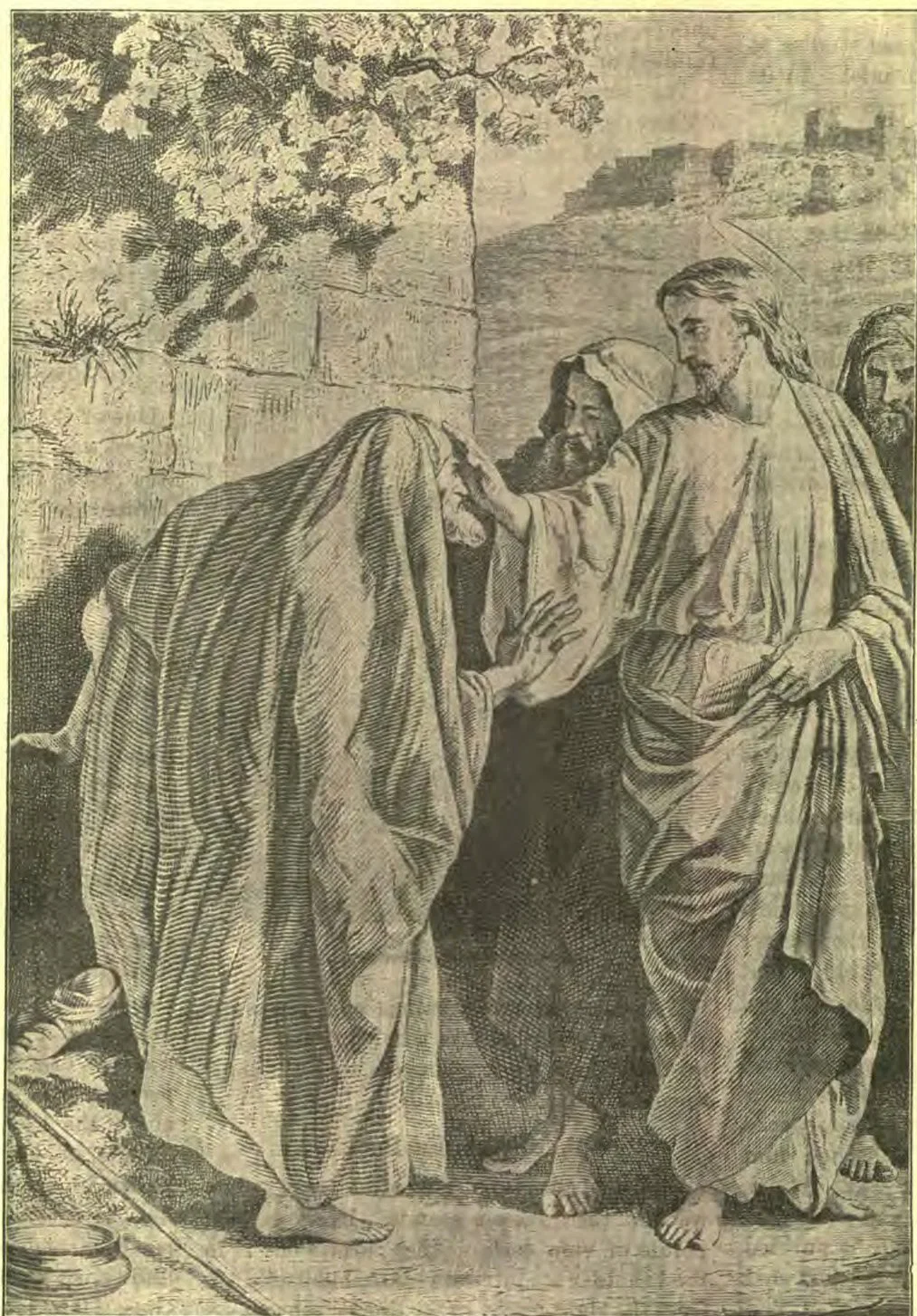
WE will not quarrel with the artist Bida in his painting of the scene. It may not have been at all as he has pictured it. Surely the leper did not stand by a wall when our Lord touched him, and there were doubtless many more people about the Master. The leper may have been old and bent, or he may have been younger. These are details which matter little. In the beautiful picture the artist has given us his conception of the scene; we will thank him for that.
THE story is very brief, and reads as follows:
"When He was come down from the mountain, great multitudes followed Him. And, behold, there came a leper and worshipped Him, saying, Lord, if Thou wilt, Thou canst make me clean. And Jesus put forth His hand, and touched him, saying, I will; be thou clean. And immediately his leprosy was cleansed.
"And Jesus saith unto him, See thou tell no man; but go thy way, show thyself to the priest, and offer the gift that Moses commanded, for a testimony unto them."
THE miracle occurred, according to Matthew, just after Jesus came down from the mountain where He had delivered His wonderful instruction known as the Sermon on the Mount. There is nothing in the detached accounts of Mark or Luke contrary to this. A great multitude followed and thronged Him. But as He passes along the street, probably near the city gate, in the poor leper's heart a new hope is born. Before this his case had been hopeless. With others similarly afflicted, he had mingled with none save his kind for years. When he neared others he must raise the mournful, despairing cry, "Unclean, unclean." Did he forget it at this time in his eagerness to reach the Healer? We can readily imagine the consternation in the crowd as the loathsome object approached. We can see them flee and fall back, and jostle one another to give the leper room as he presses on toward the Central Figure of that throng, who stands and awaits the leper's coming. He does not flee. He does not turn away. He does not repulse the fearfully, loathsomely afflicted man, the picture of a living death. The attitude of Jesus adds to the few rays of hope kindling in the heart of the afflicted one. Would Jesus turn from Him? Men had done it so long, so often, that he had become hardened against rebuffs. He could only be turned away. And so he comes on, and, according to Luke, falls at the feet of Jesus, and cries from the very depths of his soul,—
"Lord, if Thou wilt, Thou canst make me clean."
He believed that the great Teacher had the power; but would He condescend to do it?—Yes. His Spirit it was which kindled the hope in the poor leper's breast, and He will not disappoint the longing heart. As He has the power, so has He the love. Jesus "put forth His hand, and touched" the prostrate man, saying, "I will; be thou clean."
THERE was sympathy in the touch; there was life in the word; for "immediately his leprosy was cleansed." Every fiber of his being felt the thrill of the life-current of God; for he was "full of leprosy," according to Luke; but after the touch of Jesus he was full of health. In one moment of time he had been changed from death to life, from misery to happiness, by a word, by a touch of the Master of righteousness and life.
JESUS instructs him to still comply with the law. He should show himself to the priest as a cleansed man, according to the instructions given in Leviticus 14. Thus doing would show that the Healer did not dishonor the law, and it would be a testimony to the priests of the power and mission of Jesus.
BUT the greater lesson is designed for the sinner's heart; for there is no better4type of sin than leprosy. Stealthy in its approach, slow-working but deadly in its action, when it once lays hold of its victim, no human remedy can heal. The victim is doomed to die. Even so with sin. It benumbs the faculties, nerves, senses; it smites every fiber of its devotee with the disease of death, and leaves its victim hopeless, despairing. But Jesus can cleanse the sinner. He is not only willing that the sinner should come and be cleansed; He invites the weary and sin-sick to come. He declares, "Him that cometh unto Me, I will in nowise cast out." He says with infinite heartiness, "Come on now, and let us plead together [before God's court]; tho your sins be as scarlet, they shall be as white as snow; tho they be red like crimson, they shall be as wool." Isa. 1:18, Lowth's rendering. Then come, sinner, come. Do not wait a more convenient time. Delay is dangerous. You will never grow better. You can not heal yourself. All the panaceas of human devisings can not heal you. But Jesus Christ can heal, will heal, if you will come as did the leper. Sing the song,—
"Plenteous grace with Thee is found,
Grace to cover all my sin;
Let the healing streams abound,
Make me, keep me, pure within."
And He will. He is Jesus, Saviour, the same yesterday, to-day, and forever.
Studies in the Book of Daniel
The Book and Its Writer.
The special subject of these studies at present is the book of Daniel. In its study we need not concern ourselves with the discussion or strictures of the higher critics. Let it suffice the believer of the Gospel of Jesus Christ to know that Daniel's prophecy had the indorsement of Him who spake as never man spake. In His prediction of the destruction of Jerusalem and of future judgments upon the world, the Great Teacher cites Daniel's prophecy as authority, and declares, "Whoso readeth, let him understand." Matt. 24:15; Mark 13:14. Of what account should be the babel of a multitude of "higher critics," or lower critics, when the Master has spoken?
Moreover, the book itself, confirmed as it is by God in history, is its own evidence of its divine origin and absolute truthfulness. History demonstrates its prophecies. All this we will learn as we study its lessons.
The Purpose of the Book.
While ages past could find many precious and practical lessons in the book of Daniel, it was written especially for the latter times,—the last days, the very age in which we are living. Even the prophet himself did not understand much of what God had given thru him; and when he had written the greater part of his prophecy, he was told, "But thou, O Daniel, shut up the words, and seal the book, even to the time of the end; many shall run to and fro, and knowledge shall be increased." Dan. 12:4. And when in the prophet's anxious interest to know more, he sought God further to enlighten him, he was again told, "Go thy way, Daniel; for the words are closed up and sealed till the time of the end. Many shall be purified, made white, and tried; but the wicked shall do wickedly; and none of the wicked shall understand; but the wise shall understand." Dan. 12:9, 10. Both of these affirm that the prophecy was written for the future, and both contain the implied promise that when the time of the end shall be reached, those who are wise in God ["Behold, the fear of the Lord, that is wisdom; and to depart from evil is understanding." Job 28:28.] shall understand the prophecy, knowledge of which was denied to the very one thru whom it was given simply because it could not be understood till the events predicted had been fulfilled or were in process of fulfilment.
The same truth is thus stated again: "There is a God in heaven that revealeth secrets, and maketh known . . . what shall be in the latter days." Dan. 2:28.
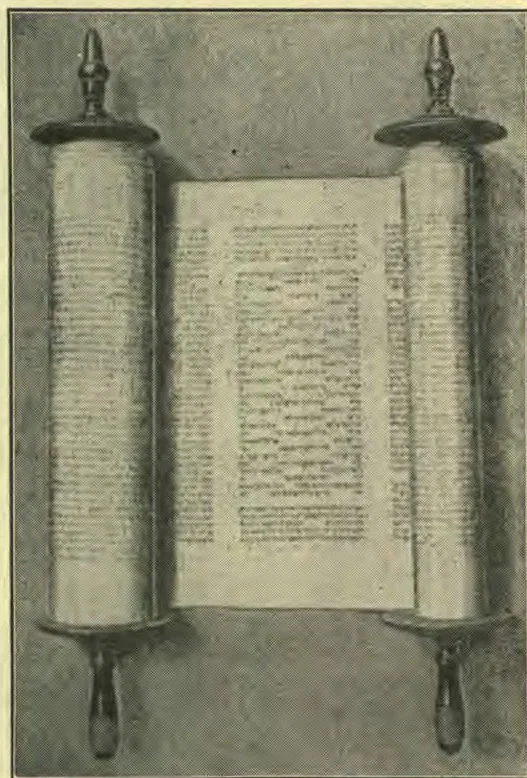
An Ancient Scroll of Scripture.
"The vision of the evenings and mornings which hath been told is true: but shut thou up the vision; for it belongeth to many days to come." Dan. 8:26, A.R.V.
A Key to the Book.
Difficult problems are often easy when we find their simple secrets. From certain points of view certain lines form what is to the beholder an intricate maze, but looked at from the right angle, every line is in harmony with the rest, and the whole is simple. This principle is true in the study of God's word. Every book has its divine purpose. Every subdivision has its central thought. Every lock has its key; every seeming snarl the clue, which, when found, will unwind its precious golden cord to the devout student.
One of the great purposes for which the book of Daniel was given is to teach that "the Most High ruleth in the kingdom of men, and giveth it to whomsoever He will." While this is stated in but one chapter—the fourth—it is taught from beginning to end, a lesson that God would have every ruler and statesman and politician on earth learn, and learn without the sad experience of many of earth's rulers in the past.
Keys to Chapters.
Every chapter, or rather subdivision, has its key, generally embodied in some expression found in the subdivision itself. Sometimes the subdivision is complete with the chapter; sometimes the chapters should be combined. This is true to a certain extent of chapters 8 and 9, for both deal with the same subject and vision; and emphatically true with chapters 10 and 11.
The book of Daniel is written in two languages: From the first to the first clause of chapter 2:4, it is written in Hebrew; thence to the close of chapter 7, in Aramaic; from the beginning of chapter 8 to the close it is again written in Hebrew, with both of which languages the prophet was doubtless well acquainted.
The time of writing the book was from B.C. 603 to 534. The writer was Daniel, whose name means, "God is my judge," who was renowned in Israel for his greatness and piety (Eze. 14:14, 20), and God characterizes him as "a man greatly beloved" (Dan. 10:11).
How He Came to Babylon.
One of the noblest and greatest of Judea's rulers was Hezekiah, who reigned twenty-nine years, from B.C. 726 to 697 ("Usher's Chronology"). Of his faithfulness it is said, "He trusted in the Lord God of Israel; so that after him was none like him among all the kings of Judah, nor any that were before him; for he clave to the Lord, and departed not from following Him, but kept His commandments." 2 Kings 18:5, 6.
In his faithfulness God prospered him. Hezekiah threw off the yoke of the Assyrian, recovered the cities taken by the Philistines, erected public buildings, improved the water-supply system of Jerusalem, and encouraged education in art, science, literature, and religion. It almost seemed as tho Israel would come back to that place in the world which God gave her as light-bearer, as God's missionary to lead other peoples and nations to Him, but the idolatry of self and nature was too deeply rooted in the hearts of the people. And even in Hezekiah we are taught again the lesson of man's frailty. In the middle of his reign God restored him to health from a sickness unto death, prolonging his life fifteen years. The king of Babylon, sending ambassadors to congratulate him and learn of the miracle wrought at that time, Hezekiah, instead of giving God the glory, in foolish pride showed them all the treasures and richness of his kingdom and thus aroused their cupidity. The vast treasures of Jerusalem thus became an ever-dazzling temptation to the Babylonians, till Jerusalem was taken by Nebuchadnezzar, and the treasure-houses of Jerusalem were robbed of their riches. And thus, more than a century before it occurred, the Lord told the foolish king that it would be:
"Behold, the days come, that all that is in thine house, and that which thy fathers have laid up in store until this day, shall be carried to Babylon; nothing shall be left, saith the Lord. And of thy sons that shall issue from thee, which thou shalt beget, shall they take away; and they shall be eunuchs in the palace of the king of Babylon." Isa. 39:6, 7.5
This was Babylon's answer to Hezekiah's folly. Had Hezekiah showed the riches of God's grace, as he had the opportunity, the sequel would have been of a different character. He had the opportunity to preach the Gospel to the inquiring heathen, and failed.
The sad prophecy was fulfilled when Nebuchadnezzar, who became the greatest king of Babylon, came against Jerusalem, plundered it of its treasures, burned the city and its glorious temple, and took the youths of the royal seed for his servants. Among these were Daniel, Hananiah, Mishael, and Azariah. Their deportation to Babylon took place at the time Nebuchadnezzar first captured Jerusalem, B.C. 605.
As Israel had utterly apostatized, as God could do nothing else for them or thru them, He sets up His light, the center of illumination on earth, in the persons of the faithful in the heathen city of Babylon, and purposes to use that great empire for the promulgation of His truth in the earth. The book of Daniel is the divine record of God's work in this respect. And as we study it, we shall find that a Divine Hand shaped the events, a Divine Foresight selected the lessons for later times, a Divine Inspiration penned them; and may the Divine Spirit guide in their study, even as Divine Power will attend their infinite truths to the lives of all who receive them.