Your ShelfYour Projects

Signs of the Times, Vol. 40, No. 47.

Prophets Had Promised a Saviour of Men

Signs of the Times

Dec 9, 1913

Pacific Press Publishing Association · Mountain View, California · Dec 9, 1913

Prophets Had Promised a Saviour of Men

He Arrived When the Clock of Time Pointed to the Hour—Heroism of Divine Love Displayed in Sending the Helpless Babe into a Hostile World
BY MRS. E. G. WHITE
Even angels were deceived by Satan, and the night of woe settled down upon the world.
Choir of angels announced, “Christ the Lord”
THIS article is complete in itself. In its paragraphs are set forth, in a most comforting and encouraging manner, the heroism and self-sacrificing love of God and Christ in providing for the salvation of mankind. Not only is this little world concerned, but all the other worlds of the whole universe of God are studying with undivided interest the unfolding of the love and self-sacrifice of God and Christ as these attributes are revealed in the working out of the plan of salvation. We earnestly commend the article for the soul-helpful spiritual food it contains.
In previous articles, Mrs. White has traced the controversy between Christ and Satan, from its inception down to the birth of the Messiah. The next article will tell of the supreme effort of Satan to overthrow Christ in His temptation in the wilderness.
Editor.
“When the fulness of the time was come, God sent forth His Son . . . to redeem them that were under the law, that we might receive the adoption of sons.”
The Saviour’s coming was foretold in Eden. When Adam and Eve first heard the promise, they looked for its speedy fulfilment. They joyfully welcomed their first-born son, hoping that he might be the Deliverer. But the fulfilment of the promise tarried. Those who first received it, died without the sight. From the days of Enoch the promise was repeated through patriarchs and prophets, keeping alive the hope of His advent; but not all rightly interpreted the message. Century after century passed away. The voices of the prophets ceased. The hand of the oppressor was heavy upon Israel, and many were ready to exclaim, “The days are prolonged, and every vision faileth.”

Like the Stars, Prophecy Marches with Stately Accuracy

But like the stars in the vast circuit of their appointed path, God’s purposes know no haste and no delay. Through the symbols of the great darkness and the smoking furnace, God had revealed to Abraham the bondage of Israel in Egypt, and had declared that the time of their sojourning should be four hundred years. “Afterward,” He said, “shall they come out with great substance.” Against that word, all the power of Pharaoh’s proud empire battled in vain. On “the selfsame day” appointed in the divine promise, “it came to pass, that all the hosts of the Lord went out from the land of Egypt.” So in heaven’s council, the hour for the coming of Christ had been determined. When the great clock of time pointed to that hour, Jesus was born in Bethlehem.
The angels had wondered at the glorious plan of redemption. They watched to see how the people of God would receive His Son, clothed in the garb of humanity. Angels came to the land of the chosen people. Other nations were dealing in fables and worshiping false gods. To the land where the glory of God had been revealed, and the light of prophecy had shone, the angels came. They came unseen to Jerusalem, to the appointed expositors of the Sacred Oracles and the ministers of God’s house. Already to Zacharias the priest, as he ministered before the altar, the nearness of Christ’s coming had been announced. Already the forerunner was born, his mission attested by miracle and prophecy. The tidings of his birth and the wonderful significance of his mission had been spread abroad. Yet Jerusalem was not preparing to welcome her Redeemer.

Heaven Amazed at the Indifference of Men

With amazement the heavenly messengers beheld the indifference of that people whom God had called to communicate to the world the light of sacred truth. The Jewish nation had been preserved as a witness that Christ was to be born of the seed of Abraham and of David’s line, yet they knew not that His coming was now at hand. In the temple the morning and evening sacrifice daily pointed to the Lamb of God yet even here was no preparation to receive Him. The priests and the teachers of the nation knew not that the greatest event of the ages was about to take place. They rehearsed their meaningless prayers, and performed the rites of worship to be seen by men; but in their strife for riches and worldly honor, they were not prepared for the revelation of the Messiah. The same indifference pervaded theland of Israel. Hearts selfish and world-engrossed were untouched by the joy that thrilled all heaven. Only a few were longing to behold the unseen. To these heaven’s embassy was sent.
Angels attend Joseph and Mary as they journey from their home in Nazareth to the city of David. The decree of imperial Rome for the enrolment of the peoples of her vast dominion has extended to the dwellers among the hills of Galilee. As in old time Cyrus was called to the throne of the world’s empire that he might set free the captives of the Lord, so Cæsar Augustus is made the agent for the fulfilment of God’s purpose in bringing the mother of Jesus to Bethlehem. She is of the lineage of David, and the Son of David must be born in David’s city. Out of Bethlehem, said the prophet, “shall He come forth . . . that is to be ruler in Israel; whose goings forth have been from of old, from the days of eternity.” But in the city of their royal line, Joseph and Mary are unrecognized and unhonored. Weary and homeless, they traverse the entire length of the narrow street, from the gate of the city to the eastern extremity of the town, vainly seeking a resting-place for the night. There is no room for them at the crowded inn. In a rude building where the beasts are sheltered, they at last find refuge, and here the Redeemer of the world is born.

Deeper and More Tender Interest

Men know it not, but the tidings fill heaven with rejoicing. With a deeper and more tender interest, the holy beings from the world of light are drawn to the earth. The whole world is brighter for His presence. Above the hills of Bethlehem are gathered an innumerable throng of angels. They wait the signal to declare the glad news to the world. Had the leaders in Israel been true to their trust, they might have shared the joy of heralding the birth of Jesus. But now they are passed by.
In the fields where the boy David had fed his flock, shepherds were still keeping watch by night. Through the silent hours, they talked together of the promised Saviour, and prayed for the coming of the King to David’s throne. “And, lo, the angel of the Lord came upon them, and the glory of the Lord shone round about them: and they were sore afraid. And the angel said unto them, Fear not: for, behold, I bring you good tidings of great joy, which shall be to all people. For unto you is born this day in the city of David a Saviour, which is Christ the Lord.”
The heavenly messenger had quieted their fears. He had told them how to find Jesus. With tender regard for their human weakness, he had given them time to become accustomed to the divine radiance. Then the joy and glory could no longer be hidden. The whole plain was lighted up with the bright shining of the hosts of God. Earth was hushed, and heaven stooped to listen to the song,—
“Glory to God in the highest. And on earth peace, good will toward men.”
As the angels disappeared, the light faded away, and the shadows of night once more fell on the hills of Bethlehem. But the brightest picture ever beheld by human eyes remained in the memory of the shepherds. “And it came to pass, as the angels were gone away from them into heaven, the shepherds said one to another, Let us go now even unto Bethlehem, and see this thing which is come to pass, which the Lord hath made known unto us. And they came with haste, and found Mary, and Joseph, and the Babe lying in a manger.”
Departing with great joy, they made known the things they had seen and heard. “And all they that heard it wondered at those things which were told them by the shepherds. But Mary kept all these things, and pondered them in her heart. And the shepherds returned, glorifying and praising God.”

Divinity Unites with Humanity

The story of Bethlehem is an exhaustless theme. In it is hidden “the depth of the riches both of the wisdom and knowledge of God.” We marvel at the Saviour’s sacrifice in exchanging the throne of heaven for the manger, and the companionship of adoring angels for the beasts of the stall. Human pride and self-sufficiency stand rebuked in His presence. Yet this was but the beginning of His wonderful condescension. It would have been an almost infinite humiliation for the Son of God to take man’s nature, even as it was when Adam stood in his innocence in Eden. But Jesus accepted humanity as weakened and defiled by four thousand years of sin. Like every child of Adam, He accepted the results of the working of the great law of heredity. What these results were is shown in the history of His earthly ancestors. He came with such a heredity to share our sorrows and temptations, and to give us the example of a sinless life.
Satan in heaven had hated Christ for His position in the courts of God. He hated Him the more when he himself was dethroned. He hated Him who pledged Himself to redeem a race of sinners. Yet into the world where Satan claimed dominion, God permitted His Son to come, a helpless Babe, subject to the weakness of humanity. He permitted Him to meet life’s peril in common with every human soul, to fight the battle as every child of humanity must fight it, at the risk of failure and eternal loss.

Revealed to Angels as Well as Men

By coming to dwell with us, Jesus was to reveal God both to men and to angels. He was the Word of God—God’s thought made audible. In His prayer for His disciples He says, “I have declared unto them Thy name,”—“merciful and gracious, long-sufferingand abundant in goodness and truth,”—“that the love wherewith Thou hast loved Me may be in them, and I in them.”
But not alone for His earth-born children was this revelation given. Our little world is the lesson-book of the universe. God’s wonderful purpose of grace, the mystery of redeeming love, is the theme into which “angels desire to look,” and it will be their study throughout endless ages. Both the redeemed and the unfallen beings will find in the cross of Christ their science and their song. It will be seen that the glory shining in the face of Jesus is the glory of self-sacrificing love. In the light from Calvary it will be seen that the law of self-renouncing love is the law of life for earth and heaven; that the love which “seeketh not her own” has its source in the heart of God; and that in the meek and lowly One is manifested the character of Him who dwelleth in the light which no man can approach unto.
Weary and homeless, they traverse the entire length of the narrow street . . . vainly seeking a resting-place for the night. There is no room for them at the crowded inn.

Organizing for Uprising of the Masses

Pitiless Force the Argument to Be Used—The New Industrial Unionism and the Coming Conflict
By PROF. G. W. RINE
In three preceding articles, Professor Rine, of the Pacific Union College, has presented numerous facts regarding the various phases of the industrial conflict and social unrest that have become an alarming international peril. Each article, the same as this one, has presented independently some division of the great subject. Next week the professor will produce not only further evidence of the approaching industrial “war,” but will also set forth the testimony of inspired prophecy to the effect that such a struggle will characterize the “last days,” or end of the age. In his article in the issue of November 18, beginning with the last line of page 594, he is made to say the population of the United States, during the second half of the nineteenth century, increased “three hundredfold.” It should have read “threefold.” The population of the nation increased only threefold, while manufactures increased eighteenfold during the same time.
Editor.
Since the great labor revolt of 1877, students of economic history have been predicting that the perennial strife between capital and labor must sooner or later culminate in a class war. Is the prediction well founded? Is such a war probable? There is ample warrant for answering these questions affirmatively. The conviction that such a clash is not only near, but inevitable, obtains almost universally among business men and publicists.

Rapidly Increasing Number of Strikes

The growing antagonism between the two social classes is shown by the rapidly increasing number of strikes during the last thirty years. Between 1880 and 1890 the average number of strikes in the United States annually was, in round numbers, 500; between 1890 and 1900 the average yearly number was approximately 2,800.
During the summers of 1911, 1912, and 1913, England was virtually paralyzed, economically, because of the strike fever which raged intermittently throughout the kingdom. Respecting those irrepressible labor revolts, the London Nation said editorially, in part: “There are several very disconcerting symptoms in this season’s strike epidemic. Perhaps the most serious is the inadequacy—indeed, the triviality—of most of the causes assigned for the stoppages of work. The strike fever has got into their blood. But there can be no doubt that these troubles are symptoms of a discontent among the working classes that is becoming chronic, and is attended by a growing feeling of class consciousness.”
The same writer goes on to express the conviction that this acute, general unrest among the workers is the natural result of popular education, which tends to enlarge and enrich the workers’ outlook upon life. Accordingly, new needs, tastes, and aspirations are spreading among them, which they have not the means to satisfy. They want more money, more leisure, more liberty to enjoy the good things of life, and they chafe ever more intensely against the narrow economic barriers that shut them in.
In a world of congested wealth, the working classes as a whole are finding themselves worse off than ever before. This London editor asks, “Is it likely that they will stand this?” and he answers his own question with an emphatic negative.

Present Trend of Industrial Conflict

In direct reference to the present trend of the industrial conflict, Dr. Josiah Strong writes: “We are building a leaning tower of Pisa with an indefinite number of courses to be added. If we continue building on existing lines, the time will certainly come when we shall pass the center of gravity, and precipitate a catastrophe.” He says further: “Either the wealth of the nation will be made the wealth of the people by a radical change in the fundamental laws of the land, or the rich will be despoiled by violence—that is, I believe that the penalty of failure will be Socialism or anarchy.”
Note the testimony of the Hon. E. J. Phelps, ambassador to the court of St. James, during the second Cleveland administration. In a letter to a friend, he said, “I hope for the ultimate triumph of the republic, but not until after a period of anarchy, followed by the man on horseback.”
Similar testimony of equal weight could be adduced indefinitely would space permit. We shall, however, note the evident bearing of a comparatively new movement in the labor world upon our economic troubles.

Syndicalism and “Direct Action”

In all the great industrial nations of the world, there has risen in recent years a movement which is obviously destined to contribute powerfully to the precipitation of the inevitable social upheaval.
Syndicalism—known in the United States as the Industrial Workers of the World—had its birth in France in 1895. It came into being chiefly as a protest against what its originators conceive to be the supineness of the old trade-unionists, and the ineffectual methods adopted by them to secure redress of the grievances of labor. Like a flash the movement found its way into Germany, Austria, Russia, Italy, Great Britain, and the United States.

Aim and Animus of the Movement

Mr. F. C. Pease, the most brilliant advocate of the I. W. W. movement, in an article contributed to the August (1913) Forum, said in reference to the I. W. W. convention of 1905, “For the first time a definite, conscious class movement of the proletariat toward revolution was launched upon the American continent.” In respect to the character and aim of the movement, he explains: “It is a secular movement of men, and not the rallying ground of aspirants for a New Jerusalem. . . . It is a new psychology, a new value-creating economic mechanism. It seeks economic control, for that is power. . . . Its militancy is more implacable, more potential, more aggressive, than the ephemeral ‘programs’ with which idealists have tortured the proletariat hitherto. . . . We are interested in the propagation of revolutionary economics, in the organization of the proletariat on strictly class lines for the actual control of industry, and the abolition of the wage system. This is our conception of revolution, nothing less.”
In the preamble of the I. W. W. constitution are found these ominous words: “The working class and the employing class have nothing in common. There can be no peace so long as hunger and want are found among millions of working people, and the few who make up the employing class have all the good things of life.”
In the Independent, January 9, 1913, Mr. Andre Tridon, a militant leader of French Syndicalism, tells us that Syndicalists do not recognize the right of the employer, as such, to live, any more than a physician recognizes the right of typhoid bacilli to thrive at the expense of the patient, the patient merely keeping alive. The employer is, in their eyes, not a part of the social body, but a parasite on the social body. He must for that reason be driven out of existence by all available means, much as pathogenic microbes must be driven out of the patient’s system, the choice of remedies being determined solely by the physician’s care not to affect harmfully the patient’s vital organs. He declares that Syndicalists can no longer brook the slow, devious methods of legislation. Their weapons are sabotage and the “general strike.” Sabotage is tantamount to direct action, and both spell unlawful force or violence.
A few methods of applying sabotage in the several industries are set forth by Mr. Tridon, as follows: Coal can be set on fire in the pockets; explosives can be put into boilers; acids can be used to corrode boiler tubes; emery and sand can be put into the oil-cups; dynamos and transformers can be managed by short circuits and inversion of poles, etc.

Revolutionary, and a Complete Overthrow

Respecting the attitude of Syndicalists toward the general strike, the London Times said not long ago: “The general strike of Syndicalism is not a means of securing higher wages. It is a revolutionary act. . . . It aims at the complete overthrow of the existing order by the cessation of all activity. The manual workers stop work, society comes to a standstill, food is soon exhausted, there is no public lighting or conveyance, plundering and disorder begin, the soldiers are called out but refuse to turn against the rioters, and lo! the revolution is accomplished.” The reader is doubtless aware that the one all-comprehensiveobjective of the Syndicalist (I. W. W., in America) propaganda is to prepare the toiling masses of a whole nation for a simultaneous strike, and thus bring the nation’s industries to a complete standstill. This unique consummation would render capitalism an impossibility, and would reduce society to such an absolute plight as to compel it to surrender unconditionally to the demands of the strikers, who would then proceed to appropriate and socialize all the sources of wealth and all the means of production and distribution. This end once realized in any one nation, the same end will be quickly realized in all other civilized nations.

Revolutionary Doctrines—The “Creed of Force”
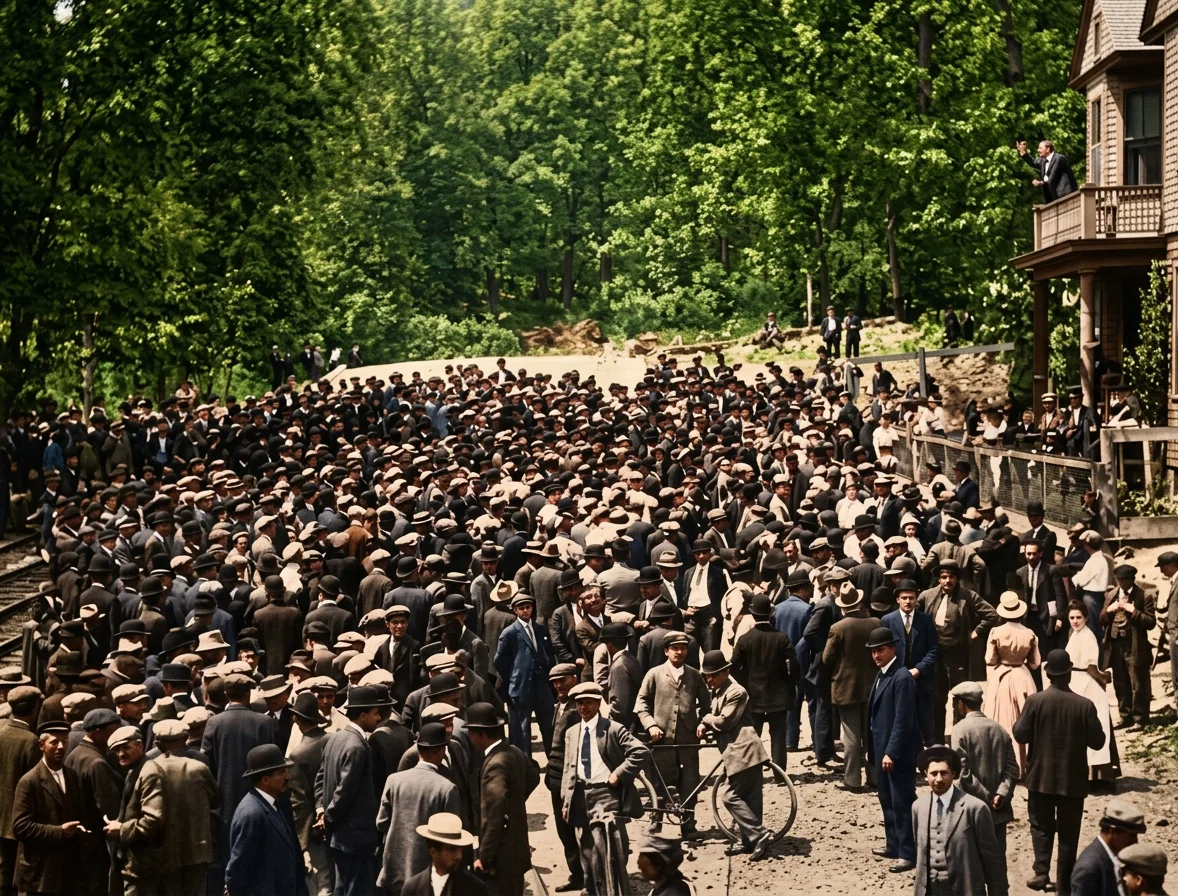
“Syndicalism—the Creed of Force” is the title of a paper contributed to the Independent, October 30, 1913, by Mr. A. M. Giovannitti, one of the most accomplished I. W. W. leaders. In this article he says, in part:
Photograph by Underwood & Underwood, N. Y.
“Now the I. W. W. is avowedly levying war on capitalist society, and so its tactics are neither justifiable nor unjustifiable; first, because the only law of war is to inflict the greatest possible harm by the least effort. . . . In the ultimate analysis, what the I. W. W. wants is the unconditional surrender of the capitalist class, and this would mean the social and economic demise of all the other classes whose existence is conditioned by the existence of capitalism. It follows that we can never expect anybody outside the militant working class to agree with such a fierce proposition. . . . The question that Syndicalism bravely confronts and lays down for discussion, is not one of right or justice, but one of force, taking the word in its broadest meaning. To quote the unrefuted axiom of Marx: ‘Between two irreconcilable conflicting interests, the only arbiter that can decide, is force.’”
“Verily, the law, like bourgeois morality, is no concern of ours; as our movement, which is essentially revolutionary and aims at the complete transformation of the economic foundations of society, must necessarily subvert its social, ethical, and juridical superstructure also.”
“The industrial revolution toward which the I. W. W. is steering the laboring classes is, therefore, not an economic question only, but it implies a complete and radical revolution of all the spiritual conceptions and forces now operating in capitalistic society. . . . Thus while we are not concerned with what the other classes consider right and wrong, on the other hand we create our own laws, our own moral values, and the strongest spirit of responsibility and interdependence ever known among men.”
“You will call this a fearsome creed, a sinister philosophy of force. So it is. Our ethics are the ethics of power, those of the absolute social and economic dictatorship of the proletariat, exactly as yours are those of the supreme mastery of plutocracy, or of the exclusive dominion of middle-class cowardice and imbecility. No, we do not believe in killing or bearing false testimony against you, our neighbor, nor do we want your ass, your ox, or your wife, but we do want your land, your machinery, your mill, your mine, your railroad, and your beloved thirty-six per cent—and we are going to take them back, as surely as you have stolen them from us. . . . We are going to do what we need and intend to do, simply because we have the power to do it.”

“Most Portentous Movement of the Times”

Not at all strange, is it, that the editor of the Independent, in the issue of January 9, 1913, was led to say that the rise of Syndicalism, or “industrial unionism,” is the most portentous movement of the times in the labor world? Its plan is ceaseless class warfare without regard to the humanitarian rules of war. “Its weapon is direct action, a euphemistic term which has been used to cover all sorts of violence.”
In the editor’s comment upon Mr. Giovannitti’s article in the Independent above referred to, he says: “Mr. Giovannitti throws down the gauntlet to civilization. He says that he and his associates are for war, and they acknowledge no standards, no principles other than the purposes of the proletariat.”
Syndicalists avow insistently that they have nothing in common with other classes of society, that they do not recognize the “public,” the “people,” the “nation,” Christendom, or humanity—they know only the working class, and doggedly maintain that outside of that class there is not, nor ever can be, any hope of salvation “in the great social hereafter.” Their leaders allege that the last and everlasting god, creator of all life and beauty and happiness, is—LABOR.
Surely the situation to-day is tense, and it is daily growing tenser. We are inevitably headed for trouble. Prophets of things mundane are announcing the oncoming of social bankruptcy. They insist that there is enough material of discontent already in solution to make a red revolution when the precipitation moment arrives. Mr. Bouck White, a social worker in New York City, says piquantly: “There is piling up to-day the vastest accumulation of vested rights that the world has ever seen; and there is moving toward it a lava stream of insurgency. Voices cry a head-on collision not far ahead.”

The Sure Mercies of David

The Divine Word Can Not Fail—Joy of Heart to the One Who Trusts It—Special Promises to the “Remnant”
By Francis Monroe Burg
A careful study of the fifty-fifth chapter of Isaiah reveals an unbroken line of thought throughout. A direct relationship will be seen between verses ten and eleven and what has preceded. These verses grow out of what has gone before:
“For as the rain cometh down, and the snow from heaven, and returneth not thither, but watereth the earth, and maketh it bring forth and bud, that it may give seed to the sower, and bread to the eater: so shall My word be that goeth forth out of My mouth: it shall not return unto Me void, but it shall accomplish that which I please, and it shall prosper in the thing whereto I sent it.”
The thought is that we can depend upon the word of God and its fulfilment. Just as the farmer is sure of results to follow if the rain falls upon his fields, so can we be sure of God’s promise being fulfilled to us. He has promised to forgive—to “abundantly pardon,” as stated in the verses before; and this precious promise is certain of fulfilment.
David found salvation in the “sure” mercies of God. Verse 3. He said, “Mercy shall be built up [established] forever: Thy faithfulness shalt Thou establish in the very heavens.” Ps. 89:2. His faith and confidence in the mercy of God is expressed in the words which he so frequently uttered, “His mercy endureth forever.” Psalm 136.

LEFT NOTHING UNDONE

God has left nothing undone to help us to believe, and so to enter into His rest. See Heb. 4:1–3. He promised through Abraham the blessings of the gospel to all families of the earth. And though His promise can not fail, because it is impossible for Him to lie, yet to “help our unbelief” He has “confirmed His promise by an oath.” Hence, two immutable things—His unfailing promise and His oath—become the ground upon which our faith may rest.
(Continued on page 8)

Sure Mercies of David

(Continued from page 4)
Could we ask for any more to establish us in a confidence that can not be shaken than these assurances which have been cited? Surely if we are condemned at last, it will be for our failure to believe God. But, as the next verse in this wonderful chapter assures us, if we will believe the promise of God, we shall “go out with joy, and be led forth with peace: the mountains and the hills shall break forth . . . into singing, and all the trees of the field shall clap their hands.” Verse 12. It is the privilege of the believer to be so happy within that all creation will seem joyful with him. The birds will sing a new song, and the very trees of the field will seem to shout for joy.
“Instead of the thorn shall come up the fir-tree, and instead of the brier shall come up the myrtle-tree: and it shall be to the Lord for a name, and for an everlasting sign that shall not be cut off.” Verse 13. To him who is living and walking with God, the thorn-strewn path seems to be covered with roses. If God is with us, a tent is a palace, poverty is wealth, and want our abundant supply.

ONE BLESSED, ONWARD MARCH OF JOY

With an experience like this, that brings God into the life, and fills the soul with singing, our foes will be put to confusion before us; and our experience will be one blessed, onward march, with victory inscribed on our banners. So it was of old when Israel went out to battle. In the lead of the army was a company of singers, selected and appointed, who were to “praise the beauty of holiness,” and to say, “Praise the Lord; for His mercy endureth forever.” 2 Chron. 20:21. The result was that their enemies fought among themselves till all were slain, and the people triumphed in God.
The Lord would have us to-day filled with praise for His goodness, and to join with David, His “chosen,” to show forth His praises, till many shall “see it, and fear, and shall trust in the Lord.” When we have such an experience as this in the love of God, our foes will fall before our advance, and “Victory” will be our ceaseless song. Instead of the brier and the thorn will be the fir and the myrtle-tree. The happiness of the Christian is not dependent upon favorable temporal conditions. To be “rich in faith” is to rejoice in the knowledge of being “a child of a King.”

SPECIAL TO THE “REMNANT”

The following words of the prophet Zephaniah, describing the experience of the “remnant” people,—the loyal, trusting children of God,—will form an appropriate conclusion. First I would call the reader’s special attention to the fact that those whom the prophet describes are an “afflicted and poor” people; yet they “trust in the name of the Lord.” They are told to “sing” and to “be glad and rejoice with all the heart,” for their enemies are conquered and cast out. Victory is theirs, because God is with them.
The following is the prophet’s beautiful language, describing the remnant people:
“I will also leave in the midst of thee an afflicted and poor people, and they shall trust in the name of the Lord. The remnant of Israel shall not do iniquity; nor speak lies; neither shall a deceitful tongue be found in their mouth: for they shall feed and lie down, and none shall make them afraid. Sing, O daughter of Zion; shout, O Israel; be glad and rejoice with all the heart, O daughter of Jerusalem. The Lord hath taken away thy judgments, He hath cast out thine enemy: the King of Israel, even the Lord, is in the midst of thee: thou shalt not see evil any more. In that day it shall be said to Jerusalem, Fear thou not: and to Zion, Let not thine hands be slack.”
Continue reading: The People of the Valleys