Your ShelfYour Projects

Signs of the Times, Vol. 25, No. 36.

How Will Christ Come to You?

Signs of the Times

Sep 6, 1899

Pacific Press Publishing Company · OAKLAND, CALIFORNIA · Sep 6, 1899

How Will Christ Come to You?

Jesus, the Messiah, is coming again. This the blessed Bible abundantly affirms. He is coming as a flaming fire; He is also coming as a Saviour, a King, a mighty Conqueror. Many will die when they see Him, because of the overpowering, resplendent glory. "All kindreds of the earth shall wail because of Him." But, blessed be God, others will greet Him with gladness and be changed from glory to glory. How will Christ come to you?
There are different comings of Christ, and over this many become confused. Understanding nothing of His threefold office of prophet, priest, and king, they are easily misled by erroneous the somewhat plausible theories. It is said that there is a "secret rapture" for the saints, and then a public coming later; that the "secret rapture" is the coming as a thief; but in the later appearing all will see Him.

Three Comings.

There are three different events in the close of Christ's work, referred to in our English versions as "coming." These all come in close connection and are vitally associated together. They are included in the expression, "the day when the Son of man is revealed." In fact, "the coming of the Son of man" sometimes includes all the various events connected with His second appearance.

"The Bridegroom Came."

The first of these comings is expressed in the above scripture; but the text (Matt. 25:10), nor the parable in which it is found, does not tell us the time of this coming, but it reveals this, that it is when the marriage of the Lamb is about to be consummated, or when the Bridegroom comes to take His bride.
The bride is the New Jerusalem. The angel said to John, "Come hither, I will show thee the bride, the Lamb's wife." Rev. 21:9. And the next verse reveals as clearly as words can who the bride is: "And he carried me away in the Spirit to a great and high mountain, and showed me that great city, the holy Jerusalem, descending out of heaven from God." Paul says in Gal. 4:26, "But Jerusalem which is above is free, which is the mother of us all." And Isa. 9:6 declares that Christ is "the everlasting Father." We are of God, begotten through Him. Jerusalem is our mother, and is therefore the Lamb's wife.
“As a Thief.”
“As a Thief.”
But this New Jerusalem is also the capital of the Abrahamic inheritance, or the kingdom of the Seed, Christ. It is that city for which Abraham looked, "whose builder and maker is God" (Heb. 11:10), the capital of that "better country" (verse 16). Isaiah tells us: "Thou [Jerusalem] shall no more be termed Forsaken; neither shall thy land any more be termed Desolate; but thou shalt be called
Hephzibah [My delight is in her], and thy land Beulah [married]; for the Lord delighteth in thee, and thy land shall be married. For as a young man marrieth a virgin, so shall thy sons marry thee; and as the bridegroom rejoiceth over the bride, so shall thy God rejoice over thee." Isa. 62:4, 5. Jerusalem which is above is now said to be barren; the children have not yet come home, and she is represented as mourning for them. See Isa. 54:1; Gal. 4:26, 27. But of the waiting city, representing the entire glorious kingdom, it is said: "Thy Maker is thine husband; the Lord of Hosts is His name; and thy Redeemer the Holy One of Israel; The God of the whole earth shall He be called." The Bridegroom is Christ, and the bride is His everlasting kingdom, of which the New Jerusalem is the representative or the capital city, the palace of the King, the home of His redeemed people, the church of the living God.

When Does Christ Take This Kingdom?

He was not a King while here; He prevented those from making Him King who so desired. He went away from earth "to receive for Himself a kingdom, and to return." Luke 19:11, 12. He now reigns a kingly Priest on His Father's throne. Rev. 3:21; Heb. 8:1; 5:10; 7:1, 2. He sits on the Father's right hand till His foes are subdued by the Father. Ps. 110:1.
In the end of Christ's priestly work, at the end of the gathering out of subjects for His kingdom, when man's probationary period isending, Christ goes in before His Father. This is the coming to receive the kingdom. So the prophet states:—
“I saw in the night visions, and, behold, one like the Son of Man came with the clouds of heaven, and came to the Ancient of Days, and they brought Him near before Him. And there was given Him dominion, and glory, and a kingdom, that all people, nations, and languages, should serve Him.” Verses 13, 14.
This coming, therefore, is not a coming to this earth, but a coming to the Ancient of Days in heaven, where He sits as judge in the last closing work, in the most holy place of the heavenly temple. Christ not only finishes His work as priest in the most holy place, but He then receives His kingdom. This was the coming or going in of the Bridegroom. This occurred in 1844. His people by faith follow Him in this work.

Coming to Reckon.

The second of these comings of Christ is after this judgment is over, and He comes to reckon with His servants, or decides forever the cases of all living. Matt. 25:19. At the time this judgment work closes, the following decree goes forth previous to the glorious appearing to this earth:—
“He that is unjust, let him be unjust still; and he which is filthy, let him be filthy still; and he that is righteous, let him be righteous still; and he that is holy, let him be holy still. And, behold, I come quickly.” Rev. 22:11, 12.
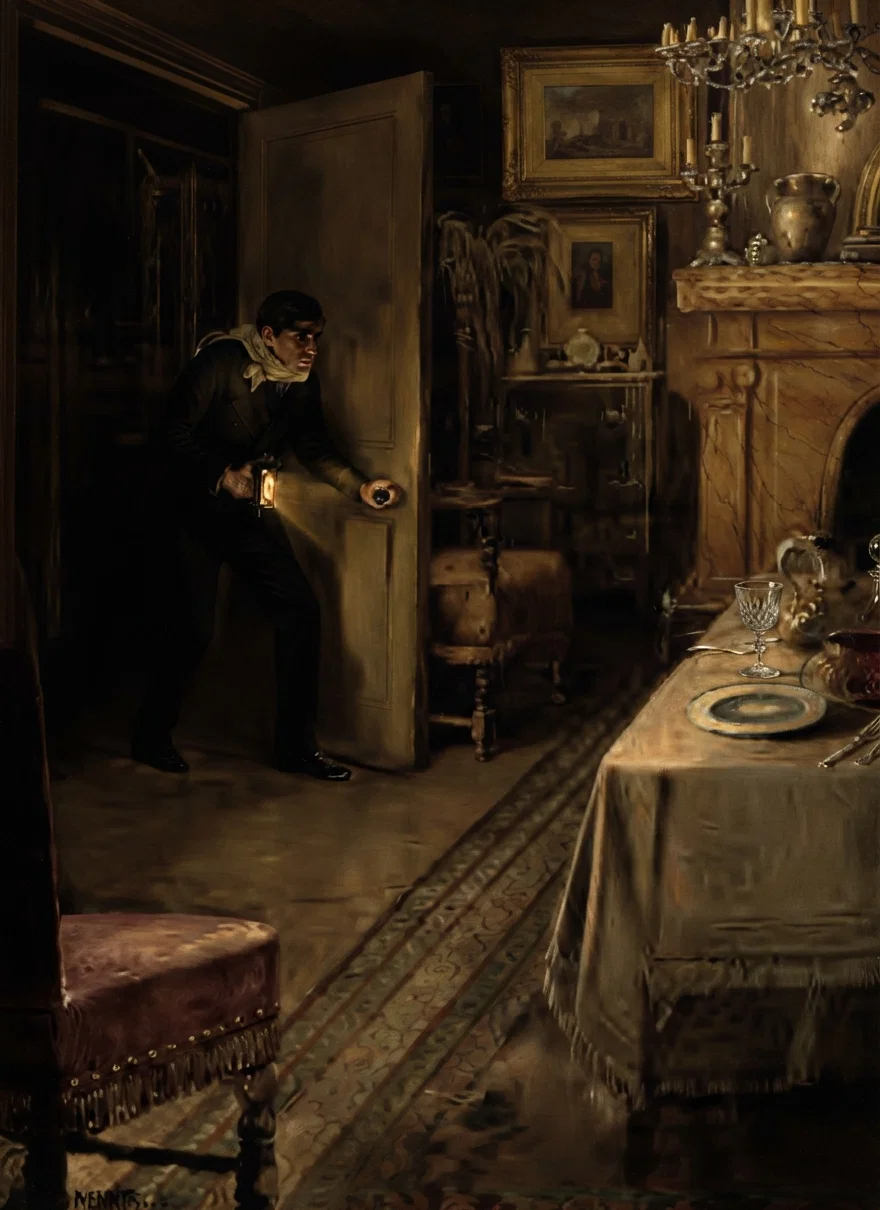
This coming to reckon ushers in a time of momentous importance. When that decree goes forth, the day of salvation ends and the day of Jehovah's fierce anger begins. Zeph. 2:1-3. This is evident from the decree itself. That day will be of greater moment to those then living than any other ever known. It will not be ushered in by the sound of a trumpet or shout of Archangel. Christ will simply lay off His priestly robes, and put on the garments of vengeance. Isa. 59:17, 18; Rev. 15:5-8. This does not mean an arbitrary cutting off of God's mercy toward the wicked; it is the sad announcement of the God of love that men have decided their own cases by wilfully closing their ears to His appeals, and their hearts to His love. They have so identified themselves with the sin that with the sin they must be destroyed. The approach of this time will not be indicated any more than was the approach of the angel of Jehovah, who slew the firstborn of Egypt; in the language of Scripture, that day “will come as a thief in the night.” 2 Peter 3:10. The following passages, and similar, refer to the same time:—
“For ye know not what hour your Lord doth come. But know this, that if the good man of the house had known in what watch the thief would come, he would have watched. . . . Therefore be ye also ready, for in such an hour as ye think not the Son of man cometh.” Matt. 24:42-44. “Blessed is that servant, whom his Lord when He cometh [hēkō, is come] shall find so doing.” Verse 46. “After a long time the lord of those servants cometh, and reckoneth with them.” Matt. 25:19. “Ye know not when the Master of the house cometh, at even, or at midnight, or at the cock crowing, or in the morning.” Mark 13:35. Luke 12:40. “Will come [hēkō, will have come] in a day when he looketh not for Him.” Luke 12:46. “The day of the Lord so cometh as a thief in the night.” “Are not in darkness, that that day should overtake you as a thief.” 1 Thess. 5:2, 4. “If therefore thou shalt not watch, I will come [hēkō, will have come] on thee as a thief.” Rev. 3:3.
The fitness of speaking of this event as a coming will be seen if we will consider the change in relation between Christ and mankind. Previous to this time He appears in the presence of God for them as priest, pleading His blood in their behalf; but when that day is reached, men will have rejected His mercy, and He is no longer priest, but appears as judge, to execute sentence. But this coming is not to this earth, but a coming forth from the heavenly sanctuary, where He has till this time stayed the vials of wrath from the world, to execute judgment upon the guilty. Rev. 11:15-19; 15:5-8; Dan. 12:1. Those who have accepted Christ, will not be overtaken as a thief. Like the Israelites in Egypt, the sprinkled blood of the Lamb of God will keep far from them every plague. Psalm 91.

His Strange Work.

This coming to execute judgment, or the beginning of the day of the Lord, when Christ closes His work as high priest, is thus alluded to by the prophet:—
“For the Lord shall rise up as in Mount Perazim, He shall be wroth as in the valley of Gibeon, that He may do His work, His strange work; and bring to pass His act, His strange act. Now therefore be ye not mockers, lest your bands be made strong; for I have heard from the Lord God of hosts a consumption, even determined upon the whole earth.” Isa. 28:21, 22.
By referring to Josh. 10:10, 11 it will be seen how final wrath fell upon the enemies of God. Great hailstones were cast upon them, such as will be under the last plague when all the wicked perish. Rev. 16:21; Job 38:22, 23. This will be indeed God's strange work and strange act. Heretofore wrath has been restrained; but when that event takes place, and Christ comes forth from the heavenly sanctuary, and wrath is released upon the wicked, it will be doing His strange work. Sin must of necessity be destroyed, and men have so identified themselves with sin that they must perish with it. God's mercy is manifest in their destruction. The garment of the righteousness of God and the shield and buckler of truth alone will save man then. That day will come as a thief, but it will not overtake the faithful as a thief. He who watches not will have his house spoiled by the thief, but he who watches will not be taken unawares. Even so it will be when the day of the Lord comes, and Christ comes forth from His work as priest. Will His coming be as a thief to you?

His “Glorious Appearing.”

The third coming is the glorious forthshining of Christ's presence as King of kings and Lord of lords. If His sprinkled blood is upon us, if we are sealed with the seal of the living God, we shall shout glad welcome to our “King in His beauty,” and be changed to immortality, to reign forever with Him in the kingdom of eternal peace and joy. X.

THE LAW OF GOD.

A WRITTEN law is always the expression of the mind of the lawgiver; the mind of an individual is that which controls his actions. Therefore the mind or will of any one is an expression of his character.
In the law of God (the Ten Commandments) we have expressed the mind or character of the living God. Not what His mind was, but what it is, and ever has been. He (God) is from everlasting to everlasting, the self-existent One, who created all things, the Governor of the universe.
The law of God is then in character like its Author, eternal, and self-existent. Its principles must necessarily exist because of a relationship existing between intelligent creatures and the God who created them.
Some have said that these principles could not apply in all parts of the universe. If that were true, it would still remain a fact that wherever they would apply, they are the mind of God with reference to what intelligent creatures should be in the place where they do apply. But the writer believes they apply in all parts of the universe.
Christ and God are one in character. Therefore, in studying the law, we study the character of Christ, as well as the character of God. The character of angels and the inhabitants of unfallen worlds must be in harmony with the character of God. Therefore in the law we find the character of these brought to view. All who are saved from sin will be in character like God before they can enter heaven. In the law of God, we then have the character of God, of Christ, of angels, of the inhabitants of unfallen worlds, and of the redeemed of this world.
“God is love.” 1 John 4:8. There is nothing foreign to love in the character of God. He is the Fountainhead from which all love flames, hence all those who meet His mind will be filled with love, and therefore wholly free from hatred and malice.
“God is holy.” Lev. 19:2. God is within Himself holy, there is no such thing as unholiness to be found in Him, therefore in all His universe those who are accepted of Him must be holy, made so by God's holiness being imparted to them by His grace and Spirit.
“God is good.” Matt. 19:17. God is the embodiment of all goodness, ever seeking to impart His own goodness to all His creatures. All who have a living connection with Him will be good. No one need be afraid of a good angel, or a good man or woman, for they will harm no one in any way.
“God is a Spirit.” John 4:24. God is a spiritual being, and will impart to all who are loyal to Him true spirituality. Carnality and spirituality are just opposite, one to the other, therefore, they who are God's children, walk not after the flesh, but after the Spirit, because they have a living connection with the Source of all spirituality.
“God is just.” Rom. 3:26. God is just in all His ways. No injustice will ever be found in Him, all who have any dealings with Him will receive justice at His hand; all those who are truly His servants will also deal justly with their fellow men, and thus they will be a living example of what God is in character.
There are two things which the law of God must do for us who live in this world. It must point out and condemn sin, and it must present to us the true idea of righteousness. Therefore it should be studied by opposites. As it points out sin it goes to the very lowest depths of sin and condemns the very root of the matter, and is a discerner of the intents of the heart, but, as we turn away from the condemned sin and turn to the opposite, we see the highest ideal of right doing that it is possible for us to attain unto even in and through Jesus Christ. For we see the righteousness of God, which is perfect righteousness.
J. W. WATT.

LOVE WINS AND HOLDS.

[By Sally Campbell, in S. S. Times.]
You know the story of the boy who went faithfully to a Sunday-school in his own neighborhood until at last the church to which it longed moved miles away to another part of the city. There were other schools near him, but the boy ignored their existence, trudging perseveringly, Sunday after Sunday, to his place in his old class. At last somebody said to him: “Why do you pass by all our schools, and walk so far every Sunday? Why not come in with us?” “Well,” the boy explained, “you see, they love a fellow over there.”

A Praying Mother’s Strength

"The devil has to fight hard to hold his own anywhere near a praying mother."

GOD, THE WORD.

“IN the beginning was the Word, and the Word was with God, and the Word was God. The same was in the beginning with God.” The Word and God are the same. God is the Word, and the Word is God. The Word is a revelation of God to man. The written Word would not have been necessary if man had not sinned. Sinless Adam and Eve could hear “the voice of the Lord God walking in the garden in the cool of the day.” But sin erected a barrier, darkened the mind and deafened the ear to the audible voice of Jehovah. Because of the condition that sin brought, God saw fit to bring Himself within the reach of all by the written Word. So God is within our reach by His written Word. This was God’s arrangement so that man might be without excuse.
“And the Word was made flesh, and dwelt among us (and we beheld His glory, the glory as of the Only-begotten of the Father), full of grace and truth.” This is another revelation of God. “For in Him dwelleth all the fulness of the Godhead bodily.” Christ was the Word in human flesh. It was God dressed in human flesh. Not a divine body brought from heaven, but a sinful body, born of humanity, subject to temptations like every other human being. His sinless life sanctified sinful flesh, so that sinful humanity might take hold upon the divine life and represent the Word, Christ, in this life. These facts are self-evident to every one who stops to consider the teachings of the Word. It is written on everything in nature and in every line of God’s Word.
“That which was from the beginning, which we have heard, which we have seen with our eyes, which we have looked upon, and our hands have handled, of the Word of life (for the life was manifested, and we have seen it, and bear witness, and show unto you that eternal life, which was with the Father, and was manifested unto us).” God and Christ are, therefore, Life, Eternal Life, and that Life is in the Word. It is health, it is the healing or restoring of the mind and the body. It was visible in Christ’s life. He lived in sinful flesh the character of the Father, which was the Word itself. In other words, Christ was the Living Word. Let no one, therefore, neglect the Old Testament as out of date, or one chapter or even one verse in the Bible: “For man shall not live by bread alone, but by every word that proceedeth out of the mouth of God.” “All Scripture is given by inspiration of God, and is profitable.” “Whatsoever things were written aforetime were written for our learning.” “Knowing this first, that no prophecy of the Scripture is of any private interpretation. For the prophecy came not in old time by the will of man; but holy men of God spake as they were moved by the Holy Ghost.” The Spirit of Christ was in them, and it testified: “Not unto themselves, but unto us” they did minister the things preached by the apostles. “If they hear not Moses and the prophets, neither will they be persuaded, though one rose from the dead.” “Had ye believed Moses, ye would have believed Me; for he wrote of Me. But ye believe not his writings, how shall ye believe My words?” There is, therefore, no neglecting, or rejecting, any one portion of the Inspired Volume without neglecting or rejecting God, Christ, and the Holy Spirit.
Who believes this? Our Bible lies upon the shelf scarcely read at all. If read, oftentimes it is so hurriedly read it furnishes no food for meditation. Is this the way you treat a friend? But it is the way you treat the Father and the Son. For as your attitude is towards that Word, so it is towards God and Christ. If Christ were on earth, as eighteen hundred years ago, when He walked the hilly country of Judea, could you entertain Him? Could you find time to sit at His feet as did Mary? Or would you give Him some corner of the room where He would be out of your immediate presence, without talking to Him or listening to His voice?
Remember, as you treat the Word of God, so you are treating the God of the Universe, and His Son, whom He sent into the world to die for us, that we might be saved. When you pray, you are talking with God; and when you read His Word, He is talking to you. If you read it carefully, critically, and meditate upon it, you are listening to the voice of One who spake as man never spake. When you refuse to do this, you choose the company to “went back and walked no more with Him.”
Many place themselves in the position of the Jews, the scribes, and the Pharisees. They see Him walking about, they hear of His wondrous works, perchance have listened to His gracious words, and have heard tell of His miracles in healing, lifting the fallen, saying to the sin-sick soul, “Go and sin no more,” and for all of this, place themselves in the position of those whom the Saviour pronounced the woes upon in Matthew 23.
Let us stop and consider how we treat God and Christ. Our profession will not help us in the day of judgment. Eternal life is in your house in the Word of God; do you have it in your heart? Is your interest in your worldly affairs such that you can not stop to talk with God and let Him talk with you? Not a single day should pass without at least one hour spent with Christ, in reading and closely meditating upon the words of God. He should be the Magnet of the soul. As the magnet drawn through the dust and dirt will attract to itself the steel, so Christ should draw our thoughts while amidst the cares of this life, and even while we sleep. It is even then God openeth the ears and sealeth instruction. Our last thoughts at night, our first thoughts in the morning, should go out after Him who is our nearest and dearest of all friends. Our dreams would then be of Him.
“The Lord hath given me the tongue of the learned, that I should know how to speak a word in season to him that is weary; He wakeneth morning by morning, He wakeneth mine ear to hear as the learned.” It is Christ, when the mind is quiet in sleep, that will awaken you in the morning to suggest to the soul precious thoughts that will encourage, warn, strengthen you for the day’s duty.
Is this your experience? If not, are you striving for it? If not, your soul is in danger. It is worth your while to wrestle like Jacob for it until your character, like his, is changed; then peace and joy will enter the soul, and Christ and the Father will come in, not to stop for a night, but to abide. S. N. HASKELL.

STRENGTH IN JOY.

THERE have been sorrowful hearts that have risen up to heaven’s gates—but not by their sorrow. They have risen on the wing that was unbroken. Their power was not the joy lost, but the joy remaining; they mounted on the sunbeam which the cloud had spared. So shall it be with thee. Do not court the broken wing. If it come to thee, thou needst not despair. Thou still shalt be able to fly. But thou shalt fly in spite of it, not by reason of it. Thou shalt soar on the wing that remaineth, the “rest that remaineth.” Bless thy Father for that remaining rest. Bless Him for thine unbroken wing. Bless Him for thy sunbeam unextinguished. Bless Him for thy lingering light. Bless Him for the songs in the darkness. Bless Him for the lining in the cloud. Bless Him that in all thy failing thou hast never been cast utterly down, for it is thy distance from the ground that makes the strength of thy faith. Let the pinnacle of thy temple be a pinnacle of joy.—George Matheson.

The Burdens We Borrow

“The burdens we borrow are the hardest to bear.”

Lamps Do Not Talk—They Shine

"LAMPS do not talk—they shine."

TAUGHT TO BABYLON.

GOD had delivered His people from Egypt, and had united them to Himself in order that they might be separated from all the nations. And having brought them out of Egypt, and joined them to Himself, He said of them, "The people shall dwell alone and shall not be reckoned among the nations." Num. 23:9. It was only by remaining faithful to their union with God that they could be separated from all the nations. Ex. 33:16.
Israel was then the church,—"the church in the wilderness." Acts 7:38. That church was united to God in solemn covenant, upon which the Lord said: "I am married unto you," and, "I was an husband unto them." Thus was that church united to God. And in this there was the complete separation of Church and State.
But Israel was unfaithful to God. She rejected Him and set up a State, and thus formed a union of Church and State. The result was the complete ruin of the State which they had formed, the scattering of the people in captivity among the nations, and the desolation of their land. In their captivity and their trouble they sought the Lord in contrition, and joined themselves again in faithfulness to Him. And this brought them back to their original position of being the church only, and so to their original condition of total separation of Church and State.
God had planted Israel—His church—in Canaan to be the light of the world, to give the knowledge of the true God: as at that time and for ages afterward Palestine was the pivot of the known world. By their being faithful to Him and having Him abide with them, He intended that they should influence all the nations for good. But they revolted and became not only "like all the nations," but even "worse than the heathen." Therefore the land became sick of them, and spewed them out, as it had the heathen before them.
As by their apostasy and union of Church and State, Israel had frustrated God's purpose to enlighten all nations by them in the land where He had planted them, He would fulfil His purpose nevertheless, and, separating them again entirely from the State, would enlighten all the nations by them in the lands where He had scattered them. Israel, by becoming like all the nations, had lost the power to arrest and command the attention of all the nations, that the nations might know God, and be taught of Him. Nevertheless God would now use them to enlighten those who, under Him, had acquired the power to arrest and command the attention of all the nations. Thus by them still He would bring to all the nations the knowledge of the true God, and teach them that "the Most High ruleth in the kingdom of men, and giveth it to whomsoever He will." This is the whole philosophy of the captivity and subjection of Israel and Judah to Assyria, Babylon, Medo-Persia, Grecia, and Rome.
Through Darius and his brethren, God conveyed to the kings and people of Babylon and Medo-Persia, the knowledge of Himself and of His truth for people and kings. And, as we have found over and over in these studies, that the separation of religion and the State is one of the fundamental principles of the truth of God for kings and nations, this is one of the great truths taught to the kings of Babylon and Medo-Persia. And this instruction was written out in the Word of God for the instruction of all kings and people until the world's end.
In the second year of his reign, alone to king Nebuchadnezzar there was shown in a dream a great image, whose head was of gold, his breast and arms of silver, his sides of brass, his legs of iron, and his feet and toes part of iron and part of clay. By the word of the Lord through Daniel this was explained to Nebuchadnezzar as signifying the course of empire from that time until the end of the world.
This dream was given to Nebuchadnezzar because that, while upon his bed, thoughts had come into his mind as to "what should come to pass hereafter." From what came to pass afterward with him, it is evident that his thoughts upon that question were to the effect that the mighty kingdom of Babylon which he ruled—the head of gold—would in its greatness and glory continue on and on indefinitely. To correct this view, and to show him the truth, was the purpose of the dream.
The instruction in the dream, through the divine interpretation, was that the golden glory of his kingdom would continue but a little while, and then another would arise, inferior to his, and another, and another, and then there would be division, with all these descending in a regular scale of inferiority; and then, at last, "the God of heaven" would "set up a kingdom," and this alone would be the kingdom that should stand forever, and not be given to other people.
But Nebuchadnezzar would not accept this view of the subject. Accordingly he formulated his own idea in a great image, about a hundred feet tall, all of gold from head to feet. This image he set up in the plain of Dura, in the province of Babylon, to be worshiped; and called all his princes, governors, sheriffs, captains, rulers of the provinces, and people generally, to worship it.
This was a positive setting up of his own idea against that of God. This was to declare to all people, that his golden kingdom was to endure forever, that there was to be no such thing as another kingdom arising separate from his and inferior to it, and after that others, descending so low as iron mixed with miry clay. No! there should be only his golden kingdom of Babylon, and it should never be broken nor interrupted, but should stand forever.
In a number of points this was an open challenge to the Lord. It was the assertion that Nebuchadnezzar's idea of the kingdoms of men should be accepted as the true and divine idea, as against that of God's who had been given. It was the assertion that the embodiment of this opposing idea should be worshiped as God. As the idea and the embodiment of it was altogether Nebuchadnezzar's, this was simply the putting of Nebuchadnezzar himself in the place of God, as the ruler in the kingdom of men, the head of all religion, and the director of all worship.
A great day was set for the dedication of Nebuchadnezzar's idea, and the inauguration of the universal worship of it. A great multitude was assembled of many peoples, nations, and languages of his wide realm. When all were assembled, a herald proclaimed: "To you it is commanded, O people, nations, and languages, That at what time ye hear the sound of the cornet, flute, harp, sackbut, psaltery, dulcimer, and all kinds of music, ye fall down and worship the golden image that Nebuchadnezzar the king hath set up; and whoso falleth not down and worshipeth shall the same hour be cast into the midst of a burning fiery furnace."
In the great assembly were three young Jews—Shadrach, Meshach, and Abed-nego. And when all the others fell down and worshiped, these stood bolt upright, paying no attention to the law that had just then been proclaimed, nor to the image. They were at once reported and accused to the king. Then the king "in his rage and fury" commanded them to be brought before him. It was done. He asked them if it was true and of purpose that they had not worshiped. He then repeated his decree and the dreadful penalty. But they answered: "O Nebuchadnezzar, we are not careful to answer thee in this matter. If it be so, our God whom we serve is able to deliver us from the burning fiery furnace, and He will deliver us out of thine hands, O king. But if not, be it known unto thee, O king, that we will not serve thy gods, nor worship the golden image which thou hast set up."
The furnace was heated seven times hotter than usual, and they were bound and cast into it. But suddenly the king rose up in astonishment from his throne and cried to his counselors, "Did not we cast three men bound into the midst of the fire? They answered and said unto the king, True, O king." But he exclaimed, "Lo, I see four men loose, walking in the midst of the fire, and they have no hurt; and the form of the fourth is like the Son of God."
Then the king called them forth, and said in the presence of all: "Blessed be the God of Shadrach, Meshach, and Abed-nego, who hath sent His angel, and delivered His servants that trusted in Him, and have changed the king's word, and yielded their bodies, that they might not serve nor worship any god, except their own God."
God had commanded all nations to serve king Nebuchadnezzar, and that whatsoever nation would not serve him, that nation the Lord would punish. Yet here He wrought a wondrous miracle to deliver the men who had openly and directly refused to obey a plain and direct command of the king. How could this consistently be? Easily enough. This command, this law, of the king was wrong. He was demanding a service which he had no right to require. In making him king of the nations, the Lord had not made him king in the religion of the nations. In making him the head of all the nations, God had not made him the head of religion.
But being an idolater, and having grown up amid idolatrous systems, Nebuchadnezzar did not know this. With idolaters, religion always has been, and still is, a part of the government. In heathen systems, religion and the governments are always united; while in the true system, the Christian system, they are always separate.
And this was the lesson which God there taught to Nebuchadnezzar. In a way in which it was impossible not to understand, the Lord showed to that king that he had nothing whatever to do with the religion, or the directing of the worship of the people. The Lord had brought all nations into subjection to king Nebuchadnezzar as to their bodily service; but now, by an unmistakable evidence, this same Lord showed to king Nebuchadnezzar that He hadgiven him no power nor jurisdiction whatever in their souls' service.
The Lord thus showed to king Nebuchadnezzar that while in all things between nation and nation, or man and man, all people, nations, and languages had been given to him to serve him, and he had been made ruler over them all; yet in things between men and God, the king was plainly and forcibly given to understand that he had nothing whatever to do. The God of heaven there taught to that king, and through him to all kings, rulers, and people forever, that in all matters of religion and worship, in the presence of the rights of conscience of the individual, the word of the king must change, the decree of the ruler is naught.
And this was written for our admonition upon whom the ends of the world are come. This is important instruction and present truth to-day. For throughout this whole nation of the United States, King Nebuchadnezzar's example of arrogance is being followed—and that even by those who profess to know God and to be guided by the Bible. Nebuchadnezzar's offense was in setting up his own idea and forming it into a decree and then enforcing it as the law. And throughout this whole nation to-day, there are people who profess to know God and to be guided by the Bible, who have set up their own, or some other one's altogether human idea of the Sabbath against God's idea of the Sabbath—Sunday against the Sabbath of the Lord—and have secured the framing of it into a decree and are having it enforced as the law. But it is all wrong, just as Nebuchadnezzar's assumption was. And every one who will be faithful to God must say, We will not serve thy gods nor worship the image of the Sabbath which thou hast set up. And in the presence of the rights of conscience of the individual to-day, the word of the ruler must change; such laws are simply naught.
Nebuchadnezzar learned his lesson. And this truth was spread to all the nations and languages in that day; and it must be spread to all in this day. Will all who to-day are following his wrong course, learn this lesson and correct their ways as did he?
ALONZO T. JONES.

DOES EXTRAVAGANCE HELP THE POOR?

It is often affirmed that it does. Those who believe this would do well to ponder the following words of the noted author, John Ruskin:—
“Do not cheat yourself into thinking that all the finery you can wear is so much put into the hungry mouths of those beneath you; it is not so; it is what you yourselves, whether you will or no, must sometime instinctively feel it to be—it is what those who stand shivering in the streets, forming a line to watch you as you step out of your carriages, know it to be; those fine dresses do not mean that so much has been put into their mouths, but that so much has been taken out of their mouths. The real politico-economical signification of every one of those beautiful toilets is just this, that you have had a certain number of people put for a certain number of days wholly under your authority by the sternest of slave-masters, hunger and cold; and you have said to them: ‘I will feed you, indeed, and clothe you, and give you fuel for so many days; but during those days you shall work for me only; your little brothers need clothes, but you shall make none for them; your sick friend needs clothes, but you shall make none for her; you yourself will soon need another and a warmer dress, but you shall make none for yourself. You shall make nothing but lace and roses for me; for this fortnight to come you shall work at the patterns and petals, and then I will crush and consume them away in an hour.’”
“As long as there are cold and nakedness in the land around you, so long there can be no question at all but that splendor of dress is a crime. In due time, when we have nothing better to set people to work at, it may be right to let them make lace and cut jewels; but as long as there are any who have no blankets for their beds and no rags for their bodies, so long it is blanket-making and tailoring we must set people to work at—not lace.”
Continue reading: THE OBJECT OF CHRIST'S COMING