Your ShelfYour Projects

Review and Herald, Vol. 89, No. 30.

The Law of God

Review and Herald

Jul 25, 1912

Review and Herald Publishing Association · Takoma Park, Washington, D. C. · Jul 25, 1912

The Law of God
I
Thou shalt have no other gods before Me.
II
Thou shalt not make unto thee any graven image, or any likeness of anything that is in heaven above, or that is in the earth beneath, or that is in the water under the earth: thou shalt not bow down thyself to them, nor serve them: for I the Lord thy God am a jealous God, visiting the iniquity of the fathers upon the children unto the third and fourth generation of them that hate Me; and showing mercy unto thousands of them that love Me, and keep My commandments.
III
Thou shalt not take the name of the Lord thy God in vain; for the Lord will not hold him guiltless that taketh His name in vain.
IV
Remember the Sabbath day, to keep it holy. Six days shalt thou labor, and do all thy work: but the seventh day is the Sabbath of the Lord thy God: in it thou shalt not do any work, thou, nor thy son, nor thy daughter, thy man servant, nor thy maid servant, nor thy cattle, nor thy stranger that is within thy gates: for in six days the Lord made heaven and earth, the sea, and all that in them is, and rested the seventh day: wherefore the Lord blessed the Sabbath day, and hallowed it.
V
Honor thy father and thy mother: that thy days may be long upon the land which the Lord thy God giveth thee.
VI
Thou shalt not kill.
VII
Thou shalt not commit adultery.
VIII
Thou shalt not steal.
IX
Thou shalt not bear false witness against thy neighbor.
X
Thou shalt not covet thy neighbor's house, thou shalt not covet thy neighbor's wife, nor his man servant, nor his maid servant, nor his ox, nor his ass, nor anything that is thy neighbor's.
Cover Design in Two Colors

A GOOD PROPOSITION FOR AGENTS!

PRICES: $1.00 a year, 10 cents a copy; 5 to 40 copies, 5 cents each; 50 or more copies, 4 cents each. Send 10 cents for sample copy. Better still, send $1.00 for 20, or $2.00 for 50. Discount to agents on yearly subscriptions. A few of the following bound volumes are for sale: Vols. I and II (1909-10), in one, cloth covers only, each, $1.75; Vol. II (1910), paper covers only, each, 50 cents; Vol. III (1911), cloth, 90 cents, paper, 50 cents. All post-paid.

The "President's Letter" and "Vatican Influence" Number

Commencing with the next, or October number, this magazine will be issued every month. Price, $1.00 a year
America now faces a great Protestant revival. Bible Protestants everywhere are looking to this magazine for their weapons in this spiritual warfare.
A letter from Rome to the New York Sun, July 11, 1892, reveals the plan of the Papacy for America: "What the church has done in the past for others, SHE WILL NOW DO FOR THE UNITED STATES."

A FEW FEATURES

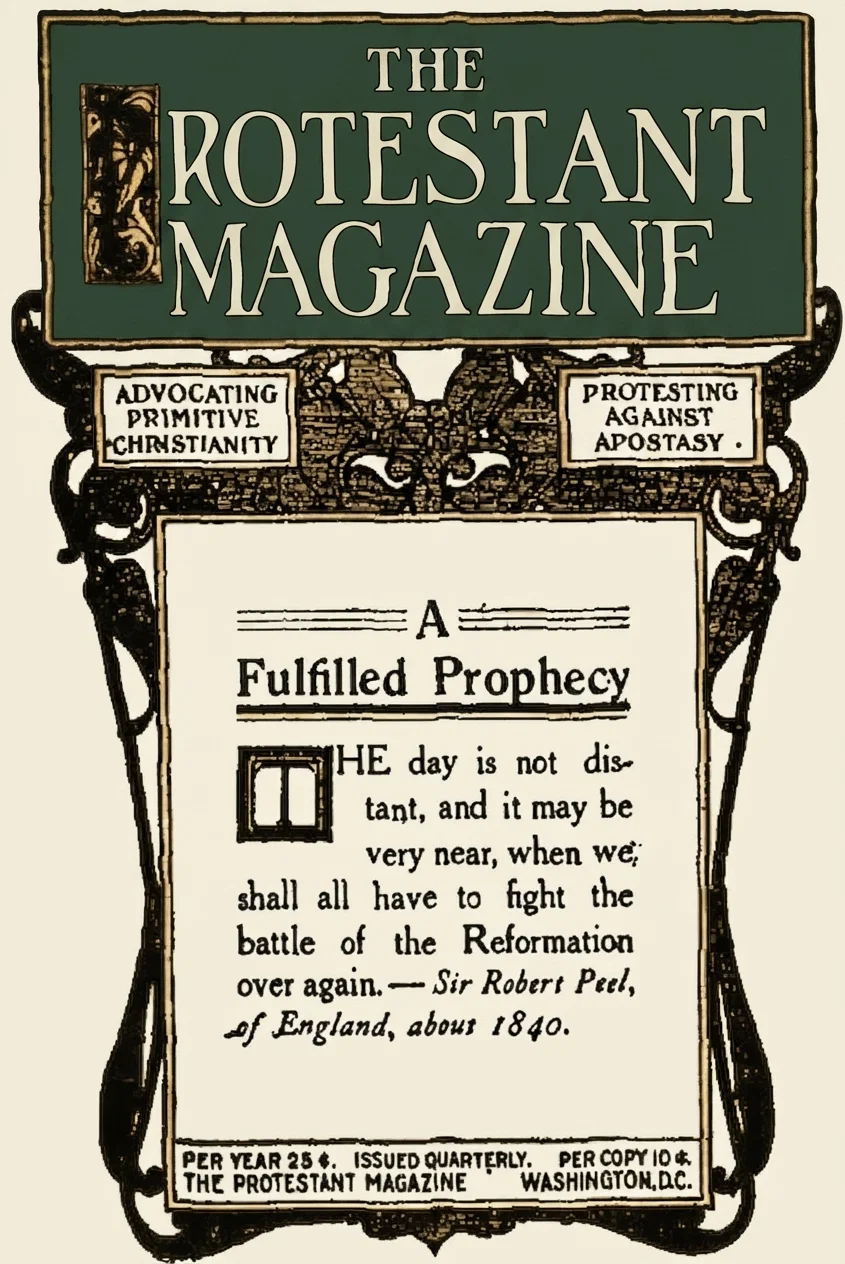
Double Frontispiece — Photographs of "The White House and the American Cardinals" and "Governor Taft's Mission to the Vatican." Sir Robert Peel's Prophecy Fulfilled (Cover). President Taft's Letter. The Mediation of Christ. The Awakening of Protestantism. Rome's Methods in Protestant Lands. Rome's Growth and Power in Germany. Trial and Self-Conviction of Leo XIII. The Final Call Out of "Babylon." Bishop Burt on the Reformation. Singer on "The Future of the Papacy." Catholic Population in Twenty-Five States. Rome's Boast of Control of Massachusetts. Rome and the American Flag, and Other Articles.

SPECIAL OFFER ON FIVE, ONE YEAR

Five copies, one year, to one address or to 5 separate addresses, only $3.00, or 60 cents each. Sender may include his own name. Or, send $1.50 for ten copies, six months. This number should be placed in the hands of every editor, attorney, clergyman, city and county official, and public-school teacher. We can furnish names and addresses.

ORDER THROUGH YOUR TRACT SOCIETY

If you do not know your Tract Society address, send to "The Protestant," Washington, D. C.

HISTORY OF THE SABBATH

REVISED AND ENLARGED

THIS splendid volume by Elder J. N. Andrews, which was so highly prized by our people during the early years of this denomination, and which was the means of persuading many to accept the Bible Sabbath, has just been reissued in its revised and enlarged form.
For several years Elder L. R. Conradi, who has had access to the large libraries in Europe, has been making a thorough research in the ancient histories with regard to the Sabbath question. The information thus gained has been carefully prepared for this book, thus adding greatly to its completeness. It is a mine of useful information on the Sabbath question.
This book treats the Sabbath question from both the Biblical and the historical standpoint. Every passage of Scripture which has any connection with the Sabbath is carefully examined. The prophecies relating to the change from the seventh to the first day of the week and the history showing how and when the change was made, combine to make the study of this important subject one of great interest and profit. The various steps by which the change was made are given in detail; also the scriptures showing that the Sabbath will finally be exalted and restored to its proper place by the people of God.
A copious index enables the reader readily to find any passage of Scripture, or the statement of any historian.
The revised edition contains over 800 pages. Standard edition, full cloth binding, $1.50 Thin paper edition, flexible leather binding, $2.50
Order of Your Conference Tract Society, or of

REVIEW AND HERALD PUBLISHING ASSOCIATION

TAKOMA PARK, WASHINGTON, D. C.

The Everlasting Arms

PEARL WAGGONER
"The eternal God is thy refuge, and underneath are the everlasting arms." Deut. 33 : 27.
THE everlasting arms are underneath. How blest to know it, on the somber day, In hour of loneliness and bitter grief, When all life's dearest props seem giving way!
Those arms unfailing, changeless through the years, We scarce can really sense when life is fair; But when in grief we bow, mid blinding tears, Ah, then we know His loving arms are there.
And he to whom these arms of love belong,— So oft on earth outstretched to heal and bless,— Whose word so oft brought peace, whose touch made strong, Stands close beside, in pitying tenderness.
He cometh in — a friend, of friends the chief — When all the world's best joy, best love, has flown; He fills the empty space, he shares the grief, Nor for a moment leaves his child alone.
The sorrow which no human heart can share, The heavy loss it seems none else can know, He feels, he knows; while in his watchful care He puts his everlasting arms below.
Those very outstretched, nail-pierced hands but prove Him greater far than all, than e'en the tomb; More great than all our burdens is his love, And in himself earth's curse shall find its doom.
Those everlasting arms shall ne'er forsake Until they've borne us to the yonder shore; Till earth's rough road is past, till day shall break, And need for comfort be forever o'er. Hinsdale, Ill.

A Faithful Under-Shepherd

LITTLE mention is made in the book of Acts of the later work of the apostle Peter. During the busy years of ministry that followed the outpouring of the Spirit on the day of Pentecost, he was among those who put forth untiring efforts to reach the Jews who came to Jerusalem to worship at the time of the annual festivals.
As the number of believers multiplied in Jerusalem and in other places visited by the messengers of the cross, the talents possessed by Peter proved of untold value to the early Christian church. The influence of his testimony concerning Jesus of Nazareth extended far and wide. Upon him had been laid a double responsibility. He bore positive witness concerning the Messiah before unbelievers, laboring earnestly for their conversion; and at the same time he did a special work for believers, strengthening them in the faith of Christ.
It was after Peter had been led to self-renunciation and entire reliance upon divine power that he received his call to act as an under-shepherd. Christ had said to Peter before his denial of him, "When thou art converted, strengthen thy brethren." These words were significant of the wide and effectual work which this apostle was to do in the future for those who should come to the faith. For this work, Peter's own experience of sin and suffering and repentance had prepared him. Not until he had learned his weakness, could he know the believer's need of dependence on Christ. Amid the storm of temptation he had come to understand that man can walk safely only as in utter self-distrust he relies upon the Saviour.
At the last meeting of Christ with his disciples by the sea, Peter, tested by the thrice-repeated question, "Lovest thou me?" had been restored to his place among the twelve. His work had been appointed him: he was to feed the Lord's flock. Now, converted and accepted, he was not only to seek to save those without the fold, but was to be a shepherd of the sheep.
Christ mentioned to Peter only one condition of service, "Lovest thou me?" This is the essential qualification. Though Peter might possess every other, yet without the love of Christ, he could not be a faithful shepherd over the flock of God. Knowledge, benevolence, eloquence, zeal,—all are essential in the good work; but without the love of Christ in the heart, the work of the Christian minister is a failure.
The love of Christ is not a fitful feeling, but a living principle, which is to be made manifest as an abiding power in the heart. If the character and deportment of the shepherd is an exemplification of the truth he advocates, the Lord will set the seal of his approval to the work. The shepherd and the flock will become one, united by their common hope in Christ.
The Saviour's manner of dealing with Peter had a lesson for him and his brethren. Although Peter had denied his Lord, the love which Jesus bore him had never faltered. And as the apostle should take up the work of ministering the Word to others, he was to meet the transgressor with patience, sympathy, and forgiving love. Remembering his own weakness and failure, he was to deal with the sheep and lambs committed to his care as tenderly as Christ had dealt with him.
Human beings, themselves given to evil, are prone to deal untenderly with the tempted and the erring. They can not read the heart; they know not its struggle and its pain. Of the rebuke that is love, of the blow that wounds to heal, of the warning that speaks hope, they have need to learn.
Throughout his ministry, Peter faithfully watched over the flock entrusted to his care, and thus proved himself worthy of the charge and responsibility given him by the Saviour. Ever he exalted Jesus of Nazareth as the hope of Israel, the Saviour of mankind. He brought his own life under the discipline of the Master Worker. By every means within his power he sought to educate the believers for active service. His godly example and untiring activity inspiredmany young men of promise to give themselves wholly to the work of the ministry. As time went on, the apostle's influence as an educator and leader increased; and while he never lost his burden to labor especially for the Jews, yet he bore his testimony in many lands, and strengthened the faith of multitudes in the gospel.
In the later years of his ministry, Peter was inspired to write to the believers "scattered throughout Pontus, Galatia, Cappadocia, Asia, and Bithynia." His letters were the means of reviving the courage and strengthening the faith of those who were enduring trial and affliction, and of renewing to good works, those who through manifold temptations were in danger of losing their hold upon God. These letters bear the impress of having been written by one in whom the sufferings of Christ and also his consolation had been made to abound; one whose entire being had been transformed by divine grace, and whose hope of eternal life was sure and steadfast.
At the very beginning of his first letter, the aged servant of God hastened to ascribe to his Lord a tribute of praise and thanksgiving. "Blessed be the God and Father of our Lord Jesus Christ," he exclaimed, "which according to his abundant mercy hath begotten us again unto a lively hope by the resurrection of Jesus Christ from the dead, to an inheritance incorruptible, and undefiled, and that fadeth not away, reserved in heaven for you, who are kept by the power of God through faith unto salvation ready to be revealed in the last time."
In this hope of a sure inheritance in the earth made new, the early Christians rejoiced, even in times of severe trial and affliction. "Ye greatly rejoice," Peter wrote, "though now for a season, if need be, ye are in heaviness through manifold temptations: that the trial of your faith, being much more precious than of gold that perisheth, though it be tried with fire, might be found unto praise and honor and glory at the appearing of Jesus Christ: whom having not seen, ye love; in whom, though now ye see him not, . . . ye rejoice with joy unspeakable and full of glory: receiving the end of your faith, even the salvation of your souls."
The apostle's words were written for the instruction of believers in every age, and they have a special significance for those who live at the time when the "end of all things is at hand." His exhortations and warnings, and his words of faith and courage, are needed by every soul who would maintain his faith "steadfast unto the end."
The apostle sought to teach the believers how important it is to keep the mind from wandering to forbidden themes, or from spending its energies on trifling subjects. Those who would not fall a prey to Satan's devices, must guard well the avenues of the soul; they must avoid reading, seeing, or hearing that which will suggest impure thoughts. The mind must not be left to dwell at random upon every subject that the enemy of souls may suggest. The heart must be faithfully sentinelled, or evils without will awaken evils within, and the soul will wander in darkness. "Gird up the loins of your mind," Peter wrote, "be sober, and hope to the end for the grace that is to be brought unto you at the revelation of Jesus Christ; . . . not fashioning yourselves according to the former lusts in your ignorance: but as he which hath called you is holy, so be ye holy in all manner of conversation; because it is written, Be ye holy; for I am holy."
"Pass the time of your sojourning here in fear: forasmuch as ye know that ye were not redeemed with corruptible things, as silver and gold, from your vain conversation received by tradition from your fathers; but with the precious blood of Christ, as of a Lamb without blemish and without spot: who verily was foreordained before the foundation of the world, but was manifest in these last times for you, who by him do believe in God, that raised him up from the dead, and gave him glory; that your faith and hope might be in God."
Had silver and gold been sufficient to purchase the salvation of men, how easily might it have been accomplished by him who says, "The silver is mine, and the gold is mine." But only by the precious blood of the Son of God could the transgressor be redeemed. The plan of salvation was laid in sacrifice. The apostle Paul wrote, "Ye know the grace of our Lord Jesus Christ, that, though he was rich, yet for your sakes he became poor, that ye through his poverty might be rich." Christ gave himself for us that we might be rich. Christ gave himself for us that he might redeem us from all iniquity. And as the crowning blessing of salvation, "the gift of God is eternal life through Jesus Christ our Lord."
"Seeing ye have purified your souls in obeying the truth through the Spirit unto unfeigned love of the brethren," Peter continued, "see that ye love one another with a pure heart fervently." The word of God—the truth—is the channel through which the Lord manifests his Spirit and power. Obedience to the word produces fruit of the required quality—"unfeigned love of the brethren." This love is heaven-born, and leads to high motives and unselfish actions.
When truth becomes an abiding principle in the life, the soul is "born again, not of corruptible seed, but of incorruptible, by the word of God, which liveth and abideth forever." This new birth is the result of receiving Christ as the word of God. When by the Holy Spirit divine truths are impressed upon the heart, new conceptions are awakened, and the energies hitherto dormant are aroused to cooperate with God.
Thus it had been with Peter and his fellow disciples. Christ was the revealer of truth to the world. By him the incorruptible seed—the word of God—was sown in the hearts of men. But many of the most precious lessons of the great Teacher were spoken to those who did not then understand them. When, after his ascension, the Holy Spirit brought his teachings to the remembrance of the disciples, their slumbering senses awoke. The meaning of these truths flashed upon their minds as a new revelation, and truth, pure and unadulterated, made a place for itself. Then the wonderful experience of his life became theirs. The Word bore testimony through them, the men of his appointment, and they proclaimed the mighty truth, "The Word was made flesh, and dwelt among us, (and we beheld his glory, the glory as of the only begotten of the Father,) full of grace and truth. . . . And of his fulness have all we received, and grace for grace."
(To be continued)

Organizations Indorsing Religious Legislation

ONE of the most striking movements of the present is that of federation. The idea of forming combinations for securing power and influence is manifested in many quarters. The political, social, commercial, and religious forces are binding themselves together in order to carry out their purposes.
In many instances a vast amount of good is done as the result of such organization, but in some cases, especially in the sphere of religion, the power which comes as the result of union and federation is being used to enforce institutions of the church which should be left to the individual. This is notably true in respect to the enforcement of Sunday laws. Through the efforts of religious bodies other organizations not supposed to be particularly concerned with religious matters have been prevailed upon to use their influence in securing the enforcement of religious reforms.
The following list of organizations that are now lending their power and influence to the cause of religious legislation, will be of interest:—

The International Reform Bureau

"The big four evils the bureau fights most of all are (1) intemperance, (2) impurity, (3) Sabbath-breaking, and (4) gambling."We attack these by four methods: (1) By legislation, (2) by letters, (3) by lectures, and (4) by literature."—Wilbur F. Crafts, superintendent of bureau, in pamphlet.

National Reform Association

"Perceiving the subtle and persevering attempts which are made to prohibit the reading of the Bible in our public schools, to overthrow our Sabbath laws," this association is endeavoring to "place all the Christian laws, institutions, and usages of our government on an undeniably legal basis in the fundamental law of the land."—Constitution of National Reform Association.

Lord's Day League of New England

"Its object shall be to maintain the observance of the Lord's day as a civil rest day and a day for religious uses," "defending it against encroachments of business and pleasure."—The Defender, January, 1911.

Lord's Day Alliance of Canada

"To secure the faithful and impartial enforcement of laws which are intended to procure for all classes the weekly day of rest."
"To secure such amendments in legislation as may be necessary adequately to protect the quiet and rest of the Lord's day."—Annual Report, 1908.

Roman Catholics

"There are many Christian issues to which Catholics could come together with non-Catholics and shape civil legislation for the public weal. . . . We should seek an alliance with non-Catholics for proper Sunday observance."—Catholic Lay Congress, Baltimore, Nov. 12, 1889.

Woman's Christian Temperance Union

In 1886, the W. C. T. U. added a "Sabbath Observance" department to its national organization, and "aims to secure and maintain good Sunday laws."—"Sunday Rest in Twentieth Century," page 433.

The American Federation of Labor

"The American Federation of Labor, representing, as it does, over two million working men and women, has emphatically declared itself in favor of the Sunday-rest day, and it has done as much as any other organized body of men and women, if not more, to enforce the observance of the Sunday-rest day."—Samuel Gompers, president A. F. of L.

Lord's Day Alliance of the United States

Object: "(1) To preserve the Lord's day for America; (2) to secure an active alliance in every State not yet organized; (3) to induce the general government as far as possible to set the example of Sabbath observance; (4) to press the rest-day feature of the fourth commandment, until every toiler in the land has guaranteed unto him fifty-two full rest days a year.—Circular.

Philadelphia Sabbath Association

"As a result of the work done by the association, the Sunday law of Pennsylvania has been retained upon the statute-books. It is one of the best Sunday laws in any State in the Union."—"Sunday Rest in Twentieth Century," page 429.

Cleveland Sunday Union

"The Cleveland Sunday Union was called into existence because of the increasing tendency to secularize the Sabbath and defy the law generally." It "helped to influence Congress in seeking to have the gate of the Portland (Oregon) exposition closed on Sunday."—Id., page 445.

Men and Religion Forward Movement

"Thirty-two reforms for the District of Columbia will be recommended by the Social Service Commission. These recommendations are directed at an attempt to mold public sentiment to such a point that Congress will be forced to enact such legislation as the church people believe will be necessary to make Washington the model moral city in America."—Washington Times, Feb. 17, 1912.
Number 18 of its social service recommendations is, "One day's rest in seven."

The Federal Council of the Churches of Christ in America

One of its social service reforms is, "A release from employment one day in seven."
"The churches could do no more for the cause of human betterment than by working for such laws [Sunday]. They could well initiate a movement for six-day legislation comparable with the old Sunday-observance movement, which resulted in the placing of Sunday laws on the statute-books of most States."—"Report of Special Committee of Investigation," pages 15, 16.

New York Sabbath Committee

"It has to do chiefly with Sunday observance as a civil and secular institution.
"It aims to combine the efforts of all good citizens—Protestants, Roman Catholics, and others—in the protection of the day as essential to the peace and good order of the community, the rights of wage-earners, the welfare of the State. It seeks to foster a right public sentiment, by means of documents, addresses, and the press; to secure the wise enforcement of existing laws, and additional legislation where necessary."—Circular.

Christian Endeavor Society

"We urge all Christian Endeavorers to set the example of Sunday observance, and to throw all their influence in favor of the preservation of Sunday as a day of rest and worship. We most heartily commend and indorse the action of the Postmaster-General in closing the post-offices on Sunday in large measure, and pledge our united support as representing four millions of young people in the United States to this action in the interests not only of the post-office employees, but also of public morality and proper respect for the laws of God. We urge also upon civic authorities the enforcement of Sunday laws without discrimination."—Christian Endeavor Convention, Atlantic City, July, 1911.

Woman's National Sabbath Alliance

"In days so crowded with activity as are ours, few will rest apart from a time provided, ready, and waiting for this express and sole use. Hence the great importance to all of a legal rest day each week, which can be demanded of reluctant employers of labor."—"The Young and the Lord's Day," page 3.

The Sunday League of America

"This organization seeks to preserve the Sabbath [Sunday] for every American citizen. It also has for its object the enforcement of the Sabbath laws and the strengthening of these laws wherever it is possible."—Baptist Standard, Sept. 8, 1910.

International Federation of Sunday Rest Associations

In a letter to Theodore Roosevelt, when president of the United States, this federation asked that in his next message he would "call attention to the great necessity that a Sunday-rest law be enacted for the national capital, corresponding to the laws of most of the States of the Union."—"Sunday Rest in Twentieth Century," page 454.
Writing in the United Presbyterian (Jan. 26, 1911) regarding the different federations, W. H. McMaster said:—
"The organized movements on behalf of the Sabbath are almost world-wide. The Lord's Day Alliance of the United States and Canada covers North America. The Lord's Day Alliance of Scotland, the Imperial Alliance in Great Britain, the New Lord's Day Defense Society in Germany, together with various alliances and federations in Europe, all point to a world movement of mighty force on behalf of the day God made for man and his own great glory. Recent enactments have been made in Spain, Italy, France, Germany, and Japan in recognition of the weekly Sabbath. . . . All this is preparatory to the formation, eventually, as now suggested by the world's committee at Geneva, Switzerland, of the International or World's Lord's Day Alliance."
Thus we see the forces at work that will soon attempt to boycott those who will not respect and observe the first day of the week as a day of rest.
Takoma Park, D. C.

"Where Are the Men and Means?"

MRS. D. A. FITCH
As I read appeals for Africa and other fields, I think how the above question may be favorably answered if all will cooperate to give the Lord his way.
Had all who profess a love for this last-day message so much love for it that the claims of the world were lighter upon them, the men and means God has in reserve would be forthcoming very soon. Perhaps he is waiting for us to come into line with the light he has given, before he sees best to call into our ranks those who might be lost by following our example.
Were we to expend less money on self and on our families, we should have more with which to send the precious message to those who know it not, but who are hungering for it. The example of plainness thus set would testify to our neighbors that a genuineness of purpose is actuating the life, and many would embrace the truth who now see no difference between us and the nominal professor of religion except that we attend church on Saturday instead of Sunday.
Is it not true that a real change of heart will cause expensive but uselessadornments to fall as do the leaves of the tree whose root is dead? Time and money saved to God's cause by self-denial are very precious in his sight, and he will use them in securing bright stars to adorn the crown of his faithful children.
A recent experience in the home of the writer shows the transforming power of the Spirit in the heart of a child fully surrendered to Jesus. Gladys, a girl of eleven years, who had been reared in theatrical environments, was this year placed in our good church-school. As she received Christian instruction, she thought seriously about her own salvation. The coming of the Saviour seemed very precious to her. She said: "Auntie, how soon will Jesus come? I hope not right away, for I am not a perfect girl all through yet.". At another time when we were speaking of the inheritance of the saints, she said: "I do not want to go to school to-day. I prefer to stay at home and talk about Jesus."
She heard something said about tithing, and asked what it meant. A brief study of Malachi 3 caused her to prepare a box for her tithe. She was wearing several rings. She asked me at family worship to read what the Bible says about wearing gold. I did so; and when we rose from prayer, her rings were on the table, and have not since been worn. Later she said, "I do not care for the fashions any more."
Could such a spirit pervade our ranks, soon, very soon, men and means would be furnished to carry the message everywhere.
Glendale, Cal.

Good Books

"The cloak that I left at Troas with Carpus, when thou comest, bring with thee, and the books, but especially the parchments." 2 Tim. 4:13. Thus wrote the great apostle from a Roman dungeon. He felt his need of books. Even an apostle must read. He was an inspired instrument of the Lord, and had been preaching for many years, but he still wanted books. He was "Paul the aged," and the years of his usefulness seemed about ended. He was then a prisoner, sentenced to death, but he still wanted books. He had been educated at the feet of Gamaliel, but he did not stop reading and studying. He felt that books were still one of his needs. He had seen the Lord when on the way to Damascus, had been caught up to the third heaven and heard things that it was impossible for him to utter, and had a very wide experience, yet all this did not take the place of books. To grow intellectually he must read and fill his mind with useful information. Though an inspired writer himself, he was not beyond reading the writings of other men. Books and parchments seemed to weigh more in his mind than food for the outward man.
Surely the example of this mighty hero of the cross, studying and seeking for light and knowledge, when almost in the presence of the executioner, is an inspiring example for God's servants to-day to be diligent students and readers of good literature. Intellectual laziness is as great a sin as any other kind of laziness.
Paul wrote to Timothy, "Give attendance to reading." Spurgeon once said, "The man who never reads will never be read; he who never quotes will never be quoted; he who will not use the thoughts of other men's brains, proves that he has no brains of his own. Brethren, what is true of ministers is true of all people: you must needs read."
While it is true that there is much literature in the world that should not be read, there are many excellent books that will impart light and information, and we should be constantly searching for the good that we may constantly improve the mind.
Takoma Park, D. C.

The Journey of a Day — No. 1

IN reading the divine narrative of God's dealings with his people in olden times, we are sometimes prone to think that God and his people seemed to live very near together, to hold very close personal intercourse; but "the thing that hath been, it is that which shall be; and that which is done is that which shall be done: and there is no new thing under the sun." Did men live holier lives of old? Did they walk with God? Did they obey God? "The thing that hath been, it is that which shall be," is God's answer. He has promised to sweetly, gently abide with his children to-day, for "that which hath been is now" with God in all his dealings with men.
Abraham often conversed with God as one of our children converses with father and mother, on terms of filial and yet familiar affection. Eliezer, the steward of Abraham, addressed Jehovah in the same direct, though reverent manner. He addressed God, in a simple, childlike fashion: "I pray thee, send me good speed this day." Gen. 24:12. Their faith was as simple as their style of living. Abraham sent Eliezer, the "eldest servant of his house," to Mesopotamia in search of a wife for his son Isaac.
Eliezer set off with his caravan of camels, and soon reached the city of Nahor, near which resided Bethuel, who was a kinsman of Abraham. The caravan halted beside a well in the vicinity of the town.
With straightforward directness Eliezer offers up this prayer: "O Lord God of my master Abraham, I pray thee, send me good speed this day, and show kindness unto my master Abraham. Behold, I stand here by the well of water; and the daughters of the men of the city come out to draw water: and let it come to pass, that the damsel to whom I shall say, Let down thy pitcher, I pray thee, that I may drink; and she shall say, Drink, and I will give thy camels drink also: let the same be she that thou hast appointed for thy servant Isaac; and thereby shall I know that thou hast showed kindness unto my master."
The speedy appearance of the beautiful Rebekah with her pitcher upon her shoulder, attested the answer which Eliezer sought for his petition. After acknowledging her kindness by rich gifts, the messenger asked her parentage, and on learning that she was the daughter of Bethuel, Abraham's nephew, he "bowed down his head, and worshiped the Lord." Eliezer was a man of piety, and remembering Abraham's assurance that God would send his angel, he prayed earnestly for divine guidance, and was abundantly rewarded for his faith.
The theme I wish to emphasize, however, is the journey of a day, and how, by God's blessings, to make good speed upward and heavenward through every hour. Life is frequently presented as a pilgrimage or a journey; and John Bunyan was only following the line of Scriptural suggestion when he conceived the plan of his immortal allegory. The actual journey of human life is subdivided into several stages. Of these a day is the most visible and definite, for it is measured by the globe on its axis. A person of the average age (thirty years) sees about eleven thousand days. A veteran of fourscore sees about thirty thousand days, of which there is a faithful record kept. Were they good days or bad days the records of heaven will disclose in the judgment hour.
In ordinary phrase, we apply the word day to those hours of the twenty-four which are marked by sunlight. The period we call night is the bivouac after the march; and the hours of sleep are the blank leaves in the diary of life. A few hours of unconscious slumber and the rosy finger of the morning touches us as the Divine Restorer touched the motionless form of Jairus's daughter, and saith to us, Arise! In an instant the wheels of conscious activity are set in motion, and we leap up from the temporary tomb, our bed. Was yesterday a sick day? Sleep, like a good doctor, may have made us well. Was yesterday a sad day? Sleep kindly soothed the agitated nerves. Was it like too many of its predecessors, a lost day? Then our merciful Heavenly Father puts us on new probation, and gives us a chance to save this new-born day for him and for his holy purposes of our existence.
Do we lose the morning either by our sleep or indolence or aimlessness? Then we commonly lose the day. One hour of the morning is worth two or three at sunset. The early morning hours are the best time to begin the day's work and the worship of God. Napoleon, who made time a great factor in all his successes, chose the early dawn. The numerous commentaries of Albert Barnes are monuments of early rising; they attest how much a man may accomplish who gets at his work early.

Work Is Not Man’s Punishment

WORK is not man's punishment. It is his reward and his strength, his glory and his pleasure.—George Sands.

Editorial

“He that saith he abideth in him ought himself also so to walk, even as he walked.” 1 John 2:6.
“Abide in me, and I in you. As the branch can not bear fruit of itself, except it abide in the vine; no more can ye, except ye abide in me. I am the vine, ye are the branches: he that abideth in me, and I in him, the same bringeth forth much fruit: for without me ye can do nothing.” John 15:4, 5.
The experience represented in these scriptures is not one of a transitory or uncertain character. He who abides in Christ has effected through the Spirit a union with keeping power. The life that he lives is not his own selfish life of sin, but the Christ-life. The spirit he manifests is not the sordid, selfish spirit of the world, but the humble, meek, and self-denying spirit of the lowly Master. He is not controlled by blind impulse or unreasoning passion, but submits himself to the leadings and directions of the Spirit of God. His aims in life are not those of selfish ambition, but rather of unselfish ministry to those around him.
Abiding in Christ represents no passive experience; it is a positive, active, aggressive existence. The evidence of the union is that of fruit bearing. “He that abideth in me, and I in him, the same bringeth forth much fruit.” It is not indicated alone by the profession. Some there were, Christ declared, who would cry, Lord, Lord, but do not the things which he said. This class John the Baptist admonished in his day: “Bring forth therefore fruits meet for repentance.” Matt. 3:8. Union with Christ does not come as a result of fruit bearing. Fruit bearing results from the union. Indeed, without the union, fruit bearing is impossible. The union is effected not through the will of the flesh, man-made resolution, or human striving. It results from surrender to God, from asking Christ to cleanse the soul temple, and to enthrone himself in the affections as the supreme object of the heart’s adoration. United with this surrender, and with this seeking, a simple faith brings him into the life. Rev. 3:20; Eph. 3:17; Gal. 2:20. Keeping oneself upon the altar of surrender, keeping one’s heart open to divine influences, and relying constantly upon the power of the Holy Spirit to live a consecrated life,—by this experience abiding in Christ is made possible. The conditions are such that every man, woman, and child, regardless of nation, color, education, wealth, or worldly station, may accept God’s gracious provision. “Whosoever will, let him take the water of life freely.”
Continue reading: Union With Christ