Your ShelfYour Projects

Signs of the Times, Vol. 41, No. 34.

EIGHT HUNDRED THOUSAND AUTOMOBILES

Signs of the Times

Sep 1, 1914

Pacific Press Publishing Association · Mountain View, California · Sep 1, 1914

EIGHT HUNDRED THOUSAND AUTOMOBILES
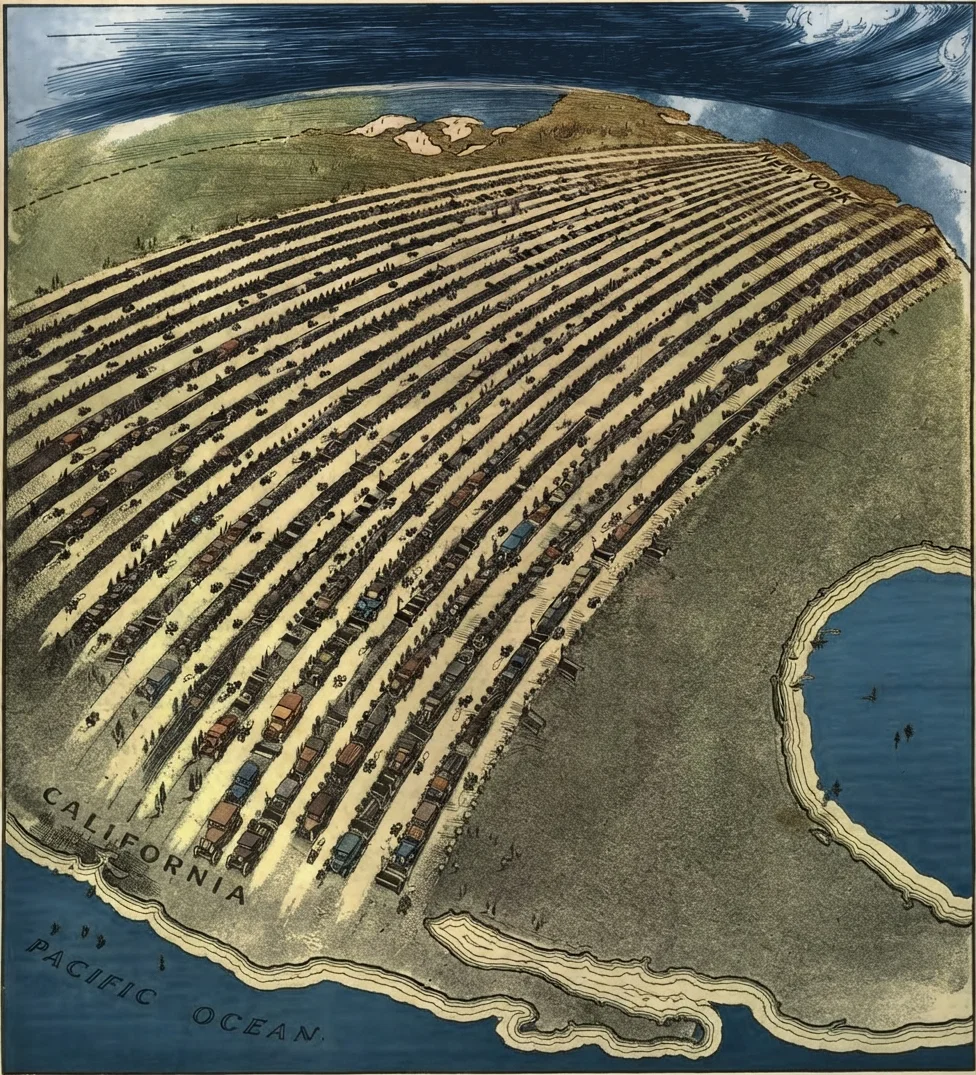
Twenty Lincoln Highways from Sea to Sea

Exit King Alcohol

By GUY WOODBRIDGE WADSWORTH, A. B., D. D.
General Superintendent of California "Dry" Federation
A DISTINGUISHED American educator said recently, "Show the American people what alcohol really is, and the American people will banish every saloon from the land." The American people are being shown. King Alcohol is on the run.
July 1, 1914, was a red letter day in the anti-liquor fight. West Virginia entered the column of prohibition states. The "drys" won the battle, November, 1912, by 92,000 majority; but the saloons remained open until midnight of June 30, 1914. This last day of the liquor régime will long be remembered in West Virginia, as five deaths, due to liquor, occurred on that day.
The United States navy went "dry" on the same day and hour; and Secretary Daniels had the satisfaction of seeing the kingdom of Norway establish a similar regulation June 10, 1914, to apply not only to the navy, but to the army.
From Boise, Idaho, comes a despatch, dated July 1, "Planks favoring state-wide prohibition were incorporated in the platform of the Republican, Democratic, and Progressive parties."
Let us notice certain reasons why alcohol's day of doom is near:

Condemned by Science and Business

1. Science condemns alcohol. It is not a true stimulant, but a narcotic poison. Alcohol is the excretion of the yeast microbe. The medical profession no longer consider it a food, and regard it as a drug whose use is rapidly vanishing.
Dr. Harvey W. Wiley says of prohibition: "Personally I would be glad to see nation-wide and world-wide prohibition. I am a prohibitionist. I am firmly convinced that the evils produced by alcohol so far outweigh any of its supposed advantages as to lead logically to but one conclusion, namely, the absolute prohibition of the use of alcohol for any but industrial purposes."
2. Business has no use for alcohol. In January, 1914, the board of trade of Pittsburg, Pennsylvania, passed a resolution favoring national prohibition of the liquor traffic. The reasons for doing so were economic. Alcohol is an enemy to efficiency. The liquor traffic greatly reduces the purchasing power of the average citizen. The same dollar can not buy dry-goods and "wet" goods.
In answer to the question, Why do not all commercial bodies take similar action? the truth is that, in many of our cities, the brewer and the distiller are heavy depositors and frequently stockholders in the banks. Some of the banks own stock in the breweries and distilleries. The business world is an organism, and the liquor men hold the balance of power; but their day will be short, for intelligent and moral business men are everywhere showing signs of revolt against liquor domination.

Condemned by Patriotism

3. Patriotism cries out against alcohol. This is true in France, the greatest wine-producing country in the world. M. Joseph Reinach, a member of the French Chamber of Deputies, January 23, 1910, delivered a speech in the amphitheater of the Sorbonne, before a joint meeting of the National League against Alcoholism, and the National Federation of Mutual Insurance. The following are quotations from his speech:
"I do not believe, gentlemen, and I will not tire of repeating it, that there is at this moment for men of courage and good will, for all parties, and preeminently for the government itself, a single duty which is more pressing than that of engaging in a systematic and irresistible fight against alcoholism."
"If France does not wish to die—and who can doubt but that she still desires to live, and that her genius will yet give the world marvelous surprises—she must begin by burning out the cancer which gnaws within her, which is making greater ravages in the twentieth century than ever famine and the black death made in the middle ages."
In Ernest Gordon's recently published book on "Anti-Alcohol Movement in Europe," which is up to date and authoritative, we find, on page 232, these words: "Turning to France, a land in a galloping alcoholic consumption, we find a marked advance in physical degeneracy. Of the 275,234 conscripts summoned to the colors in 1907, 55,093 were rejected. Normandy a hundred years ago was the principal recruiting ground for cuirassier regiments. To-day the French military authorities are obliged to lower the requirement for cuirassier height."
"In the Norman regiments," writes a correspondent in En Normandie, "every fourth man has alcoholic trembling, tinglings in the hands, and mucous vomitings in the morning when rising. They have no power of resistance. On the march it is necessary to watch over them as if they were delicate children. . . . In the department of the Orne fifty-seven per cent of the recruits, according to a circular of the Ligue Nationale contre l'Alcoolisme, were rejected in 1903, in the Manche fifty per cent, in the Vallée des Vosges sixty per cent. The military authorities reckon that France loses an army corps each year through alcohol."
General Gallifet, in an interview, after remarking that all serious wounds meant death to a drinking soldier, affirmed that the French race was losing in height, physical force, and morale, because of this plague, and that there was more and more difficulty in filling the contingents. "In a mountain department we have had to do with, we got, thirty years ago, a splendid body of cuirassiers. Now not a single one comes thence."
Mr. Gordon, speaking of conditions in Germany, on page 234 makes the following statement: "In the sanitary report of the German marine for the ten years 1891-1901, a fourfold rise in heart-disease was noted. This army specialists attributed to the increase in beer drinking. The first and second Bavarian army corps lead in conscript rejections for heart trouble. It is not for nothing that Bavaria holds a beer record. In the Bavarian army between 1882-93 the number of admissions to army hospitals for heart sickness was from 3.1 per cent to 6.8 per cent of all. In the Prussian army it was but from 1.1 per cent to 3 per cent. Beer corpulence brings into the army multitudes of short-breathed, heavy, easily tired men, subject to heart fluttering and peculiarly liable to succumb to infectious diseases."
Concerning Italy, another great wine-producing country, the following statement appears on page 81 of Mr. Gordon's book: "Dr. Arcelli reports an infantile alcoholism. An investigation carried on in the schools of Milan among 36,462 children brings to light the fact that 24.8 per cent of the boys and 11 per cent of the girls confess to having been intoxicated at various times."
"The opinion as to the great danger in which Italy stands from alcoholism is a very great plague," writes the procurator of Undine. "The number of saloons is enormous. Sixty-five per cent of the crimes of violence are due to drink." The procurator of Treviso attributes more than half of the local crime, including crimes of carnal violence, to drink. In Padua "the number of drunkards is not small. Crime and frequent suicides are largely to be set down to drink." From Venice: "The vice of drunkenness is wide-spread and deeply rooted, and the number of drink shops continually increases." Brescia: "Eighty per cent of the crimes of violence result from the use of alcohol." The Milan prosecutor says: "It falls to my lot frequently to have to sum up the causes of a tragedy in two words—wine and knife."
The experience of these great nations in Europe and that of our own country is a call to every patriot to use his influence to have our government sever its connection with the liquor business, and for all to unite forces to annihilate the entire traffic.

Morality's Demand

4. Morality demands alcohol's destruction.
Dr. Legrain, a distinguished French author on insanity, characterizes the saloon as "a laboratory of moral poison"; and the procurator of S. Angelo dei Lombardi has said that in many cases which have come before his court, the criminal confesses to having deliberately charged himself with wine or other alcohol solution as a preparation for committing crime.
In this country, authors agree that from eighty to ninety per cent of the crimes are due directly or indirectly to alcohol. Riots seldom take place uninfluenced by drink.
In the name of morality, let us annihilate the traffic in alcoholic liquors of every kind, even in so-called pure and harmless wines. The much advertised wines of California are strongly alcoholic. The dry wines contain from ten to twelve per cent of alcohol, and the sweet wines from eighteen to twenty-four per cent. The iniquities of the restaurant with private wine-rooms are too well known for wine to be considered an innocent drink. Therefore let us make a clean sweep of the entire traffic.
There are now nine prohibition states. Six more vote this year on prohibitory amendments. Texas, Nebraska, Idaho, and Ohio will soon follow their example. Congress either now or later will pass constitutional amendments prohibiting the liquor traffic, which in the near future will be adopted by the necessary three fourths of the states in the American union. Possibly before that time the United States supreme court will decide against the legality of licensing saloons, on the ground that they are public nuisances. However the result may be reached, the more quickly it comes the better. May the cry soon be: "King Alcohol is dead. May his death be eternal."

What the Liquor Traffic Demands

We want six thousand boys a year, To sacrifice to old King Beer— Young fellows, full of life and cheer, All bright and active, With agile form and manly grace, Straightforward look and manly face, The very noblest of the race, And most attractive.
Don't mention wives' or mothers' tears, Or victims stretched on early biers. However serious this appears, We'll try to scout it. Don't talk of pain or crime or wo. We've got to have the boys, you know, Or else the business wouldn't go. That's all about it.
We'll make their lives a living hell, And all their manly hopes dispel. We'll ruin homes and friends as well. We don't deny it. We don't regard the public health; For since the business brings us wealth, By flattery, falsehood, gold, and stealth, We must stand by it.
Now, fathers, have you sons to spare? We think it only right and fair That you should gladly yield your share, If you uphold us. Though we your home and land enslave, And dig your boy a drunkard's grave, If now our cause you try to save, You needn't scold us.
R. A. Hanley.

What Liquor Men Say

It Has Lost the “Approval”

"Truth" (liquor organ), Detroit, Michigan, December 20, 1903: "The raising of money by the liquor trade to further its interests in legislative bodies meets with almost universal disapprobation. Men who are known as drinking men, and who have no fault to find with the saloon, denounce such methods. The liquor trade exists through public approval. Just as soon as the trade loses this approval it will cease to exist. Raising of funds to corrupt the machinery of government, and publicly announcing its intent to do so, will not aid the trade in holding public confidence."

"Nuisance," "Stench," "Disgrace," but Legitimate Fruit

"Wine and Spirit Gazette," New York, August 23, 1902: "The saloon as conducted is a nuisance and a loafing place for the idle and vicious. It is generally on a prominent street and is usually run by a sport who cares only for the almighty dollar. From this resort, the drunken man starts reeling home. At this resort, the local fights are indulged in. It is a stench in the nostrils of society, and a disgrace to the wine and spirit trade."

A Persistent Lawbreaker

"Champion of Fair Play" (Chicago liquor organ), June 7, 1902: "The laws of this state governing the liquor trade are so severe, that there is not a licensed saloon-keeper in Illinois who does not lay himself open to prosecution under the law a dozen times a day."

Forfeited Their Right to Live

"Wholesalers' and Retailers' Review," San Francisco, September, 1907: "Any man who knows the saloons well, can honestly say that most of them have forfeited their right to live."
The Great Prohibition Movement. The Mightiest Question before the American People

The Great Prohibition Movement

The Mightiest Question before the American People
By the HON. FRED F. WHEELER
Chairman of Convention That Inaugurated "Dry" Federation of California
THE proposed amendment to make California "dry," coupled with the Hobson bill introduced in Congress proposing to submit to a vote of the states a similar amendment to the national Constitution, together with similar measures in a dozen other states, is such a radical departure from the governmental partnership heretofore existing between the towns, cities, counties, states, and national government, on the one hand, and the liquor traffic on the other, as necessarily to involve more or less economic loss and business demoralization to many of our citizens. In order to justify such loss, we must be able to show clearly that our proposed action is based on principles fundamentally sound. Let me state some of them very briefly:

The Standard of Judgment

1. The liquor traffic is entitled to be weighed in the same scales and measured by the same standard by which we judge every other business; namely, by its effects upon the peace, happiness, and prosperity of the majority of the people. The preacher, the teacher, the merchant, and the manufacturer, the lawyer, the doctor, and the farmer, the editor, the capitalist, and the railroad man, as well as the gambler, the pickpocket, the thief, and the murderer, are all judged by this standard, and are either approved as a blessing to the community, or condemned as a curse. The liquor traffic therefore can not complain of or object to being judged in exactly the same manner, by the same standard; and we must insist that it shall abide by such a verdict reached by a jury of the citizens qualified to serve on the juries of states or nation.

The Findings of the People

2. The experience and observation of the American people during the fifty years that have elapsed since Abraham Lincoln reluctantly signed the internal revenue bill of 1862 which made the United States government the largest partner in this business, have enabled them to make up their verdict already. They have observed:
(a) That no man has ever made a better father or husband or citizen because of his drinking alcoholic liquors.
(b) That fifty per cent of our extremely poor are brought to that condition because of the drinking habit.
(c) That possibly fifty per cent of our idiotic and insane are in that deplorable condition either directly or indirectly because of the liquor traffic.
(d) That seventy-five per cent of our inmates of jails, prisons, and penitentiaries are products of the liquor traffic.
(e) That every dollar expended for intoxicating liquor is an absolute economic waste. The buyer receives for his money that which is worse than nothing, because it reduces his strength, vitality, and ability to perform any useful labor and to support himself or his family. The amount of money thus spent as the direct cost of the liquor traffic in the nation, based upon the government reports, is not less than $1,752,109,635 annually, and is usually stated in round figures as being two billion dollars. The indirect cost involved in caring for the victims of the traffic, and the loss of labor of the victims, and the interest, and depreciation of the necessary buildings, is probably as much more. If these estimates are approximately correct, then this issue is by all odds the largest financial and economic question now before the American people, and California's share alone of the direct cost can not be less than thirty-five million dollars annually, and the indirect cost as much more.
(f) The above stupendous statement does not include the destruction of manhood or womanhood, the criminals produced, the ruptured homes and the broken hearts, the orphaned children, and the numerous other tragedies that follow in the wake of this business.
(g) Neither does it include the destructive and demoralizing political results of the traffic. For fifty years it has been bulldozing and terrifying officials, from councilman to United States senator, until they have not dared to express their honest convictions. It is the most gigantic and law-defying trust or business combination that exists under the American flag, by the side of which the Standard Oil Company and the steel trust are angels of mercy and benevolence.

We Can Not Let It Alone

That is unthinkable and indefensible. We have tried license and regulation for fifty years, and we have concluded that these methods are not only morally wrong but entirely inadequate, as the per capita consumption of liquor has steadily grown larger notwithstanding an ever-widening area of "dry" territory.

Objections Considered

Let us consider some of the objections that are raised to our proposed amendment:
1. "It is an interference with personal liberty." Of course it is. So is nearly all other legislation. If a man were the only living thing on an island, he could do as he pleased; but the moment a dog came upon that island, his right to do as he pleased would end just where the rights of the dog began.
2. "It is sumptuary legislation." This is a false argument, inasmuch as we are not trying to legislate on what a citizen may eat or drink, but upon what he can manufacture and sell, and the latter comes squarely within the police powers of the state.
3. "It will destroy our grape-growing industry and confiscate much property." There will undoubtedly be some financial loss involved in such a sweeping governmental revolution, but my judgment is that it will only be a fractional part of the amount claimed by our opponents. The raising of wine grapes has not been profitable for several years, as such grapes have only sold for six to ten dollars a ton, as against twenty to thirty dollars for table grapes. Wine grapes may be grafted over into table grapes, or grape juice can be profitably manufactured instead of wine from wine grapes. Many farmers are already digging out their wine grape-vines, because they have been so unprofitable for several years; and this amendment, if adopted, will be a blessing in disguise by accelerating that movement. The land in nearly all cases can be used for other crops, and the buildings generally can be used for other purposes profitably. But whatever the final economic loss may be, the individual, the community, and the state will be the gainer a thousandfold in moral fiber and real riches.
4. "Prohibition does not prohibit." Neither does an ax cut, nor a gun shoot, without a man behind them. For five years Kansas has been giving the nation the most wonderful and the most convincing demonstration that prohibition does prohibit when there is placed behind the law an administration that is in full sympathy with it. The results in Kansas in their increased wealth, sobriety, freedom from crime, increase in educational and religious advantages, are almost unbelievable. No wonder that her newspapers, her state officials, her representatives in Congress, her educators and leaders in the business world, are all so overwhelmingly in favor of prohibition. Her experience can be confirmed in a lesser degree by a thousand other communities whose experience has been similar when the law was faithfully enforced.
In conclusion let me say that if two thirds of the women of California will stand with us at the ballot-box next November, we will adopt the amendment, and this grand commonwealth of the West will be free from this blight and curse forever.

Corporation of Glasgow

Abuse of Alcohol and Its Results

THE Committee on Health urge the citizens to consider the following statements from the report, recently submitted to Parliament, of the Committee on Physical Deterioration:

Effect on Adults

  1. The abuse of alcoholic stimulants is a most potent and deadly agent in producing physical deterioration.
  2. Alcohol IS NOT A FOOD.
  3. It is NOT a source of muscular vigor or dexterity, but the reverse.
  4. It may produce temporary exhilaration, but DEPRESSION SOON FOLLOWS.
  5. Its continued use IMPAIRS THE PRODUCTIVE POWER of the skilled artisan.
  6. Its CONTINUED USE, whether in the form of beer, wine, or spirits, even though never to the extent of producing drunkenness, RESULTS IN CHRONIC POISONING.
  7. It WEAKENS the natural FORCES WHICH RESIST DISEASE.
  8. It increases the risk of CONSUMPTION.
  9. It INCREASES LIABILITY TO DISEASE, adds to its severity, and RETARDS RECOVERY.
  10. It PERVERTS the moral nature, affects the judgment, and impairs the memory.
  11. It deadens sensibility to miserable surroundings, and destroys all desire for improvement.
  12. It is INCREASING the PROPORTION of men and women who are being CONFINED in LUNATIC ASYLUMS.
  13. It SHORTENS LIFE. The death-rate of abstainers is little more than half that of the whole male population living between the ages of twenty-five and sixty-five.

Effect of Parental Intemperance on the Children

  1. Intemperance in parents BRINGS SUFFERING on their CHILDREN.
  2. It produces PHYSICAL and sometimes MENTAL WEAKNESS in them.
  3. If they escape death in infancy, PERMANENT DISABLEMENT may still result from PARALYSIS, EPILEPSY, or IDIOCY.
  4. The DEATH-RATE among INFANTS of inebriate mothers is two and one half TIMES GREATER than among the children of sober mothers.
  5. The report states that drinking habits are increasing among women of the working classes.
A. K. CHALMERS, M. D., Medical Officer of Health, Glasgow.

The Liquor Traffic and the Attitude of the Christian

By IRWIN H. EVANS President of the North American Conference of Seventh-Day Adventists
INTEMPERANCE is almost universal, and is a universal curse. But the tragedies lived daily before their eyes have failed to impress many well-meaning persons with the awfulness of this unspeakable curse. Prisons filled and workhouses overflowing, poverty-stricken widows and orphans, the mentally and physically deficient offspring of drunken parents, the humiliation and shame that daily follow in the trail of the empty glass,—all these are so continually before our eyes that we lose in some degree our sensibility of the heinous thing, and even come to tolerate it.

Money before Men

Were it not for the great profits received from the sale of intoxicating liquors, the evil traffic would not be so difficult to overthrow. But the profits are enormous, and they fall into the treasuries of nations, states, cities, and individuals; and because of this, men are willing to shut their eyes to the miseries it engenders.
The present generation has been philanthropic in the erection of asylums for the insane, incurables, imbeciles, etc. Our prisons have undergone reconstruction, and public sentiment toward all the unfortunates of society has been enlisted until immense sums are cheerfully supplied for improved accommodations of all classes of public charges; but while this is true, the great seed sower for degeneracy is allowed to remain.
Fabulous sums of money are invested in promoting the use of alcoholic beverages. Often the public press voices the desires of the liquor manufacturer and salesman, utterly regardless of the lives of those who fall victims to drink. And as long as the saloon is legalized, and allowed to carry on its work, there will remain with drinking a popularity that could not be if the manufacture and sale of liquor were prohibited.
To lead men to indulge in drinking alcoholic beverages is prohibited by the word of God. One of the ancient seers wrote, "Wo unto him that giveth his neighbor drink, that puttest thy bottle to him, and makest him drunken."

Can Not Stand for Licensed Crime

God's people can never stand for licensed crime. They must forever lift up their voices against intemperance and the sale of alcoholic beverages. They are not only to be temperate themselves, but they are to be more—they are to be active in opposing the licensing of saloons and the indiscriminate sale of opiates and narcotics. It is the duty of every Christian to cooperate in saving his fellow men from alcoholism and every other form of intemperance.

Strong, Definite Action Demanded

In this country, the voice of the people makes the laws. The voters can not escape responsibility on this question if they would. Indifference, neglect, lack of time,—none of these flimsy excuses can count, when the home, the children, the family, the future of the nation, are at stake. Action—strong action, and action on the right side—is now demanded of every total abstainer, that those less favored morally than himself may be as free as he, and not exposed to this accursed evil. The traffic in the souls and bodies of human beings should forever be prohibited by a free people. Therefore it is the duty of every one to vote for the prohibition of the liquor evil whenever and wherever he has the opportunity.

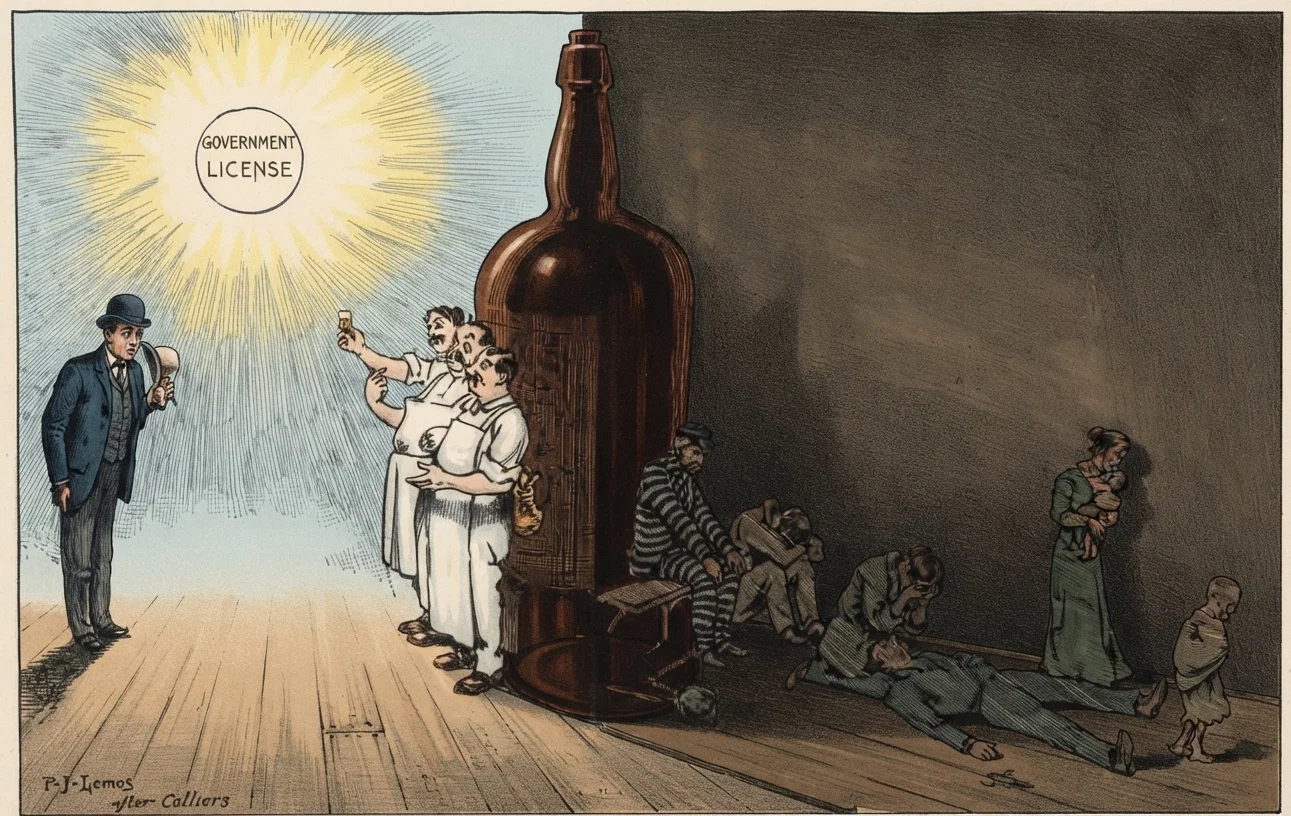
In the Shadow of the Bottle

By GEORGE B. THOMPSON
Secretary of North American Conference of Seventh-Day Adventists
I AM told that it is the custom at a certain insane asylum to set the inmates to bailing out a watering-trough into which water is running. If they keep bailing, they are adjudged imbecile; but if they are bright enough to shut off the water, there is hope for them. This illustrates to some extent what is before us in the liquor question.
You ask which side I am on. Go to the willing slaves of drink, the saloon-keepers, the brewers, the distillers, and find out which side they are on, and you can put me down on the other side. Go into the cheerless hovel where, without fire or food, sit the widowed mother and the orphaned children, made such by the curse of drink, and you can put me down on their side.
In licensing the sale of intoxicating drink, we are making paupers, beggars, and drunkards. We are sanctioning the sale of that which incites riot, robbery, and bloodshed, that which is increasing disease, making widows and orphans, and transforming loving fathers into fiends. It is filling jails and penitentiaries with convicts, and multiplying the insane and idiots in the land. The question is, Will we keep “bailing,” or will we shut off the supply of intoxicants? So far we have been “bailing.”
Suppose a man should come into your community and open a shop where the brightest and purest of the youth would go, and the proprietor, by making a few passes over them, could transform them into chattering idiots. Would you license him to do this terrible work for a money consideration?—Hardly; yet this is what the licensed saloon is continually doing.
The insatiate monster of intemperance is indeed a terrible tyrant. “Who hath wo? who hath sorrow? who hath contentions? who hath babbling? who hath wounds without cause? who hath redness of eyes?” Through all the years that these startling questions have been propounded by the sacred Book of God, the victims of intemperance stand as the answer.

Intemperance and War

We speak of the horrors of war, and God knows there are horrors enough,—carnage and bloodshed and mutilation. There are crippled men and desolate widows and suffering orphans. It brings enormous debts and grinding taxation. But they fail to compare in their horrors with those of intemperance. The Hon. Richmond P. Hobson, in a speech delivered in Congress, says:
“The Army College at Washington made an investigation of the destructiveness of war. Taking all the wars of the world, from the Russo-Japanese war back to 500 B. C., the War College found that the total number killed and wounded in battle amounts to about 2,800,000, of which it is estimated that about 700,000 were killed, and something over 2,000,000 wounded. The comparative figures show the appalling fact that alcohol is killing off as many Americans every year as all the wars of the world have killed in battle in 2,300 years. Applied to the whole white race, we find that alcohol is killing 3,500,000 white men every year, five times as many as have been killed in war in 2,300 years.”
To all these must be added the degenerates, the imbeciles, the tramps, the paupers, the vagabonds, the epileptics, and the nervous wrecks produced as the result of strong drink.
We shudder, and well we may, at the ravages of a pestilence as it stalks through the land. But the pestilence kills only the body, leaving the soul unharmed. But think of the tramp, tramp, of that ragged army of blear-eyed victims of intemperance who annually reel down into drunkards’ graves, and every one damned to all eternity; for the eternal Judge has declared that no drunkard “shall inherit the kingdom of God.” 1 Cor. 6: 10.
The claim is put forth that the saloon-keeper and the brewer are the revenue producers. But they are not. They merely collect the revenue. The man who drinks the accursed stuff,—the moderate drinker, the bum, the sot,—are the ones who are the real revenue producers. Revenue is blood money. It represents the life, the tears, the agony, of tens of thousands of widows and orphans left to struggle with poverty, the husbands and fathers having gone down prematurely into drunkards’ graves, lost forever.

“Pray for Papa”—One of Many

In a city in the Northwest, as a preacher sat at his breakfast table one Sunday morning, the doorbell rang. He answered it, and there stood a boy twelve years of age. He was on crutches, his right leg being off at the knee. Shivering, he said: “Please, sir, will you come up to the jail and talk and pray with papa? He murdered mama. Papa was good and kind, but whisky did it, and I have to support my three little sisters. I sell newspapers and black boots. Will you go up and talk and pray with papa? And will you come back and be with us when they bring him back? The governor says we can have his body after they hang him.”
The preacher hurried to the jail, and talked and prayed with the man, who had no knowledge of what he had done. He said: “I don’t blame the law, but my heart breaks at the thought that my children must be left in a cold and heartless world. O, sir, whisky, whisky did it!”
The preacher was at the little hut when the undertaker’s wagon drove up. The pine coffin was carried in, and the little boy was led up to it. He leaned over and kissed his father, and sobbed, and said to his sisters: “Come on, sisters. Kiss papa’s cheeks before they grow cold.” And the little hungry, ragged whisky orphans hurried to the coffin, shrieking in agony. Policemen, whose hearts were inured to such sights, buried their faces in their hands and rushed from the house, and the preacher fell on his knees, and lifted his clenched fist and tear-stained face, and took an oath before God, and before the whisky orphans, that he would fight the cursed business until the undertaker carried him out in his coffin.
You can put me down on the side of this little boy peering into papa’s coffin and weeping because of “the shadow of the bottle.” In the name of noble womanhood, of the pure, innocent, defenseless children whose merry laugh is heard about us, we should stamp out the sale of this accursed thing from our midst. We can do it if we will.

The Perils of Wine

"Look not thou upon the wine when it is red, when it giveth his color in the cup, when it moveth itself aright. At the last it biteth like a serpent, and stingeth like an adder." Prov. 23: 31, 32.
Continue reading: Pertinent Facts Regarding the Wine Grape Industry