If I speak with the tongues of men and of angels,
BUT HAVE NOT LOVE,
I am become sounding brass, or a clanging cymbal.
And if I have the gift of prophecy,
And know all mysteries and all knowledge;
And if I have all faith, so as to remove mountains,
BUT HAVE NOT LOVE,
I am nothing.
And if I bestow all my goods to feed the poor,
And if I give my body to be burned,
BUT HAVE NOT LOVE,
It profiteth me nothing.
LOVE suffereth long, and is kind;
LOVE envieth not;
LOVE vaunteth not itself,
Is not puffed up,
Doth not behave itself unseemly,
Seeketh not its own,
Is not provoked,
Taketh not account of evil;
Rejoiceth not in unrighteousness,
But rejoiceth with the truth;
Beareth all things,
Believeth all things,
Hopeth all things,
Endureth all things.
LOVE NEVER FAILETH:
But whether there be prophecies, they shall be done away;
Whether there be tongues, they shall cease;
Whether there be knowledge, it shall be done away.
For we know in part,
And we prophesy in part;
But when that which is perfect is come,
That which is in part shall be done away.
When I was a child,
I spake as a child,
I felt as a child,
I thought as a child:
Now that I am become a man,
I have put away childish things.
For now we see in a mirror, darkly;
But then face to face:
Now I know in part;
But then shall I know fully even as also I was fully known.
But now abideth
FAITH, HOPE, LOVE,
These three;
And the greatest of these is
LOVE
With Our Inquirers
By Editor
“If ye will inquire, inquire ye.”
[All questions to this department will be answered which to the editors will seem to minister to the good of the readers and to the mission of the paper. The same question can not be answered repeatedly in the same volume. The name and address must accompany question, not for publication, but as an evidence of good faith, and that answer may be made by letter if deemed advisable. It is well always to enclose a stamp for reply.]
Please explain Heb. 4: 1-12. It is stated that that chapter proves a change of the day, as Jesus in the 8th verse means Joshua, and he did not give the people of God rest, so Jesus gave them another day. A. B.
The point of the passage in Hebrews is not the matter of a change of the Sabbath. Reading from chapter 3 the one thing which the writer is impressing upon them is that God’s children had not yet entered into their rest. He wanted to bring them in in the days of Joshua, it is true, and give them rest from all their enemies, and make their days as the days of heaven upon earth; but thru unbelief they fell; they did not enter into that rest. It was not because God was not ready, but they were not ready; and God’s pledge that He was ready is that His works for man were finished from the foundation of the world; and He rested on the seventh day from all His works. The very Sabbath itself was proof that the Lord had in waiting an eternal rest for man. Man sinned in the beginning; but God gave His children the privilege of entering into that rest at the time of the Exodus, and told them that their days would be as the days of heaven upon earth, yet they would not do it. Now if Joshua had given them rest in his day the Lord would not have offered another time thru David. The term “day” there has no reference whatever to days of the week, but to the special time and opportunity which God gave them of entering into His rest. When they refused those special times, then the Lord fixed no other time until the whole of sin’s career shall be closed and all His children shall be gathered home; so that from that time forward it is “Today if ye will hear His voice, harden not your heart.” The rest still awaits, spiritual rest to all those who will truly give themselves to Christ, and eternal rest when they enter into that eternal inheritance which God has for His children, and which was there from the foundation of the world. So when that time comes, Christ shall say, “Come, ye blessed of My Father, inherit the kingdom prepared for you from the foundation of the world.” Matt. 25:34. That rest we enter now, spiritually, when we cease from our own works of sin and accept of Jesus Christ. The pledge of that rest is the Sabbath, and so also the symbol of eternal rest will be the ever-recurring Sabbath of Jehovah. Isa. 66:22, 23.
The statement that is made to you that in Exodus is given a Sabbath regulated by the Passover has no foundation in truth at all. Men have attempted to juggle expressions in endeavoring to make out a yearly schedule for the Sabbath of the Lord, but they have utterly failed.
2356.—J. B.; and Mary Hohnvall.—Shambles, 1 Cor. 10: 25.
The word “Shambles” comes from a word which in the original means market, a place where flesh foods of various kinds were sold. The point in 1 Corinthians 10 is not as to the kind of meats or animals from which the meat comes, but the question is as to whether it has been offered to idols. Much of the food that was sold in the shambles kept by the heathen had been killed as sacrifices to some of their gods. Only a small portion, however, was given for religious purposes to the heathen priests, and the rest was sold in the markets. The apostle of course takes for granted that this is fit for food, proper food to eat. Some with a very tender conscience who had been worshiping idols before could not take it lest they themselves should honor the idol to which the beast had been dedicated. Therefore the apostle instructs all that they were not to bother themselves over this, or question about it. If the meat was proper for food, if it was that which would glorify God, buy it without any reference to the idols at all, because the idols were nothing. And again in the 27th verse, if one is asked to a feast where he meets the same conditions, eat the food, saying nothing; but if some one should say, This food has been offered to idols, for the sake of one’s conscience do not eat it. This has little bearing upon the meat question at the present time. There are reasons why vegetarianism is best. There were certain flesh foods which the Bible allowed and called clean. There are reasons now which did not obtain then why some of these foods should be discarded. This we hope to discuss at greater length in a future issue.
2357.—The 144,000.
Of whom are the 144,000 made up?
All that we can reply to our inquirer is that they are made up of characters which are described in Rev. 14:1-5, and which we are told in the seventh chapter are “servants of our God.” Ezekiel 9 speaks of them as those that sigh and that cry for the abominations that are wrought around them. Just how many that will include we do not know; a few perhaps of those who have died in the fulness of the knowledge of God’s last message may be among them, taken from the dead by special resurrection, according to Dan. 12:1, 2. But evidently these are but few; for the 144,000 have special experiences, as indicated in Rev. 14:1-5; 15:2, 3. Whether this reckoning includes all persons, male and female, we do not know. In computing the number of Israel of old only the males were counted; women and children were accepted with them, but only the male members were reckoned. It seems to be the Bible method of reckoning; the five thousand and the four thousand which were fed on two different occasions were men, besides women and children. Upon these questions the Bible does not give particular light. The one question which ought to be uppermost in our minds is, Are we meeting God’s requirement? If we do, and are worthy to be among that special band, it shall be well; we will glorify God thruout all eternity. If in His infinite wisdom we are not among the 144,000, yet still are given a part in His glorious kingdom, we will still receive more of His kingdom than we deserve, and will have reason for praising Him in all the ages to come. The great object of our lives should be to live so as to please Him, and leave with Him as to who shall make up the number of that special company.
The passage is not difficult if we will only remember the adverbs of time. In simple words this is the teaching of the text: “Because Christ also suffered for sins once, the righteous for the unrighteous, that He might bring us to God,” this, of course, when He died upon the cross. He was “put to death in the flesh, but made alive in the spirit;” that is, when He was raised from the dead; “in which [that is, by which Spirit] also He went and preached unto the spirits in prison.” When did He do this?—“Which sometime were disobedient, when once the long-suffering of God waited in the days of Noah, while the ark was a preparing, wherein few, that is, eight souls were saved by water.” The man who is in sin is in bondage. He is a prisoner, because of sin “kept under the law, shut up.” Gal. 3:22, 23. When Jesus came, He came for the purpose of preaching deliverance to the captives, the opening of the prison to them that are bound. Isa. 61: 1, 2; Luke 4:18. Those who lived in the days of Noah were in the prison-house of sin; they were shut up, to a period of time of which God forewarned them, and the Lord Christ by His Spirit thru Noah preached to those who were in sin at that time. Heb. 11:7; also 2 Peter 2:5, in which Noah is said to be “a preacher of righteousness.” And He did that “when the long-suffering of God waited in the days of Noah, while the ark was a preparing.” He also tells us in the 21st verse that the ark was a figure of baptism. Those who accept of Christ are in a sense overwhelmed and brought thru the flood; but He would have us understand also that baptism does not mean the mere putting away of the filth of the flesh; it must be the answer of a good conscience and mean a new life of the resurrection of Jesus Christ who has gone into heaven, seated on the right hand of God, to save His people and bring them home.
2359.—Service of Christ.
When was the true tabernacle pitched? Heb. 8:2. Did this tabernacle have a service before Christ entered it? If so, who performed the service? When did Christ enter upon His priestly service? G. W. B.
The whole intent of the epistle to the Hebrews indicates that the way into the holy places in heaven was not made manifest while as yet the tabernacle was standing. When that tabernacle was made or prepared, we do not know. Heb. 9:8. Evidently it was a living tabernacle composed of the angels of God. The time when Jesus began His ministry as priest is indicated in Ephesians 1 and Heb. 8:1, when He ascended on high and took His seat at the right hand of the Father. He was not made a priest until He went thru the suffering and experience that fitted Him for that, for He was made a priest by an oath, “after the order of Melchizedek.” Heb. 7:17, 21. And we are expressly told in the 28th verse of the seventh chapter, “For the law appointeth men high priests, having infirmity; but the word of the oath, which was after the law, appointeth a Son, perfected forevermore.”
has absolutely no reference whatever to the day of the Sabbath. The first part of that chapter tells us who the foundation of our faith is, that is, the Lord Jesus Christ; but Jesus kept all the commandments of God, including the seventh day, and died, and rose again in order that our sins might be forgiven and that we might be made followers of Him in the keeping of those commandments. Verse 13 tells us that we should be subject to every ordinance of man for the Lord’s sake. And that is true in all those things that pertain to earthly governments; but it is not for the Lord’s sake that we disobey Him. It is only for the Lord’s sake and for His truth’s sake when we obey Him. In every right ordinance it is our duty to obey, but where duty to God comes in contact with what governments require of us, in the language of Peter in another place (Acts 5:29), “We must obey God rather than men.” Again Peter tells us “Whether it is right in the sight of God to harken unto you rather than unto God, judge ye.”
We have not space in this department to give an exposition of Rev. 14:10, 11. If you will obtain the tract, published by the Pacific Press, entitled, “Tormented Forever and Ever,” it will give you a complete explanation of this striking passage.
2361.—The Antitypical Scapegoat.
What is the “fit” man that the scapegoat is sent by into the wilderness in this dispensation? S. F. P.
The antitype of the sending of the scapegoat into the wilderness of Leviticus 16 is in Rev. 20: 1-3. It is an angel sent from God, who lays hold upon the antitypical scapegoat, Satan, and casts him into the abyss for a thousand years.
These verses tell us where Abraham came from. The “flood” there mentioned refers to the Euphrates River. The American Standard Revision has “Beyond the River.” There Abraham’s ancestors worshiped false gods. From that condition God called him, and Abraham responded by faith.
Christ the Teacher and Healer
By Mrs. E. G. White
By Mrs. E. G. White
Power to the Helpless.
NOW there is at Jerusalem by the sheep-market a pool, which is called in the Hebrew tongue Bethesda, having five porches. In these lay a great multitude of impotent folk, of blind, halt, withered, waiting for the moving of the water.” At certain seasons the waters of this pool were agitated, and it was commonly believed that this was the result of supernatural power, and that whosoever first after the troubling of the pool stepped into the waters, would be healed of whatever disease he might have. Hundreds of sufferers visited the place; but so great was the crowd when the water was troubled that they rushed forward, trampling underfoot men, women, and children weaker than themselves. Many could not get near the pool. Many who had succeeded in reaching it died upon its brink. Shelters had been erected about the place, that the sick might be protected from the heat of the day and the chilliness of the night. There were some who spent the night in these porches, creeping to the edge of the pool day after day, in the vain hope of relief.
Jesus was at Jerusalem. Walking alone, in apparent meditation and prayer, He came to the pool. He saw the wretched sufferers watching for that which they supposed to be their only chance of cure. He longed to exercise His healing power, and make every sufferer whole. But it was the Sabbath day. Multitudes were going to the temple for worship, and He knew that such an act of healing would so excite the prejudice of the Jews as to cut short His work.
But the Saviour saw one case of supreme wretchedness. It was that of a man who had been a helpless cripple for thirty-eight years. His disease was in a great degree the result of his own evil habits, and was looked upon as a judgment from God. Alone and friendless, feeling that he was shut out from God’s mercy, the sufferer had passed long years of misery. At the time when it was expected that the water would be troubled, those who pitied his helplessness would bear him to the porches. But at the favored moment he had no one to help him in. He had seen the rippling of the water, but had never been able to get farther than the edge of the pool. Others stronger than he would plunge in before him. The poor, helpless sufferer was unable to contend successfully with the scrambling, selfish crowd. His persistent efforts toward the one object, and his anxiety and continual disappointment were fast wearing away the remnant of his strength.
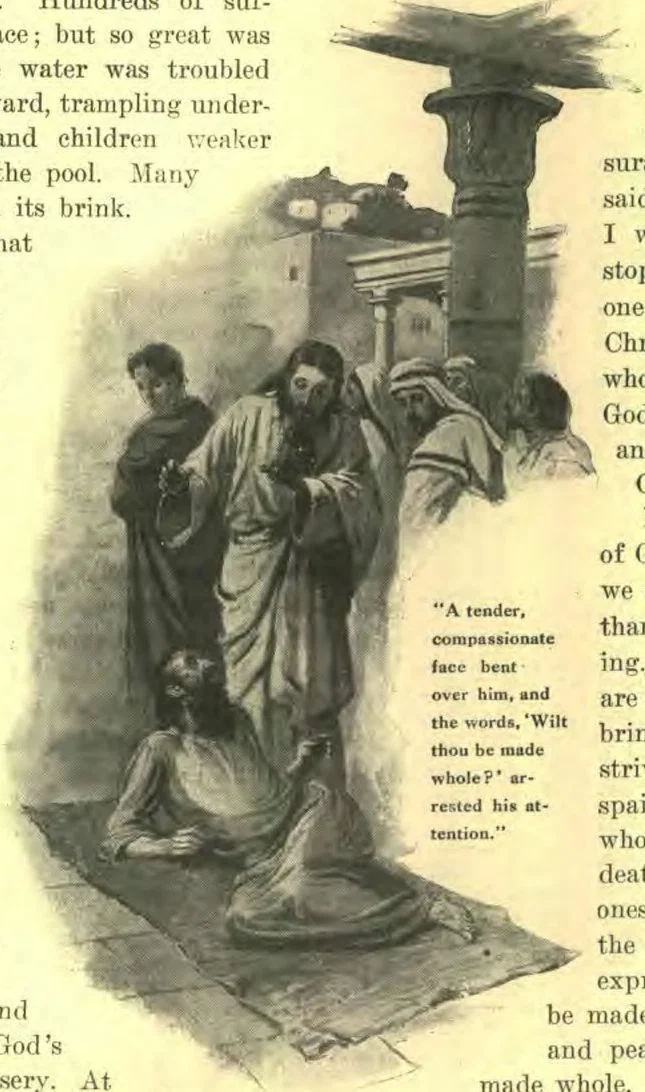
The sick man was lying on his mat, and occasionally lifting his head to gaze at the pool, when a tender, compassionate face bent over him, and the words, “Wilt thou be made whole?” arrested his attention. Hope came to his heart. He felt that in some way he was to have help. But the glow of encouragement soon faded. He remembered how often he had tried to reach the pool, and now he had little prospect of living till it should again be troubled. He turned away wearily, saying, “Sir, I have no man, when the water is troubled, to put me into the pool; but while I am coming, another steppeth down before me.”
Jesus bids him, “Rise, take up thy bed, and walk.” With a new hope the sick man looks upon Jesus. The expression of His countenance, the tones of His voice, are like no other. Love and power seem to breathe from His very presence. The cripple’s faith takes hold upon Christ’s word. Without question he sets his will to obey, and as he does this, his whole body responds. Every nerve and muscle thrills with new life, and healthful action comes to his crippled limbs. Springing to his feet, he goes on his way with firm, free step, praising God, and rejoicing in his new-found strength.
"Springing to his feet, he goes on his way with firm, free step."
Jesus had given the palsied man no assurance of divine help. The man might have said, “Lord, if Thou wilt make me whole, I will obey Thy word.” He might have stopped to doubt, and thus have lost his one chance of healing. But no, he believed Christ’s word, believed that he was made whole; immediately he made the effort, and God gave him the power; he willed to walk, and he did walk. Acting on the word of Christ, he was made whole.
By sin we have been severed from the life of God. Our souls are palsied. Of ourselves we are no more capable of living a holy life than was the impotent man capable of walking. Many realize their helplessness; they are longing for that spiritual life which will bring them into harmony with God, and are striving to obtain it. But in vain. In despair they cry, “O wretched man that I am! who shall deliver me from the body of this death?” Let these desponding, struggling ones look up. The Saviour is bending over the purchase of His blood, saying with inexpressible tenderness and pity, “Wilt thou be made whole?” He bids you arise in health and peace. Do not wait to feel that you are made whole. Believe the Saviour’s word. Put your will on the side of Christ. Will to serve Him, and in acting upon His word you will receive strength. Whatever may be the evil practise, the master passion which thru long indulgence binds both soul and body, Christ is able and longs to deliver. He will impart life to the soul that is “dead in trespasses.” He will set free the captive that is held by weakness and misfortune and the chains of sin.
The sense of sin has poisoned the springs of life. But Christ says, “I will take your sins; I will give you peace. I have bought you with My blood. You are Mine. My grace shall strengthen your weakened will; your remorse for sin I will remove.” When temptations assail you, when care and perplexity surround you, when, depressed and discouraged, you are ready to yield to despair, look to Jesus, and the darkness that encompasses you will be dispelled4by the bright shining of His presence. When sin struggles for the mastery in your soul, and burdens the conscience, look to the Saviour. His grace is sufficient to subdue sin. Let your grateful heart, trembling with uncertainty, turn to Him. Lay hold on the hope set before you. Christ waits to adopt you into His family. His strength will help your weakness; He will lead you step by step. Place your hand in His, and let Him guide you.
Never feel that Christ is far away. He is always near. His loving presence surrounds you. Seek Him as One who desires to be found of you. He desires you not only by living faith to touch His garments, but to walk with Him in constant communion.
Christian Science in the Light of Reason and Revelation
By R. A. Underwood
By R. A. Underwood
V. The Lord's Prayer; the Ego.
THE advocates of the doctrine of Christian Science "wrest" the "Scriptures." 2 Peter 3 :16. Christian Scientists read the Scriptures in their public services, but in all cases they read what they call the true or spiritual application of the same from "Science and Health with Key to the Scriptures."
Christ, the prophets and apostles, did not give, according to their interpretation, the clear light as to the being of man, matter, sin, disease, and death. But it has been left to Mrs. Mary Baker G. Eddy to discover the science of being, as she has given it to the world in her book. She says her book gave to the world "the first rules for demonstrating this science, and registered the revealed truth uncontaminated by human hypotheses." Page 456.
If this is true, it follows as a logical result that Mrs. Eddy's book should be taken in preference to the Scriptures as authority. When the Bible and Mrs. Eddy's book conflict in their statements, of course Mrs. Eddy's statements must be given the preference. In fact, whenever the Bible is read in public or elsewhere by Christian Scientists, Mrs. Eddy's interpretation of the scripture is read, and always taken as authority. This is much like the manner of the Jews in reading the Bible in the days of the first advent of Christ. They had a method of explaining away the statements of God's word by their traditions. Christ said of them:
"Thus have ye made the commandment of God of none effect by your tradition. Ye hypocrites, well did Esaias prophesy of you, saying, This people draweth nigh unto Me with their mouth, and honoreth Me with their lips; but their heart is far from Me. But in vain they do worship Me, teaching for doctrines the commandments of men." Matt. 15 :6-9.
The following is an illustration of the method of Christian Science in wrestling the Scriptures, altho the case cited is modest compared with some other interpretations. On pages 16 and 17 of "Science and Health," edition 1905, we have the Lord's Prayer quoted by Mrs. Eddy, with the interpretation, as follows:
"Here let me give what I understand to be the spiritual sense of the Lord's Prayer:
"'Our Father which art in Heaven.'
"'Our Father-Mother God, all harmonious.'
"'Hallowed be Thy name.'
"'Adorable One.'
"'Thy kingdom come.'
"'Thy kingdom is within us, Thou art ever-present.'
"'Thy will be done in earth, as it is in heaven.'
"'Enable us to know,—as in heaven, so on earth,—God is supreme.'
"'Give us this day our daily bread.'
"'Give us grace for to-day; feed the famished affections.'
"'And forgive us our debts, as we forgive our debtors.'
"'And infinite Love is reflected in love.'
"'And lead us not into temptation, but deliver us from evil.'
"'And Love leadeth us not into temptation, but delivereth us from sin, disease, and death.'
"'For Thine is the kingdom, and the power, and the glory, forever.'
"'For God is now and forever all Life, Truth, and Love.'"
This is perversion and contradiction of the sentiment of the Lord's Prayer. According to this interpretation, Christ utterly failed to give a model form of prayer, to say nothing of the failure to instruct us that our "Mother" is to be implored in prayer.
Whenever the Lord's Prayer is repeated by this people, this spiritual meaning is always rehearsed as above cited.
The claims Mrs. Eddy makes of healing, and the adoration given her by those who accept this doctrine, are one of the strongest evidences of the source of darkness from which this whole movement emanates. Christ said, "I am come in My Father's name, and ye received Me not; if another shall come in his own name, him ye will receive." John 5 :43. A few citations of Mrs. Eddy's assumptions of power to heal, as printed in "Science and Health," will illustrate her claims:
"I have healed infidels whose only objection to this method was that I, as a Christian Scientist, Believed in the Holy Spirit, while they, the patients, did not." Page 359.
"In her belief, the woman had chronic liver complaint, and was then suffering from the complications of symptoms connected with this belief. I cured her in a few minutes." Page 389.
"Mortal existence is a dream, it has no real entity, but saith, 'It is I.' Spirit is the EGO which never dreams, but understands all things. Man is the likeness of this ego." Page 250.
A significant paragraph is found on the fly-leaf of her book, credited "anonymous," but evidently endorsed as the epitome of the whole character of Christian Science to exalt man as his own saviour. It reads:
"'I, I, I, I itself, I,
The inside and the outside, the what and the why,
The when and the where, the low and the high,
All I, I, I, I itself, I.'"
This is much like the statements above quoted, where Mrs. Eddy says, "I have healed," "I cured her," etc. We read of a character brought to view in Isaiah 14, where the ego stands out in a similar manner. The statements are as follows: "I will ascend into heaven, I will exalt my throne above the stars of God: I will sit also upon the mount of the congregation, in the sides of the north: I will ascend above the heights of the clouds; I will be like the Most High." Isa. 14 :13, 14.
There seem to be five declarations in which "I," in this case, stands most prominent. The personage brought to view does not at present have the best reputation. He once was a covering cherub. He once was the being designated as light-bearer; but this spirit of ego, which developed into such self-importance and self-exaltation, proved to be the ruin of this bright and shining character, and the exclamation is made: "How art thou fallen from heaven, O Lucifer, son of the morning! How art thou cut down to the ground, which didst weaken the nations!" We tremble as we see any human being following the example of this being, whose final doom and utter destruction are as certain as his self-exaltation was manifest.
How different is the spirit of Christ, shown in His followers. I will cite only one instance to illustrate this: "Ye men of Israel, why marvel ye at this? or why look ye so earnestly on us, as tho by our own power or holiness we had made this man to walk? The God of Abraham, and of Isaac, and of Jacob, the God of our fathers, hath glorified His Son Jesus; whom ye delivered up, and denied Him in the presence of Pilate, when he was determined to let Him go. . . . And His name thru faith in His name hath made this man strong, whom ye see and know; yea, the faith which is by Him hath given him this perfect soundness in the presence of you all." Acts 3 :12-16.
In the closing part of Mrs. Eddy's book, "Science and Health," there are one hundred pages occupied by testimonials of individuals who claim to have been healed. These testimonials are given under the caption, "Fruitage." I have read these testimonials carefully, which were given by sixty-eight different persons. The name of Christ or Jesus is used less than a dozen times in these testimonials, and in no instance is the work of healing attributed to Christ. "I owe it all to Christian Science," or similar expressions, are often used. These persons speak in terms of praise and adoration of "our mother," "leader," "founder of Christian Science," "Science and Health with Key to the Scriptures." A few quotations will show the hypnotic power of this movement over the minds of those who claim to be healed by it.
"'Science and Health with Key to the Scriptures,' by Mrs. Mary Baker G. Eddy, . . . will do more for the reader thereof, physically and spiritually, than all the books he has ever read or can read, not excepting the Bible.—T. C. D., Toronto, Canada." Page 608.
"'Science and Health' is the greatest book that has ever been published in modern times. It is the key to the Bible and all the hidden principles of life.—J. W. R., San Francisco, Cal." Page 614.
"'The blessed science never seemed hard to5understand, because from the first I loved it, and loved her who gave it to a starving world. My prayer now is that I may become worthy to call her 'mother.'—C. D., DeFuniak Springs, Fla.'" Page 642.
"'Words can not express our gratitude to dear Mrs. Eddy for her book, 'Science and Health,' which is our daily strength for daily needs. I would like to tell her all it has done for us.—H. L. S., Chicago, Ill.'" Page 689.
"'I can not express my gratitude to our dear Mother for the light of Christian Science.—A. J. A., Salem, Ore.'" Page 638.
How different are the expressions and sentiments of the soul set free from sin by the power of God thru Jesus Christ. Instead of expressions of adoration and praise being poured out upon a mortal being, who seeks the flattery and even the worship of her followers, the saved soul gives all glory and thanks unto Him that hath sought us and bought us with His own blood upon Calvary. Be not deceived by cunningly devised fables.
Christ and the Law.
[From Wesley's Sermon XXVII, Discourse V on the Sermon on the Mount.]
II. Jot or Tittle.
1. “For verily I say unto you [a solemn preface which denotes both the importance and certainty of what is spoken], Till heaven and earth pass, one jot or one tittle shall in nowise pass from the law, till all be fulfilled.”
ONE jot, it is literally not one iota, not the most inconsiderable vowel; or one tittle, one corner or point of a consonant. It is a proverbial expression which signifies that no one commandment contained in the moral law, nor the least part of any one, however inconsiderable it might seem, should ever be disannulled.
“Shall in nowise pass from the law.” The double negative here used strengthens the sense so as to admit of no contradiction. And the word “shall,” it may be observed, is not barely future, declaring what will be, but has likewise the force of an imperative, ordering what shall be. It is a word of authority, expressing the sovereign will and power of Him that spake,—of Him whose word is the law of heaven and earth, and stands fast forever and ever.
“One jot or one tittle shall in nowise pass,” “till heaven and earth pass,” or, as it is expressed immediately after, till all (or rather all things) be fulfilled, till the consummation of all things. Here is therefore no room for that poor evasion (with which some have delighted themselves greatly) that “no part of the law was to pass away till all the law was fulfilled; but it has been fulfilled in Christ; and therefore now must pass away for the Gospel to be established.” Not so; the word all does not mean all the law, but all things in the universe; as neither has the term fulfilled any reference to the law, but to all things in heaven and earth.
2. From all this we may learn that there is no contrariety at all between the law and the Gospel, that there is no need for the law to pass away in order to the establishing the Gospel. Indeed, neither of them supersedes the other, but they agree perfectly well together. Yea, the very same words considered in different respects are both parts of the law and the Gospel; if they are considered as commandments, they are parts of the law; if as promises, of the Gospel. Thus, “Thou shalt love the Lord thy God with all thy heart,” when considered as a commandment, is a branch of the law; when regarded as a promise, is an essential part of the Gospel, the Gospel being no other than the commands of the law, proposed by way of promises. Accordingly, poverty of spirit, purity of heart, and whatever else is enjoined in the holy law of God, are no other, when viewed in a Gospel light, than so many great and precious promises.
3. There is, therefore, the closest connection that can be conceived between the law and the Gospel. On the one hand the law continually makes way for, and points us to, the Gospel; on the other the Gospel continually leads us to a more exact fulfilling of the law. The law, for instance, requires us to love God, to love our neighbor, to be meek, humble, or lowly; we feel that we are not sufficient for these things, yea, that “with men this is impossible.” But we see a promise of God to give us that love and to make us humble, meek, and lowly. We lay hold on this Gospel, on these glad tidings; it is done unto us according to our faith, and “the righteousness of the law” is “fulfilled in us,” thru faith which is in Christ Jesus.
We may yet further observe that every command in Holy Writ is only a covered promise. For by that solemn declaration, “This is the covenant that I will make . . . after those days, saith the Lord; I will put My laws into their mind, and write them in their hearts,” God hath engaged to give whatsoever He commands. Does He command us then to pray without ceasing? to rejoice evermore? to be holy as He is holy? It is enough. He will work in us this very thing. It shall be unto us according to His word.
4. But if these things are so, we can not be at a loss what to think of those who in all ages of the church have undertaken to change or supersede some commands of God, as they professed, by the peculiar direction of His Spirit. Christ has here given us an infallible rule whereby to judge of all such pretensions. Christianity, as it includes the whole moral law of God, both by way of injunction and of promise, if we will hear Him, is designed of God to be the last of all His dispensations. There is no other to come after this. This is to endure till the consummation of all things. Of consequence all such new revelations are of Satan and not of God and all pretenses to another more perfect dispensation fall to the ground of course. Heaven and earth shall pass away; but this word shall not pass away.
The Study of History.
By Earle A. Rowell
GOD speaks to man thru His word; “for no prophecy ever came by the will of man: but men spake from God, being moved by the Holy Spirit.” 2 Peter 1:21, A.R.V. God speaks thru nature; for “the heavens declare the glory of God; and the firmament showeth His handiwork. Day unto day uttereth speech, and night unto night showeth knowledge.” Ps. 19:1, 2. God speaks thru history; for “He increaseth the nations, and He destroyeth them; He enlargeth the nations, and He leadeth them captive.” Job 12:23. These are God’s complete revelation, each throwing light on the other.
The usual view of history is stated by Creighton: “History is concerned with tracing the evolution of human affairs.” To him the rise and fall of nations seems to be dependent upon the will of man, and determined by his power, ambition, or caprice. Thus viewed the soul of history is not discerned, the genius of history is disregarded. Those who study history aright “behold behind, above, and thru all, the play and counter-play of human interests and powers and passions, the agencies of the all-merciful One, silently, patiently, working out the counsels of His own will.” They see the divine purpose in forming every reform, see the hand of God hovering over every historic page, and His handwriting on every ancient monument. There is only one way to study history, and that is with “the intent that the living may know that the Most High ruleth in the kingdom of men.” Dan. 4:17.
The whole philosophy of history is given in one comprehensive sentence by Paul, in his address to the sages at Athens: He “hath made of one blood all nations of men for to dwell on all the face of the earth, and hath determined the times before appointed, and the bounds of their habitation.” For what purpose?—“That they should seek the Lord, if haply they might feel after Him, and find Him.” Acts 17:26, 27. In view of these words, then, it is evident that the whole history of man thru heathen darkness to twentieth century light is one long working out of God’s plan for the salvation of man.
The Bible, and the Bible only, gives a foreview of God’s plan. Here we learn of events that are casting their dark, ominous shadows before, “the sound of their approach causing the earth to tremble, and men’s hearts to fail them for fear.” It is only in the study of the execution of God’s purpose in history that we may correctly value things seen and unseen; “that, viewing the things of time in the light of eternity, we may put them to their truest and noblest use; that we may learn what is the true aim of life.”
(Continued on Page 12.)6### The Study of History.
(Continued from Page 5.)
As usually taught, history is little else than a story of battles, intrigues, ambition, greed, rapacity, bloodshed; the iteration and reiteration of crimes, cruelties, enormities of nations and their rulers can serve no useful purpose, and can bring forth only an ultimate harvest of evil. But from the vantage-ground of the great I AM, we see down thru the ages and in all the movements of man the out-working of God’s infinite plan, and we see that history is not a string of episodes, a compendium of accepted facts, nor a selection of pleasing or even instructive narratives. Unless the purpose of the Creator is seen in the study of history, it is as profitless as the study of nature when nature is placed above God.
As we study history aright we see that all events tend to a definite end. Each nation or power is a stream—rivulet or river—flowing slowly or rapidly to the throne of God.
Each nation is encircled by that great golden chain of faith and love and salvation that reaches from darkness to light, from man to the Maker of man.