WHAT God knows of us and our limitations and what he has said of us and our powers should be of infinitely more concern to us than any theory of the human mind. Theories cannot save, no matter how captivating they may appear to be. Everything that is out of harmony with God's purpose for us and his declarations concerning us, is designed to lead us into ruin. If we could but realize that there is no neutral zone between the powers of good and evil, no place but a place of danger when outside the line of absolute truth, we should look much more closely to our bearings than we do.
The campaign by pen and pulpit against the position and work of Jesus Christ is extending everywhere, and the masses are becoming saturated with this man-pleasing but deadly solution. It is the supreme effort of the powers of darkness against the kingdom of Christ and the triumph of the gospel. While the attack is general all along the line, the citadel of the Christian's hope is now the chief point of attack. That citadel is the work of Christ in man's behalf. The fact that this is now the focal point of attack should indicate to us that the battle is nearly finished. In harmony with this deduction are the reiterated statements in recent Testimonies that the work is more nearly finished than we think.
While men are exalting man to the skies and declaring the work of Christ for us unnecessary, the truth of the Bible still rings out over the turbid waters of earth's night: “All flesh is grass, and all the goodliness thereof is as the flower of the field. The grass withereth, the flower fadeth, because the breath of Jehovah bloweth upon it; surely the people is grass. The grass withereth, the flower fadeth; but the word of our God shall stand forever.”
This inspired testimony is directly contrary to the theory of man's self-sufficiency in the matter of salvation and his oneness with the divine. “The grass withereth;” and “surely the people is grass.” Then the people wither, and as “the flower fadeth,” so the people fade.
The righteousness that God requires is most certainly not found in the natural human heart; for the Bible tells us again: “The heart is deceitful above all things, and it is exceedingly corrupt: who can know it?” Jer. 17:9. That is how the human heart appears in God's sight; and he sees it as it is. We may blind our eyes to our own imperfections, and so exalt self; but we cannot turn aside, nor shield ourselves from one ray of the searchlight of heaven, which will show us just as we are; and the reward we receive will be measured according to what we are, and not according to what we think we are, or to what we have tried to make others believe we are.
Therefore, if we appear at the judgment bar of God with the light of heaven shining back over the record of our lives, and we have left out Jesus Christ as our Saviour, we are lost. The law will condemn us; the righteousness which it demands as the prerequisite of eternal life, will not be found in us. We shall be found clad in the “filthy rags” of “our righteousness” instead of the faultless apparel of the righteousness of Christ. “He which is filthy, let him be filthy still,” will be heaven's decree concerning such.
“Christ is the end of the law unto righteousness to every one that believeth.” Rom. 10:4. Having “the mind of Christ,” having Christ enthroned in the heart, that righteousness will be wrought out which the law demands and heaven approves. “In the way of righteousness is life; and in the pathway thereof there is no death.” Prov. 12:28.
God's law is set as the standard of righteousness. We have not been able by our own efforts to reach that standard; but there stands Christ ready to work out righteousness in and for us. Inside the eternal kingdom will enter nothing that does not meet the standard. There is and can be no other way. Those who are outside of Christ, who do not recognize in him their all and in all, are foredoomed to condemnation by that standard, and that condemnation means eternal death. This will be said of them: “Being ignorant of God's righteousness, and seeking to establish their own, they did not subject themselves to the righteousness of God.” Rom. 10:3. They are “ignorant of God's righteousness” because they are ignorant of its standard, the law of God.
We cannot set too high an estimate upon the work of Christ in our behalf. The effort to make men think highly of themselves originated in the mind of the great adversary of man. It is his most alluring deception, and has been an active agent in his hands for man's ruin from Eden until now. The myriads of ways in which it finds expression today is one of the many indications that we are nearing the culmination of the controversy.
C. M. S.
The Sick Man Still in Trouble
By Louis Richard Conradi
For more than two centuries, the Turkish Empire has suffered so many amputations, and always with the claim that the rest of the body would be profited and preserved thereby, that one might naturally be led to think that, with all the vitality of Islam, the remaining portion now would be in a splendid condition. However, both the past and the present show the fallacy of such reasoning. When Turkey was at the height of its power, besieging Vienna in 1683, its territory was not less than 2,080,000 square miles. Of this, 1,020,000 square miles were in Africa, which in recent years have been entirely lost, Great Britain, Italy, and France dividing the spoil; 680,000 square miles were in Asia, and Russia has taken half of Armenia, and England the island of Cyprus. Of the 390,000 square miles in Europe, only 11,500 square miles remained, and had it not been for the strife among the Balkan powers themselves, probably this would have been reduced to 3,000 or 4,000 square miles.
From 1683 to 1817, European Turkey had to cede considerable territory to Austria-Hungary and Russia, so that only 200,000 square miles remained. But at that time a new competitor arose. The Servian nation had thrown off the Turkish yoke, and 15,000 square miles were now for the first time ceded to form a Balkan state. But during the last one hundred years, six Balkan states have been sliced off from the Turkish possessions in Europe, and they have swallowed up nearly 200,000 square miles, only 11,500 remaining for Turkey. In like manner their population has increased to 23,000,000, while Turkey in Europe has only 2,000,000, and Asiatic Turkey not more than 17,000,000. As far as the portion of Turkey which still remains in Europe is concerned, it is the worst mixture of creeds and nationalities found anywhere, and the nations are certainly at a loss as to who should rule it.
Turkey’s strength now lies in Asia, and the great question is: Is Asiatic Turkey chiefly inhabited by Turks, or do we find that the nationalities there form not only a coat of many colors, but a patchwork of many colors? Do they have but one religion, or are they divided on the question of creed? That different nationalities abound also in Asiatic Turkey is best seen from the fact that there are only about 8,000,000 Turks, probably 5,000,000 Arabs, about 1,200,000 Greeks, and an equal number of Armenians, 1,000,000 Syrians, and the rest are a mixed multitude of foreigners. This diversity of nationality itself begets a similar diversity of creeds. Of the 13,000,000 followers of Mohammed, about 2,000,000 are Shiites, or Shiahs, while the remaining 11,000,000 are divided between Greeks and Turks. About 3,500,000 profess Christianity, but they belong to a multitude of different churches. Although the 1,200,000 Armenians chiefly belong to the old Gregorian church, yet quite a number are Roman Catholics and Protestants; and the same is true of the Syrians. There are also about 560,000 Jews. This at once reveals the difficult situation in which Turkey finds itself—even in its Asiatic possessions today. One fourth of its total population is of foreign nationality and of different creed. But there is another fourth, the Arabic portion, which makes about as much trouble as the other. The latest news from Turkey and Arabia is quite significant; the sheriff of Mecca and two other rulers of Arabia have formed a triple alliance against Turkey. Then there has been quite a strife between the khedive of Egypt and the sultan of Turkey about the possession of the caliphate. But though there is certainly enough internal trouble, political surgeons still have their eyes intently fixed upon performing the final operation upon the sick patient. Russia has her eyes on the rest of Armenia, France on Syria, and Germany, Great Britain, Italy, Austria, and the Balkan States surely want a slice somewhere. Italy is still occupying some of the Ægean islands; Greece has been accorded some, but wants them all.
Were the Turks good rulers, enterprising merchants, skillful mechanics, successful financiers, there might be hope. But though they have many good qualities, are brave, hospitable, full of dignity, yet they lack the spirit of enterprise, the gift of ruling and finance. The Turks are seldom good merchants, mechanics, or doctors. They are mostly farmers, officials, or soldiers. Their greatest statesmen and generals, even when at the height of power, were not Turks, but of mixed birth. Thus, for example, among the fifty grand viziers who ruled Turkey between 1453 and 1623, only five were Turks; the rest were Slavs, Albanians, Greeks, Armenians, etc. One writer fitly says:—
Not by Turkish brutality and exclusiveness has the Ottoman Empire grown by land and sea into a colossus, and as such trod upon the neck of the subdued nations, but rather by Greek and Slav subtlety and cunning, by the perseverance and tenacity of Bosnians and Croatians, by the bravery and lack of conscientiousness of all these renegades, and by the talents and generalship of the natives of the subdued countries.
The proverb says, “Lightly come, lightly gone.” Turkey easily became the ruler of an immense territory. It has ruled it with brutal force. It has proselyted with the sword. Instead of developing the land, it has impoverished it. While other nations advanced, the real Turks did all in their power to stay behind. They often allowed their subdued slaves to do their thinking and acting while they themselves idled away the time. All that has happened thus far is but the natural result of such a course. One oppressed nation after another has asserted its independence. One piece of territory after another has been amputated without adding any more vitality to the rest. What remains, instead of being a coherent live mass, is rent asunder by national and religious strifes, and divided into many factions. Foreigners build their railways, control the steamship lines, develop their industries, manage their banks, and drill their army and navy. The great powers hold an ever-increasing mortgage on the country, and the government taxes and customs are pawned to its creditors for many years to come. It is only a question of time when utter bankruptcy must be declared. But how the creditors will divide the spoils will yet be the hardest problem to solve, and especially who will become heir to Constantinople and Jerusalem.
L. R. CONRADI.
The Development of Common Sense
COMMON sense appears oftentimes to be a very uncommon thing. There are many well-educated persons who seem at a loss to know how rightly to apply their knowledge or adapt themselves wisely to the varying conditions of life's experience. It is not strange, therefore, that Amherst College should propose to establish a professorship which has for its aim the development of practical academic common sense. Says the United Presbyterian of June 18, 1914:—
The president has been impressed with the fact that when freshmen come into college, they commonly don't even guess what they are there for. They do not know how to study. Their minds are vagrant and untrained. Of what is worth aiming at in life they have vague, even distorted notions. They therefore miss a large part of the value of their college course before they get the genuine meaning of what a college opportunity signifies. A professor will give a course to the freshmen in common sense as applied to life. The department will reach into the higher years of the course, with advice about the way that educated men ought to fit themselves into the world. It is an important work, and will require a rare man if the plan is adequately filled. Some of the smaller schools have been and are blessed with counselors of the kind contemplated.
There is much need of the practice of common sense in Christian work. We need to cultivate it, to pray for it, to exercise it. Read Heb. 5: 12-14.
The New Patagonian Mission
By A. G. NELSON
A. G. NELSON
AFTER spending four months in Argentina and Uruguay, and attending the camp meeting and the session of the South American Union Conference, we sailed March 1, 1914, for our permanent field of labor.
En route we passed the Falkland Islands, a part of our field. These islands are situated about four hundred and fifty miles east of the Magellan Strait. The group is a British possession, containing twelve inhabited islands, and thirty or more uninhabited ones. Their surfaces are hilly, with many rocky points. No trees are found on them, but they have an abundance of grass, which furnishes pasture for thousands of sheep.
The entire population of the group is 2,400. Most of these are English-speaking people engaged in sheep raising.
Few vegetables are grown on the Falklands. All fruit and other provisions are imported. The climate is cold and windy, with considerable snow during long winters.
Stanley, the largest town and chief seaport, having a population of about nine hundred, is situated on the East Falkland. It has three schools, a Catholic, a Baptist, and a government school; three churches, Catholic, Baptist, and Episcopalian; two large stores, and five saloons.
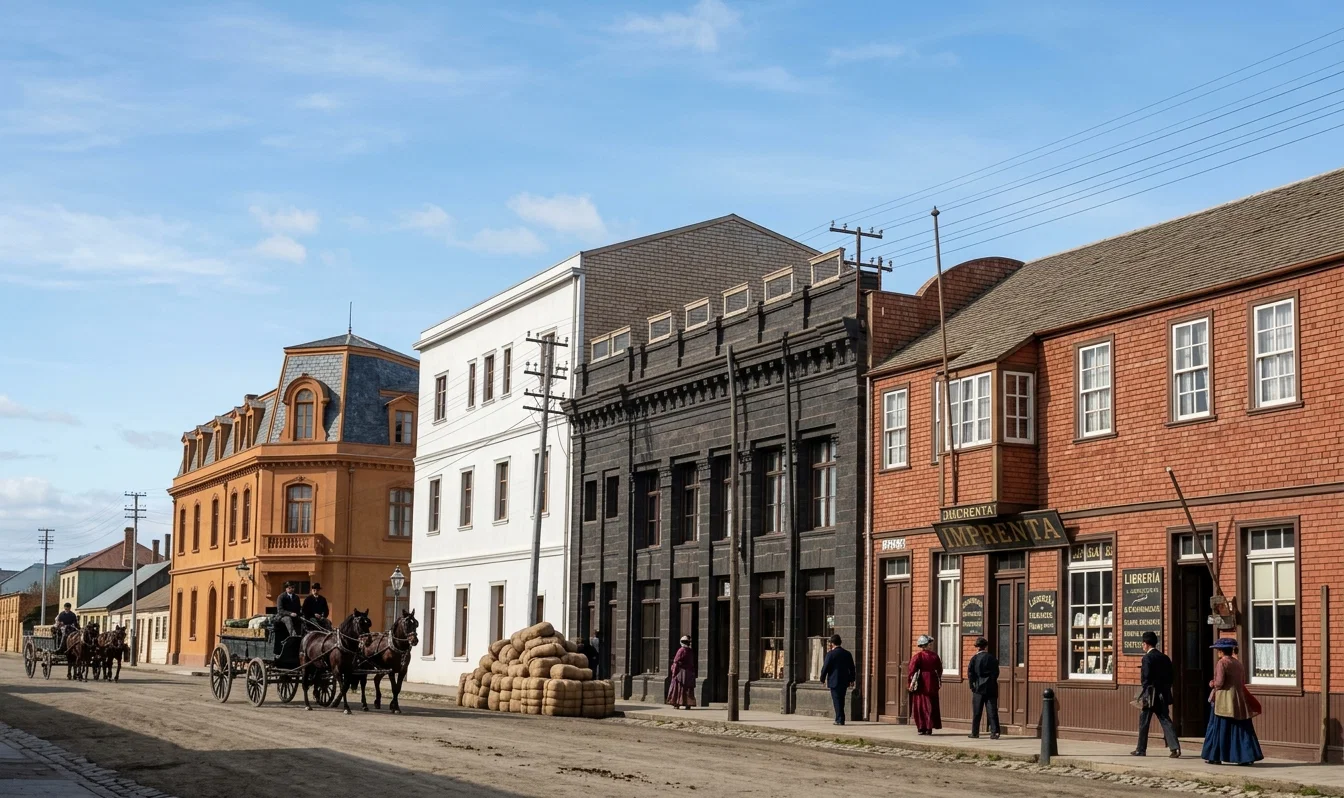
STREET IN PUNTA ARENAS, SOUTHERNMOST CITY IN SOUTH AMERICA
The Royal mail steamer stops at Stanley twice a month, bringing the mail and supplies for the islands.
These islands, with the territories of Santa Cruz and Chubut of Argentina, Magallanes of Chile, and the islands of Tierra del Fuego, constitute the southern mission field of South America.
There has never been a worker located here permanently. Several years ago a few books were sold on the Falklands and in Punta Arenas.
We reached Punta Arenas, our destination, on March 6, 1914. This is a thriving city of 17,000 inhabitants. It is made up of a cosmopolitan population. It is an important wool-shipping and coaling station. Being the distributing point in the south, nearly all vessels stop here on their way through the strait. It is a city only about fifteen years old, and is quite modern in many respects.
As we are giving this closing message to these people of the frozen regions of the south, we hope our brethren will remember us in their petitions at the throne of grace.
Punta Arenas, Chile.
H. STEINER
By H. STEINER
From the Abyssinian Mission
H. STEINER
[A note from the superintendent of our Abyssinian Mission at Asmara gives some news which it is not so pleasant to report, and in addition an item of sad news of the death of one of the Abyssinian believers.]
SINCE last I wrote you, we have had an experience of the kind that we do not like to report so well. The enemy has been working his part it seems, and we have lost some of our pupils for whom we had hope. We had some good ones in our school. Now, alas! they have been attracted by the opportunities to enter the military service here. They had made progress in their work, and were in our special Bible study class. Now they have left us. There are many temptations for our students, as we are near the government headquarters in this Italian colony. We are sad, but we must make the best of it. We shall continue our special Bible study with some of the more advanced students left. May the Lord give us souls is our constant prayer.
We have just lost one of our first members through death. Segu, the oldest of our native members, fell asleep in Jesus, as we trust, last Sabbath morning. We were called to his house in a village near us, in the night, before dawn, so as to be with him in his last hours. He recognized us and spoke our names. Alas! we could not render him help save to pray the Lord to be with him.
We had difficulty in restraining the people from noisy mourning before he died. He himself seemed to have fully forsaken the ways of the Abyssinian church, as he also requested quietness while we endeavored to read lessons of hope from the Bible. We believe he will come up in the first resurrection. Meanwhile he sleeps here in a grave near our10mission building. We secured permission to bury him thus from the city government in Asmara. This was his wish, as he told his people in the village that he wanted to be buried near his brethren. We loved him, as he seemed a very honest soul. Many were present at the burial service, and we trust this death in hope may bring forth fruitage. In the meantime we shall try our best to rescue others. Pray for us still, and for the progress of the work here.
Asmara.
Sumatra
By B. JUDGE
B. JUDGE
THREE million five hundred thousand souls cry out, How long, O Lord, how long must we sit in darkness and know not the “light of life”? It is their wretched and miserable condition that appeals with such forceful language, yet their hearts know not that “from the sole of the foot even unto the head there is no soundness in it; but wounds, and bruises, and putrefying sores,” and that they have “no healing medicines.”
Mohammedanism with all its baneful practices, such as polygamy, holds sway over eighty per cent of the population, and is doubtless the greatest single obstacle to the advancement of Christianity and its work in this country, which, were it allowed the same rights and privileges, would bring with it the “light of life.”
But notwithstanding the darkness, the superstition, the blinding of the eyes with the smoke ascending out of the bottomless pit, and the filthy habits of siri chewing, tobacco smoking and chewing, and opium using, some have found “the One altogether lovely,” and are serving him day by day.
We are very much in need of laborers. A good, patient evangelistic nurse and an ordained minister and his wife are required for the northeast of this immense island.
Our school-teacher has now relieved the mission treasury of further expense by taking over the school on his own responsibility. But the school is sadly in need of a little help in the way of three charts, maps, etc.
We thank you who have in any way helped us in the past, and would still solicit an interest in your prayers on our behalf, believing that you will yet meet in the eternal kingdom those from this mission field for whom you have sacrificed and prayed.
Among the People of Brazil
LAST year a party of nearly twenty missionary recruits went to Brazil. The first few months were spent in language study. They settled on a little farm where part of their time could be profitably spent raising vegetables, etc., at the same time getting needed physical exercise.
Following a general meeting in tents, the workers separated to their different fields of labor. In connection with the services in a fifty-foot tent each week, something quite unique in Brazil, one of the speakers gave a health talk. One of the nurses, Miss Louise V. Wurts, in reporting the health phase of their work, writes:—
“Miss Corinne Hoy and I demonstrated from the platform many helpful treatments in hydrotherapy, and we have had one evening given up to healthful cookery. The people have shown a remarkable interest. They say that never was such a thing before seen in Brazil. The tent was more than full for a month. Miss Hoy and I are now kept busy with the medical work, although neither of us cared to devote our time to it. The necessity of the people touched our hearts, and we soon were forced to open a clinic or turn the sick ones away.
“After the conference was over, we took the dining tent and fitted it up for our consultations and treatments. More than one hundred persons have been relieved of suffering in two months. Many have been instructed in the laws of health, and at least thirty out-patients have received complete and speedy recovery in answer to the prayer of faith and by rational treatment. Among them were cases of fever, poisoning, accident, and one of spastic paralysis.
“We rejoice that the medical work has cost the conference nothing for supplies or running expenses; but with the materials which our kind friends from the States supplied us, and the donations from the grateful recipients of its benefits, it has been self-supporting.
“Our case of paralysis was caused by a fall. A little Negro of seven years had been suffering for eleven days. The eliminative organs of the body had ceased to functionate, and he probably would have soon died of auto-intoxication. The doctors here had done nothing for him. We went to work on the poor little fellow, with massage and fomentations. I prayed in Portuguese, although I had been here only three months, but God heard those prayers of faith.
“In a very short time the little body began to respond to treatment. Life and activity returned, and in three weeks the lad was carried to the health meeting, and walked up to the platform, where we demonstrated to the audience what the rational methods of treatment, under the blessing of God, will do.
“The neighbors looked in at the windows and saw us using the hot and cold water. They said to the mother, after we had gone away, ‘He will die with that treatment.’ But she replied, ‘He will die without it.’ When the boy began to walk, I asked what the neighbors were saying now, and the reply was, ‘They have nothing to say.’
“The people where we are laboring fear to put water on their bodies, especially in sickness; but notwithstanding this, they have been ready to do everything we have told them, after seeing the marvelous cures that God has wrought.
“I am sending with this a picture of the paralyzed boy, with our tent clinic in the background.
“Twenty candidates were baptized yesterday, as truly converted and as stanch people as can be found anywhere. Our hearts rejoice and go out in humble praise to Him who knows how to glorify his great name.”
With God Over the Sea
WITH God go over the sea; without him, not over the threshold.—Russian proverb.
Glendale Mission, South Africa
By Elsie G. Gibson
ELSIE G. GIBSON
Many of the readers of the REVIEW have never had mission experiences, but as it is by their sacrifices that this work is carried on, they are entitled to glimpses of mission life; so we shall invite them to spend Friday and Sabbath at Glendale Mission. It is just daylight, and all is quiet. A door opens, and the morning call rings out in the native language, “Morning dawns; get up!” There is no appeal from this. Almost before we are ready, we hear, “Come on, boys,” and all scatter to their various duties. The milk buckets rattle, smoke begins to rise, but the majority are up the hill, where the walls of the new brick mission house are slowly rising.
Every one is busy till 10:30 A. M., when the week’s work is over, and all are hungry for breakfast.
After the morning meal is finished, the Sabbath preparations begin. The natives spend the day in washing, ironing, mending, and bathing.
Soon after noon two of the older boys ask for passes to a kraal seven miles away. They look clean and tidy. We know they are good representatives to send to their people. They will stay at the kraal Friday night, and have a meeting early Sabbath morning.
As the sun sets, all gather outside the huts for social meeting, and we hear those who were recently in heathen darkness praising God for bringing them to the light.
Sabbath morning after breakfast, old Jack, the big donkey, is saddled, and Mr. Gibson sets off with a few boys, one running behind with a whip to insure speed. They are bound for kraals eleven miles away.
Or if it is Brother Sparrow’s Sabbath to visit the kraals, we hear a stir outside at daybreak, and we know he has had a lunch, and is off to hold meetings at kraals eight miles away. Several boys go with him. Those who are left spend a quiet forenoon with their books.
About 1 P. M. we begin to look for the absent workers. They come by twos and threes, dusty, tired, and wet with perspiration.
After a rest and dinner, we have Sabbath school. And then come the reports of those who went out to give the message. As we add up the attendance at the kraal meetings, it comes to two hundred nearly every Sabbath. The sunset hymn marks the close of another day’s work for Jesus.
“They that sow in tears shall reap in joy.” “By and by the harvest and the labor ended, we shall come rejoicing, bringing in the sheaves.”
Love of Christ Constrains Us
'Tis not for reward we labor,
'Tis not for success we toil,
Nor for joy, renown, or pleasure,
Nor to win the victor's spoil.
'Tis the love of Christ constrains us;
This motive leads us on.
Love for him alone sustains us;
Let us labor and be strong.'
A Precious Bit of Encouragement
THERE IS some danger in this day of progress and advancement that we may lose sight of the thing that is really gold, while we rush on after that which only glitters. This seems to be a time when woman is leaving the mountain peaks of her nature and is drifting out into broader fields of activity. She stands beside her brother in the professions, the arts, and the sciences. She even aspires to hold a place in the industries of the world. She takes contracts for the construction of great buildings, she swings the hammer, and blows the bellows. There is scarcely a position held by man that woman does not occupy.
In the midst of all these activities one can but wonder what has become of motherhood. True it is that God has called many noble mothers into public life, and used them mightily for the advancement of reforms. But is there not danger in the midst of all this glitter of our overlooking the gold of womanhood—the work of the mother in her own home? Is there not danger of her feeling that her work is unimportant, and of little worth? To such there is precious encouragement found on page 144 of “Counsels to Teachers:”—
“The mother’s work often seems to her an unimportant service. It is a work that is rarely appreciated. Others know little of her many cares and burdens. Her days are occupied with a round of little duties, all calling for patient effort, for self-control, for tact, wisdom, and self-sacrificing love; yet she cannot boast of what she has done as any great achievement. She has only kept things in the home running smoothly. Often weary and perplexed, she has tried to speak kindly to the children, to keep them busy and happy, and to guide their little feet in the right path. She feels that she has accomplished nothing. But it is not so. Heavenly angels watch the careworn mother, noting the burdens she carries day by day. Her name may not have been heard in the world, but it is written in the Lamb’s book of life.”
“Their Father”
It is true that of necessity the burden of the home cares must fall on the mother. She must kiss away the tears, and bind up the bruised heads and hearts of the little ones. She must keep the machinery running smoothly day after day, week in and week out, the whole year through. But aside from being the bread winner, the duty of the father is forcibly set forth in the following little story by Lucile Lovell, in Herald of Life, May 24, 1914:—
“Bess closed the encyclopedia with a bang.
“‘Bother!’ she said, in such a loud whisper that Barton looked up from his algebra, and mother, who was sewing at the window, laid down her work.
“‘What is it, Bess?’
“‘It’s this dreadful lesson, mother. I’ve got to write something interesting about a man—and there’s nothing interesting about him.’
“‘What man?’ demanded Barton,
“‘Sydney Smith.’
“‘The encyclopedia must tell something about him,’ Barton persisted.
“‘That he was born in 1771 and died in 1845,’ pouted Bess. ‘He was an English clergyman and humorist. That means, of course, that he was funny; but how am I to know? That thing doesn’t tell a single thing he ever said.’
“‘He was something better than funny,’ said mother. ‘He was such a dear, delightful father that his children—Saba and Douglas—adored him, as their mother did, too. I know a little story about him that shows how well his children loved him, and why.’
“‘Truly?’ questioned Bess.
“‘Truly!’ said mother, smiling. ‘Once, when he was away from home, poor little Douglas was lying on the dining room sofa very ill, while Saba and their mother were at table. Mrs. Smith could not eat, and pretty soon she said:—
“‘Well, dear little Chuffy,’ that was his father’s name for Douglas, ‘I don’t see what is the matter with us both, but we seem very good for nothing.’
“‘Why, mamma,’ said Saba, ‘I’ll tell you what the matter is. You and Chuffy are sick and dull and unhappy because father is away; he is so merry that he makes us all gay. Our family doesn’t prosper, you see, without a father.’”
“‘Good stuff!’ said Barton, going back to his algebra
“‘That’s lovely! You’ve made that great man seem just like anybody’s father. I wish mothers wrote encyclopedias,’ said Bess, fondly.”
“Mamma, Tell Me a Story”
THIS is a request that comes to every mother’s ear. Who has not longed to be able to answer this plea? Is it a reasonable request? What prompts it? Why does the child make it? It is the natural craving for food on the part of the developing mind. All children, young and old, black and white, alike enjoy a story. Do we ever outgrow this appetite for entertainment? Then surely it is worth while to study this art; for it is an art that contributes long and, it may be, effectively to the entertainment and education of the human family in all its various stages of development.
There are many stories in the Bible, and it is an accomplishment worthy of the best efforts of any parent to discover these stories and translate them into the language of childhood. At the Bible Conference in Washington, D. C., last winter, Mr. Frank N. Palmer, of Winona Lake, Ind., told us there are fifty-three stories in Genesis, and six chapters of stories in Daniel. Many psalms have a story background. The seventeenth chapter of First Samuel is a “story in a story in a story.” Mr. Palmer thinks this story is the finest in the Bible. He has been working on it for ten years, and its interest is not exhausted yet.
There are several characteristics of the Bible stories that make them peculiarly effective. They are real. They have not been written out of the imagination, but out of real experience. Children often say, “Is it a true story?” They want the truth. “Truth is stranger than fiction.” The Bible story has a touch of the marvelous; for where God is manifest, wondrous things happen, and the events of the story touch life and influence it. It is said that Bishop MacDowell had a good illustration of the power of a Bible story as he read one to his little daughter. He was reading to her the story of Esther, and as he came to the part where the queen was deciding whether or not to risk her life for her people by going into the king’s presence unbidden, the daughter cried out, “I hope she’ll do it!”
Mr. Palmer continued by saying: “Use objects. In telling the story of David and Goliath, get a pole six cubits and a span long. Get a piece of iron equal in weight to a spear head. Use a blackboard, however little your skill may be. If you draw too well, attention may be called to the drawing instead of the12story. By the use of a long blackboard, one may almost make a moving picture of the story. ‘He who makes the eyes and ears makes the best teacher.’ Children who see are the children who remember. Objects attract and hold attention.”
“Parents should learn to tell Bible stories in the home. Get down on the floor, if it may be, and use paper for lakes and tents. Use something for people. Use objects conveniently at hand. It isn’t necessary to buy expensive material. Do not keep the lessons till you come to the end of the story, but insert them apparently carelessly as the story progresses.”
I hope a number of parents will try Mr. Palmer’s suggestions, and tell us their experience in Our Homes department.
The Gospel of Labor
By Henry van Dyke
HEWING wood and drawing water, splitting stones and cleaving sod,—
All the dusty ranks of labor in the regiment of God
March together toward his triumph, do the task his hands prepare:
Honest toil is holy service; faithful work is praise and prayer.
This is the gospel of labor,—ring it, ye bells of the kirk,—
The God of love came down from above to live with men who work.
This is the rose he planted here in the thorn-cursed soil;
Heaven is blessed with perfect rest, but the blessing of earth is toil.
—Henry van Dyke.
The Home Department
By Mrs. C. C. Lewis
Conducted by Mrs. C. C. Lewis, Takoma Park, Washington, D. C.
Through the columns of this department, hints will be given on all matters pertaining to the home life. Short articles and letters are solicited from home makers, telling of their everyday experiences,—their joys and sorrows, their failures and successes.
Economical Buying
MANY people think if a sale is in progress they must go and buy, because things are “on sale;” and off they go, and probably pay more for some articles than the regular price. Unscrupulous dealers, having learned this weakness of human nature, place on the counter articles of various qualities, and put up a card saying, “Your choice for so much.” Doubtless there are a few articles really worth more than the price named. These are soon picked up by the wise purchaser. Those of less experience follow, only to carry away inferior qualities at a high price, thinking, however, they have got a bargain; for did they not buy at the sale?
What shall we do then? Are there no honest dealers, and no really good sales?
Yes, there are both honest dealers and real sales. In every city there are firms which, at the close of the season, desire to reduce their stock, and would rather divide the profits with their customers than carry the goods over to the next season. These sales usually come in January and July, and any one who is a judge of quality can buy at a saving of about one half. The thrifty housekeeper will plan for these opportunities, and save up a few dollars to buy the various summer goods this season for herself and family next year.
Every woman should study fabrics of wearing apparel, and be able to select the kind and quality best suited to her station and business. It is very poor taste to purchase those articles that do not correspond with the rest of the wardrobe, or that are inappropriate for the purpose of the wearer.
A Poor Mother
SHE was sitting in the yard with her children, apparently without any purpose only to kill time and indulge in gossipy conversation, for which she evidently had a relish. To be sure, she said nothing very bad, merely chit-chat, in which the tall lad and half-grown girls joined for want of something better. The mother seemingly had no true conception that the aimless, listless habits of her children were owing to her failure to give their thoughts and purposes proper cultivation and direction; that her own undecided life had no strength of character for herself or them. She was content if she could be pleased, and relieved of responsibility. Yes, she would be glad to have her children take the right course, which idea was a very vague one in her mind, except to be thought honorable in the eyes of the world. She had no thought that it took stern necessity and constant discipline to make strong character, and that a mother's training would build it. Having no right conception of her work, she loved selfishly and devotedly; her children were her toys to be enjoyed as a child does a doll. She kept them on the same plane as herself, and judged that selfish indulgence would satisfy their God-given longings after something nobler.
She belongs to the church, and when the so-called revival came and swept in so many young people, she was glad that her children were induced to rise for prayer, and join the church with the rest. It was a satisfaction that they had “made a start.” Now she must do what she could to make it pleasant for the young people that they might not “give up.”
This Christless mother had never prayed with her children nor spoken to them about personal salvation. She knew nothing of their convictions or the longing of their hearts for help. The church had done the work, and they were in its communion, and that satisfied.
She does no differently than before, but studies how to dress them fashionably, and fit them for society, and hopes that they will marry ’well and relieve her of future responsibility.
Poor, deceived mother! How you will wake up some day to see your fatal mistake! How these petted, neglected children will charge you with their loss of a life of usefulness, and it may be their eternal loss. Why not rally at once and ask God to help you comprehend the trust committed to your charge of training souls for life and eternity? These important, susceptible days of childhood and youth, how fast they are going from you, and with them these God-given opportunities! Whether you will or not, the responsibility is upon you. Your children are your work. They mirror your character. Take up this work gladly, determinedly, and prayerfully, and many mistakes may yet be corrected, and the world blessed and God honored by your faithful efforts.—Selected.