Signs of the Times, Vol. 43, No. 1.

Rapid Developments in the Philippines

Signs of the Times

Jan 4, 1916

Pacific Press Publishing Association · Mountain View, California · Jan 4, 1916

Rapid Developments in the Philippines

Earnestness of the Native Converts—Successful Evangelists Are Soon Developed from Those Who Accept the Message
By ARTHUR G. DANIELS
OUR efforts in behalf of the spiritual enlightenment and uplift of the Filipinos have met a most encouraging response. Pastor and Mrs. Finster spent their first year in the Philippines studying the Tagalog, the language spoken by the people about Manila, in the province of Luzon. While engaged in language study, they employed competent scholars to translate some of our smaller publications into Tagalog.

HELD THEIR FIRST BAPTISMAL SERVICE

Having obtained a working knowledge of the Tagalog, and having provided themselves with some literature in that tongue, they began to visit from house to house, holding Bible studies, and distributing literature. In March, 1911, two years and three months after landing in Manila, they held their first baptismal service, and organized our first church in the Philippines. Eighteen believers, including the two missionaries, united in church relationship. During the following year, the membership of this church grew to one hundred; and at the beginning of 1913, it was one hundred fifty.
As these persons embraced our message, they became earnest witnesses to the truth, among their neighbors. They were active in distributing message-filled publications, and in holding Bible studies with their friends. Some of the young men became successful preachers, and others gave their entire time to colporteur work. As a result of these activities, our numbers are rapidly increasing. When I visited the field in March, 1915, I found much to cheer and encourage us. Pastor Finster, the superintendent, had brought to Manila the native evangelists, Bible workers, and canvassers, for a workers’ meeting during our visit.
Instruction in different lines of service was given to these workers each day during the week. Including the young people employed in the printing plant, there were about forty workers present. They were very responsive to the instruction given, and unitedly renewed the consecration of their lives to God and the work to which He has called them. In all my travels, I think I have not met a more self-sacrificing, active body of young people than these Filipinos. Surely God’s grace has wrought great changes in them, and now He is using them in the proclamation of His message to the Filipino people.

FIVE YOUNG EVANGELISTS

Five of the young men of best education and largest experience are giving their entire time to our evangelistic work. At the time of our visit, some of these young evangelists were holding tent meetings in the city of Manila, and were having most gratifying success. Forty-six converts were baptized while we were there, and twenty or thirty more were receiving instruction in preparation for baptism. The evening services were attended by many more interested listeners than could get inside the tent.

AUTOMOBILE TRIP THROUGH LUZON

The encouraging reports given us regarding the work going on in the country north of Manila led to a visit to some of the villages and towns in that region. As it was impossible to reach all these places by train, Pastor Finster secured a large automobile, and took seven of us on a journey of one hundred fifty miles.
The first church we visited was at the village of Bukawa, about twenty miles north of Manila. The manner in which this little church was raised up is an example of the missionary zeal that characterizes our new believers in the Philippines. One of our Filipino brethren who was teaching in the public schools of Manila, located his family in this village, where he could devote his spare time to missionary work—visiting families, distributing literature, and holding Bible studies. By these efforts, an interest was awakened, which led Pastor Finster tosend one of the young evangelists to the village to hold public meetings. The result was the organization of a church of sixteen members.

NATIVES HARD TO DISCOURAGE

We next visited Malolos, twenty miles farther north, where we have a church of thirty-three members. Here we enjoyed a most excellent meeting with these earnest people.
Upper: A FAMILY OF NATIVE FILIPINO BELIEVERS. Lower: GROUP OF NATIVE FILIPINO EVANGELISTS DEVELOPED SINCE ELDER FINSTER ENTERED THE FIELD IN 1909.
About a year ago, this congregation erected a neat church building; but soon after its dedication, it, with many other buildings in the town, was burned to the ground. This was a heavy loss to these poor people; but their courage was good, and they were preparing to rebuild.
Leaving this place, we hastened on to Narzagaray, about seventy-five miles north of Manila. Here we found ninety believers. Between fifty and sixty had been baptized, and the rest were receiving instruction more fully in the Christian life, preparatory to baptism. The chief of police and two members of the town council are members of this church. These people were all brought into the church by the labors of two of our Filipino evangelists. It is surely a great blessing to our cause in foreign lands to have native workers who can raise up good, substantial churches. Our meeting at this place was held in the open air, as there was no building at our command large enough to hold the audience. There is an excellent interest here, and the outlook for the growth of our cause is promising. It is a real Filipino town, fifteen miles away from the railroad. So far as any of us can judge, this is an illustration of what can be done in many other towns in these islands. Everything impresses our workers in these fields that just now is the time to press our work with all zeal and devotion.

MARKED SUCCESS OF NATIVE EVANGELISTS

Left: NATIVE FILIPINO COSTUME. Right: NATIVE COSTUME GATHERED UP FOR A STROLL ON THE STREET.
Our next meeting was held in Baliwag, a good railway town in the north. A short time prior to our visit, two of our native evangelists began a series of tent meetings here. The people became deeply interested, and the attendance grew until there seemed to be as many people standing around the tent as could possibly be seated inside. Just as this large attendance had been secured, Brother Bibiano Panis, the more experienced preacher of the two, became ill of appendicitis and had to be taken to the hospital in Manila. This was a sad blow to one of the most encouraging openings we have so far seen in the Philippines. I spoke in this tent, to a large, appreciative audience. As I looked into the earnest faces of these people, who seemed deeply impressed, I greatly desired to remain and unfold to them the purpose of God regarding the salvation of lost men and women as that purpose is revealed in His inspired word; but at the close of the service, we were obliged to hurry away to Manila. When Pastor Finster visited this place two months later, he found fifty rejoicing in the message that had been preached in the tent.
This journey gave us some idea of the density of the population in the island of Luzon. During a large part of the journey, we passed through village after village, so close together that many of them seemed like one continuous town. The sad part of it all is that tens of thousands of these people have no spiritual life. For hundreds of years, they have been groping in moral darkness and superstition. However, their readiness to accept light and truth is a cheering and impressive omen to the missionary. Now is the time to exert ourselves to the utmost to save them; and the Lord of the harvest is going before us, to prepare the way for a great work.
Group of Native Bible Workers, Philippine Islands

The Personal Return of Christ

Has Never Been Absent in Spirit — Literal Eyes, and Not Merely Eyes of Faith, Will See Him
By WALTER C. THOMPSON
ONE of the most precious promises of Jesus reads, “Where two or three are gathered together in My name, there am I in the midst of them.” Matt. 18: 20. And just before Jesus left this world to return to heaven, He gave the comforting assurance, “Lo, I am with you alway, even unto the end of the world.” Matt. 28: 20.
Taken in a spiritual sense, Christ has not been absent from this world; so to prove that His second coming is to be personal, it is only necessary to show that in no other sense has He been absent. Some may contend that His spiritual presence has reference only to His church; but again it is written: “Behold, I stand at the door, and knock: if any man hear My voice, and open the door, I will come in to him, and will sup with him, and he with Me.” Rev. 3: 20.
“Any man” includes those in and without the church. In other words, Christ has not been spiritually absent from the world, but has been accessible at all times and to every one.
The personal absence of Jesus is very real. His going away was a personal leaving. The place to which He went is represented as local — “I go to prepare a place for you.” John 14: 2. This place is in heaven. “Whom the heaven must receive until the times of restitution of all things.” Acts 3: 21. When He returns, He comes from heaven. “For our conversation is in heaven; from whence also we look for the Saviour, the Lord Jesus Christ.” Phil. 3: 20.

NOT MERELY BY THE EYE OF FAITH

One of the popular theories teaches that the second coming of Christ has already taken place, but that His presence is not manifest. But again it is written, “So Christ was once offered to bear the sins of many; and unto them that look for Him shall He appear the second time without sin unto salvation.” Heb. 9: 28. Here it is plainly stated that when He comes the second time, He will appear.
In a further endeavor to elude the force of the Scriptures, the argument is made that it is by the eye of faith that Jesus is seen at His second coming. The following scripture, however, precludes any such position: “Behold, He cometh with clouds; and every eye shall see Him, and they also which pierced Him: and all kindreds of the earth shall wail because of Him.” Rev. 1: 7.
As the kindreds that wail because of Him have not faith, so cannot see with the eyes of faith, it is obvious that it is with the natural eyes that they see Him. This is also in harmony with the instructions of the angels at the ascension of Jesus. Their comforting assurance to the disciples was, “This same Jesus, which is taken up from you into heaven, shall so come in like manner as ye have seen Him go into heaven.”

THE SAME PERSONAL JESUS

“Like manner” includes the form. The same personal Jesus is to return, not merely His spiritual influence. That, as we have shown, is here with the world at all times. To teach otherwise is to do violence not only to the language of the text, but to the teaching of the Word.
The prophecies relating to Christ’s first advent were all literally fulfilled; and to teach that the prophecies relating to His second advent will not be as literally fulfilled, is to commit the same error that the rabbis committed when they perverted the Scriptures and misled the people at His first advent.
The doctrine which denies the personal return of Christ, is only another master stroke of the adversary of souls to blind the eyes of the world to the saving message for this age — the last message that is to be given to a perishing world. Only those who are looking for His personal return does Jesus come to save. Matt. 24: 42-47; Heb. 9: 28. Only those who are looking for His personal return will join in the glad song at His appearance: “Lo, this is our God; we have waited for Him, and He will save us: this is the Lord; we have waited for Him, we will be glad and rejoice in His salvation.”

The Backslider in Heart

“THE backslider in heart shall be filled with his own ways.” Prov. 14: 14. Are you filled with your own ways? Is your first thought always to please yourself? If so, you are probably a backslider in heart.
Since our words and actions are prompted by what is in the heart, one must first backslide in heart before he performs the outward act. Are you growing to love self more, and your neighbor less? Do you love to indulge your fleshly lusts more than to commune with God through prayer and the study of His word? If so, you should ask the Lord to give you a new heart, for you need it. Mrs. Iva F. Cady.
“Speak to the earth, and it shall teach thee.” Job 12:8.

Voices from the Dust of Assyria’s Mounds
Who Were Pul and Tiglath-Pileser?—Shalmaneser, Sargon, and the Siege of Samaria—Sennacherib, Esar Haddon, and Asnapper—Jewish Kings Mentioned on the Monuments
By A. EARL HALL, B. A.
This is the seventh of Professor Hall’s articles on the reply of archaeology to present-day Biblical criticism. In the six preceding articles, published during the latter part of 1915, he has stated the position of the higher critics—has told of their claims that certain portions of the Bible were pure myth and fable, and therefore could not be relied upon; he has told of how these critics have questioned the historical accuracy of some things that the Bible has affirmed; and then he has presented the evidence which scholars from every land have found in the inscriptions on the monuments and tablets of the ancient world, showing that the Bible record is miraculously correct, and that the child of God may safely and securely anchor his faith to the grand old Book.
The story he has presented of how the discovery of the Rosetta Stone and the Behistun Rock placed keys in the hands of scholars which enabled them to unlock the literary treasures of the ancient world, is a very fascinating one; and we trust that all our subscribers have had the privilege of studying and enjoying this important series of articles.
His concluding article next week will deal with the claim formerly made by the critics, that the prophet Daniel could not have written the book that bears his name, and that there was no such person as the Belshazzar mentioned by Daniel, etc. EDITOR.
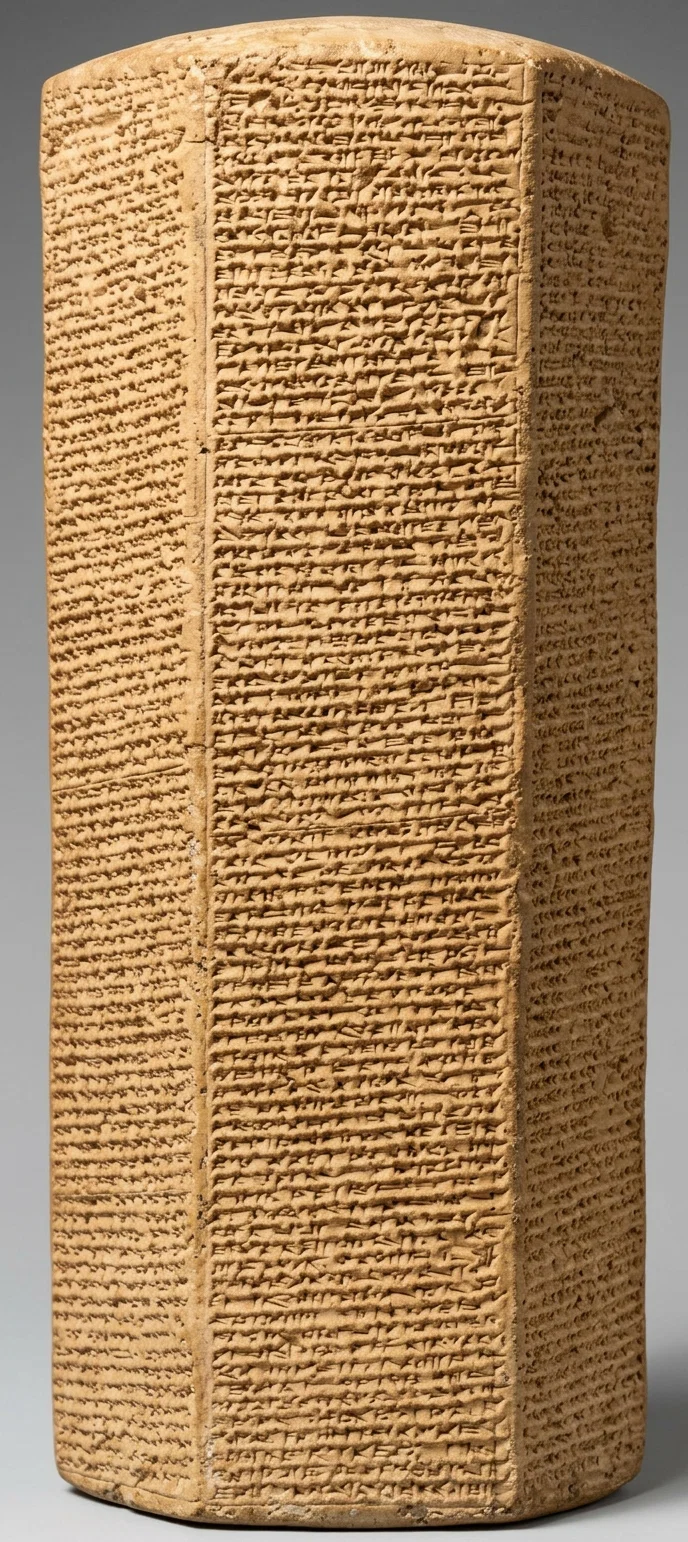
Six-sided clay prism of Sennacherib, king of Assyria. The cylinder is now in the British Museum.
“IF these should hold their peace, the stones would immediately cry out.” Again we quote extensively from the Assyrian records, to confirm whole sections of the history in Kings and Chronicles. It is now generally agreed that Pul and Tiglath-pileser are one and the same person, though there is at least one good reason to the contrary,—the name Pul alone in 2 Kings 15:19, and Pul and Tiglath in 1 Chron. 5:26. However, so far as is now known, the name Pul has not been found in the Assyrian lists of kings, and the name of Tiglath-pileser is found where Pul belongs. In the Babylonian lists, Tiglath-pileser does not occur, but in its place Pulu is found. It may be noticed in passing that a “break” in chronology is remedied by assuming that there were two kings, as will be seen by noting the kings of Israel and Judah they mention. For convenience, this article is written on the basis of the “one king” theory, Tiglath-pileser III, and not II, as was formerly thought.

THE STONES MENTION NINE MONARCHS AND FIVE NATIONS
He is the first Assyrian king mentioned in the Bible. In his own records, he tells of three kings of Israel,—Menahem, Pekah, and Hoshea; two of Judah,—Azariah (Uzziah) and Ahaz; Rezon of Damascus; Hiram of Tyre; and two queens of Arabia, previously unknown.
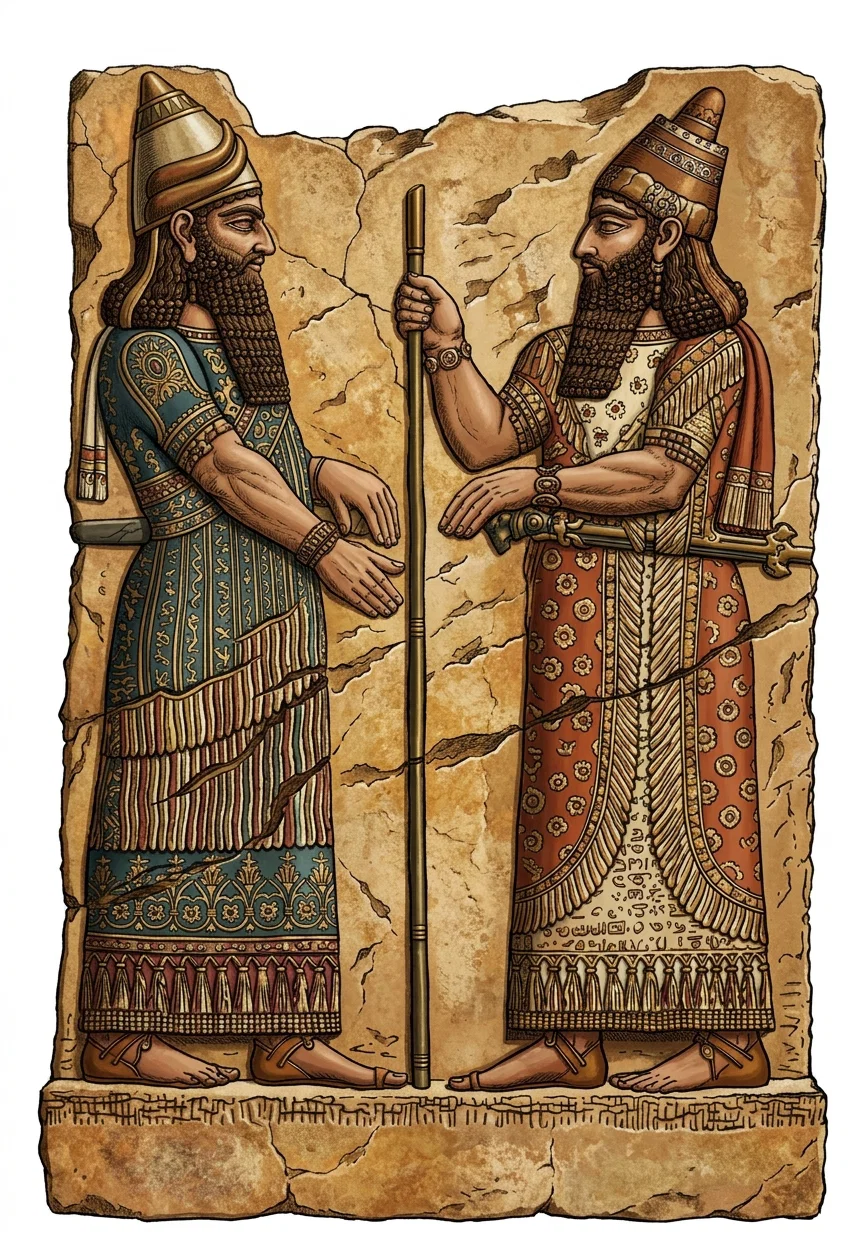
BAS-RELIEF OF SARGON II
Think of it! Here we have information from the “stones” of nine monarchs of five nations,—Israel, Judah, Syria, Phoenicia, and Arabia. The records are “graven in the rock,” and cannot tell what is not true. Now the chapters in the Bible dealing with this period can be read with much greater interest. The closing days of Israel—sad as they were—are now flooded with light from outside sources. The Bible student understands his Bible better, and so does the archeologist understand the monuments better, one record supplementing the other.
Believing that the reader will be desirous to read for himself from this material, we here give some selections that are of special interest. The figures refer to the lines of the inscriptions; the dots, to breaks in the tablets.
“The tribute of . . . Razinu, of the land of Damascus; of Minihimmi, of the city of Samirinai; of Hirummu, of the city of Zurai.” A list of the tribute is then given. (“Records of the East,” old series, volume 5, pages 48, 49.)
2 . . . “In the course of my expedition, the tribute which 3 . . . (Azari)ah, of the land of Judah, like . . .
4 . . . Azariah, of the land of Judah, in . . .
5 . . . without number to heaven were raised . . .
6 . . . in their eyes like that which from heaven . . .
7 . . . battle and to my yoke they
8 . . . of Assyria the great they heard and their heart feared . . .
9 . . . I pulled down. I razed.
10 . . . (to Azari)ah went over and strengthened him and . . .”—Id., page 45.
The next one speaks of affairs in Samaria:
15 . . . “The land of Beth-Omri (Samaria)
16 . . . the population . . . the goods of its people
17 (and the furniture to) the land of Assyria, I sent Pakaha (Pekah) their king they had slain . . . Husih (Hoshea)
18 to the kingdom over them I appointed . . . ten talents of gold, one thousand of silver . . . I received from them as their (tri)bute and19 to the land of Assyria I sent.”—Id., page 52.
An alliance of Judah with Hamath is mentioned by this king, which is of interest. From Sayce we take this statement: “At any rate, the alliance between Judah and Hamath explains a passage in 2 Kings 14:28, which has long presented a difficulty. It is now clear that Jeroboam is here stated to have won over Hamath to Israel, though previously it had been allied with Judah.”—“Fresh Lights,” page 103.

SHALMANESER IV

We possess thus far little information from this king, who ruled from 727 to 722. One record states that he remained “at home” during his first year. In the last three years, campaigns were undertaken, but the names of the places are missing. One of the campaigns, however, was against Samaria, as we learn from the next topic, and of course from the record in 2 Kings 17:3–5. He began the siege, but died before the city capitulated.
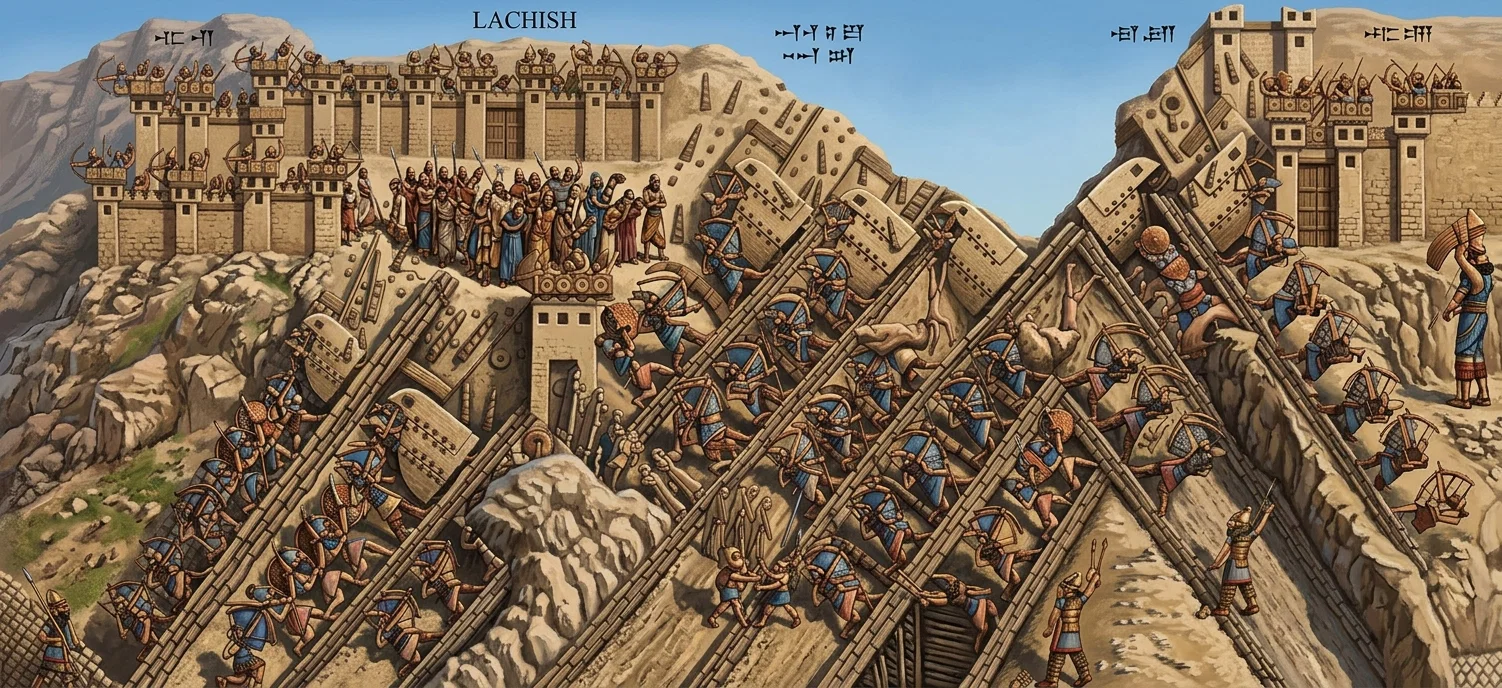
THE STORMING OF LACHISH BY SENNACHERIB’S ARMY

SARGON II

From Professor Price we get the following position of the critics concerning this man, who is mentioned once only in the Bible:
“There is one name in Isaiah (chapter 20:1) which well illustrates my point. Sargon is mentioned as king of Assyria; other kings of Assyria are given in other passages, but the writers have been extremely consistent and very shrewd in their introduction of these mythical monarchs. This case in Isaiah is unique. The name is not mentioned again in the Old Testament, neither is it found in any other literature. Now it is manifestly absurd to say that such a name is anything but a myth, or a scribal error.”—“Monuments and the Old Testament,” pages 33, 34.

RATHER ACTIVE MYTHS

Now if any confidence can be placed in the monumental records at all, Sargon was somewhat of a “personified” myth; for he says that he took 27,280 people from Samaria, and scattered them all over the Tigro-Euphrates valley. It was into this very country that the last two great kings of Assyria transported other peoples, whose descendants became the Samaritans of a later time. It was neither an error of the royal scribe, as Sargon was doubtless seeing that due notice was given him in the writing of the royal annals.
Another point is of much interest in dealing with this monarch. In Isa. 10:5–14, 28–34, is a bit of history that is rather vague. There seems to be no clue as to the person who did the deeds recorded there. This fact led the critics to call this “an ideal invasion” of the land of Judah by an “ideal” Assyrian king. See Sayce, “Fresh Lights,” pages 111, 112; and Brookes, “Testimony of History to the Bible,” page 11.
By a careful comparison of the record of Sennacherib’s campaign in Isaiah 37, it can be seen that the campaign of the tenth chapter must have been made by Sargon. Notice verse eleven: “Shall I not, as I have done unto Samaria and her idols, so do to Jerusalem and her idols?” He also tells of a campaign that he made in Judah which would settle the matter anyway. We also learn, from the Bible and the monuments, that the campaigns of Sennacherib were from the southwest, and this is from the northeast. Thus another victory for the Old Testament, especially as the mention in Isaiah is a very casual one.

SENNACHERIB AND HEZEKIAH

Sennacherib is probably the best known of all the kings of Assyria, from his frequent mention in the Bible. The special item of interest here has been mentioned in the above topic on Sargon. The record of his campaign against the cities in the west land has been found written on the wainscoting of the palace. Here also is a scene representing the siege of Lachish, and the king on a throne, receiving the spoils of the city.
Hezekiah had shut Padi, the king of Ekron (a vassal of Assyria), in prison in Jerusalem, and joined others in an alliance against Sennacherib, expecting aid from Egypt. How many expressions of the prophet Isaiah come to our minds here, warning Israel not to rely on Egypt for help, and similar ones!

HEZEKIAH OF JUDAH ON THE CYLINDER

A few excerpts from the famous cylinder which refer to this will be given:
Column 2: “The lords, nobles, and the people of Ekron, who had cast into fetters Padi their king against the covenants and oath of Assyria, and had turned him over with hostile intent to Hezekiah of Judah (and he shut him up in a dungeon), feared in their hearts.”
Column 3: “Padi their king, I brought out from the midst of Jerusalem, and set him upon the throne of dominion over them, and the tribute of my sovereignty I imposed upon them.”
“But Hezekiah of Judah, who had not submitted to my yoke—forty-six of his fenced cities and fortresses and small towns . . . I besieged and took [a record of the captives and spoil is then given] I brought forth from the midst of them, and counted as spoil. As for Hezekiah himself, like a bird in a cage in Jerusalem, his royal city, I shut him up. To the former tribute, the gifts payable every year, the presents due to my sovereignty, I made an addition and imposed it upon him (them).”
The record then tells of the desertion of his allies and the tribute imposed by Sennacherib.
The destruction of his army is not told by him. Indeed, we do not suppose that he would record a crushing defeat of this kind for his successors to read. The former successful one—see 2 Kings 18:13, 16—is that of which he tells in the record, a part of which has been given. An Egyptian legend tells of an event occurring, as some think, near the Egyptian border, though Sayce inclines to placing it near Jerusalem, that speaks of the destruction of an invading army.
Here is an array of facts written on slabs in the palace, and now in the British Museum, confirming Kings, Chronicles, and Isaiah.
The will of this king is of interest, and is here given: “I, Sennacherib, king of multitudes, king of Assyria, have given chain of gold, stores of ivory, a cup of gold, crowns and chains, besides all the riches, of which there are heaps, crystal and other precious stone, and bird’s stone, one and a half maneh, two and a half cibi, according to their weight, to Esar Haddon, my son, who was afterwards named Assur-Ebil-Mucir-Pal according to my wish, the treasures of the Temple of Amuk and (Nebo)-Irik-Erba, the harpist of Nebo.”—“Records of the Past,” old series, volume 1, page 138.
As Esar was not the eldest son, the jealousy of his brothers, ending in the murder of the father, is better understood.

ESAR HADDON AND ASHUR-BANI-PAL

These are the last two kings of Assyria of whom there are any definite records. In fact, those from the death of the latter to the fall of the nation are hardly known by name. From the prophetic standpoint, these two are of interest on account of the part they acted in bringing about the partial fulfillment of the prophecies of Isaiah concerning Egypt, especially chapter 20, verses 3–6. From our present one, the capture of Manasseh, the place to which he was taken, his release and return, demand our attention.
The monuments tell us that Manasseh paid tribute to both monarchs, but it is not plain as to which king took him captive. It seems plain that his capture occurred under Ashur-bani-pal. This question is outside our realm, as the Bible does not give the name, but says the captains of the host of the king took him captive; but it seems necessary to mention it at least.

THE RECORDS SOLVED THE MANASSEH PUZZLE

The fact recorded in 2 Chron. 33:11, that he was taken to Babylon, was one that puzzled the critics. Why should an Assyrian king take captives to Babylon, the capital of a rebellious province, and not to Nineveh, the headquarters of the Assyrian empire? From the reign of Sargon II, the Assyrian kings were called kings of Babylon. On account of trouble there, Sennacherib partially destroyed the city, but Esar Haddon repaired it in his early reign, and made it his capital for six months of the year. We also know, from the monuments, that Ashur-bani-pal spent part of his time there.
The treatment of Manasseh was in full accord with the customs of the times. Worse criminals than he were treated royally, and sent to their former positions, loaded with honors. The case of Necho is a good example of this fact. The cruelty of the Assyrians is well known to-day from their own records. Bear in mind that this record is found only in Chronicles.
This article has given a brief sketch of six of the greatest kings of Assyria; and counting from the reign of Shalmaneser II of the previous article, the time from the early ninth century to 626 is covered by an abundance of monumental evidence to the accuracy of the Old Testament. In Israel, the history from Ahab to the fall of Samaria has been given; and in Judah, from
(Continued from page 4)
Uzziah to and including Manasseh’s reign. This is a test against which no charge of partiality or unfairness of any kind can be successfully brought. This portion of the Bible is accurate, and worthy of our study and firm belief. “All Scripture is given by inspiration of God.”
The next article will deal wholly with the book written by a Hebrew captive who became prime minister of the Babylonian and Medo-Persian kingdoms.
Continue reading: HOW DO WE FACE THE NEW YEAR?