Your ShelfYour Projects

Review and Herald, Vol. 87, No. 31.

His Power Sufficient
Earlier text: Editorial

The Agencies of God

It seems a part of the divine purpose that in the day of the Lord’s preparation, in the period when there is to be carried to all the world in a short space of time the warning message of the last great judgment, agencies should be prepared whereby this work may be made possible. To the point are the following words from an address given by Dr. Naphtali Luccock, as printed in the Northwestern Christian Advocate of May 25:—
All lines of progress are converging in these days. More than a century and a half ago, Sir Isaac Newton made a prophecy almost as startling as his announcement of the law of gravitation. “I believe,” he said, “from the study of God’s Word, that in the future he will greatly accelerate the movement of converting the world, and accomplish thework suddenly. But I am convinced, also, from the study of the Word, that before that comes to pass, there will be a marvelous increase in the speed of transportation on the earth. I believe that, in the providence of God, though the method now be entirely hidden, men will yet travel on the earth at the rate of fifty miles an hour.” The world laughed at him; an increase of speed from eight to fifty miles an hour was utterly beyond the frontier of its thought. The keen and caustic Voltaire said, in bitter scorn: “One can see how stupid the old Bible is, in that it has addled the intellect of Sir Isaac Newton, the most acute on the earth, until he talks like a fool. He says the time will come when a man will be at one point on the earth’s surface at the beginning of an hour and fifty miles away at the end of it. Absurd! unthinkable!” But this day the prophecy of Newton is fulfilled before our eyes, both as to the rate of transportation and communication and as to accelerated missionary movements.
Says the prophet Nahum: “The chariots shall be with flaming torches in the day of his preparation. . . . They shall seem like torches, they shall run like the lightnings.” Prepared to hand are the agencies of God. The railroad train, the steamship, the telegraph, the telephone, the printing-press, the mail service,—all these, and other means, have been brought into existence for the giving of the last message. Let us utilize these agencies to the utmost in the fulfilment of the great commission.

A “New Christianity”

In the current number of the Biblical World, issued by the University of Chicago press, there appears an editorial, responsibility for which is accepted by thirteen editors, which points to the coming of a “new Christianity,”—a Christianity which shall result in “the releasing of men’s minds from the bonds of tradition and creed.” The Christianity of Jesus Christ honored the Word of God, especially “Moses and the prophets.” The attitude of the new Christianity is thus stated:—
If there be a controversy between Genesis and geology, the new Christianity will stand with geology. The record left in the strata of the earth can not be impugned by a poet of the prescientific age, even though that poet be also a prophet of a higher conception of God than had before his day prevailed. In conformity to the same principle, the new Christianity will accept the assured result of historical investigation into the records of ancient times. Religion has its rights, but so also has history; and one of these is that it be studied by historical methods.
He who has received the Bible “not as the word of men, but as it is in truth, the word of God,” and who has experienced the power of its effective work in his own life, will put this “new Christianity” in the category of “another gospel,” and will regard its science as a science “so-called.” Truly, departure from the faith is a prominent characteristic of our times.
J. N. Q.

Loma Linda College of Medical Evangelists

THE question of establishing a denominational medical college has received more or less thought and discussion among us for a number of years. Such a school has been greatly desired by our young people wishing to secure a medical education. The parents of these young people have had the same desire, and many of our medical men and women have felt that we should establish a medical school that could give our young people the advantages they need in preparing for the medical work we aim to do.
Such a school would no doubt have been established before this had it not been for the great expense and the many difficulties that such an undertaking involves. Not knowing how to surmount these, we have hesitated to launch the enterprise.
But in view of counsel given to those in charge of the Loma Linda Sanitarium, the brethren on the Pacific Coast took the matter up last December in the Pacific Union Conference, and passed resolutions looking to the establishment of a medical college in connection with the Loma Linda Sanitarium. These resolutions led to the appointment of a large committee to take this enterprise in hand. The committee met at Loma Linda the sixth of last May. After giving the question in all its phases the best study of which they were capable, the members of this committee decided that, notwithstanding the greatness of the undertaking, there could not consistently be any further delay in establishing a good medical school.
When the committee met at Loma Linda, and gave the problem earnest, prayerful study, light and courage came to them. Some of the difficulties that had stood in the way were removed, and the undertaking began to seem more possible than it had before. It was found that the Loma Linda Sanitarium plant offered many advantages for the work of the new school.
When we began our study of the question, it was understood that a medical school would be added to the sanitarium; but it became evident that the better plan was to turn the sanitarium plant into a medical school. This would place the buildings, land, orchard, dairy, food factory, and the entire equipment in the hands of the medical college trustees, to be used to the advantage of the college. This was agreed to by the trustees of the sanitarium, and in a few days the transfer was made in due legal form, thus starting the school with more than a hundred thousand dollars’ worth of property.
This action was not intended to terminate the existence of the Loma Linda Sanitarium, but this institution will continue as a part of the college plant. It has already established an excellent record as a sanitarium, and has built up a large patronage which it should not only hold but enlarge. This sanitarium is well managed and is doing a good work. It will continue to be known as the Loma Linda Sanitarium, and will be conducted as heretofore, but will be under the ownership and management of the medical college board.
To meet the requirements of the medical students, it will be necessary to build a hospital and carry on hospital work. This has been recommended by the board of trustees, and the funds required to erect and equip the building are now being solicited. It will also be necessary to build a dormitory for the medical students.
It will be the aim of the Loma Linda College of Medical Evangelists to furnish three classes of workers. One class will be regular physicians, who can meet the requirements of medical boards, and take charge of our sanitariums. It will not be the aim of the college to graduate a very large number of physicians each year. It is thought that only ten or fifteen will complete this course annually.
There is great demand for another class of medical workers,—those who will go to foreign mission fields as medical missionary evangelists. The work of this class will be very different from that of the physician working on strictly professional lines in the home land. It is hoped that each year a large number of this class will go out to the great fields where their services are sorely needed.
A third class who will receive training at Loma Linda will be the regular nurses. There is great demand for Christian missionary nurses in the home land and in foreign fields. There is scarcely any limit to the helpful service such nurses can render.
It should be understood by all our people that the one great aim of this medical college will be to educate and train our young people to render the most efficient service possible in carrying forward the work of the third angel’s message. It is not the purpose of this school to turn out merely professional physicians and nurses to carry on private work. Every one who goes from that school is to be a medical evangelist.
This undertaking is so great that it must have the earnest prayers, and the hearty, continuous co-operation of all our people. A. G. DANIELLS.

Our New Swedish Seminary

As our work has developed, our brethren have seen wisdom in the plan of establishing a seminary exclusively for the training of Swedish workers. In studying the field, and the situation in general, it is apparent that when we get a Swedish school established near the center of the Swedish colonies of this country, where we can surround the students with a Swedish atmosphere, there will be better opportunities for them to become perfected in the Swedish language.
The Swedish department at UnionCollege has done much good; but it has been located to one side of the Swedish colonies, and the English language has been used most of the time outside of the class-room. For these reasons the department has not served the purpose for which it was designed as well as a school differently situated would be able to do.
In looking over the field we have found that there are about two million Swedes in a territory having Chicago as its most central point. Chicago itself has one hundred sixty thousand Swedes,—a larger number than any other city in the world except Stockholm,—and there are as many more in the State outside of Chicago. This situation seems to indicate Chicago as a central location for the Swedish school.
Last April it was decided to buy a seventy-eight-acre farm twelve miles west of Chicago, near Broadview, a station on the Central Illinois Railroad. This farm has a very rich, productive soil, and is all under cultivation, except a few acres used for pasture. The farm has good buildings, which can be utilized for our purpose. There are two houses, a frame house with six rooms, and a brick house with eleven rooms, both in good condition. We plan to use the brick house for a dormitory, and shall have room for over thirty students in it. There is also another building which can be used as a dormitory after a few alterations are made. With these buildings we shall be prepared to begin the school on the farm this fall.
We paid twenty thousand dollars for the farm, a very reasonable price, when we compare it with the price generally paid for property in the neighborhood. Four hundred dollars an acre is usually paid for land with fewer improvements than are found on our farm, and three hundred dollars an acre for land without improvements.
In this new Swedish school we shall not only be able to give students some work on the farm; but those who are adapted to the work can sell our magazines in the city, and in that way scatter the truth while at the same time they are securing money for their support.
We earnestly ask the co-operation of our American brethren in this enterprise planned by the General Conference. We need their financial help, and we would also like to have them encourage our Swedish young people to come to this school, and receive a preparation that will fit them to take an active part in the message. All those who desire further information concerning this school should write to me at 5942 Peoria St., Chicago, Ill. S. MORTENSEN.

Prize-Fight Pictures

THE action taken by many cities in the United States and throughout the world in prohibiting the exhibition of pictures of the recent prize-fight is to be strongly commended. The youth of the present day do not need education in these matters. There can not possibly be in these exhibitions one redeeming quality. The whole influence makes for the cultivation of wrong ideals and the corruption of the morals. It is to be hoped, as has been expressed by many, that the recent prize-fight will be the last brutal exhibition of this sort which shall be witnessed in the civilized world. Such exhibitions of physical, and we might add brute, force, do not make for the good of the human family, from whatever standpoint they may be regarded.

A Great Agency

As illustrating the very general use now made of the telephone, one of the world's great utilities, the following, by Engineering, is of interest:—
There are in the whole world 9,600,000 telephones, and the lines have an aggregate length of about 12,500,000 miles. There are 1,800,000 telephones in Europe, 56,000 in Asia, 9,000 in Africa, 7,700,000 in America (of which 7,590,000 are in the United States), and 53,000 in Australia.

A School for Workers in Mexico

Two years ago there came to Mexico four young men from California to enter the canvassing work. They spent six months in study and work, beginning in the City of Mexico very shortly after arriving here. At the end of six months they went out into the field as canvassers, and had good success. One young man died, and lies in the Dolores Cemetery not far away; another returned to the United States to pursue his studies further; two are still in the country, and several others have joined them. Our experience with these young men has led us to believe that we can do a successful training work on a larger scale. At a recent meeting of the Mexican Mission Committee, plans were laid to open a school in Tacubaya to accommodate twenty or thirty young persons. We want those who are ready for their last year's work in school to take it with us here, making Spanish one of their principal studies. Living in the country, and hearing the language continually, and practising it during one year, will give these young people a better working knowledge of the language than two or three years of study from books in schools in the United States.
Brother W. A. Yarnell, who has been working in California during the present year, writes that a number there desire to come. As our accommodations are limited, we must know beforehand just who will come. We have made quite a careful study of expenses, and can offer board and good accommodations for four dollars a week, this to include room, lights, and plain laundry.
Our committee here has asked the writer to take general charge of the school, with Brother Yarnell, Mrs. Caviness, and a Mexican young lady as the other teachers. Having spent thirteen years in this country in literary work, my wife and I are prepared to help somewhat in this school, although we have many other duties to look after. Brother Yarnell is a graduate of Union College, and has spent nearly two years in Mexico in study and preparation. Our Mexican sister is a graduate of the Mexican schools here, and has had some experience in teaching; so we believe we can offer a good course to the young people who may come,—a course that will be worth a great deal to any one who is thinking of laboring in a Spanish field. The course begins September 21, and continues thirty-six weeks.
The Spanish-speaking people of the world number some seventy millions, and our work is only just begun among them. Many workers will be needed. The design of this school is to prepare workers for Spanish fields.
We hope that the blessing of the Lord will rest upon this enterprise, and that in the future we shall have a goodly number of young persons for this needy and promising field. Address the undersigned at 1599 Avenue 22, Tacubaya, D. F., Mexico. G. W. CAVINESS.

British West Indies

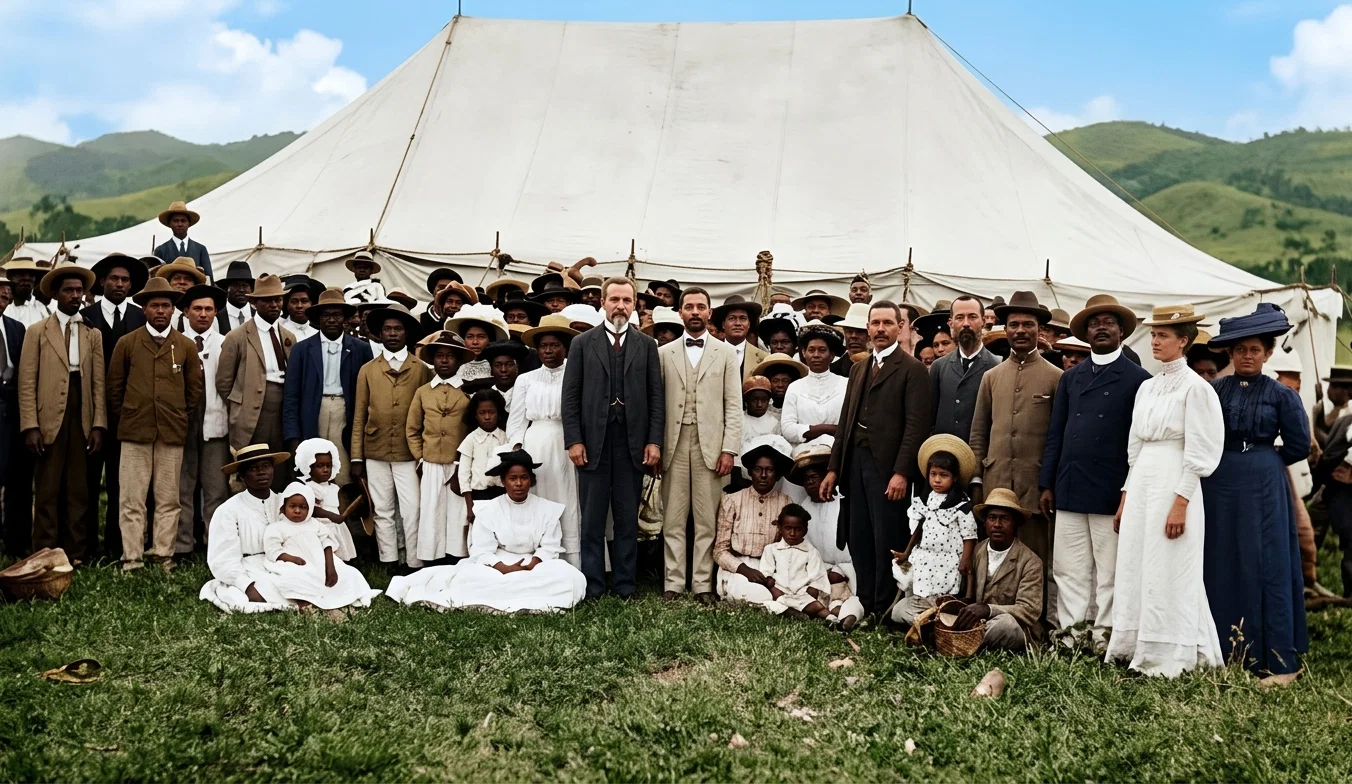
TRINIDAD.—February 8 we pitched a tent, and continued a series of meetings for seven weeks. The field was not a new one, as years ago some of our workers did some work in the village by open-air meetings and canvassing. An interest was then created, and an attempt was made to build a place of worship on a lot that was offered; but the matter was neglected, the place was sold, and the man who had offered it became an enemy to our work.
We worked against many obstacles, such as sickness, bad weather, and opposition; but to the praise of God, nine persons accepted the truth, and others are interested. The Lord moved upon the heart of the man who had before offered the ground for a church, and he has given another spot, and is now very friendly. The land has been cleared, and we are trying to put up a place of worship, though it will mean quite a struggle, as all the people are poor.
TENT-MEETING AT TRINIDAD
Elder F. G. Lane, of Barbados, by invitation kindly spent the last week and a half of the effort with us, and his labors were much appreciated. Pray for the work here.
A. N. DURRANT, P. C. CARRINGTON.

Our Supreme Opportunity

Of the grand opportunity in missionary evangelization before this generation, J. Campbell White speaks thus optimistically:—
“The fair share of the United States in the solution of the missionary problem, is to provide for the evangelization of about 560,000,000 people in the non-Christian world. This will require the quadrupling of our present force of missionaries, and a corresponding increase in contributions from approximately $11,000,000 last year to about $45,000,000 annually. As we spend over $300,000,000 annually for religious purposes in our own country, one sixth of this amount to reach a population equal to six times that of the United States is surely a conservative estimate of our financial responsibility. I believe that the churches of the United States are going to accept this task and perform it.”

Religious Liberty — a Bible Reading

Force Not a Gospel Agency

1. How is the work of God in saving men carried on in the earth? Zech. 4:6.
2. How are men's hearts purified? Acts 15:8, 9.
3. How does Christ dwell in the heart? Eph. 3:17.
4. Can faith be forced? or is it a voluntary act? Note 1.
5. What is our Saviour's attitude toward freedom in belief? John 12:47; note 2.
6. What does Paul say of the weapons of the Christian warfare? 2 Cor. 10:3, 4.
7. What is the only sword he mentions in enumerating the whole armor of God? Eph. 6:13-17.
8. What does he say of its power? Heb. 4:12.
9. What reason did Christ give for his servants not fighting in his behalf? John 18:36.
10. When Peter attempted to defend his Master with a sword, what did Christ say to him? Matt. 26:52.
11. When two of Christ's disciples desired to use force against the Samaritans, who “did not receive him,” how did he rebuke them? Luke 9:51-56.
12. To whom does vengeance belong? Rom. 12:19; note 3.
13. What kind of worshipers does the Lord seek? John 4:23, 24.
14. What did the Saviour say of his attitude toward those who refused to believe his word? John 12:47.
15. What course does he pursue with every soul? Rev. 3:20; John 12:32.
16. What course does he forbid among his disciples? Luke 22:25, 26; Matt. 20:25, 26.
17. What Scriptural expressions indicate proper methods of gospel work? — Answer: “Go ye into all the world, and preach the gospel;” “I entreat thee;” “We persuade men;” “We pray you;” “I beseech you;” “Whosoever will, let him take the water of life.”
18. How is the servant of the Lord to labor for the erring? 2 Tim. 2:24-26.
19. In seeking to convert men, how does God appeal to them? Isa. 1:18.

Notes

1. Faith is the gift of God, but it is ours to exercise. God leaves it optional with us whether we will use the faith he gives. All the nations of earth have not sufficient power to force a single soul to believe anything. If one believes, it must be through force of conviction from accepting certain testimony, and not by outward constraint. Faith is voluntary. Its foundation is the Word of God (Rom. 10:17); but no one can by force compel another to believe the Bible. “Where legal enactment begins, moral suasion ends.”—Christian Union.
2. “Almighty God hath created the mind free; all attempts to influence it by temporal punishments or burdens, or by civil incapacitation, tend only to beget habits of hypocrisy and meanness, and are a departure from the plan of the holy Author of our religion, who, being Lord both of body and mind, yet chose not to propagate it by coercion on either, as was in his power to do.”—Thomas Jefferson.
3. Vengeance, or retributive justice, belongs to God to execute, and not to man, because all men are alike accountable to God for their conduct. Therefore we are not to become angry and avenge ourselves for the wrong-doings of others, but we are to “give place unto wrath,” that is, God's wrath,—for it is written, “Vengeance is mine; I will repay, saith the Lord.” The Lord's wrath will be visited in harmony with the principles of justice, love, and righteousness. God has not committed to men the work of judging, condemning, and executing vengeance upon any one. The Papacy has often shown its antichristian character by engaging in such work.
C. M. S.

Sanitarium Relief Campaign

The Spiritual Side of Sanitarium Work

Much could be quoted from the Testimonies to emphasize the fact that, in general and in detail, the work of our sanitariums should advance the third angel's message and be a blessing to souls. This work was not given to this denomination as a means of financial income, for its own support and that of other branches of the cause. However, this is not to say that we should not try to make it self-supporting, nor that it is out of place to use surplus earnings in the advancement of other interests of the message.
We can not estimate the full strength of our sanitarium work as an evangelical factor in reaching persons with the truth, but there are some facts that indicate its possibilities in this respect. Figures for last year show that more than twenty-five thousand persons were in our sanitariums either as guests or as patients. The average stay is five weeks each. Taken as a whole, this gives a vast audience for a time sufficiently long to receive much instruction in principles of truth. The sanitarium facilities for successful spiritual work are usually very good. Those in attendance are in a state to be especially susceptible to real spiritual help, it being often their greatest need. They have plenty of time to spare for attending services, at the regular worship hour and at special services on Sabbath or at other times. If the workers are awake to their opportunity and privilege of helping souls to the fullest extent, it is an easy matter to secure the attendance of patients at worship. The routine work can usually be so planned as to permit both patients and workers to be free at that hour, physicians making their prescriptions accordingly, and heads of departments co-operating, so that nothing will hinder any one from attending who wishes to be there.
From experience I can say that the worship hour may become the most precious part of the day to many. Serving as chaplain for a number of years in two of our smaller sanitariums, in connection with other duties, it has been my privilege to have, night after night, an audience of from ten to forty persons who showed the deepest interest in the services. The exercises may be varied by reading suitable selections from our own or other good books, timely articles from our periodicals, giving Bible lessons on doctrinal points or of a practical character, etc. Often request is made for some special subject; and then it becomes an easy matter to present a theme that might otherwise be thought out of place. Thus by exercising care there may be given a very full line of truth that will be well accepted. An anxiety to be present at worship will be seen, outdoor games and pleasures, visiting, or anything else of the kind not being sufficient to detain. Even persons who are much prejudiced on first coming often show a gradually growing interest, until they are seated in the inner circle of those most interested in the principles we hold.

Special Opportunity

A matter of special interest in this line of work is that of reaching people of all classes, from the poorest to the most wealthy. While the greater part of the patronage is drawn from the more common classes, there is also a goodly number of persons of special prominence or influence. A knowledge of the truth is to be given to all, and we can readily see that many would hardly have the opportunity of receiving it through our canvassing work, Bible work, or public services. We should be grateful that God has given us a means whereby these may be reached.
Is it not proper that we give due consideration to what is being done by our sanitariums as evangelical factors, and recognize that this work is deserving of credit? This denominational work is done without cost to the denomination, except that in a few instances conference support is given to the chaplain, or to the physician who is serving as conference medical secretary while also employed in an institution. Should we not recognize that there is something definite to show for the outlay of means that has been made in the establishment of our sanitariums? Is it too much to say that some of their deficits in earnings might be properly accounted for in the work that has been done in evangelical lines?
Can we not even say that it is a good thing to have these institutions as undoubted means of extending the truth, and that, as such, they are worthy of our support? Then let us respond heartily to the call that is now being made in the present relief campaign. It is not much that is asked, after all, nor is it in the form of a bill to the denomination for services rendered, but at the same time it comes to us as a legitimate call for help. L. A. HANSEN.

A Questionable Communion

Quoting from the Association Men, the Western Recorder (Baptist) of June 16 refers to a communion service held in a certain city in which twelve churches, including the Baptist, engaged in the communion service. It says:—
“The writer assures us that ‘never before in America’ has such a service been held. We are at least thankful that this unscriptural, spectacular performance has never occurred before, and we sincerely trust that it will never occur again in America, or any other portion of the civilized or uncivilized world. We would recommend to the Baptists who participated in this Corinthian celebration of the supper, that they take a course of instruction from the janitor of some Baptist theological seminary, and learn the A B C of Bible truth and practise.”
This communion service was brought about by the influence of the Y. M. C. A. The Recorder gives this friendly advice to this association:—
“We would modestly suggest to the Y. M. C. A. that it ‘stick to its knitting,’ and let the question of church union severely alone. It has been said that some men have made fortunes by attending to their own business, and it is probably equally true that some have marred their fortunes by trying to attend to the business of others. As much as we think of the Y. M. C. A. and its work, we have never felt called upon to ask it how to run our church. Nor do we hesitate to say that, should the Y. M. C. A. become sponsor for the destruction of our denominational tenets, we would feel it our duty to oppose it to the extent of our ability and influence. Baptists have, through the ages, had a divine and distinct mission; and this mission, by the help of God, they propose to fulfil, without interference or dictation.”

Christian Liberty

Reports, Notes, and Comments Pertaining to the Current History of the Rights of Conscience
Conducted by the Religious Liberty Bureau
K. C. RUSSELL — Secretary
C. M. SNOW — Corresponding Secretary

_Forward to All Nations_

“Go ye therefore, and teach all nations, baptizing them in the name of the Father, and of the Son, and of the Holy Ghost: teaching them to observe all things whatsoever I have commanded you: and, lo, I am with you alway, even unto the end of the world.”
In harmony with the spirit of this great commission, the following resolution was adopted by the General Conference in its last session:—
“Whereas, The good hand of God has been with our publishing work, and the Lord has begun to fulfil to us his promise that ‘the publishing work is to be revived;’ and,—
“Whereas, The sale of literature has increased during the past quadrennial term from half a million dollars a year to one million two hundred eighty thousand a year; therefore,—
“Resolved, That we render thanksgiving to God for all his dealings with us; that we renew our vows of consecration to this department of his service; and that we do our utmost to provide the necessary trained workers, literature, organization, and facilities for the speedy proclamation of the third angel’s message to all nations, kindreds, tongues, and peoples by means of the printed page.”
The foregoing resolution was discussed with much enthusiasm, and was unanimously adopted. We are glad to be able to report that this resolution has not suffered the fate of many which are passed by such large assemblies. The providences of God have opened wide the doors of opportunity for us in all nations; and one by one these doors are being entered, and the pioneers of this message are rapidly taking possession, and with such success as God alone can give they are publishing the good news of the gospel of the kingdom.
Pursuant to the policy adopted in passing this resolution, general agents have been sent out to important fields during the past year as follows:—
Carl E. Weaks, formerly general agent of the North Pacific Conference, to India.
G. H. Clark, formerly field agent of the Chesapeake Conference, to Africa.
E. Max Trummer, formerly general agent of the German canvassing work in the Mississippi Valley, to the east coast of South America.
Henry Tonjes, formerly field agent of the Greater New York Conference, to Brazil.
E. T. Wilson, formerly a student at the Foreign Mission Seminary, and a man of mature experience in the distribution of literature, to Peru.
C. F. Innis, formerly field agent of the Western Colorado Conference, to Panama.
In addition to these general leaders, we have sent four experienced canvassers to Mexico, two to Porto Rico, one to Cuba, and one to India. Another, also, is under appointment to India, and expects to sail in a few days.
The success which these workers have attained in their respective fields almost from the beginning of their efforts, indicates that the time was fully ripe for this movement; and we are encouraged to press forward in harmony with this missionary policy, as expressed in the resolution given above.
On the last page of the previous number of the REVIEW, there appeared two brief articles, one from the president of the General Conference, calling for one hundred twenty missionaries, and the other from Elder N. Z. Town concerning the twenty-five canvassers whom we wish to secure as soon as possible.
We want twenty-five strong, experienced young men who give promise of developing into reliable, permanent leaders of our colporteurs in the respective fields to which they may be assigned. After having given satisfactory evidence to the Mission Board of their fitness for the work, these twenty-five candidates will be placed under provisional appointment, and brought to the Foreign Mission Seminary for a brief, special course of training. Those who are unable to pay their own expenses will be given a sufficient salary to cover school expenses, and will be assigned to the foreign work, and sent forward as soon as they are fitted for the work.
The Lord has greatly blessed us thus far in the selections that have been made. Valuable men have been secured through the unselfish co-operation of leading men in our union and State conferences and publishing houses. By the same means we hope to secure the full number required.
All correspondence relating to this matter should be directed to N. Z. Town, Takoma Park, Washington, D. C.
E. R. P.

The Summary

The accompanying summary is one of the best we have ever published. The success of our agents is well distributed. While there is an apparent decline in some of the unions of the United States, due partially, at least, to the heavy contributions made during the past year to foreign fields, there are, on the other hand, a strong upward tendency and better regularity in the reports from many foreign fields. The total sales in foreign lands have averaged from twenty to thirty thousand dollars a month for two or three years, but recently they have sprung upward to thirty-five and forty thousand dollars a month.
It is too early for us to say whether there has actually been a decline in the union conferences of the United States for the month of June. In 1908 our banner month was July, because during that month nearly all the recruits from our schools were working for their scholarships. In 1909 the schools closed earlier on account of the time of the General Conference, therefore June was the banner month. This year it was near the middle of June before students from many of the schools were at work on their scholarships, and it is quite possible that their work will affect the month of July as much as the month of June.
Whatever the results may be, it is evident that our union conferences are strengthening their organization for handling our literature, and the breaches that have been made in the leadership by calling strong men to foreign fields are being made up, and the Lord is giving steadily increasing success to the men who have taken on new burdens. Therefore, while there may be occasional fluctuations in the summaries from our union conferences, there is no indication of chronic weakness.
Our hearts are cheered by this splendid report, and we trust it will be an inspiration to all. E. R. P.

_More Catholics Than Protestants_

THE Christian Advocate for July 21 is responsible for the statement that in sixteen States and Territories in this country, the majority of church-members are Roman Catholics, and gives the following percentages in support of this claim:—
“New Mexico, 88.7; Rhode Island, 74; Montana, 73.1; Massachusetts, 69.2; Nevada, 66.7; Arizona, 66.2; New York, 63.6; New Hampshire, 63; Louisiana, 61.3; Connecticut, 59.6; California, 58; Vermont, 55.9; Maine, 53.3; New Jersey, 51.5; Wisconsin, 50.5; Michigan, 50.1.”
From this list it is apparent that in all the New England States, Roman Catholic communicants outnumber those of the combined Protestant churches.

Waste in Denominational Effort

MUCH has been said of late about the large amount of waste in Christian effort due to the fact of duplication of effort on the part of the various churches. This charge, however, seems not to be well founded, as applied to some sections of the country. Says the United Presbyterian of July 21:—
“A joint committee of forty, representing twenty-one denominations, undertook an investigation of conditions in Colorado, to discover whether or not there was such duplication of religious privileges and waste of missionary funds in that State. There has been a report made of the findings, and it gives little or no support to the familiar charge. It was found that there are 133 towns having populations of from one hundred fifty to one thousand which have no Protestant church of any sort.”

The Missionary and Publishing Work

Notes, Plans, Reports, Statistics, and Other Information Regarding Missionary Endeavor and the Circulation of Gospel Literature.
Conducted by the Missionary and Publishing Department of the General Conference.
E. R. PALMER — Secretary N. Z. TOWN — Assistant Secretary A. J. S. BOURDEAU — Missionary Secretary
Continue reading: Canvassers’ Summary for June, 1910