Your ShelfYour Projects

Signs of the Times, Vol. 24, No. 41.

SELLING THE LORD

Signs of the Times

Oct 13, 1898

Pacific Press Publishing Company · Oakland, California · Oct 13, 1898

SELLING THE LORD.
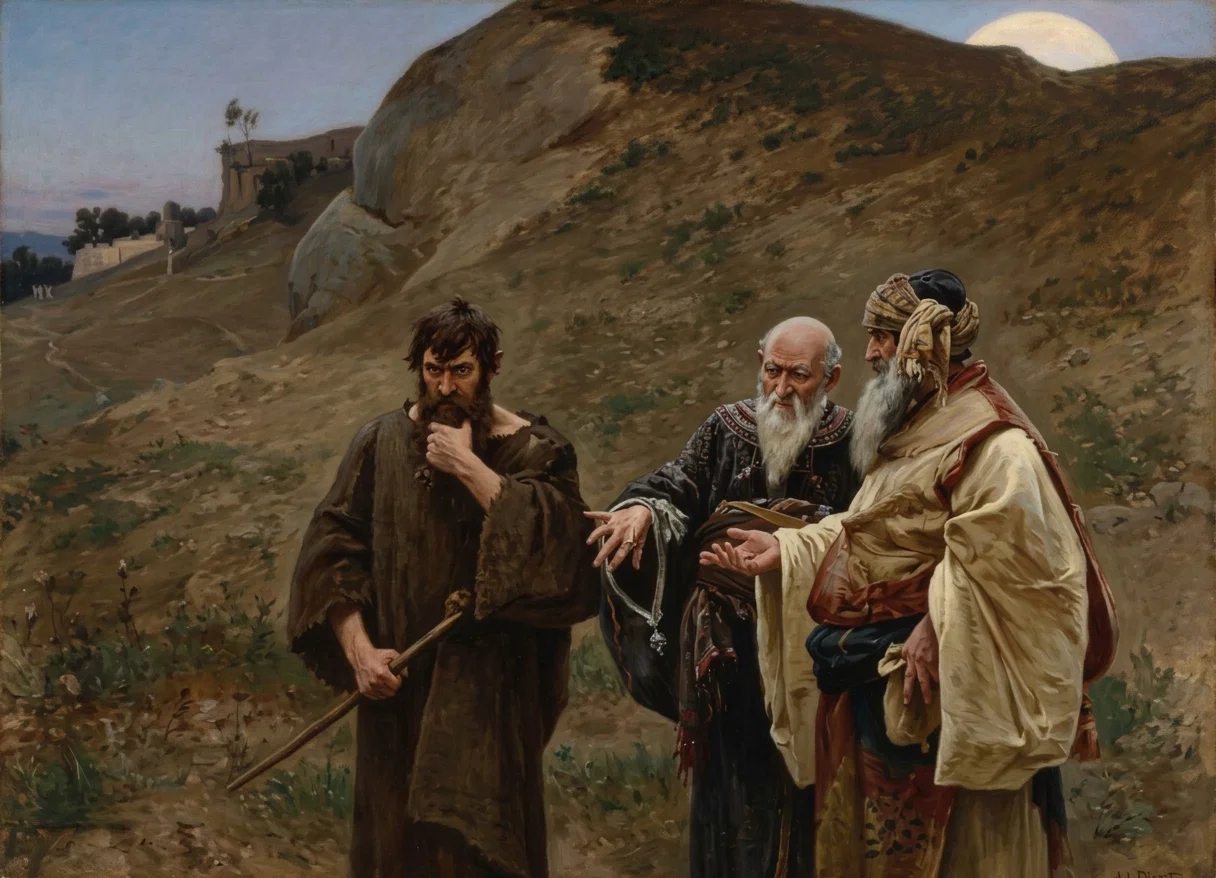
The sun had just sunk to rest behind the hills of Judea. The last supper of our Lord with His disciples had just been celebrated. Depressed by the thoughts of the bitter cup of agony He must soon drink, our Saviour with His little band of followers sought the cooling freshness of the evening hour in the quiet places of retreat in the Garden of Gethsemane. Here it was He had so often enjoyed the communion with His Father His soul most craved, and here it was that floods of light from heaven above had so often filled His soul and strengthened Him for the conflicts of His ministry.
THE PRIESTS BARGAINING WITH JUDAS.
Judas is not a member of the little band. A great purpose possesses his soul, but a purpose so evil in its conception, and so terrible in its execution, better would it have been for him had the day never dawned that linked him with its fatal destiny. While Jesus is wending His way to Gethsemane, Judas, with furtive glance and nervous step, is treading his way through the streets and alleys of Jerusalem to the palace of the high priest. In that palace the plan for the apprehension of the Saviour had been concocted, and the night had been chosen for its execution. And while the utmost secrecy had been observed, Judas in some way has received a knowledge of the plans of the chief priests to effect the destruction of Jesus.
Judas had joined himself to the standard of Jesus at what he deemed an opportune moment. The tide of enthusiasm and admiration over the works of the new Teacher in Israel was running high. It was pleasant to ride on the crest of the rising wave. But the praises of Jesus and His spotless purity had stirred the envy of His rivals. The tide seemed changing in its course. The noisy rabble and vacillating multitude who had followed Jesus for temporal gain or idle curiosity, had their minds poisoned against the Master. Expressions of discontent, of envy, and evil suggestion, fermented by the enemies of the Lord, had taken the place of the wild adoration on the part of the great multitude.
Judas had noted the change. Should he continue longer with a cause that seemed absolutely doomed to oblivion? And even if the cause of Jesus were really of God, would it not be more profitable for him to stand in favor with both sides of the controversy? Could he not gain favor with the chief priests and serve his own temporal advantage, and still maintain his friendship for the Lord?
The Jews sought a man to betray to them the Saviour’s whereabouts. In what secluded spot could they find Him that night, and before the morning dawned place Him upon trial for His life? Judas knows their desire, and is bent on the terrible mission of deliveringhis Lord into the hands of His enemies. Perhaps he thought that Christ by that divine power he had so often seen Him manifest, would deliver Himself from the bars and chains of Roman imprisonment.
Who can tell the conflicting emotions that must have possessed his soul as he wended his way from that quiet supper scene in the upper chamber to the rendezvous of the scheming, plotting men who sought the life of the One who by His spotless purity had rebuked their sinful doings? He enters the palace of the high priest. The plot is already formed, and they are only lacking now a guide to its fearful execution. The temptation for sordid gain is too great for the double-minded Judas. During all his association with the Lord he had continued still to nurture in his heart the spirit of covetousness, and oftentimes from the Lord’s scanty store had this covetousness manifested itself in theft, to supply that which Judas desired above his fellows. Here was an opportunity to reimburse himself for a part of that which he had lost in joining himself to the standard of Jesus. The priests call him aside and propose their evil purpose. “And he said unto them, What will ye give me, and I will deliver Him unto you? And they covenanted with him for thirty pieces of silver.” O, what a value to set upon his precious Lord! Sixteen dollars and ninety-six cents, the common price of a slave, was the sum at which Judas valued his Master.
Judas had loved his Lord, at least he thought he did, but here was the test of his love. Here was the test of his friendship.
The experience of Judas is not unlike that of thousands of others in the world to-day. How many there are who are betraying their Lord for something suited to their carnal desires! With some it is the exchange of the Christian’s hope for earthly possessions, for an earthly name, for that which will prove of temporal, personal advantage. Esau sold his birthright, with all the blessings it involved, for the lust of appetite. Peter denied his Lord through fear of ridicule and scoffing. Judas valued Him at the price of a slave. Demas exchanged Him for the riches and pleasures of this world. And that man or woman to-day who holds in reserve any earthly desire or sordid purpose, does so to the exclusion of God’s blessing, and counts that thing of more value than the things of God.
At what price do you value Him? To you is He the chiefest among ten thousand, the One altogether lovely? To you is He more precious than gold, even the fine gold of Ophir? Is His love the ruling passion of your life? And is the great purpose that possesses your soul to live for Him, and to be sanctified by the indwelling of His Spirit? Be sure, if this is not the case, if you have not put on the Lord Jesus Christ, making no provision for the lusts of the flesh, there will surely come a time when this reserve will prove your weakness, and you will be found betraying your Lord in the market of your own carnal desires, for that which will prove your everlasting destruction, as in the case of the object lesson before us.
The value of Jesus is the value of a soul; and the value of a soul is the value of an eternity of joy in the presence of God. May the priceless treasure of a Saviour’s love appeal to our hearts so sensibly that we shall count the things of this world of little moment, compared with the inestimable riches of His grace. • F. M. WILCOX.

“SAVED BY HIS LIFE.”

“For if, when we were enemies, we were reconciled to God by the death of His Son, much more, being reconciled, we shall be saved by His life.” Rom. 5:10. It was not enough to bring about the salvation of fallen humanity that Christ should die. That was necessary for our reconciliation, but a perfect, sinless life must be lived in the flesh for us. It is by that life we are saved. All agree that Jesus lived this perfect life. He was without sin. By this sinless life he “condemned sin in the flesh.” Many sought to entangle our Redeemer in sin. The Jews believed him to be a Sabbath-breaker, and tried to fasten this sin upon Him. Some thought he had a devil. Others brought other accusations, but He continued to speak the truth, and asked, “Which of you convinceth Me of sin?” John 8:46. Again, at the close of His work, He says, “Hereafter I will not talk much with you; for the prince of this world cometh, and hath nothing [no sin] in Me” (John 14:30), nothing in harmony with Satan.
“Sin is the transgression of the law.” If Jesus had been convinced of sin, He would have broken some portion of the law; “for sin is the transgression of the law.” Every one of the ten precepts He kept. He must, then, have kept the fourth commandment, which enjoins the keeping holy of the seventh day of the week—not the first. All His life He observed this day; for it was His custom to read in the synagogue. Luke 4:16.
But we are saved by His life. And that life was a Sabbath (seventh-day) keeping life. Every individual, therefore, saved in the kingdom of God must have imputed to Him, through faith, this life of Jesus Christ.
Inasmuch as the Lord gave no intimation of His followers observing any other day for the Sabbath, how can it be possible for them, since light has shone upon the Sabbath, to receive by faith this Sabbath-keeping part of Jesus’ life, when they believe another day to be the Sabbath, which He never recognized? Can they by some sleight-of-hand movement in faith, conform their Sunday-keeping life with the true Sabbath-keeping life of Jesus Christ? For to be a Christian we must even now live His life. “I am crucified with Christ; nevertheless I live; yet not I, but Christ liveth in me; and the life which I now live in the flesh I live by the faith of the Son of God, who loved me, and gave Himself for me.” Will the Son of God live a different life now in the flesh of His followers of Nazareth than He lived eighteen hundred years ago in the flesh of Jesus? Will He in the flesh now live a Sunday-keeping life, when before He lived a Sabbath (seventh-day) keeping life? Would He then be “Jesus Christ the same yesterday, and to-day, and forever”?
Reader, ponder carefully the life of Jesus. Is it not a perfect example? Are you not satisfied with it just as it was lived? Then try not to climb up some other way, but rejoice that you can be saved “by His life,” and remember that you can not change it.
T. E. BOWEN.
Newburg, W. V.

Give Time to the Evil One

GIVE time to the “evil one” and you give him all he requires.—Gladstone.

WHERE JESUS IS FOUND.

[By Henry Van Dyke, D.D., in Scribner’s Magazine.]
NEVER in a costly palace did I rest on golden bed, Never in a hermit’s cavern have I eaten idle bread.
Born within a lowly stable, where the cattle round Me stood, Trained a carpenter in Nazareth, I have toiled, and found it good.
They who tread the path of labor follow where My feet have trod; They who work without complaining do the holy will of God.
Where the many toil together, there am I among My own; Where the tired workman sleepeth, there am I with him alone.
I, the Peace that passeth knowledge, dwell amid the daily strife, I, the Bread of heaven, am broken in the sacrament of life.

THE ONLY PROFITABLE UNION.

The world's alliances are very unreliable. They are generally expensive, and when one becomes unable to keep up the expense, his expected benefits are liable to be cut off. This principle is true not only of individuals, but of nations. Italy's connection with the triple alliance with Germany and Austria has well-nigh bankrupted her, and greatly impoverished her people. Her purpose is to be strengthened in case of war, yet war would be just the thing to expose her weakness, as was shown in the trouble with Abyssinia.
Aside from the expensiveness, however, there is the uncertainty. For instance, look at the alliance between France and Russia. The people of the republic were much elated over their offensive and defensive alliance with the autocratic monarchy. When the czar visited the city of Paris, there was an effort to show that even the seasons had been reversed in his honor. It was in the month of October, but the cherry, peach, and apple trees were everywhere in bloom. The labor and expense of thus decorating the trees with artificial blossoms of tissue paper must have been enormous, but the outlay showed the anxiety of the republic to outdo all other governments in adoration of the czar, and secure an alliance with the monarchy. Illogical as such a union must appear, France felt the need of some offset to the dreibund, or triple alliance of Germany, Austria, and Italy. This was important to France, on account of her purpose to seize the first opportunity for an effort to regain from Germany the territory lost in the war of 1870; as also a source of encouragement in the oft-recurring friction with England.
But the fickleness of human friendship and the bitterness of such an alliance was manifested at a most critical moment. Just as the famous Dreyfus scandal was to be reopened, making imminent a fresh trouble with Germany, Russia sends out her disarmament proposition, which was quite generally interpreted as a ruse to cover up a sudden recognition of present inability to back up her bluff against England in China. So republican France has found her monarchical crutch a questionable support in a time of need.
The lesson, however, is an individual one: “Put not your trust in princes, nor in the son of man, in whom there is no help. His breath goeth forth, he returneth to his earth; in that very day his thoughts perish. Happy is he that hath the God of Jacob for his help, whose hope is in the Lord his God; which made heaven, and earth, the sea, and all that therein is; which keepeth truth forever; which executeth judgment for the oppressed; which giveth food to the hungry.” Ps. 146:3-7. The only alliance that can truly guarantee relief from the oppressions and dangers everywhere to be met in this world, is a union with Christ. “If ye abide in Me, and My words abide in you, ye shall ask what ye will, and it shall be done unto you.” John 15:7. W. N. G.

THE TRUTH AND ITS POWER IN THE HEART.

“THE kingdom of heaven is like unto leaven, which a woman took, and hid in three measures of meal, till the whole was leavened.” By this parable Christ seeks to illustrate the work of the Holy Spirit upon the human heart. The process is invisible by which the leaven changes the meal into which it has been introduced; but it continues to work until the meal is converted into bread. So the leaven of truth, working inwardly, produces a complete change in the human heart. The natural inclinations are softened and subdued. New thoughts, new feelings, new motives, are implanted. But while every faculty is regenerated, man does not lose his identity. New faculties are not supplied, but a thorough change is made in the employment of those faculties. The heart is cleansed from all impurity, and man is fitted with traits of character that will enable him to do service for God.
The leaven of truth, hidden in the heart, will not produce the spirit of rivalry, the love of ambition, the desire to be first. Thousands upon thousands of those to whom God has intrusted talents become slaves to their earthly possessions. They abuse their intrusted capabilities, and scheme and plan to obtain those things which have no value with God. They buy and sell, and get gain, but they neglect to secure the precious things that are placed within their reach,—the bread of life, the ornament of a meek and quiet spirit, which is in the sight of God of great price. Money is of value only as it is used as the Lord’s intrusted means, only as we hold it in trust as a precious gift of heaven with which to bless humanity. If it is used to indulge and glorify self, it becomes a curse, and an incumbrance and a constant temptation.
In his letter to Timothy, Paul speaks of a class of people who dishonor God. In the place of seeking for purity of heart, for love and unity, they reveal that they know not what it means to have the leaven of truth in the heart to mold the affections and sanctify the soul. They are proud, “knowing nothing, but doting about questions and strife of words, whereof cometh envy, strife, railings, evil surmisings, perverse disputings of men of corrupt minds, and destitute of the truth, supposing that gain is godliness. From such,” the apostle warns Timothy, “withdraw thyself. But godliness with contentment is great gain. For we brought nothing into this world, and it is certain that we can carry nothing out. And having food and raiment let us be therewith content. But they that will be rich fall into temptation and a snare, and into many foolish and hurtful lusts, which drown men in destruction and perdition. For the love of money is the root of all evil; which while some coveted after, they have erred from the faith, and pierced themselves through with many sorrows.”
With the follower of Christ the love of money will not be all-absorbing. For Christ’s sake he will labor for it, deny self, cut off every needless expenditure, that the means which come into his possession may be used in the great work of saving souls who are without Christ and without hope in the world. Thus he will co-operate with the world’s Redeemer, who for our sake became poor, that we through His poverty might be made rich. The Commander of the angelic host laid aside His royal robes and crown of honor. He left the royal courts of heaven, and clothed His divinity with humanity, that humanity might touch humanity, and that divinity might lay hold of the power of God in behalf of the fallen race. The love of ease and pleasure and self-exaltation did not characterize the life of Christ. He was a man of sorrows and acquainted with grief. He was wounded for our transgressions, and bruised for our iniquities. The chastisement of our peace was upon Him, and with His stripes we are healed. All who make an unreserved surrender of themselves to God will share in the self-denial of Christ, and will have fellowship with Him in His sufferings.
The meal in which the leaven is hidden represents the heart that receives and believes in Jesus. Christ works out the principles which He alone can work in. The world regards as a mystery the man who is imbued with these principles. The selfish, money-loving man lives only to eat and drink and enjoy his worldly goods. He loses the eternal world from his reckoning. But the man who receives and believes the truth will have that faith which works by love and purifies the soul. The world can not know Him, for He is keeping in view eternal realities. A motive power is working within to transform the character. The love of Jesus with its redeeming power has come into the heart to conquer the entire being, body, soul, and spirit. When counter-influences work to oppose the grace of Christ which bringeth salvation, this love masters every other motive, and raises the human being above the corrupting influences of the world.
Because he clings to Jesus in faith and prayer, because he looks unto Him who died that man might have all the power that God has to bestow, the believing soul enters into fellowship with Christ. His life is hid with Christ in God. He is widely separated from the motives which move and control the world, and therefore the world knows Him not.
The apostle Paul declares: “You hath He quickened, who were dead in trespasses and sins; wherein in time past ye walked according to the course of this world, according to the prince of the power of the air, the spirit that now worketh in the children of disobedience; among whom also we all had our conversation in times past in the lusts of our flesh, fulfilling the desires of the flesh and of the mind, and were by nature the children of wrath, even as others. But God, who is rich in mercy, for His great love wherewith He loved us, even when we were dead in sins, hath quickened us together with Christ, . . . and hath raised us up together, and made us sit together in heavenly places in Christ Jesus; that in the ages to come He might show the exceeding riches of His grace in His kindness toward us through Christ Jesus. For by grace are ye saved through faith; and that not of yourselves; it is the gift of God.”
Here is brought to view the change that must take place in the heart. And “faith cometh by hearing, and hearing by the Word of God.” The Scriptures are to be the great agency in this transformation. Christ prayed, “Sanctify them through Thy truth; Thy Word is truth.” The true Christian will show himself a believer in sanctification, and his works will testify of him that he is born of God.
The apostle exhorts us: “If there be therefore any consolation in Christ, if any comfort of love, if any fellowship of the Spirit, if any bowels and mercies, fulfil ye my joy, that ye be like-minded, having the same love, being of one accord, of one mind. Let nothing be done through strife or vainglory; but in lowliness of mind let each esteem other better than themselves. Look not every man on his own things, but every man also on the things of others. Let this mind be in you, which was also in Christ Jesus.” “Put on therefore, as the elect of God, holy and beloved, bowels of mercies, kindness, humbleness of mind, meekness, long-suffering; forbearing one another, and forgiving one another, if any man have a quarrel against any; even as Christ forgave you, so also do ye. And above all these things put on charity, which is the bond of perfectness. And let the peace of God rule in your hearts, to the which also ye are called in one body; and be ye thankful. Let the Word of Christ dwell in you richly in all wisdom; teaching and admonishing one another in psalms and hymns and spiritual songs, singing with grace in your hearts to the Lord.”
MRS. E. G. WHITE.

WHAT DOES THE LIQUOR TRAFFIC CONCERN?

[From an address by John G. Woolley, in N. Y. Voice.]
It concerns society at large; for, like the fox beneath the Spartan soldier’s doublet, it tears her very heart out, bravely as she carries it.
It concerns government; for it feeds the wells from which it draws its very breath of life, denies its title to itself, violates the dead, plunders the living, and breeds prenatal paupers and criminals to perplex and defeat it.
It concerns capital; for it is the mainspring of arson, embezzlement, mobs, riot, and murder.
It concerns labor; for it saps its strength, its honor, and its hope, until industry becomes a galley slave, willing to take its pay in blows and sweaty rags and squalor.
It concerns the church; for by so much as it enjoys she suffers loss.
It concerns the school; for by so much as it outruns it in the race for power, it converts culture into crime, and makes the educated “the dangerous classes” to the common weal.
It concerns every home; for it is a denial of its every sanctity and an insult to its best ideals.
It concerns love—and how many a love-story is going through its first chapter in this convention; it leeches its very blood, and leaves behind the ashes of inexpressible desolations.
It concerns the land not only, but the sea as well; for every stately “ocean liner” that clears our ports and sails down over the edge of the world with the “Union” at her flagstaff, carries on board a “bar” of uncharted shoals and sunken reefs for some of the voyagers; and many a gallant life goes down at sea inside the ship, and while the watch is calling at every bell, “All’s well! All’s well!”
London fog was never denser than the popular misapprehension of the drink question. Not long ago I was in conversation with a lady, who evidently thought to show me a politeness by asking about the progress of what she called “temperance.” She spoke as one might mention a new orchid she had heard of, but never seen; and by her knee her little boy was clinging, rosy, and lusty, and fine. “It must be dreadful work,” she said, “but I have no personal interest in it, and so I do not keep informed about it. There has never been a drunkard in our family on either side.”
She was a moral somnambulist, wide-eyed but stone blind, walking along the eaves of Tophet with her child. I woke her, as in duty bound, by saying: “Madam, how do you know that this boy will not be a drunkard? My mother was as good and as beautiful as you are, and our home was far more beautiful than this of yours. My father’s blood ran as pure as any in your husband’s family or your own, and they were as loving, and as tender and as careful as you can be. But when the natural and honorable griefs and losses of the world had beaten them with many stripes, but left them family pride and an untarnished name and an only son whom their united love clothed upon as with a garment of immunity against defilement, the saloon came and took all. And the only bit of land I own to-day at a mid-life of ceaseless labor is a little square of cemetery hillside, where they lie, with their broken hearts, waiting for whatever possible joy may be requited to them at the last.”
Before I had finished, her bosom was heaving with tumultuous breathing, and her eyes were pitiful with unshed tears; and, snatching the boy to her heart, she cried: “Forgive me! Forgive me! I had not thought!”
I do not speak of this to lay a railing accusation against the careless-seeming, happy people; I know perfectly that the ignoble servitude of Christian people to the saloon parties is due to the lack of thought; but your church has thought, and spoken so that all earth and heaven have heard, and you are thinking now, and must think. Bear with me this once. I do not expect you to feel as I do; you could not without suffering what I have suffered, and I have no enemy and never had one whom I would not spare that if I could. I am pleading with you for the merest humanity, such as you would show a wounded dog. There is not a cradle rocking, rocking in an American home to-night, but close beside, the drink wolf crouches and grins and waits. There is not a baby man swinging into the lists of life in the royal chariot of his mother’s arms, pressed hard and safe against the snowy pillows, but the saloon vulture, with bloody beak and claws, and sick of old carrion, flaps its hideous wings above that holiest pageant of the universe, and soars and waits.

PEACE BY RIGHTEOUSNESS.

Not peace at any price, Of battles, Lord! Some diplomatic, dark device To end abhorred.
Drive Thou the plowshare home, Our shallow thought confound; Then better yield shall come Out of earth’s broken ground.
Truth’s sword upon Thy thigh, Thy steed snow white, Ride on in majesty, All wrong to right. Heed not our blood and tears, Our outcries of distress. Bring, in these latter years, A peace by righteousness.
Earth’s kingdom Thine, The end, the sum; Tho they in turn decline, Thy kingdom come. Give all earth’s lands new birth; Drive home truth’s share again, Till come new heavens and earth, Amen, O Lord, amen!
—J. E. Rankin, in N. Y. Observer.

THE PURPOSE OF THE DISPENSATION OF GRACE.

God’s plan or dispensation of the ages,—the arrangements of His house,—is rapidly being carried to its completion. When His work is finished, harmony will again reign throughout the universe of God. Not a discordant voice will again be raised against the law of the King of Eternity. “And there shall be no more curse.” Every intelligent creature will be united in loving service to God and the Lamb forever and ever. We read in Eph. 1:10, “That in the dispensation of the fulness of times He might gather together in one all things in Christ, both which are in heaven, and which are on earth; even in Him.” “And I, if I be lifted up from the earth, will draw all men unto Me.” John 12:32. Yes, all the worlds, by the sacrifice of Christ, will again be united with the continent of heaven.
Christ will not fail nor be discouraged in this work until He has vindicated the righteous character of God and His law before all the intelligences of the universe. In closing up the dispensation of grace, God’s plan of the ages in the fulness of times, it is God’s purpose “that all things might again be made new in the Messiah, things in heaven, and things on earth.” Eph. 1:10, Syriac Ver. This refers to the time spoken of in Rev. 21:5: “And He that sat upon the throne said, Behold, I make all things new.” “And every creature which is in heaven, and on the earth, and under the earth, and such as are in the sea, and all that are in them, heard I saying, Blessing, and honor, and glory, and power, be unto Him that sitteth upon the throne, and unto the Lamb forever and ever.” Rev. 5:13.
When that time is reached, the curse will have been forever wiped away. The wicked will have been destroyed root and branch. Mal. 4:1–3. And from that time forth, the peace of God’s loving, loyal subjects will never again be disturbed by a tempting foe. The whole universe will have learned the lesson taught them by the six thousand years of sin and misery experienced by the inhabitants of this world since the fall of Adam. And the lesson is that God accepts of nothing but the voluntary service of loyal hearts made obedient by love, and that God administers His law in love.
The Lord is now giving all a chance to determine on which side they will stand,—whether under the leadership of Jesus Christ or of Satan; whether they will renounce their sins and by grace be brought into harmony with God, and made obedient to His commandments, and thus become fitted as heirs of His everlasting kingdom, or take their stand among those who trample down His law, and defy His government. The Lord is saying to us by His grace, “Choose ye this day whom ye will serve.” “If the Lord be God, follow Him; but if Baal, then follow him.” O, that all would choose the gift of God, which is eternal life, through Jesus Christ our Lord! God is gracious, and has madeevery provision by His grace to make us partakers of His nature, and heirs of His eternal glory. “The Spirit and the Bride say, Come. And let him that heareth say, Come. And let him that is athirst come. And whosoever will, let him take the water of life freely.” Rev. 22:17. “Blessed are they that do His commandments, that they may have right to the tree of life, and may enter in through the gates into the city.” Verse 14.
G. T. WILSON.
Cooranbong, N. S. W.

THE LORD COMES TO BLESS.

WHILE Dr. Arnot was pastor at Glasgow, his attention was called to a woman who was in great distress, being unable to pay her rent. So he went to her for the purpose of giving her assistance. He rapped at the door, listened, and believed he heard some one in the house. He rapped again. The third time he rapped very hard, listened, but again heard nothing. After waiting a little while, he made a great noise, and finally went away. A few days afterwards he met the woman on the street and said: “I was at your house the other day; I had heard that you could not pay your rent, and I came to assist you.” “O, was that you?” the woman replied. “I was in the house the whole time, but I thought the proprietor of the house had come to demand the rent, and, as I had not the money, I left the door locked.” This woman is a picture of the sinner. He thinks God comes to demand something of him, while in reality God comes to give and to bless. Sinner, unbolt the door and allow Him to enter. “Behold, I stand at the door, and knock; if any man hear My voice, and open the door, I will come in to him, and will sup with him, and he with Me.” Rev. 3 : 20.—Anon.

THE LORD'S TENTH FIRST.

A LITTLE girl who had two dimes, one for herself and the other for the missionaries, unfortunately lost one. She at once decided that it was the missionaries’ dime that was lost. Some people do their proportionate giving in much the same way. They make sure that they get the nine-tenths, and if the other tenth is not at hand when needed, the Lord’s cause must do without it. This spirit is illustrated in the story of a colored man who was to raise a crop of corn on the shares. The owner of the land was to receive one-third of the grain. The season passed and the corn was gathered, but the owner did not get any. Meeting the old man, he said:—
“Why haven’t you lived up to your contract about the corn?”
“Deed, master, I have,” was the reply. “I was to get two-thirds an’ you one, and there warn’t but two-thirds of it. I’m mighty sorry. I ’lowed there would be three loads, but there warn’t but two.”—Anon.

GOD VERSUS SCIENCE.

Man’s reasoning can never find The depths of words divine; Nor can all scientists combined E’er fathom God’s design. Past finding out His actions are; Man’s wisdom ne’er can know Why He the objects of His care Protects and keeps below.
Philosophists oft theorize, Each with contrary views; But seldom do they realize What doctrines they diffuse. Some claim the world for myriad years Has on its axis turned; While other wise men, it appears, This theory have spurned.
Some have averred the earth was flat, While some have claimed ’twas round; And ridiculed this idea, that They thought was so unsound; While others hold that worlds afar Are peopled like our own, And that each brilliant, shining star Shall soon to us be known.
And some there are who boldly state Our world by nature came. Tho lacking proof of all they prate They press the groundless claim: “’Tis nature makes the sun to rise, That makes the rain to fall, That keeps the planets in the skies— ’Tis nature does it all.”
How true, not many wise shall know The working of God’s hand; But yet the humblest saint below, By faith can understand. No vain philosophy we need God’s mysteries to explain, Since He Himself our souls will feed With wisdom’s golden grain.
In vain do men researches make While they our God exclude; True science follows in His wake Not in defiant mood, But in obedience day by day, To bend with things divine; Nor will it stand in false array God’s works to undermine.
By faith we each can understand The things of God sublime: His works, the mighty sea, and land, Through endless years, and time. What science fails to vindicate, The poorest saint below, However lowly his estate, God’s highest things may know.
JOHN MCCARTHY.
Argentine Republic.
Continue reading: THE PARAGRAPH BIBLE AND HOW TO USE IT