Your ShelfYour Projects

Signs of the Times, Vol. 39, No. 38.

The Seed Sowing and the World Harvest

Signs of the Times

Oct 1, 1912

Pacific Press Publishing Association · Mountain View, California · Oct 1, 1912

The Seed Sowing and the World Harvest
ANOTHER parable set He before them, saying, The kingdom of heaven is likened unto a man that sowed good seed in his field: but while men slept, his enemy came and sowed tares also among the wheat, and went away. But when the blade sprang up and brought forth fruit, then appeared the tares also. And the servants of the householder came and said unto him, Sir, didst thou not sow good seed in thy field? whence then hath it tares? And he said unto them, An enemy hath done this. And the servants say unto him, Wilt thou then that we go and gather them up? But he saith, Nay; lest haply while ye gather up the tares, ye root up the wheat with them. Let both grow together until the harvest: and in the time of the harvest I will say to the reapers, Gather up first the tares, and bind them in bundles to burn them; but gather the wheat into my barn."
"Then He left the multitudes, and went into the house: and His disciples came unto Him, saying, Explain unto us the parable of the tares of the field. And He answered and said, He that soweth the good seed is the Son of Man; and the field is the world; and the good seed, these are the sons of the kingdom; and the tares are the sons of the evil one; and the enemy that sowed them is the devil: and the harvest is the end of the world; and the reapers are angels. As therefore the tares are gathered up and burned with fire; so shall it be in the end of the world. The Son of Man shall send forth His angels, and they shall gather out of His kingdom all things that cause stumbling, and them that do iniquity, and shall cast them into the furnace of fire: there shall be the weeping and the gnashing of teeth. Then shall the righteous shine forth as the sun in the kingdom of their Father. He that hath ears, let him hear."
Schedule for Week Ending October 12, 1912

Schedule for Week Ending October 12, 1912

Sunday October 12 John 19
Monday " 13 " 20
Tuesday " 14 " 21
Wednesday " 15 Acts 1
Thursday " 16 " 2
Friday " 17 " 3
Sabbath " 18 Acts 4; Psalm 107
— ★ —
Wonderfully touching and instructive in their detail are the last of John's chapters. Chapter 19 reveals the weakness of Pilate. He declared Jesus to be innocent, but even the innocent must not stand in the way of his self-interest. He gave Jesus over to the cruel scourge and to the mocking, tantalizing, brutal soldiers. John omits the visit to Herod. Beaten, bleeding, suffering, Pilate presents Jesus again before the mob, hoping to arouse their pity, but he is met with the mad cry, "Crucify! Crucify!" The test developed Pilate's cowardice and the Jews' disloyalty. They cut the last strand that held them as a nation to God, when they said, "We have no king but Cæsar." Then followed the awful crucifixion, our Lord's unselfish remembrance of His mother, the development and courage of Nicodemus, the resurrection, and all the wonderfully good related lessons. And in all that Jesus did, in all that He said, in the record that He left, there is life to every believing soul.
Acts was written by Luke. Compare verse one with the opening of Luke. The object of the book is to show the gospel in operation, God working out His purposes through consecrated men united in Him.
The first chapter records the choosing, under God, of a successor to Judas, and Matthias was taken. He may not since have been mentioned. That is not against his apostleship. Several of the twelve are not mentioned after Acts 1. Chapter 2 is the manifestation of what Spirit-filled men can do. And so also, in a more limited way, are chapters 3 and 4. Such men can suffer as well as speak. They can be both patient and earnest, bold and kind. God is just as willing to work to-day, and the name of Jesus is not less potent than then.
Psalm 107 is always good, cheering, instructive, heartening.

Question Corner

"IF YE WILL INQUIRE, INQUIRE YE."
This Inquirers' Department is conducted for the purpose of helping those who are studying the Bible. The answers are oftentimes only suggestive. They are never to be considered infallible, only as they agree with the infallible Word. The writer who may answer them does not consider that his opinion is infallible. He will simply give the best that he has, and plead with the inquirer to search the Word. Such questions only will be answered as, to the editors, seem to minister to the good of the readers and to the mission of the paper. We can not answer repeatedly in the same volume questions upon the same scripture. The name and address must accompany question, not for publication, but as an evidence of good faith, and that answer may be made by letter if deemed advisable. No letters are answered which do not contain the name of the writer. It is well always to enclose stamp for reply.

3570 — Sunday Laws and Prohibition

Please give the reasons why a law prohibiting the manufacture and sale of intoxicants is right, and one forbidding Sunday labor is wrong. Are not both class legislation?
A. C. B.
The design of the prohibition of the manufacture and sale of intoxicants has naught to do with class. It does not prevent any one from drinking, if he has liquor. It does prohibit the manufacture and sale for public purposes. One of the chief reasons for doing this, from a political standpoint, is the enormous drain that the liquor business is upon the community. If those who manufacture and sell liquor, met all the expense and tragedy of the liquor traffic, that would be one thing. But they do not. They impose upon the community a fearful burden, which the community itself must bear, in the drunkards and paupers they make, in the widows and orphans, or worse than widows and orphans, in the crime and corruption that is fostered, in a hundred different ways, breaking down all barriers of law, of society, and loading continually heavy burdens upon the community. The saloons make necessary the great number of police in our cities and towns; they furnish a great deal of the material for the courts. The mere suggestion of these will bring to the minds of our readers very much more than we have mentioned as the result of the liquor traffic. It has to do wholly and solely with the economic problem of our cities and towns. In a long series of years, a country could better afford to pay pension to the men engaged in the liquor traffic, until they died, than to allow the traffic to go on; and this from a purely economic standpoint.
A Sunday law is altogether different. It is class legislation; it is more, it touches the rights of mankind. It touches the very highest class of those rights, the right to worship God according to the dictates of one's own conscience, and the right to earn a living for his family, working in what way and how long one will. It does not strike directly at evils, economic or otherwise. It certainly has been demonstrated that the Sunday is as well kept in communities where there is no Sunday law as in communities where there is one. Neighbors get along just as peacefully; there is just as much quiet; there is far more agreement, less trouble and prejudice in every way, than where Sunday laws exist. Their most serious effects fall, many times, upon those the most conscientious and faithful.
In nearly all cases of prohibition of the liquor traffic, time is given for the saloon man to adjust his business. Adjusting his business, he has no trouble from the law. He could not say that conscientiously he must follow that business. No saloon-keeper in the world would ever make such a claim as that. Any other business equally profitable, or less, would be preferable; for few saloon-keepers would actually prefer a business like that, were they not trained to that one thing. But this is not the case at all with the Sunday law. It does have to do with conscience and one's relationship to his God.

3873 — Shall We Know Each Other?

In harmony with Eccl. 1:11 and Isa. 65:17, can we expect to recognize our children and friends in the new earth?
We see nothing in these scriptures to indicate to the contrary. The text in Ecclesiastes simply is speaking of the fashion of this world. Men forget all that has gone before. Simply the careless, selfish forgetter of this world is referred to, and Isa. 65:17 indicates that those who are saved in the kingdom of God shall not sorrow over the past, no matter what it may have been. God has dealt with it all right in every way. We are told this elsewhere,—that even the wicked shall see Abraham and Isaac and Jacob in the kingdom of God, and they themselves thrust out. Luke 13:28. And we read in 1 Cor. 13:12 of that blessed state, "For now we see in a mirror, darkly; but then face to face: now I know in part; but then shall I know fully even as also I was fully known."

3867—Where Will We Meet the Lord?

Please give me Bible proof as to where the saints—body and soul—meet the Lord. J. F.
The question is answered very clearly in 1 Thess. 4:16, 17: "For the Lord Himself shall descend from heaven, with a shout, with the voice of the Archangel, and with the trump of God: and the dead in Christ shall rise first; then we that are alive, that are left, shall together with them be caught up in the clouds, to meet the Lord in the air; and so shall we ever be with the Lord." Our Lord does not at this time descend upon the earth. He takes the saints to heaven, to the mansions prepared, in the New Jerusalem. John 14:1-3; Rev. 21:2. At the end of the millennium, the city descends to the earth, the earth is renewed, and becomes the eternal home of the people of God.

3868 — The 144,000

As long as we believe that those who died under the third angel's message are included with the 144,000, is there any possibility of calculating how many are dead since that message was proclaimed? Probably that number is nearly summed up, and the end is near. T. A. Z.
In the first place, we do not know as there is any general belief that all who have died in the third angel's message are included in the 144,000. There are many who do not hold this. Nor do we know how it could be calculated how many have died since that message was proclaimed. Not a few hold that the 144,000 represent a special class, more in number than themselves. In all the numberings in the Scripture, the males only are numbered — it is the men, besides women and children — and the males only of a certain age. That may be the case with the 144,000; we do not know. It is not safe to speculate on any numbers of that kind.

3869 — The Case of Esther

Persians could not marry Jews. What about the case of Esther?
Our querist has turned the question around. Persians were not forbidden to marry Jews, but Jews were forbidden to marry Persians. But in this case it was not the choice of Esther, but the choice of the king, and the Jews were captives and slaves in the land of Persia. Esther seems to have been gathered among the beautiful maidens of the kingdom from whom the king was to take his choice; and she was chosen. It was an exceptional case, and God overruled it for the good of His children. There were those exceptional cases all the way through. For instance, Rahab, of the inhabitants of Canaan, of the city of Jericho, who housed the spies, became an ancestress of our Lord, and so also did Ruth the Moabitess. But these were exceptional cases, and did not pervert the holy seed.

3571 — Sodom and Gomorrah

Is it not likely that Sodom and Gomorrah were destroyed by an ordinary volcanic eruption? A. K.
Not if we believe the record. All of the various means which entered into their destruction we do not know, but it certainly was not an ordinary volcanic destruction. In the first place, it was known that it was coming, and coming as the judgment of God. Abraham himself was warned concerning it. So also was Lot, and the words of the angels were, "For we will destroy this place, because the cry of them is waxed great before Jehovah; and Jehovah hath sent us to destroy it." "Then Jehovah rained upon Sodom and upon Gomorrah brimstone and fire from Jehovah out of heaven." Gen. 19:13, 24. We have no more reason to question the record there than we have the record concerning the character of Sodom and Gomorrah.

3872 — Underneath the Waters

Who are the deceased that tremble beneath the waters? Job 26:5, A.R.V.
Read the whole chapter. It is a setting forth of the majesty and greatness of God. Spurrell renders: "The mighty dead shall be cast forth from beneath the waters, with their inhabitants. Hades is disclosed before Him, and for destruction there is no concealment." In other words, God knows and understands it all, and by His mighty power the very dead are reached, and in His knowledge all is open. The expressions are decidedly figurative. Compare with Isa. 14:15-18, in which those who have died are represented as expressing their surprise at the fall of Lucifer. This does not mean they have life, but it means that in the matter of character and desert Lucifer would be welcomed by them if they were alive, and in chapter 26 God's power is represented as reaching even to them that are dead, and of course He will bring forth those who are dead from their graves when He shall come.

3874 — Chiropractic

I have seen "chiropractic" mentioned in the "Signs" in connection with osteopathy. What is chiropractic? I can not find that word in the dictionary.
It is not there unless it is a very recent dictionary. It comes from two words, "cheir" — hand, and "practic" — practise, — hand-practise. It can hardly be called a school of medicine, because it does not use medicine. It is a school of practise for the healing of humanity by hand manipulation, especially to the spine. It is quite similar to osteopathy in this respect.

3875 — The Sabbath of the Land

A friend says Lev. 25:4 is still binding. Is it, and should our land lie idle? C. L.
No, Lev. 25:4 is not binding. All the Jewish national laws expired by limitation when our Lord Himself died upon the cross. That nation then was no longer God's special people. The laws regarding the jubilee were wholly and solely national laws, for the nation of the Jews and their land. Of course one could observe such a law for himself if he wished, but the Scripture law is not binding upon any one. The only laws that are binding are laws which in the very nature of the case apply to all men under all conditions. The seventh-day Sabbath is a law of that kind. It is an essential part of the Decalogue, a law which, in the nature of the case, is eternal; but these other laws, which enjoined duty for a time, passed away when our Lord came, expired by limitation.

EDITORIAL

The Sabbath and the Creator

OUR English Bible begins with the statement of the work of the Creator in forming this earth. The steps in creation are followed through six successive days, and then we reach this declaration: "And the heavens and the earth were finished, and all the host of them. And on the seventh day God finished His work which He had made; and He rested on the seventh day from all His work which He had made. And God blessed the seventh day, and hallowed it; because that in it He rested from all His work which God had created and made." Gen. 2:1-3.
If we ask the foregoing text what God did after finishing the work of creation, it will tell us that He "rested." If we ask it again on what day He rested, it is equally plain in saying that He rested on "the seventh day." If we ask the text to tell us still further what He did with the seventh day after resting upon it, it will say that "God blessed the seventh day, and hallowed it." And do we ask the text why He blessed the seventh day and hallowed it, the answer is, "Because that in it He rested from all His work which God had created and made." Do we come to the text with the theory that one seventh part of time was blessed, and that it was no day in particular, we can get no support for our assumption; the words "the seventh day" are so definite and specific that the blessing and the hallowing of the sacred hours of time can not be made to apply to any day but the one that is definitely set apart by the act of the infinite Jehovah. It would seem that truths so plain would be above controversy, and that all could see them.
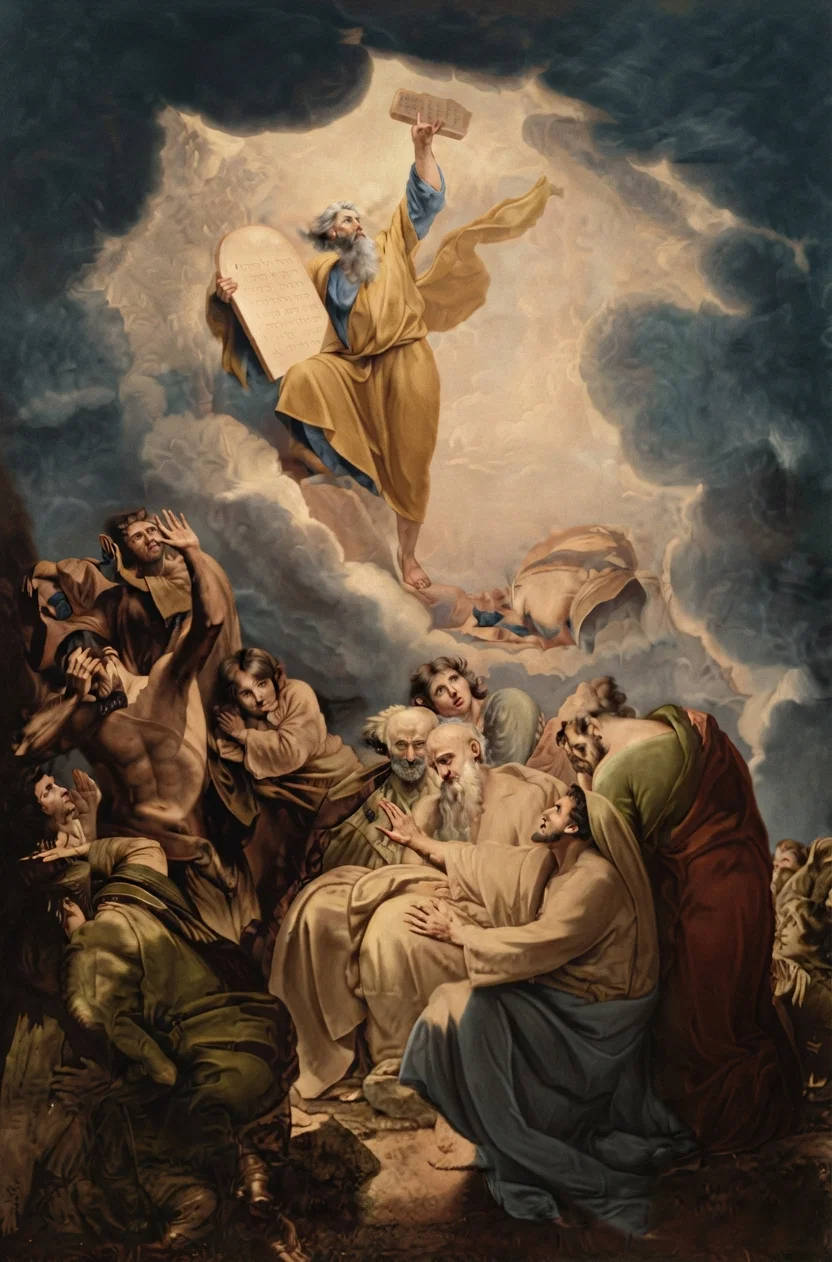
Benjamin West MOSES RECEIVING THE LAW AND COMMANDMENTS ON MOUNT SINAI
This first statement concerning the blessing and hallowing of the seventh day does not come in the form of a law. It comes rather in the form of a history of the institution of the day that God blessed and sanctified. But to show that there was a law concerning the seventh-day Sabbath before we come to Sinai, we have only to read the record in Exodus:
"Then said Jehovah unto Moses, Behold, I will rain bread from heaven for you; and the people shall go out and gather a day's portion every day, that I may prove them, whether they will walk in My law, or not. And it shall come to pass on the sixth day, that they shall prepare that which they bring in, and it shall be twice as much as they gather daily. . . . And when the dew that lay was gone up, behold, upon the face of the wilderness a small round thing, small as the hoar frost on the ground. And when the children of Israel saw it, they said one to another, What is it? for they knew not what it was. And Moses said unto them, It is the bread which Jehovah hath given you to eat. This is the thing which Jehovah hath commanded. Gather ye of it every man according to his eating; an omer a head, according to the number of your persons, shall ye take it, every man for them that are in his tent. And the children of Israel did so, and gathered some more, some less. And when they measured it with an omer, he that gathered much had nothing over, and he that gathered little had no lack; they gathered every man according to his eating. And Moses said unto them, Let no man leave of it till the morning. Notwithstanding they harkened not unto Moses; but some of them left of it until the morning, and it bred worms, and became foul: and Moses was wroth with them."
"And they gathered it morning by morning, every man according to his eating: and when the sun waxed hot, it melted. And it came to pass, that on the sixth day they gathered twice as much bread, two omers for each one: and all the rulers of the congregation came and told Moses. And he said unto them, This is that which Jehovah hath spoken, To-morrow is a solemn rest, a holy Sabbath unto Jehovah: bake that which ye will bake, and boil that which ye will boil; and all that remaineth over lay up for you to be kept until the morning. And they laid it up till the morning, as Moses bade: and it did not become foul, neither was there any worm therein. And Moses said, Eat that to-day; for to-day is a Sabbath unto Jehovah: to-day ye shall not find it in the field. Six days ye shall gather it; but on the seventh day is the Sabbath, in it there shall be none. And it came to pass on the seventh day, that there went out some of the people to gather, and they found none. And Jehovah said unto Moses, How long refuse ye to keep My commandments and My laws? See, for that Jehovah hath given you the Sabbath, therefore He giveth you on the sixth day the bread of two days; abide ye every man in his place, let no man go out of his place on the seventh day. So the people rested on the seventh day." Ex. 16:4-30.
The first part of the foregoing text affirms that the Lord will give the manna a day's portion at a time, that He "may prove them, whether they will walk in My law, or not." Thus it is shown that God had a law in that time. Otherwise how could He prove whether they would walk in it or not? Then we find that this law had the Sabbath commandment in it, for it was the Sabbath over which He proved them. They tried to keep the bread on the six working-days, but could not, for it became foul and bred worms; but it kept through the seventh day all right. And when some of the people went out on the seventh day to find the manna, they found none. Then it was that Jehovah, according to the text, "said unto Moses, How long refuse ye to keep My commandments and My laws? See, for that Jehovah hath given you the Sabbath, therefore He giveth you on the sixth day the bread of two days; abide ye every man in his place, let no man go out of his place on the seventh day."
Thus we see that the text affirms that Jehovah had given them the Sabbath. And it was by a constantly occurring miracle every day, and that right over the Sabbath itself, that He proved them, whether they would walk in His law or not. Nothing could be made plainer than the Scriptures make this truth. For forty years the children of Israel wandered in the wilderness, and for forty years there was a constant miracle every day to impress them with the Sabbath truth, and they could not make the seventh day in that time come anywhere in the week except on the seventh day. Some of them tried it by trying to keep the food on other days, but it would not keep. Andsome of them went out on the seventh day, but they could not find anything. It would seem that a scripture given in such plain language ought to be clear enough to satisfy any one. The individual who thinks to tell the Lord in the judgment-day that he could not understand such plain words, will hardly have power to open his mouth; he will be speechless.
In a few weeks after the giving of the manna, and this test of Sabbath observance, to see whether they would keep God's law or not, the Ten Commandments were proclaimed from Sinai. And in the very center of those commandments we find the command of the Sabbath. But when we read that commandment, we do not find it more definite than these texts that we have already examined. Indeed, it is in strict accord with the texts already given, thus showing conclusively that God required the observance of the Sabbath all through the ages before, as one of His great moral precepts. The Sabbath command reads:
"Remember the Sabbath day, to keep it holy. Six days shalt thou labor, and do all thy work; but the seventh day is a Sabbath unto Jehovah thy God: in it thou shalt not do any work, thou, nor thy son, nor thy daughter, thy man servant, nor thy maid servant, nor thy cattle, nor thy stranger that is within thy gates: for in six days Jehovah made heaven and earth, the sea, and all that in them is, and rested the seventh day: wherefore Jehovah blessed the Sabbath day, and hallowed it." Ex. 20:8-11.
It is easy for any one to see that this commandment points right back to creation. It refers directly to the same creative facts that are pointed out in the text quoted from the second chapter of Genesis. The testimony is unmistakably clear that the Sabbath is a memorial of creation, and thus points to Jehovah as the Creator of all things. The Sabbath, then, serves a great purpose. It is not given that men may merely have physical rest; but it is that they may have the seventh day of each and every week to devote exclusively to communing with their Creator, and to keeping alive in their minds that they worship a living God, that can create, and not a dead idol, that can do nothing. If men would take time to learn the real purpose and character of the Sabbath, they would not have so much trouble concerning it. They would certainly see that it is of such a nature that it could not be changed without blotting out all the past and doing all the work of creation over again.
When God gave that Sabbath law to Moses on Sinai, He wrote it on tables of stone. It is the only part of the Bible that was distinguished by being written on such a solidly enduring substance. And observe, too, that God wrote this law Himself. It is the only part of the Bible that He took the pains to write with His own finger. God inspired men to write all the rest of the Sacred Book; but when it came to His law, in which was His holy Sabbath, He wrote it Himself. Men had better think twice before they talk of changing a law that was given in such a way, and by the direct hand of the Infinite Himself. It is well to think of these facts when talking of the change of the Sabbath.
In the time of ancient Israel the Sabbath was a test to prove whether men would walk in the law of God or not. And in like manner it is a test to-day. There is no evading the issue. Men may quibble; but truth that is so plain can not be set aside.
T.

Science and the Sabbath

MAN is a forgetful creature, and yet he can remember if he will. And because man is prone to forget, God has used devices to aid and refresh his memory.
"God created the heaven and the earth." God is the origin of creation. So weighty a truth ought not to be in danger of forgetfulness; but the very fact that a memorial has been given, shows that there is danger that it will be forgotten.
And to forget it is to forget God.
The Sabbath is the memorial by which God would have kept in mind what He has done for man, and, therefore, what He is to man. That man is prone to forget all this, is clearly shown by the fact that even with a memorial, some deny a divine origin to creation, and others are inclined to explain away all that would be worthy of divinity by substituting a humanly easier way.
A noted scientist, for example, who claims the name of Christian, asserts that higher forms of life are derived from lower forms, and the old notion—mark the words, "old notion"—of a special creation is exploded once and forever.
But so long as the Sabbath remains, some will remember that of which it is a reminder, and will believe in the special creation of God. Truly the Sabbath is needed as a safe bulwark against those sophisms which would remove God as the real Creator of the heaven and the earth.
"God created the heaven and the earth." Nature itself voices forth the truth of this text. Nature manifests its divine origin. Whether we look at the dewdrop on some wayside plant, or gaze enraptured at the stars in the depths of heaven, we see revealed mysteries too deep for the mind of man. In the humble calyx of a flower or the shining glory of the skies, we see harmonies of color and splendors of light that no art of man can other than faintly suggest.
The constitution of matter can not be adequately explained. The transfer of energy is as yet only guessed at. Gravitation, in its causal and essential nature, is a baffling mystery. Life is a perfect riddle.
Through the microscope, we see the infinite in the perfection of the minute. Through the telescope, we see the infinite in the perfection of the immeasurably ponderous and great.
In the constancy of nature's work, in the harmonious working of all her complex parts, in the adaptions of means to the end, in conformity to type, in subjection of lower to higher,—in manifold ways, nature voices the truth of revelation that God is the origin of creation. The work testifies of the Worker.
But nature must be read in order to teach of the Creator. And not all are students of nature in any large sense. Not all men are scientific. Some are deficient in the lore of nature and science. And because it would be so, God instituted the Sabbath as a memorial.
God has never left the knowledge of Himself dependent upon a man's scientific attainments. The record of creation itself, which is the first great chapter in all science, is so given in the pages of the Scriptures that it may be understood by even a child. This is true of all God's revelation.
Even those scriptures which at one stroke illumine the most profound science, can be understood in their great and blessed essentials by even the simple-minded. When the Word speaks of worlds, suns, stars, or the depths of space, the appeal is made to every man who reads, be he wise or less wise in the things of science.
If, then, a man be never so ignorant of science, provided he intelligently observe the Sabbath of God, he has in that the great key to all scientific knowledge whatsoever. Observing that day, he has therein the great knowledge that will illumine all other knowledge. No man can long observe piously the day that memorializes creation, without becoming intelligent with reference to that creation. At the very first, he learns that the Sabbath commemorates the creative work. He knows at the start that God made all things. He has the alpha and omega of all science; and in time, by the aid of the Sabbath knowledge, he can build in all the rest.
And whatever of truth he learns with reference to the creation, the Sabbath will continue to be to him a memorial of all that he has thus learned.
And eternally it will call God to mind. And not only will it call God to mind, but it will call Him to mind as the Creator, as the One of all power. Thus it will be realized that God, who made and cares for all things, has pledged His power to His creatures for their preservation and happiness.
Then, when a man hears the word to Abraham, "I am the almighty God; walk before Me, and be thou perfect," he will realize that the might is the pledge and assurance of the perfection. And thus comes the word of Christ to all disciples in any age, "All power is given unto Me in heaven and in earth. Go ye therefore, and teach all nations . . . and, lo, I am with you alway, even unto the end of the world."
Knowing these things, a man may not only sing but know that "the hand that bears creation up can guard His children well." In the deepest fibers of his soul there sounds a harmony of trust.
"The God who rules on high, And all the earth surveys,— Who rides upon the stormy sky, And calms the roaring seas,— This awful God is his, His Father from above; Who sendeth down His heavenly powers To keep him by His love."
And thus, with the prophet of old, he cries out in exultant faith, "Ah Lord God! behold, Thou hast made the heaven and the earth by Thy great power and stretched out arm, and there is nothing too hard for Thee." Jer. 32: 17.If such a man knows anything of science or nature, he knows more of God than of either. He has more faith in the Creator than he has in creation. He sees in creation the evidences of God's power, but trusts the God of that power. He knows how great God is, since He "hath measured the waters in the hollow of His hand, and meted out heaven with the span, and comprehended the dust of the earth in a measure, and weighed the mountains in scales, and the hills in a balance." Isa. 40: 12.
He knows that it is this Mighty One who brings out the host of heaven in mathematical order, that calls them all by names by the greatness of His might; and that because He is strong in power, not one fails. Isa. 40: 26.
He knows, too, that heaven and earth may pass away in obedience to the word of that Mighty One, but that His Word will not pass away. Luke 16: 17.
He feels that all things are within the control of Him who made and upholds all things; and amidst the seeming crash of worlds, he can look up and say: "God is our refuge and strength, a very present help in trouble. Therefore will not we fear, tho the earth be removed, and tho the mountains be carried into the midst of the sea; tho the waters thereof roar and be troubled, tho the mountains shake with the swelling thereof."
It is thus that the intelligent, pious Sabbath observer must regard the Creator of all things. God is all this to him because He made and preserves all things. And the Sabbath, being a memorial of God's creative and beneficent work, is to such a man the sign of all that God is to him.
Thus viewed, the Sabbath becomes an intensely religious thing; for it constantly applies the great truths of God and His power to the heart and conscience of man. And man, as he observes the day, testifies that he trusts in that power which made all things. He shows that he believes, with Christ, that man shall not live by bread alone, but by every word that comes from God's mouth. In the Sabbath he has first of all accepted the principle that the word of God gave existence to the world; and by its observance, he now further shows that he is consistent enough to believe that the word, if obeyed, can still give him life.
Thus to him the Sabbath is an effectual bar against all forms of infidelity whatsoever. It teaches him the correct idea of God. And it teaches him the correct idea of nature. And furthermore, it teaches him the right idea of God in nature.
Teaching him the right idea of God, it teaches him true religion. Teaching him the right idea of creation, it teaches him true science. And teaching him the right idea of God in nature, it teaches him true and sound philosophy.
Therefore the Sabbath becomes to man the handmaid of all religion, science, and philosophy. Whatever God is and whatever nature is, of that the Sabbath is a memorial and a sign. And as we observe it, it will be a constant reminder of all that these things are to us, and a testimony of what we have experienced.
Thus the Sabbath becomes a means by which to apply the knowledge of God to the soul. It becomes a school-teacher. It stands like a pillar to mark the true road into that knowledge that saves, for it teaches the right knowledge of God, which is life eternal.
R.
Continue reading: The Increasing Vices of Sodom