Your ShelfYour Projects

Signs of the Times, Vol. 22, No. 12.

GOD AND CÆSAR

Signs of the Times

Mar 19, 1896

Pacific Press Publishing Company · Oakland, California · Mar 19, 1896

GOD AND CÆSAR
TO GOD? OR TO CÆSAR?

TO GOD? OR TO CÆSAR?

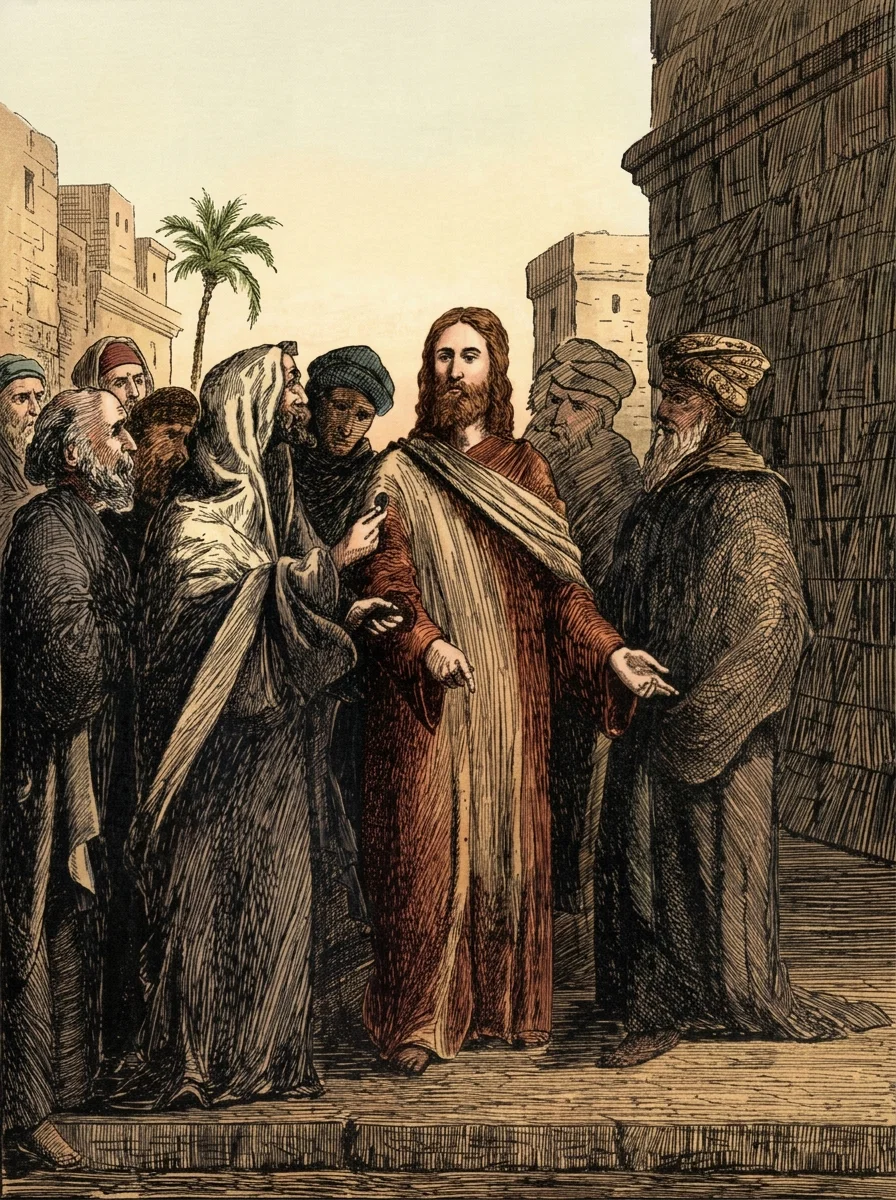
When the Jews sought to entrap Jesus into committing himself into opposition to civil government, by asking him if it was lawful to give tribute unto Cæsar, he asked them to show him the tribute money, and they brought him a penny. “And he saith unto them, Whose is this image and superscription? They say unto him, Cæsar’s. Then saith he unto them, Render therefore unto Cæsar the things which are Cæsar’s; and unto God the things that are God’s.” Matt. 22: 19-21.
The completeness of this answer was recognized even by the enemies of Jesus; for when they had heard it, “they marveled, and left him, and went their way.” It settled the question as to what belongs to Cæsar, or human governments, and what to God. Everything that belongs to Cæsar is to be given to him, and that which belongs to God is to be held as sacred to him. That is but simple justice; no one can gainsay the statement that every one should have what belongs to him.
From this distinction, what may we learn as to ourselves and our service? The Scriptures furnish the answer, by telling us to whom we belong. The apostle Paul but repeated the statement of Christ, when he said, “Render therefore to all their dues; tribute to whom tribute is due; custom to whom custom; fear to whom fear; honor to whom honor.” Rom. 13: 7. Yet he did not include himself and his service as belonging to Cæsar, and to be rendered to him; for when he was in the hands of Cæsar’s soldiers, on the way to Rome, he said, “There stood by me this night the angel of God, whose I am, and whom I serve.” Acts 27: 23.
Writing to the church at Corinth, and to us all as well, he said, “What! know ye not that your body is the temple of the Holy Ghost which is in you, which ye have of God, and ye are not your own? for ye are bought with a price.” 1 Cor. 6: 19, 20.
If we are not our own, whose are we?—Why, we belong to Him who has bought us. But that was not Cæsar nor any other earthly name. No; “for whether we live, we live unto the Lord; and whether we die, we die unto the Lord; whether we live therefore, or die, we are the Lord’s.”
We are the Lord’s because he bought us with a price, and that price was his life. For we were “not redeemed with corruptible things, as silver and gold,” “but with the precious blood of Christ, as of a lamb without blemish and without spot.” 1 Peter 1: 18, 19. He “gave himself for us.” Titus 2: 14.
Jesus gave his life for us. He gave himself for us in death, and he ever liveth to make intercession for us. Therefore, since he died and lives for us, it necessarily follows that “whether we live therefore, or die, we are the Lord’s.” The service of our lives belongs to him, and if we die, it is to be only to his glory, and not to that of any man or any society of men. All is to be to the glory of God, whose we are.
The Christian, therefore, may, at the demand of the state, give it his money, for that bears the image and superscription of the state. But he can not give himself to the state, for he bears the image of God. He belongs to God, who has bought him, and he must render unto God that which is God’s. To give himself to the state would be to rob God.
It is true of all men that they belong to God; but it is true of Christians in a special sense, since in their case the purchase has been acknowledged and sealed. Not being their own, they are not at liberty to dispose of themselves. God has the sole right to direct their time and their actions. No Christian, therefore, can enter into any service which will put him, as in the case of a soldier, absolutely under the control of some “superior.” To say that the giving of one’s self to the state, for it to have absolute control of one, is service to God, is to make the state synonymous with God, which is paganism.
Let no one imagine that this means rebellion or any manner of opposition whatever to earthly governments. Far from it. The God whom we serve is “the very God of peace,” and therefore we can serve him only by living quiet and peaceable lives. Earthly governments may make demands upon us that are obviously unjust, but we are not judges, nor are we sent to reform government; we must submit even to unjust demands, and not do or say anything to the prejudice of the government or its officers. But when it demands ourselves, when it claims supreme authority as to time and service, then we are to remember whose we are. We can not give ourselves to the state, not because such a demand interferes with our rights or convenience, but because we are not our own to give.
He who best serves God, best serves man. It is becoming more and more common to reverse this order, and to make the service of God consist solely in a service to man. Butit is wrong. God is first, and he alone can tell us how we can serve our fellow-men the best. He who puts man first, will fail to serve either man or God. The correct answer to the question, “Whose are you?” will enlighten us as to our duty in many difficult situations.
E. J. W.

A TRUE AND FALSE THEOCRACY.

BY G. E. FIFIELD.
“For unto us a Child is born, unto us a Son is given; and the government shall be upon his shoulder; and his name shall be called Wonderful, Counselor, The mighty God, The everlasting Father, The Prince of Peace.” Isa. 9:6.
As Israel rejected God as king, and rejected the counsel of his prophets, while still assuming the right to rule in religious things and command the consciences of men, that kingdom was gradually transformed from a true to a false theocracy.
A true theocracy is the government of God. A false theocracy is the government of haughty men, who, assuming that they are sitting in the seat of God, and ruling in the place of God, and that they infallibly know the divine will, blasphemously seek to enforce upon all men their ideas of God’s law.
A true theocracy is the highest possible ideal of government; it is, therefore, the government of heaven, and will be the government of the redeemed world.
God always knows the best thing for the good and highest happiness of all his creatures, and he, being love itself, loves all with an impartial love. His rule is the rule of infinite wisdom combined with infinite love. This is absolutely ideal.
A false theocracy is the most terrible form of despotism, for it is the rule of erring, wicked men, who, assuming that their own narrow ideas are the will of God, and that therefore obedience to them is necessary to salvation, enforce these ideas with merciless severity upon all. They stop not with seeking to control the outward acts, but they thrust themselves into the sacred inner sanctuary of the soul, seeking to make themselves lords of the inmost thoughts; and this they do because they claim to be the official administrators of that divine law which extends to the thoughts and intents of the heart.
True theocracy is the government of infinite, all-embracing love. False theocracy is the government of boundless, ambitious, and towering human selfishness, envy, and hatred, assuming the forms of love to better gain their hellish end,—the subjugation of the conscience and the soul. The selfishness of those engaged in this work is disguised even to themselves, so that they too are deceived, and the more sincere they are in their error, the more mercilessly they enforce their despotic will, believing it to be the will of God.
The true theocracy sets men free by writing its laws of love by the divine love-finger in the heart, so that men delight to do the divine will. Delighting to do what the law requires, because it is what their own conscience dictates, they can do what they please—what they delight in. They are therefore free. Mind, and heart, and conscience are cultivated to the highest possible point, and the whole man is developed into perfect righteousness.
A false theocracy rules by arbitrary force, which can never reach the heart or transform the soul. It terrifies people into an external submission, and teaches them that if they thus submit they are righteous. It crushes the individual conscience, and outlaws it entirely, assuming to decide for it in each case as to what is right and what is wrong, and then to simply compel submission. Such rule can only make hypocrites, who externally conform to the forms of religion, but who within are full of hatred and all evil.
The scribes and Pharisees and hypocrites of Christ’s time were the logical and only possible fruit of this false theocratic tree.
Jesus pronounced a woe upon them because they made clean the outside of the cup and the platter, but within they were full of extortions and excess. He said they were whited sepulchers, which indeed appeared beautiful without, but within were full of dead men’s bones and all uncleanness.
With direct reference to these Pharisees and their false theocratic government that made them what they were, Jesus says: “A good tree can not bring forth evil fruit, neither can a corrupt tree bring forth good fruit. Every tree that bringeth not forth good fruit is hewn down.” John the Baptist also said of them: “Now also the ax is laid unto the root of the trees; every tree therefore which bringeth not forth good fruit is hewn down, and cast into the fire.”
That theocracy having become a false theocracy, bearing only false fruit, was to be destroyed. The prophet had spoken of this before: “Thus saith the Lord God: Remove the diadem, and take off the crown; this shall not be the same. . . . I will overturn, overturn, overturn it; and it shall be no more, until he come whose right it is; and I will give it him.” Eze. 21:26, 27.
Here it is plainly declared that with all the overturning of earthly governments, there shall be no more a true theocracy until Jesus Christ comes in glory, and then the kingdoms of this world shall become the kingdom of our Lord and his Christ. Rev. 11:15. Or, as Daniel tells it, the kingdoms of force, of intrigue, of arbitrary power, shall be as the chaff of the summer’s threshing floors, and the wind carried them away, that no place was found for them, and the kingdom of Christ, set up without human hands, filled the whole earth. See Daniel 2.
Any attempt that men may make, therefore, to set up a kingdom of Christ, or a government of God on this earth, before the second coming of Christ, will result only in a false theocracy, with all its crushing despotism, and bearing its only possible fruit of phariseeism and hypocrisy.
The church leaders of the fourth century tried it. They said that they were going to set up the kingdom of Christ on earth. They quoted with glowing enthusiasm all those texts which speak of beating the swords into plowshares, and of not learning war any more. They said that on the very bells of the horses would be written, “Holiness to the Lord.” When their scheme was completed, instead of the kingdom of Christ, it was the kingdom of Satan, who, in the person of the theocratic lords,—the popes,—ruled for centuries, putting to death the true children of God, and crushing out thought and conscience, until the world was darkened down into a night of a thousand years, even to-day known as the Dark Ages.
The modern Christian citizenship movement, and the effort of some to usher in the kingdom of Christ “through the gateway of politics,” can, if carried out, result only in the same thing,—a second false theocracy, the image of the Papacy. This will be the great delusion of the last days.
People are everywhere forgetting that Christ’s kingdom is set up fully on this earth only when he comes, and that, too, without human hands. There are many efforts, all coalescing in one great scheme, to set up his kingdom for him. When they ask us to associate and to organize with them for this purpose, we have to say, in the very language of Scripture: “Associate yourselves, O ye people, and ye shall be broken in pieces.” “Say ye not, A confederacy, to all them to whom this people shall say, A confederacy!” but rather say, “I will wait upon the Lord, that hideth his face from the house of Jacob, and I will look for him.” See Isa. 8:9–17.

Christ Ruling Within.

Yet all this time since the theocracy was destroyed, there is a sense in which Christ’s kingdom has been in this earth.
When Christ was upon earth, he preached the good news of the kingdom, and when it was demanded when that kingdom should come, he answered, “The kingdom of God cometh not with observation [or outward show]; neither shall they say, Lo here! or, lo there! for, behold, the kingdom of God is within you.” Luke 17:20, 21.
It has been said that wherever there beats a loyal British heart, there is the kingdom of Great Britain. It is even more true that wherever there beats a heart loyal to King Jesus, a heart in which Christ has been enthroned Prince of Peace, there is the heavenly kingdom. By the “new birth,” the birth of the Spirit, Christ is born within. As Paul says, “The first man [that is, the result of the first birth], is of the earth, earthy; the second man [the result of the new birth], is the Lord from heaven.” See 1 Cor. 15:45–47.
Every true Christian can say, with almost unspeakable joy, “Unto us a Child is born, unto us a Son is given, and the government shall be upon his shoulder.” Learning more and more each day to cast all their care upon him, and to let him rule in each minutest detail of the life, they will have such splendid experiences in him that spontaneously, out of a full heart, they will name him, “Wonderful, Counselor, The mighty God, The everlasting Father, The Prince of Peace.” Isa. 9:6.
Thus Christ is ruling even now in the hearts of his people. By the mighty power of his love he is winning his way in the individual heart, and gaining subjects who will even now submit to his mild will. When these are finally gathered out of every nation and kindred and tongue and people, and marshaled into the city eternal, it will be no arbitrary force that will put Christ on the throne and compel all to bow down. Each one before coming there will have enshrined Christ within, King of kings and Lord of lords, and will learn in every case to say, “Not my will, but thine be done.”
Christ will, by his life of love, and his death of immaculate love, have won for himself first place next the Father in the everlasting kingdom of love. When the redeemed, gathered out of every nation, behold him, they will recognize him as the King, and say, “This is the Lord, we have waited for him.” They will cast their crowns at his feet, andcrown him Lord of all. Dear reader, may we be there; and that we may, may we learn now to let him rule and reign in the heart and life.

THE GOLDEN RULE AND THE RIGHTS OF CONSCIENCE.

BY C. P. BOLLMAN.
The most comprehensive law ever given to direct men in their conduct toward their fellow-men is the Golden Rule: “All things whatsoever ye would that men should do to you, do ye even so to them; for this is the law and the prophets.” Matt. 7:12.
This rule obeyed would reduce human woe to the minimum, for selfishness is directly accountable for very much of the misery incident to our selfish natures. “Man’s inhumanity to man makes countless millions mourn.”
The thought of doing as we would be done by, runs all through the Gospel. It is as plainly taught in the parable of Matt. 18:27-35 as in the Golden Rule itself; and the conclusion shows that eternal life depends upon loyalty to this principle. Referring to the fate of the unforgiving servant, our Lord says:—
“So likewise shall my heavenly Father do also unto you, if ye from your hearts forgive not every one his brother their trespasses.” Matt. 18:35.
Nor is this principle taught alone in God’s written word. The Creator implanted love of justice in the very nature of man, a trace of which still remains; and every man feels that he ought to be free in matters of conscience, and he knows that every other man has the same natural right to soul liberty. Hon. Richard M. Johnson, in his capacity as Chairman of the House Committee of Post Offices and Post Roads, in his matchless report to the National House of Representatives on Sunday Mails, March 4, 1830, expressed this truth in these ringing words:—
The framers of the Constitution recognized the eternal principle that man’s relation with his God is above human legislation, and his rights of conscience inalienable. Reasoning was not necessary to establish this truth; we are conscious of it in our own bosoms. It is this consciousness which, in defiance of human laws, has sustained so many martyrs in tortures and in flames. They felt that their duty to God was superior to human enactments, and that man could exercise no authority over their consciences. It is an inborn principle which nothing can eradicate. The bigot, in the pride of his authority, may lose sight of it; but strip him of his power, prescribe a faith to him which his conscience rejects, threaten him in turn with the dungeon and the fagot, and the spirit which God has implanted in him rises up in rebellion, and defies you.
This consciousness is doubtless more acute in the Christian than in other men, for in such an one it springs not only from a native sense of his own right to liberty, but from the conviction that God has a right to his service, and to the undivided allegiance of his soul. But, as Mr. Johnson has so well said, it is innate in the human breast. Bruno, the Italian freethinker, met death at the stake even more heroically than did Servetus, the Christian victim of the intolerant Calvin; and Thomas Paine, probably the most noted deist of modern times, said:—
Man worships not himself, but his Maker; and the liberty of conscience which he claims, is not for the service of himself, but of his God. In this case, therefore, we must necessarily have the associated idea of two beings; the mortal who renders the worship, and the immortal Being who is worshiped. . . . Who, then, art thou, vain dust and ashes, by whatever name thou art called, whether a king, a bishop, a church or state, a parliament, or anything else, that obtrudest thine insignificance between the soul of man and his Maker? Mind thine own concerns. If he believeth not as thou believest, it is a proof that thou believest not as he believeth, and there is no earthly power can determine between you.
Our own matchless Declaration of Independence recognizes this principle in the words, “All men are created equal, and are endowed by their Creator with certain unalienable rights.” Thus, notwithstanding the fact that sin has so darkened the human mind, a sufficient trace of the Golden Rule remains in the human heart to cause all classes of men, as we have seen, to recognize it, at least theoretically, in its application to the rights of conscience. But only he who has the Spirit of Christ is capable of a practical application of this principle. The Golden Rule is the expression of the character of Christ, and he who finds himself unwilling to cheerfully award to every other individual equal liberty of thought and action with himself, certainly has need that some one teach him again the first principles of the Gospel of the Son of God. In other words, “If any man have not the Spirit of Christ, he is none of his.”

CHRIST'S TEACHING AND EXAMPLE.

BY J. H. D.
CHRIST, the Son of God, was sent to this world to live in the flesh, that fallen humanity might know the power of God in the flesh to meet sin in its various forms. He took upon him sinful flesh and human weaknesses, to show man that sin could be overcome in this world. He took all the liabilities of man to sin, that he might reveal to sinful man the power of the divine nature. See Gal. 2:20; Eph. 3:17; Col. 1:27.
In every true conversion, therefore, Christ is enthroned within to direct and control his own. As he directed the human nature, which he took when he came to the earth nearly two thousand years ago, so will he direct every human nature that will fully surrender all to his keeping and directing power.
When Jesus was incarnate, the Father bore testimony concerning him, saying, “This is my beloved Son, in whom I am well pleased.” Matt. 17:5. He is the believer’s Instructor, and we are admonished to hear him when he speaks. Again the word of truth says, “He that saith he abideth in him ought himself also so to walk, even as he walked.”
These principles apply as much to the Christian’s relations to civil powers as they do to individual and private duties. Jesus dwells in the heart by his representative, the Holy Spirit. By his Spirit and the word we may know our relationship to everything in this world. By a close study of the life of Christ we may be able to know just how we should relate ourselves to civil governments.

Christ’s Teaching.

We will first notice the Saviour’s teaching in regard to the relation the Gospel sustains to civil government. We can do this in no better way than to note his saying in regard to Gospel freedom: “And ye shall know the truth, and the truth shall make you free.” John 8:32. But by reading Eph. 1:13 we find that the “word of truth” is the Gospel; therefore it is the Gospel of Jesus Christ that makes man free. Again he says, “If the Son therefore shall make you free, ye shall be free indeed.” John 8:36. Here he speaks of himself as being the source and means of freedom, which would make himself the power of the Gospel. He had this freedom, and is willing, yea, anxious, to give it to all who will come to him.
With this freedom he taught all to recognize earthly governments as having authority; and, as far as consistent with the principles of freedom in Christ, to be obedient to the civil authorities.
When the civil authorities came to arrest him, his companions were disposed to resist. “When they which were about him saw what would follow, they said unto him, Lord, shall we smite with the sword?” Luke 22:49. But Jesus bade them to suffer it without resistance, although there was no real cause of the arrest. A word in favor of this resistance of the law would have been all that was needed for his friends to have used the sword and have fought for their Master until they released him, or they themselves were cut down in death. But Jesus taught them to recognize civil government, and to obey its officers, even when they were in the wrong. Not that they should obey the laws of the civil power when contrary to God’s law, but they should be subject to the civil authorities when apprehended for violating the civil statute for conscience’ sake.
When he was asked, “Is it lawful to give tribute unto Cæsar, or not?” he replied, “Render therefore unto Cæsar the things which are Cæsar’s; and unto God the things that are God’s.” Matt. 22:17, 21. In all his teachings he advocated this truth, of recognizing the power of governments, and rendering to them their just dues.

His Example.

The example of Jesus was in perfect harmony with his teachings. He not only taught his disciples to pay tribute, but told Peter to take the money he received from the mouth of the fish and “give unto them for me and thee.” See Matt. 17:27. He paid his own taxes, and thus upheld the authority of the civil power.
When he was in the garden pleading for strength to bear the trial just before him, when every disciple had forsaken him, he had to meet the officers of the civil power. “And they that had laid hold on Jesus led him away to Caiaphas the high priest, where the scribes and the elders were assembled.” “Then did they spit in his face, and buffeted him; and others smote him with the palms of their hands, saying, Prophesy unto us, thou Christ, Who is he that smote thee?” Matt. 26:57, 67, 68.
He was submissive to the authority, and “opened not his mouth.” He knew he was innocent of all the charges, and might have called to his assistance a legion of angels, yethe did not. He went to the courts, to the prison, and to the cross, yet he sinned not, neither was guile found in his mouth. He was true to his Father and to his mission, and at the same time he was true to the civil power, as far as that power was true to the principles which God had given it to uphold. When it asked him to deny his mission in the plan of salvation, he refused. When it asked him to die because he refused the other, he refused not, but went forward to the cross.
These principles and example of Christ should guide us to-day in all our relationship with the civil government. Let us study carefully his life, that we may know what we should do in every particular.

RELATIONS OF CHRISTIANS TO CIVIL GOVERNMENT.
BY W. N. GLENN.
Had man never sinned, there would have been no use for that species of social regulation known as civil government. The difference between the government of God and that of the civil power is that God governs by love, the civil ruler by force. The government of God is spiritual and eternal, while civil government is temporal and temporary. Behind all civil authority is the sword as the ultimate resort. Man became a sinner because he refused to be governed by the law of love, as designed by the Almighty. But, when the plan of salvation gave a new probation to the race, there must needs be some kind of government, in order that there might be some measure of security in society during the probationary period. And this improvised government, or the temporary expedient, must needs be a government of physical restraint, from the fact that man had refused to be controlled by other means. The murder of Abel by his brother Cain shows that even the right to life would not be voluntarily respected by sinful man.
Aside from the positive assertion that “the powers that be are ordained of God” (Rom.13:1), we have the example of the government of Israel. When God brought his people out of Egyptian bondage, and would make them a “peculiar treasure” unto himself, “above all people,” he gave them a civil government for the regulation of their temporal affairs, in addition to the moral law and regulations for religious services. Again we have a most emphatic illustration in the kingdom of Babylon. When Israel, under the government which God had given them in detail, became “worse than the heathen” (2 Chron. 33:9), the Lord gave them into the hands of the heathen king Nebuchadnezzar. Although this king took the holy vessels from the temple of God at Jerusalem and placed them in the house of his god at Babylon, yet the Lord made him ruler over all the earth. Dan. 2:37, 38.
These instances are sufficient (altho there are many others) to show that civil government is an ordinance of God, and to show that it is ordained without reference to religion,—without reference to the religious convictions of the people or of the ruler. And this fact also shows that civil government is but a temporary arrangement for the preservation of a measure of order during the probation of a sinful world.
In view of these facts, what are the relations of Christians to civil government? Answer—Christians will of course view it just as God does; they will recognize it, and honor it, without reference to the religion of the people or the religion of the ruler. A Christian is a follower of Christ, and he recognized the civil government of Pagan Rome. He enjoined the people to render unto Cæsar the things which were Cæsar’s, and he did not resist the power of the civil government even to save his life, altho every step in his arrest and trial was illegal, and the judge who gave sanction to his execution had previously pronounced him innocent of the charges brought against him.
The apostle Paul is very explicit as to the duty of the Christian toward civil rulers. He writes as follows to the church at Rome: “Let every soul be subject unto the higher powers. For there is no power but of God; the powers that be are ordained of God. Whosoever therefore resisteth the power, resisteth the ordinance of God; and they that resist shall receive to themselves damnation. For rulers are not a terror to good works, but to the evil. Wilt thou then not be afraid of the power? do that which is good, and thou shalt have praise of the same; for he is the minister of God to thee for good. But if thou do that which is evil, be afraid; for he beareth not the sword in vain; for he is the minister of God, a revenger to execute wrath upon him that doeth evil. Wherefore ye must needs be subject, not only for wrath, but also for conscience’ sake. For, for this cause pay ye tribute also; for they are God’s ministers, attending continually upon this very thing. Render therefore to all their dues: tribute to whom tribute is due; custom to whom custom; fear to whom fear; honor to whom honor.” Rom. 13:1-7.
This is the theory of civil government from the standpoint of the Spirit of God. The Christian will view it in the same light, and relate himself to it accordingly. He will so far interest himself in the welfare of rulers as to pray for them—“for kings, and for all others in authority.” But while the foregoing is the theory of civil government, as showing the purpose for which it was ordained, it is a patent fact that many times civil rulers have abused the power placed in their hands and perverted the government from its legitimate sphere. For this reason God has overturned the greatest of them, and in his providence others have taken their places.
For this reason also God’s people have been brought into conflict with civil government many times. When the civil government promulgates laws requiring the people to transgress the law of God, he has repeatedly sustained his servants in their total disregard of such laws. But they are not to resist the power, they are to submit to the consequences, and leave the matter of vindication in the hands of the Lord. In such cases we have the example of Daniel when he was doomed to the lions’ den for disobeying the king’s decree; also the example of Meshach, Shadrach, and Abed-nego, when they were consigned to the fiery furnace for a like offense. We have also the example of Peter and other apostles when they suffered scourging and imprisonment rather than to obey the mandate of the Jewish council not to preach any more in the name of Jesus of Nazareth. Their answer was, “We ought to obey God rather than men;” and this position is good for Christians for all time. They are always to obey the civil government unless such obedience involves disobedience of the law of God. Peter gives us this further exposition of the mind of the Lord: “Submit yourselves to every ordinance of man for the Lord’s sake: whether it be to the king, as unto them that are sent by him for the punishment of evil-doers, and for the praise of them that do well. For so is the will of God, that with well-doing ye may put to silence the ignorance of foolish men.” 1 Peter 2:13-15.
But what part may the Christian take in the civil government? We answer by asking, What part did Christ and his apostles take in the matter of civil government? The command of Christ is, “Follow me.” It is emphatically stated that the business of the civil ruler is the punishment of evil-doers. How much can the Christian do of that kind of work? His Master devoted all his time to the advancement of the kingdom of God, a restoration in the earth of a rule of love. He positively declined any part in judging the affairs of this life (Luke 12:14; John 6:15; 8:3-11); he would not even judge those who deliberately rejected his teaching (John 12:47). The principle inculcated by him is: “Bless them that curse you, and pray for them which despitefully use you. And unto him that smiteth thee on the one cheek offer also the other; and him that taketh away thy cloak forbid not to take thy coat also.” Luke 6:28, 29. And the apostle Paul gives inspired instruction as follows: “Thou therefore endure hardness, as a good soldier of Jesus Christ. No man that warreth entangleth himself with the affairs of this life.” 2 Tim. 2:3, 4.
The man who diligently follows these plain instructions will have little time or inclination for participation in the governments of this world, which are so soon to be “broken to pieces together,” and become “like the chaff of the summer threshing floors.”
Continue reading: THE LIMITS OF CIVIL GOVERNMENTS