[All questions to this department will be answered which to the editors will seem to minister to the good of the readers and to the mission of the paper. The same question can not be answered repeatedly in the same volume. The name and address must accompany question, not for publication, but as an evidence of good faith, and that answer may be made by letter if deemed advisable. It is well always to enclose a stamp for reply.]
2284.—Beginning of Months.
I met a minister recently who tried to show me a change in the Sabbath in the book of Exodus where it speaks of the beginning of months. Ex. 12:1-3. The heading of this chapter is that the beginning of the year is changed.
The heading, which is of course by man, is all right. We have no objection to that, but the beginning of the year and the beginning of months does not necessarily mean the beginning of a week. In fact, if the Lord wanted to point that out, why did He not say, This month shall be unto you the beginning of months, it shall be the first month of the year; and this shall be the beginning of weeks, it shall be the first of weeks to you? The very fact that the Lord does not mention that is certainly evident proof that there was nothing of the kind in it, and that is solid fact. The Lord was simply marking the beginning of Israel's years, and the beginning of years, as we know, has absolutely nothing to do with the beginning of weeks. Sometimes the week might begin with the year, sometimes it would not begin that way, even as with our own year at the present time. The use of such scriptures as that shows how tremendously hard pressed the Sunday cause is. If those who keep the Sabbath of the Lord were forced to use scriptures from which no honest inference could be drawn for the observance of the seventh day, they would be ridiculed out of existence, and ought to be.
The scripture is a part of a vision which the Lord showed to Ezekiel of the corruption that existed among God's children. First He showed him the abominations of the children of Israel worshiping the image of jealousy. Verse 3. Next where they were worshiping every form of creeping thing and abominable beast and various idols portrayed upon the walls. Verses 9-12. Then still greater abominations where the women were weeping for Tammuz, the Sidonian Venus, or goddess of love, the one representing female lewdness. And yet greater than that abomination even was where he found the very elders of the church worshiping the sun. The tabernacle opened toward the east, the altar and center of God's worship was toward the west. To worship the sun toward the east was to turn their backs upon the worship of God, and sun-worship in all ages has stood for the most abominable of all kinds of nature-worship. For that the judgments of God were visited upon them, and it is set forth in the 9th chapter what the judgment would be. The second verse represents the means that the Lord would use, the six men with slaughter-weapons in their hands; but before that work should begin, God sends another messenger who sets a mark upon the foreheads of the men that sigh and that cry for all the abominations. In other words, he seals them as His. They are stamped with the stamp of His own character so that the destroying angel shall not touch them. This chapter is also typical of the sealing work of God, mentioned in Revelation 7, and the destruction upon all those who are not sealed in the seven last plagues, set forth in Revelation 16.
2286.—Wearing Long Hair.
Did the Saviour wear long hair while on earth? 1 Cor. 11:14, 15.
1 Cor. 11:14, 15 has nothing to do with the question. We have no such expression of long hair elsewhere as is there recorded. It means hair dressed in a way that women do, in which great pains is taken so as to adorn themselves. The apostle does not refer to the instruction which the Lord gave to the Nazarites, that long hair should be worn. Absalom wore long hair (2 Sam. 14:26) and there is no reproof against his wearing it. God's instruction to the parents of Samson was that "no razor shall come on his head; for the child shall be a Nazarite unto God from the womb." Judges 13:5. The instruction concerning the Nazarites is that "all the days of the vow of his separation there shall no razor come upon his head: until the days be fulfilled, in the which he separateth himself unto the Lord, he shall be holy, and shall let the locks of the hair of his head grow." See Num. 6:1-5. In the pictures representing Jesus, He is represented as a Nazarite, one separated unto the Lord. For that reason we suppose the artists represent Him as having long hair; and such may have been the case.
2287.—The True Seventh Day.
(1) Where is your proof that Saturday is the actual seventh day of creation? (2) At what point or meridian on earth did this day commence and end? (3) If at the Garden of Eden, where on earth was this located? (4) Do Seventh-day Adventist people recognize the international date line or Greenwich time in dividing the day? If so, was this instituted by God or man? (5) If we are governed by the rising and setting of the sun, what about the poor Eskimos, who have souls the same as we? What are they going to do when they do not see the sun from November to February? (6) If you travel westward around the earth, observing strictly the seventh day, when you get around you find you are one day behind those who stayed at home. Are you justified in dropping a day so as to make it coincide with the seventh day of your friends, when Moses received the commandment that we must observe every seventh day, governing ourselves by the rising and setting of the sun?
1. Let us first say that Saturday does not coincide with the Bible day. The Bible day begins at sunset and ends at sunset. Saturday begins at midnight and ends at midnight. Let this always be understood in such connections, so when Saturday is spoken of as the seventh day, the day will be considered as beginning at sunset Friday and ending at sunset Saturday. There are a few simple events which clearly fix the identity of the seventh day. First, it matters not if the race had lost the reckoning of the days of the week—a preposterous thing—for the first twenty-five hundred years of Bible history, the Lord fixed it by the falling of the manna for forty years. See Exodus 16. There was no difficulty whatever for them to know the Sabbath of the Lord. That Sabbath which originated at creation was confirmed by the commandment from Sinai, not to remember a seventh day, or every seventh day, but the seventh day, on which God rested. If Israel had become so blinded to the simple truth as to forget the day of the Sabbath during the next fifteen hundred years of their history, they were set right by the life and teaching of Christ, who Himself observed the Sabbath, and of which Inspiration declares that the holy women who were with Him kept the Sabbath day according to the commandment. Since that time the whole world has been at one in regard to the day of the week. A noted antiquarian of London, William Jones, D.D., published not many years ago a chart of the week in which 160 languages and dialects were presented, with the names of the weeks, the number of days of the week, and the names of the days. These were languages from lands entirely separate, but the week is identical in all. 108 of the 160 languages call the seventh day by a term which indicates its holiness, the Sabbath day, "the day of rest to the heart," showing conclusively that the original day known in Noah's time has come down thru various languages of earth to the present time. Of this there can be no question.
2-4. As to just what point on the earth's surface the day began matters nothing. In all probability the face of the earth was altogether different before the Deluge than since. Peter tells us that the world, or cosmos, that then was perished. Out of the Deluge came the broken condition of the earth as we see it at the present time. Those that survived the Deluge kept the Sabbath still as it came to them in Asia. In God's providence some of them drifted eastward to the eastern shores of Asia, keeping the same day, and from time immemorial the day has been identical; one could travel westward from the eastern shores of the Eastern Continent to the western shores of the Western Continent and find himself in perfect harmony with all the countries thru which he passed in the numbering of the days. Crossing the narrow ocean, in God's providence the week was carried with the migrators to America, so that from the western shore of America to the eastern shores of Asia eastward there is perfect harmony. In God's providence when the Pacific Ocean was crossed, men saw that a day must be dropped or added, according to the direction in which the ocean was crossed, and this, not fixed by astronomical date-line, but in God's providence. Sunday-keepers have no trouble whatever in adjusting themselves to this. No one raised any objection to it. Never until the Sabbath question was agitated, and men have desired to evade—to them a cross, but really a blessing—the keeping of God's Sabbath, has the objection been raised that the Sabbath can not be kept on a round world. God in His providence selected the Pacific Ocean and settled the change of time in connection with it.
5. So far as the Eskimos are concerned, they have no trouble in keeping the day as far north as any one lives. Such objections as this and the one that follows are not against men who may observe the Sabbath, but against the God who gave the Sabbath. Here are two scriptures: "The Sabbath was made for man." Mark 2:27. "God that made the world . . . hath made of one blood all nations of men for to dwell on all the face of the earth, and hath determined the times before appointed, and the bounds of their habitation." Acts 17:24-26. He that made the world knew that it was round, and placed man upon it; He has overruled thru all the ages of the past so that every soul that desired has had no trouble whatever in keeping God's times before appointed; and every objection that is brought against it is not against man, but is against the wisdom of God as expressed in His word, and demonstrated by the conduct of His faithful children.
The other questions in this connection have been clearly answered, it seems to us, in what has already been said. We wish only to remark again that it is not every seventh day which the Lord has told us to keep, but the seventh day on which He rested and which He has blessed.
2288.—The Wise Men.
Why were the wise men of the East called wise men?
The more correct term for wise men is Magi, as given in the American Revised Version. The Hebrew word is chartumim, meaning sacred scribe, from two roots, sacred and style or pen; priests who were skilled in sacred writings and in divining thru signs the will of heaven. They were a regular order among the Eastern nations. The word magi comes from the Persian. Take, for instance, in Jer. 39:3 the term, Rabmag, meaning chief of the magicians. The Magi were a priestly caste among the Medes in connection with the Zoroastrian religion. "They waited upon the sacred fire, and performed ablutions, and practised observation of stars." One writer tells us that the Chaldeans first gave them the name of Magi. Some of these men seem to have been devoted men and worshipers of one God. They seem to have been enlightened by Balaam's prophecies in Numbers, and doubtless also by Daniel's prophecies; inasmuch as so many of them came in contact with Daniel, they doubtless were brought to a knowledge of the Scriptures in that way; and it was these Magi who came from the East to find Jesus.
"By Faith."
SAYS one writer: "The apples of sin are all poisoned at the core. And every unlawful pleasure we pursue is transformed at last into a hound that turns and rends us." There is a great truth in the words. The Scriptures express the same thought: "The wages of sin is death." "Sin, when it is finished, bringeth forth death." In every sin is a seed of death. It matters not how beautiful it may appear, how sweet to the taste, fragrant to the smell, or melodious to the ear, in every pleasure of sin lies hidden the germ of death.
But all this man will not believe by the evidence of his senses, because his senses are in harmony with the fleshly lusts, and are educated to pander to their demands. Man of himself, the natural man, can not, therefore, discern sin. He judges only by conscience and experience; but as conscience has been educated by the desires of the flesh and hardened by continually resisting its own admonitions, it becomes a very uncertain and erratic guide. And so with experience. No living man has experienced in himself all of the results of sin; for its ultimate result is death. He may have reaped some of its results, he may have seen them in others, but he is often persuaded that the same sin will not again result the same in himself, because it has not in others, and so the sin deceives and his experience becomes as uncertain as his conscience. This brings us to the all-important thought.
THE only way of knowing sin is by faith. But faith is not built on experience, nor on conscience, but on the word of God. "Faith cometh by hearing, and hearing by the word of God." That word is ever the same. The Spirit which inspired that word and enlightens our heart thru that word is ever the same. Sin, therefore, however changeable we may be, is ever the same. Says one apostle, "Sin is the transgression of the law." Says another, "Nay, I had not known sin but by the law; for I had not known lust except the law had said, Thou shalt not covet." It matters not, therefore, whether we may feel a certain thing to be sin or not, if the word of God calls it sin, it is sin, and if we have faith, we will accept it as such; and if in simple faith we acknowledge it as sin because God says so, and turn from it, the Spirit of God will give us a tender conscience and spiritual sense to see and feel the sin. John 16: 7-11; 2 Cor. 2:15, 16. But the Spirit brings feeling to the heart thru the word. John 6:63; Heb. 4:12.
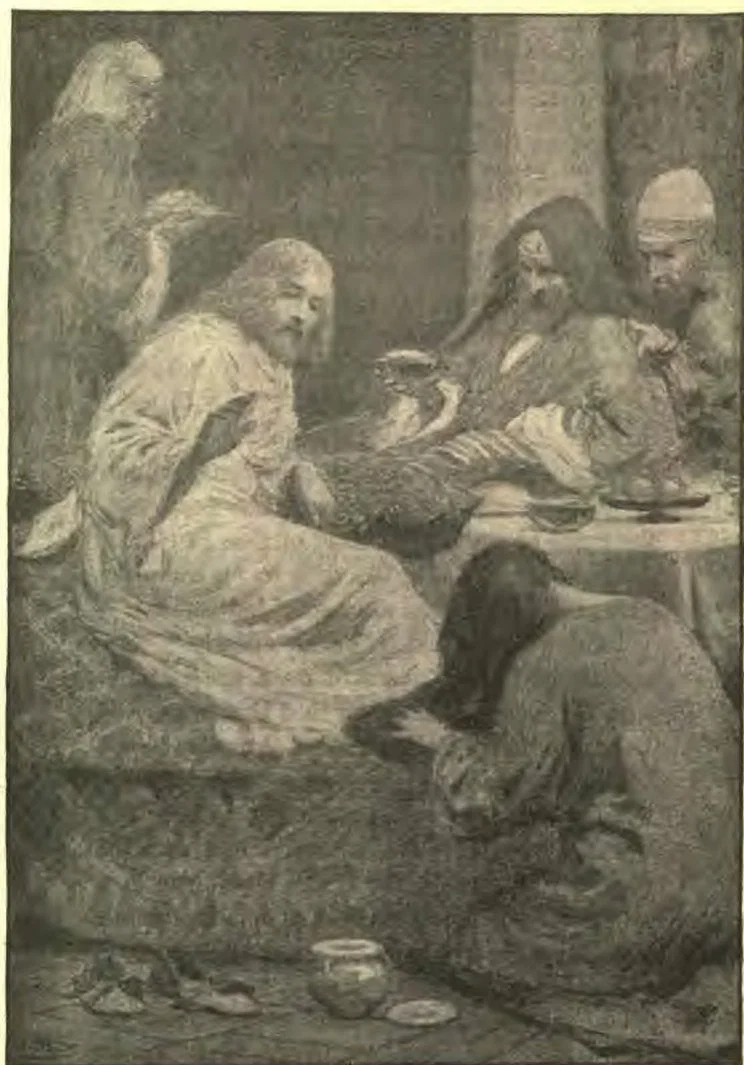
"And one of the Pharisees desired Him that He would eat with him. And He went into the Pharisee's house, and sat down to meet. And, behold, a woman in the city, which was a sinner, when she knew that Jesus sat at meet in the Pharisee's house, brought an alabaster box of ointment, and stood at His feet behind Him weeping, and began to wash His feet with tears, and did wipe them with the hairs of her head, and kissed His feet, and anointed them with the ointment. . . . And He said unto her, Thy sins are forgiven. . . . Thy faith hath saved thee; go in peace."
THE word of God, therefore, becomes an absolute necessity to salvation. In every sin is the seed of death. Walking in sin is walking in the way of death. But as we must know sin in order to turn from it, and as we can only know it by God's law revealed in His word, we must have a knowledge of that word, and simple faith in what it says. The word will then reveal to us not sin alone, but a Saviour from sin. It reveals to us the sin in order that it may reveal to us a Saviour. It shows us that we are desperately sick in order that we may be healed by the great Physician. It points out the exceeding sinfulness of sin, of sinful pleasure, that we may be led to choose those joys, those pleasures, which are unalloyed with base metal, and which never pall upon the heart. Reader, will you not look upon sin in all its deceptive forms the way God looks upon it? You may do this in the light of His word. Will you not also choose that Saviour from sin and sinning, who was manifested to take away our sins, that you may walk in the way of eternal joys? Is there a better time to choose than now? Why choose sin? Why not choose Christ?
JESUS is now the Friend of sinners; and therefore, sinner, whoever you are, however great your sins, He is your Friend. He cleansed men from that vilest of all physical diseases, the leprosy, by a word, to show to all that He has power and will to cleanse from the viler disease of sin. From the vile leper every one shrank with loathing, save Jesus of Nazareth. He loved the leper, but He hated the leprosy, and when the mind of the leper had faith to lay hold of the mind of Jesus, the leprosy was cleansed and the man was saved. The poor woman, despised by her kind, feeling to give the lowest of service if only so she might expiate her iniquity, is told in the life-giving words of the Master, "Thy faith hath saved thee; go in peace." And so Jesus hates the sin, but He loves the sinner; and when the sinner will renounce the sin, and by faith lay hold of Christ, the Healer, that same word which cleansed the leper will cleanse the sinner. The power which banished the leprosy will banish the sin. When He comes the second time, He will destroy all sin and all that is identified with sin. Those who forsake the sin now will welcome Christ at His coming as the dearest Friend4ever known, because He has delivered them from the worst enemy. Those who do not now renounce the sin will then be identified with it, and will be involved in its destruction. Jesus Christ wants to save you from that now. Will you let Him?
Studies in Romans
IN the study of the book of Romans, as in the study of all portions of the sacred Scriptures, the fact should be kept before the mind all the time that the very words of the Lord are to be carefully considered and closely scrutinized if we are to receive the desired benefit. The divinely inspired instruction on this point is, "Consider what I say; for the Lord shall give thee understanding in all things." 2 Tim. 2: 7.
It is with the firm conviction that the only profitable Bible study consists of considering just what the Lord Himself says that we enter upon these lessons from the book of Romans.
The book of Romans opens with the salutation:
"Paul, a servant of Jesus Christ, called to be an apostle, separated unto the Gospel of God, which He promised afore thru His prophets in the Holy Scriptures, concerning His Son, who was born of the seed of David according to the flesh, who was declared to be the Son of God with power, according to the spirit of holiness, by the resurrection from the dead; even Jesus Christ our Lord, thru whom we received grace and apostleship, unto obedience of faith among all the nations, for His name's sake; among whom are ye also, called to be Jesus Christ's; to all that are in Rome, beloved of God, called to be saints: Grace to you and peace from God our Father and the Lord Jesus Christ." Rom. 1: 1-7.
Paul announces himself as a "servant of Jesus Christ." He gave himself to Christ, holding nothing in reserve. In another scripture the apostle states the complete method on which he gave himself to the service of his Master. He says: "One thing I do, forgetting the things which are behind, and stretching forward to the things which are before, I press on toward the goal unto the prize of the high calling of God in Christ Jesus." Phil. 3: 13, 14. His was a complete surrender. His was an undivided service.
Paul was "called to be an apostle." An apostle of God is one sent on a special mission for God. And so we find that when the Lord was telling His prophet Ananias about the conversion of Paul, He said to him, "He is a chosen vessel unto Me, to bear My name before the Gentiles and kings, and the children of Israel; for I will show him how many things he must suffer for My name's sake." Acts 9: 15, 16.
Paul was "separated unto the Gospel of God." And God's Gospel was "promised afore thru His prophets in the Holy Scriptures." Hence Paul must be a masterly student of the word of God, for it is this word that reveals the very Gospel that He is commissioned to preach.
And it should be observed that this Gospel that Paul is separated unto God to teach reveals Him who is "declared to be the Son of God with power, according to the spirit of holiness, by the resurrection from the dead." Christ is revealed thru the prophets in the Scriptures. The Gospel of Christ is revealed thru the prophets in the Scriptures. There is where Paul tells us that he finds the evidence for his faith in the Christ and the Gospel that he is so unreservedly commissioned to teach. And he devoted this study to the Scripture notwithstanding the fact that Paul himself was taken into prophetic visions and permitted to receive direct revelations from the Lord.
In going to the Scriptures of the prophets to find the things he was commissioned to teach concerning the Son of God, Paul was following the example of the Master Himself. For soon after His resurrection He joined two of His disciples in their journeying to Emmaus, and when they expressed to Him their perplexities in regard to the things that the Son of God had just suffered, "beginning from Moses and from all the prophets, He interpreted to them in all the Scriptures the things concerning Himself." Luke 24: 27. And as the Master thus opened the Scriptures to the minds of His perplexed disciples, they said, "Was not our heart burning within us, while He spake to us in the way, while He opened to us the Scriptures?" Luke 24: 32.
The mighty power of the Master's teaching was in the simplicity with which He gave to the people His own words, drawing His great lessons of truth from the teachings of the prophets thru whom He had spoken in the centuries before. And likewise Paul, whom we must recognize as one of the most devoted and one of the Master's greatest followers, found his power and his success in winning souls to Christ thru the simple teaching of the sacred word. In one of his other letters Paul says, "For I determined not to know anything among you, save Jesus Christ, and Him crucified. And I was with you in weakness, and in fear, and in much trembling. And my speech and my preaching were not in persuasive words of wisdom, but in demonstration of the Spirit and of power: that your faith should not stand in the wisdom of men, but in the power of God." 1 Cor. 2: 2-5.
Continuing his letter to the Romans, the apostle says:
"First, I thank my God thru Jesus Christ for you all, that your faith is proclaimed throughout the whole world. For God is my witness, whom I serve in my spirit in the Gospel of His Son, how unceasingly I make mention of you, always in my prayers making request, if by any means now at length I may be prospered by the will of God to come unto you. For I long to see you, that I may impart unto you some spiritual gift, to the end ye may be established; that is, that I with you may be comforted in you, each of us by the other's faith, both yours and mine. And I would not have you ignorant, brethren, that oftentimes I purposed to come unto you (and was hindered hitherto), that I might have some fruit in you also, even as in the rest of the Gentiles. I am debtor both to Greeks and to barbarians, both to the wise and to the foolish. So, as much as in me is, I am ready to preach the Gospel to you also that are in Rome." Verses 8-15.
In the foregoing verses the apostle shows the burden of constant care that he bestowed upon the converts that he had been instrumental in bringing to the knowledge of the Gospel. "I make mention of you, always in my prayers," are the words he writes to the church at Rome. He desired to be prospered by the will of God so that he could come to them to impart some spiritual gift, to the end that they might be established. Writing to the Corinthian church, he says concerning the care he felt for those that had been converted to the Gospel, "Besides5those things that are without, there is that which presseth upon me daily, anxiety for all the churches. Who is weak, and I am not weak? who is caused to stumble, and I burn not?" 2 Cor. 11: 28, 29.
How remarkably complete is the devotion that the apostle manifests. Surely he was indeed "a servant of Jesus Christ." But note the still further evidence of his devotion. In verses 14 and 15 he says, "I am debtor both to Greeks and to barbarians, both to the wise and to the foolish. So, as much as in me is, I am ready to preach the Gospel to you also that are in Rome." No matter what the nationality, no matter what the intellectual attainments of the people within his reach, all that was in him was devoted to the one great work to which he was called.
The labors of the apostle Paul left their effects in all parts of the world in his day. And all parts of the world from that day to this have been affected by the uplifting power of his teaching. Is it any wonder that his Lord said of him at his conversion, "He is a chosen vessel unto Me, to bear My name before the Gentiles and kings, and the children of Israel"?
Paul's complete and absolute devotion to the service of Christ has placed him in the very front rank of the men whose lives and work have molded and influenced the world. This same apostle tells us farther on in his letter to the Romans that "there is no respect of persons with God." God asks for the same devoted service to-day, so that He may carry on the work that Paul assisted so devotedly in establishing.
A person that has devoted himself so completely to the Gospel will certainly give us some wonderful gems of truth in his inspired utterances. May we not look forward with the anticipation of deriving much profit from the consideration of what is said in the book of Romans?