Your ShelfYour Projects

Signs of the Times, Vol. 26, No. 34.

THE OPPORTUNITIES OF FAITH

Signs of the Times

Aug 22, 1900

Pacific Press Publishing Company · Oakland, California · Aug 22, 1900

THE OPPORTUNITIES OF FAITH.
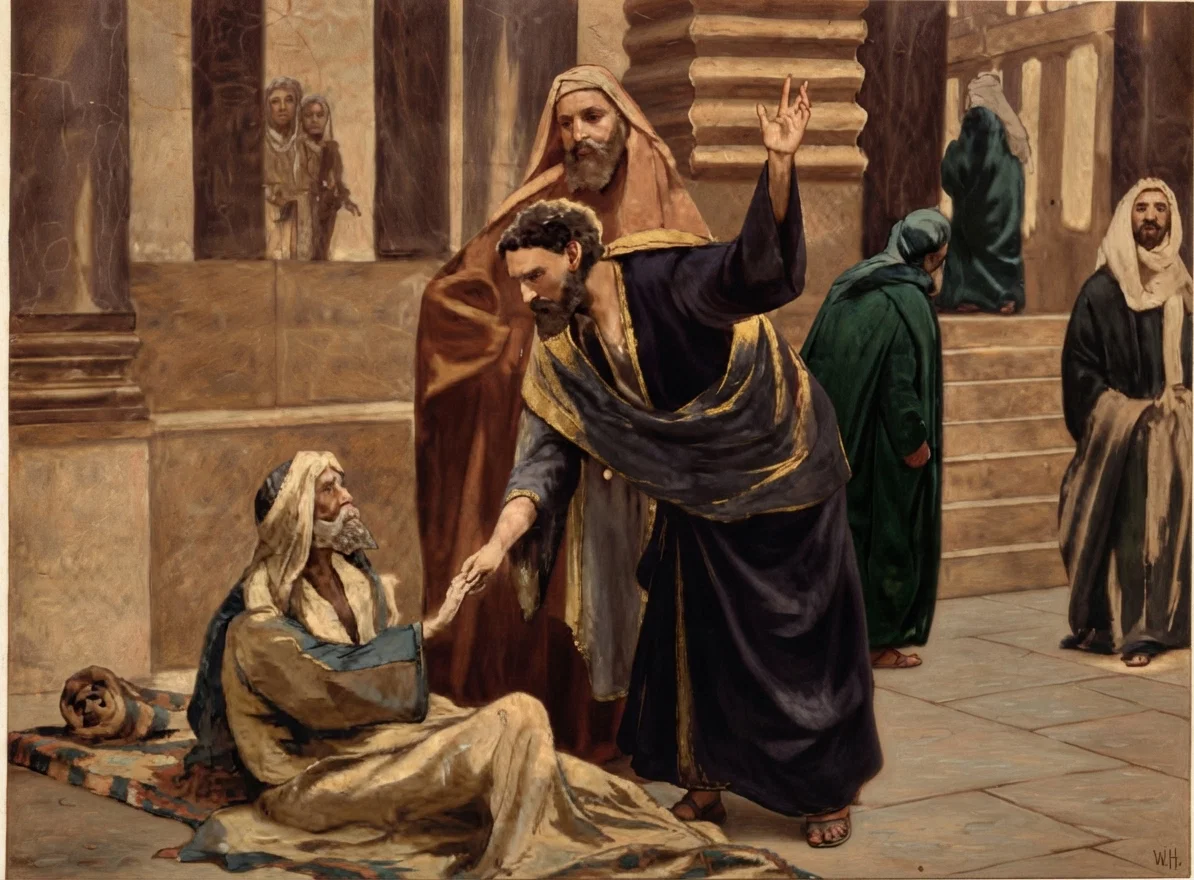
THERE are always unexpected blessings in store for those who have faith. To such God "is able to do exceeding abundantly above all that we ask or think." And station in life makes no difference with Him; for "there is no respect of persons with God." There are many surprise blessings in store for those who will believe; for "with God all things are possible," and therefore "all things are possible to him that believeth."
"PETER and John went up together into the temple at the hour of prayer, being the ninth hour. And a certain man lame from his mother's womb was carried, whom they laid daily at the gate of the temple which is called Beautiful, to ask alms of them that entered into the temple; who seeing Peter and John about to go into the temple asked an alms." He had had experience as a beggar, and did not expect much. There was nothing in the dress or other appearance of Peter and John to indicate opulence, or upon which to base any great expectation. The beggar asked of every one in a perfunctory manner, not knowing who would give or who would refuse.
Healing the Impotent Man at the Beautiful Gate.
"AND Peter, fastening his eyes upon him with John, said, Look on us. And he gave heed unto them, expecting to receive something of them." This special attention would naturally excite a feeling of expectation, yet it was only an expectation of a pecuniary donation. What was really in store for him was not even dreamed of on his part.
"THEN Peter said, Silver and gold have I none." It is not hard to imagine that the poor man's expectation was for the moment disappointed. "But," added the apostle, "such as I have give I thee." That is all any one can give. No man can give what he has not himself. No matter what the profession, no matter what the assumption, no one can give over and above what he has.
UP to this point all had been preliminary. The Spirit of God was reaching out through the apostles to call forth the poor beggar's faith—which the mind of the Spirit had already discerned—and to reward it. Now comes the testing point: "In the name of Jesus Christ of Nazareth rise up and walk." Ah! that was a name which the lifelong invalid had heard before. But it is evident that he had not been so fortunate as to meet the great Physician in person, else he would not now have been begging alms as a cripple.
PETER added the encouragement of his own works. He demonstrated his own faith by taking hold of the lame man's hand and assistinghim. Thus his faith and works wrought together to inspire courage in the mind of the humble suppliant. The invalid's faith at once responded to the proffered aid, "and immediately his feet and ankle-bones received strength."
INSTANTLY the spirit of witnessing took hold of him. The spirit of thankfulness and the spirit of imparting united in impelling praise to God before the people. "And he leaping up stood, and walked, and entered with them into the temple, walking, and leaping, and praising God." His faith in the name of Jesus had brought to him more than he had thought of asking at the hands of men. Thus may the true, consecrated servants of God always carry with them heaven's choicest blessings to impart to even the poorest and most needy, whose faith in the name and in the Word of Christ is ready to receive them. The opportunities of faith are everywhere open in this world of sin and affliction. G.

RESISTANCE TO LIGHT. No. 2.

CHRIST looked with sadness upon the deceived multitude who, while rejoicing in the representation of the light which had led them through the wilderness, were rejecting and turning from the true Light. What pitiful blindness! What strange inconsistency! Standing as He did in the very shadow of the cross, Christ longed to save the people from the doom to which they were hastening. But as He lifted up His voice in earnest accents of entreaty, the Jewish leaders watched Him with cruel malice, hoping to hear Him say something by which they could condemn Him. They had departed from the Word of God, and when the truth revealed itself, they were ready, under Satan's direction, to attack it.
Why did not the priests and rulers recognize Christ? Simon took the infant Jesus in his arms, and said, under the inspiration of the Holy Spirit, "Lord, now lettest Thou Thy servant depart in peace, according to Thy word; for mine eyes have seen Thy salvation, which Thou hast prepared before the face of all people; a light to lighten the Gentiles, and the glory of Thy people Israel."
Why did not the Jewish teachers search the Scriptures, beginning at Moses and the prophets, and carefully studying the types and shadows which pointed to Christ? How easily they could have traced out the prophecies concerning His mission! But they read God's Word as those who understood it not; and the prince of darkness helped them not to see in Jesus the promised Messiah. Under the guidance of Satan they drifted into darkness and unbelief.
The world's Redeemer was not to come the first time surrounded by the host of heaven; for human beings would not have been able to bear the sight. It was necessary that Christ should humble Himself and become a Man of sorrows. "He was wounded for our transgressions, He was bruised for our iniquities; the chastisement of our peace was upon Him; and with His stripes we are healed."
Thus plainly had the Messiah been set forth in prophecy; but the Jewish leaders did not want to understand these words. They believed not in the Christ represented in the Scriptures, but in a Christ of the imagination, who, they claimed, would come with great power, to conquer every nation, and put down all authority but the authority of the Jews. They looked for a Messiah who would reign as a temporal prince in Jerusalem, and who would exalt the Jews above every other nation. Christ did not come according to their ideas, and therefore they refused to receive Him.
"Ye can not tell whence I come, and whither I go," Christ said to them. Virtually He told them that they had no desire to know whence He came. They had closed the eyes of their understanding to the evidence which again and again He had given them. You have allowed prejudice and imagination to control you, He said. You may claim to have authority over the people by virtue of your piety, you may pride yourselves on your superior knowledge of God, but you do not know the Father, and therefore you do not know Me; for to know the Father is to know Me. It is your lack of a true knowledge of Me that destroys your spiritual eyesight.
"I lay down My life, that I might take it again," He said. "No man taketh it from Me, but I lay it down of Myself." The Saviour could have avoided the suffering and death which He endured. Had He so chosen, He might have left the human race to the consequences of their apostasy. But in counsel with the Father He pledged Himself to secure the salvation of every human being. An irrevocable covenant was made between the Father and the Son. Christ must go forward and finish the work which He had undertaken, or all the world would perish.
Christ's death on the cross was one of willing obedience, else in it there would have been no merit; for justice would not punish in the place of the sinner an innocent being who was unwilling to bear the penalty. It was the Saviour's full and free acceptance of the penalty that made His sacrifice wholly acceptable in every point. So the sinner must freely surrender his own will to God, and accept Christ as his substitute and surety. He must rely upon Him as the only one who can change a sinner to a saint. God calls upon us to acknowledge our guilt and accept pardon from Christ, revealing our sincerity by copying His way and doing His will. Of the one who does this the words are spoken, Ye are complete in Him, not having your own righteousness, but the righteousness which is of Christ by faith.
"Whither I go, ye can not come," Christ said. "Then said the Jews, Will He kill Himself?" The answer came, clear and decided: "Ye are from beneath; I am from above; ye are of this world; I am not of this world. I said therefore unto you, that ye shall die in your sins; for if ye believe not that I am He, ye shall die in your sins."
The wily spies upon Christ's track were determined to make Him state in specific terms that He was the promised Messiah. The false ideas of the Messiah with which Satan had filled their minds they had presented to the people, so that the general idea of what Christ should be was very different from the representation given in prophecy. If they would provoke Him to make a claim that He was the Messiah, they could work upon the minds of the Jews to pronounce Him an impostor. "Who art Thou?" they asked; and Christ answered: "Even the same that I said unto you from the beginning, I have many things to say and to judge of you; but He that sent Me is true; and I speak to the world those things which I have heard of Him."
Christ read the thoughts of His enemies, and did not answer as they wished Him to answer. He did not attempt to prove His Messiahship, but spoke of His relation to God. He accused the Jews of not knowing the Father. Their opposition to His work was the result of this lack of knowledge.
"They understood not that He spake to them of the Father. Then said Jesus unto them, When ye have lifted up the Son of man, then shall ye know that I am He, and that I do nothing of Myself; but as My Father hath taught Me, I speak these things. And He that sent Me is with Me; the Father hath not left Me alone; for I do always those things that please Him." As He spake these words, many believed on Him.
His words made a deep impression upon many minds; for as He spoke, divinity flashed through humanity, and a convincing power attended the truths He uttered. Many were unconsciously imbued with the heavenly influence which surrounded Christ.
"Then said Jesus to those Jews which believed on Him, If ye continue in My word, then are ye My disciples indeed; and ye shall know the truth, and the truth shall make you free."
Truth never brings the soul into bondage. It is turning from truth to error that brings the soul into captivity. The one who is bound up in close relationship with Christ is freed from the slavery of sin.
MRS. E. G. WHITE. (Concluded next week.)

PROOF OF IMMORTALITY.

THERE is in the Word of God a revelation of two important doctrines. The first is that in death man rests, as it were, in sleep, wholly unconscious, until the resurrection at the personal second coming of Christ to the earth, when the righteous will be changed from the mortal to the immortal state. This is the positive teaching. The second is the doctrine that man does not really die; that the soul is now immortal; that what seems to be death is only transition. And the Word informs us that the author of this doctrine is the devil.
This second doctrine originated in a deception, and the single object in its propagation is, on the part of its author, that the minds of men may be made susceptible to the reception of error of all descriptions, and thus be kept from a knowledge of the truth that would save them from the destruction of the wicked. The doctrine is somehow popular, but, as it lacks Bible proof, except as to its unsavory origin, we are hearing more and more these years of scientific research looking towards some physical proof of immortality. To the believer in the Word of God these attempts appear worse than useless, and yet scientists, laymen, theologians, and otherwise are watching the movement with hopeful eyes, and lending their influence wherever possible.
One of the latest items adduced as "evidence" in this direction appears in a late issue of the New York Observer. Under a heading similar to the caption of this article, reference is made to information imparted at the late Ecumenical Conference by Mr. Grubb, missionary among the South American Indians. Concerning these Indians and their belief the article says:—
These people are pure pagans, living under that terrible tyranny of fear which oppresses the pagan world, that of injury by evil spirits. Every act of their lives is influenced by this dread, and no part of Mr. Grubb's talk was more interesting than his description of the results of that influence upon himself. The natives believe that during sleep, consciousness, or the power that directs us when awake, may wander about, and may even take possession of another sleeping body whose guiding intelligence is similarly absent. This intelligence may thus become conversant with the thoughts passing in the mind in a dreaming state of the other body, and may thus know what that body intends to do when its controlling consciousness returns, and the bodyawakes. In the same way they believe that the spirits of the dead return to plague or help the living.
Then follows the account of an attempt to kill Mr. Grubb, made by a native, who had dreamed that his spirit had occupied the missionary's body and learned of sinister attempts toward himself. This, the Observer remarks, illustrates anew the fact "that superstition and degradation are the natural order in the heathen world." Then it proceeds to say:—
But it was enlightening also in the evidence it gave that these pure pagans had gotten hold, however unconsciously, of one of the best of physical proofs of the immortality of the soul. This is that the directing power of the mind and body—the consciousness, or soul—may leave the body during sleep—does, in fact, do so—to return when the body awakes. We know that in sleep this controlling force is relaxed, the body lying inert, and the mind, if acting at all, doing so in such erratic fashion as to preclude the possibility of guidance at all. The instant the body awakens, the directing intelligence, or soul, resumes its sway. Is it not a reasonable conclusion, then, that the soul is not present save in the waking body; that it is not tied to the body, is in no sense material? It waits outside, as it were, during sleep or the physical disease we call insanity, ready to re-enter when waking or recovery comes. But if it does that, what is to prevent it living on when death renders the body no longer habitable?
Truly, what a remarkable "evidence" in proof of immortality! Those poor, pure pagan heathen attempt to kill a man because of their superstition and degradation; but this same superstition is nevertheless "one of the best proofs of the immortality of the soul"! And then, if the Observer's position is tenable, why was not the pagan Indian right, after all? Did not his soul really occupy Mr. Grubb's body while Mr. G.'s soul was out? Perhaps it wasn't a dream at all, and Mr. Grubb's subconsciousness thought an evil thought in an unfortunate moment. But the Observer continues:—
Nothing is more certain than that it [the soul] does leave the body, and return. Why, then, should it not continue to exist without the body?
"Nothing more certain" than this for which the tangible proof does not exist, and for which such profound search is being made? Nothing? What unreal creatures we all are, and what a world of unrealities we are living in! Surely the Observer is not in earnest. Well, if the thing is true, why, indeed, should not the soul continue to exist without the body? And why should it remain here with its earthly clod at all? Why not fly away and be at rest? Why shouldn't there be a general exodus of souls from these disease-racked and earth-bound shells? But we are curious to know where the proof is that the above statement is true. We may gain some clue to it from the next statement, which is as follows:—
It is true that the soul alone is not perceived by other intelligence occupying bodies unless itself inhabiting a similar body. But that is no more proof of its non-existence than the removal of Brown from his present home would be evidence that he had ceased to live. Even Mr. Grubb's pagans would regard it as inadequate.
That is to say, there are two ways of perceiving a soul alone; first, when the observer is occupying his own body, and the observed soul is at the same time in its proper body. That is good, providing the individuals presided over by souls are awake and in their right minds. That is first-class and legitimate. By that method we are all perceiving lots of souls—yes, a world full of them daily. That is the ordinary flesh-and-blood, wide-awake, eye-to-eye way, and no one would think of using this commonplace method to prove the immortality of the soul. The Observer remembers that, and immediately attempts to correct any diverse conclusion that might be drawn from its statement by the unfortunate reference to the "removal of Brown." Now Brown, outside of his house, is a "soul alone," and, according to the statement preceding the reference to him, he ought to be invisible to any one in a house, even tho the other party were looking through the window, and in his direction; he can only be perceived when he is inside his house, with the door closed, and then only by observers nicely shut up in their own houses! We believe even Mr. Grubb's pagans would find some flaw in this theory.
The other way is only inferential, it is true, from the statement of how souls are perceived. But it is when both souls are out of the body and chance to meet, or, perhaps, when a returning soul is obliged to wait outside until some usurper can be ousted. Herein, then, must lie the proof that the soul "does, in fact," leave the body, and return, for the proof seems to be nowhere else. This is the universal proving-ground,—this extra-corporeal field, where discarnate souls meet and perceive each other, clasp ghostly hands, and agree to vouch for each other's immateriality and immortality! This is the meaning of the dominant consciousness that speaks from within, from the fulness of its experience in astral wanderings, asserting that the soul is immortal. For it is the "something within," the "universal desire for immortality," the "universal belief in the doctrine," and like reasons that are wheeled into line by the popular theology as "facts" in proof of the soul's immortality. These go hand in hand with the "proofs" furnished by spiritistic phenomena, and the whole is destined to work untold evil for every "soul" that is not firmly fortified with the true and everlasting facts of God's Word in reference to this important subject.

TRIALS FROM GOD.

THE all-important lesson for the Christian to learn is that all trials, difficulties, troubles, and losses, whatever they may be, come from God. The Christian is in God's hands, and nothing can befall him except God permit it, and "no good thing will He withhold from them that walk uprightly."
It may be that a mighty whirlwind of sorrow is bearing down upon you like that Ezekiel saw coming out of the north enfolded with fire, and it seems that you will be swept to destruction by it; but behind it and over and above it is the throne of an almighty God.
We can not see the end from the beginning, but He can, and the very thing that looks like an instrument of destruction may be a power that He is using to bring about our happiness and joy.
The storm that spans the sky, unfolding like a monster of destruction, shaking the earth with its mighty peals of thunder, and cleaving the clouds with the forked lightning, is the power that lends a new luster to grass, flower, and shrub, and is the canvas upon which a moment later God paints the rainbow.
"What I do thou knowest not now," said Jesus, "but thou shalt know hereafter." It is enough for us to know that God has the doing in charge, hence we know all is well, and that no ill can befall us.
A dark, heavy cloud hung for years over the patriarch Jacob, and as he saw the calamities coming thick and fast, shutting out the light of a happy home, we hear him saying with heart-touching sadness: "Me have ye bereaved of my children; . . . all these things are against me. . . . Then shall ye bring down my gray hairs with sorrow to the grave." These words escaped from Jacob under the pressure of having first lost Joseph, then Simeon, and now the call for Benjamin. But when the cloud was lifted, and he found the long-lost Joseph on the throne of Egypt, and he could see the workings of an all-wise God, we find him pouring out his thankfulness in these words: "I had not thought to see thy face; and, lo, God hath showed me also thy seed."
Joseph also traveled through seas of affliction. Thirteen long years the heavy shadow enshrouded him. Hated and despised by his brethren, sold by them into bondage, persecuted, and cast into prison for obeying God, and forgotten by those he had befriended, he learned well the lesson of self-abasement and humiliation; but when it was all past, when the sun broke through the gloom, the glory was so surpassingly lovely that he said to his repentant brethren as they bowed around him, in fulfilment of the vision of the sheaves: "Be not grieved, nor angry with yourselves, that ye sold me hither; for God did send me before you to preserve life. . . . So now it was not you that sent me hither, but God."
Happy the servant of God who learns that the providences of God are but the unfolding of the great plan of a wise Master Builder, and that the end of it all is the peace and happiness of His children. It is faith in God that smooths the way, and enables us to endure. John put it this way: "This is the victory that overcometh the world, even our faith." The faithless man can not gain the victory. The trial is not sent to help him, he thinks, but to thwart his own dear plans and purposes. He can see nothing but disaster and ruin in it. But the child of God knows "our light affliction, which is but for a moment, worketh for us a far more exceeding and eternal weight of glory; while we look not at the things which are seen, but at the things which are not seen; for the things which are seen are temporal; but the things which are not seen are eternal."
Sad is that professed child of God who shrinks and flinches when God in His mercy sends him a trial to fit him for some useful place in His vineyard, or to prepare him for the mansion He is building.
F. W. HIDDLESON.

FAITH.

I WILL not doubt, tho all my ships at sea Come drifting home with broken masts and sails; I will believe the Hand which never fails, For seeming evil worketh good for me. And, tho I weep because those sails are tattered, Still will I cry, while my best hopes lie shattered, "I'll trust in Thee."
I will not doubt. Well anchored in this faith, Like some staunch ship, my soul braves every gale; So strong its courage that it will not quail To breast the mighty unknown sea of death. O! may I cry, tho body parts with spirit, "I do not doubt," so listening worlds may hear it, With my last breath. —Selected.

Lessons from Defeat

DEFEAT makes the school in which most of us have to be trained. In all kinds of work men learn by mistakes. The successful business man did not begin with success. He learned by experience, and the experience was very costly. The true science of living is not to make no mistakes, but not to repeat one's mistakes. Defeat, when one has done one's best, and when one takes a lesson from his defeat, is not something to be ashamed of, but something to be glad for, since it sets one's feet on a little higher plane. Defeat which makes us wiser and better is a blessing to us. We owe more to our defeats, with the humblings of the old nature, the cleansing of motive and affection, and the deepening of trust in God, than we owe to the prouder experiences which we call our successes.

THE RIVER OF LIFE

GOD'S MATERIALS FOR BUILDING.

"Ye also, as lively stones, are built up a spiritual house." 1 Peter 2:5.
"In whom ye also are builded together for an habitation of God through the Spirit." Eph. 2:22.
SINCE the Christian is a temple out of which issues the Living Water to heal and save others, and since the building of that sanctuary back there was to reveal how God will build us into a sanctuary for His indwelling, we shall not be surprised that the materials used in building the tabernacle are such as to be symbolical of character building.
When the nomadic tribes of Israel became a permanent nation, Solomon built a glorious temple to take the place of the tabernacle or sanctuary built in the wilderness. In the references given, the church, as a sanctuary for the divine indwelling, is compared to this temple. Each individual Christian is a "lively stone," built upon Christ, the "Living Stone," and "growing unto a holy temple in the Lord." If we will but yield ourselves to Him, it is God's covenant to take us, rough stones from earth's quarry, and build us into this glorious temple of praise that shall stand forever. Travelers tell us of a stone in the quarry at Baalbeck cut out, and moved a little, but now moss-o'ergrown and crumbling to dust. In some way it did not yield itself properly to the workman's touch, and so it missed being builded into that splendid temple that has stood so many centuries. What a picture of the fate of the man who refuses to yield himself to God! Dust to dust, instead of a polished stone in God's everlasting temple.
But we wish to speak more particularly of the materials in the tabernacle as symbolical of God's methods of individual character building. These materials are chiefly silver, wood, gold, and fine linen. The sockets of silver, which formed the very foundation of the sanctuary, were made of the atonement money of the children of Israel. So the foundation of our hope of being made one with God, is that God through Christ has in all ages been giving His life to make an atonement. "Ye are bought with a price," purchased with Christ's own blood. This is the foundation, and we, the human sanctuaries of God, are built on this foundation, even on the foundation of the apostles and prophets, Jesus Christ Himself being the chief corner-stone.
Consider the wood. God says of those with whom He has sealed His covenant, They shall be "called trees of righteousness, the planting of the Lord, that He may be glorified." The tree grows into its forms of strength and beauty, not by any struggling or striving of its own, but by the silent working of a life power implanted in the seed. If the life is there, "all things work together for good" to that tree. The sun warms it, the rain waters it; even drought and storms cause it to take deeper, wider root, to better resist the force of the wind, and to find more permanent moisture, making also the grain of the wood more firm and beautiful. If the life is wanting, everything works together for the destruction of that tree. The sun withers it, the rain rots it, and the storms break it down and destroy it.
How hopeless the task of attempting to live a Christian life in this world of trial and temptation, without first having the life to cause us to live, without having had the divine life implanted by the divine Seed in the new birth! All things work together for good to him who has this. The fiercer the temptation, the greater the power of resistance it develops. Sorrows but make him more tender and sympathetic, and so more Christlike. Even failures and mistakes but teach him utter dependence upon Christ, and make him more ready to own brotherhood of love to all the suffering, erring human race. That spiritual life will, under all these circumstances, manifest itself by bearing the Spirit's fruit of love, joy, and peace. But if the divine life be not there implanted in the soul, all these things work together for evil. Temptations then mean only failure and loss, and sorrows and trials breed bitterness and hatred toward all who seem to be more favored. Truly the growth of the tree, and its utter dependence upon the living water, is a great lesson in the growth of character.
The wood of the sanctuary was covered with pure beaten gold. This gold was tried and purified in the fire until all its dross was consumed, and until it reflected the perfect image of the master workman. Then it was beaten into these forms of beauty. So God wants to cover us all with Christ's righteousness, which perfectly reflects the divine image. This can only be brought about through the cross,—through the furnace of affliction. Says the Scripture, "The trial of your faith is more precious than that of gold which perisheth." Even the purified gold must be beaten by the mallet of the Master Workman into forms of beauty after the heavenly pattern. Dear heart, are you willing to know the fellowship of Christ's suffering? If so, God can realize in you the glorious heights of His spiritual beauty.
More wonderful still, if possible, is the lesson of the fine linen,—the fine linen "which is the righteousness of the saints." The inner curtain of the sanctuary was of fine linen, blue and purple and scarlet, with hovering angel forms wrought upon it with cunning needlework. Here is brought to view the same process of character building. The flax stands up for a little time straight and beautiful in its own strength, but before it can become the "fine linen," it must be cut down, rotted, and dried, and then hatcheled till all of its native stiffness is gone, and only the yielding fiber is left. Then only will it yield itself to the hand of the master workman so as to be woven into the fine linen, and then wrought by the artist into cunning needlework. We, too, have so much inherent stiffness of our own,—so much self-will, so much self-righteousness, so many of our own ideals which we so much want to realize! How difficult it is for us to learn that God's ideals for us are better than our own ideals for ourselves! God has to mow us down with the scythe of humiliating failure, and let us lie till as it were our own purposes are decayed and our own plans become obnoxious to us. He has to strip us, and hatchel us, till only the yielding fiber is left. Then, when our only prayer is, "Thy will, not mine, be done," the Divine Workman can spin and weave us into the fine linen of righteousness.
The writer once saw in operation a machine for weaving brocaded silk handkerchiefs. Over the machine was a strange-looking apparatus consisting of a long piece of cardboard, with many holes in it, which he was told was the pattern. It had no beauty or comeliness, and was apparently without order or arrangement. This pattern was fed through the top of the machine, various pins that controlled the shuttles, catching in the holes. Below, many shuttles were playing, each with a thread of a different color from all the others. Dire confusion it seemed, and a hopeless, inextricable tangle it was, surely, that the threads were making. There were so many dark threads, too, where the writer thought there ought to be light ones. But stop! See the handkerchief itself coming forth from the loom, the marvelous product of all this apparent confusion. Fair and beautiful it is, perfect, indeed, in its blending of color and tint, inwrought most marvelously with delicate forms of leaves and vines and flowers.
What a lesson! Look at the righteousness of Christ. The complete product is fair and beautiful, without a flaw. How often we wish we were like Christ! Do we really? Are we willing to submit to the process? Are we able to drink of the cup of which He drank, and be baptized with His baptism? Place yourselves in imagination with Him when He was in the wilderness fasting for forty days, so tempted that He knew not of His hunger. Place yourself with Him when He was compelled to know the baseness and ingratitude of the human heart, saying, "Were there not ten cleansed? but where are the nine?" Go with Him when He was wayworn, footsore, weary, and hungry, and without where to lay His head. Go with Him when He was betrayed with the Judas kiss, when all His loved disciples forsook Him and fled. Yes, go with Him to Gethsemane and to Calvary. Does it not seem a hopeless tangle, dark threads many and light ones few? Does there seem any beauty, order, or arrangement in the pattern? Can we believe that the Master Workman, with His infinite wisdom and His limitless love, is brooding over all this?—Ah, yes, this is the material, and these are the means by which God produces His marvelous results in us, as in Jesus! Let us learn to trust and hope, and let Him have His way. He will build us, and weave us, into a sanctuary, curtained and lighted and glorified by and for His indwelling presence.
Even the colors of this linen were most significant. They were blue, and purple, and scarlet. Blue was understood by the spiritual Jews to represent the heavenly source of their righteousness. This we know by tradition. Not only is Christ the heavenly gift, the source of all righteousness, but all the motives for true right-doing must come from the eternal world. He whose only motive for honesty is that it is the best policy, will find even this motive to fail when he needs most that it shall stand firm. Purple was the royal color. Everything connected with true righteousness is connected also with the only true royalty; for Christ is Prince of Peace and King of Righteousness, yea, King of kings and Lord of lords, and His kingdom only is eternal. We have seen that the sanctuary represents the throne which God, through Christ, is building in the submissive soul. How appropriate, then, the royal purple of the sanctuary! for righteousness in the human heart is the oneand only infallible evidence that Christ has there established His throne. Righteousness is the true royal purple of the soul. If the righteousness is there, the kingdom which is everlasting is there.
Scarlet is the color of the blood. It means sacrifice,—the giving of the life. This is the very foundation of all righteousness. In short, the rightness or wrongness,—the righteousness or unrighteousness,—of each heart lies in simply this, that it either gives or keeps the life. The life of the sinner centers in self. The life of the true Christian, like the life of God, centers in every one else in the universe but self. So here, in the materials and colors of the ancient sanctuary, is revealed the knowledge of God, which “the world by wisdom knew not.”
All this was understood by the spiritual Israelite, and was to him a revelation of the same everlasting Gospel which to-day brings to us the living water direct from the throne.
Continue reading: THE GREAT STONE